Evaluation of HDPE Geomembrane Liners for Unconventional Gas
Extraction Brine Associated Water
Daniel Tan, Engr., Solmax International Asia Pacific Sdn. Bhd., Malaysia, [email protected] Robert Denis, P.E., Solmax International Inc., Canada, [email protected]
Guy Elie, P.E., Solmax International Inc., Canada, [email protected] Paul Payeur, Solmax International Inc., Canada, [email protected]
David Cao, Solmax International Inc., Canada, [email protected]
ABSTRACT
Unconventional gas such as shale gas and coal seam gas has become increasingly important in the world particularly experienced in North America and Australia. The potential of extracting unconventional gas in the Middle East is also gaining momentum. This paper summarizes the laboratory test results of a specially formulated 2.0mm high-density polyethylene geomembrane (HDPE GMB) intended for the lining of brine evaporation pond to contain the unconventional gas extraction associated water. The average operating temperature of coal seam gas brine stored in HDPE GMB lined evaporation pond is 600C with maximum temperatures possibly reaching 1000C. The mechanical and durability properties of the HDPE GMB liner are required to be thoroughly evaluated in view of its long term performance. A unique laboratory testing regime was specified by the project to simulate and observe the behaviour of the HDPE GMB liner exposed to such aggressive environment for assessment of its performance.
1. INTRODUCTION
Unconventional Gas
Reservoir gas or rather ‘conventional gas’ that is found in gas fields has been used industrially for applications such as to power gas turbines for electricity generation or used domestically as fuel for stoves. Amidst the gain in popularity of unconventional gas in North America and Australia amongst other countries, Carlisle (2011) and Neuhof (2012) reported that major oil and gas companies are gathering its pace to explore the huge potential in the Middle East.
Coal Seam Gas (CSG), a type of naturally occurring gas found in water saturated coal seams has recently been the new alternative in Australia as CSG predominantly consists of approximately 98% methane (CH4) which combusts well in air and can be used as fuel (Brannock et al. 2011). CSG was formed during the coalification geological process when organic matter was converted into coal. The operation to extract CSG is similar to extraction of shale gas (another form of unconventional gas prevalent in North America) and is called hydraulic fracturing. Hydraulic fracturing is the practice of using high-pressure pumps to inject a mixture of sand, water and chemicals into bore wells in order to fracture rocks and to open cracks (cleats) present in the coal seams thereby releasing natural gas in the process. CSG can also be extracted by dewatering of the coal seams thus reducing the pressure
that keeps the gas in place. The water is pumped out, and the natural gas released from the coal (Roarty 2011).
Environmental Concerns
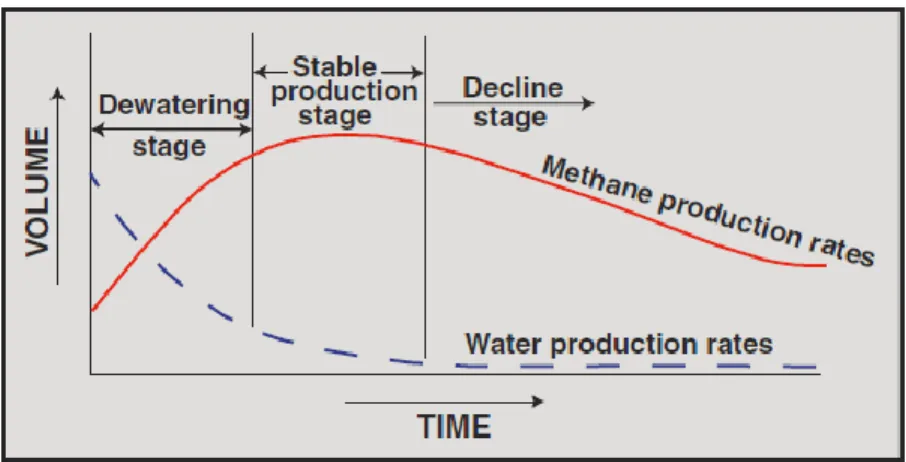
CSG extraction produces a substantial amount of associated water that poses significant concerns to the environment. The CSG associated water quality differs from one site to the other and is dependent on the extraction process as well. However, general characteristics of CSG associated water are that it is brackish in quality, has high pH levels, contains extremely high sodium adsorption ratio (SAR), comprises mostly of sodium chloride (NaCl) and sodium bicarbonate (NaHCO3), total dissolved solids (TDS) ranging between 1000 – 10,000 mg/L, has traces of cations (K, Ca, Mg, B, Sr, Ba) and anions (SiO2, F, Br) and the chemicals used to facilitate CSG extraction (Keller et al. 2009; Brannock et al. 2011). Given the composition of CSG associated water that may be harmful to the environment, an active management of the substantial amount of water produced is required. The typical production curve of associated water produced in relation to CSG extraction is illustrated in Figure 1.
Figure 1. Typical water and methane production rates for CSG. After Kuuskraa and Brandenberg, 1999 (USGS 2000).
There are several methods to treat the CSG associated water such as reinjection into disused coal seams, desalination treatment using reverse osmosis or thermal distillation technologies or storage in GMB lined evaporation pond. As Australia has the availability of land and its climate is suitable for evaporation process (average annual solar radiation in Queensland is 2000 kWh/m2), management of CSG associated water through treatment and brine evaporation pond appears to be the most economically viable option (Keller et al. 2009).
CSG associated water is generally firstly stored in gathering ponds near the extraction wells. The associated water is then channelled into larger ponds for water treatment. Finally the treated CSG associated water is transferred to brine ponds where it contains high brine concentration at high operating temperatures (Gassner 2011) averaged 600C with maximum temperatures possibly reaching 1000C.
HDPE GMB
GMBs are impervious sheets of polymeric material primarily used to reduce the hydraulic conductivity of in-situ soils. They represent a branch of engineering materials called geosynthetics which are specifically designed to enhance the building properties of natural soils which have been deemed deficient from an engineering point of view. GMBs are thus extensively used to provide additional imperviousness to natural soils in order to protect water tables against contamination from industrial activities such as landfills, mining and more generally hazardous material storage. GMBs come in a variety of polymers of which polyethylene represent the most significant percentage because of their inherent engineering and endurance properties, including excellent chemical resistance to a wide range of contaminants. In particular, ever since their inception in the early 80’s, HDPE GMBs have indeed become the material of choice of every industrialized nation for containment applications. Their rapid growth and industry wide acceptance through worldwide governmental endorsements and ensuing regulations have been acknowledged due to their many advantages when compared to other more traditional waterproofing materials, such as natural clay soils. In particular, as opposed to archaic unlined storage facilities and associated dismal containment properties, modern engineered containment structures with GMBs such as HDPE now represent the safest, most efficient, reliable and economical containment technique.
Specification
GM 13 from the Geosynthetic Research Institute (GRI) is the most widely and internationally accepted specification for HDPE GMB. However, GRI GM 13 has its limitations as its’ original design was intended for common applications such as impermeable barrier liner for landfills and may not be suitable when exposed to extreme conditions in aggressive environments such as CSG brine with high pH coupled with elevated temperatures between 600C to 1000C. As such, specially formulated HDPE GMB with endurance properties exceeding GM 13 is required.
In order to assess the suitability and performance of HDPE GMB for the CSG brine evaporation pond, onerous laboratory testing to replicate site conditions was instructed by the project consultant. The HDPE GMBs were subjected to independent laboratory testing in Excelplas Pty Ltd with special preparations as follows:
i) GMB incubated in low and high brine concentration at 950C. ii) Incubation period was 6 weeks.
iii) Additional samples were also incubated in low and high brine concentration at 850C and 750C to check the antioxidant depletion behaviour at different temperatures.
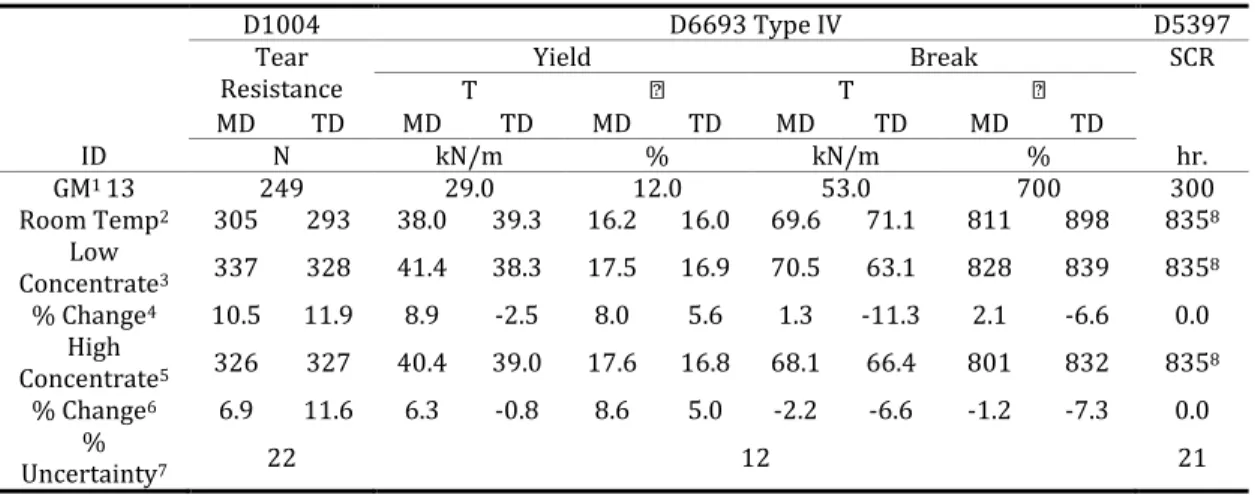
Two HDPE GMB samples were sent for the independent laboratory testing. One taken directly from HDPE GMBs already sent to site and another newly formulated enhanced HDPE GMB sent directly from the manufacturing plant. Table 1 and 2 summarizes the properties respectively and benchmarked against GRI GM 13 specification as well as compared the change in properties of samples incubated under onerous laboratory conditions. Evaluation of the HDPE GMB welding properties were also carried out and benchmarked against GRI’s specification for seam strength of thermally bonded polyolefin geomembranes, GM 19. The properties in both Table 1 and 2 were also compared against known variance in laboratory results termed as % uncertainty following recommendations from GRI’s geosynthetic accreditation institute – laboratory accreditation program (GAI-LAP) (Koerner et al. 2006).
Table 3 presents the values of antioxidant tested following ASTM D3895 for standard (Std) OIT and ASTM D5885 for high pressure (HP) OIT for both of the site extracted and newly formulated
enhanced HDPE GMB. Antioxidant values are important for the Stage A service lifetime prediction of HDPE GMBs.
Table 1. Summary of 2.0mm HDPE GMB properties from site (GMBsite)
D1004 D6693 Type IV D539
7 D6392
Tear
Resistance T Yield T Break SCR Weld Strength
Shear Peel MD TD MD TD MD TD MD TD MD TD ID N kN/m % kN/m % hr. N/25mm GM1 13 or 19 249 29.0 12.0 53.0 700 300 701 530 Room Temp2 338 335 36.3 36.2 15.0 16.0 61.4 65.0 783 846 657 911 655 Low Concentrate3 319 310 44.28 41.78 16.6 16.2 60.1 59.2 711 775 4878 937 672 % Change4 -5.6 -7.5 21.8 15.2 10.7 1.3 -2.1 -8.9 -9.2 -8.4 -25.9 2.9 2.6 High Concentrate5 358 332 44.48 42.78 18.08 17.0 62.4 55.58 722 7218 2349 932 696 % Change6 5.9 -0.9 22.3 18.0 20.0 6.3 1.6 -14.6 -7.8 -14.8 -64.4 2.3 6.3 % Uncertainty7 22 12 21 14
1GRI GM 13 recommended values for HDPE GMB sheet properties and GRI GM 19 for HDPE GMB welded seam properties; 2Mean values of unexposed samples; 3Mean values of samples exposed to low concentration brine at 950C for 6 weeks; 4Difference in values between samples exposed to low concentration brine compared to room temperature controlled
samples; 5Mean values of samples exposed to high concentration brine at 950C for 6 weeks; 6Difference in values between
samples exposed to high concentration brine compared to room temperature controlled samples; 7Maximum % uncertainty as
recommended by GRI for GAI-LAP geosynthetic tests; 8Values change beyond % uncertainty but complies or exceeds GRI GM
13 or 19 recommended values; 9Values change beyond % uncertainty and falls below GRI GM 13 or 19 recommended values.
Table 2. Summary of newly formulated enhanced 2.0mm HDPE GMB properties (GMBnew)
D1004 D6693 Type IV D5397
Tear
Resistance T Yield T Break SCR
MD TD MD TD MD TD MD TD MD TD ID N kN/m % kN/m % hr. GM1 13 249 29.0 12.0 53.0 700 300 Room Temp2 305 293 38.0 39.3 16.2 16.0 69.6 71.1 811 898 8358 Low Concentrate3 337 328 41.4 38.3 17.5 16.9 70.5 63.1 828 839 8358 % Change4 10.5 11.9 8.9 -2.5 8.0 5.6 1.3 -11.3 2.1 -6.6 0.0 High Concentrate5 326 327 40.4 39.0 17.6 16.8 68.1 66.4 801 832 8358 % Change6 6.9 11.6 6.3 -0.8 8.6 5.0 -2.2 -6.6 -1.2 -7.3 0.0 % Uncertainty7 22 12 21
1GRI GM 13 recommended values for HDPE GMB sheet properties; 2Mean values of unexposed samples; 3Mean values of
samples exposed to low concentration brine at 950C for 6 weeks; 4Difference in values between samples exposed to low
concentration brine compared to room temperature controlled samples; 5Mean values of samples exposed to high
concentration brine at 950C for 6 weeks; 6Difference in values between samples exposed to high concentration brine compared
to room temperature controlled samples; 7Maximum % uncertainty as recommended by GRI for GAI-LAP geosynthetic tests; 8All samples have not failed.
Exposure
Condition D3895 Low Concentration Brine D5885 D3895 High Concentration Brine D5885
Std – OIT HP – OIT Std – OIT HP – OIT
ID Temperature (0C) min.
%
Change min. Change % min. Change % min. Change %
GM 13 Room Temp 100 - 400 - 100 - 400 -
GMBsite Room Temp 189 - 923 - 189 - 923 -
75 154 -18.5 900 -2.5 164 -13.2 919 -0.4
85 67 -64.6 831 -10.0 144 -23.8 919 -0.4
95 65 -65.6 865 -6.3 181 -4.2 1015 10.0
GMBnew Room Temp 302 - - - 302 - - -
95 169 -44.0 - - 273 -9.6 - -
Service Lifetime Prediction
The service lifetime prediction of HDPE GMBs have been studied by many and the current industry norm adopts the Arrhenius modelling prediction methodology (Hsuan and Koerner 1998; Sangam and Rowe 2002). In brief, the lifetime of a HDPE GMB is divided into 3 stages. Stage A is the period where antioxidants are present to protect the HDPE GMB from degradation. As such, significant variation in mechanical properties is unlikely to be observed in Stage A while there is still presence of antioxidants. Stage B is the induction time and onset of polymer degradation. It begins when antioxidants have been completely depleted from the HDPE GMB signifying the end of Stage A and start of Stage B. Stage C is the period it takes to reach 50% of a specific HDPE GMB design property. It starts when significant changes of mechanical properties are observed. Therefore the service life of a HDPE GMB is defined by the total duration it takes (Stage A + B + C) before it reaches its half-life i.e. 50% of a specific design property of concern. The basic formulas used to estimate Stage A antioxidant depletion are:
ln(OIT) = ln(P) – (S)(t) [1]
and
ln(S) = ln(A) + (-E/R)(1/T) [2]
where P = Initial value of OIT in the GMB (min.); S = antioxidant depletion rate (month -1 or year -1); t = ageing time (months or years); OIT = OIT at time t (min.); E = activation energy of antioxidant depletion mechanism (KJ/mol); R = universal gas constant (8.31 J/mol0K); T = test temperature in absolute value (0K); A = constant.
Table 4 presents the estimated antioxidant depletion rate and time to antioxidant depletion i.e. period of Stage A over the CSG brine evaporation pond operating exposed temperature of between 600C to 950C for both GMBsite and GMBnew samples.
Exposed Temperature
(0C)
Low Concentration Brine High Concentration Brine
S (month-1) t (years) (monthS -1) t (years) GMBsite 60 0.0107 46 0.0355 14 75 0.1464 3.4 0.1013 4.9 85 0.7412 0.7 0.1942 2.5 95 3.4364 0.1 0.3593 1.4 GMBnew 95 0.4147 1.3 0.0721 7.4
Figure 2 benchmarked the performance of the HDPE GMBs exposed to CSG brine against HDPE GMB of similar thickness and formulation as the site sample by the same manufacturer exposed to municipal solid waste (MSW) leachate. The performance data for HDPE GMB exposed to MSW leachate was taken after Ewais and Rowe (2012). Table 5 compares the initial properties of HDPE GMB after Ewais and Rowe (2012) and GMBsite.
(b)
Figure 2. Performance of 2.0mm HDPE GMB of similar formulation exposed to coal seam gas brine compared to municipal solid waste leachate with data from Ewais and Rowe (2012).
Table 5. Comparison between 2.0mm HDPE GMB properties after Ewais and Rowe (2012) and GMBsite
Property Test
Method Units After Ewais and Rowe (2012) GMBsite
Nominal thickness D5199 mm 2.0 2.0
Std – OIT D3895 min. 175 ± 3 187
HP – OIT D5885 min. 960 ± 35 923
Tensile Properties in MD (Min.
Avg.) D6693
- Yield Strength, (T yield) kN/m 37.2 ± 1.3 36.3 ± 1.3
- Break Strength, (T break) kN/m 65.6 ± 4.1 61.4 ± 4.5
- Yield Elongation, ( yield) % 20 ± 0.4 15 ± 0.8
- Break Elongation, ( break) % 830 ± 38 783 ± 49
Tensile Properties in TD (Min.
Avg.) D6693
- Yield Strength, (T yield) kN/m 38.4 ± 0.8 36.2 ± 1.5
- Break Strength, (T break) kN/m 66.0 ± 3.2 65.0 ± 4.8
- Yield Elongation, ( yield) % 18.4 ± 0.6 16.0 ± 0.7
DISCUSSION
Mechanical Properties Tear Resistance
The changes in tear resistance for both GMBsite and GMBnew after incubation of 6 weeks in CSG brine at 950C ranges between 5.9% to -7.5% and 6.9% to 11.9% respectively. As the values are lesser than the GAI-LAP % uncertainty of 22%, it can therefore be considered as no significant change.
Tensile Properties
Due to the effects of oxidation, HDPE GMB will become more and more brittle. Increase in yield stress and decrease in yield strain coupled with decrease in both break stress and strain are signs of brittleness in HDPE GMB (Hsuan and Koerner 1995 ; Rowe et al. 2009). Slight increase in yield stress for both MD and TD as well as decrease in break stress in TD and break strain in TD was observed for GMBsite. However, no significant changes in tensile properties were observed for GMBnew. As such, it can be concluded that the performance of GMBnew is better than GMBsite when exposed to CSG brine at elevated temperatures of 950C.
Endurance Properties Stress Crack Resistance (SCR)
The SCR for GMBsite performed well when exposed to low concentration CSG brine with 487 hours > 300 hours minimum requirement of GRI GM13. However, when exposed to high concentration of CSG brine, the SCR only managed to achieve 234 hours.
The SCR for GMBnew when exposed to both low and high concentration CSG brine registers value of 835 hours and none of the samples have broken prior to termination of test. As such, it can be seen that the GMBnew had performed better compared to GMBsite when evaluated with one of the more important endurance properties of SCR test.
Oxidation Inductive Time (OIT)
At first glance, the results of OIT show readings that are counter intuitive such as follows:
i) Better retention of OIT when exposed to high concentration CSG brine compared to low concentration brine;
ii) Better retention of OIT when exposed to brine at 950C compared to 850C.
It is naturally perceived that OIT depletion would be greater when exposed to more aggressive chemicals of higher concentration brine compared to lower concentration and at higher temperatures compared to lower. Having explored these issues further, the following explanation is offered:
i) Scheirs (2011) reported that greater retention of OIT was observed in high concentration brine due to the greater concentration gradient which inhibits the outward migration of antioxidants. This was observed to be true for brine at elevated temperatures of 750C or greater. When extrapolation was carried out to temperatures below 750C following Arrhenius modelling, it was observed that the behaviour changes back to normal intuition of greater retention of antioxidants observed in HDPE GMB when exposed to lower concentration brine;
ii) The mysterious effects of lesser antioxidant depletion in HDPE GMB when exposed to elevated temperature greater than 850C have also been observed by Rowe et al. (2012) for exposure to liquids (leachate and distilled water). One of the observations by Rowe et al. (2012) was that this effect is due to the build-up in vapour pressure when incubation was carried out in sealed steel tanks to reduce evaporation instead of using glass jars where there is no build-up of vapour pressure. However, the effect of vapour pressure on antioxidant depletion remains an unknown (Rowe et al. 2012). As the authors were not directly involved with the sample incubation preparation, the authors are not able to confirm that the mysterious behaviour is due to the same reason of increased vapour pressure but can only postulate that similar conditions might have occurred.
The results of antioxidant depletion when evaluated with HP-OIT was poor (no significant change observed) when compared with Std-OIT. No reasonable explanation could be offered by the authors at time of writing. Further evaluation of antioxidant depletion time for lifetime prediction were carried out with data from Std-OIT test. In order to gain confidence that the evaluation of antioxidant depletion rate and time was carried out reasonably, the data for GMBsite was compared with HDPE GMBs of similar thickness and formulation exposed to MSW leachate also evaluated using Std-OIT method. The trend of antioxidant depletion rate for GMBsite was found to be consistent with Ewais and Rowe (2012)’s data. As such, the method of assessment of antioxidant depletion rate and time for HDPE GMB exposed to CSG brine was deemed validated.
Only Std – OIT test at 950C was carried out for GMBnew. The results however show performance that is better than GMBsite at same temperature exposure.
Weld Properties
The results of both shear and peel weld strength test show no significant changes for GMBsite when exposed to CSG brine of low and high concentration at 950C. Although no weld strength test was carried out for GMBnew, it can be deduced with confidence given the results of all other test that there would be no deficiencies in the weld performance of GMBnew when exposed to similar CSG brine conditions.
SUMMARY AND CONCLUSION
From both the mechanical properties and endurance properties tests carried out on the two HDPE GMBs exposed to CSG brine at elevated temperatures, it can be concluded that GMBnew outperforms GMBsite in all areas. It is therefore recommended that GMBnew be considered for liner of CSG brine evaporation ponds of similar conditions as per the tests carried out.
It is also noted that the HDPE GMBs incubated in the laboratory exposes both sides of the GMBs to the aggressive CSG brine environment whereas in actual conditions, the HDPE GMB will only be exposed on 1 side. As such, the lifetime prediction of the HDPE GMB is likely to be longer than the values estimated in this paper.
REFERENCES
Brannock, M., Stuart, B., Kane, R., Wauchope, A. and Broome, I. (2011). Brine Management of Coal Seam Gas Associated Water. WorleyParsons and Australia Pacific LNG. (Presentation only)
Carlisle, T. (2011). Middle East could start tapping ‘plentiful’ shale gas resources: Partex,
http://www.platts.com/RSSFeedDetailedNews/RSSFeed/NaturalGas/8522884. (Web Reference) Ewais, A.R.M. and Rowe, R.K. (2012). The effects of thickness on OIT depletion of HDPE
geomembranes made from the same resin and immersed in synthetic leachate, GeoAmericas 2012, IGS – Perú Chapter, Lima, Perú.
Gassner, F. (2011). Geosynthetics Applications in CSG Ponds. Golder Associates Presentation, Solmax International Annual Installer Meeting, Brisbane, QLD, Australia. (Presentation only)
GRI GM 13. Test Methods, Test Properties and Testing Frequency for HDPE Smooth and Textured Geomembranes, Geosynthetic Institute, Folsom, PA, USA.
GRI GM 19. Seam Strength and Related Properties of Thermally Bonded Polyolefin Geomembranes, Geosynthetic Institute, Folsom, PA, USA.
Hsuan, Y.G. and Koerner, R.M. (1995). Long term durability of HDPE geomembrane: part I – depletion of antioxidant, GRI Report No. 16, Geosynthetic Institute, Folsom, PA, USA.
Hsuan, Y.G. and Koerner, R.M. (1998). Antioxidant depletion lifetime in high density polyethylene geomembranes, Journal of Geotechnical and Geoenvironmental Engineering, ASCE, 124(6): 532-541.
Keller, J., Gernjak, W. and Pratt, S. (2009). Technology options for coal seam gas (CSG) water management, SPE Technical Seminar ’99, Advanced Water Management Centre, The University of Queensland, QLD, Australia. (Presentation only)
Koerner, G.R., Hsuan, Y.G. and Koerner, R.M. (2006) GRI White Paper #7 on Geosynthetic Accreditation Institute – Laboratory Accreditation Program (GAI-LAP), Geosynthetic Institute, Folsom, PA, USA.
Neuhof, F. (2012). Unconventional gas gathers pace in Middle East [National, The (United Arab
Emirates)],
http://www.equities.com/news/headline-story?dt=2012-07-19&val=289906&cat=energy. (Web Reference)
Roarty, M. (2011). The development of Australia’s coal seam gas resources, Science, Technology, Environment and Resources Section, Parliamentary Library, Parliament of Australia, Canberra, ACT, Australia.
Rowe, R.K., Rimal, S. and Sangam H. (2009). Ageing of HDPE geomembrane exposed to air, water and leachate at different temperatures. Geotextiles and Geomembranes, Elsevier, 27: 137-151
Rowe, R.K., Abdelaal, F.B., Islam, M.Z. and Hsuan, Y.G. (2010). The strange effect of increasing temperature in accelerated ageing of HDPE geomembranes immersed in liquids. 9th International Conference on Geosynthetics, IGS – Brazil Chapter, Guarujá, Brazil: 793 – 798.
Scheirs, J. (2011). Test Summary, Solmax Sheet from Malaysia and QGC Site. Excelplas Pty Ltd, Edithvale, VIC, Australia.
USGS (2000). Coal-Bed Methane: Potential and Concerns. Fact Sheet FS-123-00, U.S. Geological Survey, Reston, VA, USA.