ISSN 2251-838X / Vol, 5 (11): 1438-1445 Science Explorer Publications
Presenting a model for the deployment of
Service-Oriented Architecture Governance (SOA
Governance) in Information & Communication
Technology Department of Isfahan Municipality
Fateme Javeri
1*, Mohammad Davarpanah Jazi
2, Shohreh Ajoudanian
3, Homayoon
Yazdan Panah
4, Fazilat Hojaji
5, Saeid Jafari
6, Mojgan Behrooz
71. Master student, Department Of Computer and Information Technology, Foolad Institute of Technology, Fooladshahr, Isfahan 8491663763, Iran
2. Faculty member, Department Of Computer and Information Technology, Foolad Institute of Technology, Fooladshahr, Isfahan 8491663763, Iran
3. Faculty Member, Computer engineering Department - Islamic Azad University of Najafabad. 4. Manger Director, Department of information & communication technology-Isfahan municipality. 5. Service Level Manager, Department of information & communication technology-Isfahan municipality.
6. Planning and Research Manager, Department of information & communication technology-Isfahan municipality.
7. Business Process Improvement Expert, Department of information & communication technology-Isfahan municipality.
Corresponding Author email: [email protected]
ABSTRACT: Today's organizations are trying to use service-oriented architecture (SOA) as a tool for IT and business alignment, to maintain their competitive advantage. Since the implementation of this architecture as many challenges including the design of decision-making structure, determine the details of the governance process, assess the current status of SOA, organizations need a comprehensive framework for implementing service-oriented architecture and address these challenges. In this paper, we define a set of important elements for a desired SOA governance framework and then compare these elements in four samples of international SOA governance frameworks such as IBM, Oracle, Open Group, and Eric A.Marks. After that the new framework of SOA Governance is proposed based on the important elements. To use the new model, the Information & Communication Technology Department of Isfahan Municipality has been chosen as a case study and initial evaluations have been done to determine the SOA maturity, SOA governance maturity, process maturity and roles and responsibilities of SOA governance processes. Finally, some solutions are proposed to improve the determined levels of maturity with the alignment of SOA governance strategy.
Key Word: service-oriented architecture, SOA governance, service lifecycle, SOA maturity, service portfolio, service solution.
INTRODUCTION
The concept of SOA (Service-Oriented Architecture) was first proposed by Gartner in 1996. A thought in nature, SOA goes beyond all the technologies and architectures while also containing them (Ai-hu L,2007). it improves business agility by building systems with reusable, and loosely coupled services (Erl,2005); however, SOA implementation always has a lot of challenges and complexities such as designing decision structure, funding and ownership of shared services and identifying and managing services (Open Group,2009). To successfully implement SOA and address the existing challenges and capture maximum benefits of SOA, organizations need a precise definition of processes, control mechanisms, SOA metrics and enforcement of policies that are mainly defined in SOA governance frameworks (Niemann,2009). There are many frameworks that have been proposed by organizations and researchers such as Open Group (Open Group,2009), Oracle (oracle,2012), IBM (IBM,2013),Eric A.Marks (Marks,2008) and AUT (Hojaji,2012a). Each of these frameworks has some deficiency. In this research we first analyze these frameworks through the main elements of a comprehensive framework and then we propose a new model that is a composite framework and it includes the
1439
optimal elements of the four global frameworks. Then we assess the first steps of deploying SOA governance in Information & Communication Technology Department of Isfahan Municipality. We have chosen ICT, because the alignment if business and technology is very important in this department to give the best services to the other departments of Isfahan Municipality and the Citizenry. Through these assessments we propose some solutions for implementing new SOA governance framework.METHOD
Analyses the related frameworks
We define the main elements of a desired SOA governance framework and then compare these elements in four samples of international SOA governance frameworks such as IBM, Oracle, Open Group, and Eric A.Marks. Some of the main elements are defined in (Hojaji,2012b):
Service lifecycle
Service lifecycle encompasses the processes of design, development, test, deployment, management, and ultimate retirement of services. In a good SOA governance framework, governance policies should be complied through service lifecycle.
Governance lifecycle
Governance lifecycle involves several processes to provide checkpoints in multiple entry points of service lifecycle where policies are checked to comply and establish a governance model for managing service activities.
Governance structure
The deployment of SOA governance makes some changes in organization structure, and also new processes and roles should be defined. Furthermore, SOA boards and committees and their responsibilities must be determined.
SOA technology & tools
Governance technology is technology capabilities that can be used to perform the SOA governance processes. Technology capabilities include a repository, policy enforcement tool, manual processes and sophisticated software.
SOA governance artifacts
SOA governance artifacts are new artifacts to support SOA governance. These artifacts consist of business level artifacts (governance vision, scope), organizational artifacts (processes description, roles and responsibilities, RACI chart ...), services, policies, contracts, metadata and related SOA assets such as XML schemas and plans.
SOA maturity model
A SOA maturity model is a method of evaluating the organization that creates an understanding of the maturity level of SOA within the organization and its readiness to ensure the SOA governance framework is defined in an appropriate level for the organization.
Evaluation metrics
In an SOA governance framework, metrics are established and regularly monitored to measure business agility, processes efficiency and performance of governance processes and activities.
More over the defined criteria, using the studies done in this research, several parameters have been added to make more accurate comparisons between governance frameworks:
SOA Governance maturity
in addition to SOA maturity, SOA governance maturity is another parameter as one of the key features of the frameworks. At governance maturity several parameters define such as SOA strategic alignment, implementing governance processes, operational models of governance policies, and different levels of maturity are measured. As seen in table1, only the Eric A.Marks model has this feature.
The SOA solution lifecycle
SOA service lifecycle management is the extension of the organization’s Software Development Life Cycle (SDLC) by adding or putting emphasis on activities necessary for service lifecycle. Service lifecycle
1440
processes cover the design, development, deployment, management, and ultimate retirement of services (Open Group,2009).The SOA solution portfolio management
SOA solution portfolio management is the process of ensuring that the organization has a set of SOA solutions appropriate to its needs and capability to implement and understand those solutions. Solution Portfolio Management processes to identify the solution scope and develop solution plans for service re-use and new development in order to meet the solution requirements (Open Group,2009).
Service portfolio management
service portfolio management is the SOA process of ensuring that the organization has a set of services appropriate to its needs. By establishing service planning strategies in accordance with Business, IT, and EA Governance principles and goals, Service Portfolio Management has the responsibility to plan for, assign implementation to specific projects, and deploy the services at the right time (Open Group,2009).
Categorized SOA policies
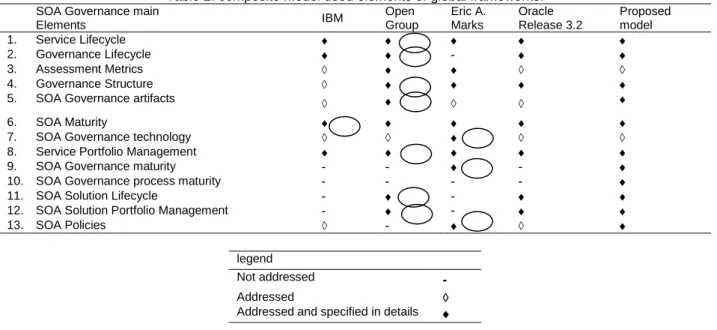
policies are the means by which governance is operationalized. Policies are what make a governance model tangible, enforceable, and meaningful for the stakeholders of an SOA. There are several categories of SOA policies such as, Security Policies, Service Design and Implementation Policies, Semantic, Data, and Schema Governance policies, SOA Platform and Operations Policies, SOA/SDLC Policies (Marks,2008). The comparisons between four Frameworks are shown in Table 1 based on the defined criteria. The White cells in left columns are the elements that defined in paper (Hojaji,2012b) as a evaluate framework and the gray cells are the elements that have been documented in this study and presented as new elements.
Table1. The comparisons between four Frameworks based on the defined criteria. Oracle Release 3.2 Eric A. Marks Open Group IBM
SOA Governance main Elements Service Lifecycle 1. - Governance Lifecycle 2. Assessment Metrics 3. Governance Structure 4.
SOA Governance artifacts 5. SOA Maturity 6.
SOA Governance technology 7.
Service Portfolio Management 8.
-
- -
SOA Governance maturity 9.
- -
- -
SOA Governance process maturity 10.
-
-
SOA Solution Lifecycle 11.
-
-
SOA Solution Portfolio Management 12. - SOA Policies 13. legend - Not addressed Addressed Addressed and specified in details
As can be seen in table 1theOpen Group framework is the most suitable framework and addresses most of the required elements. Hence, it has been tried in the model presented in this paper, rather than use the Open Group model (Open Group,2009).
Presenting the selected model
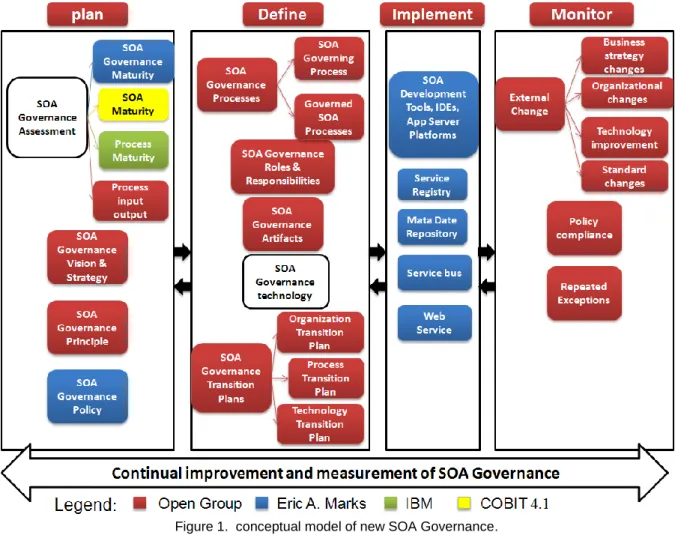
According to studies in this section we presented a composite model of SOA governance. In this model for most of elements we used Open Group(Open Group,2009). However, in some cases such as SOA governance maturity and policies we used Eric A.Marks model (Marks,2008), for SOA maturity IBM model is used (IBM,2013) and to assess process maturity we use COBIT4.1.The conceptual framework is shown in figure 1. The model consists of four primary phases of governance lifecycle that their elements shown in figure 1. We used different colors for different models to show which element extract from which model. The main phases of the model such as planning, definition, implementation and monitoring are taken from Open Group. In the planning phase, business requirements and priorities are analyzed and documented, also the current state of maturity is assessed and inputs and outputs if the processes are analyzed. In the definition phase, the existing gaps between the current governance and the desired governance are identified and the roles and processes are introduced. The implementation phase is for the empowerment and fulfillment of the governance
1441
solutions in the previous phases. Monitor phase identifies external changes and exceptions that occurred during work and assesses trends.Figure 1. conceptual model of new SOA Governance.
Three elements are not specified with color in the framework: 1) SOA governance assessment, 2) SOA governance technology and 3) Continual improvement and measurement of SOA Governance. Because SOA governance assessment is a combination of other methods we can't say exactly which model is used. Hence, it is not indicated with colored. Required technology for SOA governance include tools, infrastructure, hardware, software and databases that are developed by different companies. Using technology depends on world's newest technologies and the tools that organizations have already used. In this case Open Group only addressed capabilities that can be used to perform the SOA Governance Processes. However, Eric A. Marks in the ninth chapter of his book (Marks,2008) describe technologies in details. In this paper we proposed some cases that are necessary for starting SOA governance. However, due to the organizational and technical conditions, various projects will define as technology transition plans. So the proposed model has not explicit and detailed explanation of this issue. The third issue is continual improvement and measurement of SOA Governance that has been considered as a plan between the four main phases of the framework. This element implicitly considered in other frameworks in monitor or assessment phases. But in the proposedmodelin addition to monitor phase checking the changes and mismatches are done in continual improvement and measurement of SOA Governance.
As noted earlier and red components in figure1 indicate that most elements in the model are selected from the Open Group. Open Group is just a framework that is a technical standard in the context of SOA governance. Also noteworthy is the fact that the Eric A.Marks also is a SOA governance framework that has been developed in a book in 2008. According to the studies Open Group model, in some areas such as governance maturity model, process maturity, governance policies and technologies has deficient. In this paper we tried to overcome some of these shortcomings to present a composite model for department of ICT. In programming phase, in a subset of SOA governance assessment, we use IBM model to evaluate SOA maturity, Eric A.Marks model to assess SOA governance maturity, COBIT4.1 model to evaluate process maturity and Open Group model to identify inputs and outputs of processes. These evaluations have been
1442
done to identify the current status of SOA governance in department of ICT in the Isfahan municipality. We also use governance policies and technologies from Eric A.Marks, because only this model addresses these issues. To ensure to address the basic elements in the proposed model, table2 shows the elements in a composite model extract from each of global model. As you can see there are many elements that have been addressed in the proposed model. In most cases, the efficient elements of global models have been used. Ellipse shapes in some of the parameters in the table are shown the model's parameters that proposed model used them.Table 2. composite model used elements of global frameworks.
Proposed model Oracle Release 3.2 Eric A. Marks Open Group IBM
SOA Governance main Elements Service Lifecycle 1. - Governance Lifecycle 2. Assessment Metrics 3. Governance Structure 4. SOA Governance artifacts
5. SOA Maturity 6. SOA Governance technology
7. Service Portfolio Management
8. - - - SOA Governance maturity
9. - - - - SOA Governance process maturity
10. - - SOA Solution Lifecycle
11. - - SOA Solution Portfolio Management
12. - SOA Policies 13. legend - Not addressed Addressed Addressed and specified in details
RESULTS AND DISCUSSION
Evaluation
Since ICT is one of the organizations in which the alignment of business and information technology is one of the main objectives, and it is responsible for projects related to the provision of electronic services to all business areas of the municipality, this organization may be a good option to implement service-oriented architecture governance. To implement the proposed model in ICT department, first of all we should determine the current status of ICT in some issues such as service oriented processes and their inputs/outputs, roles and responsibilities, current governance framework maturity, process maturity and etc. these are all shown in the planning phase in the proposed framework.
Mapping the SOA governance processes
The first step that must be undertaken in order to assess the current status of ICT is mapping between ICT's processes and SOA governance processes of Open Group model. Mapping was done through interviewing with the relevant authorities. ICT uses ITIL process framework, so some of the processes related to service-oriented governance are exactly exist, some of them are informal processes and some others, are not exist.
Process maturity
After mapping between processes, we can assess the maturity of the processes through six levels of the maturity model of COBIT4.1such as non-existent, initial/ad hoc, repeatable but intuitive, defined process, manageable and measurable, optimized. The maturity level of processes that are similar in ITIL and Open Group is clear such as access management, incident management, change management and problem management, but the maturity level of other processes are determined through interviewing with the relevant authorities. Finally the mean value of the all SOA governance processes (30 processes) among six levels of maturity (0-5), is 1.83.
Inputs/outputs of processes were evaluated during interviewing for mapping processes between ICT's processes and Open Groups. Most of inputs/outputs of processes that are implemented in the organization formally or informally are existed with different titles.
Roles and responsibilities
As mentioned before, one of the major components of SOA governance is roles and responsibilities or in other words an organizational structure. Therefore, in this research the presence or absence of SOA
1443
governance roles of responsibilitiesis discussed. According to an interview with an ICT's expert, specific responsibilities of SOA governance such as SOA chief architect and SOA director in the ICT were absent. SOA MaturityTo assess the maturity of SOA and SOA governance, two kinds of questionnaires used in this research. ICT professionals and managers and experts of the population are collected. Total of 35 questionnaires were distributed in ICT and finally 23 questionnaires for governance maturity and 20 questionnaires for SOA maturity were completed and obtained. In this paper we use Microsoft Excel and SPSS to get useful information from gathered data in the questionnaire.
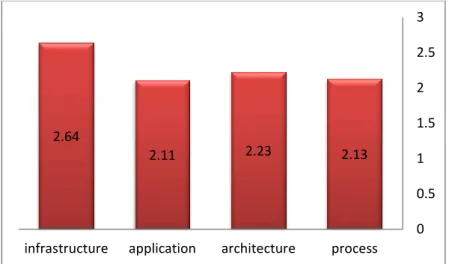
The SOA maturity questions were selected from IBM's online questionnaire. The questionnaire contained 16 questions in four dimensions of process, architecture, applications, and infrastructure and assesses SOA maturity in 4 levels such as ad-hoc, systematic, composite and dynamic (0-4).Results show that current SOA maturity level is systematic. The mean value of each dimension of SOA shown in figure 2.
Figure 2. Mean value of SOA Dimensions.
It is noteworthy that the total mean value of SOA is 2.27. As we will see in figure 2process and application dimensions have less maturity and infrastructure's maturity is higher. In other diagram, as you can see in figure 3 IBM shows the percent of the capabilities in each dimension.
Figure 3. Capabilities gap analysis in SOA (IBM,2013).
The ICT infrastructure capability is 69%, process is 50%, architecture is 56%, application is 50% and it is shown that infrastructure capability is higher than the other dimensions. More over the final preparation of ICT using IBM's SOA assessment tool is diagnosed in56%, while for global SOA benchmark it diagnosed 48%. It shows that ICT is in more desire level than other organizations those use IBM's assessment tool especially in infrastructure aspect.
2.13 2.23
2.11 2.64
0 0.5 1 1.5 2 2.5 3
process architecture
application infrastructure
1444
SOA Governance Maturity
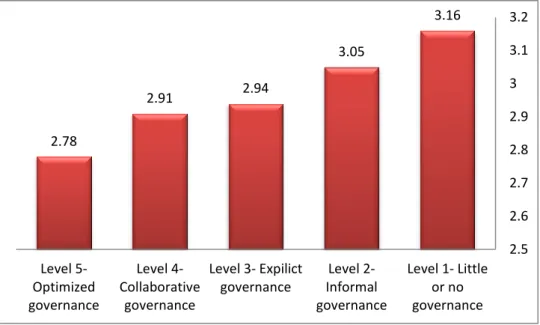
In SOA governance maturity assessment, we design a questionnaire with 35 questions using Eric A.Marks model. This model defines 5 levels of maturity for SOA governance such as little to no governance, informal governance, explicit governance, collaborative governance and optimized governance. The questions are qualitative in 5 levels (1-5). As can be seen the results shown in figure 4, in higher levels of maturity the quality is lower.
Figure 4. Mean value of SOA governance. Proposed Solution
SOA Governance has four main dimensions such as process, policy, people and technology. So in this research we propose some solutions in these dimensions. To move towards SOA governance for ICT, processes such as services portfolio, solution portfolio, training service oriented architecture solution, service modeling, service tests, service reuse planning have high priorities. For technology dimension, web services, dashboards, business processes management software (BPMS), registry, repositories and their updating maps have priorities. For people dimension that means roles and responsibilities of SOA governance, ICT needs service architect and SOA director and especially it needs some boards of SOA governance like SOA Governance Board (Informing and Monitoring) or Solution Development Team (Execution and Delivery of solutions) and Service Development Team (Execution and Delivery of services) and Change Advisory Board (responsible for assessing and prioritize of changes). In addition to these technical roles and boards, ICT also needs some undertaker for necessary processes such as responsible for service reuse, SOA maturity assessment, service test and service change. Addition to these three dimensions ICT also needs some policies for implementing SOA governance such as:
Security Policies
Authentication, authorization, and credential management Encryption and signing of confidential content
Passing credentials within and across trust domains
Service Design and Implementation Policies
Service interface design standards Service payload standards
Service integration and interoperability standards
SOA Platform and Operations Policies
Specification and implementation of your SOA development and runtime platform Management and operations of services via the SOA platform
Operational and management policies for runtime
Quality of services and service level agreement (SLA) policies
SOA/SDLC Policies
Defined and consistent overall SOA SDLC delivery model
3.16 3.05
2.94 2.91
2.78
2.5 2.6 2.7 2.8 2.9 3 3.1 3.2
Level 1- Little or no governance Level
2-Informal governance Level 3- Expilict
governance Level
4-Collaborative governance Level
5-Optimized governance
1445
SOA-enabled application delivery model, or a process to compose or assemble business applications by consuming servicesSOA process orchestration and composite services lifecycle Service development lifecycle: provider side
Service development lifecycle: consumer side
REFERENCES
Ai-hu L. 2007. The Theory, Technology and Integration of SOA. Electronic Industry Press. pp. 1-30.
Erl T. 2005. Service Oriented Architecture - Concepts, Technology, and Design. Prentice Hall Professional Technical Reference. Boston. Hojaji F, Ayatollahzadeh Shirazi M. 2012 a. A design science approach to develop a new comprehensive SOA governance framework,
(IJMIT) Vol.4, No.3.
Hojaji F, Ayatollahzadeh Shirazi M. 2012 b. A framework for evaluating SOA governance frameworks.( JATIT) Vol. 40 No.2.
IBM Department. 2013. SOA Self-Assessment. Retrieved from: https://www14.software.ibm.com/iwm/web/cc/flash/soa/en/us/Tool.htm Marks EA. 2008. SOA Governance For The Services Driven Enterprise. Wiley.
Niemann M, Christian J, Nicolas R, Ralf S. 2009. Challenges of Governance Approaches for Service-Oriented Architectures. IEEE. Open Group. 2009. SOA Governance framework. Technical standard.