21
Health Management Associates
Appendix A. State Programs’ Approaches on Building Blocks
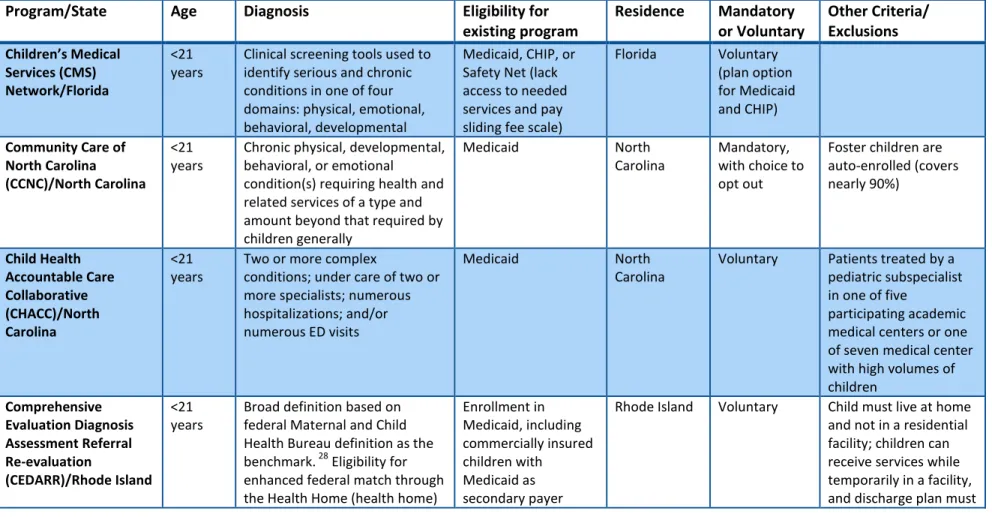
Table 1. Eligibility Requirements
Program/State
Age
Diagnosis
Eligibility for
existing program
Residence
Mandatory
or Voluntary
Other Criteria/
Exclusions
Children’s MedicalServices (CMS) Network/Florida
<21 years
Clinical screening tools used to identify serious and chronic conditions in one of four domains: physical, emotional, behavioral, developmental
Medicaid, CHIP, or Safety Net (lack access to needed services and pay sliding fee scale)
Florida Voluntary (plan option for Medicaid and CHIP) Community Care of
North Carolina (CCNC)/North Carolina
<21 years
Chronic physical, developmental, behavioral, or emotional
condition(s) requiring health and related services of a type and amount beyond that required by children generally
Medicaid North
Carolina
Mandatory, with choice to opt out
Foster children are auto-enrolled (covers nearly 90%)
Child Health Accountable Care Collaborative (CHACC)/North Carolina
<21 years
Two or more complex
conditions; under care of two or more specialists; numerous hospitalizations; and/or numerous ED visits
Medicaid North
Carolina
Voluntary Patients treated by a pediatric subspecialist in one of five
participating academic medical centers or one of seven medical center with high volumes of children
Comprehensive Evaluation Diagnosis Assessment Referral Re-evaluation
(CEDARR)/Rhode Island <21 years
Broad definition based on federal Maternal and Child Health Bureau definition as the benchmark. 28 Eligibility for enhanced federal match through the Health Home (health home)
Enrollment in Medicaid, including commercially insured children with
Medicaid as secondary payer
Rhode Island Voluntary Child must live at home and not in a residential facility; children can receive services while temporarily in a facility, and discharge plan must
28
The federal Maternal and Child Health Bureau defines Children with Special Health Care Needs as “children who have or are at increased risk for chronic physical, developmental, behavioral, or emotional conditions and who also require health and related services of a type or amount beyond that required by children generally.”
22
Health Management Associates
Program/State
Age
Diagnosis
Eligibility for
existing program
Residence
Mandatory
or Voluntary
Other Criteria/
Exclusions
requires that the program assigna diagnosis.
(Katie Beckett waiver in Rhode Island)29
include discharge to home.
South Carolina Solutions (SCS)/South Carolina
<18 years
Meet Nursing Facility (NF) or Intermediate Care Facility for the Mentally Retarded (ICF/MR) criteria; meet Medical Eligibility Criteria that indicates the child has:
- A serious illness or condition that is expected to last longer than 12 months and which generally makes the child dependent upon
comprehensive medical, nursing, health supervision or intervention; and - Significant medication,
hospitalization, therapy, nursing care, and specialist needs
Medicaid South
Carolina
Voluntary MR/DD children not eligible
Rare and Expensive Case Management (REM)/Maryland
All ages Specific diagnoses, with age requirements, included on the REM Disease List
Medicaid Managed Care Program (HealthChoice) 30
Maryland Voluntary Dual eligible individuals are not eligible Vermont Blueprint for
Health/Vermont
All ages Not linked to diagnoses All payers (Medicaid, Medicare, and Commercial)
Vermont Voluntary All patients in participating primary care practices are eligible for care coordination services
29
Rhode Island has a Katie Beckett Waiver, also known as the Deeming Waiver or the 2176 Model Waiver. This creates an eligibility category that allows certain children under age 19 who have long term disabilities or complex medical needs to become eligible for Medicaid coverage. Katie Beckett eligibility enables children to be cared for at home instead of in an institution. With Katie Beckett, only the child’s income and resources are used to determine eligibility. Approximately 40% of kids enrolled in CEDARR are commercially covered with Medicaid serving as secondary coverage; the other 60% are enrolled in Medicaid managed care.
30
23
Health Management Associates
Table 2. Eligibility Determination
Program/State
Referral/Assessment
Processing/Determination
Children’s Medical Services (CMS) Network/Florida
Families applying for Florida KidCare are asked a series of questions regarding their child’s medical, behavioral, and developmental status to determine whether screening for CMS is needed.31
CMS nurses administer a clinical screening tool to determine clinical eligibility.
Community Care of North Carolina (CCNC)/North Carolina
Predictive modeling based on claims data is used to identify high-cost patients; and referrals from providers.
Networks and care managers contact identified patients and coordinated with the patients’ providers. CCNC employs a risk stratification tool.
Child Health Accountable Care Collaborative (CHACC)/North Carolina
Referrals from NICU, PICU, specialty clinics, and primary care providers
CHACC care manager implements a broad assessment tool. Care managers have discretion to complete a partial or full
assessment based on the screening criteria – at risk for needing services – and existing care coordination being provided. Comprehensive
Evaluation Diagnosis Assessment Referral Re-evaluation
(CEDARR)/Rhode Island
Self-referral by the family; or referral by a provider, school, or other agency based on the child’s need for services and assistance that CEDARR can provide
Licensed Clinician screens the child for eligibility during the initial meeting with the child and family. Licensed Clinicians in the CEDARR program must determine ongoing eligibility for home and community-based services provided through the CEDARR Family Centers.
South Carolina Solutions/South Carolina
Children are referred by a provider. The Medical Eligibility Assessment Tool is used to evaluate the child against medical complexity criteria, based upon diagnoses and subsets. Rare and Expensive
Case Management (REM)/Maryland
Self-referral with referral form signed by a physician; or referred by a physician, MCO, specialty clinic, NICU, etc. All applicants require the REM referral, or application, and supporting medical documentation from the individual’s provider.
Nurses within the Division of Children’s Services of the Maryland Department of Health & Mental Hygiene; all application denials are reviewed by a physician.
Vermont Blueprint for Health/Vermont
All patients in participating practices and organizations are eligible for care coordination services provided by their primary
N/A
31
The following questions from the Florida KidCare application address a child’s medical, behavioral, and/or developmental condition(s): (1) Is this child limited or prevented in any way in his or her ability to do the things most children of the same age can do?
(2) Does this child need to get special therapy, such as physical, occupational or speech therapy, or treatment or counseling for an emotional, developmental, or behavioral problem?
24
Health Management Associates
Program/State
Referral/Assessment
Processing/Determination
care provider and Community Health Team (CHT).
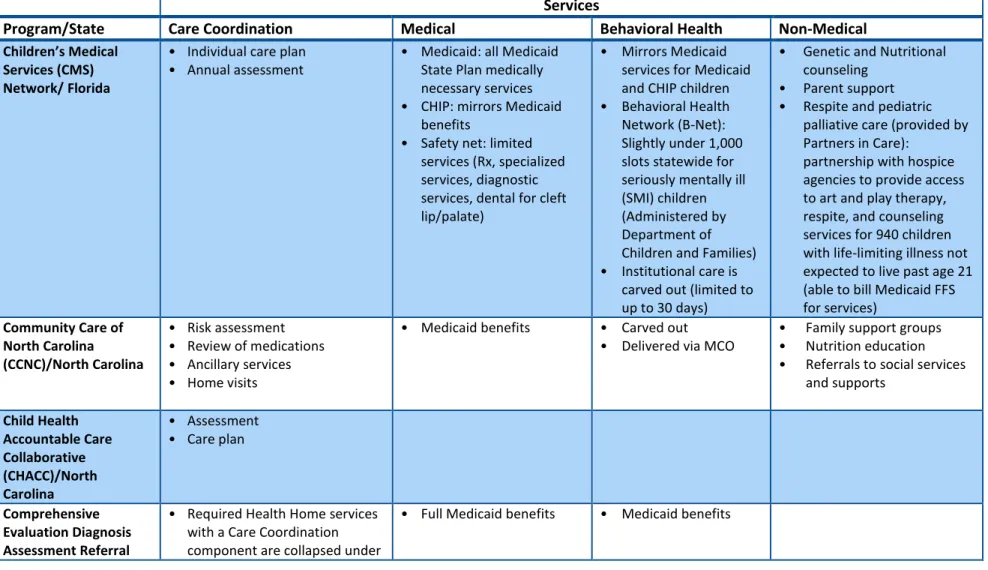
Table 3. Care Coordination Services
Services
Program/State
Care Coordination
Medical
Behavioral Health
Non-Medical
Children’s Medical Services (CMS) Network/ Florida
• Individual care plan • Annual assessment
• Medicaid: all Medicaid State Plan medically necessary services • CHIP: mirrors Medicaid
benefits
• Safety net: limited services (Rx, specialized services, diagnostic services, dental for cleft lip/palate)
• Mirrors Medicaid services for Medicaid and CHIP children • Behavioral Health Network (B-Net): Slightly under 1,000 slots statewide for seriously mentally ill (SMI) children (Administered by Department of Children and Families) • Institutional care is
carved out (limited to up to 30 days)
• Genetic and Nutritional counseling
• Parent support • Respite and pediatric
palliative care (provided by Partners in Care):
partnership with hospice agencies to provide access to art and play therapy, respite, and counseling services for 940 children with life-limiting illness not expected to live past age 21 (able to bill Medicaid FFS for services)
Community Care of North Carolina (CCNC)/North Carolina
• Risk assessment • Review of medications • Ancillary services • Home visits
• Medicaid benefits • Carved out • Delivered via MCO
• Family support groups • Nutrition education • Referrals to social services
and supports Child Health
Accountable Care Collaborative (CHACC)/North Carolina
• Assessment • Care plan
Comprehensive Evaluation Diagnosis Assessment Referral
• Required Health Home services with a Care Coordination component are collapsed under
25
Health Management Associates
Services
Program/State
Care Coordination
Medical
Behavioral Health
Non-Medical
Re-evaluation
(CEDARR)/Rhode Island
the broader service definition of “Health Needs Coordination”
o Education o Peer interaction o Family support groups o Navigation
o Acquiring benefits
• Initial Family Intake and Needs Assessment (IFIND)
• Family care plan development and review
• Family Care Coordination Assistance
o Provision of specials needs resource information o System mapping and
navigation
o Resource identification o Eligibility assessment and
application assistance o Peer support and guidance South Carolina
Solutions/South Carolina
• Identify resources for family in the community
• Authorize respite care
• Monthly review of educational topic with caregiver
• Monthly review of care plan with caregiver and instructions for caregiver to ensure compliance
• Monitor interventions and therapies provided
• Comprehensive • Carved out
• Comprehensive community based system
• Emergency preparedness plans
• Home modifications • CPR training
• Home and community based services and supports • Transportation
• Respite
• Private duty nursing • Equipment maintenance • Education for family Rare and Expensive
Case Management
• Assessment of enrollee needs • Patient education
• Comprehensive Medicaid FFS benefits
• Carved out • Provided by an ASO
• Coordinated by case managers and provided
26
Health Management Associates
Services
Program/State
Care Coordination
Medical
Behavioral Health
Non-Medical
(REM)/Maryland • Family support services • Development of a treatment
plan
• Coordination of provider services
• Follow-up on enrollee’s progress
• Optional services such as shift home health aide
through the Developmental Disability Administration and Division of
Rehabilitation Services
Vermont Blueprint for Health/Vermont
• Individual care coordination • Outreach and population
management
• Integration with community-based social and economic supports
• Based on patient’s coverage
• Based on patient’s coverage
• Connect patients with chronic care management, behavioral health, health and wellness coaching, social/economic services support
• Physical therapy • Nutritional therapy • Chronic disease
self-management programs • Wellness, Recovery and
Action Plan (WRAP) • Support and Services at
Home (SASH) for elderly and disabled Medicare beneficiaries
27
Health Management Associates
Table 4. Care Coordination Standards
Standards
Program/State
Assessment and care
plan
Staff ratio/caseload
Care coordinators
Medical home
model/care team
Other
Children’s MedicalServices (CMS) Network/Florida
• Clinical screening tool and medical records assessment • Assessment
conducted with the family in person or via phone
• Assessments used to develop care plan • Individual care plan
updated every six months
• No specific caseload requirement • Goal is 1-2 care
coordinators per primary care practice with 300-400 kids
• 250 to 450 cases based on number of care coordinators per office/ region • Medical foster care
program: 22:1 for nurses and 25: 1 for social workers
• Registered Nurses • Social workers
• Each child is assigned a care coordinator • Interdisciplinary team
approach
Community Care of North Carolina (CCNC)/North Carolina
• Risk stratification tool to assess major pediatric chronic conditions
• Rate level of care as heavy, medium, or light
• Care managers work through priority patient list based on risk stratification
• Based on the target and intensity of the target
• Registered Nurses • Multidisciplinary team approach
• Behavioral health professional included for members with behavioral health condition • Care managers
embedded in primary care practices of larger networks or assigned to cluster of practices in smaller network
• Care managers required to enter data into CMIS
• Web-based care management system
28
Health Management Associates
Standards
Program/State
Assessment and care
plan
Staff ratio/caseload
Care coordinators
Medical home
model/care team
Other
Child Health Accountable Care Collaborative (CHACC)/North Carolina
• Broad assessment tool
• Specialty Care Manager embedded in academic medical centers, tertiary hospitals, and specialty clinics • Registered Nurses
• Patient management information tool used to
communicate between specialist and PCP
Comprehensive Evaluation Diagnosis Assessment Referral Re-evaluation
(CEDARR)/Rhode Island
• IFIND intake assessment
o Completed within 30 calendar days of request by family • Family care plan
o Completed within 30 days of the assessment o Reviewed and
revised annually • Interim care plan
(1-2 months)
• Licensed clinician: Licensed Social Worker, Licensed Mental Health Counselor, Licensed Marriage and Family Therapy Counselors, and Registered Nurses • Licensed clinician
required to contact family at least every six months • Family service
coordinator
• Health Home model
South Carolina Solutions/South Carolina
• Proprietary tool to determine level of care
• Level of care reviewed quarterly
• Transitional assessments in hospitals: 45-50 cases per nurse • Qualifying events
assessments: ≤40 cases per nurse
• Monthly contact with patient and family
• Monitor claims monthly
• Interdisciplinary care team
• Behavioral health professional included in team for members with behavioral health condition
29
Health Management Associates
Standards
Program/State
Assessment and care
plan
Staff ratio/caseload
Care coordinators
Medical home
model/care team
Other
• In homeassessments: ≤60 cases per nurse Rare and Expensive
Case Management (REM)/Maryland
• Assessment
• Interdisciplinary plan of care
• Care plan developed with family/caregiver input
• Level of care guidelines and assignment
• 80-100 members per case manager
• Registered Nurses • Social workers • Minimum contact
requirements based on level of care
• Reporting requirements
• Multidisciplinary team • Included primary care
provider and variety of other providers
• Quality
improvement and performance measures • Electronic case
management system
Vermont Blueprint for Health/Vermont
• HRA not
standardized across practices
• Five FTE serve 20,000 patients
• Nurses
• Varying job titles
• NCQA PCMH certification • Community Health
Team
(multidisciplinary) • Track patients who
are overdue for tests • Manage short-term
care for high needs patients
• Check that patients are filling
prescriptions and taking medications appropriately • Follow up with
patients on personal health management goals
• CHT meets at least weekly
• Web-based central health registry to capture all patient data
30
Health Management Associates
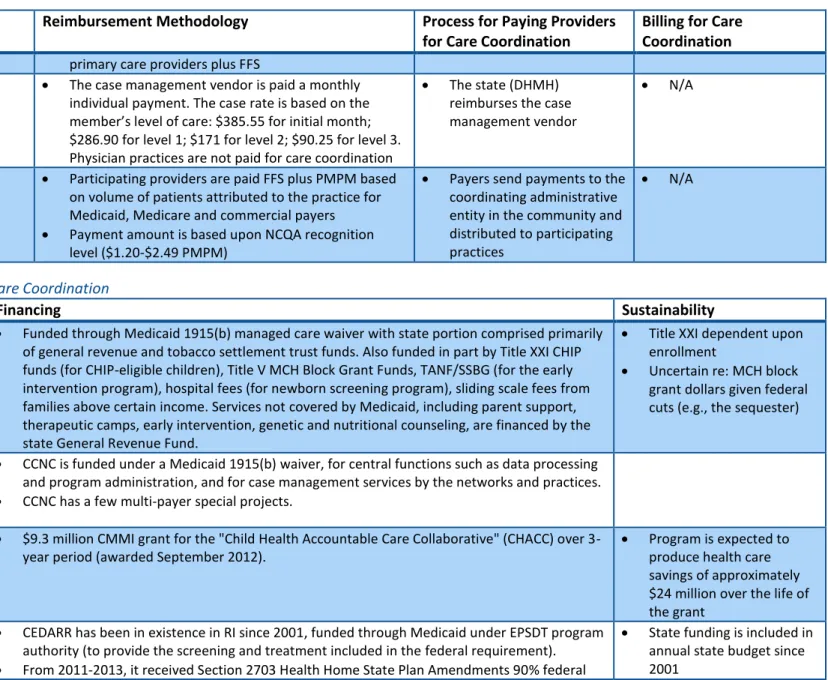
Table 5. Reimbursement Methodology and Process
Program/State
Reimbursement Methodology
Process for Paying Providers
for Care Coordination
Billing for Care
Coordination
Children’s Medical Services(CMS) Network/Florida
CMS network care coordinatorswithin the local CMS Network field offices are state-employed nurse care coordinators and social workers
Salaried N/A
Community Care of North Carolina (CCNC)/North Carolina
CCNC care managers are employed by the (14) CCNC networks, which are private non-profit and contract with the state. The state provides operating expenses for staff and health care initiatives. The networks receive a management fee based on the number of Medicaid recipients enrolled with the network.
In addition, practices that participate in CCNC are paid (2013) $2.50 PMPM for program requirements that include 24 hour phone access and referral or
authorization of services to other providers when the service cannot be provided by the PCP; $5 PMPM if patient is ABD. (Medical services are reimbursed FFS).
Most CCNC care managers are employed by the networks and are salaried; they do not receive incentive payments, but there are productivity expectations and goals
Each CCNC network receives PMPM from the state based on monthly enrollment
Childhood Accountable Care Collaborative (CHACC)/ North Carolina
Nurse case managers, administrative staff that make appointments and provide linkages under direction of the nurse, and some patient navigators that are not medically trained are salaried through the CHACC networks32
Salaried N/A
Comprehensive Evaluation Diagnosis Assessment Referral Re-evaluation (CEDARR)/Rhode Island
Providers are paid on a per 15-minute unit basis, with rates tied to the provider’s qualifications: $16.63 for the Licensed Clinician, $9.50 for the Family Services Coordinator
Changing to PMPM of $70.93 (proposed), split between team members (pending CMS approval)
Providers are paid directly by the state; no payment is made to the MCOs
Providers bill Medicaid through MMIS for Care Coordination services, using CPT code H2021 (with modifiers for different
reimbursement rates) based upon 15 minutes of effort per unit South Carolina Solutions $214 PMPM for care coordination; half is paid to N/A N/A
32
CHACC networks are centered on each of five academic medical centers or seven tertiary children’s hospitals, so they are not exactly a one-to-one ratio with the 14 CCNC networks.
31
Health Management Associates
Program/State
Reimbursement Methodology
Process for Paying Providers
for Care Coordination
Billing for Care
Coordination
(SMS) /South Carolina primary care providers plus FFSRare and Expensive Case Management
(REM)/Maryland
The case management vendor is paid a monthly individual payment. The case rate is based on the member’s level of care: $385.55 for initial month; $286.90 for level 1; $171 for level 2; $90.25 for level 3. Physician practices are not paid for care coordination
The state (DHMH) reimburses the case management vendor
N/A
Vermont Blueprint for Health/Vermont
Participating providers are paid FFS plus PMPM based on volume of patients attributed to the practice for Medicaid, Medicare and commercial payers
Payment amount is based upon NCQA recognition level ($1.20-$2.49 PMPM)
Payers send payments to the coordinating administrative entity in the community and distributed to participating practices
N/A
Table 6. Financing of Care Coordination
Program/State
Financing
Sustainability
Children’s Medical Services (CMS) Network/Florida
Funded through Medicaid 1915(b) managed care waiver with state portion comprised primarily of general revenue and tobacco settlement trust funds. Also funded in part by Title XXI CHIP funds (for CHIP-eligible children), Title V MCH Block Grant Funds, TANF/SSBG (for the early intervention program), hospital fees (for newborn screening program), sliding scale fees from families above certain income. Services not covered by Medicaid, including parent support, therapeutic camps, early intervention, genetic and nutritional counseling, are financed by the state General Revenue Fund.
Title XXI dependent upon enrollment
Uncertain re: MCH block grant dollars given federal cuts (e.g., the sequester)
Community Care of North Carolina (CCNC)/ North Carolina
CCNC is funded under a Medicaid 1915(b) waiver, for central functions such as data processing and program administration, and for case management services by the networks and practices.
CCNC has a few multi-payer special projects. Childhood
Accountable Care Collaborative (CHACC)/North Carolina
$9.3 million CMMI grant for the "Child Health Accountable Care Collaborative" (CHACC) over 3-year period (awarded September 2012).
Program is expected to produce health care savings of approximately $24 million over the life of the grant
Comprehensive Evaluation Diagnosis Assessment Referral
CEDARR has been in existence in RI since 2001, funded through Medicaid under EPSDT program authority (to provide the screening and treatment included in the federal requirement).
From 2011-2013, it received Section 2703 Health Home State Plan Amendments 90% federal
State funding is included in annual state budget since 2001
32
Health Management Associates
Program/State
Financing
Sustainability
Re-evaluation (CEDARR)/Rhode Island
match (about 95% of enrollees meet criteria); enhanced payment reported to help bridge difficult budget times for CEDARR
As of October 1, 2013, the State resumed funding the full State share (48%), which has been included in the annual budget passed by the Legislature every year since 2001.
RI is a Katie Beckett state, so about 40% of children enrolled are commercially covered with Medicaid serving as secondary coverage; the other 60% are enrolled in Medicaid managed care
Commercial insurance starting to look at paying for care coordination. State is encouraging CEDARR sites to become credentialed with commercial insurers
Looking at pilot for pediatric-based medical home
South Carolina Solutions/South Carolina
Began with a managed in long term care 1115(c ) waiver, currently under Medically Complex Children 1915(c) waiver (2012-2017; Community Health Solutions of America (CHS) administers the program for the state under an umbrella medical home network model.
Rare and Expensive Case Management (REM)/ Maryland
REM started in July 1997 with the implementation of Medicaid managed care. Amidst concern that medically complex individuals would not get needed care under managed care, the state and a panel of providers led the effort as part of the overall work on the 1115 waiver.
REM case management services are funded through the Maryland Medicaid Program and include federal funding
The funding is included in the annual State Medicaid budget
Vermont Blueprint for Health/Vermont
Commercial payers, Medicaid and Medicare provide funding through PMPM payments to participating practices and organizations and funding for Community Health Teams that include care coordination when appropriate
Medicaid global commitment waiver provides $5 million per year for administration of program, salaries, evaluation, and grants at the local level. Budget covers : 3 chronic disease self-management programs (general, diabetes, pain management), wellness, recovery and action plan (WRAP) – mental health, CDC evidence based diabetes prevention program tobacco cessation
Medicaid and private insurers (3 major commercial insurers) in Vermont split the costs of the community health teams and pay FFS for care; total support is provided at the rate of $70,000 (approximately 1.0 FTE/ 4,000 patients).
Medicare funding for provider payments and CHT support is provided through CMS’ Multi-payer Advanced Primary Care Practice Demonstration (a CMMI grant)
Prior to the demonstration, Medicaid funded the Medicare portion of provider payments and CHT support.
Blueprint is also supported by federal funds for HIT (ARRA, HITECH Act)
Some money from Department of Health through CDC to operate disease specific programs
Evaluation has
documented the return on investment (ROI) of the program for Medicaid and commercial payers – improved health outcomes and decreased costs
The demonstration is scheduled to end July 2014. The state has submitted a formal request to OMB to extend it through December 2014. Extension is an option if the program meets cost neutrality requirements and is at the discretion of
33
Health Management Associates
Program/State
Financing
Sustainability
through an MOU
The funds are fully matched
As part of the “Hub and Spoke” Health Home initiative, state is seeking a 90-10 FMAP rate for health home services.
Some private foundation funding, like for WRAP in 2010.
the Secretary of HHS. OMB has not yet responded. Funding is available through July 2014 or December 2014 if the extension is approved
Uncertain whether Medicare will continue to participate once the Multi-Payer Advanced Primary Care Practice
Demonstration ends.
The state is not in a position to fill in the funding once the demonstration ends.