613
DISCHARGE, SUBSTRATE TYPE AND TEMPERATURE AS FACTORS AFFECTING
GASTROPOD ASSEMBLAGES IN SPRINGS IN NORTHWESTERN BOSNIA AND
HERZEGOVINA
Dejan Dmitrović1,*, Ana Savić2 and Vladimir Pešić3
1 Department of Biology, Faculty of Sciences,University of Banja Luka, 78000 Banja Luka, Republic of Srpska, Bosnia and Herzegovina
2Department of Biology and Ecology, Faculty of Sciences and Mathematics, University of Niš, 18 000 Niš, Serbia
3Department of Biology, University of Montenegro, 81000 Podgorica, Montenegro
*Corresponding author: [email protected]
Received: October 9, 2015; Revised: November 3, 2015; Accepted: November 10, 2015; Published online: May 23, 2016
Abstract: In this study, we analyzed changes to gastropod assemblages with regard to the seasonal variations of discharge, substrate composition and temperature in 19 springs in northwestern Bosnia and Herzegovina. Six aquatic gastropod spe-cies were identified, including Bosnidilhia vreloana Boeters, Glöer & Pešić, 2013 and Islamia dmitroviciana Boeters, Glöer & Pešić, 2013, two species endemic for the studied area. Surprisingly, we did not observe a significant influence of discharge on the composition of gastropod assemblages in the studied springs. This could mean that gastropod assemblages in the springs examined are well adapted to intermittent conditions (i.e. fluctuations in discharge). The results of canonical cor-respondence analysis (CCA) showed that specific substrate types can be good predictors for the occurrence of particular species. Interestingly, we found that spring specialists such as Bythinella schmidti and Islamia dmitroviciana also inhabit springs with intermittent dry periods. The studied springs should be considered at risk and some of their gastropod dwell-ers, such as the endemics Bosnidilhia vreloana and Islamia dmitroviciana, are possibly endangered, requiring conservation planning to protect these spring habitats.
Key words: springs; intermittent springs, gastropods; discharge; substrate types
INTRODUCTION
Springs, with exception of karst and intermittent springs, are often treated as stable ecosystems due to the low variability of their abiotic conditions (es-pecially low temperature amplitudes), small impact of nutrients and relatively stable discharge regime [1,2]. Consequently, they are inhabited by organisms adapted to the stable abiotic conditions typical for this environment [3,4].
However, hydrological disturbances also occur in springs and may become important factors in shap-ing sprshap-ing assemblages [5], especially in karst and in-termittent springs, where heavy rainfall and drought periods influence the aquatic macroinvertebrates [6]. Many studies have shown that other abiotic factors,
including hydrochemistry and substrate composition, also influence spring fauna [7-12]. The western Bal-kans harbor a high biodiversity that includes a high number of endemic species living in springs [13,14]. This has been attributed to the highly diverse geology and historic climate conditions of the region [15], as well to the fact that the Balkan Peninsula was a one of refuges of genetic diversity during the Pleistocene [16].
[18,19]. Recent studies on the diversity of spring snails in the mountainous region of Bosnia and Herzegovina found intriguing biogeographic patterns and several new species [13,20,21], including Bosnidilhia vrelo-ana Boeters, Glöer & Pešić, 2013, a member of the monotypic moitessieriid genus Bosnidilhia, and Isla-mia dmitroviciana Boeters, Glöer & Pešić, 2013, both endemic to the studied area of northwestern Bosnia and Herzegovina [20].
However, the pattern of distribution of aquatic snails in springs has been poorly studied, despite the fact that these snails constitute a major faunistic com-ponent of spring environments [22]. Given the low levels of migration and gene flow between popula-tions of spring snails [18] and the fact that most spring habitats are already threatened by human impacts [23] or even destroyed by draining or cattle trampling [24], further conservation planning and management is required to protect these habitats.
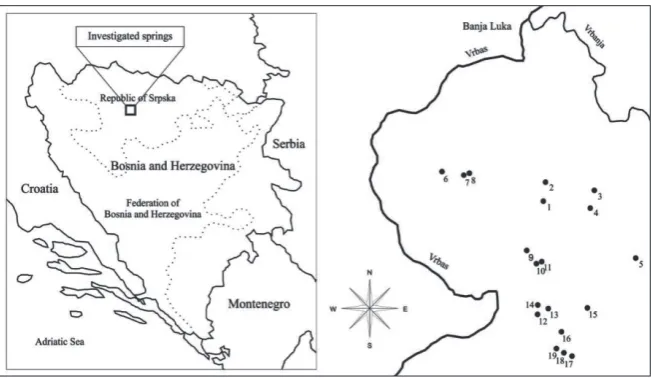
This study examines the influence of disturbances in discharge, substrate type and temperature on the taxonomic richness and seasonal patterns of aquatic gastropod assemblages in the studied springs of north-western Bosnia and Herzegovina. All springs examined are situated around the city of Banja Luka in the Repub-lic of Srpska in Bosnia and Herzegovina (Fig. 1). The springs are situated between 247 and 603 m a.s.l., with
an average altitude of 411.79 m. The climate is temper-ate: winters are moderately cold and summers warm and wet. The landscape ranges from urban to agricul-tural areas and forest. After preliminary investigations, 19 relatively undisturbed springs (I1-I19) were selected.
MATERIALS AND METHODS Experimental specimens
Aquatic gastropods were quantitatively sampled with a Surber sampler (34x33.5 cm=0.1139 m2, 350-μm mesh
width)in the eucrenal zone of each spring, taking care not to damage the habitat. Two seasonal surveys were carried out: in winter, 20-21 March, 2010 and summer, 14-15 August 2010. All samples were immediately pre-served in 70% ethanol, and subsequently sorted and determined in the laboratory.
Study area
Water temperature was measured in situ on each sam-pling occasion. Discharge was assessed by eye and classified according to Hoffsten and Malmqvist [25]. The springs were divided into 4 groups according to discharge (0: without flow; 1: <1 L min–1; 2: >1 and <5
L min–1; 3: >5 and <20 L min–1). The substrate types
were categorized into five classes of frequency based on percentage of areal coverage [9]: 0: 0%; 1: 1-25%; 2: 26-50%; 3: 51-75%; 4: 76-100%. An overview of the springs’ characteristics is given in Table 1.
Statistical analyses
All statistical analyses were performed using PRIM-ER version 7.0, SPSS version 17 and MVSP version 3.21. Normality tests (Kolmogorov-Smirnov) were performed on faunistic and environmental data, and accordingly appropriate nonparametric tests/analy-ses were used. The Kruskal-Wallis test was used to determine the significance (at α=0.05) of differences in substrate composition between springs [26]. The Wilcoxon test [27] was used to determine differences between environmental factors of the three spring types examined in winter and summer. Categorical principal components analysis (CATPCA) for data was performed on raw, untransformed substrate data. Ordination of the springs was conducted using nonmetric multidimensional scaling (NMDS). Bray-Curtis similarity was used as the similarity index for
the faunistic data. Faunistic similarities between sam-ples were analyzed using the analyses of similarities (ANOSIM) procedure. ANOSIM was used to deter-mine significant differences in all substrate types (in a multivariate sense) between the sampling seasons. CCA [28] was applied to test the influence of envi-ronmental variables on the gastropod assemblages.
RESULTS
A total of 6 species of the three families of freshwater gastropods (Moitessieriidae, Hydrobiidae and Lym-naeidae) were collected from 19 springs. Lymnaeidae was the most diverse family with three species (see Table 2). We found on average 1.05±0.93 species per spring, and diversity ranged from 0 (I13, I15) to 3 (I3, I5, I12, I16) species found. The recorded gastropod assemblages comprised of one stygobiotic species, Bos-nidilhia vreloana (indicated by the completely reduced eye spots [20]), and 5 non-stygobiotic species. The as-semblage density of springs varied from 0 individuals per square meter (ind/m²) and reached 685 ind/m² in I12. The hydrobiid Bythinella schmidti (Kuster, 1852) Table 1.Selected characteristics of the investigated springs.
Springs Latitude Longitude Altitude above sea level (m) Mode of outflow Type of spring Land use
I1 44o43.724ʹ 17o13.490ʹ 526 Artificial pipe Perennial Urban area
I2 44o43.757ʹ 17o13.550ʹ 504 Artificial pipe Perennial Urban area
I3 44o43.628ʹ 17o14.730ʹ 462 Artificial pipe Perennial Meadow
I4 44o43.317ʹ 17o14.613ʹ 554 Artificial pipe Perennial Edge of forest
I5 44o42.470ʹ 17o15.674ʹ 603 Seeping Perennial Edge of forest
I6 44o43.974ʹ 17o11.025ʹ 461 Artificial pipe Intermittent Forest
I7 44o43.905ʹ 17o11.564ʹ 517 Artificial pipe Perennial Forest
I8 44o43.941ʹ 17o11.701ʹ 522 Artificial pipe Intermittent Forest
I9 44o42.620ʹ 17o13.085ʹ 425 Seeping Perennial Edge of forest
I10 44o42.398ʹ 17o13.318ʹ 482 Artificial pipe Perennial Edge of forest
I11 44o42.419ʹ 17o13.419ʹ 438 Artificial pipe Intermittent Forest
I12 44o41.550ʹ 17o13.319ʹ 289 Artificial pipe Perennial Meadow
I13 44o41.710ʹ 17o13.335ʹ 291 Flowing Intermittent Forest
I14 44o41.642ʹ 17o13.576ʹ 302 Artificial pipe Perennial Village
I15 44o41.654ʹ 17o14.509ʹ 377 Artificial pipe Perennial Village
I16 44o41.265ʹ 17o13.897ʹ 290 Artificial pipe Perennial Meadow
I17 44o40.850ʹ 17o14.133ʹ 275 Flowing/seeping Perennial Forest
I18 44o40.911ʹ 17o13.934ʹ 247 Flowing/seeping Intermittent Meadow
was recorded in 13 springs and it was the most abun-dant and frequent species, especially in the winter. The lymnaeid Galba truncatula (O. F. Müller, 1774) represented the most abundant and frequent taxon in the summer and was found in 10 springs.
In the studied springs, 13 different types of sub-strates were identified (Table 3-4). Discharge ranged from low in most springs to high in four springs in winter (I1, I2, I4, I15). The water temperature ranged from 8.5 to 17.5°C (mean 11.06±2.39). Water tempera-ture was significantly different in some springs. The highest water temperature (17.5°C) as well as the larger seasonal amplitude (8.5°C) were recorded at I19. The Kruskal-Wallis test did not reveal statistically significant differences (α=0.05) in substrate composition between springs of different discharge capacity. A comparison of seasonal environmental values using the Wilcoxon test showed the presence of statistically significant sea-sonal differences in temperature (p=0.002), discharge (p=0.011), leaf litter (p=0.000) and clay (p=0.028). The CATPCA (Fig. 2), performed with the 13 substrate types recorded in 19 winter samples, showed that
fac-tors one (pca1 axis) and two (pca 2 axis) explained 28.7% and 21.2% of the total variance, respectively. Component one is dominated by anoxic mud and al-gae on the positive axis and by leaf litter on the negative axis. Component two is determined positively by roots Table 2. List of taxa recorded in the investigated springs; indicated as ind/m².
Spring Bosnidilhia vreloana Bythinella schmidti Galba truncatula dmitrovicianaIslamia Radix balthica Radix labiata
w s w s w s w s w s w s
I1 - - - - 9 - - -
-I2 - - - - 9 - - - 18 - -
-I3 - - 18 9 53 53 9 - - - -
-I4 - - 9 - - - 53 - - - -
-I5 79 9 9 - - - 9 - - - -
-I6 - - 53 - - - 26 - - - -
-I7 - - 193 395 - - - 9 - - -
-I8 - - 70 - - -
-I9 - - - - 9 35 - - -
-I10 - - 114 - 35 - - -
-I11 26 - 140 - - -
-I12 - - - 9 - 219 149 457 - - -
-I13 - - -
-I14 - - 132 - 26 - - -
-I15 - - -
-I16 - - - - 26 35 44 - - - 88
-I17 - - 18 53 - - -
-I18 - - - 53 - 325 - - -
-I19 - - 18 - - 114 - - -
-Abbreviations: w − winter; s − summer.
Table 3. Temperature and substrate composition of the 19 investigated springs (I1-I19) in winter 2010.
Spring T D Am De Ll Db Ms R SubstrateM C S G St A Wm
I1 10 3 0 0 2 0 1 0 0 0 0 2 0 0 1
I2 9.5 3 0 3 3 0 0 0 0 0 1 0 0 0 0
I3 11 2 0 0 2 0 1 0 2 3 1 1 1 0 0
I4 11 3 0 0 4 0 0 0 0 4 0 0 0 0 0
I5 8.5 2 0 0 4 0 0 0 0 0 1 1 0 0 0
I6 8.5 2 0 0 3 1 1 0 0 0 0 2 2 0 0
I7 9 1 0 1 3 1 1 0 0 0 0 0 1 0 0
I8 9 1 0 0 4 0 0 0 0 0 0 1 1 0 0
I9 9 1 0 0 0 0 0 0 0 0 1 1 1 0 0
I10 10 2 0 0 2 0 1 0 0 0 1 1 1 0 0
I11 10 2 0 0 4 0 0 0 0 0 0 0 4 0 0
I12 9 1 0 2 3 1 1 2 1 0 0 0 0 0 0
I13 9 1 0 2 2 1 1 0 0 1 1 1 2 0 0
I14 12 2 0 0 1 0 1 0 0 0 1 1 2 0 0
I15 12 3 3 0 0 0 0 0 0 1 0 0 0 2 0
I16 9 1 0 2 3 2 0 0 0 0 0 1 0 0 0
I17 9.5 1 0 2 2 1 0 0 0 0 0 0 1 0 0
I18 8.5 1 0 1 0 0 0 0 0 4 1 1 1 0 0
I19 9 1 0 2 4 0 1 0 0 0 0 0 0 0 0
Discharge: 0: without flow; 1: <1 L min–1; 2: >1 and <5 L min–1; 3: >5 and <20 L min–1. Substrate type classes (percentage of area coverage): 0: 0%; 1: 1-25%; 2: 26-50%; 3: 51-75%; 4: 76-100%. Abbreviations: T − temperature, D − discharge, Am – anoxic mud, De − detritus, Ll − leaf litters, Db − dead branches, Ms − moss, R − roots, M − macrophytes, C − clay, S − sand, G − gravel, St − stones, A − algae, Wm – waste material.
Table 4. Temperature and substrate composition of the 19 investigated springs (I1-I19) in summer 2010.
Spring T D Am De Ll Db Ms Rs SubstrateM C S G St A Dr
I1 12.9 2 0 1 0 0 0 0 0 0 0 3 0 0
-I2 10.7 2 0 4 0 0 0 0 0 0 1 0 0 0
-I3 11.5 2 0 3 0 0 1 0 2 2 1 1 1 0
-I4 11 1 0 2 1 0 0 0 0 4 0 0 0 0
-I5 13 1 0 2 0 0 0 0 0 3 1 1 0 0
-I6 - 0 0 0 0 0 0 0 0 0 0 0 0 0 +
I7 9.1 1 0 1 2 1 1 0 0 0 0 2 2 0
-I8 - 0 0 0 0 0 0 0 0 0 0 0 0 0 +
I9 14 1 0 0 0 0 1 0 0 0 1 1 1 0
-I10 12 1 0 0 1 0 1 0 0 0 1 1 1 0
-I11 - 0 0 0 0 0 0 0 0 0 0 0 0 0 +
I12 13.5 1 0 1 1 1 1 1 1 3 0 0 0 0
-I13 13 1 0 0 0 1 1 0 0 3 0 0 3 0
-I14 13 1 0 0 0 0 0 0 0 1 1 1 2 0
-I15 12.9 2 3 0 0 0 0 0 0 1 0 0 0 2
-I16 15 1 0 2 0 0 0 0 0 0 1 1 2 0
-I17 15 1 0 1 0 1 0 0 0 2 1 1 2 0
-I18 16 1 0 1 0 0 0 0 0 4 1 1 1 0
-I19 17.5 1 0 1 1 0 1 0 0 3 1 1 0 0
and macrophytes and negatively by gravel. Results of CATPCA performed with the 12 substrate types ob-served in 16 summer samples, revealed that factors one and two explained 26.8% and 22.2% of the variance, respectively. Component one is dominated by anoxic mud and algae on the positive axis, and negatively by detritus and gravel. Component two is determined positive by macrophytes and plant structures (roots) and negative by sand (Fig. 3).
ANOSIM revealed significant differences in sub-strate composition in terms of the season of sampling
(R=0.16 p=0.001). The substrate composition is sig-nificantly influenced by discharge (R=0.305 p=0.002). ANOSIM showed that springs with low discharge (>1 and <5 L min–1) differ significantly by their substrate
composition from springs with medium discharge (>1 and <5 L min–1; R=0.232 p=0.01) and high discharge
(>5 and <20 L min–1; R=0.549 p=0.0031).
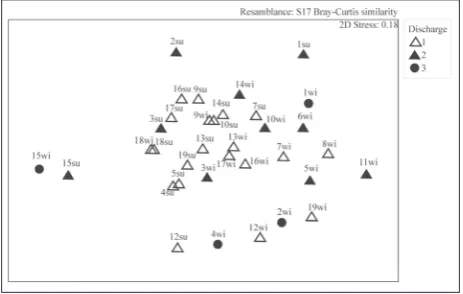
When faunistic data were used, ANOSIM showed that there is no significant influence of discharge (R=-0.079 p=0.9) on the gastropod assemblage. On the other hand, ANOSIM revealed significant differenc-es in gastropod assemblage relative to the season of sampling (R=0.076 p=0.026). The NMDS applied to substrate composition did not show any grouping of springs, except for locality 15, which is well separated on the NMDS plot (Fig 4).
The CCA (Fig. 5) based on species data and en-vironmental variables (Tables 2, 3 and 4) showed that the first axis explained 25.03% and the second 17.05% of the variance. CCA indicated gastropod species re-lated to temperature, discharge and substrate types. Thus, B. schmidti and B. vreloana were found to prefer springs with a stone-rich substrate and higher dis-charge, while G. truncatula prefers springs with higher temperature and clay-rich substrate. Islamia dmitro-viciana prefers springs with roots and detritus-rich substrate, Radix balthica prefers springs with moss and dead branches-rich substrate and Radix labiata prefers springs with dead branches rich-substrate.
DISCUSSION
Freshwater gastropod assemblages are influenced by many factors at regional and local scales, each of which varies considerably. Lodge et al. [29] showed that disturbance regimes, competition and predation were the most important variables affecting the small-scale distribution of freshwater snails. On the other hand, the role of hydrochemistry was not established on a local spatial scale for assemblages of freshwater snails [29], but some studies showed that factors such as dissolved free carbon dioxide [30] and temperature [31] play a significant role in the distribution or den-sity and growth rate of some species.
Fig. 4. Nonmetric multidimensional scaling (NMDS) of the in-vestigated springs based on the substrate data. Similarity index: Bray-Curtis; factor: discharge (0: without flow;1: <1 L min–1; 2: >1
and <5 L min–1; 3: >5 and <20 L min–1). Abbreviations: wi – winter,
su – summer; spring localities as in tables 1.
The results of our study confirmed that substrate composition is important to gastropod assemblages, which is consistent with several studies [32-34] that showed that substrate type influences the diversity of freshwater gastropod communities or particular spe-cies. These studies revealed that a sandy bottom cov-ered with a thin layer of organic silt is the most suitable substrate for snails in rivers [34]. On the other hand, spring snails seem to prefer firm substrates, such as cobble, rocks, woody debris and aquatic vegetation, and are rarely found on or in soft sediment [35]. In our study, the highest abundances of gastropod assemblag-es in winter were recorded in the springs dominated by leaf litter. As demonstrated [36], leaf litter is particu-larly important as a source of energy in springs with little allochthonous material. In summer the highest densities of gastropod assemblages were recorded in the springs dominated by a clay-rich substrate, mostly due to the higher density of Galba truncatula. CCA showed that the latter species prefer springs with a higher water temperature and a clay-rich substratum. Discharge stability or variability is the most im-portant abiotic factor influencing spring fauna directly
as well as indirectly through the shaping of substrate structure and composition [5,37,38]. In our study, springs with low discharge were found to be signifi-cantly different from springs with higher discharge with respect to substrate composition. However, sur-prisingly we did not found a significant influence of discharge on the composition of gastropod assem-blages in the studied springs. This indicates that the gastropod assemblage in the springs examined in cur-rent study is well adapted to intermittent conditions (i.e. fluctuations in discharge). This might be expla-nation for the lower species richness in the studied springs [37,39].
On the other hand, ANOSIM analysis showed that there are significant differences in gastropod assem-blage in terms of season of sampling, suggesting that a seasonal disturbance of abiotic interactions, such as discharge and substrate composition, is an impor-tant factor in the shaping of gastropod communities in springs. However, it is worth mentioning that the seasonal difference in gastropod assemblages might be the result of differences in biotic interactions such as predation and competition [33]. Increased preda-Fig. 5.CCA of the freshwater snail assemblages and environmental factors in the investigated springs.
tion by invertebrate predators [40] and changes in competitive ability (increased for pulmonate taxa and decreased for prosobranch, [41]) at the localities where food is a limiting factor may alter the habitat preferences of some species.
The results of our study are consistent with von Fumetti and Nagel [5] and confirms the absence of a correlation as described in the intermediate dis-turbance hypothesis, which predicts a peak in bio-diversity at an intermediate level of disturbance [42]. Further, our results are not in accordance with studies showing that, because of the periodic disturbance, in-termittent springs are usually not inhabited by spring specialists [1]. In our study, spring specialists such as Bythinella schmidti and Islamia dmitroviciana also inhabit springs with intermittent dry periods.
The results of CCA in our study showed that dis-charge, substrate type and temperature could be good predictors for the occurrence of particular species. Bythinella schmidti prefers springs with a higher dis-charge and a stony substrate. According to Zollhöfer [42] and Zollhöfer et al. [43], species of Bythinella are typical for springs exhibiting karst characteristics with highly fluctuating discharge conditions.
In groundwater-fed springs the gastropod assem-blages often include species from the aquifer that feeds the spring (hypogean species) by a constant washout. Therefore, it is not surprising that we collected sty-gobiotic Bosnidilhia vreloana mainly in winter, when the discharge capacity of springs is generally higher.
Among the studied springs only a few natural springs are found; the majority were piped (spring wa-ter emerging from an artificial pipe). Such a situation indicates that the spring snail fauna of the studied area should be considered at risk. Given the susceptibil-ity of springs to modification from land-use changes and water extraction, as well climate change (since 2010 two of the studied springs have dried up), further studies will require long-term monitoring to assess the impact on freshwater snail assemblages.
Acknowledgments: The first author is grateful to Nenad Dmitrović, Jasminka Dmitrović and Dario Čolić for their help in
the field work. The Vladimir Pešić is grateful to Peter Glöer (He-tlingen) for help in the identification of the material considered in this study. Furthermore, we are grateful to the two anonymous referees for their careful work and valuable suggestions.
Authors’ contributions: Dejan Dmitrović: sampling and process-ing material, submission; Ana Savić: statistical analyses, Vladimir Pešić: writing
Conflict of interest disclosure: The authors do not have any conflict of interest disclosure. All authors certify that the manu-script is original work and it has not previously been published elsewhere. We certify that the manuscript is not currently being considered for publication elsewhere. All authors have signifi-cantly contributed to the research. We state that all data in the paper are real and authentic. All authors state that there are no any conflicts of interest.
REFERENCES
1. Gooch JL, Glazier DS. Temporal and spatial patterns in Mid-Appalachian springs. Mem Entomol Soc Can. 1991;123(155):29-49.
2. Van der Kamp RO. The hydrogeology of springs in relation to the biodiversity of spring fauna: a review. J Kans Entomol Soc.1995;68(2):4-17.
3. Williams DD, Danks HV. Arthropods of springs: Introduc-tion. Mem Entomol Soc Can. 1991;123(155):3-5.
4. Ferrington LC. Biodiversity of aquatic insects and other invertebrates in springs: Introduction. J Kans Entomol Soc. 1995;68(2):1-3.
5. Von Fumetti S, Nagel P. Discharge variability and its effect on faunistic assemblages in springs. Freshw Sci. 2012;31(2):647-56.
6. Meyer A, Meyer EI, Meyer C. Lotic communities of two small temporary karstic stream systems (East Westphalia, Ger-many) along a longitudinal gradient of hydrological inter-mittency. Limnologica. 2003;33(4):271-9.
7. Glazier DS. The fauna of North American temper-ate cold springs: patterns and hypotheses. Freshw Biol. 1991;26(3):527-42.
8. Orendt C. The chironomid communities of woodland springs and spring brooks, severely endangered and impacted eco-systems in a lowland region of eastern Germany (Diptera: Chironomidae). J Insect Conserv. 2000;4(2):79-91.
9. Hahn HJ. Studies on classifying of undisturbed springs in Southwestern Germany by macrobenthic communities. Lim-nologica. 2000;30(3):247-59.
10. Ilmonen J, Paasivirta L. Benthic macrocrustacean and insect assemblages in relation to spring habitat characteristics: pat-terns in abundance and diversity. Hydrobiologia. 2005;533(1-3):99-113.
Acari, Crustacea) in the south-eastern Alps. J Limnol. 2011;70(1):65-76.
12. Cantonati M, Füreder L, Gerecke R, Jüttner I, Cox EJ. Crenic habitats, hotspots for freshwater biodiversity conserva-tion: toward an understanding of their ecology. Freshw Sci. 2012;31(2):463-80.
13. Glöer P, Pešić V. Two new species of the genus Bythinella Moquin-Tandon, 1856 (Mollusca: Gastropoda: Hydrobiidae) from the Western Balkan Peninsula. Ecol Montenegrina. 2014;1(4):249-55.
14. Vitecek S, Previšić A, Kučinić M, Bálint M, Keresztes L, War-inger J, Pauls SU, Malicky H, Graf W. Description of a new species of Wormaldia from Sardinia and a new Drusus spe-cies from the Western Balkans (Trichoptera, Philopotamidae, Limnephilidae). ZooKeys. 2015;496:85-103.
15. Crnobrnja-Isailović J. Cross-section of a refugium: genetic diversity of amphibian and reptile populations in the Balkans. In: Weiss S, Ferrand N, editors. Phylogeography of South-ern European Refugia: Evolutionary perspectives on the ori-gins and conservation of European biodiversity. Dordrecht: Springer Netherlands; 2007. p. 327-37.
16. Hewitt GM. Post-glacial re-colonization of European biota. Biol J Linn Soc Lond. 1999;68(1-2):87-112.
17. Radoman P. Hydrobioidea a superfamily of Prosobranchia (Gastropoda). I. Systematics. Beograd: Serbian Academy of Sciences and Arts; 1983. 256 p.
18. Haase M. Rapid and convergent evolution of parental care in hydrobiid gastropods from New Zealand. J Evol Biol. 2005;18(4):1076-86.
19. Scarsbrook MR, Barquín J, Gray DP. New Zealand coldwater springs and their biodiversity. Wellington: Department of Conservation; 2007. 72 p.
20. Boeters H, Glöer P, Pešić V. Some new freshwater gastropods from southern Europe (Mollusca: Gastropoda: Truncatelloi-dea). Folia Malacol. 2013;21(4):225-35.
21. Glöer P, Pešić V. Belgrandiella bozidarcurcici n. sp., a new species from Bosnia and Herzegovina (Gastropoda: Hydro-biidae). Arch Biol Sci. 2014;66(2):461-4.
22. Strong EE, Gargominy O, Ponder WF, Bouchet P. Global diversity of gastropods (Gastropoda, Mollusca) in freshwater. Hydrobiologia. 2008;595(1):149-66.
23. Szarowska M, Falniowski A. Destroyed and threatened locali-ties of risooid snails (Gastropoda: Risooidea) in Greece. Folia Malacol. 2011;19(1):35-9.
24. Zettler LM. Two records of the regional endemic hydro-biid snail Grossuana codreanui (Grossu, 1946) in Bulgaria (Dobrudja) and some nomenclatorial notes. Mollusca. 2008;26(2):163-7.
25. Hoffsten P-O, Malmqvist B. The macroinvertebrate fauna and hydrogeology of springs in central Sweden. Hydrobiologia. 2000;436(1-3):91-104.
26. Kruskal W, Wallis W. Use of ranks in one-criterion variance analysis. J Am Stat Assoc. 1952;47(260):583-621.
27. Wilcoxon F. Individual comparison by ranking methods. Bio-metrics. 1945;1(6):80-3.
28. Ter Braak CJF. Canonical Correspondence Analysis: a new eigenvector technique for multivariate direct gradient analy-sis. Ecology. 1986;67(5):1167-79.
29. Lodge DM, Brown KM, Klosiewski SP, Stein RA, Covich AP, Leathers BK, Bronmark C. Distribution of freshwater snails: spatial scale and the relative importance of physicochemical and biotic factors. Am Malacol Bull. 1987;5(1):73-84. 30. O’Brien C, Blinn DW. The endemic spring snail
Pyrgulop-sis montezumenPyrgulop-sis in a high CO2 environment: impor-tance of extreme chemical habitats as refugia. Freshw Biol. 1999;42(2):225-34.
31. Mladenka GC, Minshall GW. Variation in the life history and abundance of three populations of Bruneau Hot spring snails Pyrgulopsis bruneauensis. West N Am Naturalist. 2001;61(2):204-12.
32. Chertoprud MV, Udalov AA. Ecological groups of freshwa-ter Gastropods in the central part of European Russia. The influence of the type water body and substrate. Zool Zhurnal. 1996;75(5):644-76.
33. Dillon RTJr. The Ecology of Freshwater Molluscs. Cambridge: Cambridge University Press; 2010. 509 p.
34. Strzelec M, Królczyk A. Factors affecting snail (Gastropoda) community structure in the upper course of the Warta river (Poland). Biologia. 2004;59(2):159-63.
35. Martinez MA, Darrin TM. Habitat usage by the Page spring snail, Pyrgulopsis morrisoni (Gastropoda: Hydrobiidae), from Central Arizona. Veliger. 2006;48(1):8-16.
36. Rosi-Marshall EJ, Wallace JB. Invertebrate food-webs along a stream resource gradient. Freshw Biol. 2002;47(1):129-41. 37. Smith H, Wood PJ, Gunn J. The influence of habitat structure
and flow permanence on invertebrate communities in karst spring systems. Hydrobiologia. 2003;510(1-3):53-66. 38. Mori N, Brancelj A. Macroinvertebrate communities of
karst springs of two river catchments in the Southern Lime-stone Alps (the Julian Alps, NW Slovenia). Aquat Ecol. 2006;40(1):69-83.
39. Erman NA, Erman DC. Spring permanence, Trichoptera spe-cies richness and the role of drought. J Kans Entomol Soc. 1995;68(2):50-64.
40. Turner AM, Chislock MF. Dragonfly predators influence bio-mass and density of pond snails. Oecologia. 2007;153(2):407-15.
41. Brown KM, Alexander JE, Thorp JH. Differences in the ecol-ogy and distribution of lotic pulmonate and prosobranch gas-tropods. Am Malacol Bull. 1998;14(2):91-101.
42. Zollhöfer JM. Spring biotopes in northern Switzerland: Habi-tat heterogeneity, zoobenthic communities and colonization dynamics. [dissertation]. [Zürich]: Swiss Federal Institute of Science and Technology, Zürich. 1999. 142 p.