USING SERVICESCAPE TO MANAGE STUDENT COMMITMENT
TOWARDS A HIGHER EDUCATION INSTITUTION
E. Theron*
e-mail: [email protected]
A. Pelser*
e-mail: [email protected]
*Department of Business Management
University of Stellenbosch
Stellenbosch, South Africa
ABSTRACT
Although a variety of approaches can be used to manage student commitment, the role of physical
elements, such as a facility or institution’s virtual presence, appearance of infrastructure and
signage, is often neglected in the literature. This gap in the literature is surprising considering the
growing interest in the field of social sciences regarding the influence of physical elements (or
tangibles) on commitment. It is against this background that this study investigated the possible
effects of physical element attributes on student commitment. A number of antecedents of physical
elements were identified by means of a literature review and their expected relationships with
student commitment were proposed as hypotheses. These hypothesised relationships were
assessed and a survey amongst 290 students from a multi-cultural South African university was
conducted. The statistical program SPSS version 23 was used to analyse the data, and the
hypothesised relationships were assessed by means of regression analyses. The findings of the
study indicate that the physical element dimensions ‘communicators’ and ‘virtual servicescape’
most significantly influenced overall student commitment. Contrary to popular belief, the study
revealed that social servicescape did not have a significant impact on student commitment.
Furthermore, it appears that a specific set of physical element attributes should be applied when
student commitment is managed. Finally, the study offers an in-depth discussion of the theoretical
and managerial implications of these findings for relationship marketing strategies.
Keywords: studentcommitment, physical environment, higher education institutions
INTRODUCTION AND BACKGROUND
The South African higher education (HE) landscape has changed considerably since the
country’s first democratic election in 1994. A number of factors, such as the demand for free
higher education and high dropout rates (38% for residential universities and about 60% for
existing service offerings. Furthermore, the emergence of private universities, many of them
affiliated with renowned global HE institutions, has resulted in increased competition among
these institutions to attract the best prospective students. It should be noted that the HE
environment in South Africa is characterised by further challenges such as poverty,
unemployment, non-access to the different levels of education in general and a lack of facilities.
However, it is crucial for HE institutions to withstand the almost unstoppable tide of concerns,
and to retain their levels of academic excellence, and to contribute to student success rates.
Much has been written about the ways in which student success can be encouraged, and
to make students committed to both their personal studies and their selected HE institutions,
appear to be central in the literature. For example, previous research on student commitment
has indicated the importance of instructor commitment (Dachner and Saxton 2015), financial
aid (Strauss and Volkwein 2004) and academic integration (Beck and Milligan 2014). However,
there still are other areas of student commitment that are under-researched. For example, as far
as could be ascertained, no study could be found in which the influence of a student’s physical
environment (such as an institution’s virtual presence, appearance of infrastructure and signage)
on student commitment has been comprehensively investigated. However, these elements have
been studied extensively from a social sciences perspective, where it has been established that
a physical environment does play a significant role in an individual’s commitment towards an
organisation, service provider, product or brand (Mari and Poggesi 2013; Bitner 1992). The
question is, therefore, whether a multidisciplinary approach could be used to apply the existing
knowledge on the role of physical elements to student commitment. It is against this background
that this study investigated the influence of a student’s physical environment on their
commitment to the HE institution of their choice.
STUDENT COMMITMENT
The importance of commitment has long been recognised as a key ingredient of any successful
relationship (Morgan and Hunt 1994), whether it is commitment to personal relationships, such
as marriage (Kelmer, Rhoades, Stanley and Markman 2013), or towards sports teams (Biscaia,
Correia, Rosado, Ross and Maroco 2013), or towards non-profit organisations (Vecina, Chacón,
Marzana and Marta 2013), to mention but a few.
Despite the different perspectives on commitment, researchers are almost unanimous in
their findings that commitment is a powerful predictor of retention as well as intentions such as
switching or staying with a firm or service provider (Jones, Fox, Taylor and Fabrigar 2010).
relevance to one or more targets’ (Meyer and Herscovitch 2001, 299). This definition further
holds that the underlying psychological states of commitment have the potential to influence an
individual’s behaviour and decision to maintain a relationship.
More recent research on commitment suggests that the concept should be viewed from a
multi-dimensional perspective consisting of three distinct components: affective commitment,
continuance commitment and normative commitment (Meyer and Allen 1997). Affective
commitment originates from customers experiencing a psychological state of emotional
attachment to a service provider (Fullerton 2003). The premise for this attachment are
circumstances with which customers are able to identify with, participate in and feel delighted
to be with a particular service provider (Gruen, Summers and Acito 2000). This type of
commitment, therefore, refers to feelings of belonging, identification, shared values, dedication
and resemblance (Pritchard, Havitz and Howard 1999).
Secondly, continuance commitment denotes the psychological binding force between a
customer and a service provider based on the anticipated switching costs (Jones et al. 2010;
Gilliland and Bello 2002). Switching costs refer to the perceived costs customers would have
to incur in order to terminate their relations with a firm (Gruen et al. 2000) and include the
searching costs for alternatives (Jones et al.2010) and vast learning requirements. Often it is a
lack of alternative service providers which leads to continuance commitment, meaning that
substitutes are either scarce or unable to compete with the initial service provider
(Evanschitzky, Iyer, Plassmann, Niessing and Meffert2006). In addition, these perceived high
costs result in high levels of continuance commitment which are, in turn, rooted in customers’
dependence on the firm (Gundlach, Achrol and Mentzer1995).
Normative commitment, the most recently identified commitment type, is defined as the
degree to which an individual is psychologically attached to a relational partner as a result of
perceived obligation (Jones et al. 2010). It has been found that normative commitment stems
from socialisation processes during which customers adopt a set of subjective norms to guide
the appropriateness of their actions (Bansal, Irving and Taylor2004).
In the context of academia, Metzner and Bean (1987) argue that commitment relates to
the psychological attachment that students have towards an HE institution, academic processes,
as well as towards domain-specific interests. Once students have committed themselves, they
are willing to assign more time, resources or energy in their pursuit of scholarly success (Sheard
and Golby 2007). Therefore, Ramsey and Lorenz (2016) believe that academic commitment is
an important outcome when students set goals and exert efforts to strengthen their skills. As
self-perception ‒ knowledge and skills as well as the ability to confront challenging situations (Liao
and Ji 2015). Furthermore, Strauss and Volkwein (2004) found that commitment is a strong
predictor of students’ intent to persist, whilst Cabus (2015) established a significantly positive
relationship between student commitment and reduced failure rates. Student commitment
should therefore be viewed from the perspective of a student’s commitment towards goals, time
schedules and study plans (Martinsuo and Turkulainen 2011).
PHYSICAL ENVIRONMENT
Throughout their daily schedules, individuals interact with many distinct physical environments
by means of behavioural processes such as consumption, experience, utilisation or disposal
(Schiffman and Kanuk 2010). These physical environments consist of multiple dimensions
which are able to stimulate all individuals’ senses, such as sight, hearing, smell, touch and taste.
The term ‘servicescape’ is often used to describe the physical environment in which a service
is delivered (Line, Hanks and Kim 2015), and traditionally include three reflective elements:
spatial layout and functionality; ambient conditions; and signs, symbols and artefacts (Bitner
1992). However, recent research suggests that two additional components should be added to
the servicescape mix, namely ‘virtual servicescape’ (Rafaeli and Vilnai-Yavetz 2004) and
‘social servicescape’ (Tombs and McColl-Kennedy 2003).
Designing a service environment (such as required by HE institutions) is not only an
important competitive marketing tool, but an effective design can establish a desired positioning
and image and alter quality perceptions (Babin, Boles and Griffin 2015). Furthermore, a
servicescape design is especially applicable to interpersonal services, which are typical at HE
institutions, where both the customers (students) and the employees are highly involved in the
service delivery process by performing critical tasks (Bitner 1992).
Higher education institutions face the challenging task of selling an intangible offering, as
their core service is directed towards people’s minds (Wilson, Zeithaml, Bitner and Gremler
2016). Therefore, the use of traditional elements and ways to introduce and sell their offerings
may no longer be effective. Institutions of HE thus should continuously search for new and
innovative ways to communicate with their clientèle. One of these approaches is to focus on
the physical environment, and, more importantly, to find a mix of physical elements that best
suit the interest of all their stakeholders. However, despite the richness of research on
servicescapes and physical environments, it appears that the application of the concept in an
HE environment in particular is under-researched.
‘servicescape’ will be used during the remainder of this study.
SERVICESCAPE AND COMMITMENT
Several studies have confirmed the effect of the physical environment on emotional responses
and behavioural intentions (Lee, Chua and Han 2016; Han and Ryu 2009; Ryu and Jang 2008).
Despite the substantial body of evidence that exists on the importance of servicescape and
commitment as separate concepts, there appears to be a gap in the literature about the
interrelatedness of these two concepts. This lack in the literature is noticed at a time when HE
institutions need to understand the role that servicescape elements play when student
commitment is managed. This section of the study, therefore, examines the effect of five
attributes of servicescape, namely ambient conditions; spatial layout and functionality;
communicators; virtual servicescape and social servicescape on student commitment.
Ambient conditions
Ambient conditions of servicescape entail sensory stimuli such as scent, noise level,
temperature and lighting (Line at al. 2015). The physiological effects of atmospherics are more
apparent. For example, loud noise or extreme temperatures may cause discomfort; bad odours
or poor air quality may inhibit normal breathing and extreme lighting conditions may weaken
sight and increase the risk of injury (Bitner 1992). According to Lin (2004), lighting in an
environment can influence customers’ consciousness of physical, emotional, and psychological
facets in a particular environment. When lighting is designed to be in congruence with a service
environment, customers are expected to experience pleasant feelings (Steffy 1990), causing
them to lengthen their stay in that environment (Areni and Kim 1993). Other ambient conditions
are colour (Lin 2004; Dube and Morin 2001), music and background noise (Lin 2004; Areni
and Kim 1993), and odours or scents (Bone and Ellen 1999).
By demonstrating that a specific ambient stimulus of a servicescape activates a customer’s
sensory system and ultimately forming certain emotional, cognitive and behavioural responses
towards a firm, it is posited that sensory cues may affect customer commitment. As mentioned
before, customer commitment, in turn, is an attitudinal construct that comprises three
components, namely affective commitment, continuance commitment and normative
commitment.
Based on the literature review and the specific objectives of the study, the following
H1a There is a positive relationship between servicescape ambient conditions and
affective student commitment
H1b There is a positive relationship between servicescape ambient conditions and
continuance student commitment
H1c There is a positive relationship between servicescape ambient conditions and
normative student commitment
Spatial layout and functionality
Environmental design cues are instrumental in assisting individuals to achieve their purchasing
goals, which frequently includes convenience through the successful completion of employees’
actions (Baker, Parasuraman, Grewal and Voss 2002). Spatial layout is defined as the
arrangement of rooms, equipment and furnishings, along with the spatial relationships among
them (Medabesh and Upadhyaya 2012). In addition to the spatial layout, functionality refers to
the ways in which these items can fulfil individual needs and enhance service performance.
According to Baker et al. (2002), the layout of a servicescape, the equipment used during
service delivery as well as in a general facility, and the built structure itself, substantially
influence individuals’ affections, while it also facilitates the formation of their cognitive
judgments (Lin 2004). Furthermore, the placement of furniture and the volume of interior space,
portray visible or invisible boundaries, spaciousness (Ching 1996) or confinement and ease of
movement, or in other words, traffic flow (Mari and Poggesi 2013).
Both the customers’ and employees’ needs are considered during spatial layout and design
to ensure that the equipment and furnishings promote optimal functioning, based on the latter’s
degree of interaction with the environment (Bitner 1992). Furniture serves as a link between
the space and its occupants while conveying a firm’s personality and influencing individuals’
affective responses, particularly of comfort (Medabesh and Upadhyaya 2012). Moreover, as an
example of spatial layout and design’s effect on customer cognitions, offices in a service facility
may induce certain beliefs about the organisation’s competence, trustworthiness and
dependability, based on aspects such as office layout and interior design. The following
hypotheses are therefore assessed:
H2a There is a positive relationship between servicescape spatial layout and functionality
and affective student commitment
H2b There is a positive relationship between servicescape spatial layout and functionality
H2c There is a positive relationship between servicescape spatial layout and functionality
and normative student commitment
Communicators
What initially has been classified as signs, symbols and artefacts by Bitner (1992), simply refer
to those items in a servicescape serving as implicit and explicit communicators about the
physical environment to its occupants (Medabesh and Udaphyaya 2012). Explicit signals are
those signs and labels featuring on the exterior and interior of a service facility which fulfil the
function of directing individuals and informing them of rules and policies so that they can
respond or act appropriately. Signage as an explicit communicator, conveys an organisation’s
image which has been found to be positively related to customer loyalty (Kandampully and
Suhartanto 2000).
More indirect environmental cues, serving as implicit communicators of standard
expected behaviour as well as the meaning of the setting, are objects such as décor, artwork and
other displayed items. Such objects transmit messages of symbolic meaning and develop an
overall impression about the firm in customers’ minds (Medabesh and Udaphyaya 2012). It has
also been reported that signs, symbols and artefacts are positively associated with customer
support of a service firm in terms of customers’ external responses, such as approach behaviour,
staying with the firm and repeat patronage (Bitner 1992).
It is reasonable to expect that communicators could influence commitment on various
levels, based on the prior discussion suggesting that interior and exterior signals may influence
an individual’s decision to stay with an organisation, and whether or not they will make repeat
purchases with the service provider (Bateson and Hui 1992). Based on the literature review, the
following hypotheses are formulated:
H3a There is a positive relationship between communicators and affective student
commitment
H3b There is a positive relationship between communicators and continuance student
commitment
H3c There is a positive relationship between communicators and normative student
commitment
Virtual servicescape
(Browne, Durret and Wetherbe 2004), which resulted in the focus being shifted from a physical
servicescape, to a virtual one as well (Mari and Poggesi 2013). A virtual servicescape, also
referred to as ‘cyberscape’ (Williams and Dargel 2004), ‘e-servicescape’ (Hopkins, Grove,
Raymond and La Forge 2009) or ‘e-scape’ (Koering 2003), can be defined as the purposeful
design of web environments to generate positive effects in visitors to enhance favourable
customer responses (Dailey 2004).
It has become increasingly important to comprehend the effects of e-servicescape on
customers (Zafar, Verma and Baran 2003). When purchases or service encounters take place
on a virtual platform, the servicescape plays a key role in representing a firm and forming
customers’ perceptions about the firm. These perceptions, in turn, may lead to expectations
based on the firm’s virtually created image (Rafaeli and Vilnai-Yavetz 2004).
The dimensions of a virtual servicescape are primarily based on Bitner’s (1992)
servicescape model along with some new additional cues. Mari and Poggesi (2013) directly
applied ambient cues of a traditional servicescape to e-scape, and found that colour specifically
attracted considerable attention in the e-scape environment (Nitse, Parker, Krumwiede and
Ottaway 2004). Griffith (2005) examined space and functionality cues and discovered that
customer-friendly interfaces are preferred in a virtual servicescape layout. In addition, new
stimuli (Mari and Poggesi 2013) have been identified, namely ‘design cues’ (e.g. screen clutter,
simplicity of search paths, and speed of presentation), ‘navigational atmosphere’, and
‘timeliness of information’. Furthermore, ‘site security’ has proved to be a central issue for
users of virtual servicescapes (Harris and Goode 2010). Based on the evidence in the literature,
the following hypotheses are formulated:
H4a There is a positive relationship between a virtual servicescape and affective student
commitment
H4b There is a positive relationship between a virtual servicescape and continuance
student commitment
H4c There is a positive relationship between a virtual servicescape and normative student
commitment
Social servicescape
Service encounters often occur in settings where multiple customers share a particular
servicescape with one another (Grove and Fisk 1997). It is therefore not unexpected to learn
process. A conceptual model called the ‘social servicescape’ model, introduced by Tombs and
McColl-Kennedy (2003), accounts for the effect of social density and the portrayed emotions
of other customers on customer-affective states, subsequently resulting in cognitive and
behavioural responses. The same model (Tombs and McColl-Kennedy 2003) posits that a social
servicescape comprises five variables: purchase occasion (service context), social density
(physical elements), displayed emotions of others, customers’ affective responses (internal),
and customers’ cognitive responses (behavioural intent or actual behaviour).
Social density, or crowdedness, refers to a psychological state when there is less space
available than what is demanded (Eroglu and Machleit 1990). This social aspect of the service
environment may aid or constrain the level of pleasure experienced by customers. As a result,
customers’ feelings towards a firm (i.e. their affective state) determine either an approach or
avoidance behaviour, such as making repeat purchases or not (Tombs and McColl-Kennedy
2003). Social interactions are deemed as consequences of interactions and exchanges among
customers, employees and the environment, rather than being viewed as environmental stimuli
(Bitner 1992). Along the same lines, a social servicescape acts as a facilitator of social
interactions among customers themselves, as well as among customers and employees (Mari
and Poggesi 2013). Therefore, a social servicescape does not merely represent physical
environmental cues, but it also provides social meaning (Tombs and McColl-Kennedy 2003).
Against this background, the following hypotheses are put forward:
H5a There is a positive relationship between social servicescape and affective student
commitment
H5b There is a positive relationship between social servicescape and continuance student
commitment
H5c There is a positive relationship between social servicescape and normative student
commitment
The hypothesised relationships are graphically depicted in Figure 1.
METHODOLOGY
A quantitative, cross-sectional approach was used to gather data from a carefully selected target
population.
Measurement instrument: A self-administered questionnaire was used to gather the data.
the constructs. Therefore, only items and scales of which the reliability and internal consistency
were previously established, were considered for inclusion in the study. The scales to measure
the dependent variable (consisting of three sub-dimensions) were predominantly taken from the
following studies: Bansal et al. (2004), Garbarino and Johnson (1999) and Walter, Mueller and
Helfert (2000). The five independent variables were measured using scales that emanated from
Wakefield and Blodgett (1996), Lin and Mattila (2010), Raajpoot (2002), Ryu, Lee and Kim
(2012), Parasuraman, Zeithaml and Malhotra (2005), Harris and Goode (2010) and Rosenbaum
and Montoya (2007).
Figure 1: Hypothesised relationships
Five items were used to measure each of the dimensions of servicescape (the independent
variables), whilst six items were used to assess each of the three types of commitment. The final
measurement instrument therefore consisted of 43 items. All scales were measured using a
seven-point Likert scale (1=strongly disagree and 7=strongly agree).
Sampling: The selected target population for this study was registered students at
institutions of HE in South Africa. A non-probability sample was used to select respondents
from a multicultural South African university, whilst convenience sampling was used as
sampling technique. A total of 290 respondents participated in the study.
Data collection: Respondents were given a self-administered questionnaire, along with a
included in which respondents had to indicate their agreement to participate.
Data analysis: The validity of the data was assessed by means of a factor analysis, whilst
Cronbach alphas were used to determine the reliability of the measurement instrument. The
relationships between the independent and dependent variables were assessed by means of
regression analyses. The statistical program SPSS version 23 was used for all analyses.
Ethical considerations: Ethical clearance for the study was obtained from the
Departmental Ethical Screening Committee, as well as the Research Ethics Committee, and
overall institutional permission was received since its students were used in the research.
EMPIRICAL RESULTS
A total of 290 respondents participated in the research. Since no sample frame was available, a
response rate could not be determined. A confirmatory factor analysis captured five factors
related to the proposed independent variables: ambient conditions (AM), spatial layout and
functionality (SPA), communicators (CO), virtual servicescape (VIR) and social servicescape
(SOC). Principal Component Analysis was selected as method of extraction along with Direct
Oblimin rotation based on the assumption that the data were correlated. The rotation converged
in 12 iterations, and based on the KMO measure which loaded higher than 0.7 and the Bartlett’s
test score which was significantly lower than 0.05, the collected data could indeed be analysed.
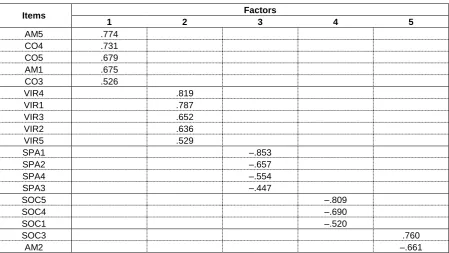
Items which loaded below 0.4 were removed. In the final instance, a five-structure pattern as
shown in Table 1, emerged:
Table 1: Factor analysis
Items Factors
1 2 3 4 5
AM5 .774
CO4 .731
CO5 .679
AM1 .675
CO3 .526
VIR4 .819
VIR1 .787
VIR3 .652
VIR2 .636
VIR5 .529
SPA1 ‒.853
SPA2 ‒.657
SPA4 ‒.554
SPA3 ‒.447
SOC5 ‒.809
SOC4 ‒.690
SOC1 ‒.520
SOC3 .760
Based on the results depicted in Table 1, the following adjustments were made:
Factor 1: This newly formed factor consisted of two items from ambient conditions as
well as three of the initial communicator items. The two-condition items refer to the interior
colour schemes used in facilities, as well as the degree to which furniture is colour-coded. In
turn, the three remaining communicator items all refer to the HE institution’s architecture and
interior décor. Therefore, it is argued that similarities between the items could exist. The label
‘communicators’ was subsequently retained.
Factor 2 in Table 1 shows a stable and satisfactory output for the dimensions of virtual
servicescape. None of these items had to be reassigned or deleted as they loaded together well
above 0.4. The same pattern was detected in terms of Factors 3 and 4, resulting in a situation
where all three the original labels (‘virtual servicescape’, ‘spatial layout and functionality’, and
‘social servicescape’) were retained.
The final factor that emerged from the factor analysis, consisted of two items: one from
ambient conditions and one from social servicescape. Both these items relate to the atmosphere
of the HE institutions and how other students affect it due to their levels of tension. Therefore,
this new factor was termed ‘relaxed atmosphere’, which replaced ambient conditions after the
output of the factor analysis reassigned and regrouped a single social servicescape item with a
single ambient conditions item. Both these items relate to the atmospherics of servicescape.
Cronbach’s alpha was used to assess the reliability of multi-item scales for each construct.
The reliability statistics for the three dependent variables (affective, continuance and normative
commitment) ranged between 0.754 and 0.846, demonstrating sufficient evidence of reliability
(Nunnally 1978). The dimension ‘relaxed atmosphere’ rendered a reliability score of 0.363 and
had to be completely removed from the dataset. Communicators (with a reliability score of
0.792) and virtual servicescape (0.795) were also found to be reliable, whilst both spatial layout
and functionality (0.659) and social servicescape (0.632) were below the level of 0.7. However,
based on the view of Peterson (1994) on acceptable levels of reliability, these two dimensions
were retained in the dataset.
In order to assess the hypothesised relationships, three separate regression analyses were
conducted. In the first regression analysis, the four remaining dimensions (communicators,
virtual servicescape, spatial layout and functionality and social servicescape) were stated as
independent variables relative to affective commitment (the dependent variable). The second
regression analysis used the same set of independent variables, however, continuance
commitment was stated as the dependent variable. During the final regression analysis,
Table 3: Results of the regression analyses
Variables Beta Sig. T-value
Regression analysis 1: Affective commitment
Spatial layout and functionality .177 .003 3.013
Communicators .293 .000 4.842
Virtual servicescape .146 .017 2.402
Social servicescape .071 .222 1.224
Regression analysis 2: Continuance commitment
Spatial layout and functionality .099 .120 1.558
Communicators .262 .000 3.997
Virtual servicescape .132 .047 1.998
Social servicescape ‒.003 .967 ‒.042
Regression analysis 3: Normative commitment
Spatial layout and functionality .106 .079 1.765
Communicators .284 .000 4.588
Virtual servicescape .176 .005 2.836
Social servicescape .080 .181 1.342
Results of the first regression analysis where the dimensions of servicescape were regressed on
affective commitment, indicate that three of the four dimensions are positively related to the
dependent variable. Specifically, 28.4 per cent of the variation in affective commitment
(R2=.284) can be explained by three of the four dimensions of servicescape with significant
influence: spatial layout and functionality, communicators, and virtual servicescape. Spatial
layout and functionality is significantly and positively related to customer affective
commitment based on its p-value of .003 (p < .05; β= .177). Communicators, with a p-value of
.000 (p < .05; β= .293), suggests a significant, positive relationship between communicators
and student’s affective commitment. With respect to virtual servicescape, the results of the
regression analysis show that the p-value is below .05 (p=.017, p < .05, β= .146), confirming
that virtual servicescape has a significant and positive influence on students’ affective
commitment. Support was therefore found for hypotheses H2a, H3a and H4a. The study failed to
find support for a relationship between social servicescape and affective commitment.
The second regression analysis concerning students’ continuance commitment, indicates
that 15.9 per cent of the dependent variable can be explained by two significant independent
variables: communicators and virtual servicescape. The predicted relationship between
communicators and students’ continuance commitment was confirmed (p=.000, p < .05, β=
.262). Then, supported by the results of the regression analysis, virtual servicescape was also
found to have a significant and positive influence on students’ continuance commitment
servicescape and normative student commitment, reveals that 25.2 per cent of the variance in
the dependent variable can also be explained by the two aforementioned variables, namely
communicators and virtual servicescape. As the independent variable, communicators were
found to be positively related to students’ normative commitment (p=.000, p < .05, β= .284).
The positive relationship between virtual servicescape and normative commitment was
confirmed by the third regression analysis (p=.005, p < 0.05, β= .176). Hypotheses H3c and H4c
were hereby supported.
The results of the regression analyses are graphically represented in Figure 2.
Figure 2: Hypotheses supported
DISCUSSION
The results firstly indicate that three dimensions significantly and positively influenced
students’ affective commitment: spatial layout and functionality, communicators, and virtual
servicescape. Secondly, the data revealed that only communicators and virtual servicescape
were positively related to continuance commitment. In the context of this study, it was found
that these two variables have the ability to induce this rational form of commitment amongst
students at an HE institution. Thirdly, the results of the regression analyses illustrated how these
two variables (communicators and virtual servicescape) influence normative commitment. In
other words, the relevant physical and virtual aspects of these variables will lead to students
feeling as though they have the moral obligation to stay with a particular service provider.
Apart from these three main contributions, some additional findings deserve attention.
Firstly, as a relatively new dimension of servicescape, social servicescape did not significantly
influence any type of student commitment towards an HE institution. Thus, it may be inferred
that students’ overall commitment towards an HE institution will not be significantly influenced
predictor of all three types of student commitment, followed by virtual servicescape, which was
only surpassed by spatial layout and functionality in its relationship with affective commitment.
The study appears to be consistent with some areas of the existing literature. For example,
the importance of spatial layout and functionality (Kerin, Varadarajan and Peterson 1992),
communicators (Bateson and Hui 1992) and virtual servicescape (Menon and Kahn 2002) was
reaffirmed. However, the fact that the results of this study failed to support certain dimensions
of servicescape, might be somewhat unexpected. For example, in their study, Medabesh and
Udaphyaya (2012) found that individuals’ overall assessment of a service facility’s spatial
layout and functionality influenced their rational attitudes towards and support of a service
provider (therefore resulting in continuance commitment). This finding could not be confirmed
in the present study. It could therefore be assumed that the spatial layout and functionality of
HE institutions does not influence students’ perceptions of the servicescape as a restraint
prohibiting them from switching to alternative institutions.
Also, despite Namasivayam and Lin’s (2008) finding that the design and functionality of
a servicescape can be manipulated to such an extent that it may enhance customer satisfaction
and repurchase behaviour, this study failed to provide evidence for the relationship between
spatial layout and functionality and normative commitment.
The non-support for all three the hypotheses pertaining to social servicescape, deserves
closer inspection. This non-support is in contrast with the findings by Tombs and
McColl-Kennedy (2003). A reasonable explanation for the non-support of these hypotheses may lie in
the diversity of South Africa which may make it more difficult for students to feel as though
they belong, resemble or are able to identify or share values with the majority of their fellow
students and, consequently, develop positive attitudinal loyalty towards an HE institution. It is
also plausible that students studying at South African HE institutions may follow a more
rational approach when making decisions about commitment, as opposed to opting for an
emotional decision-making route.
South Africans are different in terms of their wealth distribution, as well as their cultural
and contextual backgrounds. Therefore, it is debatable whether South African students would
rather evaluate their service experiences clinically without viewing social servicescape as a
contributing factor or determinant of their commitment towards an HE institution.
MANAGERIAL IMPLICATIONS
Higher education institutions in South Africa face the daunting task of creating infrastructure
efficiently as possible, the focus should also be placed on the re-development of facilities.
Spatial layout and functionality becomes more important than ever, since this study has proved
that a student’s commitment to an institution of HE is dependent on the quality of the physical
learning environment. Consultation with industrial psychologists thus becomes imperative.
The critical role of communicators cannot be overemphasised, especially since this
concept influences student commitment in a holistic manner; neither continuance or affective
student commitment, nor normative student commitment can be managed without an extensive
focus on communicators. Therefore, the attractiveness of the architecture, interior décor,
interior colour schemes and how these environmental cues tie in with the public image of HE
institutions are critically important. Higher education institutions’ possible negligence to
maintain the aforementioned physical cues may portray a ‘do-not-care’ message, whilst these
elements are important attributes of student commitment. From a branding perspective, HE
institutions should realise the value of signage in terms of style, fonts and size elements. On a
practical level, a number of aspects become almost non-negotiable, such as clear signage (both
inside and outside facilities), fire-extinguishers, clearly visible venue numbers, directions
towards restrooms and disabled facilities, as well as outdoor maps and/or directions.
In terms of virtual servicescape, electronic tools of communication are integral to students’
commitment to an HE institution. For example, an institution’s website has become an essential
platform that is accessed almost daily for the purposes of communication, administration,
information and research. A virtual servicescape should continuously be updated, with specific
focus on aspects such as ease-of-use, visually appealing graphics and images, innovative
design, well-organised information, and high speed. A relative simple action such as regularly
servicing printing devices in computer facilities, could have a lasting effect on a student’s
commitment towards an institution of HE.
Although institutions of HE might view the proper management of physical elements as a
daunting challenge, the opposite is true: It is often easier and less time-consuming to attain
student commitment by means of servicescape than to focus on less tangible concepts, such as
managing student learning. Furthermore, servicescape can be modified in the relative short run,
whilst influencing student commitment by means of the actual educational part of the service
offering, requires a much more long-term approach. HE institutions in South Africa should
realise that managing student commitment calls for a holistic approach, and that it is not
dependent on teaching only. Besides, it is almost certain that influencing student commitment
by focusing on the actual educational part of the service offering (as opposed to focusing on
LIMITATIONS AND FUTURE RESEARCH
This study was conducted among students of one HE institution only, and the results of the
study may thus not necessarily be generalised to all South African HE institutions. However,
since the HE institution in this study can be classified as a large, culturally diverse institution,
the results can at least be generalised to a number of similar South African institutions.
Although not a limitation to the study as such, the relative unavailability of literature on
the term ‘social servicescape’ restricted its conceptualisation. Moreover, the inadequate
literature on the determinants and effects of social servicescape resulted in a lack of external
validity.
Interesting findings could emanate from research on the influence of demographics (such
as gender) on students’ commitment to an HE institution. Also, a further step could be to
examine experimentally the behavioural implications of each of the dimensions of servicescape.
An example of this would be to establish the effect of communicators and virtual servicescape
on other relational constructs as these two dimensions were identified as the most significant
contributors to student commitment in this study. The result of such a study could help
practitioners to gain a deeper understanding of other relational effects associated with the
various dimensions of servicescape, especially the effects on loyalty as the latter is widely
acknowledged to translate into long-term profitability.
More importantly, there is a need for additional studies to examine social servicescape in
more depth while paying special attention to its conceptualisation, antecedents and effects.
These areas are relatively under-researched and consequently provide ample opportunities for
those marketing scholars who are interested to contribute to this field of research.
CONCLUSION
Although marketing has traditionally been associated with business activities, the domain of
marketing has expanded considerably during the past two decades. Marketing has now emerged
as a multi-dimensional field of study, and its influence stretches far beyond than was initially
conceived. It is therefore not unexpected to find that a variety of industries, such as higher
education, is increasingly turning to marketing principles to achieve their educational
objectives.
This study provides an empirical perspective to the potential use of physical evidence
when student commitment is managed. The findings of the study support the notion that an
Furthermore, the study found that it is important for HE institutions to not approach student
commitment as a unidimensional construct, as specific relationships (relating to the three
distinct components of commitment) have been confirmed. Each of these components,
therefore, needs to be managed separately. For example, a more comprehensive approach
should be used to manage affective commitment, whilst both continuance and normative
commitment could primarily be established by using servicescape communicators. It is often
the smaller changes (such as changing signage) that render the biggest return.
The ever-changing HE environment in South Africa necessitates stakeholders to
reconsider the way in which they manage their resources, of which students are considered to
be the most critical resource. Once students commit themselves towards their selected
institution of HE, it could have a significant effect on student success.
REFERENCES
Areni, C. S. and R. Kim. 1993. The influence of in-store lighting on consumers’ examination of merchandise in a wine store. International Journal of Research in Marketing 11(2): 117‒125.
Babin, B. J., J. S. Boles and M. Griffin. 2015. The moderating role of service environment on the customer share → customer commitment relationship. In New meanings for marketing in a new millennium, 266‒271. Springer International Publishing.
Baker, J., A. Parasuraman, D. Grewal and G. B. Voss. 2002. The influence of multiple store environment cues on perceived merchandise value and patronage intentions. Journal of Marketing 66(2): 120‒ 141.
Bansal, H. S., P. G. Irving and S. F. Taylor. 2004. A three-component model of customer commitment to service providers. Journal of the Academy of Marketing Science 32(3): 234‒250.
Bateson, J. E. G. and M. K. Hui. 1992. The ecological validity of photographic slides and videotapes in simulating the service setting. Journal of Consumer Research 19(2): 271‒281.
Beck, H. P. and M. Milligan. 2014. Factors influencing the institutional commitment of online students. The Internet and Higher Education 20: 51‒56.
Biscaia, R., A. Correia, A. F. Rosado, S. Ross and J. Maroco. 2013. Sport sponsorship: The relationship between team loyalty, sponsorship awareness, attitude toward the sponsor, and purchase intentions. Journal of Sport Management 27(4): 288‒302.
Bitner, M. J. 1992. Servicescapes: The impact of physical surroundings on customers and employees. Journal of Marketing 56(2): 57‒71.
Bone, P. F. and P. S. Ellen. 1999. Scents in the marketplace: Explaining a fraction of olfaction. Journal of Retailing 75(2): 243‒262.
Browne, G. J., J. R. Durret and J. C. Wetherbe. 2004. Consumer reactions towards clicks and bricks: Investigating buying behaviour on-line and at store. Behaviour & Information Technology 23(4): 237‒245.
Cabus, S. J. 2015. Does enhanced student commitment reduce school dropout? Evidence from two major dropout regions in the Netherlands. Regional Studies 49(4): 599‒614.
Ching, F. 1996. Architecture: Form, space, and order. New York: Van Nostrand.
Dailey, L. 2004. Navigational web atmospherics: Explaining the influence of restrictive navigation cues. Journal of Business Research 57(7): 795‒803.
Dube, L. and S. Morin. 2001. Background music pleasure and store evaluation intensity effects and psychological mechanisms. Journal of Business Research 54(2): 107‒113.
Eroglu, S. and K. A. Machleit. 1990. An empirical examination of retail crowding: Antecedents and consequences. Journal of Retailing 66(2): 201‒221.
Evanschitzky, H., G. R. Iyer, H. Plassmann, J. Niessing and H. Meffert. 2006. The relative strength of affective commitment in securing loyalty in service relationships. Journal of Business Research 59(12): 1207‒1213.
Fullerton, G. 2003. When does commitment lead to loyalty? Journal of Service Research 5(4): 333‒ 344.
Garbarino, E. and M. S. Johnson. 1999. The different roles of satisfaction, trust, and commitment in customer relationships. Journal of Marketing 63(2): 70‒87.
Gilliland, D. I. and D. C. Bello. 2002. Two sides to attitudinal commitment: The effects of calculative and loyalty commitment on enforcement mechanisms in distribution channels. Journal of the Academy of Marketing Science 30(1): 24‒43.
Griffith, D. A. 2005. An examination of the influences of store layout in online retailing. Journal of Business Research 58(10): 1391‒1396.
Grove, S. J. and R. P. Fisk. 1997. The impact of other customers on service experiences: A critical incident examination of ‘getting along’. Journal of Retailing 72(1): 63‒85.
Gruen, T. W., J. O. Summers and F. Acito. 2000. Relationship marketing activities, commitment, and membership behaviors in professional associations. Journal of Marketing 64(3): 34‒49.
Gundlach, G. T., R. S. Achrol and J. T. Mentzer. 1995. The structure of commitment in exchange. Journal of Marketing 59(1): 78‒93.
Han, H. and K. Ryu. 2009. The roles of the physical environment, price perception, and customer satisfaction in determining customer loyalty in the restaurant industry. Journal of Hospitality & Tourism Research 33(4): 487–510.
Harris, L. C. and M. M. H. Goode. 2010. Online servicescapes, trust, and purchase intentions. Journal of Services Marketing 24(3): 230‒243.
Hopkins, C. D., S. J. Grove, M. A. Raymond and M. C. La Forge. 2009. Designing the e-servicescape: Implications for online retailers. Journal of Internet Commerce 8(1‒2): 23‒43.
Jones, T., G. L. Fox, S. F. Taylor and L. R. Fabrigar. 2010. Service customer commitment and response. Journal of Services Marketing 24(1): 16‒28.
Kandampully, J. D. and D. Suhartanto. 2000. Customer loyalty in the hotel industry: The role of customer satisfaction and image. International Journal of Contemporary Hospitality Management 12(6): 346‒351.
Kelmer, G., G. K. Rhoades, S. Stanley and H. J. Markman. 2013. Relationship quality, commitment, and stability in long distance relationships. Family Process 52(2): 257‒270.
Kerin, R. A., P. R. Varadarajan and R. A. Peterson. 1992. First-mover advantage: A synthesis, conceptual framework, and research propositions. Journal of Marketing 56(4): 33‒52.
Koering, S. K. 2003. E-scapes: The electronic physical environment and service tangibility. Psychology & Marketing 20(2): 151‒167.
Lee, S., B. L. Chua and H. Han. 2016. Role of service encounter and physical environment performances, novelty, satisfaction, and affective commitment in generating cruise passenger loyalty. Asia Pacific Journal of Tourism Research 20(10): 1‒16.
on customers’ emotions and satisfaction. Journal of Hospitality Marketing & Management 19(8): 819‒841.
Lin, I. Y. 2004. Evaluating a servicescape: The effect of cognition and emotion. Hospitality Management 23(2): 163‒178.
Line, N. D., L. Hanks and W. G. Kim. 2015. An expanded servicescape framework as the driver of place attachment and word of mouth. Journal of Hospitality & Tourism Research 20(10): 1‒24.
Mari, M. and S. Poggesi. 2013. Servicescape cues and customer behavior: A systematic literature review and research agenda. The Service Industries Journal 33(2): 171‒199.
Martinsuo, M. and V. Turkulainen. 2011. Personal commitment, support and progress in doctoral studies. Studies in Higher Education 36(1): 103‒120.
Medabesh, A. and M. Upadhyaya. 2012. Servicescape and customer substantiation of star hotels in India’s metropolitan city of Delhi. Journal of Marketing & Communication 8(2): 39‒47.
Menon, S. and B. Kahn. 2002. Cross-category effects of induced arousal and pleasure on the Internet shopping experience. Journal of Retailing 78(1): 31‒40.
Metzner, B. S. and J. P. Bean. 1987. The estimation of a conceptual model of non-traditional undergraduate student attrition. Research in Higher Education 27(1): 15‒38.
Meyer, J. P. and N. J. Allen. 1997. Commitment in the workplace: Theory, research and application. California: Sage Publications Inc.
Meyer, J. P. and L. Herscovitch. 2001. Commitment in the workplace: Toward a general model. Human Resource Management Review 11(3): 299‒326.
Morgan, R. M. and S. D. Hunt. 1994. The commitment-trust theory of relationship marketing. Journal of Marketing 58(3): 20‒38.
Namasivayam, K. and I. Y. Lin. 2008. The servicescape. In Handbook of Hospitality Operations and IT, ed. P. Jones, 43‒62. Oxford: Butterworth-Heinemann.
Nitse, P. S., K. R. Parker, D. Krumwiede and T. Ottaway. 2004. The impact of color in the e-commerce marketing of fashions: An exploratory study. European Journal of Marketing 38(7): 898‒915.
Nunnally, J. C. 1978. Psychometric theory, New York: McGraw-Hill.
Parasuraman, A., V. A. Zeithaml and A. Malhotra 2005. ES-QUAL a multiple-item scale for assessing electronic service quality. Journal of Service Research 7(3): 213‒233.
Peterson, R. A. 1994. A meta-analysis of Cronbach’s coefficient alpha. Journal of Consumer Research 21(2): 381‒391.
Pritchard, M., M. Havitz and D. Howard. 1999. Analyzing the commitment-loyalty link in service relationships. Journal of the Academy of Marketing Science 27(3): 333‒348.
Raajpoot, N. A. 2002. TANGSERV: A multiple item scale for measuring tangible quality in foodservice industry. Journal of Foodservice Business Research 5(2): 109‒127.
Rafaeli, A. and I. Vilnai-Yavetz. 2004. Emotion as a connection of physical artefacts and organizations. Organization Science 15(6): 671‒686.
Ramsey, J. R. and M. P. Lorenz. 2016. Exploring the impact of cross-cultural management education on cultural intelligence, student satisfaction, and commitment. Academy of Management Learning & Education 15(1): 79‒99.
Rosenbaum, M. S. and D. Y. Montoya. 2007. Am I welcome here? Exploring how ethnic consumers assess their place identity. Journal of Business Research 60(3): 206‒214.
Ryu, K. and S. C. Jang. 2008. Influence of restaurant’s physical environments on emotion and behavioral intention. The Service Industries Journal 28(8): 1151–1165.
Sheard, M. and J. Golby. 2007. Hardiness and undergraduate academic study: The moderating role of commitment. Personality and Individual Differences 43(3): 579‒588.
Schiffman, L. and L. Kanuk. 2010. Global and Southern African perspectives: Consumer behaviour. Cape Town:Pearson Education South Africa.
Steffy, G. 1990. Architectural lighting design. New York: Van Nostrand Reinhold.
Strauss, L. C. and J. F. Volkwein. 2004. Predictors of student commitment at two-year and four-year institutions. Journal of Higher Education 75(2): 203‒227.
Subotzky, G. 2015. Enhancing retention and success in South Africa. International Higher Education 58(March 25): 24‒26.
Tombs, A. and J. R. McColl-Kennedy. 2003. Social-servicescape conceptual model. Marketing Theory 3(4): 447‒475.
Vecina, M. L., F. Chacón, D. Marzana and E. Marta. 2013. Volunteer engagement and organizational commitment in nonprofit organizations: What makes volunteers remain within organizations and feel happy? Journal of Community Psychology 41(3): 291‒302.
Wakefield, K. L. and J. G. Blodgett. 1996. The effect of the servicescape on customers’ behavioral intentions in leisure service settings. Journal of Services Marketing 10(6): 45‒61.
Walter, A., T. A. Mueller and G. Helfert. 2000. The impact of satisfaction, trust, and relationship value on commitment: Theoretical considerations and empirical results. In IMP Conference Proceedings, 1‒18. Germany: University of Karlsruhe.
Williams, R. and M. Dargel. 2004. From servicescape to ‘cyberscape’. Marketing Intelligence & Planning 22(3): 310‒320.
Wilson, A., V. A. Zeithaml, M. Bitner and D. D. Gremler. 2016. Services marketing: Integrating customer focus across the firm. London: McGraw-Hill Education.