www.wjpr.net Vol 7, Issue 01, 2018. 750
DEVELOPMENT AND VALIDATION OF RP-HPLC METHOD FOR
THE ESTIMATION OF BICALUTAMIDE IN BULK AND
PHARMACEUTICAL DOSAGE FORMS
V. Rajashakar*1, D. Bheemudu2 and V. Padma Bhushana Chary2
1
Department of Pharmaceutical Chemistry, 2Department of Pharmaceutical Analysis and QA
Anurag Pharmacy College, Ananthagiri, Kodad, Suryapet, Telangana, India.
ABSTRACT
A specific, accurate and precise Reverse Phase High Performance
liquid chromatographic (RP-HPLC) method has been developed and
validated for the estimation of bicalutamide in bulk and tablet dosage
forms. A Symmetry C18 (250 x 4.6 mm, 5µ) column with a moble
phase of aetonitrile: water (90:10) was used. A flow rate of 0.5 ml/min
was maintained. UV detection was performed at 270 nm. The retention
time of bicalutamide was 6.15 min, and the total run time was 20 min.
The method was validated as per ICH Q2 (R1) guidelines, for
specificity, linearity, accuracy, precision, and robustness. The recovery
of bicalutamide in tablets was found to be in the range 99-100.83%.
KEYWORDS: Bicalutamide, HPLC, Validation.
INTRODUCTION
Bicalutamide is an oral non-steroidal anti-androgen, used in the treatment of prostate Cancer
and hirsutism.[1] It competitively inhibits the action of androgens by binding to cytosol
androgen receptors in the target tissue. It is chemically, N-[4- cyano-3(trifluoromethyl)
phenyl]-3-[(4-fluorophenyl) sulfonyl)]-2-hydroxy-2-methyl propanamide. Literature survey
reveals that various spectrophotometric[2] and HPLC methods[3-4] have been reported for the
determination of bicalutamide in bulk and pharmaceutical dosage forms. In this study a
simple, rapid, accurate, sensitive and precise HPLC method was developed for the estimation
of bicalutamide in pharmaceutical dosage forms.
Volume 7, Issue 01, 750-760. Research Article ISSN 2277–7105
Article Received on 08 Nov. 2017,
Revised on 29 Nov. 2017, Accepted on 19 Dec. 2017
DOI: 10.20959/wjpr20181-10492
*Corresponding Author
V. Rajashakar
Department of
Pharmaceutical Chemistry,
Ananthagiri, Kodad,
www.wjpr.net Vol 7, Issue 01, 2018. 751 EXPERIMENTAL
Instrumentation
The separation was carried out on HPLC system (Waters) with Waters 1525 binary HPLC
pump, UV absorbance detector, LC Solutions software and Enable C18H 250x4.6mm.
Chemicals and Reagents
Bicalutamide was a gift sample by Hetero Labs Pvt. Ltd, Hyderabad. Acetonitrile of HPLC
grade were purchased from E. Merck (India) Ltd., Mumbai. Potassium dihydrogen phosphate
and orthophosphoric acid of AR grade were obtained from S.D. Fine Chemicals Ltd.,
Mumbai.
HPLC conditions
The mobile phase consisting Potassium dihydrogen orthophosphate and acetonitrile (HPLC
grade) were filtered through 0.2 µm membrane filter before use, degassed mixture acetonitrile
and HPLC water in the ratio of 90: 10 v/v was pumped into the column at a flow rate of
1.0ml/min. The detection was monitored at 270nm and the run time was 15min. The volume
of injection loop was 20μl prior to injection of the drug solution the column was equilibrated
for at least 30 min. with the mobile phase flowing through the system.
Preparation of working standard solution: Weighed and transfer about 10 mg o of
bicalutamideinto a 10 ml clean, dry volumetric flask and made up to volume with mobile
phase to get concentration 1 mg/ml (Stock). From stock solution 1ml was diluted with 10ml
using mobile phase to get a concentration of100 µg/ml. From this solution 1ml of solution
was transferred into 10ml volumetric flask and volume was adjusted with mobiles phase to
get 10µg/ml.
Preparation of sample drug solution for pharmaceutical formulations
Weighed contents of not less than 10 tablets. Crush pellets into uniform fine powder in
suitable Powdering device. Weighed and transfer accuretly quantity of powder equivalent to
about 10mg og Bicalutamide to a 10ml clea, dry grauated tube. Add about 10 ml of
www.wjpr.net Vol 7, Issue 01, 2018. 752
Allow the solution to cool to room temperature and dilute volume with mobile phase and mix
and filter through 0.2 micron filter.
Assay
Two commercial brands of tablets were chosen for testing suitability of the proposed method
to estimate bicalutamide in pharmaceutical dosage forms. Twenty tablets were weighed
accurately and powdered. A quantity equivalent to 50mg of bicalutamide was weighed
accurately and transferred to 50ml volumetric flask. About 30ml of acetonitrile was added
and kept in ultrasonic bath for 20min. This solution is filtered through a membrane filter and
the volume was made up to the mark with mobile phase to get 1mg/ml concentration. The
solution obtained was diluted with the mobile phase so as to obtain a concentration in the
range of linearity previously for the pure drug determined. Sample solution was injected
under the chromatographic conditions and the chromatogram was recorded. The amount of
bicalutamide present in tablet formulation was determined by comparing the peak area from
the standard. The results are furnished in Table-6.
Validation of proposed method
Selectivity of the method was assessed on the basis of elution of bicalutamide using the
above mentioned chromatographic conditions. To study the specificity, linearity, precision,
accuracy, limit of detection, limit of quantitation, robustness and system suitability
parameters has been validated for the determination of bicalutamide.
Specificity
System suitability for specificity was carried out to determine whether there is any
interference of any impurities at retention time of analytical peak. The study was performed
by injecting blank. The chromatogram is shown in the figure 4.8-4.10.
Linearity
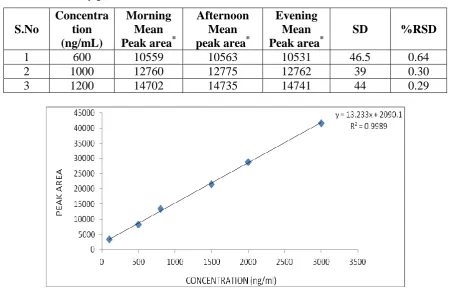
The linearity study was performed for the concentration of 100ng/ml to 3000ng/ml. Each
dilution was injected into HPLC system. The area of each dilution was used to calculate the
correlation coefficient. The chromatograms are shown in the figure and results are tabulated
www.wjpr.net Vol 7, Issue 01, 2018. 753 Precision
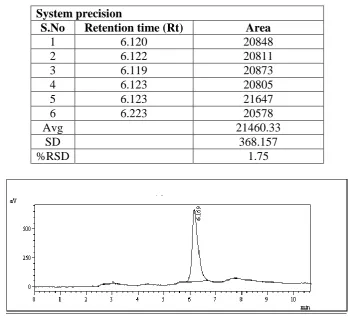
The standard solution was prepared as per the proposed assay method in six determinations
and was injected into HPLC system. The retention time and peak area of six determinations
was measured and %RSD was calculated.
LOD and LOQ
LOD and LOQ values are besend on the visual evaluation method, showing chromate gram
figure no.4.31-4.39.
Accuracy
The accuracy study was performed for 80, 100, and 120 percentage of bicalutamide. Each
dilution was injected in triplicate into HPLC system. The area of each level was used for
calculation of %RSD. Chromatograms are shown in figure 4.35-4.44.
The present study reported in thesis was aimed to develop a new method to estimate
bicalutamide in rat plasma and its application to pharmacokinetic study by RP-HPLC.
RESULTS AND DISCUSSION
The purity of bicalutamide is confirmed by melting point, TLC, UV, HPLC and IR
spectroscopy studies. The characters of bicalutamide are as follows.
Description: white crystalline powder, Melting point: 191-1930C
Solubility: practically insoluble in water, sparingly soluble in methanol soluble in
acetonitrile.
The TLC studies were performed on precoated silica gel plate and mobile phase consisted
chloroform: Petroleum ether (2:1), toluene: ethyl acetate (1:1), toluene: methanol
(4.3:5.7) indicated the presence of a single spot at R f 0.2, 0.5, 0.885 respectively.
Detection was made in iodine and UV chamber.
UV absorption is maximum at 270 nm.
All characteristic peaks of bicalutamide IR spectrum were observed.
1689.53 (C=C stretch) 3100, (C-H bend) 3579.64 (N-H stretch), 1326.92 (N-H bend),
1515.94 (C=O stretch, amide group), 2229.56 (C=N stretch), 1141.78, 1326.93, 1180.35 (C-F
stretch), 1053.06 (S-O stretch), 3336.62 (O-H stretch, alcoholic group)
The purity of sample was also confirmed by RP-HPLC analysis using mobile phase
www.wjpr.net Vol 7, Issue 01, 2018. 754
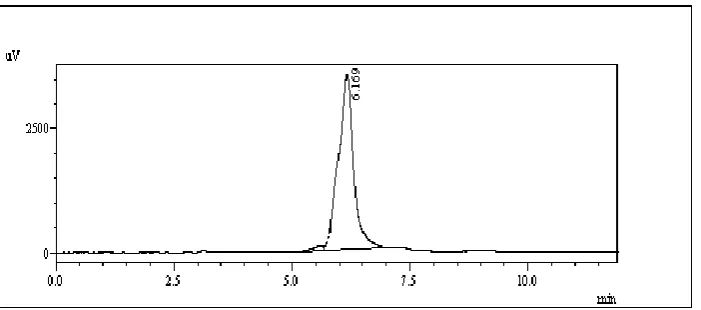
with a retention time 6.122 min and there were no minor impurities were observed, thus
confirming the sample is pure.
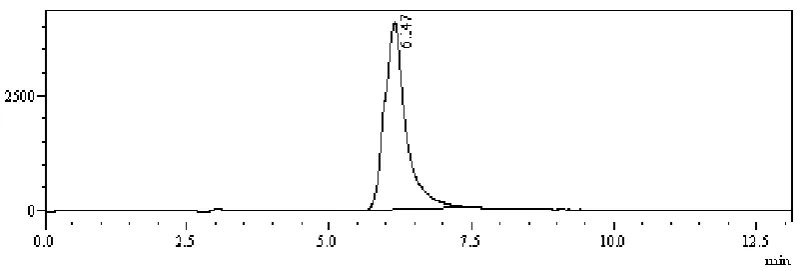
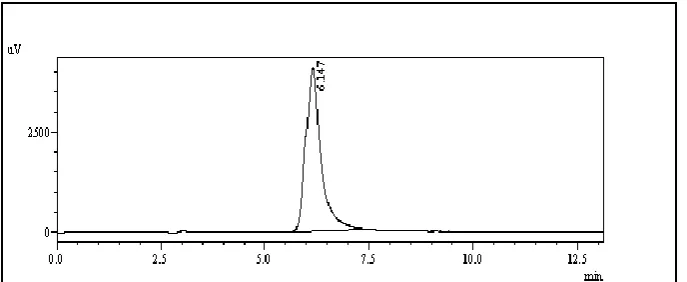
The retention time of bicalutamide was found to be 6.12min and the system suitability
studies were done with 800ng concentartion of standard drug. The %RSD values are
below 2%. The percentage purity of bicalutamide in pharmaceutical dosage form was
found to be 109.312%. The chromatograms for sample, standard and blank injection
showing in figure 4.2-4.4
The %RSD of area of system precision was found to be 1.75. Precision results are within
the limits (NMT 2). The % RSD for the area of all replicate injection found to be within
the limits. Method precision should be performed to intraday and inter day. The linearity
study was performed and the correlation coefficient of bicalutamide was found to be
0.999 (NLT 0.997). Accuracy values was found to be within the limits (should not be
more than 2)
The assay method was established for estimation of bicalutamide in tablets and the %
[image:5.595.89.512.401.538.2]purity was found to be 101.312.
Figure 1: IR spectrum of bicalutamide.
[image:5.595.101.505.593.728.2]www.wjpr.net Vol 7, Issue 01, 2018. 755 Figure 3: chromatogram standard preparation.
Figure 4: chromatogram sample preparation.
Figure 5 Chromatogram specificity of standard
[image:6.595.128.472.426.567.2]www.wjpr.net Vol 7, Issue 01, 2018. 756 Table 2: System precision.
System precision
S.No Retention time (Rt) Area
1 6.120 20848
2 6.122 20811
3 6.119 20873
4 6.123 20805
5 6.123 21647
6 6.223 20578
Avg 21460.33
SD 368.157
%RSD 1.75
Figure 7: Chromatogram system precision.
Table 3: Intra-day precision data.
S.No
Concentr ation (ng/mL)
Morning Mean
Peak area*
Afternoon Mean
peak area*
Evening Mean Peak
area*
SD %
RSD
1 600 10559 10563 10571 42 0.39
2 1000 12765 12769 12762 54 0.42
3 1200 14521 14536 14541 48 0.33
[image:7.595.120.475.533.739.2]* Average of 3 determinations.
www.wjpr.net Vol 7, Issue 01, 2018. 757 Table 4: Inter-day precision data.
S.No Concentra tion (ng/mL) Morning Mean
Peak area*
Afternoon Mean
peak area*
Evening Mean
Peak area*
SD %RSD
1 600 10559 10563 10531 46.5 0.64
2 1000 12760 12775 12762 39 0.30
3 1200 14702 14735 14741 44 0.29
[image:8.595.118.477.433.592.2]Fig 9: Standard calibration curve for bicalutamide.
Table 5 accuracy data.
Concentration level Peak
area Mean
Standard
deviation % RSD
80 %
10637
10643 38 0.35
10643 10650
100%
12801
12806 32 0.30
12803 12814
120%
14770
14776 36 0.24
14779 14881
Table 6: Percentage purity of bicalutamide.
Bicalutamide Bicalutamide
Brand name TABI ( DR.Reddy’s)
Active ingredient Bicalutamide
Label claim 50 mg
Average weight 127.66 mg
Sample weight 10 mg
Equivalent weight 25.532
Average weight in ml 600ng
Area of sample 10765
www.wjpr.net Vol 7, Issue 01, 2018. 758 Figure 10: Chromatogram showing assay of bicalutamide tablets
CONCLUSION
A new method has been established for estimation of bicalutamide by RP-HPLC using
shimadzu LC-10AT and – detector.
The chromatographic conditions are Phenomenex-Luna 5µ, C18 column, mobile phase of
acetonitrile:water (90:10 v/v).
The assay method was established for estimation of bicalutamide in tablets. And the
%purity was found to be 101.312.
The proposed RP-HPLC method is a suitable technique for the determination of
bicalutamide in pharmaceutical dosage form without any interference.
All the validation parameters were carried out as per ICH Q2(R1) guidelines. This
RP-HPLC method may be considered more specific and sensitive.
The developed method can be used for routine and quality control analysis of the
investigated drug to provide simple, accurate and reproducible quantitative analysis for
determination of bicalutamide.
SUMMARY OF THE METHOD
Validation parameter Result
Mobile phase Flow rate
Detection wavelength Retention time
Run time
LOD ( based on the visualevaluation method) LOQ (based on the visual evaluation method) Linearity
Precision Accuracy Recovery
Acetonitrile 0.5 ml/min 270 nm 6.12 min 20 min 20ng/ml 50ng/ml 0.9999
www.wjpr.net Vol 7, Issue 01, 2018. 759 REFERENCES
1. Indian Pharmacopoeia. Volume I. Ghaziabad: Indian Pharmaceutical Commission, 2014;
177.
2. Wilson and Gisvold’s Textbook of Organic Medicinal and Pharmaceutical Chemistry.
Edited by John M Beale Jr, John H Block. 12th edition. New Delhi:Wolters Kluwer
(India) Pvt. Ltd, 2014; 851-52.
3. Foye’s Principles of Medicinal Chemistry. Edited by Thomas L Lemke, David A
Williams, Victoria F Roche and S William Zito. 6th edition. New Delhi: Wolters Kluwer
(India) Pvt. Ltd, 2010; 1281-82, 1289-90.
4. Goodman & Gilman’s “The Pharmacological Basis of Therapeutics”. Edited by Joel G
Hardman, Lee E Limbird. 10th edition. New delhi:Mc Graw Hill, 2001; 993.
5. http://www.drug bank.ca/drugs/DB00285.
6. http://www.promopharm-lb.com/pdf/Bicalutamide.pdf.
7. http://www.medindia.net/drug-price/bicalutamide.htm.
8. Elen Katz. Qualitative Analysis using Chromatographic Techniques. New Delhi:John
Wiley & Sons Publications, 1987; 55-59.
9. Fifield FW and Kealey D Principles and Practice of Analytical Chemistry. 5th edition.
Oxford: Blackwell Science Ltd, 2000; 118-50.
10.Szepesi G, Gazdag M, Minalyfi K.Selection of high performance chromatographic
method in pharmaceutical analysis; III Method validation: Journal of Chromatography,
1991; 464: 265-78.
11.Lena Ohanessian, Anthony T. Streeter. Handbook of Pharmaceutical Analysis. New
Delhi: Marcel Dekker Publications, 2005; 134.
12.Willard Merritt and Dean Settle. Instrumental Methods of Analysis. 7th edition. New
Delhi: CBS Publishers and Distributors, 1986; 615.
13.Sethi PD..Quantitative Analysis of Pharmaceutical Formulations. New Delhi:CBS
Publishers and Distributors, 2001; 12
14.Snyder LR, Joseph J. Kirklana, Joseph L. Glarich. Practical HPLC Method Development.
2nd edition. New Delhi: John Wiley &Sons; Delhi, 2011; 2-6.
15.International Conference on Horminization (ICH) guidance for Industry Q2 (R1):
Validation of Analytical Procedures: Text and Methodology.
16.Sreedhar C, Sopmya M, Sreenivasa TR, Anusha V, Naresh k, Development and
validation of RP-HPLC method for the estimation of bicalutamide in pure and
www.wjpr.net Vol 7, Issue 01, 2018. 760
17.Lakshmana RA, Ramesh TG, Raojvlns. Development and validation of RP-HPLC
method for the estimation of bicalutamide in pure and pharmaceutical dosage forms.
Rasayan J. chem, 2009; v2: 512-515. sage forms. International journal of pharma tech.
research, 2012 Oct-Dec; 4: 1686-90.
18.Palleshwar GR, JVLNS Rao, Lanka A. Rama Prasad, srinivasu P. Development and
validation of new stability indicating HPLC method for quantification of process related
and degradation impuriries of bicalutamide in tablet dosage forms. Inter nationl journal
of pharmacy, 2012; 218-23.
19.Naveen KRG, Rjendra Prasad VVS, Prashanth M.K. Development and validation of a
stability indicating HPLC method for determination of bicalutramide in pure and
pharmceutical dosage formulations. Internatiuonal journal of pharmacy and biological
science, 2012 Oct-Dec; 2: 134-149.
20.Pradhan VR, Ashutosh P, siddheshwar P, satish sawant, Rathnam MV. Validation of
chiral liquid chromatography-tandem mass spectrometric method for estimation of
bicalutamide enantiomers in human plasma: application to a bioequivalence study.