CORROSION RESISTANCE OF SS 316L ALLOY IN ARTIFICIAL
SALIVA IN PRESENCE OF ALMOX 250 DT TABLET
A. Krishnaveni,
[a]S. Rajendran,
[b,c]*M. Pandiarajan,
[c]and R. Saranya
[d]Keywords: corrosion resistance of metals, SS 316L alloy, synthetic saliva, orthodontic wires.
Corrosion resistance of SS316L alloy in artificial saliva, in the absence and presence of a disinfectant tablet, namely, Almox 250 DT has been evaluated by AC Impedance Spectra. It is observed that when 50 ppm of Almox is added to artificial saliva, charge transfer resistance of SS 316 L increases. Similar observation is made in presence of 200 ppm of Almox also. Hence it is concluded that people having orthodontic wires made of SS 316L, can take the Tablet Almox 250 DT without any hesitation, because in its presence corrosion resistance of SS 316L increases.
Corresponding Authors
E-mail: [email protected]
[a] Department of Chemistry, Yadava College, Madurai, E.mail: [email protected]
[b] Department of Chemistry, Corrosion Research centre,RVS School of Engineering and Technology, Dindigul 624005, India.
[c] Corrosion Research Centre, PG and Research Department of Chemistry, GTN Arts College, Dindigul- 624005, India. E.mail: [email protected],
[d] Department of Chemistry, Jayalakshmi Institute of Technology, Thoppur-636 352, India.E.mail: [email protected].
Introduction
Over the past two decades, with the accelerated development of tissue engineering, the demand for a variety of synthetic and natural biomaterials has dramatically increased. Biomaterial sales have already exceeded $240million per year and due to the rapid development of biomaterials, the market will only increase in the years ahead for tissue engineering and artificial organ materials. Specifically, costs related to organ replacement account for8% of all global healthcare spending and by 2040 as much as 25% of the US gross domestic product (GDP) is expected to be related to healthcare. Such demands require unique, better performing biomaterials for regenerative medicine.
Corrosion resistance of metals and alloys in various body fluids has attracted the attention of many researchers. Corrosion resistance of biomaterials in synthetic body fluids such as blood plasma, urine, Hank solution, Ringer solution and artificial saliva has been extensively studied. The corrosion resistance of metals and alloys in artificial saliva has been reviewed recently. Corrosion resistance of various metals have been investigated in various synthetic (simulated) body fluids such as Ringer’s solution,1-4 simulated body fluids,5,6 Hank solution,7,8 blood plasma,9-11 urine,12-14 bovine serum,15 and artificial saliva.16-20
Various metals and alloys have been used as biomaterials whose corrosion resistance has been investigated in artificial
intermetallic alloys,21 titanium alloy,22 NiTi alloy,23 CoCrMo alloys,24,25 magnesium alloy,26,27 Cr-Ni stainless steel, Cr-Ni-Mo stainless steel,28 316L stainless steel.29,30 Five non-precious Ni-Co based alloys have been analyzed with respect to their corrosion behavior in artificial saliva.31 The effect of different concentrations of eugenol in artificial saliva on titanium corrosion has been investigated by Kinani and Chtaini .32 The corrosion resistance of the commercial metallic orthodontic wires in a simulated intra-oral environment has been evaluated by Ziebowicz et al.33 The results of corrosion resistance tests of the CrNi, NiTi, and CuNiTi wires showed comparable data of parameters obtained in artificial saliva . The effects of multilayered Ti/TiN or single-layered TiN films deposited by pulse-biased arc ion plating (PBAIP) on the corrosion behavior of NiTi orthodontic brackets in artificial saliva have been investigated by Liu et al.34 The corrosion behavior of various metals and alloys in artificial saliva has been investigated. Rajendran et al ., have studied the corrosion resistance of artificial saliva in presence spirulina powder.35 Corrosion behavior of metals in artificial saliva in presence of D-glucose has been investigated.36
Liu,et al have investigated corrosion behavior of nickel-titanium orthodontic wires in presence of Artificial saliva using the methods of continue bending stress thought the 14 days experimental process, they have been findings that bending stress, loading condition with respect to corrosion behavior.37 Koike, et al studied corrosion resistance of Titanium alloy in presence of Artificial Saliva at 37°C using the method of potentiostatic polarization. They have found that all the mechanical properties and corrosion characters were tested38. Anwar et al investigated corrosion behavior of Ti and Ti 6Al4V in presence of artificial saliva using electrochemical methods. They found that as fluoride concentration increases, corrosion resistance is decreased.39 Rajendran et al have studied the corrosion resistance of SS 316 L in Artificial Saliva in presence of electral.40
Dentists recommend the use of orthodontic wires to regulate the arrangement of teeth. After the regulation, people having these orthodontic wires, regulating the arrangement of teeth, have to take orally many tablets. These tablets may corrode the wires in the oral environment, especially saliva. Hence there is a need to investigate the influence of various tablets on the corrosion resistance of orthodontic wires made of many metals and alloys. Can people implanted with orthodontic wires made of SS316L Almox 250 DT Tablets orally? To give an answer this question, the following investigation was undertaken. Corrosion resistance of SS 316L gold in artificial saliva (AS) in the absence and presence of Almox 250 DT has been investigated by AC Impedance Spectra.
Experimental
SS 316L: The composition of SS 316L44 (in wt. %)is the following : Cr-18 %; Ni 12 %, Mo –2.5 %, C-0.03 %, balance – iron. Wire of 1mm diameter was used in the present study.
Artificial Saliva: The composition of artificial saliva45 is given as: KCl - 0.4 g L-1, NaCl – 0.4 g L-1, CaCl
2.2H2O - 0.906 g L-1, NaH
2PO4.2H2O 0.690 g L-1, Na2S.9H2O – 0.005 g L-1, urea – 1 g L-1.
Almox 250DT: The Almox 250DT contains 250 mg of Amoxicillin Tri hydrate.
AC impedance spectra: AC impedance spectral studies were carried out in a CHI – Electrochemical workstation with impedance, Model 660A. A three-electrode cell assembly was used. The working electrode was SS316L. A saturated calomel electrode (SCE) was the reference electrode and platinum was the counter electrode. The real part (Z’) and imaginary part (Z”) of the cell impedance were measured in ohms at various frequencies. Values of the charge transfer resistance (Rt) and the double layer
capacitance (Cdl) were calculated.
Results and Discussion
Analysis of AC impedance spectra
AC impedance spectra have been used to detect the formation of film on the metal surface.46 -56 If a protective film is formed, the Charge transfer resistance (Rt) increases and double layer capacitance (Cdl) value decreases. The impedance value increases.
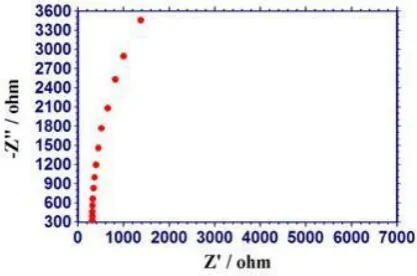
The AC impedance spectra of SS 316L immersed in various test solutions are shown in (Figs. 1 to 9). The Nyquist plots are given in Figures 1 to 6. The Bode plots shown in [Figs. 7 to 9]. The Corrosion parameters derived from AC impedance spectra are given in Table 4. The charge transfer resistance and double layer capacitance are derived from Nyquist plot. The impedance value and phase
Table 1. Impedance parameters of SS 316L in artificial saliva in presence of Almox (250DT) obtained by AC impedance spectra.
System Rt ohm cm2 Cdl, F cm-2
Impedance logZ/ohm
Artificial Saliva
5.7458x10⁴ 8.876048x10⁻⁷ 5.260
AS+ Almox (250DT) 50 ppm
7.0198x10⁴ 7.265164x10⁻⁷ 5.265
AS+ Almox (250DT) 200 ppm
1.59680x10⁵ 3.19388x10⁻⁷ 5.603
SS 316L immersed in Artificial Saliva only
When SS 316L is immersed in artificial saliva the Rt value is 5.7458x10⁴ ohm cm2 and C
d1 value is 8.876048x10⁻⁷ Fcm-2. (Figs.1 and 2).
Figure 1. AC impedance spectrum of SS 316L immersed in Artificial Saliva solution (Nyquist Plot)
Figure 2. AC impedance spectrum of SS 316L immersed in Artificial Saliva solution (Nyquist Plot Zoomed)
Corrosion behavior of SS 316L in Artificial Saliva in the presence of 50ppm Almox 250DT
When 50 ppm Almox 250DT is added Rt value increases from 5.7458x10⁴ to 7.0198x10⁴ ohm cm2 C
Figure 3. AC impedance spectrum of SS 316L immersed in Artificial Saliva +50 ppm Almox 250DT (Nyquist Plot)
\
Figure 4. AC impedance spectrum of SS 316L immersed in artificial saliva + 50ppm Almox 250DT (Nyquist Plot Zoomed).
Corrosion behavior of SS 316L in Artificial Saliva in the presence of 200ppm Almox 250DT
When 200 ppm Almox 250DT is added Rt value increases from 70198x104 to 159680x105 ohm cm2 C
d1 value decreases from 7.265164x10⁻⁷ to3.19388x10-7 Fcm-2.This is also supported by the increase in impedance value.(Figs 5 and 6).
Figure 5. AC impedance spectrum of SS 316L immersed in Artificial Saliva + 200ppm Almox 250DT (Nyquist Plot)
When 50ppm of Almox 250DT is added the log (Freq/Hz) vs impedance plot [Figure7,8,9] reveals that the impedance value sharply decreases as frequency increases. The slope of the straight line is in the low frequency region is nearly 0.5.This is characteristic of a system having very high protective efficiency.
Figure 6. AC impedance spectrum of SS 316L immersed in Artificial Saliva + 200 ppm Almox 250DT (Nyquist Plot Zoomed)
Similar observation is made in presence of 200 ppm of Almox 250DT also. There is also increase in the phase angle values (65o and 67o) respectively. [Figs.7, 8 and 9]. Thus AC impedance spectra reveal that in presence of Almox 250DT the corrosion resistance of SS 316L increases.
Figure 7. AC impedance spectrum of SS 316L immersed in Artificial Saliva solution. (Bode Plot)
Figure 9. AC impedance spectrum of SS 316L immersed in Artificial Saliva + 200ppm Almox 250DT. (Bode Plot)
It is concluded that people having orthodontic wires made of SS316L can take orally Almox 250DT without any hesitation
Conclusion
Corrosion Resistance of SS316L in artificial saliva, in the absence and presence of a Tablet, namely, Almox 250 DT has been evaluated by AC Impedance Spectra. It is observed that when 50 ppm of Almox is added to artificial saliva, Charge transfer resistance of SS 316 L increases, in presence of 50 ppm Almox 250 DT. Similar observation is made in presence of 200 ppm of Almox also. Hence it is concluded that people having orthodontic wires made of SS 316L, can take the Tablet Almox 250 DT without any hesitation, because in its presence corrosion resistance of SS 316L increases.
References
1Vijovic-Alagic, C., Cvijovic, I., Mitrovic, Z., Panic, S., Rakin,
V., Ye, M., Corros. Sci ,2011, 53(2),796.
2Singh, R., Kurella, A., Dahotre, N. B., J. Biomater.Appl, 2006,
21(1), 49.
3Popa, M. V., Vasilescu, E., Drob, P., Vasilescu, C, IFMBEPro.,
2009, 25(10), 24.
4Vasilescu, E., Drob, P., Raducanu, D., Cinca, I., Mareci, D.,
Calderon Moreno, J. M., Popa, M., Mirza Rosca, J. C.,
Corros. Sci ,2009, 51(12), 2885.
5Castaneda, I. E., Gonzalez-Rodriguez, J. G., Colin, J., Neri-Flores,
M .A., J. Solid State Electrochem, 2010, 14(7),1145.
6Zhai, W.-J., Zhu, B.-Q., Liu, L.-F., Mocaxue Xuebao/Tribology,
2009, 29(5), 425.
7Tamilselvi, S., Raman, V., Rajendran, N., J. Appl.Electrochem,
2010, 40(2), 285.
8Wang, Y. B., Li, H. F., Cheng, Y., Wei, S. C., Zheng, Y. F.,
Electrochem. Commun, 2009, 11(11), 2187
9Su, X., Hao, W., Wang, T., Han, F., Zhang, B., He, L., Cailiao
Yanjiu Xuebao, 2007, 21(5), 454.
10Hsu, R. W.-W., Yang, C.-C., Huang, C.-A., Chen, Y.-S., Mater.
Chem. Phys. 2009, 93, 531.
11Hsu, R. W.-W., Yang, C.-C., Huang, C.-A., Chen, Y.-S., Mater.
Chem. Phys, 2004, 86(2), 269.
13Przondziono, J., Walke, W., Arch. Mater. Sci. Eng, 2009, 35(1),
21.
14Walke, W., Przondziono, J., Solid State Phenomena, 2010, 165,
404.
15Hang, R., Ma, S., Ji, V., Chu, P. K., Electrochim Acta, 2010,
55(20), 5551.
16Liu, L., Qiu, C. L., Chen, Q., Zhang, S. M., J. Alloys Compd.,
2006, 425(1), 268.
17Giacomelli, F. C., Giacomelli, C., Spinelli, A., J. Braz. Chem.Soc,
2004, 15(4), 541.
18Mariano, N. A., Oliveira, R. G., Braga, E. I., Rigo, E. C. S.,Key Eng. Mater , 2009, 396, 315.
19Popa, M. V., Vasilescu, E., Drob, P., Iordachescu, D.,Cimpean,
A., Ionita, D., Vasilescu, C., Proc. 2006 Int.Conf. Microtechnol. Med. Biol. 2006, 81, Art. no.4281314.
20Christopher, M. A., Brett and Ioana Muresan, Key Eng.Mater.
2002, 230, 459.
21Castaneda, I. E., Gonzalez-Rodriguez, J. G., Colin, J., Neri-Flores,
M .A., J. Solid State Electrochem, 2010, 14(7),1145.
22Zhou, W., Shen, T., Aung, N. N., Corros. Sci., 2010, 52(3),1035.
23Shukla, A. K., Balasubramaniam, R., Corros. Sci,
2006 ,48(7),1696.
24Sun, D., Wharton, J. A., Wood, R .J .K., Tribology Int., 2009,
42(11), 1595. 25
Sun, D., Wharton, J. A., Wood, R. J .K., Ma, L., Rainforth, W. M., Tribology Int., 2009,42(1),99.
26Daniel, M., Cailean, A., Bolat, G., Creţescu, I., Sutiman, D.Stud.
Univ. Babes-Bolyai. Chem., 2009, 1, 93.
27Song, Y., Shan, D., Chen, R., Zhang, F., Han, E.-H., Mater.Sci.
Eng C, 2009, 29(3), 1039.
28Tutunaru, B., Samide, A. P., Preda, M., Rev. Chim, 2007,58(10),
923.
29Hsu, R. W.-W., Yang, C.-C., Huang, C.-A., Chen, Y.-S.,Mater.
Chem. Phys, 2004, 86(2), 269.
30Peng, P., Kumar, S., Voelcker, N. H., Szili, E., Smart, R. St.C.,
Griesser, H. J., J. Biomed. Mater. Res - Part A, 2006, 76 (2), 347.
31Mareci, D., Nemtoi, G. H ., Aelenei, N and Bocanu,C., Eur.
Cells. Mater, 2005, 10, 1
32Kinani, L., and Chtaini, Leonardo, A., J. Sci, 2007, 11, 33-40.
33Ziebowicz, A., Walke, W., Barucha-Kepka, A., and Kiel, M., J.
Achieve. Mater. Manufact. Eng, 2008, 27, 151-154.
34Chenglong Liu, K.Paul, Chu, Guoqiang Lin and Dazhi Yang, ,
Corros. Sci, 2007, 49, 3783.
35Rajendran, S., Paulraj, J., Rengan, P., Jeyasundari, J and M.
Manivannan, J. Dent. Oral .Hyg, 2009, 1, 1-8.
36Rajendran, S., Uma, V., Krishnaveni, A., Jeyasundari, J.,
Shyamaladevi, B., and Manivannan, M., Arab. J. Sci. Eng, 2009, 34(2C), 147-158.
37Liu, J. K., Lee, T.M., Liu, I. H., Am. J. Orthodont. Dent. Facial.
Orthoped., 2011, 140,166.
38Koike, M., Martinez, K., Guok, L., Chahine, G., Kovacevic, R.,
Okabe, T., Mater. Lett., 2011, 27, 677.
39Anwar, E. M., Kherialla, L. S., Tammam, R. H., Oral Implant,
2011, 37, 309.
40Rajendran, S., Chitradevi, P., John, M .S., Krishnaveni, A.,
42Bahije, L., Benyahia, H., El Hamzaoui, S., Ebn Touhami,
M.,Bengueddour, R., Rerhrhaye Abdallaoui, F., Zaoui, F., Int. Orthodont., 2011, 9, 110.
43Krishnaveni, A., Rajendran, S., Pandiarajan, M., Eur. Chem. Bull. 2013, 2(8), 558.
44Gurappa, I., Mater. Character, 2002, 49, 73.
45Saranya, R., Susai Rajendran, Krishnaveni, A., Jeyasundari, J.,
Eur. Chem. Bull., 2013, 2(6), 389.
46Shyamaladevi, B., and Rajendran, S., Eur Chem Bull., 2012, 1(2),
503-510.
47Kalaivani, R, Narayanaswamy, B, Selvi, J. A, Amalraj, A J,
Jeyasundari J and
48Rajendran S, Port. Electrochim. Acta, 2009, 27(2), 177-187.
49Anthony Samy Sahayaraja and Susai Rajendran, J. Electrochem
Sci Eng., 2012, 2, 91-104
50Manimaran, N., Rajendran, S., Manivannan, M., and Johnmary,
S., Res. J. Chem .Sci., 2012, 2(3), 52-57.
51Sribharathy, V., Susai Rajendran, S., Res. J. Chem. Sci., 2012,
2(6), 72-81.
52 Mary Anbarasi, C., Susai Rajendran, Vijaya, N., Manivannan,
M., and Shanthi, T., Open Corros. J, 2011, 4, 40-46.
53Johnsirani, V., Rajendran, S., Sathiyabama, J., Muthumegala,
T.S., Krishnaveni, A., Hajarabeevi, N., Bulg. Chem. Commun., 2012, 44(1), 41-51.
54 Sangeetha, M., Rajendran, S., Sathiyabama, J., Krishnaveni, A.,
Shanthy, P., Manimaran, Shyamaladevi,B., Port. Electrochim. Acta ,2011, 29,429-444.
55 Manimaran, N., and Shyamaladevi, B., Port. Electrochim. Acta,
2011, 29(6), 429-444.
56Rajendran, S., Uma, V., Krishnaveni, A., Jeyasundari, J.,
Shyamaladevi,Manivannan, M., Arab. J.Sci.Engg,
2009,34(2c),147.