The Effects of the PORPE Method on Students’
Reading Comprehension and Metacognitive
Awareness
Saiful
Universitas Negeri Makassar, Jln. Bonto Langkasa, Kampus Gunung Sari, Makassar, South Sulawesi, Indonesia
Baso Jabu
Universitas Negeri Makassar, Jln. Bonto Langkasa, Kampus Gunung Sari, Makassar, South Sulawesi, Indonesia
Haryanto Atmowardoyo
Universitas Negeri Makassar, Jln. Bonto Langkasa, Kampus Gunung Sari, Makassar, South Sulawesi, Indonesia
Abstract—This research was conducted to ascertain: (1) whether or not the application of the PORPE method improves the students’ reading comprehension and (2) whether or not the application of PORPE method improves the students’ metacognitive awareness. The research method employed a quasi-experimental design. The population of this study was the second semester students at Makasssar Muhammadiyah University in the 2015/2016 academic year. The population consisted of two group design and Each group consisted of 32 to 33 students. The sample was chosen by applying total sampling technique. The researcher had the students answer an essay test and take a metacognitive awareness inventory questionaire. The research result showed that: (1) the application of the PORPE method improved the students’ reading comprehension and (2) there is no effect of PORPE in regarding the students’ metacognitive awareness.
Index Terms—PORPE, metacognitive awareness, reading comprehension
I. INTRODUCTION
With the need for literacy growing on a global scale, reading has taken on more importance across the planet. Literacy increases people’s self-esteem and creates opportunities to escape poverty (Victoria, 2012). Literacy programs promote equity when targeting populations with a history of marginalization (Victoria, 2012). The late news has been spread out by the institute of Unesco (2015) report that rates for adults and youth literacy are continuing to rise. However, it has been reported that 775 million adults still cannot read and write, and there are many countries were unable to meet the Education for All goal of improving adult literacy to 97% by 2015-2016 (UNESCO Institute for Statistics, 2015).
Reading is not only about decoding words, but is also about constructing meaning and understanding in order to elaborate and replace dated knowledge with newer ideas(Weaver, 2002). The goal of reading is to acquire knowledge; however, it is frequently difficult to achieve, especially for students. That is why educators and researchers now endeavor to find good strategies for reading. Hirsh and Koehler (2011), for example, state that most students in the U.S. only read at the basic level, “not at the target level” (p.34).
Lower levels of English reading also occur in Indonesia. Most students at all levels of education have difficulty reading English texts (Kachru, 2011). Hamra (2013) indicated that the Indonesian students when reading English text got poor score. In fact, many students from fresh graduate in the University cannot comprehend the reading text given. (Hamra, 2013). For students, reading is the key to improve learning outcomes in nearly all fields of study. Books or other sources such as the internet, journals, and articles are prepared in English, so the students find it difficult to acquire this knowledge (Reitz, 2014).
Many efforts have been carried out by the Indonesian government to improve the quality of English reading, such as creating Province libraries, mini libraries, and car libraries in cities around Indonesia (Ambarwati, 2015). Although these efforts are coming from an ernest need and desire to make a difference, since all of the sources are in English, the general populace is unable to benefit from them as much as they could if their English were to be better.
Another factor for low English levels of students is that some students are simply not interested in learning how to read English. This problem is becausethey have limited proficiency in English to begin with; they come from homes where the parents' reading levels and practices are low, and/or their parents do not show reading habits to their children (Lyon, 2010). Lyon states that reading failure is a high risk for students who have disabilities in speech and language. However, Lyon (2010) adds that reading difficulty is not just a dilemma for students with disabilities, but that normally functioning students with diverse language experiences also can have problems when learning to read.
Vocabulary also influences students’ reading comprehension because they often lacksuccesful reading strategies (Glende, 2013). Typically, the only strategy students apply in their reading is the translation method, using a dictionary to translate unknown words. Consequently, the results of the students are still unsatisfactory. Many students simply do not have vocabulary and background knowledge to understand what they are reading (Baker. Et. Al, 2016).Their reading achievement can be seen from their class activities, their study evaluations, or from their final semester (Baker. Et. Al, 2016).
The problem of weak reading skills in general and weak English reading skills in particular being so serious, researchers have been proposing several solutions to help remediate this issue. Acording to Simpson (1996) one medium to facilitate the classroom activities that may involve students more actively in reading comprehension is by using PORPE (Predict, Organize, Rehearse, Practice, Evaluate). PORPE is one of the teaching technique that can be used for test that apply multiple choice test or even essay test which is elaborating learning outcomes, cognitive thingking, and synthesis evaluation learning.
According to Stahl (2014), PORPE is a method in studying workbook or any reading format in which the students obligate to answer the questions. The use of PORPE method maybe need longer time, but even so, it was believed one of the best strategy and method to encourage the students to read. Stahl adds PORPE is a great way which activate the students metacognitive that effective readers will be challenged to know and learn the core of reading passage. This method prepares the students to predict questions, organize or summarize key ideas, rehearse or recite aloud in front of the class, practice by answering their predicted questions and evaluate the task by themselves before collected by the lecturer (Simpson & Stahl, 1996).
The PORPE method is a medium that may improve the students’ achievement in learning English, especially in reading. The PORPE method may be new for some students, but when students have the opportunity to interact with different kinds of reading methods a good thing happens such as the students will easily explore the content of reading passage (Simpson, 1996). Most importantly they have a better chance of becoming life-long learners. This method prepares for the implementation of metacognitive understanding when reading (Brown, 2007).
Metacognition of students’ occurs when life presents situations that cannot be solved by learner’s responses, metacognitive behavior is brought into play, in this case the students will activate the skill of planning and monitoring. Metacognition has been found to have a highly positive effect on improving learning results in different academic domains, including reading (Roebers,Krebs & Roderer, 2014). Metcognitive skills are needed when result and achievement are not successful in reading test, therefore by applying metcognitive skill will help students successfully solve the problems of reading (Brown, 2007).
Therefore this author asked the following questions to guide this research study:
1. Does the application of the PORPE method have any significant effect on improving university students’ literal, interpretative, and critical comprehension?
2. Does the application of the PORPE method have any significant effect on improvinguniversity students’ metacognitive awareness?
A. What Is Reading Comprehension?
People sometimes do not understand what reading is because of the terminology describing reading as well as the theoretical underpinnings applied to reading. For example, some experts focus on phonemic awareness and decoding skills (Suggate, 2016) without much attention paid to comprehension; whereas, others place more attention on transacting with the text and making meaning from the text from the beginning of the reading process (Weaver, 2002; P Suggate, 2016; Rosenblatt, 1978).
Reading is not just a passive and receptive process, but an active and interactive process between the reader and the writer through the medium of a text (Ashton, 2010). This means that reading cannot stand apart from both the reader and what is written (Ashton, 2010). The definition tells us that in reading comprehension the success of a reader depends not only on the reader’s skills of comprehending, but also on his/her experience and prior knowledge related to what is being read. Further, reading comprehension is a communication process (Cui, 2010). It involves reconstructing an author’s message by using one’s prior knowledge, especially the knowledge of the language (Cui, 2010).
Moreover, it is said that comprehending the reading is the dialoge that created between the reader to understand the message of the author where the reading text is the medium for them to communicate. (Grabe, 2009). Grabe adds that comprehension is an interaction process in which the information read by the reader give the meaning, and the reader should construct the meaning by themselves in order to get information.
There are various levels of comprehension that would include higher level of thinking. According to Burn (2011), “The terms of literal reading, interpretive reading, critical reading, and creative reading refer to the types of critical thinking that are related with reading comprehension. “(p.8). Burn (2011) divides the comprehension into four levels of skills. They are literal reading, interpretive reading, critical reading, and creative reading. Each of these skills could be explained as follows:
a. Literal reading. Literal reading refers to the ideas and facts that are directly stated on the printed pages. b. Interpretative reading. Interpretative reading involves reading between the lines or making inferences.
c. Critical reading. evaluation of the material, compare ideas which is found in the printed material with known standards conclusions about their appropriateness, and timeliness.
d. Creative reading. the way of the author to test the reader which exclude to answer based on the text given and based on their understanding, imagination, and comprehension;
B. What Is PORPE?
According to Simpson (1996), one medium to facilitate the classroom activities that may involve students more actively in reading comprehension is by using PORPE (predict, organize, rehearse, practice, evaluate). In the first step of PORPE, predict, students try to grouping the kinds of the question that can be occured in the passage and try to give positive responses. The second step of PORPE, organize, engage students in getting the information that will be answered from the text given. The third step of PORPE, rehearse, get the students in the active intercation such as to recite and self-test of the key answer written in their sticky notes. The fourth step of PORPE, practice, is the way of the learners to test their self wheather or not the answer they predicted can be recalled and to help their self practice answering the predicted questions before facing the real questions.. The last step of PORPE, evaluate, the students’ ask train their selves by testing them aome predicted questions such as Do my example already enough for the whole passage? Is my answer correct, trustable, and resposible? Should we study before preparing for, plan for, monitor, and evaluate the content area text.
This method prepares students to predict some questions, organize or summarize the key ideas, rehearse or recite aloud in front of the class, practice by answering their predicted questions and evaluate their task by themselves before their work is collected by the lecturer (Simpson, 1996).
PORPE is a medium that may improve students’ achievement in learning English, especially in reading, eventhough the PORPE method may be new for some students. PORPE is synergistic in buildingstudents’ thinking through the processes necessary to read, study, and learn content area material (Stahl, 2014). Stahl demonstrated that PORPE can be a powerful and durable strategy in facilitating student learning. The PORPE procedure benefited developmental college students to the concepts that were not cooveratively and need time to be accepted in the long term memory (Stahl, 2014).
In another study, Stahl (2014) stated the advantages of PORPE. Specifically, PORPE helps students remember concepts over time and stimulates students to synthesize, analyze, and think about key concepts (Stahl, 2014). In both studies students who used PORPE remember significantly more concepts. PORPE is a learning strategy that can be totally teacher directed or totally student initated. PORPE also can help high risk students increase their cognitive and metacognitive processing.
Another study conducted by Kurniawan (2011) found that therewas a significant effect using PORPE method on the reading comprehension of the second year students at SMPN 1 Bantan, Bengkalis, Indonesia. The research shows significant improvment of the t-Test result because T-table at 5% grade of significance refers to 2.04. While, in the level of significance 1% is 2.76. Therefore, it can be analyzed that Ho is higher than t table in either at 5% or 1% grade of significance. It can be concluded that (2.04<-7058>2.76). It means that there is significant efect of using PORPE Method to improve students’ reading comprehension at the second year SMPN 1 Bantan, Bengkalis Regency.
Budiyanto (2011) also reported that the use of PORPE can improve the learning process of the students reading comprehension. Specifically, Budiyanto (2011) found that the students he worked with1) had moreenthusiasm towards and were more motivated to learn English, 2) enjoyed the dynamic nature of the classroom, and 3) were more likely to express their mind freely. It can be concluded that PORPE is a systematic approach of decoding passage and one of the self assisted process which makes the learners learn their own way, classroom activity, class interaction, and can impact the result of the students outcomes significantly (Stahl, 2014).
C. Metacognition
Flavell adds that metacognitive strategies are already in lecturers' repertoires and they obviously model them for learners, Problem-solving and learning strategies in all subjects provide many chances for developing the learners’ metacognition.
Researchers, although diverse in their approaches, agree that these strategies embodied the essential metacognitive process necessary for college students to make meaning or sense of the world of academia (Mayer, 1996). In addition, Nist and Simpson (1996) taught students the metacognitive process of planning and evaluating. They found that students’metacognition gradually improved over time (Nist and Simpson, 1996). In this research the researcher would like to observe and study the students’ metacognitive awareness by using metacognitive awareness inventory (Schraw & Dennison, 2011).
Lecturers need to trainee the students’ focus on how practices can completely becoming the goals of studying, in addition to content goals, must be rediscovered and be evaluated with students in many times, so they discover that comprehending and the process of transferring knowledge improves students’ learning (Shang, 2015). Shang adds in the globalization era, the obligation of teaching is to help students encourage skills which will not become stuck but contuinity. Metacognition is an elegant knowledge for the globalization era, it will make the learners becoming more and more successful with new situations.
Lecturers should enlarge on their talents and their abilities as well as they can access a wealth of sources that should make a metacognitive environment that covers the improvement of good learners who are dealing with brilliant decision makers in solve the problems. Throughout their environment and social life’s, student’s need to be able to read many sources of knowledge that record their thinking and that will be appealed to their aptitude and metacognitive awareness. Having analyzed the literature, I am defining reading comprehension as a complex process where the ultimate responsiblity of the reader is to make meaning. Giving response to the statement above in literature review, PORPE and metacognitive awareness have a positive impact on each other. Hence, this study aims to explore the benefits of PORPE method toward reading comprehension and metacognitive awareness, seeking to observe how PORPE helps students to understand reading material more deeply (Stahl, 2014).
II. RESEARCH METHODS
In this research, the researcher applied a quasi-experimental design with nonequivalent group design (William, 2006). Utilizing quasi-experimental with nonequivalent group designs took much less effort to study because the assignment to groups was not random. In other words, the researcher does not control assignments to groups through the mechanism of random assignment (William, 2006).
The experiment involved two groups, an experimental group and a control group. The experimental group received the treatment using the PORPE method, and the researcher conducted eight meetings while the control groups received conventional teaching methods and also conducted 8 meetings where students were asked to read certain texts and then answer the questions directly. The control group is needed for comparison purposes to see whether the application of PORPE method is improving the students’ reading comprehension or not in improving students’ reading comprehension (Gay et al., 2006).
The participants in this research study were second semester students at Makasssar Muhammadiyah University, Makassar, Indonesia during the 2015/2016 academic year. There were two classes consisting of 32 and 33 students, with a total number of participants at 65 students.The classes were selected randomly by the researcher as an experimental and control group.The researcher gave both groups a pretest and post-test.
The pretest administered prior to treatment assessed their competence of reading comprehension. The post-test measured treatment effects. The aim of this test is to find out the effectiveness of the PORPE method on the students reading comprehension and metacognitive awareness.
The researcher’s main purpose of using the questionnaire was to get a deeper understanding of the students’metacognitvie awareness. The questionaire given to measure the students’ metacognitive awareness is named Metacognitive Awareness Inventory (MAI) (Schraw and Denninson,2011). The inventory consist of 52 items with 3 scores in each item where the participant answers “yes”, “unclear”, and “no”.
III. FINDINGS
A. The Development of the Students’ Reading Comprehension and Metacognitive Awareness Before and After the Treatment
The findings of the research presented below are the pretests and posttests representing the various levels of literacy comprehension: literal, interpretative, and critical. Also below are the students’ reading comprehension achievement in general through the score of pretest and posttest of both groups, the experimental and the control group.
1. Distribution score on literal level of comprehension
TABLE I.
THE PERCENTAGE OF STUDENTS’PRETEST SCORE ON LITERAL LEVEL
Classification Range
of Score Experimental Control Group
F % F %
Excellent 80-100 0 0 0 0
Good 66-79 1 3 1 3
Fairly Good 56-65 9 27 9 28
Fair 46-55 11 33 5 16
Poor 0-45 12 37 17 53
Total 32 100 32 100
Most of the students in the experiment class were in variance category or their range score spread from 0 score up to 79.00 range score and there only 1 student (3%) was in good category, 9 students (27%) in fairly good category, 11 students (33%) in fair category, and the rest or 12 students (37%)were in the poor category. In the control group indicated by a shade of difference and also variance where the students’ score spread in 0 up to 79.00 range score, only 1student (3%) in good category, 9 students (28%) in fairly good category, 5 students (16%) in fair category and the rest or 17 students (53%) were in poor category. By analyzing the results above it can be concluded that students reading comprehension in terms of literal are categorized as poor. Table 2 presents the posttest score on literal comprehension and rate percentage of the students’ score for the experimental and the control groups. TABLE II. THE PERCENTAGE OF STUDENTS’POSTTEST SCORE ON LITERAL LEVEL Classification Range of Score Experimental Control Group F % F % Excellent 80-100 5 15 0 0
Good 66-79 13 39 6 19
Fairly Good 56-65 11 33 7 22
Fair 46-55 4 12. 11 34
Poor 0-45 0 0 8 25
Total 33 100 32 100
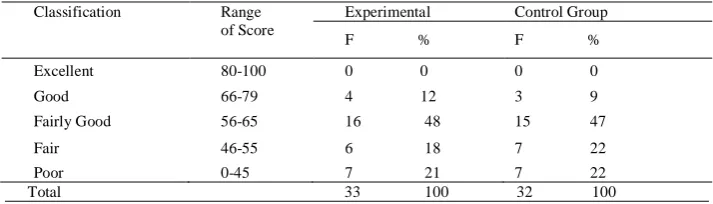
Table 2 illustrates the frequency and rate percentage of the students’ scores on their literal level of reading comprehension in the posttest. From this table, it can be seen that the students’ achievement in the experimental group was improving. The score of the students’ tend to spread from poor to fair, fairly good to good, and good to excellent.There were 5 students (15%) in the excellent category, 13 students (39%) in the good category, 11 students (33%) in the fairly good category, 4 students (12%) in the fair category, and none of the students in the poor category. Unlike for the control group, the students’ scores were spread dominantly in poor and fair, and the fairly good and good categories. There were 6 students (19%) in the good category,7 students (22%) in the fairly good category, 11 students (34%) in the fair category, and 8 students (25%) in poor category. The score distribution for the experimental group and control group on the literal level in posttest showed the difference from the pretest. After the treatment conducted to both of the groups, both of them showed an improvement, but in the experimental group the application of PORPE method gave higher achievement than the conventional teaching. It also can be concluded that the application of PORPE method gave greater contribution to the students literal reading. 2. Distribution score on interpretative level of comprehension In Table 3 are the pretest score of the interpretative level of comprehension and rate percentage of the students’ score for the experimental group and the control group. TABLE III. THE PERCENTAGE OF STUDENTS’PRETEST SCORE ON INTERPRETATIVE LEVEL Classification Range of Score Experimental Control Group F % F % Excellent 80-100 0 0 0 0
Good 66-79 4 12 3 9
Fairly Good 56-65 16 48 15 47
Fair 46-55 6 18 7 22
Poor 0-45 7 21 7 22
Table 3 indicated that the students’ scores in the experimental and control groups were spread in variance 0 up to 79 range score. The students’ reading comprehension achievement of the experimental group on interpretative level of comprehension in posttest showed a high improvement after conducting the treatment rather than in the control group. It can be seen in table 4 below:
TABLE IV.
THE PERCENTAGE OF STUDENTS’POSTTEST SCORE ON INTERPRETATIVE LEVEL
Classification Range
of Score Experimental Control Group
F % F %
Excellent 80-100 4 12 0 0
Good 66-79 11 33 5 16
Fairly Good 56-65 9 27 18 56
Fair 46-55 6 18 4 12
Poor 0-45 3 9 5 16
Total 33 100 32 100
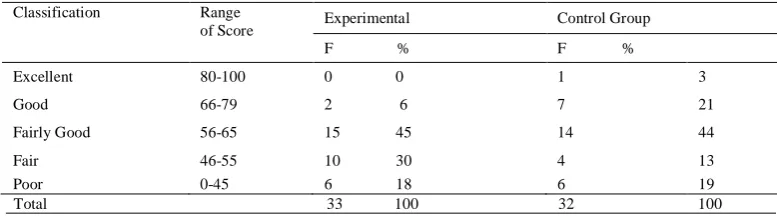
Table 4 above indicated that there is an improvement of the students’ score in the posttest, especially in the experimental group. After the treatment conducted by using the PORPE method, there were 3 students (9%) in the poor category, 6 students (18%) in fair category, 9 students (27%) in fairly good category, 11 students (33%) in good category and 4 students (12%) in excellent category.For the control group, there were 5 students (16%) in poor category, 4 students (12%) in fair category, 18 students (56%) in fairly goodcategory, 5 students (16%) in good category and none of the students were in excellent category.The data above showed that there were different variances of the resulteventhough the control group has also an improvement, but the experimental class has a higher improvment than control group. 3. Distribution score on critical level of comprehension Table 5 presents the pretest score on critical level of comprehension and the percentage for the experimental group and the control group. TABLE V THE PERCENTAGE OF STUDENTS’PRETEST SCORE ON CRITICAL LEVEL Classification Range of Score Experimental Control Group F % F % Excellent 80-100 0 0 1 3 Good 66-79 2 6 7 21 Fairly Good 56-65 15 45 14 44 Fair 46-55 10 30 4 13 Poor 0-45 6 18 6 19 Total 33 100 32 100
Table 5 indicates that the students’ scores in the experimental and the control groups were spreadfrom0 up to 100 range score, which is categorized as a variance category, the same with the students’ score on literal and interpretative level. The score distribution of the students in the experimental and the control groups in pretest students’ score were varied. This means that there is no significant difference between them. The rate percentage of the students’ pretest score in experimental group was not so much different than the control group. For the students’ achievement score on critical level comprehension after giving the treatment to both groups, the experimental group showed an improvement meanwhile in the control group there was not a big difference of achievement on the posttest scores. TABLE VI. THE PERCENTAGE OF STUDENTS’POSTTEST SCORE ON CRITICAL LEVEL Classification Range of Score Experimental Control Group F % F % Excellent 80-100 2 6 2 6
Good 66-79 10 30 13 41
Fairly Good 56-65 14 42 7 21
Fair 46-55 5 15 5 16
Poor 0-45 2 6 5 16
Table 6 shows that the students’ posttest results for the experimental group on the critical level comprehension were improving. Twostudents (6%) were in excellent category, 10 students (30%) in goodcategory,14 students (42%) infairly good category, 10 students (30%) ingood category. This proved that some students improved their comprehension on the critical level after giving the treatment using thePORPE method.
In the control group, the data showed that the students’ scores after giving the treatment were improved. Although their scores improved in the posttest, it did not show a big difference or improvement from the pretest result. The achievement of the students on the critical level of comprehension is slightly better in the experimental group by using the PORPE method rather than in the control group by using a non-PORPE method.
4. Scoring classification of students’ pretest and posttest results of the experimental and the control groups
The researcher found the pretest results of the students’ score in frequency and percentage for experimental group and control group as shown below.
TABLE VII
FREQUENCY AND PERCENTAGE OF PRETEST SCORE
Classification Range
of Score Experimental Control Group
F % F %
Excellent 80-100 0 0 0 0
Good 66-79 0 0 3 9
Fairly Good 56-65 12 36 12 38
Fair 46-55 17 51 12 38
Poor 0-45 4 12 5 15
Total 33 100 32 100
Table 7 showed that the students for experimental group were in variance category, 4 students (12%) in poor category,17 students (51%) in fair category, 12 students (36%) in fairly good category and none of the students in the good categoryor in the excellent category. For the control group, the data indicated that most of the students were dominantly in fair and fairly good category, 5 students (15%) in poor category, 12 students (38%) in fairly good category, 3 students (9%) in goodcategory and none of the students in excellent category, with the resultsmostly the same with the experimental group. While in the experimental group, none of the students belong to the top two categories; good to the excellent categories and unlikethe control group three of the students were in the good category. It can be concluded thatboth of the groups were dominantly in the fair and fairly good categories. Table 8 describes the frequency and rate percentage of the students’ posttest score in reading comprehension by applying PORPE method, there were different result from those who taught by using conventional way in teaching reading. TABLE VIII. FREQUENCY AND PERCENTAGE OF POSTTEST SCORE Classification Range of Score Experimental Control Group F % F % Excellent 80-100 3 9 0 0
Good 66-79 10 30 5 16
Fairly Good 56-65 16 48 20 62
Fair 46-55 4 12 3 9
Poor 0-45 0 0 4 12
Total 33 100 32 100
Table 8 describes the students’ achievement in the experimental and the control group after the treatment and indicates a good improvement. It can be seen in the students’ pretest, many of them were in poor, fair and fairly good category, none (0%) in good to excellent scores. Out of 33 studentsin the experimental group, there were 4 students (12%) in fair category, 16 students (48%) in fairly good category, 10 students (30%) in goodcategoryand there were 3 students (9%) in excellent category. The students’ scores ranged from fair to excellent classification. The students’ score in posttest increased and spread in fair to fairly good, and good to excellent categories.
In the control group, there were many changes between the pretest and posttest results on the classification and the range of the scores because most of the students in the pretest results were dominantly fair and fairly good.On the posttest, the results showed that 4 students (12%) were in the poor category, 3 students(9%) in the fair category, 20 students(62%) in the fairly good category and 5 students (16%) in the good category.
B. The Mean Score of The Students’ Pretest and Posttest
1. The tabulation data for the students’ achievement in their reading comprehension can be seen as follows:
TABLE IX.
THE MEAN SCORE AND STANDARD DEVIATION OF THE STUDENTS’PRETEST AND POSTTEST.
Paired Samples Statistics Mean N Std. Deviation
Pair 1 Pretest Experimental 53.3848 33 7.42046
Posttest Experimental 65.5727 33 8.82271
Pair 2 Pretest Control 53.2719 32 11.02098
Posttest Control 59.0594 32 9.48778
Table 9 showed that the total number for each group with the experimental group being 33 students and the control group 32 students. The mean score and standard deviation were shown significantly different in the pretest and posttest to both of the groups. The data was based on the computation using SPSS volume18.0. From the data showed in Table 9, the mean score of the experimental group and the control group was mostly the same before giving the treatment. After giving the treatment, the posttest score for both groups demonstrated significant improvement.
Before the treatment was conducted, both of the experimental class and control class were given a pretest in order to know the students’ achievement on their reading comprehension. The purpose of conducting the test was to find out whether both the experimental group and control group got the same level or not. The standard deviation conducted and was meant to learn how close the scores to the mean score. In table 10 above showed that the mean score of the students’ pretest of the experimental group was 53.38 and the control group was 53.27, with the standard deviation 7.42 and 11.02 respectively. Table 10 above also showed that the mean score of both groups were different after the treatment. The mean score after the treatment was 65.57for the experimental group and 59.05 for the control group. This means that the mean score of the experimental group is higher than the control group (65.57>59.05) and the standard deviation for the experimental group was 8.82 and 9.48 for the control group.
2. The mean score and standard deviation of the students on the literal level of comprehension
Table 10 below shows the mean score and standard deviation on literal level between pretest and posttest for both groups, the experimental and the control group.
TABLE X.
THE MEAN SCORE OF THE STUDENTS’PRETEST AND POSTTEST OF LITERAL COMPREHENSION
Paired Samples Statistics Mean N Std. Deviation
Pair 1 Pretest Literal Experimental 20.1818 33 4.45644 Posttest Literal Experimental 27.1212 33 2.94167 Pair 2 Pretest Literal Control 18.5625 32 5.66220 Posttest Literal Control 21.6250 32 5.32644
Table 10 above indicated that there is an improvement on the literal level in each group. It can be seen on the mean score of the pretest (20.18) to posttest (27.12) for experimental group and also for the pretest (18.56) to posttest (21.62) for the control group. In fact, the mean score of experimental posttest was higher than the control group.
3.The mean score and standard deviation of the students’ on interpretative level
Table 11 below shows the mean score and standard deviation on interpretative level between pretest and posttest for both groups.
TABLE XI.
THE MEAN SCORE OF THE STUDENTS’PRETEST AND POSTTEST ON INTERPRETATIVE LEVEL
Paired Samples Statistics Mean N Std. Deviation
Pair 1 Pretest Interpretative Experimental 27.5152 33 5.63539 Posttest Interpretative Experimental 32.0606 33 6.54761 Pair 2 Pretest Interpretative Control 26.9375 32 5.83614 Posttest Interpretative Control 29.1562 32 5.05524
Table 11 shows that there is also an improvement on the interpretative level in each group. It can be seen on the mean score of the pretest (27.51) to posttest (32.06) for experimental group and also for the pretest (26.93) to posttest (29.15) for the control group. It means that the mean score of the posttest was higher than for the control group. However, the control group shows a few improvements than the experimental one.
4. The mean score and standard deviation of the students on critical level
TABLE XII
THE MEAN SCORE OF THE STUDENTS’PRETEST AND POSTTEST ON CRITICAL LEVEL
Paired Samples Statistics Mean N Std. Deviation
Pair 1 Pretest Critical Experimental 32.3939 33 5.70054 Posttest Critical Experimental 39.1818 33 5.02154 Pair 2 Pretest Critical Control 34.4375 32 8.28110 Posttest Critical Control 37.8125 32 7.60491
Table 12 shows that the mean score of the pretest (32.39) to posttest (39.18) for experimental group and also for the pretest (34.43) to posttest (37.81) for the control group. It means that the improvement of posttest was higher than the control group.
5. The mean score and standard deviation of the students’ metacognitive awareness
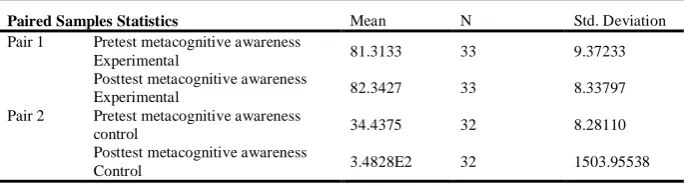
Table 13 below shows the mean score and standard deviation of the students’metacognitive awareness between pretest and posttest for both groups, experimental and control groups.
TABLE XIII.
THE MEAN SCORE OF THE STUDENTS’PRETEST AND POSTTEST IN METACOGNITIVE AWARENESS
Paired Samples Statistics Mean N Std. Deviation
Pair 1 Pretest metacognitive awareness
Experimental 81.3133 33 9.37233
Posttest metacognitive awareness
Experimental 82.3427 33 8.33797
Pair 2 Pretest metacognitive awareness
control 34.4375 32 8.28110
Posttest metacognitive awareness
Control 3.4828E2 32 1503.95538
Table 13shows that the mean score of the pretest (81.31) to posttest (82.34) for experimental group and also for the pretest (34.43) to posttest (3.4828) for the control group. It means that the improvement of posttest in control group was higher than the improvement of the students’ in experimental group.
C. Analisys Covarian (Ancova)
The hypotheses were tested by using inferential analysis. In this case, the researcher used Ancova (analisys covariance) The data analysis technique used to determine the effect of independent variable to the dependent variable in this study is an analysis of covariance (Ancova) and the pretest score as a covariate. Before testing Ancova, first tested assumptions is including normality test using the One-Sample Kolmogorov-Smirnov test and homogeneity of variance test data using Levene's Test of Equality of Error Variances.
1. The Effect of PORPE Towards Reading Comprehension
The analisys statistic result Ancova of the students reading comprehension described clearly in the table 14 below:
TABLE XIV.
THE EFFECT OF PORPE TOWARDS READING COMPREHENSION
Source
Type III Sum of
Squares Df Mean Square F Sig.
Corrected Model 4182.849a 2 2091.425 72.529 .000
Intercept 748.732 1 748.732 25.965 .000
XScore 3493.626 1 3493.626 121.156 .000
PORPE 670.321 1 670.321 23.246 .000
Error 1787.816 62 28.836
Total 258790.580 65
Corrected Total 5970.666 64
According to the Ancova statistic result the effect of PORPE to the students’ reading comprehension can be assumed that the source of learning strategies derived p-level smaller than 0:05 alpha (p <0.05), with sig. 0,000. It means that Ho is stated that "There is no effect of PORPE on reading comprehension” is not accepted and the research hypothesis which stated "There is an effect of PORPE on reading comprehension" is received. So there is a significant effect of PORPEto the students’reading comprehension.
2. The effect of PORPE towards metacognitive awareness
TABLE XV.
THE EFFECT OF PORPE TOWARDS METACOGNITIVE AWARENESS
Source
Type III Sum of
Squares Df Mean Square F Sig.
Corrected Model 1.149E6a 2 574565.526 .508 .604
Intercept 30096.908 1 30096.908 .027 .871
XMeta 117.071 1 117.071 .000 .992
Metode 1119550.190 1 1119550.190 .990 .324
Error 7.012E7 62 1130974.889
Total 7.423E7 65
Corrected Total 7.127E7 64
Based on table source above obtained p-alpha levels greater than 0.05 (p>0.05) with sig. 0324. It means that Ho is stated that "There is no effect of PORPE to the students’ metacognitive awareness" is accepted and the research hypothesis which stated that "There is the influence and effect of PORPE to the students’ metacognitive awareness" is not accepted. So there is no significant effect on metacognitive awareness by applying PORPE method.
IV. CONCLUSIONS
The description of the data collected through some tests as explained in the previous section shows that the students’ reading comprehension was improved considerably. this is also empowered by the rate of the students’ mean score in pretest and posttest of experimental group. The result of the mean score of pretest and posttest in experimental group was 53.38 to 65.57 while the result mean score of pretest and posttest in control group was 53.27 to 59.05.
The data in the previous section showed that the use of the PORPE method gives better effect in learning reading than the conventional way. It also can be seen from the mean score in which the mean score of the posttest of the experimental and the control group are quite different (See Table 10). The mean score of the experimental group 65.57 was higher than the control group that was 59.05 and the mean score difference was 06.52.
Although both the PORPE and the conventional method can also be used in teaching reading, and they both can increase the students’ achievement, the PORPE method improves the students’ reading comprehension more meaningfully and more significantly than the group conventional one. These strategies were able to change the students’ reading comprehension to be better than before. So it can be inferred statistically based analysis of covariance (ancova) that the PORPE method is more effective in developing students’ reading comprehension.
Based on the study above, the result of the students’ answers either in the control or the experimental group before and after treatment, can be noticed that students usually do not understand the questions given of the text. They just copy one meaning from the text, and sometimes they totally missing what is the core of the question. The researcher point of view that students’ reading comprehension were found some difficulties especially the meaning, the researcher summarized that they had misunderstanding also less of linguistic competence in English that affected their comprehension in reading the text. Some of my conclusions were the students has limited of vocabulary knowledge that led to not recognizing the ideas of the reading text given, even when the question was literal and factual in the test. They also were found difficulties when they interpreting the text given, which made them difficult to read critically.
This study proves that the problem that the researcher has discussed in the background section (i.e. issues with reading comprehension, etc.) still occurs however, the use of the PORPE successfully minimized the difficulties the students had with reading comprehension. The students were encouraged with the use of the mentioned strategies in their reading. Because there were so many strategies offered, the students felt free to choose which strategies will be applied for their reading activities.
Furthermore, the experimental group students gained greater autonomy in the development of their reading than the control group students. Yet, during and after the treatment period, the experimental group students were more concerned with their own activities. Through the systematic practice of PORPE is the strategy that can help the students to answer the questions in the text. Simpson 1984) stated the role of creating the questions is not all about the comprehension. Instead, learners passed the process of acquiring and generating information from the text then they take the conclusion as the answer of the passage given. In fact, students had progressively acquired the ability to monitor and control their reading comprehension and progress.
From the data showed in the pretest and posttest, the achievement of the students on their literal comprehension was increased and the data posttest also improved significantly from the distribution frequency. The mean score of the experimental group on the literal level was 20.18 in pretest to 27.12 in posttest with the differences of the mean score was 6.94 while the control group on the literal level was 18.56 to 21.62 with the differences of mean score was 3.06
On the interpretative level, the mean score of the experimental group on the posttest also increased from the pretest compared to the control group. The difference of the mean score was 4.55 with 27.51 for the pretest to 32.06 for the posttest. Similar to the control group, it also shows a little improvement with the difference of the mean score being 2.22. Unfortunately, the control group did not show a significant improvement it can be seen from the mean score of the pretests’ result was 26.93 to 29.15 for the posttest.
On the interpretative level, the students gave better responses to the text given by using the instruction or guided questions of the PORPE method, especially the use of organizing and predicting the possible questions and answers. In this case, they are able to know the ideas that are not directly stated in the text. So, it will help the students in getting meanings from the text with minimally reading the text repeatedly. As Smith (2010) states that in interpretation the readers read between the lines, make connections among individuals stated ideas, make inferences, draw conclusions, read between the lines to get inferences, or implied meanings from the text.
On the critical level of comprehension through the application of the PORPE method, students are guided to read critically. They were guided to compare ideas in the text, think about the text’s big idea and messages that are implied in the written text. By relating those ideas to their own experiences in their real life, it makes them find certain facts so they will be involved in logical thinking and reasoning as a part of reading critically. It can be seen from the improvement of the experimental group on critical level of comprehension where the mean score before the treatment given was 32.39 to 39.18 after the treatment, while the control group was 34.43 to 37.81.
From the result and the discussion above, it can be stated that an active reading is still needed to improve the students’ reading on their level of comprehension. Based on the research result, the students have already made significant progress in reading after they are given the treatment. In addition, based on the research findings, the students’ achievement taught by using the PORPE method is better than the use of a conventional way or the traditional one.
Based on the results of the covariance analysis suggest that the PORPE method can affect metacognitive awareness of students. The research findings result of the mean score of the students’ metacognitive awareness in pretest and posttest of experimental group was 81.31 to 82.39 while the mean score of pretest and posttest of control group was 34.43 to 3.482. In general, metacognitive awareness of the students increased from the pretest to the posttest, but the findings in this study showed a decrease in metacognitive awareness at the individual level as measured by a questionnaire of metacognitive Awareness Inventory (MAI) which is equal to 82 % of the 33 students in experimental group. The data also shows that the students increased around 1 % from pretest to posttest, different with the students in control group which mean score shows a high improvement.
The findings in this study is the same with the results findings of the study by Jahidin (2009) which states that there is a decrease in score of metacognitive skills of students who also measured using a questionnaire MAI a decrease of 26.85% on high academic ability students and metacognitive skills scores decreased by 28.24% the low academic ability students from 144 students. Similar research, Danial (2010) who showed a decrease in student metacognitive awareness score after treatment was given, where a decrease in the amount of 31.18% of the 93 students.
Based on the explanation above, it is known that the results of measurements of metacognitive awareness of students as measured by using the MAI inventory unrealistic when compared to measurements using a rubric. It is also caused by unrealistic metacognitive awareness measured using the MAI inventory. This finding is reinforced by Suratno (2009) who states that the measurement of metacognitive awareness by using a rubric is the best alternative.
The general view of the results of covariance analysis showed that there was no significant effect of PORPE on the student’s metacognitive awareness. Results of this study were supported by research of Miranda (2008) who also showed that the interaction of learning strategies and academic ability had no effect on student metacognitive awareness. This is in contrast with the results of the study by Warouw (2009) who showed that the interaction of learning strategies and academic ability of students influenced the metacognitive abilities of students. One finding in this study was a decrease in the score of metacognitive awareness at an individual level. This is due to a lack of awareness of students in responding to the metacognitive awareness inventory using the MAI to internalize their learning strategies such as planning, monitoring, evaluating and revising learning processes. This is confirmed by the experts that the students who apply learning strategies to process information or knowledge will become independent learners (self-regulated learners). Lack of awareness of students in response to metacognitive awareness inventory was also seen with a decrease in the level of metacognitive awareness score of 44 individual samples.
The above findings suggest that the measurement of metacognitive awareness by using questionnaires metacognitive awareness inventory (MAI) cannot properly record student metacognitive awareness. This is evident from the results of the study showed that the interaction of academic ability and learning strategies and academic ability PORPE did not significantly affect student metacognitive awareness. The same argument was made by Corebima (2009) who states that during the use of MAI instrument to measure students' metacognitive awareness in about 40 classes (in elementary, junior high, high school and university in Java and outside Java) at the beginning and end of the study showed that between 30-85% of students score decreased. This fact proves that the questionnaire instrument is not appropriate for the population in the country which resulted in the recording of metacognitive awareness score of students cannot be trusted.
1. The application of the PORPE method develops the students’ reading comprehension more significantly with the second semester students of Muhammadiyah University of Makassar than non-PORPE method.
2. There is no significant influence on metacognitive awareness by using PORPE method. No significant differences in the average score in experimental group students. This is not in line with many reference stating that there is a tendency of the students have metacognitive awareness levels after applying the PORPE method and have a higher potential to enhance metacognitive awareness than students who are not given the PORPE or conventional method.
Nowadays, teaching is directed to the students-needs, so lecturers should be creative to manage the material and the classroom for teaching reading such as by using the PORPE method. This is meant to avoid monotonous teaching technique. The teaching of reading comprehension in terms of literal, interpretative and critical level of comprehension should be continually implemented to the students. Further researcher needs to be conducted on the effectiveness of the PORPE method, particularly for high level semester of the students. It is also strongly recomended that further research be conduct on a model of teaching PORPE and designing PORPE material or developing PORPE material.
REFERENCES
[1] Ashton, A.A. (2012). Mental imagery and reading comprehension proficiency in English second language learners. An exploratory study. Master dissertation. Johannesburg: University of Withwatersrand.
[2] Ambarwati Sri, (2015). Vol. 17 No. 1 - April Peranan Perpustakaan Keliling Dalam Meningkatkan Kualitas Layanan Perpustakaan di Badan Perpustakaan dan Arsip Daerah DIY.
[3] iii. Brown, H. D. (2007). Language and assesment: principle and classroom practice. New York: Pearson Education
[4] Baker, L., & Brown, A. L. (1984). Studying. In Pearson, P. D. (Ed.), Handbook of reading research (pp. 353-394). New York: Longman.
[5] Countinho, S.A. (2007). The Relationship between Goals, Metacognitive, and Academic Success. Educate. Vol.7 (1): 39-4. (Online), (http://www. educatejournal.org/ index.php/educate/article/view/116/134. (Accessed 13/4/2016).
[6] Cui, Y. (2010). L2 proficiency and L2 reading: Consolidating the Linguistic Threshold Hypothesis. https://web.uvic.ca. (Accessed 11/2/2012).
[7] Corebima,A.D. (2011). b. Asesemen Pembelajaran. Makalah Disampaikan pada Seminar Nasional Peningkatan Kompetensi Pedagogik Melalui Penguasaan Asesmen Metakognisi dan Keterampilan Berpikir di UNM pada Tanggal 17 Desember 2011. [8] Dawson, T.L. (2008). Metacognitive and Learning in Adulthood. Prepared in Response to Tasking from ODNI/CHCO/IC
Leadership Development Office. Developmental Testing Service, LLC, Saturday, August 23, 2008. (Online). (https://www.devtestservice.org/PDF/Metacognitive.pdf), (Accessed 14/11/2011).
[9] Danial, Muhammad. (2010). Pengaruh Strategi PBL dan Kooperatif GI terhadap Metakognisi dan Penguasaan Konsep Kimia Dasar Mahasiswa Jurusan Biologi FMIPA Universitas Negeri Makassar. Disertasi tidak diterbitkan. Malang: Program Pascasarjana Universitas Negeri Malang.
[10] Doof, Adrian. (1988). Teach English, a Training Course for Lecturers (Trainer’s Handbook). London; Cambridge University Press in association with the British Council.
[11] Flavell, J. H. (1999). Cognitive Development: Children’s Knowledge about the Mind. Annual Review of Psychology. Vol. 50: 21–45. (Online). (http://web.mac.com/jopfer/courses.pdf) (Accessed 14/11/2011).
[12] Grabe, w. (2009). education in Indonesia from crisis to recovery. Available at: http//www.libraryforall.blogspot.com (accessed 7/5/2012).
[13] Gay, L.R., Mills, G.E., and Air asian P.W. (2006). Educational Research: Competencies for Analysis and Applications (8th Edition). Upper Saddle River, New Jersey: Pearson-Merill Prentice Hall.
[14] Hamra A. (2013). Memanfaatkan keterampilan membaca dalam upaya meningkatkan kemampuan memahami teks bacaaan. Jurnal pendidikan dan keguruan. Vol. 4 no 2, 89-94. (Accessed 19/9/2014).
[15] Jahidin. (2009). Pengaruh Pembelajaran Kooperatif STAD & CIRC pada Siswa Akademik Tinggi dan Rendah terhadap Keterampilan Metakognisi dan Penguasaan Konsep Biologi Siswa SMA Negeri Kota Bau-Bau. Disertasi tidak diterbitkan. Malang: Universitas Negeri Malang.
[16] xvi. Kachru, B. B. (1992). World Englishes: Approaches, issues, and resources. Language Teaching, 25, 1-14.
[17] Kurniawan, D., (2011). The effect of using PORPE method toward reading comprehension of the second year students at SMPN 1 Bantan. Islamic University Sultan Syarif Kasim Riau. Pekanbaru
[18] Leslie Glende. (2013). Vocabulary and Word Study to Increase Comprehension in Content Areas for Struggling Submitted in partial fulfillment of the requirements for the degree M.S. Literacy Education, School of Arts and Sciences St. John Fisher College.
[19] Lyon, G. R. (2000). Why reading is not a natural process. Learning Disabilities Association of America. LDA News briefs. [20] Miranda, Yula. (2009). Pembelajaran Metakognitif Dalam Strategi Kooperatif Think-Pair-Share Dan Jigsaw Serta Pengaruhnya
terhadap Hasil Belajar Biologi Siswa Di SMA Negeri Kalimantan Tengah. Disertasi tidak diterbitkan. Malang: Program Pascasarjana UM.
[21] Reitz, O, E. (2014). embaddedness: A concept analysis. Journal forum. 49 (3), pp.159-166. (Accessed 22/7/2016).
[22] Simpson, M. L. (1986). PORPE: A writing strategy for studying and learning in the content areas. Journal of Reading, 29, 407-414.
[23] Simpson, M. L., Hayes, C. G., Stahl, N., Connor, R. T., & Weaver, D. (1988). An initial validation of a study strategy system. Journal of Reading Behavior, 20, 149-180.
[26] Suggate, P. Sebastian. (2016). A meta-analysis of the long term effects of phonemic awareness, phonics, fluency, and reading intervension. Journal of learning disabilities. (Accessed 1/3/2017).
[27] Schraw, G. & Dennison, R. S. (1994). Assesing Metacognitive Awareness. Contemporary Educational Psychology, 19. 460-475.
[28] Stahl, N., (2014). PORPE: A comprehensive study strategy utilizing self-assigned writing. Publisher: Research Gate. Northern Illinois University.
[29] Suratno. (2009). Pengaruh Strategi Kooperatif Jigsaw dan Reciprocal Teaching terhadap Keterampilan Metakognitif dan Hasil Belajar Biologi Siswa SMA Berkamampuan Akademik Atas dan Bawah di Jember. Disertasi tidak diterbitkan. Malang: Program Pascasarjana UM
[30] Thinker and Collough. (1975). Teaching Elementary Reading Unplowed Cliff. 112-118. Practices Hall. [31] Victoria Manuel Camacho. (2012). world education blog Victoria/UNESCO. (Accessed 19/2/2007). [32] Wender, A. and Joan Rubin. (1987). Learner Strategies in Language Learning. New Jersey: Prentice Hall.
[33] Werderich, D. E. (2002). Individualized responses: Using journal letters as a vehicle for differentiated reading instruction. Journal of adolescent & Adult Literacy, 45, 746-754.
[34] Williams, M. and Robert L. Burden. (1997). Psychology for Language Lecturers: A Social Constructivist Approach. Cambridge: CUP.
[35] Weaver, C. (2012). Reading process and practice: From socio-psycholinguistics to whole language (2nd ed.). Portsmouth, NH: Heinemann.
[36] Warouw, Z.W.M. (2009). Pengaruh Pembelajaran Metakognitif dengan Strategi Cooperative Script, dan Reciprocal Teaching pada Kemampuan Akademik Berbeda terhadap Kemampuan dan Keterampilan Metakognitif, Berpikir Kritis, Hasil Belajar Biologi Siswa, serta Retensinya di SMP Negeri Manado. Disertasi tidak diterbitkan. Malang: Universitas Negeri Malang.
Saiful was born in Bulukumba, on June 15th 1987, in South Sulawesi, Indonesia. He is the second child of H.M Said, B and Santawali,B.A. He completed his undergraduate study in 2010 in English Education at Universitas Muhammadiyah Makassar. He earned his Master degree from State university of Makassar in Indonesia. His research interest is in Teaching English as Foreign language and the use of Mystery Stories in Improving the students reading achievement. He is a lecturer at Muhammadiyah University of Makassar. He is currently a Doctorate student at Universitas Negeri Makassar. He attended some International Conference as the Presenter. Namely: The Presenter in International Conference of Language Education (ICOLE), International Conference on language education, International Conference on Education, Science, Art and Technology (ICESAT) (2017). The Presenter in Seminar Presentation of PKPI Program Northern Illinois University, USA (2016). He also has many publications list, such as; The Application of Communicative Approach in Improving the Students Speaking Ability, published in Education Science JournalUki Toraja. Communication Anxiety, communication Competence, Communication A study comparative of the Application of K13 Curriculum at SMAN 1 Bontonompo, SMAN 2 Gowa, And SMKN 1 Patalassang (in Journal of Education, Tourism, Local wisdom, UKI Toraja), A study of English Lecturer Style in Teaching at UKI Toraja Journal of Science and Technology 2017.
Baso Jabu completed his undergraduate studies in 1987, majoring in Teaching English as a Foreign Language (TEFL) at Ujung Pandang Institute of Teacher Training and Education (currently Universitas Negeri Makassar), Indonesia. He completed his Master’s and doctoral degrees in the field of applied linguistics at Hasanuddin University in Makassar, Indonesia, in 1995 and 2007, respectively. He was awarded a Specialist Certificate in Language Testing at the Regional Language Centre Singapore in 1996. Professor Jabu is former Director of the Language Centre at Universitas Negeri Makassar, where he manages training in some foreign languages, as well as the Indonesian language for non-native speakers. He is currently as the Second Assistant Director of Postgraduate Program of Universitas Negeri Makassar. He is a lecturer, and has been teaching English as a foreign language at Universitas Negeri Makassar for more than 20 years. Prof. Jabu is a member of TEFLIN (Teaching English as a Foreign Language in Indonesia) and MLI (Indonesia Linguistic Society). His research interests are TEFL and language assessment.
Haryanto Atmowardoyo is a professor of English Education at English Department of State University of Makassar. He was born in Purbalingga, Central Java on October 29, 1959. He completed his elementary educationin SD Galuh, Purbalingga in 1971: Junior High School at SMP Borromeus Purbalinggga in 1974; and Senior High School at SMA Negeri Purbalingga in 1977. Then he completed S1 degree in English Education at IKIP Ujung Pandang in 1985, S2 degree in English Education at IKIP Malang in 1994; and S3 degree (doctor) in English Education at IKIP Jakarta 1999. From September 2009 to January 2010 Haryanto Atmowardoyo participated in academic recharging program in Ohio State University, Columbus, Ohio, USA. He has published several books: (2001), published by State University of Makassar Press Dasar-Dasar Penulisan Isu Pendidikan dan Pengajaran Bahasa Proposal Penelitian. (2008), A Collaborative Work with Sukandar Rumidi, of Gajah Mada University, Published by Gajah Mada University press (2008); and Metodologi Penelitian Kualitatif; Teori dasar (2008) published by State University of Makassar Press.
(Performance 1995); Laboratorium Bahasa Multimedia dan Fungsinya Dalam Pembelajaran Bahasa Asing (2015, Pendidikan Network); Peranan Pendidikan, Jember University, 20017); Kajian Tentang Pembelajar Bahasa Inggris yang berhasil (Humaniora hasanuddin University, 2007); and Communication Formats Compatible to Multimedia Language Laboratory (2008, Pendidikan Network).