ISSN: 2501 - 1235 ISSN-L: 2501 - 1235 Available on-line at: www.oapub.org/edu
Copyright © The Author(s). All Rights Reserved.
doi: 10.5281/zenodo.3687199 Volume 6 │ Issue 2 │ 2020
WORKPLACE MOBBING AND ORGANIZATIONAL COMMITMENT:
AN INVESTIGATION ON EMPLOYEES OF THE PROVINCIAL
DIRECTORATE OF YOUTH AND SPORTS IN TURKEY
Bekir S. Yildiz1i, Sevim Güllü2,
Rabia Kaya3 1M.Sc., Mugla Provincial Directorate
of Youth and Sports, Turkey 2PhD, Istanbul University-Cerrahpaşa,
Faculty of Sport Sciences, Turkey 3M.Sc., Nişantaşı University, School of Physical Education and Sports,
Turkey
Abstract:
Mobbing and organizational commitment are among the issues that concern sports businesses as in every profession. In this study, the effects of mobbing on organizational commitment of employees working in public institutions that provide sports services were examined. This research was attended by employees working in the youth and sports directorate, in Turkey. The mobbing scale developed by Yildiz (2019) and the organizational commitment scale developed by Meyer and Allen (1991) were used in the study. First, the reliability analysis of the scales was made, and the reliability coefficients were seen as quite high. Afterward, correlation and regression analyses were performed on the data. As a result, it has been observed that mobbing affects the employees' organizational commitment significantly and negatively.
Keywords: mobbing, organizational commitment, employee, sport organizations
1. Introduction
Today, intense competition is increasing the importance of human resources for organizations. Recently, organizations have understood that they can achieve success and high performance with employees who have a higher sense of commitment (Shahid & Azhar, 2013). Therefore, while organizations are trying for the happiness of employees
(Güllü, 2018), on the other hand, they are looking for ways to eliminate the factors that cause unrest and conflict among the employees (Kuriakose et al., 2019).
The existence of employees with the necessary knowledge and skills is not sufficient for the success of organizations alone. The success of organizations is related to
the reflection of employees’ knowledge and skills in their jobs. In addition, employees
must have positive attitudes and have strong emotions in their organizations (Yildiz, 2011). Organizational commitment is an important tool that enables employees to show strong emotions to their organizations (Ali et al., 2010). Organizational commitment is defined as an employee's identification with the organization and his/her participation in all organizational processes (Mowaday, Porter, & Steers, 1982). Among the organizational commitment models, the most accepted and used model in the literature is the model of Meyer and Allen (1991). According to this model, organizational commitment consists of three dimensions. These are the types of affective commitment, continuance commitment, and normative commitment. Affective commitment refers to employees' emotional affinity and identification with their businesses, internalize the business's values, goals and objectives, and strive to achieve these goals and objectives, and remain a part of the business with their own preferences. Continuance commitment means that employees take into account the high cost of leaving the business, that is, they must continue to operate as a necessity. Normative commitment means that employees feel connected to the business because they believe that they should not leave the company with moral duty and sense of responsibility (Allen & Meyer, 1990). There are a number of variables that positively affect organizational commitment. For example, the
organization manager’s trust on employees (Güllü & Yildiz, 2019) and effective
organizational communication (Güllü & Yenel, 2015) affect the organizational commitment of employees. The most prominent feature of organizational commitment is that employees increase their organizational citizenship behaviors (Grant-Vallone & Donaldson, 2001) and performances (Riketta, 2002). Organizational commitment
employees’ turnover intentions are decreasing (Shore & Martin, 1989) and they continue
to work in the same workplace longer (Wright & Bonett, 2002).
Mobbing is the exposure of an employee to psychological violence behavior in his / her work environment (Crawshaw, 2009). Mobbing is a phenomenon that can be seen
in any business environment regardless of the sector (Ofluoğlu & Somunoğlu, 2012).
entering the mobbing by considering the target is required (Branch, Ramsay, & Barker, 2012). As in every sector, mobbing is seen in various organizations that offer sports services (Yildiz, 2016; Yildiz, 2018). In addition, the phenomenon of mobbing is encountered in professional football (Iyem, 2007).
This study focuses on the youth and sports directorate that provides sports services, and the effect of mobbing on the organizational commitment of the employees.
2. Method
2.1. Data Collection Tools
In this study, the mobbing scale, consisting of 10 items and 2 sub-dimensions (vertical/horizontal mobbing, and vertical mobbing) developed by Yildiz (2019), to measure the mobbing perceptions of employees was used. Although this measurement instrument was developed for academicians in higher education institutions, we consider
it can be applied to sport sectors’ employees. Scale items were measured on a five-point
Likert type scale (1=never; 5=every time). In order to measure the organizational commitment perceptions of employees, the organizational commitment scale developed by Meyer and Allen (1991) was used. This measurement instrument consists of 18 items and 3 sub-dimensions (affective commitment, normative commitment, and continuance commitment). Scale items were measured on a five-point Likert type scale (1=strongly disagree; 5=strongly agree).
2.2. Sample Size
The sample of this study consists of employees of three Provincial Directorate of Youth and Sports, in Turkey. The questionnaire forms were distributed to 180 employees with an emphasis on confidentiality and were asked to respond within a week. A total of 164 forms were returned, 8 forms with deficiencies were not considered and a total of 156 forms were found suitable for the analysis.
2.3. Statistical Analysis
We used descriptive statistics, correlation analysis, and hierarchical regression analysis
for the data. Reliability of the scales was determined by Cronbach’s Alpha coefficient.
3. Results
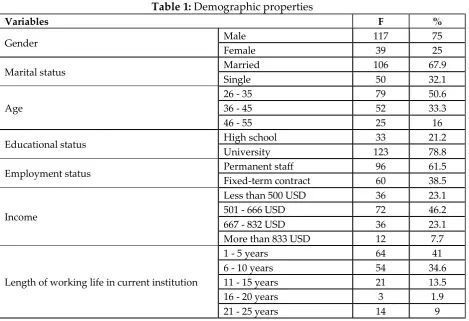
3.1. Demographic Properties of Participants
Table 1: Demographic properties
Variables F %
Gender Male 117 75
Female 39 25
Marital status Married 106 67.9
Single 50 32.1
Age
26 - 35 79 50.6
36 - 45 52 33.3
46 - 55 25 16
Educational status High school 33 21.2
University 123 78.8
Employment status Permanent staff 96 61.5
Fixed-term contract 60 38.5
Income
Less than 500 USD 36 23.1
501 - 666 USD 72 46.2
667 - 832 USD 36 23.1
More than 833 USD 12 7.7
Length of working life in current institution
1 - 5 years 64 41
6 - 10 years 54 34.6
11 - 15 years 21 13.5
16 - 20 years 3 1.9
21 - 25 years 14 9
3.2. Reliability Analysis of the Scales
Reliability analysis was applied to the scales before proceeding to further analysis. The Cronbach alpha value of the mobbing scale is 0.928, and the organizational commitment scale is 0.907. These two values show that the scales are quite reliable.
3.3. Correlation Analysis
According to the correlation results, there was a significant and negative relationship between mobbing and organizational commitment (r=-.355). As the mobbing behavior increases, the organizational commitment of the employee exposed to this behavior decreases.
Table 2: Results of correlation analysis
Variables 1 2 3 4 5 6 7 8
1. Gender 1
2. Marital status -.079 1
3. Age -.070 -.273** 1
4. Educational status .227** .053 -.136 1
5. Employment status .061 .135 -.343** -.042 1
6. Income .086 -.106 .445** .419** -.232** 1 7. Length of working life in
current institution -.115 -.225** .665** -.131 -.440** .355** 1
3.4. Regression Analysis
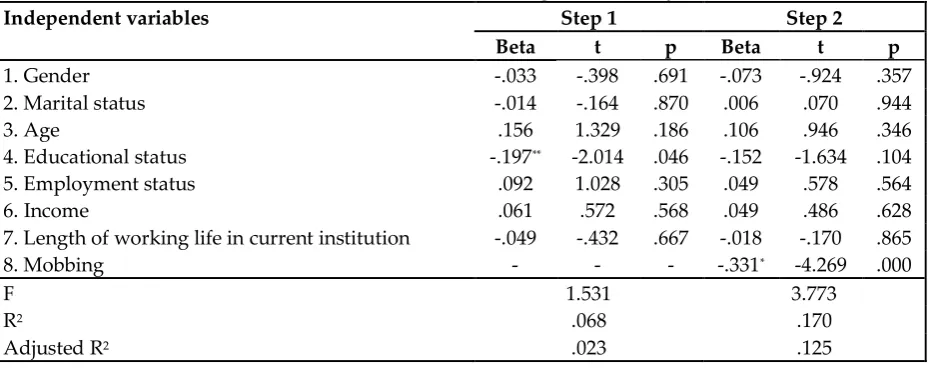
As a result of the regression analysis, a significant and negative effect of mobbing on organizational commitment was found (B=-.331). According to this result, the organizational commitment of employees decreases as mobbing increases.
Table 3: Results of hierarchical regression analysis
Independent variables Step 1 Step 2
Beta t p Beta t p
1. Gender -.033 -.398 .691 -.073 -.924 .357
2. Marital status -.014 -.164 .870 .006 .070 .944
3. Age .156 1.329 .186 .106 .946 .346
4. Educational status -.197** -2.014 .046 -.152 -1.634 .104
5. Employment status .092 1.028 .305 .049 .578 .564
6. Income .061 .572 .568 .049 .486 .628
7. Length of working life in current institution -.049 -.432 .667 -.018 -.170 .865
8. Mobbing - - - -.331* -4.269 .000
F 1.531 3.773
R2 .068 .170
Adjusted R2 .023 .125
Dependent variable: Organizational commitment*p <0.01, ** p <0.05
4. Discussion and Conclusion
This study was carried out to determine the effect of mobbing on organizational commitment of employees in youth and sports departments. The findings of the study showed that mobbing behaviors decreased organizational commitment of employees. There are studies examining both issues in the literature and we can list the findings of these studies as follows.
Karcıoğlu and Çelik (2012) found that mobbing reduced organizational
commitment in their work on employees in the banking sector. Researchers state that the business should give priority to healthy communication in order to prevent mobbing.
Ekşi et al. (2015) discussed mobbing and organizational commitment on university staffs.
As a result of the research, they found that mobbing reduced the organizational commitment of the employees. In their studies, researchers emphasize that mobbing
should be prevented in order not to damage their social image. Özler, Atalay, and Şahin
(2008) found that mobbing reduced organizational commitment in their research on hospital staff. Researchers state that businesses with strong links between employees will be more effective. They also emphasize that an organization with trust, respect, cooperation, tolerance, and solidarity will be more successful and its competitiveness will increase.
employee will change positively. In this context, it is clear that mobbing poses a significant danger to the organization and employees.
Duffy and Sperry (2012) emphasize that mobbing can occur in many workplaces and that mobbing, which has negative effects on the business environment, is an issue to be prevented. Zapf and Einarsen (2005) report that mobbing is a source of conflict in
employee relations, Zengin and Kaygın (2016) is an issue to be avoided as it increases
alienation in the organization. Improving the quality of the leader-member relationship by demonstrating effective leadership in sports organizations can be effective in preventing mobbing behaviors (Yildiz, 2013). Groeblinghoff and Becker (1996) especially emphasize the search for ways to regain them by applying psychological therapy to employees who have been victims of mobbing. Güllü (2019) states that managers should reward employees' success, however, they should develop policies to increase organizational commitment by providing open communication channels.
About the Authors
Bekir S. Yildiz is a Sports Facility Director in Mugla Provincial Directorate of Youth and
Sports, Turkey. He has a master’s degree and his research area is organizational behavior
in sports.
Sevim Güllü is an Associate Professor at Istanbul University-Cerrahpaşa, Faculty of
Sport Sciences. She works in the field of sports management and has several articles in this field.
Rabia Kayais a Research Assistant at Nişantaşı University, School of Physical Education and Sports. She works in the field of sports management.
References
Ali, I., Ur Rehman, K., Ali, S. I., Yousaf, J., & Zia, M. (2010). Corporate social responsibility
influences, employee commitment and organizational performance. African
Journal of Business Management, 4(12), 2796-2801.
Allen, N. J. & Meyer, J. P. (1990). The measurement and antecedents of affective,
continuance and normative commitment to the organization. Journal of
Occupational Psychology, 63(1), 1-18.
Branch, S., Ramsay, S., & Barker, M. (2012). Workplace bullying, mobbing and general
harassment: A review. International Journal of Management Reviews, 15(3), 280-299.
Crawshaw, L. (2009). Workplace bullying? Mobbing? Harassment? Distraction by a
thousand definitions. Consulting Psychology Journal: Practice and Research, 61(3),
263-267.
Duffy, M. & Sperry, L. (2012). Mobbing, causes, consequences, and solutions. Oxford
Ekşi, F., Dilmaç, B., Yaman, E., & Hamarta, E. (2015). The predictive relationships
between the values of university employees, mobbing, and organizational
commitment. Turkish Journal of Business Ethics, 8(2), 311-322.
Grant-Vallone, E. J. & Donaldson, S. I. (2001). Effects of perceived discrimination on job satisfaction, organizational commitment, organizational citizenship behavior, and
grievances. Human Resource Development Quarterly, 12(1), 53-72.
Groeblinghoff, D. & Becker, M. (1996). A case study of mobbing and the clinical treatment
of mobbing victims. European Journal of Work and Organizational
Psychology, 5(2), 277-294.
Güllü, S. & Yenel, F. (2015). The effect of organizational communication on organizational commitment for the academics who work for the faculties of sports education.
NWSA-Sports Sciences, 10(2), 1-5.
Güllü, S. (2018). Employee happiness in sports businesses. International Journal of Social
Sciences and Education Research, 4(3), 547-559.
Güllü, S. (2019). Sporda örgütsel bağlılık ve iletişim.Ankara: Nobel Yayınevi.
Güllü, S. & Yildiz, K. (2019). An analysis on the relationship among trust in manager, political behavior and organizational commitment: The case of a sports
organization. Journal of Education and Training Studies, 7(3), 116-127.
İyem C. (2007). Futbolda mobbing: Sakaryaspor A.Ş. örneği. Sakarya Üniversitesi, XV.
Ulusal Yönetim ve Organizasyon Kongresi Bildiriler Kitabı, 919-938.
Karcıoğlu, F. & Çelik, Ü. H. (2012). Mobbing (yıldırma) ve örgütsel bağlılığa etkisi.
Atatürk Üniversitesi İktisadi ve İdari Bilimler Dergisi, 26(1), 59-75.
Kuriakose, V., Sreejesh S., Jose, H., Anusree, M. R., & Jose, S. (2019). Process conflict and employee well-being: An application of Activity Reduces Conflict Associated
Strain (ARCAS) model. International Journal of Conflict Management, 30(4), 462-489.
Leymann, H. (1996). The content and development of mobbing at work. European Journal
of Work and Organizational Psychology, 5(2), 165-184.
Meyer, P. J. & Allen, N. J. (1991). A three-component conceptualization of organizational
commitment. Human Resource Management Review, 1(1), 61-89.
Mowday, R. T., Porter, L. W., & Steers, R. M. (1982). Employee-organization linkages. New
York: Academic Press.
Ofluoğlu, G. & Somunoğlu, S. (2012) Cases of mobbing activities as commonly seen in
the healthcare sector in the world and in Turkey. Hospital Topics, 90(4), 98-103.
Özler, D. E., Atalay, C. G., & Şahin, M. D. (2008). Mobbing’in örgütsel bağlilik üzerine
etkisini belirlemeye yönelik bir araştirma. Dumlupınar Üniversitesi Sosyal Bilimler
Dergisi, 22.
Riketta, M. (2002). Attitudinal organizational commitment and job performance: A meta‐
analysis. Journal of Organizational Behavior, 23(3), 257-266.
Shahid, A. & Azhar, S. M. (2013). Gaining employee commitment: Linking to
Shore, L. M. & Martin, H. J. (1989). Job satisfaction and organizational commitment in
relation to work performance and turnover intentions. Human Relations, 42(7),
625-638.
Wright, T. A. & Bonett, D. G. (2002). The moderating effects of employee tenure on the relation between organizational commitment and job performance: A
meta-analysis. Journal of Applied Psychology, 87(6), 1183-1190.
Yildiz, S. M. (2011). The relationship among internal marketing, job satisfaction and organizational commitment: An investigation of coaches working in sports
schools. Selcuk University Journal of Physical Education and Sport Science, 13(2),
216-225.
Yildiz, S. M. (2013). The effect of quality of work life on employee turnover intention in
sports and physical activity organizations. Ege Academic Review, 13(3), 317-324.
Yıldız, S. M. (2016). İşyerinde mobbing davranışlarının spor ve fiziksel etkinlik işletmeleri
çalışanlarının örgütsel vatandaşlık davranışına etkisi. Dokuz Eylül Üniversitesi
Sosyal Bilimler Enstitüsü Dergisi, 18(1), 165-180.
Yildiz, S. M. (2018). An empirical analysis of the leader-member exchange and employee turnover intentions mediated by mobbing: Evidence from sport organizations.
Economic Research-Ekonomska Istraživanja, 31(1), 480-497.
Yildiz, S. M. (2019). A new mobbing scale for academicians working in higher educational institutions. 9th International Social Sciences Conference in the Balkans, October, 16-27, Kusadasi, Turkey.
Zapf, D. & Einarsen, S. (2005). Mobbing at work: Escalated conflicts in organizations. In
S. Fox & P.E. Spector (Eds.), Counterproductive work behavior: Investigations of actors
and targets (p. 237-270).
Zengin, Y. & Kaygın, E. (2016). The effect of mobbing to organizational alienation: A
Creative Commons licensing terms