Research Article
a
July
2019
Computer Science and Software Engineering
ISSN: 2277-128X (Volume-9, Issue-7)
Application of Adaptive Filter on Touchless Fingerpint
Verification System Using Mathlab
Asogwa Tochukwu Chijindu
Computer Science, Enugu State University of Science and Technology, Enugu, Nigeria
Email- [email protected]
Abstract: This work presents the application of adaptive filters on fingerprint verification system using mathlab. The aim of this work is to implement this proposed image processing technique (adaptive filter), which our research revealed is more reliable than the conventional linear filtering techniques to enhance the accuracy of the existing system. The work employed other processes like the adaptive histogram equalization, segmentation, feature extraction and machine learning techniques to develop a Touchless fingerprint system. The system validation and performance evaluation were recorded with a recognition accuracy of 97% and a total processing time of not more than one minute, and tested using a local dataset of camera captured fingerprint images created by the author.
Keywords:SSR,
I. INTRODUCTION
The security of properties and information is increasingly important and challenging; this is because the intruders take advantages of the limitations in the conventional access control systems that authenticates us with the following (keys, ID cards, passwords, username, email, registration number). This is to say that these devices recognize us with what we have rather than who we are. According to [1], if someone steals, forges, duplicates, or acquires this identity, means he or she will have access to our personal information or property any time they want.
Recently, technology became available to allow verification of "true" individual identity [1]. This technology is based on a field called "biometrics". This involves the extraction of human features as a key for person identification using artificial intelligence techniques. As a result various biometric systems have been developed ranging from iris recognition, voice recognition, palm vein recognition, face recognition, and fingerprint recognition systems among others, each unique in their respective applications (authentication, person identification, biometric password, biometric accreditation, verification e.t.c). Despite the huge benefit presented by other biometric systems, fingerprint recognition system is described as the “holy grail”, this is because it is the most used and reliable of all the biometric systems.
Fingerprint recognition is an automated process for person identification comparing training and query fingerprint patterns. It became more popular due to its applications in the banks, offices, general elections, some academic institutions, and today even at homes replacing code lock security systems in the doors, to mention a few. However the increasing demand, applications and use of this device (finger print technology) gradually presents a challenge on the need to perfect its use.
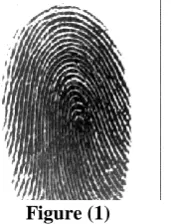
In the Convolutional fingerprint image acquisition device, the user must place his finger on the optical scanner, applying enough pressure in order to achieve good quality fingerprint image. However, this pressure produces inevitable physical distortion arbitrarily, represented differently in every area of the same fingerprint image.[2] Also since fingerprint changes with each impression, each finger print image form the same finger can appear quite different as shown in figure 1, 2 and 3, all fingerprint from one finger of the same person. And thus presents a serious challenge and recognition error during verification.
ISSN(E): 2277-128X, ISSN(P): 2277-6451, pp. 21-26
This is to say that the challenge of fingerprint error is not an image acquisition problem but rather an image processing limitation. [3] Agreed with the researcher and proposed an elastic minutiae matching algorithm using thin plate spline, however, the result revealed that if the finger is highly distorted, to extract usable features are very difficult. Therefore this work presents an adaptive noise cancelling technique that analyzes each fingerprint image pixels using local mean and variance, adopting other image processing and machine learning techniques for accurate recognition.
Research Objectives
i. To implement adaptive filtering technique for processing fingerprint image
ii. To develop a system that employs k-nearest neighbor technique for training and prediction of the fingerprint result
iii. To develop a system that captures fingerprint using any image acquisition device iv. To improve on the conventional Touchless fingerprint recognition accuracy
II. LITERATURE REVIEW
[2] studied Touchless fingerprint recognition system, revealing the challenges of fingerprint image acquisition as a result of pressure variation and propose an elastic minutiae matching algorithm using thin plate spline, however, the result revealed that if the finger is highly distorted, to extract usable features are very difficult. [5] Implemented adaptive noise filtering technique for constant power filtration of the sclera. The work used this filter to process the eye background to perfect Daugman integro differentiator algorithm. [6] Research and presented the introduction of adaptive filters to many applications, such as signal processing, channel equalization, inverse plant modeling, inverse modeling, linear prediction, channel identification, plant identification and Echo cancellation for long distance transmission. In 2017 [7] studied a novel dark channel dehazing algorithm based on adaptive filter enhanced SSR theory, the work focused on low visibility in foggy days, using adaptive filters for the image processing to enhance foggy image.
III. APPROACH
Image acquisition: this process involves the capturing of the query fingerprint image using camera. Here the image acquisition tool in mathlab is employed which has the capacity to access all image acquiring tools like the HD camera (recommended), industrial, scientific, genetic, machine vision, 3D depth, USB3 version, CCTV among others. The image used for the implementation process is that of figure (4)
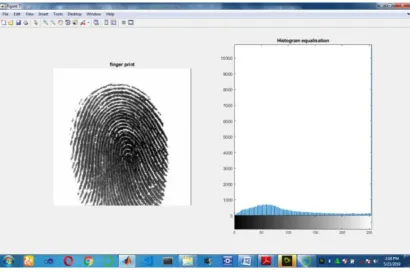
Image pre-processing: This process employs adaptive histogram equalization technique to preprocess the finger print
image regardless of the physical distortion and changes as a result of finger pressure. From the figures (4 and 5) respectively presents histogram equalization of the same fingerprint images of (figure 1 and 2) having different impression.
ISSN(E): 2277-128X, ISSN(P): 2277-6451, pp. 21-26
Figure 5: histogram equalization (b)
Adaptive filter
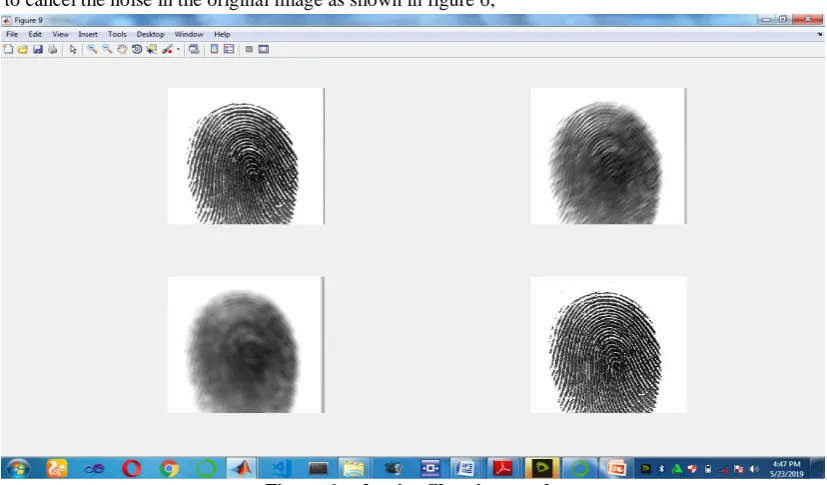
Unlike the conventional linear filter used in most of the existing systems, this filter choice is adopted due to its dynamic filtering ability fashioned to obtain the best possible fingerprint image quality. Adaptive filter according to [9] implies changing characteristics of a filter in some automated means to obtain the best possible image quality in spite of varying image conditions. Adaptive filter has two main applications which are signal and image processing. The image processing applications of this signal has to do with statistical stationary input called wiener filter. This approach will preserve the high frequency part of the image (tiles) based on statistical estimations [5] (local mean and variance) as in equation (i) and (ii) and local neighborhood of each image pixels represented as [m, n] in equation (iii) according to [9] From the equation
μ= 1
nm x1 x2 Enj(x1, x2)……….…………..equation i
2 = 1
nm j
2(x1, x2)
x1 x2 En − μ2……….………....equation ii
Where x is the n-by-m local neighborhood of each pixel in the image.
Wiener2 then creates a pixel wise Wiener filter using these estimates
I (x1, x2) = μ + μ2− v2
μ2 (j(x1, x2) – μ)……… equation iii
Where ν2
is noise variance; if the noise variance is not given, wiener2 uses the average of all the local estimated variances to cancel the noise in the original image as shown in figure 6;
ISSN(E): 2277-128X, ISSN(P): 2277-6451, pp. 21-26
Segmentation
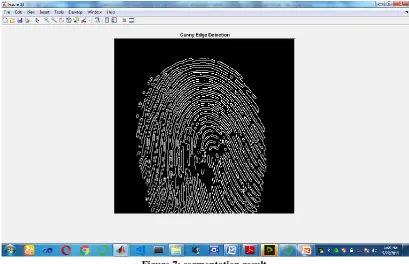
This is the process that maps the interesting section of the fingerprint, revealing the prints patterns for feature extraction process. This technique employs the canny edge detection (see figure 7) algorithm as in [8] proposed for image processing and analysis.
Figure 7: segmentation result
Feature extraction
This process is the dimensionality reduction of the image into a compact feature vector. This extracts statistically the interesting minutiae (features) of the finger print image considering the edges, pixels into a compact feature vector (x and y variables) and in figure 8 and 9 respectively.
Figure 8: (x) variable Figure 9: (y) variables
Classification
The k-nearest neighbor classifiers is used based on similarity measures designed by the spearman distance (Ds) in equation (iv). Given thatmx-by-ndata matrix x, which is mx(1-by-n) row vectors x1, x2……., ..., xmx, andmy-by-n data
matrix y, which ismy(1-by-n) row vectors y1, y2, ...,ymy, the various distances between the vector x and y are defined as
equation (v and vi) respectively [5];
Ds = 1− 𝑟𝑠−‾𝑟𝑠 (𝑟𝑡−‾𝑟𝑡)
′
𝑟𝑠−‾𝑟𝑠
(𝑟𝑡−‾𝑟𝑡)
′
𝑟𝑠−‾𝑟𝑠
(𝑟𝑡−‾𝑟𝑡)
′ ……….equation iv Where:
rsj is the rank of xj taken over x1j, x2j, ...xmx,j,.
rtj is the rank of yj taken over y1j, y2j, ...ymy,j,
ISSN(E): 2277-128X, ISSN(P): 2277-6451, pp. 21-26
‾rs = n1 =(n+1)
2
𝑟𝑠𝑗 ………..equation v
‾rs = n1 = (n+1)
2
𝑟𝑡𝑗 ………..….equation vi
Prediction of result
The approximate k-nearest neighbor technique that uses a matching point of the feature vector descriptor to predict the labeled class is adopted from [1], according to the equation vii;
𝑞 =𝑞=1,,,,,𝑘arg 𝑚𝑖𝑛 𝑇 𝑘
𝐲 𝐶 ( 𝒙 𝑘) 𝑘
𝑘 =1 ………..equation (vii)
Where: q is the predicted classification; k is the number of classes. 𝑇 𝑘
𝒙 is the posterior probability of class k for observation (x).
𝐶 (𝒚
𝑘) is the cost of classifying an observation as (y) when its true class is k
Implementing the function given a set ofnpoints and a distance in equation (1), (2) and (3) respectively, k nearest neighbor (K-NN) search finds the (k) closest points in (x)to a query point or set of points (y) as in figure 10.
Figure 10: training result for x and y (K-NN classification)
Figure 11: recognition result
IV. CONCLUSION
ISSN(E): 2277-128X, ISSN(P): 2277-6451, pp. 21-26
REFERENCE
[1] Asogwa T.C and Ituma C. (2018); the application of machine learning for digital recognition of identical twins to support global crime investigation.
[2] Chulhan Lee, Sanghoon Lee and Jaihie Kin (2006); A study of Touchless fingerprint recognition system. Yonsei Univeristy, Korea.
[3] Bazen, A.M. and Gerez, S.H., ”Elastic minutiae matching by means of thin-plate spline models” Pattern Recognition, 2002. Proceedings. 16th International Conference on Vol. 2, pp. 985 - 988, Aug. 2002.
[4] Martin D., Michal D., Jaroslav U., Eva B., and Tai-hoon K., (2012); influence of skin disease on fingerprint recognition; Journal of biomedical and biotechnology.
[5] Chioma O (2018). Implementation Of Daugman’s Algorithm And Adaptive Noise Filtering Technique For Digital Recognition Of Identical Twin Using Mathlab,
[6] Scott C. (1999); introduction to adaptive filters; Digital Signal Processing Handbook Ed. Vijay K. Madisetti and Douglas B. Williams
[7] Ebtesam M., Hong W. and Peng G. (2017); A novel dark channel dehazing algorithm based on adaptive filter enhanced SSR theory; journal of computer and communication; Vol 5; 60-71.
[8] http://www.Mathwork.com