
Research Article
a
April
2019
Computer Science and Software Engineering
ISSN: 2277-128X (Volume-9, Issue-4)
SDN in Telecom Network
Vishal Vasant Deshpande
Independent Author, Pune, Maharashtra, India
Abstract— SDN shifted the perception of value from hardware to software. Without SDN, disaggregation of the switch hardware and NOS and the emergence SD-WAN would have been far less likely to occur. Yet in reality, the original architectural approach behind SDN has achieved limited acceptance with Telecom Operators, despite high-interest.
The objective of this review paper is to specifically review how Software-defined-networking (SDN) can help Mobile Operator’s in transforming Telecom Networks. Section 1 introduces the challenges that Mobile Telecom Operators are facing. It starts with challenges due to legacy Telecom Network Architecture and then lists challenges in path of quickly adapting to SDN. Section 2 outlines the benefits of SDN, in general as well as specifically to Mobile Network. A quick view into SDN model particularly for Telecom, is mentioned. Section 3 lists Telecom Network Elements which are common SDN candidates. The final section 4, takes a summary view of challenges for SDN adaptation and discusses SDN evolution as a promise to solve these challenges.
Keywords— SDN, NFV, SDR, 5G, EPC, Packet Core
I. INTRODUCTION
Mobile operators are facing new challenges as the new patterns of usage and digital ecosystem emerge. Operators know that relying on traffic forecasts and over-dimensioning may not provide an adequate business case for rolling out nationwide networks. It is a common observation that the existing mobile networks are fragmented and multi-vendor in nature. Telco SDN and similar concepts can provide a real answer to achieving more flexible, scalable and adaptive networks for real world scenarios. [1]
II. CHALLENGES FACED BY MOBILE OPERATORS
Mobile operators are facing new challenges as the new patterns of usage and digital ecosystem emerge. Operators know that relying on traffic forecasts and over-dimensioning may not provide an adequate business case for rolling out nationwide networks. It is a common observation that the existing mobile networks are fragmented and multi-vendor in nature. Telco SDN and similar concepts can provide a real answer to achieving more flexible, scalable and adaptive networks for real world scenarios. [1]
Mobile operators face a unique set of problems today, which stem from massive increases in traffic, on the one hand, alongside relatively slower increases—and often declines—in revenue, on the other. If mobile networks are to remain competitive, such a set of issues demands new solutions. [2]
Current technology infrastructure was built around the seven layer OSI stack. It consists of a number of unique market segments, including optical networks, carrier-grade routers, wireless edge, wireless core, CPE, etc., and the transport network must be tied to a complex set of operational support and billing (OSS/BSS) tools to manage the network and bill the customer. [3]
Though Mobile operators are facing such challenges and though SDN seems to promise solution to such issues, the fact remains that in Telecommunication network ―the way to define SDN is less clear [3]‖ when compared with their Data-center network counterparts. Hence in case of Telecom Network, Mobile operators seems to be cautious in adapting to SDN architecture.
In an interview [16], a CIO of NW Equipment vendor, gave following answer about maturity curve of SDN for Indian Operators…
ISSN(E): 2277-128X, ISSN(P): 2277-6451, pp. 42-49
However, the major problem they face is the issue of security on their SDN journey. Whether it should be domestic or international? Whether the bigger control in the entire topology is robust? Can IT team manage the whole infra like it past two decades? These are few questions occupying minds of CIOs’ who are contemplating to adopt SDN.‖
As noted in [3] SDN (and OpenFlow) technology is clearly impacting the data center network, including data centers in large carriers (e.g., AT&T, SingTel, Telefonica, etc.). However, on the Telecommunication Network side, SDN seems to be in early stage. The 2016 IHS Markit NFV Hardware, Software, and Services Annual Market Report said the telecom industry is still in the early stages of a transition to SDN and NFV architected networks.
Surprisingly, according to the sixth annual ―Carrier SDN Strategies Service Provider Survey‖ in 2018 from IHS Markit still indicated the same observation, that Service providers are in the early stages of a long-term transition to software-defined networks (SDN). Service providers around the globe – representing 44 percent of worldwide telecom capital expenditure (capex) and 44 percent of revenue – are investing in software defined networks (SDNs) as part of a larger move to automate their networks and transform their internal processes, operations, and the way they offer services to their customers. Many operators have some parts of their networks running under SDN control. The rest are moving from their proof-of-concept (POC) investigations and evaluations for SDN toward commercial deployments in the tail end of 2018 and 2019.
As the Gartner blog [14] indicates, SDN had reached pretty close to the trough of disillusionment in its 2017 Enterprise networking hype cycle. There are several reasons for this including:
the conservative nature of networking buyers
concerns of stability and scalability of SDN
technological immaturity of the standards
lack of immediate business drivers
difficulty in putting a value on agility and innovation to prove ROI
protecting the current investment
The size of telecom infrastructure market is estimated to be $100 billion-plus.[3] With infrastructure vendors offering their own flavors of SDN, the interest – and confusion – in the telecoms industry is increasing. [1] Early adopters begin to deploy SDN concepts while mainstream operators attempt to understand the cultural, technical and business implications of the new concepts.
III. BENEFITS OF SDN
Providers view SDN as a key technology underpinning the fundamental changes in telecom network architecture that delivers benefits in new service agility, quicker time to revenue, automation, operational efficiency, and capex savings. Various barriers and drivers have become more prominent, as operators get closer to commercial deployment, although the barriers remain. These barriers include the problem of products that are not carrier grade and difficulty with integration into existing networks.
The top two reasons service providers are investing in and deploying network SDN are the following: Simplification and automation of service provisioning, leading to service agility and quicker time to revenue
End-to-end network management and control as part of increased automation
The majority of service providers are investing in SDN in order to simplify and automate the provisioning of their networks for end-to-end network and service management and control—with the goal of having a global view of network conditions across the various vendors’ equipment, network layers, and technologies. SDN figures in provider plans to generate revenue, with multi-cloud and network slicing for applications and IoT figuring more prominently this year.
SDN has the potential to transform the telecom industry by improving the ability of carriers (both wired and wireless) to flexibly deliver bandwidth "on demand." It is critical that carriers improve both their network flexibility (improved customer value) and reduce their high operational costs as over-the-top providers (e.g., Google, Amazon, Skype, etc.) challenge the carriers' ability to grow their revenues and impact their margins. [3]
The promise of SDN for the telecom industry is significant improvements in the manageability and flexibility of the network. This promise includes:
automated traffic management,
improved bandwidth engineering,
the ability to tailor the network "on demand" to customer needs.
ISSN(E): 2277-128X, ISSN(P): 2277-6451, pp. 42-49
Another listing of Advantages of SDN for Cellular Networks as per [11] gives a good view that not only Mobile operators but also subscribers (better mobility, more NW reliability) get benefitted due to SDN. Here are these advantages listed in [11]:
A. Advantage of logically centralized control plane
Flexible support of middleboxes
Better inter-cell interference management
Scalable distributed enforcement of QoS and firewall policies in data plane Flexible support of virtual operators by partitioning flow space
B. Advantage of common control protocol
Seamless subscriber mobility across technologies
C. Advantage of SDN switch
Traffic counters enable easy monitoring for network control and billing
SDN is likely to reshape the telecom industry in new and interesting ways. Incumbent carriers are looking to increase the flexibility and manageability of their networks to deliver bandwidth where and when customers need it with a (more) self-serve model.
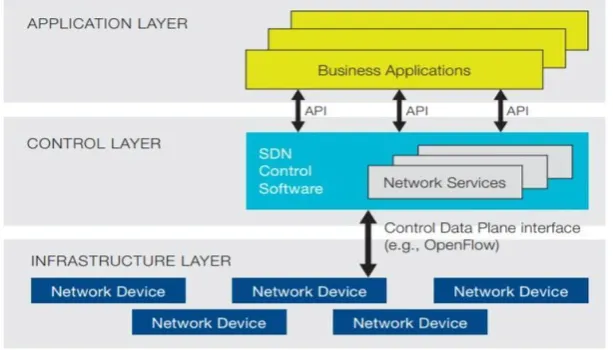
Large network equipment providers and startups are starting to invest heavily in new software centric network solutions. OpenFlow (fig1) and other enterprise SDN technologies will emerge first in the cloud data centers of the large carriers. Telecom-specific SDN technologies (in both the transport and management areas) have been in market since 2013 and help carriers to improve their network flexibility and reduce network operations costs over the next three years.
Fig 1: ONF Layered NW Architecture (Courtesy: ONF)
SDN Models [5] may take various forms and accordingly benefits could change:
The network virtualization model: Merely Virtualized Infra, focusing on physical separation only.
The “evolutionary" model: With this model, the goal is to enhance software control of the network and its operations but within the boundaries of current networking technology.
The OpenFlow model: This model replaces the traditional, discovery-based creation of forwarding tables in switches and routers with centrally controlled forwarding. This means that a central controller, which has a view of the whole network, programs each device's forwarding table.
Early pilot tests and deployments suggest that OpenFlow can improve network availability and reliability while increasing network utilizations, thus reducing both capital infrastructure costs and operational expenses. If OpenFlow switches become pervasive over time, then it's possible that future networks could be built with open hardware at much lower cost.
Carriers hope SDN that can bring significant changes to their (relatively) static networks.
OPEX savings from SDN:
ISSN(E): 2277-128X, ISSN(P): 2277-6451, pp. 42-49
The benefits this can bring to telecoms service providers are profound and can all be passed on to the customer. Replacing proprietary pieces of hardware with standardized servers and networking brings the agility to deliver new services dynamically while significantly reducing CAPEX and OPEX costs. This liberates the carriers from hardware lock-in which lock-incurs extra costs further down the llock-ine; while belock-ing a boon to their customers fatigued from service providers being unable to adapt and deliver services that address changing business needs. The elevation of all the network functions to a single virtualized infrastructure with a common framework also means OPEX costs are likewise reduced, as operational visibility and management is simplified.
In addition to these benefits, it is also observed that in some cases, SDN based switches have given a better performance than the traditional physical switch. Following tables from [10] clearly indicates the performance benefit of using OpenFlow Switch.
Table I Performance Comparison (source: [10])
IV. CANDIDATE SDN COMPONENTS IN TELECOM NETWORK
In the context of telecom networks, telco SDN refers to separation of the control and data layers, virtualization of network components and service exposure, although each vendor may have a different strategy according to their technical legacy and existing product lines. [1] Fig 2 depicts a generic view for Network Function Virtualization.
ISSN(E): 2277-128X, ISSN(P): 2277-6451, pp. 42-49
In the enterprise, SDN is defined as follows:
Separation of control and data plane -- e.g., the intelligence of the switch/router is split out from the packet forwarding engine.
Programmability. The ability to centrally change traffic flows, partition the networks and provide application-level QoS
Accordingly, before deciding the candidate Network elements as a selected SDN component/function, operators need to review their current network architecture. It is not uncommon to have high-degree of centralization of data-plane (Fig3) and high-degree of distribution in control plane [11] (Fig 4).
Fig3: Centralized Data Plane (Source: [11])
Fig4: Distribution in Control plane (Source: [11])
Hence Operators can start with reviewing following two aspects w.r.t. their present deployments, before choosing what parts of current architecture will be transformed into SDN components.
A. SDN At Radio Access: SDR (Software Defined Radio)
At this stage, its important to mention Software-defined-radio as an important consideration of Telecom Operator’s SDN transformation. It is not necessarily the first (or even one of the firsts) component to be considered for SDN transformation. Still it’s mention here is to preserve the logical sequence of starting with RAN as first part of EPC (Enhanced Packet Core) Network.
ISSN(E): 2277-128X, ISSN(P): 2277-6451, pp. 42-49
(Note: The paper [12] gives good definition of SDR along-with its functional architecture and some nice pictures of SDR available in market. Interested readers are suggested to visit it for further information)
B. SDN At Customer EDGE
The benefits of telco SDN increase towards the edge of the network and are maximum when facing the end user. For example, a virtualized CPE will not require continuous upgrades when a fixed operator upgrades to new technologies.
C. SDN At Customer EPC-Core
On the other hand, the Enhanced Packet Core (EPC) is a part of the network that is more likely to be virtualized in the short term, due to its flat (IP) nature and the need for components to be flexible and scalable. The core network is far more centralized compared to the RAN and as such, easier to upgrade, maintain and virtualize.
EPC components include the MME (mobility management) and gateways (PGW, SGW) which may be implemented in software and run from data centres in order to provide a more scalable and flexible architecture. Specific functionality of the network may be exposed to trusted third parties while operators will be able to create customized services for groups of customers, or even individual premium customers (SMEs or enterprises).
A number of large equipment vendors have publicly discussed their SDN strategy, including Cisco, Juniper, Huawei, Infinera, Ciena, NetScout. According to [3] Cisco cited telecom SDN as its reason for recently acquiring Cariden for $141 million. There are a number of startups tying their products to telecom SDN, including Big Switch, ConteXtream, Cyan, Vello Systems and Intune Networks. The technology vendors are all vying for the attention of the big carriers that have expressed interest in SDN.
D. How does it compare with IMS (IP-Multimedia Subsystem)?
It’s useful to quickly review a similar-looking technology and draw parallels. As described in [1], in many cases, telco SDN reminds of previous, somewhat unsuccessful initiatives, including IMS. But in a way, SDN is already an established concept in the IT domain in the form of OpenFlow and OpenStack; although this is in a different context, it offers similar benefits to both IT and telecoms service providers. Increased scalability, flexibility, cost savings and less dependence on overprovisioning for network design are a few examples of short-term benefits SDN brings to both IT and telecoms. In the long term, the concept will allow for new service architectures, service exposure, new revenue opportunities and more efficient operations.
SDN and IMS promise – among other things – horizontalization of network infrastructure and easier service exposure to third parties but are without clear new business and revenue opportunities. However, there are several differences from previous technologies, especially IMS.
Telco SDN (and NFV) has serious advantages:
SDN is already being implemented in the IT domain, and operators and vendors will have learned from their involvement in IMS.
SDN is attempting to enter the market by applying practices and technologies from the IT domain to the telecoms
environment – this is in contrast with IMS, which was a completely new and very optimistic concept.
Moreover, the vendors involved in SDN and virtualization also come from the IT domain and have experience of large-scale IP networks – which is the ultimate convergence of mobile networks.
V. SDN EVOLUTION AND FUTURE
Some considerations still remain as a challenge for Operators, in quickly and completely adapting to SDN architecture.
A. Interfacing considerations
What is the standard API (and its hardware dependencies)?
And how does one create an ecosystem of applications that leverage the programmability?
How to tie applications and traffic management systems to the underlying network infrastructure?
B. Cost Considerations
Though Edge networks are probably the best candidates and appear to be first to evolve, the cost to virtualize the edge of the network – especially when considering radio networks – is prohibitively expensive.
ISSN(E): 2277-128X, ISSN(P): 2277-6451, pp. 42-49
As mentioned in a report from Heavy Reading [17], ―A lot remains to be sorted out regarding SDN. No doubt SDN is a topic that will require significant research and analysis in the coming months.‖
Current thinking regarding SDN is from four specific perspectives:
SDN in carrier transport networks (including the likely path of SDN through the standards process)
The importance of SDN and OpenFlow to optical networking
The role of SDN in cloud-based services
The use of SDN technology in carrier data centers to optimize application delivery
As indicated in [4] Software defined networking (SDN) and NFV can be used independently, but SDN makes it much easier to implement and manage NFV. SDN manages network complexity via a network-wide software platform that enables centralized network coordination, control and programmability. SDN provides a programmable and customizable interface that controls and orchestrates the operation of a collection of devices at different levels of abstraction. With it, users can dynamically reconfigure the network to plumb in a function running on a server in the appropriate place in the network using just software mechanisms. Without it, NFV would require much more manual intervention to configure the network to appropriately plumb in software instantiated functions.
The following figure (Fig5) suggests a typical evolution journey of Telecom Operators’ adaption of SDN [9]. The operators would usually begin with the focus on Infrastructure first, to increase virtualization.
Fig 5: Typical Evolution Journey for SDN (courtesy: [9])
SDN effectively converts all the major resources provided by servers -- compute capacity, memory, storage, and even bandwidth itself -- into commodities [7]. Methodologies such as hyperconvergence are made possible by SDN. With each of these classes of resource dumped into pools of building blocks, like separating Legos of different colors and shapes, a configuration management system can "spin up" a virtual network with only the resources needed to execute a specific workload. That configuration can be tailored over time, adjusted in response to revelations about that workload's performance.
In a report [8], the future direction is quite well outlined. It says ―What is clear, however, is that virtualization, programmability and network automation, enabled by these new technologies, will drive down industry operating costs considerably.‖ Bringing NFV and SDN into public telecommunications networks across the EU telecom industry could produce the following results, according to estimates [8]:
As much as 14 billion euros in direct network operating expense (OPEX) savings
A further 25 billion euros of non-network savings from much needed changes in the operating model of the industry — leading to a total savings of 39 billion euros, or 26 percent of overall OPEX
VI. CONCLUSIONS
ISSN(E): 2277-128X, ISSN(P): 2277-6451, pp. 42-49
ABBREVIATIONS AND ACRONYMS
API Application Programming Interface
CAPEX Capital-Expenditure
CPE Customer Premise Equipment
IMS IP-multimedia Subsystem
NOS Network Operating System
ONF Open Network Foundation
OPEX Operating Expenditure
RAN Radio Access Network
SDN Software Defined Network
SDR Software Defined Radio
SD-WAN Software Defined Wireless Area Network
ACKNOWLEDGMENT
Sincere thanks to all the article writers mentioned in Reference section. Also, thanks to IEEE, TMF and ONF for making these articles available in open way for reference.
REFERENCES
[1] Dimitris Mavrakis, ―Telco SDN: Revolutionary Benefits of Telco SDN,‖
https://www.sdxcentral.com/articles/contributed/telco-sdn/2013/05/
[2] Mar 31, 2016 article from NEC, https://www.nec.com/en/global/ad/insite/article/sdn05.html
[3] Lee Doyle, ―What does SDN mean for telecom infrastructure?‖ in NetworkWorld from IDG.
[4] FN Division Telecommunication Engineering Center, ―Network Function Virtualization(NFV) & Its impact on
Future Telecom Networks‖.
[5] Tom Nolle, ―Three models of SDN explained‖, (technical) Tip published in searchnetworking.techtarget.com/
[6] By Telecom.com, "SDN & NFV : The Future for Telecoms" featured in NEC Article
[7] Scott Fulton III, "What is SDN? How software-defined networking changed everything", publishe in Zdnet on
May 22, 2018
[8] Narayan Raman et. al., "Reshaping the future with NFV and SDN", published in Arthur D Little - Bell Labs journal May 2015
[9] Santiago Andrés Azcoitia, "The disruptive force of NFV and SDN", TMF Feature and Analysis, February, 2016
[10] Ambrose Ahurra, Diarmuid O'Briain, Kenneth Maathe Kamurali, Dorothy Okello, "Software Defined
Networking , a comparison with the Legacy network", April 2017, publication # 316666791
[11] Li Erran, Li Z. Morley, Mao Jennifer Rexford, "Toward Software-Defined Cellular Networks", ppt presentation
[12] Wireless innovation Document at
https://www.wirelessinnovation.org/assets/documents/SoftwareDefinedRadio.pdf
[13] Left blank on purpose.
[14] Andrew Lerner, "The State of SDN", a Gartner blog in September 2017 [15] Andrew Lerner, "Networking Hype", a Gartner blog
[16] Yogesh Gupta, "SDN is steadily exiting the hype cycle in India: Dinesh Verma, Juniper", a press released for ―CIO.in‖ in Aug 2018
![Table I Performance Comparison (source: [10])](https://thumb-us.123doks.com/thumbv2/123dok_us/7802681.2084454/4.595.109.487.541.764/table-i-performance-comparison-source.webp)
![Fig 5: Typical Evolution Journey for SDN (courtesy: [9])](https://thumb-us.123doks.com/thumbv2/123dok_us/7802681.2084454/7.595.121.472.286.512/fig-typical-evolution-journey-sdn-courtesy.webp)
