© 2019 by the Serbian Biological Society How to cite this article: Bogdanović S, Jelušić A, Berić T, Nikolić I, Danilović B, 95 Stanković S, Dimkić I. Genetic polymorphism of lactic acid bacteria isolated from
“Pirot ‘ironed’ sausage” from Serbia. Arch Biol Sci. 2019;71(1):95-102.
Genetic polymorphism of lactic acid bacteria isolated from “Pirot ‘ironed’ sausage” from
Serbia
Svetlana Bogdanović1, Aleksandra Jelušić2, Tanja Berić2, Ivan Nikolić2, Bojana Danilović3, Slaviša Stanković2
and Ivica Dimkić2,*
1High Agrifood School of Professional Studies, Ćirila i Metodija 1, 18400 Prokuplje, Serbia
2Faculty of Biology, University of Belgrade, Studentski trg 16, 11000 Belgrade, Serbia
3Faculty of Technology, University of Niš, Bulevar Oslobođenja 124, 16000 Leskovac, Serbia
*Corresponding author: [email protected]
Received: September 20, 2018; Revised: October 31, 2018; Accepted: November 5, 2018; Published online: November 9, 2018
Abstract: The “Pirot ‘ironed’ sausage” (Pis) is a traditional, dry, fermented product originating from the town of Pirot, situated in southeastern Serbia. This product is made from different types of meat (goat, sheep, beef and donkey) and spices, without additives or starter cultures. Pis is an organic, unprocessed product, without heat or smoke treatment. The aim of this study was to characterize 120 isolates of lactic acid bacteria (LAB) from Pis produced by six different brands during a two-year period using phenotypic and genetic identification. Preliminary characterization of the LAB was based
on general morphology and biochemical tests. Repetitive elements such as REP, BOX and GTG5, found in the genome of
these bacteria, and randomly amplified polymorphic DNA-polymerase chain reaction (RAPD PCR) sequences were used for determination of genetic polymorphism. Identification by 16S rRNA gene sequencing showed the presence of only two
LAB species, Lactobacillus sakei (76%) and Leuconostoc mesenteroides (24%). However, genetic polymorphism was detected
using fingerprinting methods. In comparison with other primers, the profiles obtained with GTG5 showed the highest
heterogeneity for most of the tested isolates, with sequencing results additionally confirming its discriminatory power. In addition, M13 RAPD primer also produced satisfactory separation of the tested isolates.
Keywords: Pirot ‘ironed’sausage; GTG5 PCR; Lactobacillus sakei; Leuconostoc mesenteroides
INTRODUCTION
The Pirot ‘ironed’sausage is a traditional, dry, fermented product made from top quality meat, mixed with spices, such as paprika (sweet or hot), salt, pepper and garlic. This traditional product originates from the town of Pirot which is situated in southeastern Serbia. For pro-duction of the so-called flat, ‘ironed’ sausage, several different types of meat are used, principally selected pieces of non-fat goat meat, donkey or horse meat, sheep and beef. The best taste is achieved by combining differ-ent types of meat. While the ingredidiffer-ents are not secret, the recipe is always kept in the family circle. There is no universal recipe, and each producer has their own process of production. Pis is an organic, unprocessed product without preservatives, starter cultures, artifi-cial additives, heat treatment or exposure to smoke.
industrially produced sausages with defined starter cultures that depend on the composition and metabolic activity of domestic microflora [1]. The microbial profile of fermented sausages consists mainly of LAB, which are specially adapted to the ecology of meat fermenta-tion. LAB have a great influence on the entire process of fermentation and preservation by preventing the growth of other opportunistic bacteria [1-3]. The abil-ity of LAB to decrease the pH by producing acid from sugars prevents the growth of pathogens and ensures the stability and safety of the final product [4]. In addi-tion, LAB also show some other characteristics that can contribute to a better quality of meat products, such as production of aromatogenic substances and bacteriocins. Thus, they can be used for food preservation, as starter cultures in the production of various products, but also as probiotics [5]. Among LAB, the most commonly determined species in meat products are Lactobacillus sakei, L. curvatus and L. plantarum, with L. sakei the most frequently isolated species [4,6]. Classical tests used for LAB identification can be problematic, difficult to interpret, time-consuming, and sometimes, in cases of uncultivable organisms, impossible [7,8]. Therefore, the correct classification and identification of LAB are difficult without the support of genotypic techniques which are a faster alternative [9,10]. These methods are reliable, straightforward and their application avoids subjective interpretation [11]. Thus, PCR amplification of repetitive bacterial DNA elements (rep-PCR) is rec-ognized as a simple PCR-based technique with a high discriminatory power and low cost and it is used for classifying and typing a wide range of Gram-negative and several Gram-positive bacteria [8]. Rep-PCR fin-gerprinting methods can give comparative results, even when using only one primer, such as GTG5,which was proven to be one of the best elements for Lactobacillus determination [2,8,10,12]. On the other hand, RAPD requires the use of more than one primer for strain characterization in most cases [13].
The aim of this study was to determine the pheno-typic and genetic identification of LAB isolates from Pis produced by six different brands over a two-year period, and to establish their potential differences due to their different meat content. In addition, we investi-gated which fingerprinting method best reflected the inter- and intraspecies genetic heterogeneity among Lactobacillus and Leuconostoc isolates.
MATERIALS AND METHODS
Bacterial strains
A total of 120 bacterial isolates from Pis manufactured by six different producers in their personal households located around the city of Pirot in Serbia (43.1557° N, 22.5857° E) were used for this research. The Pis were made exclusively in the home environment, i.e. they did not require the existence of any production unit, and the production capacity was in smaller quantities. The analysis was comprised of isolates sampled during a two-year period (2013 and 2014) from producers 1 (27 isolates), 3 (32 isolates) and 4 (29 isolates), whereas in the case of producers 2 (10 isolates), 5 (12 isolates) and 6 (10 isolates), only samples isolated in 2014 were used. The isolates obtained in 2013 are marked with the prefix pK, whereas isolates from 2014 have no prefix, and the first number is the serial number of the producer. Dif-ferent producers were chosen based on the meat types used in the sausage-making process, on variations in their percentage distribution, as well as on different drying methods, as shown in Supplementary Table S1.
The isolates were sampled from randomly chosen sausages produced by a certain producer (two sausages per producer were used and pooled into one sample), by making cuts in 5-6 places with a sterile scalpel. Ten grams of the inner part of the sausages was sampled and immersed into 90 mL of saline solution with the addition of 0.9 g of peptone [4]. Serial dilutions were made after 20 min of shaking, and these were plated on de Man, Rogosa and Sharpe (MRS) agar and in-cubated at 30ºC for 24 h under aerobic conditions. A total of 120 isolates were chosen according to colony morphology as LAB.
Bacterial isolation and biochemical characteriza-tion were performed in the Laboratory of the Agri-food School of Professional Studies during 2013 and 2014, while the molecular analysis carried out at the Department of Microbiology at the Faculty of Biology University of Belgrade during 2015 and 2016.
Biochemical characterization of bacterial strains
from glucose, the ability to grow at different tem-peratures (+15 and +45ºC), tolerance to different salt concentrations (4 and 6.5% of NaCl), as well as for arginine and aesculin hydrolysis [14].
DNA fingerprint analysis
Genomic DNA was isolated according to the method described inDimkić et al. [15]. Rep-PCR and RAPD PCR fingerprinting analysis were performed accord-ing to the optimized programs for each of the prim-ers (REP1R-I (IIIICGICGICATCIGGC) and REP2-I (IIICGNCGNCATCNGGC) [10]; BOXA1R (CTACG-GCAAGGCGACGCTGACG) [6]; GTG5 (GTGGTG-GTGGTGGTG) [10]; and M13 (GAGGGTGGCG-GTTCT) [16]). The PCR amplification was performed in a 25-μL reaction mixture containing: 0.1-1 μg of template DNA, 10×KAPA Taq Buffer, MgCl2 at a final concentration of 25 mM, a 200-μmol/L concentration of each dNTP, each primer at a final concentration of 10µM and 5 U/µL of KAPA Taq polymerase (KAPA Biosystems, USA). The PCR reactions were performed under the following conditions: initial denaturation step at 95ºC for 7 min (for REP and BOX PCR), and for 5 min (for GTG5 and RAPD PCR), followed by 35 cycles at 94ºC for 1 min (for REP and RAPD PCR) and 30 s (for GTG5 PCR), and 30 cycles at 94ºC for 1 min (for BOX PCR); primer annealing at 40ºC for 1 min (for REP PCR) or for 20 s (for RAPD PCR), or primer annealing for 1 min (for GTG5 PCR) at 45ºC, and for 1 min (for BOX PCR) at 52ºC, and a 65ºC polymerization step for 8 min (for REP and BOX), or at 72ºC for 4 min (for GTG5 PCR) and for 2 min (for RAPD PCR). The final extension step was performed at 65ºC for 16 min (for REP and BOX), or at 72ºC for 7 min for (for GTG5 PCR), and at 75ºC for 5 min in the case of RAPD PCR.
Phylogenetic analysis
The total DNA from the selected isolates was used as a template for PCR amplification of the 16S rRNA gene, with universal primers UN116sF (GAGAGTTT-GATCCTGGC) and UN116sR (AGGAGGTGATC-CAGCCG). The PCR reaction mixture was prepared as described above. The PCR reactions were performed with primer annealing at 50ºC for 1 min. The PCR
products were purified using a column of QIAquick PCR Purification and Gel Extraction KIT/250 (QIAGEN GmbH, Hilden, Germany) and sequenced commercially by the Macrogen sequencing service (Netherlands). The obtained sequences were searched for homology with deposited genes in the GenBank database using the National Center for Biotechnology Information Blast search program for nucleotides. All sequences were aligned using ClustalW multiple sequence alignment implemented in BioEdit 7.1.3 program, and phylo-genetic trees were constructed in MEGA 6 using the neighbor-joining method based on a pair-wise distance matrix with the Kimura two-parameter nucleotide substitution model. The obtained DNA fingerprint profiles were used for dendrogram construction by free download software PyElph 1.4 [17].
RESULTS
Bacterial strains and biochemical characterization
Preliminary phenotypic identification of 120 LAB isolates showed two different types of colony mor-phologies. The first morphology was characterized as small, white, smooth and opaque (type I), and the second as slimy and transparent (type II). Gram stain-ing showed that all isolates belong to Gram-positive rods or coccoid rods, indicating that most of them probably belong to Lactobacillus and Leuconostoc genera, respectively. Biochemical tests showed that all isolates had the ability to grow at 15ºC in the presence of 4% and 6.5% of NaCl, while production of CO2 from glucose, growth at 45ºC, arginine and aesculin hydrolysis were not detected.
DNA fingerprint profiling
number of different fingerprinting profiles obtained by dendrogram analysis are presented in Table 1.
Table 1. The number of different fingerprinting profiles obtained using different primers for all analyzed producers.
Producers Number of tested isolates REP BOX GTG5 M13
1 15 7 10 6 6
2 10 5 4 7 3
3 17 6 11 11 10
4 14 6 3 8 7
5 12 5 8 7 7
6 9 4 2 2 4
Σ 77 33 38 41 37
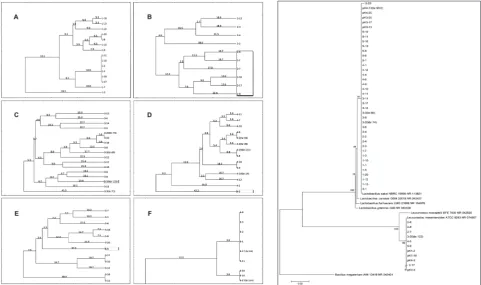
Compared to the other primers used in this study, GTG5 PCR produced the greatest number of different patterns – 41 out of 77 tested isolates (Fig. 1). Slightly less discriminatory than GTG5 PCR were BOX and M13 primers (Supplementary Figs. 1 and 2), which produced 38 and 37 different patterns, respectively. Using REP-PCR, 33 different patterns were obtained
(Supplementary Fig. 3). After choosing GTG5 PCR as the best profiling method, we screened the entire col-lection (all 120 isolates) using this primer and selected 51 isolates with different patterns to be subjected to 16S rRNA gene sequencing. The isolates were clearly grouped in two clusters on the phylogenetic tree (Fig. 2). The majority of the isolates (76%) were grouped together with the referent strain L. sakei NBRC 15893, and the rest of the isolates (24%) were grouped with the referent strain Leuconostoc mesenteroides ATCC 8293. In comparison with other primers, GTG5 revealed the highest heterogeneity between the tested sausage producers (Fig. 1). In this study, all isolated strains belonging to producers 1 and 6 are listed as L. sakei, even though they were placed into six different clusters based on their GTG5 pattern similarities (sausage from producer 1). However, the LAB content of sausages made by producer 2 showed a higher presence of L. mesenteroides (isolates 2-1; 2-6; 2-7; 2-8; 2-17, and 2-18). In the Pis from producers 3, 4 and 5, L. sakei was the dominant species and L.mesenteroides was presented
Fig. 1. Dendrograms obtained by UPGMA analysis of the tested isolates from producers 1 (A), 2 (B), 3 (C), 4 (D), 5 (E) and 6 (F) using GTG5 PCR. Genetic distances are presented with numbers placed on the branches. Isolates in rectangles were identified as L. mesenteroides.
only as one monophyletic branch with isolates 3-20, 4-5 and 5-9, respectively. All of them exhibited high similarity levels with other strains of L. sakei.
Comparative analysis of isolates from sausages made by different producers
In order to detect potential differences in dominant microflora among sausages that differ only in the percentage of types of meat and in the duration of ventilation, from producers 2 (beef 30%, sheep 15%, goat 15%, donkey 40%; 23 days of ripening), 4 (beef 40%, sheep 10%, goat 25%, donkey 25%; 30 days of ripening), 5 (beef 50%, sheep 20%, goat 20%, donkey 10%; 28 days of ripening) and 6 (beef 60%, sheep 25%, goat 10%, donkey 5%; 20 days of ripening), the GTG5 PCR patterns were compared (Fig. 3). Two clusters and one separate monophyletic branch with the isolate 2-2 were obtained on the dendrogram. Isolates from producers 2 and 5 were mainly grouped within the first cluster, whereas most of the LAB isolated from the Pis of producers 4 and 6 were associated in the second cluster. The dominant meat type in sausages produced by producers 4, 5 and 6 was beef and for producer 2 donkey meat was the main component (Supplemen-tary Table S1). Also, sausages from producers 2 and 5 had almost equal percentages of goat and sheep meat. Regarding species distribution, L.mesenteroides isolates were grouped together and clearly separated from the L. sakei strains, especially for producer 2. For produc-ers 4 and 5, two L.mesenteroides strains (4-5 and 5-9) were also observed as distant single branches.
Fig. 3. Dendrograms obtained by UPGMA analysis of the tested isolates from producers 2, 4, 5 and 6 using GTG5 PCR. Genetic distances are presented with numbers placed on the branches. Isolates in rectangles are identified as L. mesenteroides.
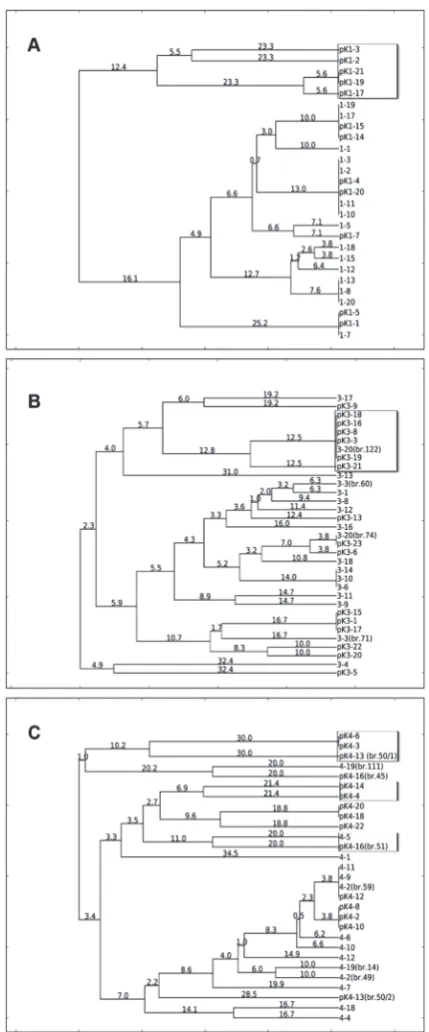
To ascertain whether there was a difference in the distribution of LAB isolates during the two-year period, dendrogram analysis of isolates from producers 1, 3 and 4 was performed (Fig. 4). Almost all isolates of producer 1 (Fig. 4A) from 2013 were clustered together with the isolates from 2014, and according to sequence analysis, they belong to L. sakei species. However, five isolates (pK1-2, pK1-3, pK1-17, pK1-19, pK1-21), identified as L. mesenteroides, were detected only in the samples from 2013. Three distinct clusters were obtained on the dendrogram for producer 3 (Fig. 4B). A number of the isolates from 2013 were clus-tered together with one from 2014 (3-20(br.122)) and identified as L. mesenteroides (pK3-3; pK3-8; pK-3-16; pK-3-18; pK3-19, and pK3-21), while the other strains were identified as L. sakei. The isolate distribution for producer 4 is presented in Fig. 4C. Three major clusters were formed. The first cluster was dominated by L. mesenteroides isolates from both years. In the second cluster, isolates from 2013 prevailed (both L. mesenteroides and L. sakei). The largest, third group was composed of isolates from 2014, with L. sakei as the exclusive species.
DISCUSSION
The preliminary phenotypic and biochemical identi-fication of 120 LAB isolates was in accordance with previous studies of these isolates [2,18], indicating that they belong to Lactobacillus and Leuconostoc genera. Phenotypic identification and characterization of LAB is insufficient, primarily because many bacterial strains have similar cell morphology, physiology and growth under the same conditions. Consequently, there is a need to complement the phenotypic characteriza-tion results with genetic characterizacharacteriza-tion [13]. Highly conserved repetitive DNA such as REP, BOX, GTG5 and M13 RAPD profiling elements are widely distrib-uted in the genomes of many bacterial groups [19]. Because of such a distribution in the small genomes of prokaryotic organisms, they can be used as rapid and reliable methods for typing a wide range of Gram-negative and several Gram-positive bacteria [20-22]. Rep-PCR techniques have been used previously and compared for their ability to type Lactobacillus strains where oligonucleotide primes such as ERIC [23] or BOX [8,10] were used together with GTG5. Hyytiä-Trees et
al. [24] suggested that by using a combination of rep-PCR (BOX and REP) and RAPD primers an adequate level of discrimination among L. sakei strains can be achieved. Contrary to that, Tran et al. [8] indicated that molecular patterns generated by REP and BOX prim-ers were not discriminatory enough for isolates from Vietnamese fermented sausages, unlike GTG5, which created more complex and diverse patterns. Gevers et al. [10] also found that the discriminatory significance was not improved when combining BOX, REP and GTG5 banding patterns, and that typing of LAB strains can be performed only using the GTG5 primer instead of multiple primers. This fingerprinting primer can be used for identification and possibly for intraspecies differentiation and is especially useful for screening a large number of strains [10]. Based on sequencing data and comparison between fingerprinting profiles, it was clear that GTG5 PCR could be a method of choice for further research into polymorphism within species of LAB. The sequencing results of isolates from the Pis pointed to the existence of only two species, L. sakei and L. mesenteroides.Among lactobacilli, L. sakei is the species that is best adapted to the fermentation processes, so it is not surprising that it was found in this type of meat product [1,4]. The domination of L. sakei in fermented sausages was also reported by several authors [16,25,26]. Leuconostoc mesenteroides appeared in a small percentage in the tested sausages. Its low presence was also confirmed in earlier studies [4,26,27]. In Petrovska sausage, which is also a tradition-ally manufactured product, L. mesenteroides (37.1%) comprises the dominant microflora with lactobacilli [2]. Generally, Leuconostoc strains are heterofermenta-tive and undesirable in meat products because of their ability to produce CO2 and form holes in the products [28]. On the other hand, they are able to produce acetic acid, acetaldehyde, diacetyl and ethanol, which form the characteristic taste and aroma of the product [29].
Lactobacillus species were always present (L. curvatus in Greek sausages; L. sakei in Hungarian; L. curvatus and L. sakei in Italian sausages). L. plantarum, L. sakei and L. curvatus are species found in all three types of sausages. Papamanoli et al. [1] also showed the absence of significant differences in microbiomes among two types of Greek sausages, both made of beef and pork meat, but with different meat contents, fermentation and duration of drying. Cluster analysis presented in an earlier study of Lactobacillus profiles [26] revealed that some strains were grouped in fermentation-spe-cific clusters, which arose from the ingredients used in production. In the same study, L. sakei showed a higher degree of heterogeneity, which was confirmed by strains that did not group evenly. Results of this study revealed the presence of L. mesenteroides in 2013, which could be a consequence of factors that we did not follow. One of the reasons could be due to the year’s batch of sheep small intestines used for sausage filling and/or the batch of spices used for cur-ing the sausage (salt, garlic, pepper, and sweet or chili cayenne pepper). Apart from the marked presence of L. mesenteroides in 2013, our result suggests that the isolate distribution of L. sakei was not affected in any conceivable way by the year of production. It is an established fact that traditionally-made fermented sausages rely wholly on environmental microflora [30]. Thus, differences can appear as a consequence of different environmental factors, such as temperature variations or humidity, and even the human factor. Meat can come into contact with environmental mi-croflora in many different ways. Some bacteria linger on animal skin or inside the natural casings used in the process of making traditional sausages. Also, every segment of preparing can lead to new contacts with environmental bacteria − knives, the working surface, skin or clothes of the manufacturer.
In conclusion, the microbial heterogeneity of the Pis was not significantly different from other naturally-fermented sausages previously described. However, this study recommends GTG5 fingerprinting as the best rep-PCR technique for LAB typing, with the strongest discriminatory power. The high genetic heterogeneity of L. sakei isolates could be important for the specific nature of naturally-fermented Pis. Also, the higher number of L. sakei isolates in all 6 producers could be an advantage because of their
potential characteristics (starter culture, production of potent bacteriocins), which can repress unwanted bacterial growth that might cause sliminess, malodor and other product defects. The differences in drying time, usage of unusual meat combinations, as well as the large number of producers, provide a good starting point for a diverse microflora and for the character-ization of novel potential starter cultures, particularly because this product is made according to traditional procedures. All of these characteristics revealing the high quality of this authentic Serbian specialty that has great potential for expansion on world markets.
Funding: This work was supported by the Ministry of Educa-tion, Science and Technological Development of Serbia, Grant No. 173026. The funding agency had no role in the study design, data collection and analysis, decision to publish, or preparation of the manuscript.
Author contributions: ID, SS and TB conceived and designed the experiments; ID, SB and AJ wrote the paper; ID and TB checked the results and the language; SB, AJ, IN and BD performed the experi-ments; SS contributed the reagents, materials and analysis tools. Conflict of interest disclosure: The authors declare that there is no conflict of interest.
REFERENCES
1. Papamanoli E, Tzanetakis N, Litopoulou-Tzanetaki E, Kotze-kidou P. Characterization of lactic acid bacteria isolated from a Greek dry-fermented sausage in respect of their technologi-cal and probiotic properties. Meat Sci. 2003;65(2):859-67. 2. Danilović B, Joković N, Petrović L, Veljović K, Tolinački M,
Savić D. The characterisation of lactic acid bacteria during the fermentation of an artisan Serbian sausage (Petrovská Klobása). Meat Sci. 2011;88(4):668-74.
3. Hugas M, Monfort JM. Bacterial starter cultures for meat fer-mentation. Food Chem. 1997;59(4):547-54.
4. Urso R, Comi G, Cocolin L. Ecology of lactic acid bac-teria in Italian fermented sausages: isolation, identifica-tion and molecular characterizaidentifica-tion. Syst Appl Microbiol. 2006;29(8):671-80.
5. Riboulet-Bisson E, Sturme MH, Jeffery IB, O’Donnell MM, Neville BA, Forde BM, Lawlor PG. Effect of Lactobacillus sali-varius bacteriocin Abp118 on the mouse and pig intestinal microbiota. PLoS One. 2012;7(2):e31113.
8. Tran KT, May BK, Smooker PM, Van TT, Coloe PJ. Distribu-tion and genetic diversity of lactic acid bacteria from tradi-tional fermented sausage. Food Res Int. 2011;44(1):338-44. 9. Gancheva A, Pot B, Vanhonacker K, Hoste B, Kersters K. A
polyphasic approach towards the identification of strains belonging to Lactobacillus acidophilus and related species. Syst Appl Microbiol. 1999; 22(4):573-85.
10. Gevers D, Huys G, Swings J. Applicability of rep-PCR fin-gerprinting for identification of Lactobacillus species. FEMS Microbiol Lett. 2001;205(1):31-6.
11. Rantsiou K, Drosinos EH, Gialitaki M, Metaxopoulos I, Comi G, Cocolin L. Use of molecular tools to characterize Lactoba-cillus spp. isolated from Greek traditional fermented sausages. Int J Food Microbiol. 2006;112(3):215-22.
12. Van Hoorde K, Vandamme P, Huys G. Molecular identifica-tion and typing of lactic acid bacteria associated with the pro-duction of two artisanal raw milk cheeses. Dairy Sci Technol. 2008;88(4-5):445-55.
13. Mohammed M, Aziz HA, Omran N, Anwar S, Awad S, El-Soda M. Rep-PCR characterization and biochemical selection of lactic acid bacteria isolated from the Delta area of Egypt. Int J Food Microbiol. 2009;128(3):417-23.
14. Greco M, Mazzette R, De Santis EPL, Corona A, Cosseddu AM. Evolution and identification of lactic acid bacteria iso-lated during the ripening of Sardinian sausages. Meat Sci. 2005;69(4):733-9.
15. Dimkić I, Stanković S, Nišavić M, Petković M, Ristivojević P, Fira D, Berić, T. The profile and antimicrobial activity of Bacillus lipopeptide extracts of five potential biocontrol strains. Front Microbiol. 2017;8:925.
16. Bonomo MG, Ricciardi A, Zotta T, Parente E, Salzano G. Molecular and technological characterization of lactic acid bacteria from traditional fermented sausages of Basilicata region (Southern Italy). Meat Sci. 2008;80(4):1238-48. 17. Pavel AB, Vasile CI. PyElph-a software tool for gel
images analysis and phylogenetics. BMC bioinformatics. 2012;13(1):9.
18. Čolo J, Mihajlović S, Tolinački M, Alkić M, Popović D, Kojić M, Terzić-Vidojević A. Characterization of lactic acid bac-teria isolated from Bosnian artisanal dry fermented sausage (sudžuk) during fermentation. Genetika. 2015;47(3):819-32. 19. De Vuyst L, Camu N, De Winter T, Vandemeulebroecke K, Van de Perre V, Vancanneyt M, Cleenwerck I. Validation of the (GTG)5-rep-PCR fingerprinting technique for rapid classification and identification of acetic acid bacteria, with a focus on isolates from Ghanaian fermented cocoa beans. Int J Food Microbiol. 2008;125(1):79-90.
20. De Urazza PJ, Gomez-Zavaglia A, Lozano ME, Romanowski V, De Antoni G. DNA fingerprinting of thermophilic lactic
acid bacteria using repetitive sequence-based polymerase chain reaction. J Dairy Res. 2000;67(63):381-92.
21. Lanoot B, Vancanneyt M, Dawyndt P, Cnockaert M, Zhang J, Huang Y, Swings J. BOX-PCR fingerprinting as a powerful tool to reveal synonymous names in the genus Streptomyces. Emended descriptions are proposed for the species Strepto-myces cinereorectus, S. fradiae, S. tricolor, S. colombiensis, S. filamentosus, S. vinaceus and S. phaeopurpureus. Syst Appl Microbiol. 2004;27(1):84-92.
22. Wieser M, Busse HJ. Rapid identification of Staphylococcus epidermidis. Int J Syst Evol Microbiol. 2000;50(3):1087-93. 23. Stephenson DP, Moore RJ, Allison GE. Comparison and
utilization of repetitive-element PCR techniques for typing Lactobacillus isolates from the chicken gastrointestinal tract. Appl Environ Microbiol. 2009;75(21):6764-76.
24. Hyytiä-Trees E, Lyhs U, Korkeala H, Björkroth J. Charac-terisation of ropy slime-producing Lactobacillus sakei using repetitive element sequence-based PCR. Int J Food Microbiol. 1999;50(3):215-9.
25. Cocolin L, Rantsiou K, Iacumin L, Urso R, Cantoni C, Comi G. Study of the ecology of fresh sausages and characterization of populations of lactic acid bacteria by molecular methods. Appl Environ Microbiol. 2004;70(4):1883-94.
26. Comi G, Urso R, Iacumin L, Rantsiou K, Cattaneo P, Can-toni C, Cocolin L. Characterization of naturally fermented sausages produced in the North East of Italy. Meat Sci. 2005;69(3):381-92.
27. Rantsiou K, Drosinos EH, Gialitaki M, Urso R, Krommer J, Gasparik-Reichardt J, Cocolin L. Molecular characterization of Lactobacillus species isolated from naturally fermented sau-sages produced in Greece, Hungary and Italy. Food Microbiol. 2005;22(1):19-28.
28. Ammor MS, Mayo B. Selection criteria for lactic acid bacteria to be used as functional starter cultures in dry sausage pro-duction: An update. Meat Sci. 2007;76(1):138-46.
29. Lee JY, Kim CJ, Kunz B. Identification of lactic acid bacte-ria isolated from kimchi and studies on their suitability for application as starter culture in the production of fermented sausages. Meat Sci. 2006;72(3):437-45.
30. Santos EM, Gonzalez-Fernandez C, Jaime I, Rovira J. Com-parative study of lactic acid bacteria house flora isolated in different varieties of ‘chorizo’. Int J Food Microbiol. 1999;39(1):123-8.
Supplementary Data