A Modified Case-based Reasoning Architecture for Solving Real Society
Problems
Gamal H. Eladl1 1
Information Systems Department, Faculty of Computers and Information Sciences, Mansoura University, Mansoura, 35516, Egypt
Abstract
Nowadays, there is no sector/society without problems. These problems are usually real difficult to solve and sizeable effort is spent to communicate with whom it may be a concern. In the last decades, "Case-based Reasoning" CBR is presented as a problem solving mechanism that depends on matching the problem description to previously solved case by using the past solution in solving the new problem. Therefore; what happen if the problem is independent of any previously solved case? In this paper, a modified CBR architecture is proposed to handle this challenge/constraint. This paper is not only focuses on creating or building any problem case in any different shapes but also supposes a third partnership of the problem solution mechanism which is called "Broker/ Society manager". He is responsible for forwarding the new problems to their interested scientific researches and specialists. The Modified CBR architecture will not only enhance the problem-solving mechanism but also utilizing the participation of scientific research to serve the civilization problems with high priority and transparency. Practically, two bank-models are included to enhance the abstraction of new kind for any problem.
Keywords: Real-world problem, CBR, Broker Manager, Bank-model
1. Introduction:
Problems are encountered by people or processes or organizations. Problem is conceptualization as a situation that is hard to deal with [1]. Problems are purposely complex, ill-structured, and open-ended, lending themselves to several interpretations and/or solutions [2]. There are different problems according to all sectors such as transportation, education, communications, traffic, low-income, increasing of products' prices, and low investment. There are many problem solution mechanisms. CBR is one the most important of problem-solved models. CBR is a problem-solving paradigm that solutions are generated by adapting the solutions to similar problems rather than solving the problem from first principles [3]. As we know, there are common four basic steps in solving a problem [4]:
1. Defining the problem. 2. Generating alternatives.
3. Evaluating and selecting alternatives. 4. Implementing solutions and getting feedback
These steps are not sufficient to solve any accurate or deeply problems. Moreover, the society becomes different and its problems update. So, urgently a comprehensive architecture is needed for solving problems.
The structure of this paper is organized as follow. A literature review is presented at section (2). The modified CBR architecture is represented in section (3) and also contains the block diagram steps for it with practical guidelines for designing and implementation of the modified architecture. Furthermore, a comparison between the existing CBR and the modified architecture is shown in section (4). Finally the conclusion is drawn in section (5).
2. Related Work: CBR
new problem a CBR system will retrieve a case that is similar, and, if necessary, adapt it to provide the desired solution. Researchers have organized problem solving into three main classes. These are: simple, routine, and innovative [5]. Figure (1) describes the problem solving process that is represented by CBR. They are RETRIEVAL, REVISON, REUSE and RETAIN. Illustration of the CBR system scheme is depicts in figure 1[6].
Fig.1 CBR Framework [6]
3. A Modified CBR Architecture
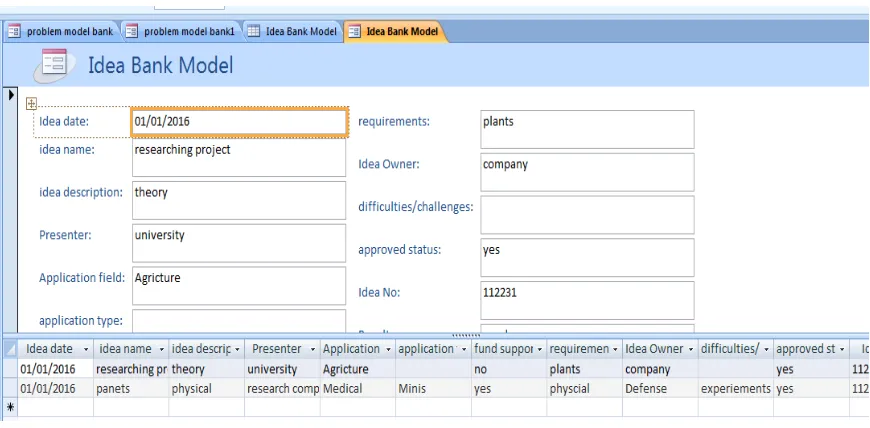
Inside this architecture a Problem Gateway (PG) which is used to receive requests to solve problems. The problem owners upload their problems documents to managers of society sectors by storing it in the problem bank model (PBM). The society managers assign the approved problem after revision and determination of the problem's scope to teamwork of specialists and expertise. It assign as a task to find an accurate solution. The role of managers of society sector is not only to coordinate between the problems owners and the scientific researchers but also navigate new ideas from Idea bank Model (IBM). At the same time, the researchers' duty is to suppose suitable solutions for these problems. The role of society sector's manager is to focus on controlling and evaluating by coordination between problems bank, ideas bank and measure the satisfaction of problem owners by accepting their feedback. There are two models; the first is Problems Bank Model (PBM) which contains all data about the problem. The second is Ideas Bank Model (IBM) which contains pre-solutions and modern studied ideas for solving similar problems. Fig.2 depicts the conceptual view of the modified CBR architecture. Fig.3 and Fig.4 summarize the steps of the modified CBR architecture and block diagrams behind each other.
Managers
Checking
PBM
IBM
Researchers Specialists Problem owners
Coordination Checking Searching Measuring Controlling
Send
Reply
store Propose
Assign as a task Find a solution
1. Register on the problem gateway (PG)
2. Access on PG by using the national identification (ID) 3. Upload the problem info/documents (video, image, ….etc) 4. Send The problem file to the specific society sector 5. Automatically store in the PBM
6. Managers review the PG to check updates 7. Search for old local solution
8. Check if it is solved before inside IBM, forward it as a respond to the problem owner and wait his/her feedback 9. Assign it as a task for researcher to find solution
10. Send a report/response to the problem owners
Fig.3 Steps of the modified CBR architecture
Fig.4 Block diagram of the modified CBR architecture
3.1 Practical guidelines for Designing and Implementing of the Modified CBR Architecture
The problem gateway allows everyone to send his/her problem easily attached with documents for the corresponding sector/manager inside PBM as seen in Fig.5. Also it includes a part for accepting new ideas which are modified CBR to find solutions and solve specific problems as seen in Fig.6.
Sign In Store
Determine Confirm
Search
Suppose
Respond+ Feedback
Log into Problem Gateway
Upload the problem documents
PBM
Problem owners
Managers find solution
Check solved before
IBM Yes
No
Society Sector M
Assign the new problem to researcher
Researchers Experts
Respond+ Feedback
Fig.5 A Modified CBR GUI for PBM
Fig.6 A Modified CBR GUI for IBM
4. Comparison between CRB and the Modified Architecture
Table 1 shows a comparison between CBR and the modified CBR architecture. It has been shown that the modified CBR architecture has many advantages and suitable for the new era.
Table 1: A comparison between CBR and the modified CBR architecture
Item: CBR Modified CBR
Problem Scope Limited
(Simple, Routine, …)
Open
Technical Architecture N.A Available
Broker/ 3rd partner N.A Available
5. Conclusion
The modified CBR architecture has been developed for enhancing the real society problem as a solving mechanism which is based on the participation scientific, specialist researchers. It is presented to support any problem either old case or new case. We mention that the role of "society manager" is very important. He is responsible for monitor the problem case until it has been solved and gets feedback from the problem owners. The piece of advice now for all departments or all society sectors is to apply this architecture inside its own systems in order to achieve transparency and fairness.
References
[1] Problem definition available on https://simple.wikipedia.org/wiki/Problem. Last access on 1st July 2016.
[2] Janet L. Kolodner et al, "Problem-Based Learning Meets Case-Based Reasoning" In D. C. Edelson & E. A. Domeshek (Eds.), Proceedings of ICLS ‘96 (pp. 188–195). Charlottesville, VA: AACE. July 1996.
[3] A. Aamodt, E. Plaza, "Case-Based Reasoning: Foundational Issues, Methodological Variations, and System Approaches",AI Communications. IOS Press, Vol. 7: 1, pp. 39-59. 1994.
[4]What is Problem solving? , electronic available on https://www.mindtools.com/pages/article/newTMC_00.htm. Last access on 1st August 2016.
[5] Barry Smyth," Complexity of Adaptation in Real-World Case-Based Reasoning Systems" Dublin, Trinity College Dublin, Department of Computer Science, TCD-CS-93-23, 1993.