
© 2019 by the Serbian Biological Society How to cite this article: Wang DS, Erihemu, Yang B. Diversity of bacterial 525 communities in the rhizosphere of the endangered plant, Paeonia jishanensis. Arch Biol Sci. 2019;71(3):525-31.
Diversity of bacterial communities in the rhizosphere of the endangered plant,
Paeonia
jishanensis
Dong-sheng Wang1, Erihemu1 and Bin Yang2,*
1College of Life Science, Shanxi Normal University, Linfen 041000, Shanxi, China
2Institute of Wheat, Shanxi Academy of Agricultural Sciences, Linfen 041000, Shanxi, China
*Corresponding author: [email protected]
Received: February 3, 2019; Revised: May 29, 2019; Accepted: May 31, 2019; Published online: June 7, 2019
Abstract: The microbial community in the rhizosphere is thought to provide plants with a second set of genomes, which plays a pivotal role in plant growth. In the present study, soil samples were collected from the rhizosphere of an endangered plant, Paeonia jishanensis. The plants were divided into three groups: well-growing plants, poor-growing plants and dead plants. Metagenomic DNA was isolated from rhizosphere soil samples of these plants and 16S rRNA genes were sequenced by the PacBio-RS II system. The results of taxonomic analysis showed that the dominant phyla were Proteobacteria, Acido-bacteria, Planctomycetes, Bacteroidetes and Actinobacteria in all three sample types. Linear discriminate analysis Effect Size (LEfSe) showed that 5 species, Hirschia baltica, Arcobacter aquimarinus, Gimesia maris, Magnetococcus marinus and
Pseudoxanthobactor soli, were significantly enriched in the rhizosphere of well-growing plants. Additionally, the results
of PCA, MDS and clustering analysis indicated that the bacterial community in the rhizosphere of living P. jishanensis
plants was similar. With the death of plants, the bacterial community changed considerably. These findings suggest that the abundance of many beneficial rhizospheric microbes declined with the death of P. jishanensis. This is a potential way to preserve endangered plants by inoculating declining species with beneficial microbes.
Keywords:Paeonia jishanensis; endangered plant; rhizosphere; microbial communities; metagenomic; next generation sequencing
INTRODUCTION
Paeonia jishanensis is a wild species of the section Moutan that belongs to the genus Paeonia, which have decorative and medicinal values [1]. It has been proven that P. jishanensis is a significant ancestral species and many cultivated tree peony species were bred from it. P. jishanensis is also a traditional Chinese herbal medicinal plant, and many medically important chemical substances, including paeonol, paeoniflorin, benzoic acid, volatile oil and plant sterol, have been detected in the root bark of P. jishanensis. The plant is used to reduce inflammation, treat cardiovascular diseases, protect the liver, decrease blood sugar and lipids and for its anticancer activity [2].
P. jishanensis is distributed in a narrow area, where the Shaanxi, Shanxi and Henan provinces converge. It mainly grows in middle and low mountainous regions,
at altitudes above 850 m and below 1550 m [3]. Unfortu-nately, this species is facing extinction. Urgent measures are needed to conserve it. It has been reported that the potential extinction of P. jishanensis was mainly caused by four factors, including weak sexual propagation, habitat restriction, deficient competition and excessive exploitation. Accordingly, some researchers have sug-gested four strategies for conservation: building a nature reserve, off-site conservation, artificial breeding and the establishment of a gene bank of P. jishanensis [3].
physi-ological and metabolic activities such as exudates of plant roots could also improve or inhibit the growth of soil microorganisms [4]. Hence the rhizosphere microbial community differs in plant species. Previous studies have shown that the rhizosphere microbial com-munity can affect plant health and seed germination [5-7]. Plant health could be improved by regulating the rhizosphere microbial community [8,9]. Moreover, rhizosphere microbes showed a more rapid response to environmental change when compared to plants. The rhizosphere microbial community structure can be used as a sensitive indicator to monitor soil quality and changes in plant health [10,11]. We speculated that a potential approach to preserving endangered plants is inoculation of beneficial microbes, with which we expect to develop a novel strategy for P. jishanensis
conservation. As far as we know, there has been no research related to the rhizosphere microbial com-munity of P. jishanensis.
In this study, we identified the bacteria present in the rhizospheres of P. jishanensis with different growth statuses by sequencing 16S rRNA genes from metagenomic DNA and comparing the corresponding communities. We hope to identify beneficial bacterial species in order to promote the growth of P. jishanensis. Moreover, these results should help in evaluating the health condition of P. jishanensis by monitoring the microbial community structure of the rhizosphere.
MATERIALS AND METHODS Site description and sample collection
This research was carried out in the Majiagou forestry station (35°43’N, 110°58’E), Shanxi Province, China. A total of 27 soil samples from the rhizosphere of
P. jishanensis were collected. According to the plant growth conditions, the samples were divided into three groups as follows: well-growing plants, poor-growing plants and dead plants. We defined the plants with strong vigor, thick green leaves and lush branches as “well-growing plants”, completely withered plants as “dead plants”, while plants with an intermediate growth status were defined as “poor-growing plants”. In each group, three samples were pooled randomly and then sequenced. Bulk soil was shaken off gently from the roots, and the residual soil closely bound to the root
was brushed and collected [12]. Samples were placed into aseptic bags and stored at 4°C in a refrigerator.
DNA extraction and sequencing
A TIANamp Soil DNA Isolation Kit (DP 336) (TIAN-GEN, China) was used to extract the total genomic DNA from 0.5-g soil samples, according to the manu-facturer’s instructions. The concentration and qual-ity of the extracted DNA were assessed by a Nan-oDrop 2000 spectrophotometer (Thermo Scientific). The 16S rRNA genes were amplified by primers 27f (5'-AGAGTTTGA TCCTGGCTCAG-3') and 1541r (5'-AAGGAGGTGATCCAGCCGCA-3'). The poly-merase chain reactions (PCR) were performed ac-cording to the described method [13]. PCR amplicons were extracted and purified using AMPureXp beads (Beckman Coulter) following the instructions of the manufacturer. Purified products were sent to Shanghai Personal Biotechnology Co., Ltd., China for PacBio sequencing.
Next-generation sequence data processing and taxonomic analysis
QIIME (version 1.8.0) was used to process the se-quencing data [14]. Specifically, sequences were first sorted by barcode and trimmed to remove the primers and barcodes, then aligned by SILVA 16S reference alignments of sequences [15]. Chimeric sequences were identified and removed using UCHIME in USE-ARCH (v11, http://www.drive5.com/usearch/). The quality-checked bacterial sequences were clustered into operational taxonomic units (OTUs) at a 3% dis-similatory threshold. The most abundant sequence in each OTU was chosen as the representative sequence. The representative sequences were used for taxonomic identification. To identify the specific bacteria in plants with different growth statuses, LEfSe analysis was per-formed using the Galaxy platform (http://huttenhower. sph.harvard.edu/galaxy/) [16].
Alpha and beta diversity parameters
evaluate the microbial species richness and evenness using QIIME and R software [17]. To calculate beta diversity, principal component analysis (PCA), mul-tidimensional scaling (MDS) and clustering analysis were calculated using QIIME software and R software. The PCA was performed on the community composi-tion structure at genus level [18]. The MDS analysis was constructed by the principal coordinates analysis (PCoA) method [18]. A clustering assay was con-structed by the hierarchical clustering analysis method [18]. The weighted UniFrac distance matrices were clustered and visualized using QIIME software [13].
Data availability
Raw data can be found in the NCBI database under accession numbers SRR8727413-SRR8727421.
RESULTS
16S rRNA metagenomics data and taxonomic analysis
After trimming and quality filtering, 54582 classifiable sequence reads were obtained from 9 samples. The mean number of classifiable sequences per sample was 6065 (dominant length: 1416–1602bp) (Supplementary
Fig. S1). These sequences were clustered into 2512 OTUs using a 3% dissimilatory threshold. A total of 145 OTUs were common for all groups, while 586, 662 and 679 OTUs were only detected in the well-growing plant group, the poor-growing plant group and the dead plant group, respectively. Total OTU numbers detected in the well-growing, poor-growing and dead plant groups were 1073, 1134 and 1035, respectively (Fig. 1). The representative sequence of each OTU was identified at different classification levels.
Microbial communities varied with plant growth status. Twenty-three phyla were detected in all of the three sample groups (Fig. 2a). Proteobacteria was the most abundant, followed by Acidobacteria, Plancto-mycetes, Bacteroidetes and Actinobacteria. The rela-tive abundances of these 5 phyla in the rhizosphere of well-growing plants and poor-growing plants were 85.35% and 86.19%, respectively, and significantly higher than in the rhizosphere of dead plants (79.39%, p<0.05). Fusobacteria was the least abundant (0.03%) phylum in the rhizosphere of well-growing plants. Deferribacteres and Chlorobi, both accounting for 0.03%, were the least present in the poor-growing plants’ microbial community, while Cyanobacteria and Deinococcus-Thermus, both accounting for 0.04%, were the least abundant phyla in the rhizosphere of dead plants. At the family level, the relative abundance
Fig. 1. Venn diagram illustrating the distributions of
of Planctomycetaceae, Pseudomonadaceae, Acidobac-teriaceaeand unidentified family 1, was more than 5% (Fig. 2b, Supplementary Table S1). The relative abundance of unidentified family 1 was 16.60% in the rhizosphere of dead plants, which was significantly higher than observed in living plants (p<0.05, Table S1). Pseudomonas and Pyrinomonas were the most abundant genera (Fig. 2c). Pyrinomonas methylalipha-togenes was the most abundant species in all samples, accounting for 5.1%, 5.5% and 14.2% in well-growing, poor-growing and dead plant groups, respectively (Fig. 2d). The relative abundance was more than 2% for
Pseudomonas extremaustralis, Pseudomonas veronii,
Candidatus Koribacter versatilis Ellin345, Pirellula staleyi and Algisphaera agarilytica. The number of species with an abundance above 1% was 25 in the rhizosphere of well-growing plants, while the numbers for poor-growing plants and dead plants were 18 and 16, respectively (Supplementary Table S2). A total of 617 species were identified and 3 species were unidenti-fied in all of the 3 groups. The 3 unidentiunidenti-fied species were only detected in well-growing and poor-growing plant groups (Supplementary Table S1).
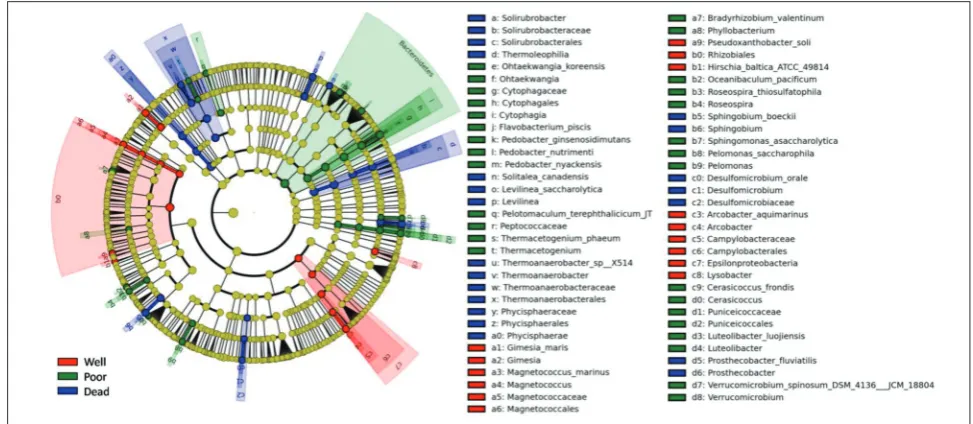
LEfSe was performed to analyze the statistical dif-ferences of the various taxa among samples (Fig. 3). According to LEfSe analysis, the class Phycisphaerae was significantly enriched in the rhizosphere of dead plants
(P<0.05), while Cytophagia was significantly enriched in the poor-growing plant group (P<0.05). At the genus level, in the dead plant group, Sphingobium, Levilinea,
Thermoanaerobacter, Solirubrobacter, Desulfomicrobium
and Prosthecobacter were significantly enriched (P<0.05), while Lysobacter, Gimesia, Magnetococcus and Arcobacter
were significantly enriched in the well-growing plant group (P<0.05). Phyllobacterium, Roseospira, Ohtaek-wangia, Thermacetogenium, Pelomonas, Cerasicoccus,
Luteolibacter and Verrucomicrobium were significantly enriched in the poor-growing plant group (P<0.05). At the species level, Desulfomicrobium orale, Prosthecobacter fluviatilis, Levilinea saccharolytica, Sphingobium boeckii
and Solitalea canadensis were significantly more enriched in the dead plant group than in other groups (P<0.05), whereas Hirschia baltica, Arcobacter aquimarinus, Gi-mesia maris, Magnetococcus marinus and Pseudoxan-thobactor soli were most abundant in the rhizosphere of well-growing plants (P<0.05). Flavobacterium piscis,
Oceanibaculum pacificum, Sphingomonas asaccharo-lytica, Pelomonassaccharophila, Cerasicoccusfrondis,
Luteolibacterluojiensis, Verrucomicrobiumspinosum,
Pedobacternutrimenti, Pedobacterginsenosidimutans,
Pedobacternyackensis, Ohtaekwangiakoreensis, Peloto-maculumterephthalicicum, Thermacetogeniumphaeum,
Bradyrhizobiumvalentinum and Roseospira thiosulfat-ophila were significantly enriched in the poor-growing plant group (P<0.05).
To evaluate the co-occurrence or co-exclusion interaction among the 50 most abundant species, Spearman’s rank correlation coefficients were calcu-lated. Dominant species with P>0.6 and P<0.01 were selected to build the association network. The results were visualized by Cytoscape (http://www.cytoscape. org/) software (Supplementary Fig. S2).
Alpha and beta diversity of the bacterial community
Alpha diversity analysis reflects the richness and evenness of species in a single sample. According to the rar-efaction curves, species saturation was achieved and the sampling size was sufficient to estimate the bacterial diversity (Fig. 4a). Rank abundance curves revealed that the abundance of the OTUs differed greatly and had a low homogeneity in each sample (Fig. 4b).
To measure the alpha diversity, four indices were calculated: ACE, Chao1, Shannon’s and Simpson’s in-dices of diversity. The results showed that bacterial communities were rich and homogeneous in diversity for each sample. Also, the species richness and evenness do not significantly differ between the 3 plant groups (Table 1). This indicated that the growth status had no influence on the bacte-rial richness and evenness in the rhizosphere of P. jishanensis.
According to PCA, MDS and clustering analysis, the microbial community structure differed in each group. The difference was smaller between
well-grow-ing plants and poor-growwell-grow-ing plants (Fig. 5a-c). To verify the significance of the difference, the weighted Uni-Frac distance between and within the groups was assayed, and showed that the difference between living plants and dead plants was significant, where-as the difference between well-growing plants and poor-growing plants was not significant (Fig. 5d). These results indicated that the bacterial community in the rhizosphere of living P.
jishan-Fig. 4. Rarefaction curves (a) and rank abundance curves (b) of OTUs.
Table 1. Richness and evenness of the bacterial community in the rhizosphere of P. jishanensis.
Samples Chao1 ACE Simpson’s Index
of Diversity
Shannon’s Index
Well-growing plants 611.5±505.2* 660.3±589.8 0.997±0 8.40±0.5
Poor-growing plants 811.6±191.3 872.9±224.0 0.990±0 8.41±0.1
Dead plants 697.0±350.5 774.1±417.4 0.993±0 8.36±0.4
*The difference among all samples was not significant (P>0.05).
ensis plants was similar; however, with the death of plants, the bacterial community changed considerably.
DISCUSSION
The edaphic condition is important for the distri-bution of local plants [19]. The interaction among plants, soils and microorganisms has been researched extensively. It has been proven that the rhizosphere microbial community differs with the plant species [20] and that environmental conditions can affect the microbial community more rapidly than the plants [21, 22]. A previous study showed that there was no significant difference in the concentrations of ten mineral elements in rhizosphere soil of P. jishanensis
growing in different areas [23]. In the present study, we examined the bacterial communities of P. jishanensis
with different growth status by PacBio sequencing. The results showed that the predominant phyla in the rhizosphere of P. jishanensis wereProteobacteria, Acidobacteria, Planctomycetes, Bacteroidetes and Actinobacteria, which was in accordance with peony cultivars (P. suffruticosa) [24].
The difference between the bacterial communities of well- and poor-growing plants was smaller than the difference between living and dead plants. LEfSe showed that four genera, Lysobacter, Gimesia, Magneto-coccus and Arcobacter, and five species, Hirschia baltica,
Arcobacter aquimarinus, Gimesia maris, Magnetococcus marinus and Pseudoxanthobactor soli, were significantly enriched in the rhizosphere of well-growing plants. Among these taxa,bacteria of the genus Lysobacter
could be used to suppress disease of plants [25]. Mag-netococcus marinus grow chemolithoautotrophically with thiosulfate or sulfide as the electron donors, and chemoorganoheterotrophically on acetate [26]. Gimesia maris accumulates α-glutamate, sucrose, ectoine and hydroxyectoine for osmoadaptation [27]. Accordingly, these bacterial species might enhance plant growth and tolerance to environmental threats.
Overall, this study suggests that the abundance of many beneficial rhizospheric microbes declined with the death of P. jishanensis. We speculate that it is helpful for the conservation of this endangered plant to inoculate with these beneficial microbes. The func-tions of these beneficial taxa have to be identified, and the presented hypothesis needs to be proven.
Funding: This work was supported by funds from the Shanxi Sci-ence and Technology Department, Grant No. 201801D221319 to Dongsheng Wang, and Grant No. 201801D221314 to Bin Yang. Acknowledgments: We are grateful for Dr. Gale for the English revision.
Author contributions: Dong-sheng Wang did a part of the ex-periments and wrote the paper, and Erihemu did a part of the experiment. Bin Yang designed the experiment.
Conflicts of interest disclosure: There is no conflict of interest.
REFERENCES
1. 1. Hong D, Pan K, Zhou Z. Circumscription of Paeonia suf-fruticosa Andrews and identification of cultivated tree peo-nies. J Syst Evol. 2004;42(3):275-83.
2. 2. Choi H, Seo H, Kim J, Um JY, Shin YC, Ko SG. Etha-nol extract of Paeonia suffruticosa Andrews (PSE) induced AGS human gastric cancer cell apoptosis via fas-depen-dent apoptosis and MDM2-p53 pathways. J Biomed Sci. 2012;19(1):82-93.
3. 3. Zhang F. The endangered causes of Paeonia suffruticosa var. spontanea, an endemic to China. Acta Ecologica Sinica. 2003;23(7):1436-41.
4. 4. Saldajeno MGB, Ito M, Hyakumachi M. Interaction between the plant growth promoting fungus Phoma sp. GS8-2 and the arbuscular mycorrhizal fungus Glomus mos-seae: Impact on biocontrol of soil-borne diseases, micro-bial population and plant growth. Australas Plant Path. 2012;41(3):271-81.
5. 5. Bothe H, Turnau K, Regvar M. The potential role of arbus-cular mycorrhizal fungi in protecting endangered plants and habitats. Mycorrhiza. 2010;20(7):445-57.
6. 6. Mekonnen B, Yahya A, Alström S. Micro-organisms asso-ciated with endangered Cordeauxia edulis affect its growth and inhibit pathogens. Afr J Agr Res. 2010;5(24):3360-8. 7. 7. Husna F, Tuheteru FD, Wigati E. Short Communication:
Growth response and dependency of endangered nedun tree species (Pericopsis mooniana) affected by indigenous Arbus-cular Mycorrhizal Fungi inoculation. Nusantara Bioscience. 2017;9(3):57-61.
8. 8. Xu XX, Cheng FY, Xian HL, Peng LP. Genetic diversity and population structure of endangered endemic Paeonia jishanensis, in China and conservation implications. Bio-chem Syst Ecol. 2016;66(7):319-25.
9. 9. Wu YN, Feng YL, Paré PW, Chen YL, Xu R, Wu S, Wang S, Zhao Q, Li H, Wang Y, Zhang J. Beneficial soil microbe promotes seed germination, plant growth and photosyn-thesis in herbal crop Codonopsis pilosula. Crop Pasture Sci. 2016;67(1):91-8.
10. 10. Youssef NH, Elshahed MS. Diversity rankings among bacterial lineages in soil. ISME J. 2009;3(3): 305-13. 11. 11. Harris J. Soil microbial communities and restoration
12. 12. Yanai RD, Fisk MC, Fahey TJ, Cleavitt NL, Park BB. Iden-tifying roots of northern hardwood species: patterns with diameter and depth. Can J Forest Res. 2008;38(11):2862-9. 13. 13. Ullah A, Akbar A, Luo Q, Khan AH, Manghwar H,
Shaban M, Yang X. Microbiome diversity in cotton rhizo-sphere under normal and drought conditions. Microb Ecol. 2019;77(2):429-39.
14. 14. Caporaso JG, Kuczynski J, Stombaugh J, Bittinger K, Bushman FD, Costello EK, Fierer N, Peña AG, Goodrich JK, Gordon JI, Huttley GA, Kelley ST, Knights D, Koenig JE, Ley RE, Lozupone CA, McDonald D, Muegge BD, Pir-rung M, Reeder J, Sevinsky JR, Turnbaugh PJ, Walters WA, Widmann J, Yatsunenko T, Zaneveld J, Knight R. QIIME allows analysis of highthroughput community sequencing data. Nat Methods. 2010;7(5):335-6.
15. 15. Quast C, Pruesse E, Yilmaz P, Gerken J, Schweer T, Yarza P, Peplies J, Glöckner FO. The SILVA ribosomal RNA gene database project: improved data processing and web-based tools. Nucleic Acids Res. 2013;41(D1):590-6.
16. 16. Segata N, Izard J, Waldron L, Gevers D, Miropolsky L, Garrett WS, Huttenhower C. Metagenomic biomarker dis-covery and explanation. Genome Biol. 2011;12(6):R60. 17. 17. Kemp PF, Aller JY. Bacterial diversity in aquatic and
other environments: what 16S rDNA libraries can tell us. FEMS Microbiol Ecol. 2004;47(2):161-77.
18. 18. Ramette A. Multivariates analyses in microbial ecology. FEMS Microbiol Ecol. 2007;62(2):142-60.
19. 19. Michaelis J, Diekmann M. Effects of soil types and bac-teria inoculum on the cultivation and reintroduction success of rare plant species. Plant Ecol. 2018;219(4):441-53. 20. 20. Finkel OM, Castrillo G, Paredes SH, Salas González I,
Dangl JL. Understanding and exploiting plant beneficial microbes. Curr Opin Plant Biol. 2017;38(8):155-63.
21. 21. Yan N, Marschner P, Cao W, Zuo C, Qin W. Influence of salinity and water content on soil microorganisms. J Soil Water Conserv. 2015;3(4):316-23.
22. 22. Verbon EH, Liberman LM. Beneficial microbes affect endogenous mechanisms controlling root development. Trends Plant Sci. 2016;21(3):218-29.
23. 23. Zhang H, Shangguan T. Comparison of element contents in Paeonia jishanensis of Jishan and Yongji, Shanxi, China. Chin J Appl Environ Biol. 2005;11(2):160-3.
24. 24. Xue D, Huang X. Changes in soil microbial community structure with planting years and cultivars of tree peony ( Pae-onia suffruticosa). World J Microb Biot. 2014;30(2):389-97. 25. 25. Islam MT , Hashidoko Y , Deora A, Ito T, Tahara S.
Sup-pression of damping-off disease in host plants by the rhi-zoplane bacterium Lysobacter sp. strain SB-K88 is linked to plant colonization and antibiosis against soilborne Perono-sporomycetes. Appl Environ Microb. 2005;71(7):3786-96. 26. 26. Bazylinski DA, Williams TJ, Lefèvre CT, Berg RJ, Zhang
CL, Bower SS. Magnetococcus marinus gen. nov. sp. nov. a marine, magnetotactic bacterium that represents a novel lineage (Magnetococcaceae fam. nov. Magnetococcales ord. nov.) at the base of the Alphaproteobacteria. Int J Syst Evol Micr. 2013;63(3):801-8.
27. 27. Ferreira C, Soares AR, Lamosa P, Santos MA, da Costa MS. Comparison of the compatible solute pool of two slightly halophilic Planctomycetes species, Gimesia maris and Rubinisphaera brasiliensis. Extremophiles. 2016;20(6):1-10.
Supplementary Data


![Bis[aquachlorobis(1,10 phenanthroline)manganese(II)] benzene 1,4 dioxyacetate dihydrate](data:image/gif;base64,R0lGODlhAQABAIAAAP///wAAACH5BAEAAAAALAAAAAABAAEAAAICRAEAOw==)