Proceedings of the
Fourth International Workshop on
Foundations and Techniques for
Open Source Software Certification
(OpenCert 2010)
Safe Integration of Annotated Components in Open Source Projects
S´ergio Areias, Daniela da Cruz, Pedro Rangel Henriques, Jorge Sousa Pinto
17 pages
Guest Editors: Luis S. Barbosa, Antonio Cerone, Siraj A. Shaikh Managing Editors: Tiziana Margaria, Julia Padberg, Gabriele Taentzer
Safe Integration of Annotated Components in Open Source
Projects
∗S´ergio Areias1, Daniela da Cruz1, Pedro Rangel Henriques1, Jorge Sousa Pinto1
Departamento de Inform´atica, Universidade do Minho, Braga, Portugal1
Abstract: The decision of using existing software components versus building from scratch custom software is one of the most complex and important choices of the entire development/integration process. However, the reuse of software compo-nents raises a spectrum of issues, from requirements negotiation to product selection and integration. The correct tradeoff is reached after having analyzed advantages and issues correlated to the reuse. Despite the reuse failures in real cases, many efforts have been made to make this idea successful.
In this context ofsoftware reuse in open source projects, we address the problem of reusing annotated components proposing a rigorous approach to assure the quality of the application under construction. We introduce the concept of caller-based slicingas a way of certifying that the integration of a component annotated with a contractinto a system will preserve the correct behavior of the former, avoiding malfunctioning after integration.
To complement the efforts done and the benefits of slicing techniques, there is also a need to find an efficient way to visualize the main program with the annotated components and the slices. To take full profit of visualization, it is crucial to combine the visualization of the control/data flow with the textual representation of source code. To attain this objective, we extend the notions of System Dependence Graph and Slicing Criterion to cope with annotations.
Keywords:Caller-based slicing, Annotated System Dependency Graph
1
Introduction
Reuse is a very simple an natural concept, however in practice is not so easy. According to the literature, selection of reusable components has proven to be a difficult task [MS93]. Sometimes this is due to the lack of maturity on supporting tools that should easily find a component on a repository or library [SV03]. Also, non experienced developers tend to reveal difficulties when describing the desired component in technical terms. Most of the times, this happens because they are not sure of what they want to find [SV03,SS07]. Another barrier is concerned with reasoning about component similarities in order to select the one that best fits in the problem solution; usually this is an hard mental process [MS93].
Integration of reusable components has also proven to be a difficult task, since the process of understanding and adapting components is hard, even for experienced developers [MS93].
Another challenge to component reuse is to certify that the integration of such component in a open-source software system (OSS) keeps it correct. This is, to verify that the way the component is invoked will not lead to an incorrect behavior.
A strong demand for formal methods that help programmers to develop correct programs has been present in software engineering for some time now. The Design by Contract (DbC) approach to software development [Mey92] facilitates modular verification and certified code reuse. The contract for a software component (a sub-program, or commonly, a procedure) can be regarded as a form of enriched software documentation composed of annotations (pre-conditions, post-conditions and invariants) that fully specifies the behavior of that component. So, a well-defined annotation can give us most of the information needed to integrate a reusable component in a OSS, as it contains crucial information about some constraints to obtain the correct behavior from the component.
In this context, we say that the annotations (the pre-, post-conditions and invariants that form the contract) can be used to verify that each component invocation is valid (preserves the con-tract); in that way, we can guarantee that a correct system will still be correct after the integration of that component. This is the motivation for our research: to find a way to help on the safety reuse of components.
This article introduces the concept of caller-based slicing, an algorithm that takes into ac-count the calls to an annotated component in order to certify that it is being correctly used. To support the idea, we also introduceGamaPolarSlicer, a tool that implements such algorithm: to identify when an invocation is violating the component annotation; and to display a diagnostic or guidelines to correct it.
The remainder of paper is composed of 8 sections. Section2is devoted to basic concepts cru-cial to the understanding of the rest of the paper: the notions ofslicingandsystem dependency graphare introduced. Section3formalizes the definition ofcaller-based slicingthat supports our approach to safety reused of annotated components. Section4defines the concept ofannotated System Dependency Graph(SDGa), used for the visual analysis of the slices and pre-conditions preservation. Section5illustrates the main idea through a concrete example. Section6gives a general overview ofGamaPolarSlicer, introducing its architecture, functionalities and implemen-tation details. Section7discusses related work onslicing programs with annotated components as it is the main idea behind our proposal. Section 8 discusses related work onvisualization of (sliced) programs, because we strongly believe that good visual tool is crucial for software analysis. Then the paper is closed in Section9.
2
Basic Concepts
In this section we introduce both the original concepts of slicing and system dependency graph.
2.1 Slicing
applications. These notions vary from Weiser’s syntax-preserving static slicing to amorphous slicing which is not syntax-preserving; algorithms can be based on dataflow equations, informa-tion flow relainforma-tions or dependence graphs.
Slicing was first developed to facilitate program debugging [M.93,ADS93,WL86], but it is then found helpful in many aspects of the software development life cycle, including software testing [Bin98,HD95], software metrics [OT93,Lak93], software maintenance [CLM96,GL91], program comprehension [LFM96,HHF+01], component re-use [BE93,CLM95], program inte-gration [BHR95,HPR89] and so on.
Program slicing, in its original version, is a decomposition technique that extracts from a pro-gram the statements relevant to a particular computation. Aprogram sliceconsists of the parts of a program that potentially affect the values computed at some point of interest referred to as a slicing criterion.
Definition 1 (Slicing Criterion) A static slicing criterion of a program P consists of a pair
C= (p,Vs), wherepis a statement inPandVsis a subset of the variables inP.
A slicing criterionC= (p,Vs)determines a projection function which selects from any state trajectory only the ordered pairs starting withpand restricts the variable-to-value mapping func-tionσ to only the variables inVs.
Definition2 (State Trajectory) LetC= (p,Vs)be a static slicing criterion of a programPand
T =<(p1,σ1),(p2,σ2),...,(pk,σk)>a state trajectory ofPon inputI.∀i,1≤i≤k:
Pro jC0(pi,σi) =
λ i f pi6=p
<(pi,σi|Vs)> i f pi=p
whereσi|Vsisσirestricted to the domainVs, andλ is the empty string.
The extension ofPro j0 to the entire trajectory is defined as the concatenation of the result of the application of the function to the single pairs of the trajectory:
Pro jC(T) =Pro jC0(p1,σ1)...Pro j 0
C(pk,σk)
A program slice is therefore defined behaviorally as any subset of a program which preserves a specified projections in its behavior.
Definition3 (Static Slicing) Astatic sliceof a programPon a static slicing criterionC= (p,Vs) is any syntactically correct and executable programP0 that is obtained fromPby deleting zero or more statements, and wheneverPhalts, on inputI, with state trajectoryT, thenP0 also halts, with the same inputI, with the trajectoryT0, andPro jC(T) =Pro jC(T0).
2.2 System Dependency Graph
The use of dependency graphs to visualize the data and control flow of a program has been widely accepted in the last years (Section8).
Before exploring the use Dependency Graphs for visualization and comprehension, we present below the definitions of Procedure Dependency Graph and System Dependency Graph.
Definition4 (Procedure Dependence Graph) Given a procedureP, a Procedure Dependence Graph, PDG, is a graph whose vertices are the individual statements and predicates (used in the control statements) that constitute the body ofP, and the edges represent control and data dependencies among the vertices.
In the construction of thePDG, a special node, considered as a predicate, is added to the vertex set: it is called theentrynode and is decorated with the procedure name.
A control dependence edge goes from a predicate node to a statement node if that predicate condition the execution of the statement. A data dependence edge goes from an assignment statement node to another node if the variable assigned at the source node is used (is referred to) in the target node.
Additionally to the natural vertices defined above, some extra assignment nodes are included in thePDGlinked by control edges to the entry node: we include an assignment node for each formal input parameter, another one for each formal output parameter, and another one for each returned value — these nodes are connect to all the other by data edges as stated above. More-over, we proceed in a similar way for each call node; in that case we add assignment nodes, linked by control edges to the call node, for each actual input/output parameter (representing the value passing process associated with a procedure call) and also a node to receiving the returned values.
Definition5 (System Dependence Graph) A System Dependence Graph,SDG, is a collection of Procedure Dependence Graphs,PDGs, (one for the main program, and one for each compo-nent procedure) connected together by two kind of edges: control-flow edges that represent the dependence between the caller and the callee (an edge goes from the call statement into the entry node of the called procedure); and data-flow edges that represent parameter passing and return values, connecting actualin,out parameter assignment nodes with formalin,out parameter
assign-ment nodes.
3
Caller-based slicing
In this section, we introduce our slicing algorithm. We start by extending the notion of static slicing and slicing criterion to cope with the contract of a program.
Definition6 (Annotated Slicing Criterion) Anannotated slicing criterionof a programP con-sists of a tripleCa= (a,Si,Vs), whereais an annotation ofPa(the annotated callee),Si
corre-spond to the statement ofPcallingPaandVsis a subset of the variables inP(the caller), that
Definition7 (Caller-based slicing) Acaller-based sliceof a programPon an annotated slicing criterionCa= (α,callf,Vs)is any subprogramP0that is obtained fromP by deleting zero or
more statements in a two-pass algorithm:
1. a first step to execute a backward slicing with the traditional slicing criterionC= (callf,Vs)
retrieved fromCa —callf corresponds to the call statement under consideration, andVs
corresponds to the set of variables present in the invocationcallf and intervening in the
precondition formula (α) of f
2. a second step to check if the statements preceding the callf statement will lead to the
satisfaction of the callee precondition.
For the second step in the two-pass algorithm, in order to check which statements are re-specting or violating the precondition we are using abstract interpretation, in particular symbolic execution.
According to the original idea ofJames Kingin [Kin76], symbolic execution can be described as “instead of supplying the normal inputs to a program (e.g. numbers) one supplies symbols representing arbitrary values. The execution proceeds as in a normal execution except that values may he symbolic formulas over the input symbols.”
Using symbolic execution we will be able to propagate the precondition of the function being called through the statements preceding the call statement. In particular, to integrate symbolic execution with our system, we are thinking to useJavaPathFinder[APV07].JavaPathFinderis a tool than can perform program execution with symbolic values. Moreover,JavaPathFindercan mix concrete and symbolic execution, or switch between them. JavaPathFinderhas been used for finding counterexamples to safety properties and for test input generation.
To sum up, the main goal of our caller-based slicing algorithm is to facilitate the use of an-notated components by discovering statements that are critical for the satisfaction of the pre-condition, i.e., that do not verify the precondition or whose statements values can lead to its non-satisfaction (a kind oftracing call analysis of annotated procedures).
4
Annotated System Dependency Graph (SDGa)
In this section we present the definition of Annotated System Dependency Graph, SDGa for short, that is the internal representation that supports our slicing-based code analysis approach.
Definition8 (Annotated System Dependence Graph) An Annotated System Dependency Graph,
SDGa, is aSDGin which some nodes of its constituentPDGs are annotated nodes.
Definition 9 (Annotated Node) Given a PDG for an annotated procedure Pa, an Annotated
Node is a pair<Si,a>whereSiis a statement or predicate (control statement or entry node) in
Pa, andais its annotation: a pre-conditionα, a post-conditionω, or an invariantδ.
The differences between a traditionalSDGand anSDGaare:
• The while nodes are also decorated with the loop invariant (or true, in case of invariant absence);
• Thecallnodes include the pre- and postcondition of the procedure to be called (or true, in case of absence); these annotations are retrieved from the respectivePDGand instantiated as explained below.
We can take advantage from thecall linkage dictionarypresent in theSDGa(inherited from the underlyingSDG) to associate the variables used in the calling statement (the actual parameters) with the formal parameters involved in the annotations.
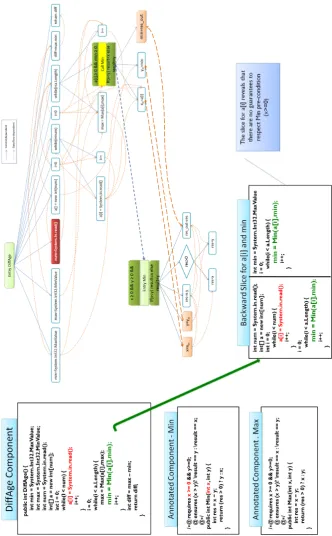
Given a program and an annotated slicing criterion, we identify the node of the respective SDGathat corresponds to the criterion (yellow node in Figure1). After building the respective caller-based slice, the critic statements will be highlighted in the graph, making easier to identify the statements violating the precondition (red nodes in Figure1).
5
An illustrative example
To illustrate the previous definitions and our proposal, consider the program listed below (Exam-ple1) that computes the maximum difference among student ages in a class.
Example 1DiffAge
p u b l i c i n t D i f f A g e ( ) {
i n t min = S y s t e m . I n t 3 2 . MaxValue , max = S y s t e m . I n t 3 2 . MinValue , d i f f ;
S y s t e m . o u t . p r i n t ( ” Number o f e l e m e n t s : ” ) ; i n t num = S y s t e m . i n . r e a d ( ) ;
i n t [ ] a = new i n t [ num ] ;
f o r ( i n t i = 0 ; i<num ; i ++) { a [ i ] = S y s t e m . i n . r e a d ( ) ; }
f o r ( i n t i = 0 ; i<a . L e n g t h ; i ++) {
max = Max ( a [ i ] , max ) ; min = Min ( a [ i ] , min ) ;
}
d i f f = max − min ;
S y s t e m . o u t . p r i n t l n ( ” The d i f f e r e n c e b e t w e e n t h e g r e a t e s t ” + ” and t h e s m a l l e s t a g e s i s ” + d i f f ) ; r e t u r n d i f f ;
}
This program reuses two annotated components: Min, defined in Example2, that returns the smallest of two positive integers; andMax, defined in Example3, that returns the greatest of two positive integers.
Suppose that we want to study (or analyze) the call toMinin the context ofDiffAge pro-gram.
With this criterion, a backward slicing process is performed taking into account the variables present inVs. Then, using the obtained slices, the detection of contract violations is executed. For that, the precondition is back propagated (using symbolic execution) along the slice to verify if it is preserved after each statement. Observing the slice corresponding to the variablea[i](see Example4below), is evident that it can not be guaranteed that all integer elements are greater than zero; so a potential precondition violation is detected.
Example 2Min
/∗@ requiresx≥0 &&y≥0
@ ensures(x>y)?\result==x:\result==y @∗/
1: public int Min(int x, int y){
2: int res; 3: res=x−y;
4: return ((res>0)? y : x); 5: }
Example 3Max
/∗@ requiresx≥0 &&y≥0
@ ensures(x>y)?\result==y:\result==x @∗/
1: public int Max(int x, int y){
2: int res; 3: res=x−y;
4: return ((res>0)? x : y); 5: }
Example 4Backward Slice for a[i]
i n t [ ] a = new i n t [ num ] ;
f o r ( i n t i = 0 ; i<num ; i ++) { a [ i ] = S y s t e m . i n . r e a d ( ) ; }
f o r ( i n t i = 0 ; i<a . L e n g t h ; i ++) {
max = Max ( a [ i ] , max ) ; min = Min ( a [ i ] , min ) ; }
All the contract violations detected will be reported during the next step. In the example above, the user will receive anwarningalerting to the possibility of callingMinwith negative numbers (what does not respect the precondition).
6
GamaPolarSlicer
In this section, we introduce GamaPolarSlicer, a tool that we are building to implement our ideas; it will become available to open source communities, as soon as possible. This project is being developed in the context of theCROSS project — An Infrastructure for Certification and Re-engineering of Open Source Softwareat Universidade do Minho4.
First we describe the architecture of the tool, and then we give some technical details about its implementation.
6.1 Architecture
As referred previously, our goal is to ease the incorporation process of an annotated component into an existent system. This integration should be smooth, in the sense of that it should not turn a correct system into an incorrect one.
To achieve this goal, it is necessary:
• to verify the component correctness with respect to its contract (using a traditional Veri-fication Condition Generator, already incorporated inGamaSlicer[CHP10b], available at
http://gamaepl.di.uminho.pt/gamaslicer);
• to verify if the actual calling context preserves the precondition;
• to verify if the component’s output, specified by its postcondition, agrees with the value expected by the caller, i.e., if the returned value is properly handled in the caller context.
The chosen architecture is based on the classical structure of a language processor. Figure2
showsGamaPolarSlicerarchitecture.
• Source Code— the input to analyze.
• Lexical Analysis, Syntactic Analysis, Semantic Analysis— the Lexical layer converts the input into symbols that will be later used in the identifiers table. The Syntactic layer uses the result of the Lexical layer above and analyzes it to identify the syntactic structure of it. The Semantic layer adds the semantic information to the result from the Syntactic layer. It is in this layer that the identifier table is built.
• Invocations Repository— is where all invocations found on the input are stored in order to be used later as support to the slicing process.
• Annotated Components Repository— is where all components with a formal specifica-tion (precondispecifica-tion and postcondispecifica-tion at least) are stored. It is used in the slicing process only to filter the invocations (from the invocation repository) without any annotation. Has an important role when verifying if the invocation respects component’s contract.
• Identifiers Table— has an important role on this type of programs as always. All symbols and associated semantic found during the analysis phase are stored here. It will be one of the backbones of all structures supporting the auxiliary calculations.
• Annotated System Dependency Graph— is the intermediate structure chosen to apply the slicing.
• Caller-based Slicing— uses both invocations repository and annotated components repos-itory to extract the parameters to execute the slicing for each invoked annotated compo-nent. The resulting slice is aSDGa this a subgraph of the originalSDGa.
• Contract Verification— using the slice that resulted from the layer above, and using the component contract, this layer analyzes every node on the slice and verifies in all of them if and verifies in all of them if every precondition (belonging to the contract annotation) is satisfied.
• Output Report— presents to the user a view of all violations found during the whole process; we plan to include, in the future, a diagnosis of each violation and suggestions to overcome it. At moment the output is just textual, but we are working on a graph visualization and navigation module to display theSDGaas preview in Figure1. Providing a visual output is, in our opinion, a fundamental feature of our analyzing tool.
6.2 Implementation
To address all the ideas, approaches and techniques presented in this paper, it was necessary to choose the most suitable technologies and environments to support the development.
To address thedesign-by-contract approach we decided to use the Java Modeling Language (JML)7. JML is a formal behavior interface specification language, based on design-by-contract paradigm, that allows code annotations in Java programs [LC04].
JML is quite useful as allows to describe how the code should behave when running it [LC04]. Preconditions, postconditions and invariants are examples of formal specifications that JML pro-vides.
As the goal of the tool is not to create a development environment but to enhance an existing one, we decided to implement it as an Eclipse8plugin.
The major reasons that led to this decision were: the large community and support. Eclipse is one of the most popular frameworks to develop Java applications and thus a perfect tool to test our goal; the fact that it includes a great environment to develop new plugins. The Plugin Development Environment (PDE) 9 that allows a faster and intuitive way to develop Eclipse plugins; has a built-in support for JML, freeing us from checking the validity of such annotations. However, the parser generated for Java/JML grammar exceeded the limit of bytes allowed to a Java class (65535 bytes). Thus, this limitation led us to abandon the idea of the Eclipse plugin and implementGamaPolarSlicerusing Windows Forms and C# (using the .NET framework).
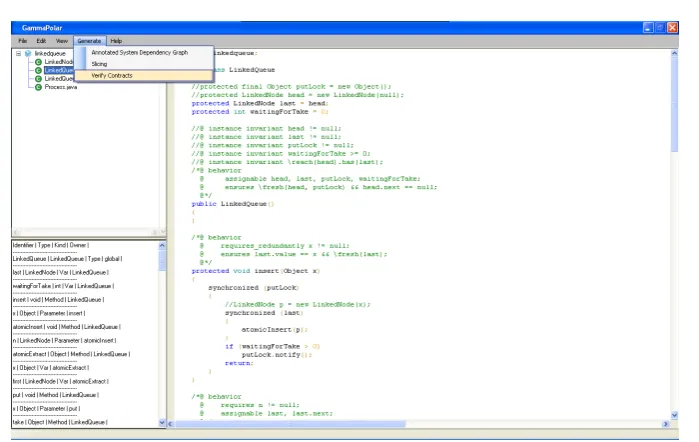
A scratch of the first version ofGamaPolarSlicerprototype is depicted in Figure3.
7http://www.cs.ucf.edu/ leavens/JML/ 8http://www.eclipse.org/
Figure 3:GamaPolarSlicerprototype
7
Related Work — Slicing
In this section we review the published work on the area of slicing annotated programs, as those contribution actually motivate the present proposal. Although the works referred use the annota-tions to slice a program, the concrete goal of such works differs from ours. The main difference is that we do not assume that all the procedures in a program are annotated and correct with respect to these contracts. We are assuming that only the procedure being integrated is annotated.
In [CH96],Comuzzi et alpresent a variant of program slicing calledp-sliceorpredicate slice, using Dijkstra’s weakest preconditions (wp) to determine which statements will affect a specific predicate. Slicing rules for assignment, conditional, and repetition statements were developed. They presented also an algorithm to compute the minimum slice.
In [CLYK01],Chung et alpresent a slicing technique that takes the specification into account. They argue that the information present in the specification helps to produce more precise slices by removing statements that are not relevant to the specification for the slice. Their technique is based on the weakest pre-condition (the same present inp-slice) and strongest post-condition — they present algorithms for both slicing strategies, backward and forward.
Comuzzi et al[CH96], andChung et al[CLYK01], provide algorithms for code analysis en-abling to identify suspicious commands (commands that do not contribute to the postcondition validity).
which satisfies the pre-condition”. In case of a program which correctly implements the pre- and post-condition, all statements from the program will be removed. Otherwise, those statements that do not respect the conditions are left, corresponding to statements that potentially break the conditions (are either incorrect or which are innocent but cannot be detected to be so by slicing). The result of this work can be applied as a correctness verification for the annotated procedure.
In [CHP10a],Cruz et alpropose the contract-based slicing notion. Given any specification-based slicing algorithm (working at the level of commands), a contract-specification-based slice can be calcu-lated by slicing the code of each individual procedure independently with respect to its contract (called anopen slice), or taking into consideration the calling contexts of each procedure inside a program (called aclosed slice).
8
Related Work — Visualization of (sliced) programs
As in this paper we also focus on the visualization of programs with annotated components, and their slices that trace the calls with respect to the called preconditions, we devote this section to review the contributions on the area of slice visualization that more directly influence our proposal.
In [BE94],Ball et al.presentSeeSlice, an interactive browsing tool to better visualize the data generated by slicing tools. TheSeeSliceinterface facilitates the visualization by making slices fully visible to user, even if they cross the boundaries of procedures and files.
In [GO97],Gallagher et al. propose an approach in order to reduce the visualization com-plexity by using decomposition slices. A decomposition slice is a kind of slice that depends only on a variable (or a set of variables) and does not consider the location of the statement (a tradi-tional slice depends on both a variable and a statement in a program). The decomposition slice visualization implemented inSurgeon’s Assistant[Gal96] visualizes the inclusion hierarchy as a graph using theVCG(Visualization of Compiler Graphs) [San95].
In [88101],Deng et alpresentProgram Slice Browser, an interactive and integrated tool which main goal is to extract useful information from a complex program slice. Some of the features of such tool are: adaptable layout for convenient display of a slice; multi-level slice abstractions; integration with other visualization components, and capabilities to support interaction and cross-referencing within different views of the software.
In [Kri04], Krinke presents a declarative approach to layout Program Dependence Graphs (PDG) that generates comprehensible graphs of small to medium size procedures. The authors discussed how a layout forPDGcan be generated to enable an appealing presentation. ThePDG and the computed slices are shown in a graphical way. This graphical representation is combined with the textual form, as the authors argue that is much more effective than the graphical one. The authors also solved the problem of loss of locality in a slice, using a distance-limited approach; they try to answer research questions such as: 1) why a statement is included in the slice?, and 2) how strong is the influence of the statement on the criterion?
nodes belonging to the two previous ones.
9
Conclusion
As can be seen along the paper, the motivation for our research is to apply slicing, a well known technique in the area of source code analysis, to create a tool that aids programmers to build correct open source programs reusing annotated procedures.
The tool under construction, GamaPolarSlicer, was described in Section 6. Its architecture relies upon the traditional compiler structure; on one hand, this enables the automatic generation of the tool core blocks, from the language attribute grammar; on the other hand, it follows an approach in which our research team has a large knowhow (apart from many DSL compilers, we developed a lot of Program Comprehension tools: Alma, Alma2, WebAppViewer, BORS, andSVS). The new and complementary blocks ofGamaPolarSlicerimplement slice and graph-traversal algorithms that have a sound basis, as described in Sections2,3, and4; this allows us to be confident in there straight-forward implementation.
GamaPolarSlicer will be included in Gama project (for more details see http://gamaepl.di. uminho.pt/gama/index.html). This project aims at mixing specification-based slicing algorithms with program verification algorithms to analyze annotated programs developed under Contract-base Designapproach. GamaSliceris the first tool built under this project for intra-procedural analysis that is available athttp://gamaepl.di.uminho.pt/gamaslicer/.
We believe that this set of tools will save time and make safer the process of build open-source software systems.
Bibliography
[88101] Program Slice Browser. InIWPC ’01: Proceedings of the 9th International Work-shop on Program Comprehension. P. 50. IEEE Computer Society, Washington, DC, USA, 2001.
[ADS93] H. Agrawal, R. A. DeMillo, E. H. Spafford. Debugging with Dynamic Slicing and Backtracking.Software - Practice and Experience23(6):589–616, 1993.
citeseer.ist.psu.edu/agrawal93debugging.html
[APV07] S. Anand, C. S. P˘as˘areanu, W. Visser. JPF-SE: a symbolic execution extension to Java PathFinder. In TACAS’07: Proceedings of the 13th international conference on Tools and algorithms for the construction and analysis of systems. Pp. 134–138. Springer-Verlag, Berlin, Heidelberg, 2007.
[Bal04] F. Balmas. Displaying dependence graphs: a hierarchical approach.J. Softw. Maint. Evol.16(3):151–185, 2004.
doi:http://dx.doi.org/10.1002/smr.291
[BE94] T. Ball, S. G. Eick. Visualizing Program Slices. InVL. Pp. 288–295. 1994.
[BHR95] D. Binkley, S. Horwitz, T. Reps. Program integration for languages with procedure calls.ACM Trans. Softw. Eng. Methodol.4(1):3–35, 1995.
doi:http://doi.acm.org/10.1145/201055.201056
[Bin98] D. Binkley. The Application of Program Slicing to Regression Testing.Information and Software Technology40(11-12):583–594, 1998.
citeseer.ist.psu.edu/binkley99application.html
[CH96] J. J. Comuzzi, J. M. Hart. Program Slicing Using Weakest Preconditions. In FME ’96: Proceedings of the Third International Symposium of Formal Methods Eu-rope on Industrial Benefit and Advances in Formal Methods. Pp. 557–575. Springer-Verlag, London, UK, 1996.
[CHP10a] D. da Cruz, P. R. Henriques, J. S. Pinto. Contract-Based Slicing. In Proceedings of the Fourth Workshop on Formal Languages and Analysis of Contract-Oriented Software (FLACOS’10). 2010. to appear.
[CHP10b] D. da Cruz, P. R. Henriques, J. S. Pinto. Gamaslicer: an Online Laboratory for Pro-gram Verification and Analysis. InProceedings of the 10th Workshop on Language Descriptions Tools and Applications (LDTA’10). 2010.
[CLM95] A. Cimitile, A. D. Lucia, M. Munro. Identifying reusable functions using specifi-cation driven program slicing: a case study. InICSM ’95: Proceedings of the In-ternational Conference on Software Maintenance. P. 124. IEEE Computer Society, Washington, DC, USA, 1995.
[CLM96] A. Cimitile, A. D. Lucia, M. Munro. A specification driven slicing process for identifying reusable functions. Journal of Software Maintenance 8(3):145–178, 1996.
doi:http://dx.doi.org/10.1002/(SICI)1096-908X(199605)8:3¡145::AID-SMR127¿3.3.CO;2-0
[CLYK01] I. S. Chung, W. K. Lee, G. S. Yoon, Y. R. Kwon. Program slicing based on specifica-tion. InSAC ’01: Proceedings of the 2001 ACM symposium on Applied computing. Pp. 605–609. ACM, New York, NY, USA, 2001.
doi:http://doi.acm.org/10.1145/372202.372784
[Gal96] K. Gallagher. Visual Impact Analysis. InICSM ’96: Proceedings of the 1996 Inter-national Conference on Software Maintenance. Pp. 52–58. IEEE Computer Society, Washington, DC, USA, 1996.
[GL91] K. B. Gallagher, J. R. Lyle. Using Program Slicing in Software Maintenance.IEEE Transactions on Software Engineering17(8):751–761, 1991.
[GO97] K. Gallagher, L. O’Brien. Reducing Visualization Complexity using Decomposition Slices. InProc. Software Visualisation Work.Pp. 113–118. Department of Computer Science, Flinders University, Adelaide, Australia, 11–12 Dezembro 1997.
[HD95] M. Harman, S. Danicic. Using Program Slicing to Simplify Testing.Software Test-ing, Verification & Reliability5(3):143–162, 1995.
citeseer.ist.psu.edu/100763.html
[HHF+01] M. Harman, R. Hierons, C. Fox, S. Danicic, J. Howroyd. Pre/Post Conditioned Slic-ing.icsm00:138, 2001.
doi:http://doi.ieeecomputersociety.org/10.1109/ICSM.2001.972724
[HPR89] S. Horwitz, J. Prins, T. Reps. Integrating noninterfering versions of programs.ACM Trans. Program. Lang. Syst.11(3):345–387, 1989.
doi:http://doi.acm.org/10.1145/65979.65980
[Kin76] J. C. King. Symbolic execution and program testing.Commun. ACM19(7):385–394, 1976.
doi:http://doi.acm.org/10.1145/360248.360252
[Kri04] J. Krinke. Visualization of Program Dependence and Slices. InICSM ’04: Proceed-ings of the 20th IEEE International Conference on Software Maintenance. Pp. 168– 177. IEEE Computer Society, Washington, DC, USA, 2004.
[Lak93] A. Lakhotia. Rule-based approach to computing module cohesion. InICSE ’93: Pro-ceedings of the 15th international conference on Software Engineering. Pp. 35–44. IEEE Computer Society Press, Los Alamitos, CA, USA, 1993.
[LC04] G. T. Leavens, Y. Cheon. Design by Contract with JML. 2004.
[LFM96] A. D. Lucia, A. R. Fasolino, M. Munro. Understanding Function Behaviors through Program Slicing. InProceedings of the 4th Workshop on Program Comprehension. Pp. 9–18. 1996.
citeseer.ist.psu.edu/delucia96understanding.html
[M.93] K. M.Interprocedural dynamic slicing with applications to debugging and testing. PhD thesis, Linkoping University, Sweden, 1993.
[Mey92] B. Meyer. Applying ”Design by Contract”.Computer25(10):40–51, 1992.
doi:http://dx.doi.org/10.1109/2.161279
[MS93] N. A. M. Maiden, A. G. Sutcliffe. People-oriented Software Reuse: the Very Thought. InAdvances in Software Reuse - Second International Workshop on Soft-ware Reusability. Pp. 176–185. IEEE Computer Society Press, 1993.
[OT93] L. Ottenstein, J. Thuss. Slice based metrics for estimating cohesion. 1993.
[San95] G. Sander. Graph Layout through the VCG Tool. In GD ’94: Proceedings of the DIMACS International Workshop on Graph Drawing. Pp. 194–205. Springer-Verlag, London, UK, 1995.
[SS07] S. G. Shiva, L. A. Shala. Software Reuse: Research and Practice. InITNG. Pp. 603– 609. IEEE Computer Society, 2007.
http://dblp.uni-trier.de/db/conf/itng/itng2007.html#ShivaS07
[SV03] K. Sherif, A. Vinze. Barriers to adoption of software reuse a qualitative study. Inf. Manage.41(2):159–175, 2003.
doi:http://dx.doi.org/10.1016/S0378-7206(03)00045-4
[Wei79] M. D. Weiser.Program slices: formal, psychological, and practical investigations of an automatic program abstraction method. PhD thesis, Ann Arbor, MI, USA, 1979.