a
2018
ISSN: 2277-128X (Volume-8, Issue-3)
Comparitive Analysis of Different Mobile Operating System
Rahul Kumar*, Prabhjeet Kaur
PG Student, IT Department, KCL-IMT, Punjab Technical University, Punjab, India
[email protected], [email protected]
Abstract- Now a days there are various Operating system for the mobile phones. An operating system is a platform that is used to run the different kinds of applications in the tablets, smartphones, smart watches and other devices. Mobile Operating system has a feature of personal computers and other mobile features like Wi-Fi, GPS, Camera, recorder, Mp3 player etc. In this paper we analyzed about various mobile operating system.
Keywords- Windows , iOS, Android, Blackberry, Mobile, Operating System.
I. INTRODUCTION
A mobile OS is an OS that is built to run the different kinds of applications in the tablets, smartphones, smartwatches and other devices. When a device starts or power on then the mobile OS starts and presents a screen with some icons that present information and provide access to the applications. It manages the cellular activity and wireless network connectivity and phone access. Some example of mobile OS are Android, Window, iOS, Symbian, Cyanogen, Blackberry etc.
A. Android
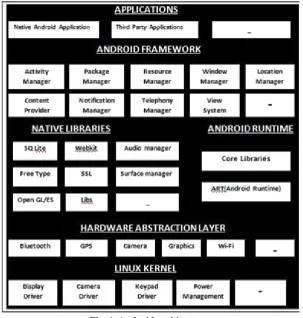
Android was developed by Android Inc. which is situated in California in 2003 after two years in 2005 it was acquired by the Google. It’s initial version was 1.5 named as Cupcake and followed by 1.6 named as Donut. It’s latest version is 7.1 known as Nougat. Applications are build using java language and also by using C/C++ (with NDK) and Android SDK. An Android OS is a software which is built on linux kernel and used in mostly tablets and smartphones. It is the cheapest operating system for the smartphones.[4]The android OS architecture has 4 layers named as Linux kernel, Application framework, Libraries and runtime and android application,as shown in Fig, 1.
ISSN(E): 2277-128X, ISSN(P): 2277-6451, pp. 63-67
1) Pros:
It provide widgets.
Millions of Applications
It is an Open source OS.
It supports customization.
2) Cons:
Android was unable to provide reliability.
Not much secure.
When install many application system may go slow
B. iOS
Apple Inc. had developed an OS in year 2007 for their iphones. It Currently runs on the apple devices such as iPad, iPod and iPhone touch. In june, 2007 iPhone OS 1 was released and the Current version is iOS 10 which is released in September 13,2016. This is another popular operating system after the android OS[3]. Application are written in Swift, C, C++ and Objective C language. The architecture of iOS is categorized into 4 layers i.e Core OS, Core services, Cocoa touch and Media as shown in Fig. 2.
Fig. 2 iOS architecture
1) Pros:
Safari browser support more than one web pages.
Quality is higher than android
2) Cons:
The lack of support for flash means some websites don’t work.
Internet is required for theuse of the Siri.
It does not support customization.
C. Windows
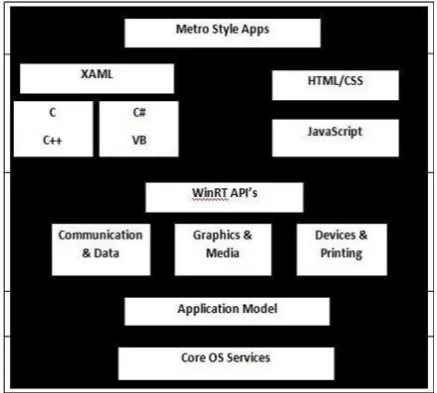
In 2000,PocketPC2000 appeared as a first launched windows mobile. But in 2003 a new name was given to this as "WindowsMobile". In 2010 Microsoft announced windows phone to Windows mobile. Windows OS is a mobile OS which is developed by the Microsoft corporation for the smartphones. In November 8, 2010 ,this mobile operating system is first launched in U.S with windows phone 7 [8]. It’s latest version is Window mobile 10 in 2015.It was the safe operating system used in phones. This operating systemrchitecture has 4 layersnamed as Core OS services, Application model, Win RT API’s and metro style applications ,as shown in Fig 3.
1) Pros:
It is very simple and easy to use. Better picture quality.
It support Microsoft pc suite for documents.
2) Cons:
There is not much apps for windows phone.
No expendable storage or SD card.
D. Blackberry
This is mobile OS which is developed by the Research on motion for the Blackberry handheld devices. The blackberry has multi layered architecture named as CPU embeddedbootloader, Microkernel, drivers, Application & services and Application runtime, as shown in Fig. 4.
Fig. 4. Blackberry architecture
1) Pros:
User friendly qwerty keyboard.
Excellent connectivity ( Yahoo, Gtalk).
2) Cons:
Image quality not good.
Battery life not good.
Application support is not worthy.
E. Symbian
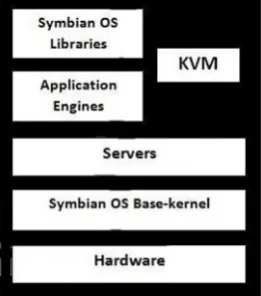
In 1998, Symbian Ltd. developed an operating system for personal digital assistant known as Symbian. In 2002, Nokia first uses the Symbian OS in their s60 Smartphones. This operating system is not available now in the market [7].The symbian OS has four layered architecture known as hardware, symbian base OS-kernel, servers and libraries, as shown in Fig 5.
ISSN(E): 2277-128X, ISSN(P): 2277-6451, pp. 63-67
1) Pros:
Huge range of applications.
Easy and fast connectivity.
Better inbuilt WAP browser.
2) Cons:
No virtual memory.
It can be easily affected by virus.
F. Bada
Bada is a OS for mobiles which is developed by the Samsung Electronics. It was used in the mobile devices such as smartphones, PDA and tablets. Bada OS is initially used in Wave S8500 device in April, 2010. This operating system is not available now in the market [6].Thisarchitecture has four layer named as framework, service, Kernel and device,as shown in Fig 6.
Fig. 6. Bada architecture
1) Pros:
It caninstall application on SD card.
Applications available for free.
It support flash and relatively cheaper.
2) Cons:
Application cannot access SMS/MMS data.
Not much apps available in the appstore.
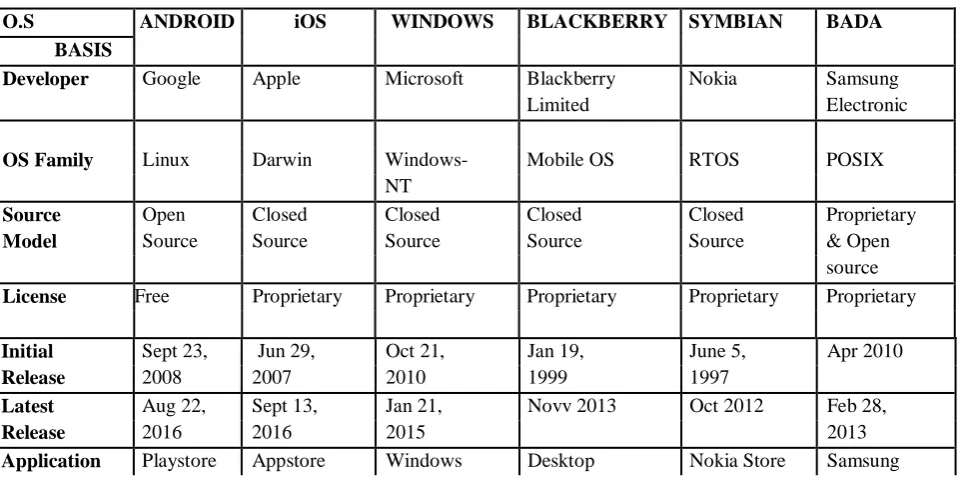
II. COMPARISON TABLE BETWEEN DIFFERENT MOBILE OPERATING SYSTEMS[1], [2], [5]
Initial Sept 23, Jun 29, Oct 21, Jan 19, June 5, Apr 2010
Release 2008 2007 2010 1999 1997
Latest Aug 22, Sept 13, Jan 21, Novv 2013 Oct 2012 Feb 28,
Release 2016 2016 2015 2013
Application Playstore Appstore Windows Desktop Nokia Store Samsung
O.S ANDROID iOS WINDOWS BLACKBERRY SYMBIAN BADA BASIS
Developer Google Apple Microsoft Blackberry Nokia Samsung
Limited Electronic
OS Family Linux Darwin Windows- Mobile OS RTOS POSIX NT
Source Open Closed Closed Closed Closed Proprietary
Model Source Source Source Source Source & Open source
Store Phone Manager Appstore Store
CPU ARM, X86, ARM, ARM ARM ARM, X86 ARM
Architecture MIPS ARM 64
Programmed C, C++ , C,C++, C++ C++ C++ C++
In Java objective-
C
App .apk .ipa .xap .cod & .alx .sis .xml, .htb, .exe
Extension
Virtual Allowed Not Allowed Not Not Not
Machine Allowed Allowed Allowed Allowed
Interface Touch- Touch- Touch- Touch- Touch- Touch-
Screen Screen Screen Screen screen Screen
Security Less Secure Secure Much Not secure Secure Not secure Secure
Market Share 86.8% 12.5% 0.3% 0% 0.84% 0%
Market Size Very High High Medium No No No
Future Very High High Medium No No No
III. CONCLUSION
As the result of this comparativeanalysis of various mobile operating system such as Android, Windows, iOS, Symbian, Cyanogen, Blackberry etc. From security point of view IOS mobile operating system is best OS for the smartphones, On the other side the Android mobile OS provide all the major features of the smartphones to their users all around the world. Android is the widely used mobile operating system as compare to other mobile operating systems.
REFERENCES
[1] Anuja H.Vaidya, Sapan Naik(2013). Comprehensive study and technical overviewof Application mobile
development in iOS, Android and Window phone 8.International Journal of Computer Applications.
[2] Kiran Bala, Sumit Sharma, Gurpreet Kaur (2015). A study on Smartphone based Operating System.
International Journal of Computer Applications.
[3] https://en.wikipedia.org/wiki/IOS
[4] https://en.wikipedia.org/wiki/Android_(operating_system)
[5] K. Divya ,S. Venkata Krishna Kumar(2016)Comparative analysis of smartphone operating system Android,
Apple iOS and Windows. International Journal of Scientific Engineering and Applied Science.
[6] https://en.wikipedia.org/wiki/Bada
[7] https://en.wikipedia.org/wiki/Symbian