International Journal Advances in Social Science and Humanities
Available Online at: www.ijassh.com
RESEARCH ARTICLE
An Investigation of the Role of Private Property Developers in
Provision of Housing in Gaborone, Botswana
Kampamba Johnson*, Lumbasio Henry, Adeyemi Yakeen Aderemi, Kelapile
Thatayaone
University of Botswana, Botswana.
*Corresponding Author:Kampamba Johnson
Abstract
Housing is one of the basic needs in a continually developing world. Botswana has been experiencing rapid urbanization in Gaborone leading to housing backlog caused by the fact that housing supply cannot commensurate the “sky-rocket” demand for housing. This in turn leads to inadequate provision of affordable housing. Private property developers have been trying to meet the demand for housing especially for middle income group. The purpose of the study was to establish the contribution of private property developers in the provision of housing in Botswana. The research objectives were to establish the role of private property developers in housing provision and the challenges that private property developers encounter in housing provision in Botswana. Data was collected from 14 private property developers out of the 20 that were identified translating into 70 per cent response rate. The data was collected using the questionnaire which was self-administered to the private property developers who met the criteria of having developed 50 houses in Gaborone through purposively sampling technique. Data analysis was using Microsoft Excel. The findings show that the role of private property developers in housing provision is average. The shortage of serviced land coupled with the excessive infrastructure costs were the major challenges affecting private property developers’ efforts in the provision of housing. The implication of the findings on society is that the shortage of housing in the city will continue to exist. The other implication is that private property developers will continue to struggle as long as there are no interventions from government in form of policy formulation.
Keywords:Private property developers, housing, role, housing provision, Gaborone, Botswana.
Introduction
According to Mosha [1] access to affordable land and housing is one of the main challenges facing policy-makers in many parts of the developing world. Living in
inadequate housing or in informal
settlements which include shacks, backyard dwellings, squatter settlements and mobile homes reduces people’s quality of life. Many of the migrants who found solace in making a home in informal settlements thought that living in a squatter settlement was a transitory measure, but they soon realised it became a permanent arrangement (ibid).
Government efforts in countries such as
Botswana, Tanzania, Ghana and South
Africa, etc. have focused mainly on provision of subsidised public low-cost housing schemes, on-site and service schemes or self-help housing programmes [2]. However, the supply elasticity of new formal housing is very low relative to new housing demand. Even households who receive site and service
housing are not satisfied with the dwellings that are offered [2].
Mosha [1] on the other hand, hinted that one of the alternatives is the provision of serviced
land and encouraging self-help or
incremental housing programmes. This approach was embraced by many countries in the continent in the 1970s and 1980s. It is often argued that the poor cannot afford to pay for housing and land, therefore, the feasibility of redesigning government programmes to offer better leverage for public investments with poor households’ own resources is very low [1].
study looked at the role of private property developers in the provision of housing in Botswana.
The provision of affordable housing in Gaborone is inadequate due to rapid urbanization thus resulting in housing
backlog as housing supply is not
commensurate with housing need and demand. The shortage of serviced land especially in urban areas coupled with the excessive infrastructure costs has greatly hampered private property developers’ efforts and their role in the provision of housing.
In view of the above problem identified, the study assessed the role which private property developers play in provision of housing in Gaborone, Botswana.
The objectives of the study were: (i) To evaluate the role of private property developers in housing provision in Botswana; (ii) To establish the challenges which private property developers encounter in housing provision in Botswana; and (iii) To create a model which can be used to predict the impact these challenges have on housing provision.
The next section is the formulation of the theoretical framework which would help in understanding how the topic, theory, and research questions relate to each other. The theoretical framework is based on the two theories which are property development theory and housing theory. This are used in order to understand the role and challenges that private property developers might be facing in pursuit to deliver housing. Figure 1 below is an illustration of the theoretical framework.
Figure 1: Linkage of research questions to the theoretical frame work Source: Authors’ own formulation
It was also hypothesised that: (i) The role private property developers play in the provision of housing are worth noting as an important one as it reduces pressure on the government pertaining to housing provision in Botswana; (ii) The highest challenge encountered by private property developers in provision of housing in Botswana is finance; and (iii) The proposed model has no
significance in establishing the impact that the challenges have on housing provision.
This study is arranged into five sections: (i) Introduction and background to housing provision; (ii) Review of related literature; (iii) Methodology on how data was collected
discussion of findings; and (v) Conclusions and recommendations.
Literature Review
Han & Wang [3] explain that a critical aspect in understanding the urban development process is the institutional structure of the
property market, referring to the
arrangement of organizations and agents, regulations on the market and the interplay among the actors. Housing privatization has also been promoted during the past two decades, allowing private ownership of properties and enabling developers to play an active role in the newly emerged property market [4-5).
Kampamba [6] explains that private sector development companies come in a variety of forms and sizes from one man band to multi-nationals. Their purpose is usually clear cut, to make a direct financial profit from the process of development. The major difference between development companies is whether they operate primarily as traders or investors. Most of small companies have to trade, that is to sell the properties they develop, as they do not have the capital resources to be able to retain their completed schemes. Private residential developers operate almost solely as traders as the market is heavily biased towards owner occupation [6].
His further explanation is that the private property developers’ role varies enormously in the degree of expertise. Their expertise may be in building, estate agency, engineering, finance, law, architecture, or business management. A private property developer may undertake the following roles in trying to achieve provision of housing:
Promoter and negotiator with regulatory and approved authorities;
Market analyst and marketing agent regarding potential tenants or purchasers;
Securer of financial resources from capital markets; and
Employer and overall manager of the professional team engaged on the project (ibid).
Kampamba [6] further emphasized that "the developer's role is to orchestrate the development process in order to bring the project to completion. Developers are the
central actors in the development process." important predevelopment stages, include conducting preliminary studies, negotiating sale or other ownership agreements, securing financing, undertaking the approval process, initiating planning and design and starting site work - followed by construction, sales and governance of the completed project. His emphasis is particularly placed on the important role of consultants in the development process.
The team might include attorneys, planners, market researchers, engineers, geologists, environmental specialists, architects, landscape architects, financiers, contractors and sales managers. Adams, Croudace, & Tiesdell [7] tend to agree with Kampamba [6] that developers are often portrayed as impresarios, orchestrating the development performance by bringing together capital, labour and rights in land to create the desired product in an ideal place at the most suitable time. He also emphasizes that the developer’s expertise is often seen to lie in knowing the local market (product); spotting opportunities (location) and resolving constraints to make things happen when required (timing). So, successful development is not solely about the old adage of ‘location, location and location’, but instead relies on broader knowledge of ‘product, location and timing’ [7].
A similar argument is proposed by Miles, Berens & Wies [8] in which it is submitted that developers must "balance an extraordinary number of requirements for completing a project" The developer's role as "creator, promoter, negotiator, manager, leader, risk manager and investor" is not only dynamic but continuously shifting. Isaac [9] on the other hand is of the view that the role of private property developers is to revitalise the economy by encouraging investment and to use the assets available in the production process to obtain greater economic growth and added value.
Kampamba [11] hinted that the contribution of private property developers in Ndola, Zambia as at 1997 was 19 per cent of its housing units, 12 per cent by government and companies where as 69 per cent by Ndola City Council. In South Africa, Hauptfleisch [12]said that the building industry represents a major portion of the total fixed
annual investment in the building industry, civil engineering construction industry, transport, equipment and machinery. Table 1 below presents the contribution of the role of the private sector developers for a period of five years (1993-1997) in Million Rands as a contribution to gross domestic product (GDP) in South Africa.
Table 1: Building and civil engineering work at nominal prices for residential buildings
Year Public Sector Public
Corporations
Total Public Total Private Grand Total
1993 952 24 976 6215 7191
1994 988 20 1017 6906 7923
1995 978 6 984 7700 8684
1996 1088 4 1092 8505 9597
1997 1208 4 1212 9137 10349
Source: (Hauptfleisch, 1999)
In another study by Kampamba [13] entitled ‘the role of government in the provision of subserviced land to private sector residential developers’. Government facilitated the supply of subserviced land to a number of private sector developers as indicated in Table 2 below in accordance with the Private
Sector Participation Policy. The purpose was for government to assume the role of a facilitator and ensure that the private sector developers are promoted and empowered in housing production in Gaborone as was envisaged in the National Policy on Housing 2000.
Table 2: Block 6 Allocations to private property developers
No Name of Developer Type of plots awarded Number of Plots
1 Time Projects (Pty) Ltd Low/medium cost plots 133
2 Teachers Union Low/medium cost plots 69
3 Premier Projects (Pty) Low/medium cost plots 224
4 Universal Builders (Pty) Ltd Low/medium cost plots 402
5 Diplomatic Services (Pty) Ltd Medium and high cost plots 72
6 Property Development Valuation Surveyors (Pty) Ltd Low/medium cost plots 108
7 More Investments (Pty) Ltd Low/medium cost plots 34
8 Mhago Building Construction (Pty) Ltd Low/medium cost plots 61
9 Tswana Design (Pty) Ltd High density plot 1
10 Alberta Construction (Pty) Ltd High density plot 1
Total 1, 105
Source: Department of Lands
In Kenya, it was noted there are obstacles to the free flow of funds from major lender and banks to the private estate developers. Hence the private property developers in Kenya in the midst of performing their roles in curbing housing problems are found wanting in terms of funds and land availability [14].
He further stated that the other challenges that residential property developers face in Kenya ranged from high rate of urbanisation whose demand they are unable to meet; absence of a proper finance mechanism; non-availability of loan capital; high interest rates; general low income levels; bottleneck in the supply of building materails; increasing building materials costs and land acquisition problems [14].further stresses that building and land costs can be
“unrealistically high” which can create challenges in trying to get the financial model right. In addition, he believes it is more difficult to secure pre-letting in office space in areas such as Nigeria and Ghana than in South Africa.
Because banks use purchased property as collateral and can repossess it if the borrower is unable to repay the loan, most prospective developers do not want to take the risk. But since there are few alternative sources of financing for housing development, most
developers reduce their number of
investments or take longer to complete a single project [14].
In the context of Botswana, however this has proved to be a different scenario all together reason being explained by Newel [16] that property ownership in Botswana is restricted only to a small portion of Botswana’s rich population, while the poor will pay rent to their graves, experts have revealed. Mokwete [17] said that Batswana’s average earnings are way too low to afford them funding to acquire property. His views struck a chord with a Fin Mark Trust report compiled in 2011, titled “Accessing housing finance in Africa,” which shows that only 17 per cent of Botswana’s employed population can actually qualify for mortgage loans. It continues to stress out that of the 2 million people in Botswana, only very few can access finance for housing. According to Statistics the unemployment rate in 2010 was 17.8 per cent.
The Fin Mark Trust report stresses that only 17 per cent of the 1.6 million workers qualify for housing finance. This means that only 278 800 people in Botswana can qualify for house loans. In the report, FinMark states that the average monthly earnings of persons employed in the formal sector (male and female, citizens and non-citizens) were P2788.00 ($278.80). “As will be seen, most existing commercially available housing finance products require borrowers to have a minimum salary of between P4000.00 ($400.00)-P4800.00 ($480.00) [16]. It was also noted by Mosha [1] that the majority of low income earners cannot access finance from commercial banks and Botswana Building Society. The other challenges that were mentioned by Mosha [1]include inadequate shelter, high property transaction costs as well as lack of access to land by all.
As a result of the above challenges, government is still seen as the major houisng provider in the country. This was substantiated by Lumbasio [18] who explained that the government plays a key role in the provision of housing in Botswana.
It was noted that in 1989, the government was directly or otherwise involved in the development of about 70% of the total urban residential housing stock through the provision of building materials loans to the Self Help Housing Agency (SHHA), sub-market loans to the Botswana Housing Corporation (BHC), development grants to the councils and institutions. He further stated that by holding almost 17000 houses by BHC in the urban centres, as well as 7500 housing units through institutions and councils, the government has almost become the defacto urban landlord in the country (Lumbasio, 2014).
The types of models that can be used in predicting the impact that the challenges have on housing provision would be (i) Weight mean score model or discriminant analysis model; (ii) regression analysis model; and (iii) factor analysis model [19-20-21]. It is further noted that the suitable model for smaller sample sizes is the weighted mean score model. For the regression and factor analysis models to work they require sample sizes that are five times larger than the number of varaibles that are being analysed [19-20-21]therefore they are not suitable for this study’s sample size.
Procedures and Methods
This study used both the quantitative and qualitative research approaches which Nouri (n.d) differentiate as follows: (i) Quantitative research approachtries to measure variables and an initial hypothesis may be formulated at the beginning. Data is often used to verify an existing theory; (ii) Qualitative research approach is aimed at exploring and understanding meanings and experience. The data collected is often used to evolve an on‐going hypothesis and the hypothesis is formulated at the beginning of the research.
Gaborone being a small city with a population of 231 592 people therefore there are few property developers. In coming up with the population for this study, consideration was given to those companies that are registered with the Registrar of Companies as property developers and have
successfully undertaken residential
they had completed 50 housing units in Gaborone before. All were furnished with questionnaires aiming at assessing their role in housing provision in Gaborone in terms of housing stock provided to the market and only 14 property developers responded to the questionnaire with a response rate of 70 per cent.
In testing the two theories, the number of housing units produced and the contribution to the GDP were used to measure the role of private developers in the provision of housing in Gaborone using property development theory. The housing theory was used to test the impact the challenges have on the delivery of housing.
Structured questionnaires were submitted to private property developers to find out data related to the research objective which was to evaluate the role of private property developers in terms of housing stock contribution to housing provision in Gaborone and also to find out the challenges that they are facing.
Results and Discussion
In establishing the characteristics of the sample that was surveyed, 93 per cent of the private property developers had their companies registered locally in Botswana and the remaining 7 per cent were international companies. It was also clear that 64 per cent of the companies were citizen owned and 36 per cent were non-citizen owned. From the responses, it was noted that 64.3 per cent of the private developers had less than 50 employees, whereas 14.3 per cent had employees between 51 to 150, 14.3 per cent with 151 to 300 employees, and 7.1 per cent with 301 to 500 employees.
The companies were asked to state their years of experience in property development. It was noted that 50 per cent of the property developers had work experience ranging from 6 to 10 years, 7 per cent had 16 to 20 years and 43 per cent with more than 20 years work experience in the field of property development. The respondents were asked to indicate their other fields of operation apart
from property development. It was
established that 10 per cent were also engaged in facilities management, whereas 31 per cent were involved in property management, 21 per cent were also estate
agents, 28 per cent do consultancy work, and 10 per cent carry out valuation work.
Respondents were further asked if they had partnered with other companies before in undertaking property development works. It was noted that 64 per cent of the private sector developers had partnered before in some property development projects whereas the remaining 36 per cent had not partnered with any companies.
The respondents were further asked to indicate their annual revenue for the past year of operation. It was revealed that 8.33 per cent of the private property developers recorded a revenue of less than P500,000.00 ($50,000.00), whereas 33.33 per cent collected annual revenue in the range of P500,000.00 to P1,500,000.00 ($150,000.00), 16.67 per cent collected between P1,500,000.00 and P5,000,000.00 ($500,000.00), 8.33% raised between P5,000,000.00 and P10,000,000.00 ($1,000,000.00) and 33.33% indicated that they had achieved over P10,000,000.00. It can therefore be noted that the total weighted average revenue that was collected by the sampled population was P69.5 million.
Respondents were asked if they had believed that their company was growing ever since it was established. It was noted that 86 per cent of the private property developers had realised growth in their companies as a result of increasing number of developments and goodwill as opposed to 14 per cent who said their companies were not growing due to lack of commitment and unavailability of land.
They were further asked to indicate how they monitored the growth of their companies over the years. In response to the question, 26 per cent of the private property developers said they monitor the progress and growth of their company through annual property sales figures, whereas 53 per cent use the size of the property portfolio, 16 per cent use the size of the market share and 5 per cent use annual property valuation and audited financial reports.
their role in housing provision in Gaborone. In establishing the mean score, the following scoring criteria were used. For an average score of less than (<) 1.49 it means their role in housing provision is very low; for an average score between 1.5 and 2.49 it means their role in housing provision is low; for an average score between 2.5 and 3.49 it means
their role in housing provision is average; for an average score between 3.5 and 4.49 it means their role in housing provision is high; and for an average score greater than (>) 4.5 it means their role in housing provision is very high. Table 3 illustrates the scoring of the responses with respect to this question.
Table 3: The role of private property developers in housing provision in Gaborone
Description of the variable Very low Low Average High Very
high
Mean Score
(1) (2) (3) (4) (5) 3.07
(%) (%) (%) (%) (%) (%)
Rate your role in housing provision in Gaborone 14.3 21.4 21.4 28.6 14.3 100
Source: Field survey
It is clear from Table 3 above that the private property developers in rating their role in housing provision in Gaborone, 14.3 per cent rated their role in housing provision as very low, 21.4 per cent rated theirs as low, whereas 21.4 per cent rated theirs as average, 28.6 per cent rated theirs as high and 14.3 per cent rated theirs as very high.
Their overall average means score of 3.07 was noted, ultimately showing that the private property developers’ role in housing provision is average. The implication of the results is that their role in housing provision is not significant as compared to their counterparts in South Africa (Hauptfleisch, 1999).
Looking at the total average annual revenue for the private property developers in the study of P69,500,000.00 ($6,950,000.00), it is clear that their contribution to the gross domestic product (GDP) was less than one per cent of the years’ budget for 2014 which was P50.18 billion. It is in this respect that the role of the private property developers in housing provision is not substantial because their contribution to economic growth as indicated by Isaac [9] and Angel [10] is low. It is lower than what private property developers in South Africa were able to contribute in 1993 to 1997 as indicated in Table 1 [12]. It is also clear that their contribution to housing provision could be as low as what [11] had noted about private property developers’ contribution to the housing stock in Zambia.
The respondents were further asked why they thought they were not doing well in the provision of housing. It was evident that 79 per cent of the private property developers
noted that their roles have not been achieved due to a number of circumstances like shortage of serviced land, unreasonable housing prices thus low occupancy which deters private property developers while 21 per cent said they had achieved their role. It is clear that the findings for the reason of not achieving their role is in line with what other previous authors had noted in Kenya and Nigeria [14-].
Private property developers have shown that they are profit motivated institutions or individuals as their response proves they mostly develop for sale than renting at a ratio of 4:3 with 8 companies citing reasons for sale as not wanting to keep the property stock, home ownership motive for buyers and faster return on investment while 6 develop for renting. This finding is in line with what Kampamba [6] had earlier noted that most property developers are traders who develop for outright sale so that they can release the cash that is tied in the project.
Those who develop for renting also hold strong viewpoints that renting offers consistent cash flow, land is retained and sustained business growth, there are few buyers since not everyone qualify for a mortgage but most afford to rent. It is also noted that in Botswana, the two types of property developers that were discussed by Kampamba [6] are available. These are traders who develop for outright sale and investors who develop for investment purposes.
which is proved to be on high demand in Gaborone, while 26 per cent develop for low cost housing and 21 per cent for high cost housing respectively. The fact that there are private property developers developing for the middle and high income earners, this contradicts what was indicated as the challenge earlier of generally low income earners [16-1].
They were further asked if their contribution has assisted in meeting the demand for housing in Gaborone. The majority of private property developers (64 per cent) agreed that indeed their involvement in housing provision has assisted in meeting the housing demand while 36 per cent disagreed by stating that they have not been able to meet the housing demand. It is clear that housing demand is increasing as a result of the high rate of urbanisation a challenge that [14] earlier noted in Kenya as well as [1-16] in Botswana.
In addressing objective two which relates to housing theory, respondents were asked to rate the impact that the challenges they
were facing had on housing provision in Gaborone using a five point Likert scale. (1 = Very low, 2= low, 3 = average, 4 = high, 5 = very high). In establishing the average overall mean score, the following scoring criteria were used. For an average score of less than (<) 1.49 it means the challenge’s impact on housing provision is very low; for an average score between 1.5 and 2.49 it means the challenge’s impact on housing provision is low; for an average score between 2.5 and 3.49 it means the challenge’s impact on housing provision is average; for an average score between 3.5 and 4.49 it means the challenge’s impact on housing provision is high; and for an average score greater than (>) 4.5 it means the challenge’s impact on housing provision is very high.
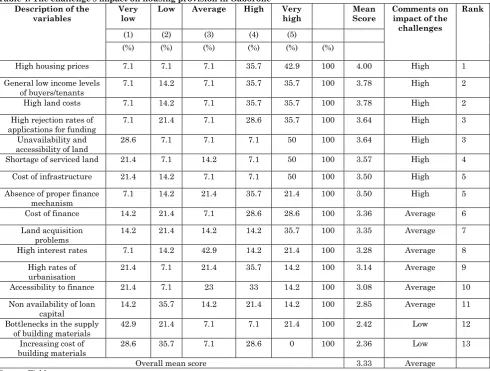
Table 4 illustrates the scoring of the responses with respect to this question. The overall mean score for all the challenges in as far as the impact on delivery of housing is concerned was 3.33. This implies that the impact of these challenges on the provision of housing by private property developers is average.
Table 4: The challenge’s impact on housing provision in Gaborone Description of the
variables
Very low
Low Average High Very
high
Mean Score
Comments on impact of the challenges
Rank
(1) (2) (3) (4) (5)
(%) (%) (%) (%) (%) (%)
High housing prices 7.1 7.1 7.1 35.7 42.9 100 4.00 High 1
General low income levels
of buyers/tenants 7.1 14.2 7.1 35.7 35.7 100 3.78 High 2
High land costs 7.1 14.2 7.1 35.7 35.7 100 3.78 High 2
High rejection rates of
applications for funding 7.1 21.4 7.1 28.6 35.7 100 3.64 High 3
Unavailability and
accessibility of land 28.6 7.1 7.1 7.1 50 100 3.64 High 3
Shortage of serviced land 21.4 7.1 14.2 7.1 50 100 3.57 High 4
Cost of infrastructure 21.4 14.2 7.1 7.1 50 100 3.50 High 5
Absence of proper finance
mechanism 7.1 14.2 21.4 35.7 21.4 100 3.50 High 5
Cost of finance 14.2 21.4 7.1 28.6 28.6 100 3.36 Average 6
Land acquisition
problems 14.2 21.4 14.2 14.2 35.7 100 3.35 Average 7
High interest rates 7.1 14.2 42.9 14.2 21.4 100 3.28 Average 8
High rates of
urbanisation 21.4 7.1 21.4 35.7 14.2 100 3.14 Average 9
Accessibility to finance 21.4 7.1 23 33 14.2 100 3.08 Average 10
Non availability of loan capital
14.2 35.7 14.2 21.4 14.2 100 2.85 Average 11
Bottlenecks in the supply
of building materials 42.9 21.4 7.1 7.1 21.4 100 2.42 Low 12
Increasing cost of
building materials 28.6 35.7 7.1 28.6 0 100 2.36 Low 13
Overall mean score 3.33 Average
The majority of the respondents agreed that they cannot achieve the role of housing provision under the challenges identified in Table 4 above due to fact that these make the business to crumble. It was clear that 64 per cent of private property developers agreed that the challenges have hampered their progress in housing provision while 36 per cent disagreed.
From Table 4 above, the variables that had a high impact on the delivery of housing by private property developers were: (i) high housing prices; (ii) high land costs; and general low income levels of buyers/tenants; (iii) high rejection rates of applications for funding; and unavailability and accessibility of land (iv) shortage of serviced land (v) cost of infrastructure; and absence of a proper mechanism for finance. Those that had an average impact on the delivery of housing were: (i) cost of finance; (ii) land acquisition problems; (iii) high rate of interest; (iv) high rates of urbanisation; (v) accessibility to finance; and (vi) non availability of loan capital. Only two variables had low impact on the delivery of housing, these were: (i) bottlenecks in the supply of building
materials; and (ii) increasing cost of building materials. From the presentation above, the variables can be grouped into five key factors that are affecting the delivery of housing in Botswana as follows:
Land related factors with a high impact score
Cost of infrastructure factors with a high impact score.
Finance related factors with an average impact score.
Socio-economic related factors with an average impact score.
Building materials related factors with a low impact score.
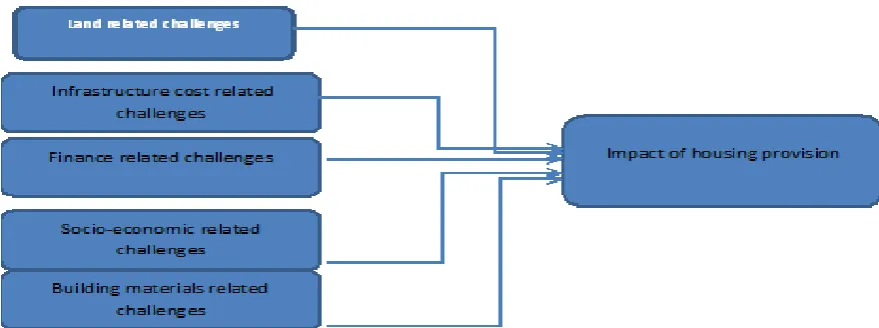
It is clear that the findings above are in line with what others noted in their studies [14-1-16] except for the building related factors that does not posse a challenge in Botswana as they can be ordered and delivered within a week. One can further therefore conclude that these five factors when grouped together can form a conceptual model for this study as outlined in Figure 2 below.
Independent variables Dependent variable
Figure 2: Conceptual model for the study Source: Authors’ own formulation
This can further be modelled into an equation of the impact the challenges have on housing provision in Gaborone as follows:
Overall impact = Wi (Land related factors) +Wii (Finance related factors) + Wiii (Cost of infrastructure)+Wiv (Socio-economic related factors) + Wv (Building materials related factors). The Wi..Wv are the group weights each factor contibute to the overall score and
the value of the factors in parenthesis is the aggregate value of all the variables within that factor. The components of the equation can be expressed below.Where as:
Land Related Factors Comprise the Following
Land acquisition problems (N = 4 out of 16,
Wi = 0.25; weighted mean = 3.6).
Finance Related Factors Would Include the Following
General low income levels of buyersand tenants; absence of proper finance mechanism; cost of finance; high interest rates; accessibility to finance; and non availabilty of loans (N = 7 out of 16, Wii = 0.4375; weighted mean = 3.37).
Cost of Infrastructure Related Factors Would Be
High housing prices; and Cost of infrastructure (N = 2 out of 16, Wiii = 0.125; weighted mean = 3.75)
Socio-economic Related Factors Include
High rates of urbanisation (N = 1 out of 16,
Wiv = 0.0625; weighted mean = 3.14)
Building Materials Related Factors Would Include
Bottlenecks in the supply of building materials; and increasing cost of building materials (N = 2 out of 16, Wv = 0.125; weighted mean = 2.39)
Therefore the overall impact score from this equation can be calculated as follows:
Y= Wi(L)+Wii(F)+Wiii(CI)+Wiv(SE)+Wv(BM)………Equation (1)
Y=
0.25(3.6)+0.4375(3.37)+0.125(3.75)+0.0625(3. 14)+0.125(2.39)
Y (Impact of challenges on housing delivery) = 3.33
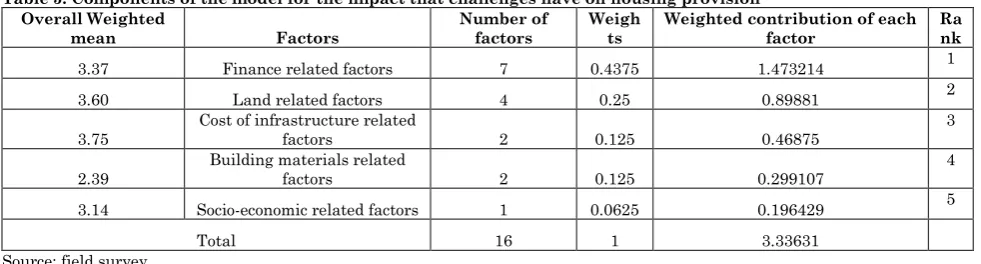
The above model can be presented in Table 5 below showing the contribution of each factor to the overall score. It is clear that though finance related factors scored a weighted mean of 3.37 which is lower than the mean scores for land related factors 3.60 and cost of infrastructure related factors 3.75, its contribution of 1.473214 is greater than their individual contribution in the model.
Table 5: Components of the model for the impact that challenges have on housing provision Overall Weighted
mean Factors
Number of factors
Weigh ts
Weighted contribution of each factor
Ra nk
3.37 Finance related factors 7 0.4375 1.473214 1
3.60 Land related factors 4 0.25 0.89881 2
3.75
Cost of infrastructure related
factors 2 0.125 0.46875
3
2.39 Building materials related factors 2 0.125 0.299107 4
3.14 Socio-economic related factors 1 0.0625 0.196429 5
Total 16 1 3.33631
Source: field survey
In Evaluating the two Hypotheses Which Were
The role private property developers play in the provision of housing are worth noting as an important one as it reduces pressure on the government pertaining to housing provision in Botswana. From the findings, though their contribution to housing provision is not substantial, it is noted that they are able to reduce pressure on government to provide housing thus allowing government to play a facilitation role and not the actual provider of housing. In terms of number of housing units produced and contribution to GDP, the private developers’ role in housing provision is still minimal as compared to their counterparts in South Africa. This hypothesis is supported by the findings of the study as well as what [10-9] noted as
the role of a property developer in form of contribution to economic growth and added value.
The highest challenge encountered by private property developers in provision of housing in Botswana is finance. It was also noted that finance has no highest impact on the provision of housing but as one of the challenges. However, it has the highest
weighted contribution towards the
finance related factors are contributing to the overall score.
The model that is created to predict the impact of the challenges on housing provision is of significance as supported by the findings of this study.
Conclusions and Recommendations
The researcher has established from the findings that the role of private property developers is average in housing provision in Botswana. Land and cost of infrastructure related factors had a high impact on the delivery of housing in Botswana, however it is noted that finance related factors poses a huge challenge on the delivery of housing in Botswana. The major contribution to the body of knowledge is through the application of the two theories (Property development and housing theories) and the development of a conceptual model (see equation 1) that can be used in the context of Botswana.
Some of the Recommendations for the Study are as Follows
Policy formulation: Legislation can also play a vital role in improving the provision of housing for private property development by coming up with sound policies that assist private property developers. This is includes drafting a policy driven towards adequate provision of housing by assisting in accessibility of finance from government initiatives similar to CEDA meant to help fund the property development projects. Government should ensure that the private sector participation policy is put to work.
The researcher largely recommends the establishment of viable private-public partnerships (PPPs) which will help in improving the servicing of land as well as delivery of housing.
The researcher also recommends that private property developers know their motivation in property development to be both driven by providing adequate housing at affordable prices than just realising profits at the expense of buyers because it
will chase them away from participating in the renting or selling of their properties as their income is generally low.
Private property developers should educate the public about their quest to meet the housing demand and how they can work hand in hand with the public in order to achieve their ultimate goal of adequate housing provision in Botswana.
There is also a need for property investors and financiers to become shareholders in the private property developers’ projects which will help facilitate adequate financing accessibility which in turn will assist in the provision of housing.
Commercial banks should be encouraged to easy their strict rules when funding first time private property developers in order to help in increase their role in housing provision in Botswana.
The limitations of the study are that these results only apply to private property developers in Botswana, one should be cautious when generalising.
The other limitation was the smaller size of the respondents which make generalisation in the context of other areas difficult and that the contribution to GDP was measured on the total weighted average revenue of the sampled population.
It is also proposed that another study be undertaken by adopting the conceptual model that has been developed in this study to establish if it will yield similar results when a larger sample size is used. Regression and factor analysis can then be used to test the feasibility of the model.
This study is the first of its kind in Botswana and hopefully these findings will add value to the general body of knowledge in the field of property development and housing.
References
1. Mosha AC (2012) Low income accesss to urban land and housing in Botswana. Urban Forum, 24,137-154.
3. Han SS, Wang Y (2003) The institutional structure of a property market in Inland China: Chongqing. Urban Studies, 40(1):91-112.
4. Bian Y, Logan J (1996) Market transition and the persistence of power: the changing stratification system in Urban China. American Sociological Review, 61,739-758.
5. Wang YP, Murie A (1999) Commercial housing development in urban China. Urban Studies, 36(9):1475-1494.
6. Kampamba J (2013)Main actors in property development process & their roles. Gaborone: 3rd Year undergraduate Lecture Notes - University of Botswana.
7. Adams D, Croudace R, Tiesdell S (2011) Design codes, opportunity space, and the marketability. Planning and Design, 38,289-306.
8. Miles ME, Berens G, Weiss MA (2000) Mike E. Miles, Gayle Berens, Marc A. Weiss (3rd ed.). Washington DC: The Urban Land Institute.
9. Isaac D (1996) Property development: appraisal and finance. London: Macmillan.
10. Angel S (2000) Housing policy matters:a global analysis. New York: Oxford University Press.
11. Kampamba J(1997) The socio-economic impact of the sale of council houses: a case of Ndola, Zambia. Kitwe: Unpublished undergraduate Thesis, School of Built Environment- The Copperbelt University.
12. Hauptfleisch AC (Ed.)(1999) Building practice (1). Florida: Technikon South Africa.
13. Kampamba J (2005) The role of government in the provision of unserviced land to residential property developers . Pretoria: Unpublished MSc Research, Department of Construction Economics, University of Pretoria.
14. Lidonga G (2014) August 20) https://www.linkedin.com/pulse/emerging challenges-kenyan-real-estate-development-sector-ltd/. Retrieved August 20, 2014, from https://www.linkedin.com/
15. Harvey J(1996) Urban Land Economics (4th ed.). London: Macmillan Press Ltd.
16. Newel K (2012)
https://www.botswanaguardian.co.bw/latest-news/97-why -you-cannot-afford-a-house.html. Retrieved October 13,2014
17. Mokwete K (2011) Botswana faces a huge housing problem. Boidus focus, 1(1):1-16. Retrieved August 8, 2014, from https://issuu.com/boidusbotswana/docs/vol-1_issue-1_july2011/13
18. Lumbasio H (2014) National Habitat III report draft. Gaborone: Unpublished- Republic of Botswana.
19. Davis G, Pecar B (2013) Quantitative methods for decision making using Excel. Oxford: Oxford University Press.
20. Malhotra KN, Birks FD, Wills P (2010) Marketing research: an applied approach (4th ed.). London: Pearson.
21. Cooper RD, Schindler SP (2011) Business research methods (11th ed.)New York: McGraw Hill International.
22. Drane J (2013)The state of contemporary property development theory. 19th Annual Pacific - RIM Real Estate Society Conference , (1-16). Melbourne, Australia. 13-16 January 2013. Retrieved August 8, 2014
23. Nouri A (n.d). A Study about Research & Research Methods. Arab British Academy for Higher Education.1-32.