43
Stormwater Quality Performance using Bioretention System: A
Preliminary Study
Norshafa Elyza Muha
1, 2,Lariyah Mohd Sidek
21Faculty of Civil Engineering, Universiti Teknologi MARA, UiTM Pulau Pinang, Jalan Permatang
Pauh,13500 Permatang Pauh, Pulau Pinang,Malaysia
2Centre for Sustainable Technology and Environment, College of Engineering, Unversiti Tenaga
Nasional Jalan UNITEN-IKRAM 43000 Kajang, Selangor, Malaysia
Abstract
Bioretention system, also known as rain garden is a new technology for urban stormwater management that was introduced in Urban Storm Water Management Manual for Malaysia (MSMA). In Malaysia, the application of bioretention system is recommended; however there are no performance data available for field scale installations. Two pilot projects at Humid Tropics Centre (HTC), Kuala Lumpur and UNITEN, Putrajaya Campus are models of lot-scale application in Malaysia. Water quality analysis was done to determine water quality level after it has flowed through the bioretention systems. Grab samples were collected during storms at inlets and outlets and were sent to a analytical laboratory for water quality analysis to be performed. Result from analysis showed that the water tested nearly reached Water Quality Index’s Class I and Class II level of classification. Further monitoring and analysis will be made to observe the continuing performance and behavior of the system in the conditions typically found in Malaysia.
Keywords: Bioretention; Stormwater Management; Water Quality Index
Introduction
Within the past decade, urban growth in Malaysia has transformed and intensified rapidly. Urban growths significantly changed the hydrology and hydraulic characteristics of catchments with the increase of impervious area, resulting to incidences of flash floods to become more severe from year to year. In recent years, excessive stormwater runoff generated from urban areas have increasingly caused concern (Yang et al., 2010). Impacts of urban development on the region’s hydrology (water flow amounts and patterns) are clearly evident where these impacts include changes to the quality and quantity of stormwater (Goonetilleke et
al., 2005; Bratieres et al., 2008). Urbanisation
process involves changing of land use, including the removal of vegetation, and the replacement of permeable to impermeable areas such as roads, highways, parking lots, housing areas and paved surfaces that prevents stormwater from infiltrating naturally into the ground. Runoff remaining on the soil surface eventually finds its way into the drainage system, rivers and finally is discharged into our water bodies such as sea. Since more hard surfaces like roads and parking lots have been
constructed, the volume of runoff has increased. Besides, rapid movement of stormwater increases peak flow and runoff volume, decreases runoff travel time, leading to erosion of stream banks. The excessive runoffs also carries untreated pollutants into bodies of surface water which results in disastrous pollution problems on top of flooding (Barbosa et al., 2012; Hsieh & Davis, 2006; Sun & Davis, 2007).
44
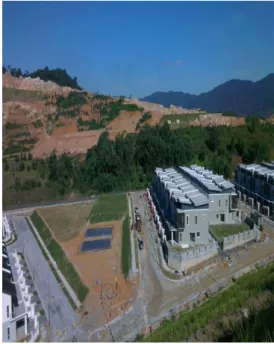
natural organic and inorganic materials (Butler & Davies, 2010) such as oil and grease, hydrocarbons, heavy metals, and salts from roadway runoffs, nutrients (fertilizer), bacteria and viruses (animal waste) from residential runoffs; heavy metals, sediments, vegetation residues and weathered particulates from structures (Kim, Sung, Li, & Chu, 2012), (Li et al., 2008a). Error! Reference source not found. shows the impacts of developed land that can create more rapid runoffs when rainfall events occur.
Figure 1. Developed Land creates more Quickly Runoff
Therefore, Best Management Practices (BMPs) are being introduced to help in a more efficient planning of stormwater management such as Low Impact Development (LID), Sustainable Urban Drainage (SUD) and Water Sensitive Urban Design (WSUD). The main objectives of stormwater management practices is to match the state of the development area that was altered in terms of its hydrologic condition due to urbanisation to the level of condition before the area was developed, as well as to maintain the pre-development hydrologic balance (Emerson et al., 2009). This stormwater management aims will help in overcoming problems created by urbanisation by employing strategies, one of which includes an integrated design that combines the importance of quality, quantity and amenities in restoring the altered hydrologic condition in the affected areas (Brown & Hunt, 2011). The application of Best Management Practices should also be seen as an opportunity for sustainable development and improvement of social, educational and environmental conditions in urbanised and surrounding areas (Barbosa et al., 2012). Stormwater BMPs are widely used in the
management planning of stormwater in the United Kingdom, United States, Australia and Singapore. The setting up of landscapes and structures such as detention and retentions ponds, wetlands, green roof, permeable paving materials and bioretention systems will be able to reduce flooding without constructing expensive upgrades to the existing drainage infrastructures. Considering this, attention on the management and treatment of urban stormwater runoff has risen noticeably through the implementation of stormwater control measures around the world (Davis et al., 2012).
Since its initial development and trial applications over a decade ago, the bioretention system, also referred to as “rain garden,” has rapidly become one of the most versatile and widely used storm-water best management practice BMP throughout the United States and many parts of the world. It has recently become identified as a preferred site practice for green building design and leads the progress in energy and environmental design. Bioretention system in Malaysia can be considered as a new innovation in stormwater management practice that is yet to be widely applied all over the country. There are only a few number of bioretention systems throughout Malaysia which are the Humid Tropic Centre, (HTC) Kuala Lumpur and National Hydraulic Research Institute of Malaysia, (NAHRIM). However, there is still a lack in studies done to evaluate their performance in terms of the hydrology characteristics and treatment performance of these facilities towards stormwater quality via bioretention system. Moreover, guidelines in the newly published second edition of MSMA (2012) are currently based on studies done overseas. Therefore, it is important to examine the fundamentals of hydrology and treatment performance of bioretention system, particularly those in Malaysia to improve the design procedures/guidelines for tropical climate conditions.
Bioretention system components
45
roadsides, and highways. Nowadays, bioretention systems are receiving increasing attention due to their design flexibility and landscape improvements in terms of the resulting aesthetic enhancement (Hatt et al., 2009). Bioretention is a novel stormwater best management practice systems that use vegetation, mulches and soil media that capture, temporarily detain and treat stormwater runoff for water quality improvement (Blecken et
al., 2010; Li & Davis, 2008b). Bioretention
systems can be designed as impermeable or permeable system depending on the application of the designated catchment area. The impermeable system design is required in underdrains to carry excess the water away from the catchment area if the infiltration capacity of native soil is low or the occurrence of intense, heavy rainfall is frequent.
Bioretention can be used to achieve multiple stormwater management objectives such as maintaining groundwater recharge and base flow, removing surface and groundwater pollutant, reducing peak flow as well as protecting channels. Water quality improvement occurs through the treatment routine of bioretention which include physical procesess such as sedimentation, filtration and infiltration, along with chemical and biological procesess via absorption and soil filtering (Davis et
al., 2003). Previous researches proved that the
effectiveness of bioretention zones in removing many pollutants from urban runoff depends their design and media composition (Davis et al., 2003; Hunt & Jarrett, 2006; Dietz & Clausen, 2005; Hunt
et al., 2008). Besides, various studies have
documented bioretention performance in improving both water quality and watershed hydrology (Li, Sharkey, Hunt, & Davis, 2009). Error! Reference source not found. shows the typical cross section of a bioretention system.
Figure 2. Cross Section of Bioretention System
Pilot Project of Bioretention System in
Malaysia
Site Description of the Bioretention System in Humid Tropic Centre
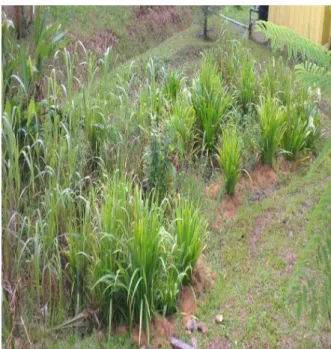
Humid Tropics Centre Kuala Lumpur (HTCKL) Malaysia has initiated the construction of the components of MSMA Stormwater Management Eco Hydrology (SME) as an example of the lot scale application within an urban area in the tropics, as well as a pilot study site in Malaysia (Lariyah et al., 2011). The typical components that were installed included green roof, grey water reuse system, wetland, porous pavement and bioretention system. The bioretention system was designed at a small scale for 3 months of ARI with small drainage areas (< 0.5 acre). It was 10m long and 5 m wide from berm to berm including the pea gravel diaphragm (Error! Reference source not found.). This impermeable bioretention system consisted plants, 230 mm of ponding depth, 70 mm of fine shredded hammered hardwood mulch layer, 1200 mm of planting soil, 250 mm of thick gravel bed and 100 mm diameter of perforated underdrain outlet pipe. The subsoil pipe was embedded in the bottom layer of the system to convey the infiltrated water to the outlet point.
Figure 3. Bioretention System in HTC Kuala Lumpur
Site Description of the Bioretention System in UNITEN, Putrajaya Campus
46
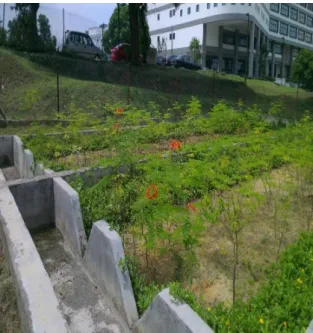
Campus in August 2013. This research site was set up under the collaboration of Universiti Tenaga Nasional (UNITEN) and Universiti Sains Malaysia (USM). Two parallel bioretention cells were constructed to capture and treat stormwater runoffs from a parking area with an approximately 0.08 ha at the university’s College of Engineering. Each of bioretention cells is composed of an asphalt surface with the length of 12.0 m and width of 4.0 m. The bioretention cells were constructed according to the standards of bioretention design as outlined in the Urban Storm Water Management Manual for Malaysia (MSMA), Second Edition. It was designed as an impermeable system with different depths (1.0 m and 0.45 m) of engineered soil media with an underdrain located in the drainage layer. The composition of the engineered soil mix included 20 to 25% top soil, 50 to 60% medium sand and 20 to 25% organic leaf compost. Small gravel was packed around the underdrain system as a drainage layer. Plants selected were based on the local climate conditions that are usually or commonly used in local landscapes as they can survive the dry and wet weathers (Error! Reference source not found.).
Figure 4. Bioretention System in UNITEN, Putrajaya Campus
Methodology
Water Quality Monitoring in Humid Tropic Centre
Water quality measurements were taken starting from May 2012 to November 2012. Within 24 hours of a monitored storm event, water quality samples were collected from the outlet manually. Once collected, the samples were chilled in a cooler filled with ice and were transported back to
an analytical laboratory. An analytical procedure was conducted based on the Standard Method for Examination of Water and Wastewater, 20th Edition APHA Standard Method. The selected water quality parameters included Total Suspended Solids (TSS), pH, Dissolved Oxygen (DO), Biochemical Oxygen Demand (BOD), Chemical Oxygen Demand (COD) and Ammoniacal Nitrogen (AN). The water quality classification was done based on Water Quality Index (WQI) sourced from the Department of Environmental (DOE), Malaysia. This index of water quality status based on different levels of pollutions and classifies it as Class I, II, III, IV and V.
Water Quality Monitoring in UNITEN, Putrajaya Campus
Field investigation consisted of gathering information on the inflow and outflow within the system and collecting representative samples from each rainfall event for water quality testing in the lab. Data were recorded by each monitoring station including the site precipitation. Water quality measurements were taken after the completion of the construction project, starting from July to December 2013. The data collection of water quality and flow at the inlets and outlets were conducted manually before the automatic sampler, rainfall and flow sensors were installed in the system. Within 24 hours of a monitored storm event, water quality samples were collected from the inlets and outlets manually. The collected samples were chilled in a cooler filled with ice and sent to a certified analytical lab to determine the water quality. The water samples were measured and analysed in accordance to the analytical procedures subscribed by the American Public Health Association (APHA) Standard Methods. The parameters were selected according to the Water Quality Index (WQI) comprising of Total Suspended Solids (TSS), Total Phosphorus (TP) and Ammoniacal Nitrogen (AN).
Results And Discussion
Humid Tropic Centre
47
Suspended Solids (TSS), heavy metals; however the outcome varied for nutrients such as Nitrogen and Phosphorus (Davis et al., 2001; Zinger et al., 2013).
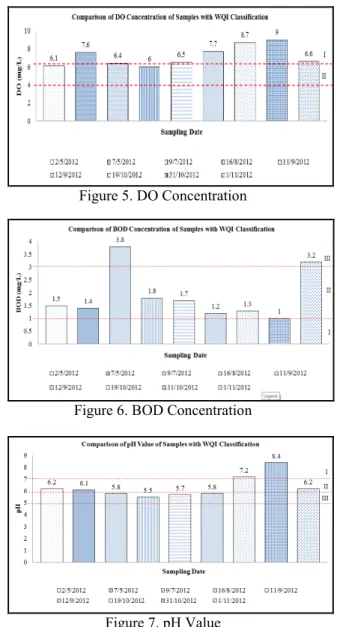
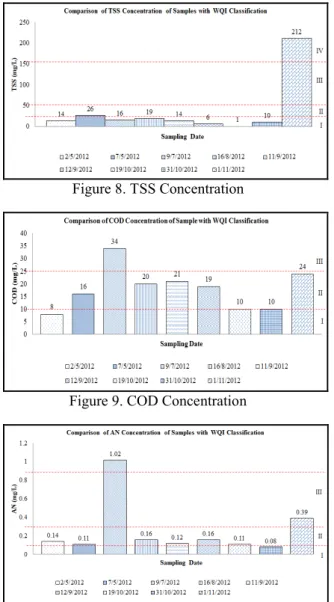
For water quality measurement, results of water quality were found to have recorded a Water Quality Index (WQI) Classification near to Class I or Class II. This Water Quality Index (WQI) classification is the common standard in Malaysia provided by the Department of Environment (DOE) of which the classes of water quality (I, II, III, IV and V) are shown in Error! Reference source not found.. Based on Error! Reference source not found., Class I indicate ‘very good’ water quality, Class II as ‘good’, Class III as ‘average’, Class IV as ‘polluted’ and Class V as ‘very polluted’ water classification. Based on the result, the average concentration of DO was between 6 mg/L to 9 mg/L and water quality classification was recorded at Class I (>7 mg/L) and Class II (5 to 7 mg/L). Most of the results for BOD concentration falls into Class II (1 to 3 mg/L) compared to 2 samples collected on 9 July 2012 and 1 November 2012 which are considered as Class III (3 to 6 mg/L). The value range of pH was 5.5 to 8.4. Based on WQI, these pH value can be categorised as Class I (>7) to Class III (5 to 6). TSS concentration was very high (212 mg/L) on the 1November 2012 compared to other sampling date which ranged between 1 mg/L to 26 mg/L. Concentration of TSS of less than 25 mg/L is considered as Class I (very good) condition. Average concentration of COD and AN was at 18 mg/L and 0.28 mg/L respectively. Based on the average concentration, COD and AN can be classification as Class II.
Table 1. Water Quality Classification based on WQI
Parameter
Class
I II III IV V
Ammoniacal Nitrogen (mg/l)
< 0.1 0.1 - 0.3
0.3 - 0.9
0.9 - 2.7
> 2.7
Biochemical Oxygen Demand
(mg/l)
< 1 1 - 3 3 - 6 6 - 12
> 12
Chemical Oxygen Demand (mg/l)
< 10 10 - 25
25 - 50
50 - 100
> 100
Dissolved Oxygen (mg/l)
> 7 5 - 7 3 - 5 1 - 3 < 1
pH > 7 6 - 7 5 - 6 < 5 > 5
Total Suspended Solid (mg/l)
< 25 25 - 50
50 - 150
150 - 300
> 300
Water Quality Index (WQI)
< 92.7 76.5 - 92.7
51.9 - 76.5
31- 51.9
> 31
From Error! Reference source not found. to Figure 10 showed that within nine sampling events, Water Quality Index (WQI) were mostly recorded to be within Class I (>92.5) and II (76.5 to 92.7) in average and were therefore considered as very good and good condition. The water was slightly polluted with results found to be within the range of 51.9 to 76.5 of Class III on 9 July 2012 and 1 November 2012. In overall, water quality from the outflow of the bioretention system can be classified as clean with high WQI classification. Hence, the bioretention system in HTC has proven to reduce and treat the stormwater quality. It showed that the application of bioretention system at a local scale in Malaysia has the potential to improve storm water management in terms of water quality.
Figure 5. DO Concentration
Figure 6. BOD Concentration
48
Figure 8. TSS Concentration
Figure 9. COD Concentration
Figure 10. AN Concentration
UNITEN, Putrajaya Campus
In the preliminary stage of site establishment, water quality sampling was conducted manually for the first four months from September to December 2013 after the site was completed. Error! Reference source not found. shows that the removal percentages of TSS concentration were high with 98.39% for outlet 1 and 94.03% for outlet 2 respectively. The removal percentage efficiency of TSS was slightly different even though the depth of the filter media for outlet 1 was 1.0m and outlet 2 was 0.45m. Preliminary results shown in Figure 11 indicate that Suspended Solids were excellently removed by more than 40% as it did with Ammoniacal Nitrogen (Figure 12).
Conversely, TP removal percentages varied and were not consistent. The lowest percentage was -11.11% and -4.55% for outlet 1 and outlet 2 as shown in Figure 13. For nutrients, previous research found that the results of TP removal were varied, most likely because of the complexity of the
chemistry make up of these species. In some cases, significant removal has been recognised, but in others, the treatment efficiency has been low. Long term monitoring will be conducted to examine trends of the removal efficiency of TP. Laboratory bioretention box studies have indicated 70–85% phosphorus removal (Davis et al., 2006) and column studies have also shown 67 to >98% removal of phosphorus mass (Davis et al., 2007).
Figure 11. TSS Removal
Figure 12. AN Removal
Figure 13. TP Removal
49
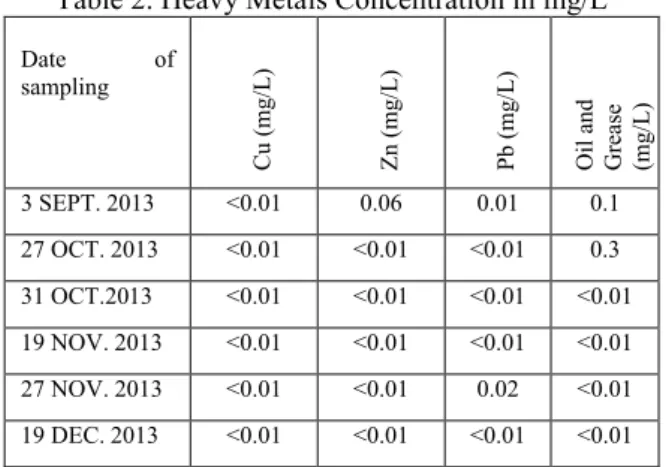
parking lot with low traffic, it was assumed that the concentration of heavy metals and hydrocarbon were not largely present and hence not significant for further examination.
Table 2. Heavy Metals Concentration in mg/L
Date of
sampling
Cu (mg/L) Zn (mg/L) Pb (mg/L) Oil and Grease (mg/L)
3 SEPT. 2013 <0.01 0.06 0.01 0.1
27 OCT. 2013 <0.01 <0.01 <0.01 0.3
31 OCT.2013 <0.01 <0.01 <0.01 <0.01
19 NOV. 2013 <0.01 <0.01 <0.01 <0.01
27 NOV. 2013 <0.01 <0.01 0.02 <0.01
19 DEC. 2013 <0.01 <0.01 <0.01 <0.01
However, early research done by Davis (2001) pertaining a laboratory study of biological retention demonstrated at various scales, the reduction concentration of heavy metals such as Cu, Pb and Zn were high (92%). Moderate reduction of phosphorus (~80%), TKN (65 to 75%) and ammonium (60 to 80%) were also found. Conversely, nitrate performance varied, revealing little amount of removal (Davis et al., 1993). Moreover, study a conducted by Dietz & Clausen (2005) demonstrated that 98.8% of the stormwater that entered bioretention cells was treated.
Observation by Hsieh & Davis (2005) also proved that biofiltration system consistently reduced the concentration of TSS and heavy metals. Load reduction generally exceeded 90% for both TSS and heavy metals. However, reduction on nutrients concentration is highly varied. The use of filter media with low organic matter content (particularly phosphorus) and plant species can facilitate the nutrient removal. Thus, filter media with low phosphorus content should be selected to ensure the effective removal of phosphorus. Nitrogen is more difficult to remove compared to phosphorus since the nutrient is highly soluble.
Previous laboratory study have revealed that stormwater biofilters were capable to reduce the concentration of heavy metals such as Pb, Zn, and Cu at more than 90% (Davis et al., 2001; Davis et
al., 2003; Sun & Davis, 2007). Generally, heavy
metals do not infiltrate too far into the filter media, instead they accumulate at the surface of the top of soil (Davis et al., 2001; Muthanna et al., 2007). Treatment of stormwater runoffs based on laboratory pot study indicates that more than 90% of input metals were reduced within 25 cm of bioretention depth (Sun & Davis, 2007).
Conclusion
Preliminary results show that bioretention systems demonstrated the capability to remove pollutants and improve water quality. The outcome of this study can be used to improve the Design Guideline for Bioretention System in future for Urban Storm Water Management Manual for Malaysia (MSMA). Further monitoring and analysis will be made to evaluate the design performance of bioretention with respect to characteristics of hydrology and hydraulics for Malaysian condition. Bioretention system can serve as an effective and integrated solution for managing urban runoff. In the long term, this study supports the government aspiration in promoting green technology in Malaysia.
Acknowledgments
The authors acknowledge the financial support provided by the Ministry of Higher Education of Malaysia under the LRGS grant scheme (Project No. 203/PKT/6720004).
References
Barbosa, A. E., Fernandes, J. N., & David, L. M. (2012). Key issues for sustainable urban stormwater management. Water Research,
46(20), 6787–98.
Blecken, G. T., Zinger, Y., Deletić, A., Fletcher, T. D., Hedström, A., & Viklander, M. (2010). Laboratory study on stormwater biofiltration: Nutrient and sediment removal in cold temperatures. Journal of Hydrology, 394(3-4), 507–514.
Bratieres, K., Fletcher, T. D., Deletic, A., & Zinger, Y. (2008). Nutrient and sediment removal by stormwater biofilters: a large-scale design optimisation study. Water Research, 42(14), 3930–40.
Brown, R. A., & Hunt, W. F. (2011). Underdrain Configuration to Enhance Bioretention Exfiltration to Reduce Pollutant Loads.
Journal of Environmental Engineering, 137(2),
1082–1091.
Butler, D., & Davies, J. W. (2010). Urban
Drainage, 3rd Edition. United Kingdom:
Taylor and Francis Books.
Davis, A. P. (2008). Field performance of bioretention: hydrology impacts. Journal of
Hydrologic Engineering, 13(2), 90–95.
Davis, A. P., Shokouhian, M., & Ni, S. (2001). Loading estimates of lead, copper, cadmium, and zinc in urban runoff from specific sources.
50
Davis, A. P., Shokouhian, M., Sharma, H., & Minami, C. (1993). Laboratory study of biological retention for urban stormwater management. Water Environment Research,
73(1), 5–14.
Davis, A. P., Shokouhian, M., Sharma, H., & Minami, C. (2001). Laboratory study of biological retention for urban stormwater management. Water Environment Research,
73(1), 5–14.
Davis, A. P., Shokouhian, M., Sharma, H., & Minami, C. (2006). Water quality improvement through bioretention media: Nitrogen and phosphorus removal. Water
Environment Research, 78(3), 284–293.
Davis, A. P., Shokouhian, M., Sharma, H., Minami, C., & Winogradoff, D. (2003). Water quality improvement through bioretention : lead ,copper , and zinc removal. Water Environmant Research, 75(1), 73–82.
Davis, A. P., Stagge, J. H., Jamil, E., & Kim, H. (2012). Hydraulic performance of grass swales for managing highway runoff. Water Research, 46(20), 6775–86.
Dietz, M. E., & Clausen, J. C. (2005). A field evaluation of rain garden flow and pollutant treatment. Water, Air, and Soil Pollution, 167, 123–138.
Emerson, C. H., & Traver, R. G. (2009). Multiyear and seasonal variation of infiltration from storm-water best management practices.
Journal of Irrigation and Drainage Engineering, 134(5), 598–605.
Goonetilleke, A., Thomas, E., Ginn, S., & Gilbert, D. (2005). Understanding the role of land use in urban stormwater quality management.
Journal of Environmental Management, 74(1),
31–42.
Hatt, B. E., Fletcher, T. D., & Deletic, A. (2009). Hydrologic and pollutant removal performance of stormwater biofiltration systems at the field scale. Journal of Hydrology, 365(3-4), 310– 321.
Hsieh, C. H., & Davis, A. P. (2005). Evaluation and optimization of bioretention media for treatment of urban storm water runoff. Journal
of Environmental Engineering, 131(11), 1521–
1531.
Hsieh, C. H., & Davis, A. P. (2006). Evaluation and optimization of bioretention media for treatment of urban storm water runoff. Journal
of Environmental Engineering, 131(11), 1521–
1531.
Hsieh, C. H., Davis, A. P., & Needelman, B. A. (2007). Bioretention column studies of phosphorus removal from urban stormwater runoff. Water Environmant Research, 79(2), 177–184.
Hunt, W. F., Smith, J. T., Jadlocki, S. J., Hathaway, J. M., & Eubanks, P. R. (2008). Pollutant removal and peak flow mitigation by a bioretention cell in urban Charlotte, N.C.
Journal of Environmental Engineering, 134(5),
403–408.
Hunt, W., & Jarrett, A. (2006). Evaluating bioretention hydrology and nutrient removal at three field sites in North Carolina. Journal of
Irrigation and Drainage Engineering, 132(6),
600–608.
Kim, M. H., Sung, C. Y., Li, M. H., & Chu, K. H. (2012). Bioretention for stormwater quality improvement in Texas: removal effectiveness of Escherichia coli. Separation and Purification Technology, 84(1), 120–124.
Lariyah, M. S., Mohd Nor, M. D., Mohamed Roseli, Z. A., Zulkefli, M., & Amirah Hanim, M. P. (2011). Application of Water Sensitive Urban Design at Local Scale in Kuala Lumpur. In 12nd International Conference on Urban
Drainage, Porto Alegre, Brazil.
Li, H., & Davis, A. P. (2008). Urban particle capture in bioretention media . I : laboratory and field studies. Journal of Environmental
Engineering, 134(6), 409–418.
Li, H., Sharkey, L., Hunt, W. F., & Davis, A. P. (2009). Mitigation of Impervious Surface Hydrology Using Bioretention in North Carolina and Maryland. Journal of Hydrologic
Engineering, 14(4), 407–415.
Muthanna, T. M., Viklander, M., Blecken, G., & Thorolfsson, S. T. (2007). Snowmelt pollutant removal in bioretention areas. Water Research,
41(18), 4061–72.
Sun, X., & Davis, A. P. (2007). Heavy metal fates in laboratory bioretention systems.
Chemosphere, 66(9), 1601–1609.
Welker, A. L., Mandarano, L., Greising, K., & Mastrocola, K. (2013). Application of a monitoring plan for storm-water control measures in the Philadelphia region. Journal of
Environmental Engineering, 139, 1108–1118.
Yang, H., McCoy, E. L., Grewal, P. S., & Dick, W. A. (2010). Dissolved nutrients and atrazine removal by column-scale monophasic and biphasic rain garden model systems.
Chemosphere, 80(8), 929–934.
Zinger, Y., Blecken, G. T., Fletcher, T. D., Viklander, M., & Deletić, A. (2013). Optimising nitrogen removal in existing stormwater biofilters: Benefits and tradeoffs of a retrofitted saturated zone. Ecological