Robust H
∞Control of a Doubly Fed Asynchronous Machine
Gherbi Sofiane
Department of electrical engineering, Faculty of Science of the engineer 20 August 1956 University, Skikda, Algeria
E-mail: [email protected] Yahmedi Said
Department of electronic, Faculty of Science of the engineer Badji Mokhtar University, Annaba, Algeria
E-mail: [email protected] Sedraoui Moussa
Department of electronics, Faculty of Science of the engineer Constantine University, road of AIN EL BEY Constantine, Algeria E-mail : [email protected]
Keywords:doubly fed asynchronous machine, robust control,Hcontrol, LMI’s
Received:April 25, 2008
The doubly fed asynchronous machine is among the most used electrical machines due to its low cost, simplicity of construction and maintenance [1]. In this paper, we present a method to synthesize a robust controller of doubly fed asynchronous machine which is the main component of the wind turbine system (actually the most used model [2]), indeed: there is different challenges in the control of the wind energy systems and we have to take in a count a several parameters that perturb the system as: the wind speed variation, the consumption variation of the electricity energy and the kind of the power consumed (active or reactive) ...etc.. The method proposed is based on the Hcontrol problem with the linear
matrix inequalities (LMI’s) solution: Gahinet-Akparian [3], the results show the stability and the performance robustness of the system in spite of the perturbations mentioned before.
Povzetek: Opisana je metoda upravljanja motorja vetrnih turbin.
1 Introduction
From all the renewable energy electricity production systems, the wind turbine systems are the most used specially the doubly fed asynchronous machine based systems, the control of theses systems is particularly difficult because all of the uncertainties introduced such as: the wind speed variations, the electrical energy consumption variation, the system parameters variations, in this paper we focus on the robust control (Hcontroller design method) of the doubly fed
asynchronous machine which is the most used in the wind turbine system due to its low cost, simplicity of construction and maintenance [1].
This paper is organised as follow:
Section 2 presents the wind turbine system equipped with the doubly fed asynchronous machine and then the mathematical electrical equations from what the system is modelled (in the state space form) are given.
The section 3 presents the H robust controller design
method with the LMI’s solution used to control our system.
The section 4 presents a numerical application and results in both the frequency and time plan are presented And finally a conclusion is given in section 5.
2 System presentation and
modelling
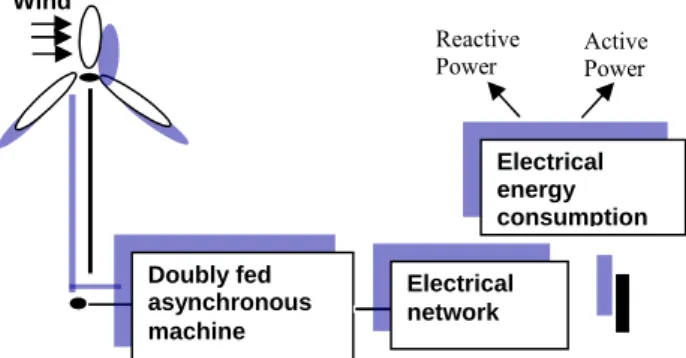
The following figure represents the wind turbine system
The system use the wind power to drag the double fed asynchronous machine who acts as a generator, the output power produced must have the same high quality when it enters the electrical network, i.e.: 220 volts amplitude and 60 Hz frequency and the harmonics held
Active Power
Doubly fed asynchronous machine Wind
Electrical network
Electrical energy consumption
Reactive Power
to a low level in spite of wind speed changes and electrical energy consumption in active or reactive power form. References [4], [5], [6] describe detailed models of wind turbines for simulations, we use the model equipped with the doubly fed induction generators (asynchronous machine) (for more details see [7]), the system electrical equations are given in
d, frame orientation, then the stator voltage qdifferential equations are:
qs s ds ds s ds w dt d I R
V . (1)
ds s qs qs s qs w dt d I R
V . (2) The rotor voltage differential equations are:
qr r dr dr r dr w dt d I R
V . (3)
dr r qr qr r qr w dt d I R
V . (4) The stator flux vectors equations are:
dr ds s
ds L .I M.I
(5)
qr qs s
qs L .I M.I
(6) The rotor flux vectors equations:
ds dr r
dr L .I M.I
(7)
qs qr
r
qr L .I M.I
(8) The electromagnetic couple flux equation :
) . .
(
. ds qr qs dr
s
em I I
L M p
C (9)
The electromagnetic couple mecanic equation :
f.
dt d J C
Cem r (10)
With:
qs ds V
V , : Statoric voltage vector components in ‘d’
and ‘q’ axes respectively. qr
dr V
V , : Rotoric voltage vector components in ‘d’
and ‘q’ axes respectively. qs
ds I
I , : Statoric current vector components in ‘d’
and ‘q’ axes respectively. qr
dr I
I , : Rotoric current vector components in ‘d’
and ‘q’ axes respectively. qs
ds
, : Statoric flux vector components in ‘d’
and ‘q’ axes respectively. qr
dr
, : Rotoric flux vector components in ‘d’
and ‘q’ axes respectively. r
s R
R , : Stator and rotor resistances (of one phase) respectively.
r s L
L , : Stator and rotor cyclic inductances respectively.
r s w
w , : Statoric and rotoric current pulsations respectively.
M : Cyclic mutual inductance.
p : Number of pair of the machine poles.
r
C : Resistant torque.
f : Viscous rubbing coefficient.
J : Inertia moment.
2.1
State space model
In order to apply the robust controller design method, we have to put the system model in the state space from; we consider the rotoric voltage
V
dr,
V
qras the inputsand the statoric voltage
V
ds,
V
qs as the outputs, i.e. we have to design a controller who acts on the rotoric voltages to keep the output statoric voltages atvolts
220 and50Hzfrequency in spite of the electric
network perturbations (demand variations … etc) and the wind speed variations (see figure.2).
Figure 2: A Doubly fed wind turbine system control configuration
Where: u,yand eare the rotoric voltage vector
(control vector), statoric output voltage vector and the error signal between the input reference and the output system respectively.K,Gare the controller and the
wind turbine system respectively.
R
: is the statoric voltage references vector and perturbations are theelectric energy demand variations, wind speed variations …etc.
Let us consider
T qr drx as a state vector, and
Tqs ds qs
ds I V V I
u as the command vector, the
stator flux vector is oriented in d axis of Parks reference frame then : qs 0 and Ids,Iqsare considered constant in the steady state i.e.: Ids Iqs 0.
We use the folowing doubly fed asynchronous machine parameters:
5
s
R ;Rr 1.0113 ;M 0.1346H H
Ls0.3409 ;Lr0.605H ;wr 146.6Hz ; Hz
ws 250
Let wwswr and
r s L L M 1 2
.
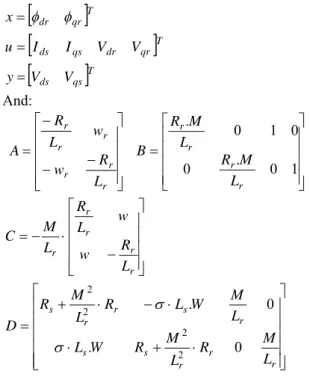
The state space (11) can be obtained by the combining of the equations (1) to (8) as follow:
u D x C y u B x A x (11) Where: ons perturbati G
R e u y
T qr drx
Tqr dr qs
ds I V V
I u
Tqs ds V V y And: r r r r r r L R w w L R A 1 0 . 0 0 1 0 . r r r r L M R L M R B r r r r r L R w w L R L M C r r r s s r s r r s L M R L M R W L L M W L R L M R D 0 . 0 . 2 2 2 2
3 The
H
∞controller design method
It is necessary to recall the basics of a control loop (figure.3). With G’: the perturbed system.
Figure 3: The control loop with the output multiplicative uncertainties
The multiplicative uncertainties at the process output which include all the perturbations that act in the system are then : ( ' ). 1
G G G
m , with GG(Im) : is
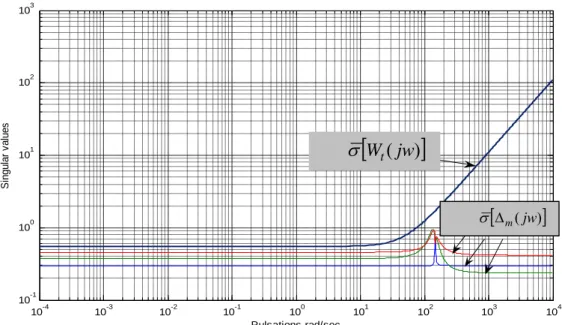
the perturbed system, figure.4 show the singular values plot at the frequency plan of
m, we can see that the uncertainties are smaller at low frequencies and grow at the medium and high frequencies, this mean a strong perturbation at high frequencies (the transient phase), we also note a pick at:
260
rad
/
s
, this is due to the fact that the system is highly coupled at this pulsation.We can bound the system uncertainties by the following weighting matrix function:
) 0001 . 0 1 ( ) 1 02 . 0 ( 55 . 0 0 0 ) 0001 . 0 1 ( ) 1 02 . 0 ( 55 . 0 ) ( jw jw jw jw jw
Wt (12)
The figure.5 show that the singular values of )
(jw
Wt bounds the maximum singular values of the
uncertainties in the entire frequency plan. The robust stability condition [11] is then:
T
jw Wt jw
1 (13) Or:
T
jw
Wt
jw
1 (14)Where:
is the maximum singular value and T
jw isthe nominal closed loop transfer matrix defined by:
1jw K jw G I jw K jw G jw
T (15)
The equations (13) allow us to guaranty the stability robustness, in other hand we most guaranty satisfying performances (no overshoot, time response …etc) in the closed loop (performances robustness), this can by done by the performance robustness condition [8]:
S
jw
W
pjw
1
(16) Or:
1jw
W
jw
S
p
(17) Where:
jwS is the sensitivity matrix given by:
1jw K jw G I jw
S (18)
) (jw
WP is a weighting matrix function designed to meet
the performance specifications desired in the frequency plan, we choose the following matrix function:
jw jw jw jw jw Wp 05 . 0 ) 1 005 . 0 ( 0 0 05 . 0 ) 1 005 . 0 ( )
( (19)
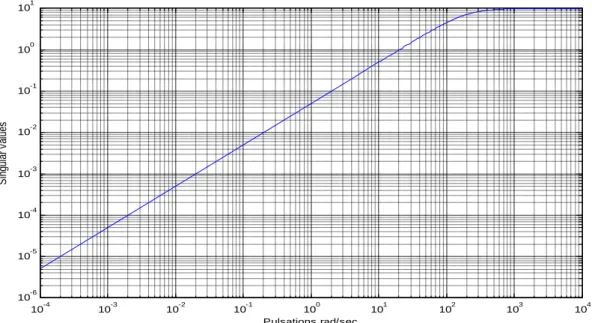
The figure.6 represent the singular values of WP
jw inthe frequency plan, one notice that the specifications on the performances are bigger in low frequencies (integrator frequency behaviour), and this guaranty no static error.
Then the standard problem of H∞ Control theory is then:
jw
W
jw
S
jw
W
jw
p g stabili K t sinT
min
(20)i.e.: to find a stabilising controllerKthat minimise the norm (20).
With: is The Hinfinity norm.
∆m
K G y
G’
_
4 Application
The minimisation problem (20) is solved by using two Riccati equations [9] or with the linear matrix inequalities approach. For our system, we use the linear matrix inequalities solution (for more details see [10]). The solution (controller) can be obtained via the Matlab instruction hinflmi available at ‘LMI Toolbox’ of
Matlab®Math works Inc [11].
The figure 7 and the figure 8 show the satisfaction of the stability and performances robustness conditions (14) and (17).
The figure.9 show the step responses step responses of the closed loop controlled nominal system with:
01
0 1
_
_
Vds ref Vqs ref
R respectively.
The Outputs Vds and Vqs follow the references with a
good time response and no overshoot.
10-4 10-3 10-2 10-1 100 101 102 103 104
10-0.6 10-0.5 10-0.4 10-0.3 10-0.2 10-0.1
Pulsations
S
in
gu
la
r
v
al
u
e
s
Figure 4: The system uncertainties maximum singular values
10-4 10-3 10-2 10-1 100 101 102 103 104
10-1 100 101 102 103
Pulsations rad/sec
S
in
g
u
la
r
v
a
lu
e
s
Figure 5: Maximum singular values of the system uncertainties mbounded by the singular values ofWt
jw .
W
t(
jw
)
m(jw)
m(jw)
10-4 10-3 10-2 10-1 100 101 102 103 104 10-6
10-5 10-4 10-3 10-2 10-1 100 101
Pulsations rad/sec
S
in
gu
la
r
va
lu
es
Figure 6: Singular Values of the weighting performance specification
10-4 10-3 10-2 10-1 100 101 102 103 104
10-5 10-4 10-3 10-2 10-1 100 101
Pulsations rad/sec
S
in
gu
la
r
va
lu
es
Figure 7: Stability robustness condition
T
(
jw
)
( )
110-4 10-3 10-2 10-1 100 101 102 103 104 10-6
10-5 10-4 10-3 10-2 10-1 100 101
Pulsations rad/sec
S
in
gu
la
r
va
lu
es
Figure 8: Performances robustness condition
Figure 9: Step response of the controlled closed loop nominal system
5 Conclusion
In this paper we deal with the control problem of a wind turbine equipped with a doubly fed asynchronous machine subject to various perturbations and system uncertainties (wind speed variations, electrical energy consumption, system parameters variations ...etc), we show that the H∞ controller design method can be successfully applied to this kind of systems keeping
stability and good performances in spite of the perturbations and system uncertainties.
S
(
jw
)
( )
1jw Wp
0 0.05 0.1 0.15 0.2 0.25
0 0.2 0.4 0.6 0.8 1
Time (sec)
O
u
tp
u
ts
0 0.05 0.1 0.15 0.2 0.25
0 0.2 0.4 0.6 0.8 1
Time (sec)
O
u
tp
u
ts
Vds
Vqs
Vqs
References
[1] G. L. Johnson (2006), ‘Wind energy systems: Electronic Edition’, Manhattan, KS, October 10. [2] ‘AWEA Electrical Guide to Utility Scale Wind
Turbines’, (2005), The American Wind Energy Association, available at http://www.awea.org. [3] P. Gahinet, P. Akparian (1994), ‘A linear Matrix
Inequality Approach to H∞ Control ‘, Int. J. of
Robust & Nonlinear Control“, vol. 4, pp. 421-448. [4] J. Soens, J. Driesen, R. Belmans (2005), ‘
Equivalent Transfer Function for a Variable-speed Wind Turbine in Power System Dynamic Simulations ‘, International Journal of Distributed Energy Resources, Vol.1 N°2, pp. 111-133.
[5] ‘Dynamic Modelling of Doubly-Fed Induction Machine Wind-Generators’ (2003), Dig Silent GmbH Technical Documentation, available at http://www.digsilent.de.
[6] J. Soens, J. Driesen, R. Belmans (2004), ‘ Wind turbine modelling approaches for dynamic power system simulations ‘, IEEE Young Researchers Symposium in Electrical Power Engineering
-Intelligent Energy Conversion, (CD-Rom), Delft, The Netherlands.
[7] J. Soens, V. Van Thong, J. Driesen, R. Belmans (2003), ‘ Modelling wind turbine generators for power system simulations ‘, European Wind Energy Conference EWEC.
[8] Sigurd Skogestad, Ian Postlethwaite (1996), ‘Multivariable Feedback Control Analysis and Design’, John Wiley and Sons. pp: 72 to 75
[9] J. C. Doyle, K. Glover, P. P. Khargonekar and Bruce A. Francis (1989), ‘State-Space Solution to Standard
H
2andH
Control Problems’, IEEE Transactions on Automatic Control, Vol. 34, N°. 8. [10] D.-W. Gu, P. Hr. Petkov and M. M. Konstantinov(2005), ‘Robust Control Design with MATLAB® ’,
© Springer-Verlag London Limited.pp:27 to 29 [11] P. Gahinet, A. Nemirovski, A. J. Laub, M. Chilali
(1995). “LMI Control Toolbox for Use with MATLAB®”, User’s Guide Version 1, The Math