Context-based Global Expertise in Recommendation Systems
Vincenza Carchiolo, Alessandro Longheu, Michele Malgeri and Giuseppe Mangioni Dip. Ingegneria Informatica e delle Telecomunicazioni
Facoltà di Ingegneria - Università degli Studi di Catania – Catania - Italy
Keywords:expertise, recommendation systems, collaborative filtering, social networks
Received:December 8, 2009
Expertise assessment is frequently required in social networks. This work proposes a method to globally rank people according to their expertise according to a set of topics We also introduce contexts similarity to allow related contexts to be exploited in expertise assessment. These ideas are applied to the Epinions.com recommender systems, showing that expertise in recommendation matters.
Povzetek: Opisana je metoda za rangiranje posameznikov glede na socialno omrežje.
1 Introduction and related work
The concept of expertise can be simply defined as the skill or knowledge that a person has in a particular field; more formally, expertise is"the ability to discriminate meaning-ful classes of domain features and patterns, and to take decisions or actions that are appropriate to the class at hand"[9].
Apart from definitions, less trivial matters are how the expertise can be evaluated, and which effective applications it can have. The expertise assessment can be hard, expe-cially in nowadays virtual social networks (e.g. Facebook, or even e-commerce oriented, as eBay), due to the the lack of real person to person interactions used in real world to judge someone’s expertise level. Several approaches to this issue have been proposed [6, 12, 31, 32].
In particular, in [6] the authors aim at ranking the expert candidates in a given topic based on a data collection, hence they locate three components, i.e. a supporting document collection, a list of expert candidates, and a set of exper-tise topics. This work (as others) shows that an experexper-tise rank is strictly related to a topic, so the question of which set of topics as well as their relationship (for instance, an arrangement into an ontology) should be addressed. That paper also highlights that expertise is commonly inferred from a set of documents (personal profiles, web pages, fo-rum messages etc.) that represent theuse casewhere ex-pertise is applied, and they are the virtual counterpart of real world interactions between persons usually used to as-sess the each other’s expertise. The evaluation of an ex-pertise rank by exploiting some data is not a new idea[13], and it has been successfully applied in other scenarios, e.g. Usenet news messages [26] or computer supported cooper-ative work (CSCW) [16].
In [12], topic expertise is ascertained by exploiting col-laborative tagging mechanisms that enable the formation of social networks around tags or topics. Authors state that in-ferring expertise from data as personal profiles is problem-atic since users should keep them updated, and they also
debate about the granularity in skill levels that should not be either too coarse or too fine (in the former case, auto-mated systems have a difficult time selecting the right peo-ple, whereas in the latter users can hardly determine their levels in relation to others).
The work presented in [31] is a propagation-based ap-proach for expertise assessment that takes into account both person local information and relationships between per-sons; this raises the question oflocalvsglobalapproaches that is frequent whenever complex networks are consid-ered, hence not only in expert finding scenarios but also others (e.g. trust, recommendation systems etc.)
In [32] the question of expertise within online commu-nities is addressed, and network structure as well as algo-rithms are tailored to the case of Java Forum; this suggests that a fundamental role is played by the specific (possibily complex) network being considered and by its properties [18, 2].
In this work we present a method to rank people accord-ing to their expertise in a set of topics. We perform this assessment in anexpertise network, i.e. where the relation-ship among nodes is the expertise rank assigned in a given context. In particular, we aim at evaluating theglobal ex-pertise a node v has in a network within a specific con-text based onlocalexpertise ranks assigned byv’s neigh-bor nodes. The placement of our work in comparison with issues highlighted in works cited so far can be schematized as follows:
– we infer expertise from data, in particular we exploit the Epinions [25] dataset, where people provide re-views about products and rating about rere-views; these ratings are used (see section 3) to infer expertise about people that provided reviews
ontology to manage the granularity of expertise skill levels, the coarser granularity is needed, the more gen-eral categories are considered
– since users provide reviews for products in a specific category, we do not need to infer the association be-tween an user and topic expertise (categories), hence we just focus on the expertise ratings assessment
– we aim at taking into account both global and local information, indeed we want to predict the review a specific user is likely to assign to an unknown prod-uct based on his neighbours’ review about the same item (local information) weighting such reviews with global expertise ranks, as illustrated in sec. 4
The last point reveals the scenario where we intend to apply expertise, i.e. recommendation systems. The con-cept of expertise indeed is useful in several real applica-tions, e.g. trust and reputation management [11], the as-signment of task in an enterprise, or paper reviewers in a conference [12].
Recommender systems are”a specific type of informa-tion filtering technique that attempts to present informainforma-tion items that are likely of interest to the user”. Such systems gained more and more attention since 1990s, when collab-orative filtering approaches were developed [24], since the increasing amount of products available, the markets ex-pansions due to e-commerce, and the diversity of customers also supported and enhanced by social networks, all en-dorse the need for effective recommender systems [1], a goal that not only relies on algorithms, but also imposes to consider several factors [15]. Recommender systems can adopt the content-based or collaborative filtering [3] ap-proach; in the former case the system recommends an user about items similar to those he chose in the past, whereas in the latter the system suggests items chosen by similar users. The concept ofsimilarusers is often based on user profiles, however others ([19]) argue that trustworthiness among users might be also considered. We adopt the exper-tise as a discriminant factor when considering users’ opin-ions (reviews) to get an effective recommendation; this ap-proach is considered in several works, e.g. [12, 27]. More-over, we also introduce the contextssimilarityto allow re-lated contexts to be exploited during ranks assessment, in order to provide an effective recommendation even when the experts’ context is not exactly the same the recom-mended item falls within.
In the rest of paper, section 2 introduces the formal-ization of our approach, while in section 3 we apply the proposed model to the expertise network built from Epin-ions.com data set, defining and exploiting contexts similar-ity, showing results and application to recommender sys-tems in section 4. Section 5 presents our conclusion and future works.
2 Expertise evaluation model
The expertise network we refer to in the following is mod-eled as G(V,L, lab), i.e. a labeled multi-digraph where the set of nodesV represent users1,Lis a set of oriented
edges, i.e. an arc (v,w) means thatv assignedwat least an expertise rank in a context2, and the labeling function lab:L→ {(C×[0,1])}associates to each arc(v, w)the set of pairs{(ci, ri)} beingri ∈ [0,1]the expertise rank
vassigned towwithin contextci ∈C (C is the set of all
contexts). Note that for a given arc, the rank is at most one for each context. In the following we indicatelc
v,w as the
rankrassociated to the arc (v,w) within contextc, assum-ing that lc
v,w = 0for any contextc when arc (v,w) does
not exist, andLc = [lc
v,w]as the weighted adjacency
ma-trix. A transition matrix Pc is then defined starting from
Lc, as detailed later. Each elementpc
vwofPc represents a
normalized expertise rankvassigned towin contextc. To illustrate the mechanism we adopt to assign a global expertise context-specific rank we initially focus on two generic usersv andw, evaluating how v can assign rank tow in a given contextc. In the real world, if wis one ofv’s neighbours, it is reasonable to usepc
vw, otherwisev
can ask to his neighbours whether they know wto get an opinion about him inc. In this case, if each ofv’s neigh-bours (denoted asj) directly knowswhe can providepc
jw,
and it is reasonable thatvweights these values with ranks he assigned to his neighbours within the same context, thus havingrc
vw=
P
jpcvj·pcjw.
This one-step neighbours ranking can be written into ma-trix form as(rc
v)(1)= (Pc)T ·pcv, wherercvandpcvare the
vectors built fromrc
vwandpcvjrespectively.
If neighbours j do not directly know the target w, v
can further extend its requests to two, three, . . ., k-steps neighbours, hence at step(k+ 1)the ranking assessment is expressed by eq. (1). IfPcis neither reducible nor
peri-odic [30],rc
vwill converge to the same vector for everyv,
specifically toPceigenvector associated with the principal
eigenvalueλ1= 1, leading to aglobalexpertise rank forw
inc.
(rc
v)(k+1)= ((Pc)T)k+1·(rcv) (1)
This approach is similar to the one proposed by Eigen-Trust [23] (where trust is replaced by expertise rank), and is frequently adopted also in other well-known works [20], [14]. They also offer a probabilistic interpretation of their method derived from the random walker graph model [17], a widely accepted mathematical formalization of a trajec-tory. We interpret the random walk as follow: if an agent
v is searching for an expert within a given contextc, he can move along the network choosing the further nodew
with probabilitypc
vw∈Pc; crawling with this method
un-til a stable state is achieved, the agent is more likely to be at an expert node than at an unqualified node. From the random walker point of view, the first principal eigenvector
ofPccorrespond to the standing probability distribution of
the Markov chain defined byPc, and network nodes are its
states; thus, we define the expertise vector as the stationary point of the transformation given in (1) with non-negative components.
So far, the contextcwas fixed, but we also want to study contexts influence, i.e. even if the walker is biased by the contextc, it can walk towards an user in a contextsimilarto
c, thus we have to choose how the walker moves along the network. To this purpose, we introduce two different walk-ing models, described in the followwalk-ing, both takwalk-ing into ac-count that an user that has a large number of incoming links (within contextc) is considered anexpertwithinc, hence a walker that moves along a path connecting experts should enforce this quality.
Strong biased model
Given a topic (or context)c ∈ C, a walker standing in a nodevat stepkmoves to one of his outgoing neighbours
w at stepk+ 1 if and only iflc
vw > 0 (i.e. one of v’s
neighbours is somehow expert withinc).
According to the above definition, we define the transi-tion matrixPcas eq. (2), whereoutdeg(v)cis the number
of arcs for whichlc
vw >0(hence
P
wpvw is always0 or 1).
pc vw=
(
1/outdeg(v)c if lc vw>0
0 otherwise (2)
Smooth biased model
Given a topic c ∈ C, a walker standing in a node v at stepkmoves to one of his outgoing neighbourswat step
k+ 1according to a probability distribution depending on similarity (relatedness) between cand all couples (ci, ri)
labelling (v, w). The relatedness in smooth biased ap-proachpc
vw is defined accordingly to relatedness between
topics pairs labelling the link (v, w) ∈ L and c ∈ C
(eq. (3)). In particular given a topic c, we define the re-latedness function asd:V ×V ×C →[0,1](denoted as
d(v, w, c)|(v, w)∈L, c∈C). Accordingly, the probabil-ity is defined in eq. (3)
pcvw=d(v, w, c)/
X
j
d(v, j, c) (3)
Note that both strong and smooth biased models may lead to a transition matrixPc where all elements of some
rows and/or some columns are 0 (thereforePc is not
ir-reducible), and sometimes the associated graph might be disconnected.
To find stationary vector the transition matrix is required to be irreducible (equivalent to state that associated digraph is strongly connected [30]) and aperiodic: the first condi-tion implies that exists a directed path from each node to any other, whereas the second implies that for any usersv
andw, there are paths fromvtowof any length except for a finite set of lengths.
Both strong and smooth biased models do not work with dangling user and disconnected graphs; dangling users are those with no outgoing link that can be present in any real network. Moreover, in the strong biased case, users that have no outgoing links labelled by topiccalso became dan-gling.
Among several solutions for dangling users that have been proposed [20, 5], we choose that a walker in a sink moves to any user according to a given probability distri-bution. We then define a new transition matrix (Pc)0
as
(Pc)0
= Pc +δ·αT, where α = (1/n, . . . ,1/n)and
δ = [δi]whereδi = 1ifiis a dangling user and0
other-wise; this guarantee thatPwpc
vw = 1,∀v, w ∈ V. The
same trick is used to avoid users without ingoing links (that violates the aperiodic property), so achieving the following formula3:
(Pc)00
=q·(Pc)0
+ (1−q)·A,
where A= (1, . . . ,1)·αT, q∈[0,1]. (4)
Thus from a non dangling user a walker follows one of the local outgoing links with probabilityqand jumps to some
w∈ V with probability(1−q); a common value forqis
0.05[5].
3 Epinions.com: a case study
Epinions (http://www.epinions.com) is a recommendation system that “helps people make informed buying deci-sions”[25]. This goal is achieved through unbiased advice, personalized recommendations, and comparative shopping. Epinions allows registered users to rate productswriting areview in order to provide visitors withopinions; a re-view can be represented as a numeric value plus a text comment about the product. Registered users could also rate the reviews, actually providing an expertise rank about other users. We use the Epinions dataset to validate our ap-proach because it is a large and real dataset and although it is mainly a recommendation network, the reviews voting actually implements an author’s reviews reputation mech-anism based on products categories (i.e. authors are as-signed an expertise rank within contexts).
We however still need to investigate the raw dataset about the assessment of (1) expertise and (2) contexts sim-ilarity.
To address the former issue, we consider an userw writ-ing a review on a product (belongwrit-ing to a given category, e.g. electronics), and another user v that can provide a rank tow’s review, considering itusefulor not;wcan pro-vide several reviews on products belonging to different cat-egories, and vcan rate all of them. Based on such infor-mation, we then build the arc (v,w) and label it with a set of pairs{(ci, ri)}, where we associate each context to
ex-actly one products category, and the expertise rank with the
rate v provided aboutw’s review for the product belong-ing to that category; note that in the casewreviewed more products belonging to the same category, we evaluate the normalized average rate provided byvover all these prod-ucts, so that ri is within the[0,1] range. Of course, we
discard all users that did not provide any review.
Another issue is to define a metric to evaluate context similarity, (e.g. TVs category is intuitively much more related to electronics than wellness and beauty); this is needed by the random walker to exploit different yet re-lated contexts. This semantic distance is a function we name sim(ch, ck) ∈ [0,1] where0 means no similarity
and1 means that contexts ch andck are identical terms.
Measuring the semantic distance between terms (contexts) has been extensively considered in literature (Vector Space Model [22], Resnik [21], Lesk similarity [4]). Since Epinions provides a hierarchical arrangement of contexts, e.g. electronicsincludes sub-contexts as cameras & ac-cessories, Home audio, we can exploit this to provide a simple semantic distance evaluation. In particular, to find the semantic distance betweenc1andc2we search for“the conceptc3which generalizesc1andc2with typeT3such thatT3is the most specific type which subsumesT1andT2; the semantic distance betweenc1andc2is the sum of the distances fromc1toc3andc2toc3”.
This metric is described in [10, 8] and it satisfies reflexiv-ity, symmetry and triangle inequality properties. Moreover topics types are always the same, therefore our metric can be stated as the “sum of the distance between two concepts and first common ancestor” (along the hierarchical classi-fication provided by Epinions). Finally, we normalize the semantic distance between contexts in order to have values into the[0,1]range as shown in eq. (5), wheremax_distis the length of the longest path between contexts anda≺b
means thatais an ancestor ofbin the Epinion hierarchy.
sim(ci, cj) = min(d(ci, ck) +d(cj, ck))
max_dist (5)
∀ck≺ci, cj
Therefore, the similarity function defined in eq. (5) is used in smooth biased approach to calculate the relatedness be-tween users (see eq. (6)).
d(v, w, c) =
(
1 iflc
vw>0
P
ksim(c, ck)∗rk/
P
krk otherwise
(6) Table 3 shows the characteristics of the dataset extracted from Epinions website we used in our first set of experi-ments.
3.1 Results
The expertise network built from Epinions dataset is used to validate the proposed expertise rank assessment model, in particular we evaluate the stationary point of transforma-tion of the transitransforma-tion matrix in eq. (4) usingPcas defined
Dataset extracted from www.epinions.com
# nodes 37 321
# sink (out-degree = 0) 1 538
# source (in-degree = 0) 0
# link 460 504
# totanl n. of topics 791
average in-degree 12.13
average out-degree 8.81
average topics per node 17.71
Table 1: Characteristics of the dataset extracted from Epin-ions website
for strong and smooth biased models, comparing them with anunbiasedcase (i.e. context independent) defined as fol-lows:
pvw=
(
1/outdeg(v) if outdeg(v)>0
0 otherwise (7)
In the unbiased case (eq. (7)), the transition probability from a nodevto a nodewis independent from the context
chence the steady state probability vector depends only on the structure of the expertise network, i.e. the more links a node has, the more often it will be visited by a random walker. This also means that using the unbiased random walker model an user that has a low number of links will receive a low expertise rank value, even if he is the only one labelled as expert on a given topicc.
In real life expertise is always assigned within a given contextcand our idea is to capture this behaviour using a random walker biased by context, as explained in the previ-ous sections. In order to validate the strong and smooth bi-ased random walker models presented in section 2, we will show that the probability of reaching nodes with expertise identical or similar to the targetcgrows with respect to the unbiased case.
In the following we report the results of a set of ex-periments performed using the network we extracted from Epinions. For each experiment we set a specific topic c
and we evaluate the expertise vector for the unbiased ran-dom walker and for both the strong and the smooth biased random walker models. Therefore, for each topic ci we
sum all the expertise ranks (or steady state probability) of those users labelled withciobtaining the so-called
cumula-tive expertiseof topicci. It corresponds to the steady state
probability that a random walker visits a node belonging to the topicci. For the sake of simplicity, in the following all
the Epinions’ topics are indicated by a number instead of their names.
Figure 1: Strong biased by #30
Figure 2: Smooth biased by #30
which is quite rare (5 links, 5 sources and 1 target, respec-tively).
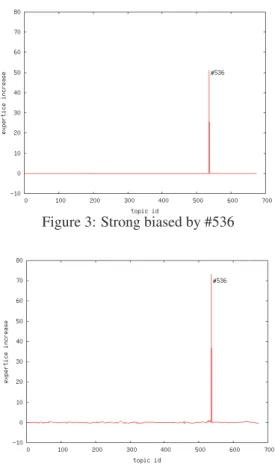
Results highlight that cumulative expertise oncalways grows with respect to the unbiased case. Let us note that when expertise is biased by the common topic #30, the cumulative expertise related to some other topics (namely #322 and #426) also increase, whereas when the rare topic #536 is used only nodes labelled with such a topic are af-fected by biasing (figs. 1,2). The fact that biasing on topic #30 also affects the cumulative expertise of other topics is mainly due to the structure of Epinions network, indeed being topic #30 very common means that a large amount of nodes are somehow expert in that topic. Some of these nodes are also expert in topics #322 and #426 and a cer-tain number of them have a high network degree, so there is a high probability that they are involved in most of paths followed by the random walker, hence the side effect of cumulative expertise increasing for topics #322 and #426 occurs.
Also note that expertise in smooth biased model in-creases much more for both rare and common topics with respect to the strong biased model, confirming the advan-tage in exploiting similarity between topics during exper-tise rank assessment (see fig. 3,4).
Another experiment focuses on Epinions’ users, showing their expertise in the rare topic #536, where just one target nodewis considered expert by just five other nodes.
Figure 3: Strong biased by #536
Figure 4: Smooth biased by #536
Figure 5 highlights each user’s expertise on topic #536, evaluated using unbiased, strong and smooth biased mod-els. In particular, we focus on users #3442 and #577, where the former is the only user labelled as expert in topic #536. Expertise evaluated in unbiased and strong-biased case slightly differs for all nodes but #3442 as expected. Indeed the unbiased case for node #3442 shows an exper-tise value that is nearly zero due to the low number of links such a node has. This confirms that our biased models are able to capture the expertise of a user on a given topic even if the topic is rare and also the node has few links with respect the average nodes degree in the network. The di-agram also shows that user #577’s expertise for unbiased case is the same as strong biased case since it has no in-links labelled with the topic #536.
The comparison of the smooth biased case with others is more interesting, indeed:
1. node #3442’s expertise increases much more than the corresponding strong biased model
2. node #577’s expertise increases also!
Item 1 is the expected behavior and confirms our hypothe-sis that the expertise of a node depends on the opinions of his/her neighbours. Item 2 instead puts in evidence
out-Figure 5: User’s expertise assessment
degree of 1333 (versus a network average of 8.81), and in-degree of 241 (versus a network average of 12.13). This means that a random walker tends to visit such a node more frequently than the other nodes of the network, since it is included in many paths. In conclusion, the increasing of expertise not only trivially depends on the expertise in a given topic, but it is also affected by the structure of the network, i.e. the presence of hubs that can be somehow considered expert for (almost) any topic.
4 Application of expertise
The assessment of expertise within a social network de-scribed so far allows to globally establish how much a user is expert and in which topic; this is useful for several appli-cations (as described in sec. 1), in particular we want to ex-ploit expertise in recommender systems to predict the rat-ing an user will assign to a given item (belongrat-ing to a spe-cific category) based on other users reviews’ on the same item, mediating such reviews with the reviewers expertise. We first introduce a measure of the utility an user re-ceives by a specific product, then we consider the Epinion social network again as the application scenario, showing how to predict product ratings using the global expertise ratings.
4.1 Getting Utility
In economics, theutilityis a measure of the relative satis-faction deriving from the consumption of goods or services [7], hence we define the utility functionu(o)that allows us to rank the user’s preferences on consumed products, that isu(o1)> u(o2)means that user strictly preferso1instead
ofo2. Based on the expertise assessment presented in
pre-vious sections we define the utilityu(o)as follows:
u(o) =
P
i∈Rori·roi
|Ro| (8)
whereRois the set of nodes that provided a review about
producto,riis the global expertise rank associated to node
i according to the eq. (1) andro
i is the numeric scorei
assigned to o . Note that the real effectiveness of u(o)
strictly depends on the number of existing rewiews, indeed the more reviews of distinct users are available, the more affordableu(o)will be.
It is reasonable however thatu(o)actually depends on the specific user being considered, i.e. it can happen that
u(o1)> u(o2)for an uservbut not forw, for instance due
to personal preferences or depending on the categorieso1
ando2belong to. Based on this consideration, we introduce
the utility function for a generic user v as uv(o) : I → [0,1], whereIis the set of items (products). Theuv(o)is simply defined asro
vifvratedoand zero otherwise.
In addition to the utilities functions, we also consider the expectedutilities, used to predict how much an user likes an unknownproduct; in recommender systems users usually leverage the others’ experience to predict such values. We then introduce the functione(o) :I→[0,1](and similarly
ev(o)) as the expected preference on product o(personal expected preference ofvono, respectively); in the follow-ing we exploit the global expertise ranks evaluated in (1) and the expertise networkGdefined in sec. 2 to evaluate bothe(o)andev(o). For the sake of clarity, we initially take into account only a topic, thus we label each arc of
G(V, L, Lab)withrinstead of{ri, ci}.
If we want to neglect personal user preferences, i.e. we focus one(o), it is reasonable that we use theu(o)defined in eq. 8 as the prediction value, so we assume thate(o) =
u(o). As stated previously however, a better contribution is given byev(o), thus we defineev(o)as follows:
ev(o) =
P
i∈No vri·r
o i |No
v|
(9)
whereNo
vis the set ofv’s neighbours that rated the
prod-ucto. The formula can be extended by considering the (lo-cal) expertise rank each neighbour is given byv, in order to properly weight their contribution, thus we define:
elocal v (o) =
P
i∈No v rvi·r
o i
P
i∈Nvrvi
eglobal v (o) =
P
i∈No vri·r
o i
P
i∈Nvri
ev(o) =δ·elocalv + (1−δ)·eglobalv (10)
whererviis the (local) expertise ratingvassigned to his
neighbouri,riis the global expertise rank aboutievaluated
in eq. (1) andδallows to balance local and global contribu-tions. Note that we avoid the use of product to calculate ex-pected value for a resource since it always gives a resulting value lower than the highest factors; this is due to the term related with expertise, which is always less than 1 (in some of the example in this paper it ranges over[3·10−6,5·10−3]
4.2 Products rating prediction
To apply utility functions defined previously in the Epinion dataset to predict product ratings by others experience and expertise, we divided the dataset into a testing dataset and a training dataset, according to insertion date, i.e. reviews and nodes belong to testing or training dataset according to the date they has been stored into Epinions. Currently our dataset contains about 433 000 reviews starting from Jan, 17 2001 up to 4/1/2009, the chosen training set contains all reviews up to Dec, 31 2007 i.e. about 381 000 entries that represents about 88% of total entries, the related ratings on reviews are about 11 800 000 that are 90% of total entries. Once created the dataset, we evaluate the global expertise using only the training dataset, then we begin to add new review according with the date they were actually written, evaluating the expected function (10). Finally the expected function is compared with the real value the user assigned to the resource, in order to assess the effectiveness of such approach.
This comparison is performed using the Mean absolute error (MAE), used in statistics [29] to measure how close predictions are to outcomes;MAEis defined as follows:
M AE=
Pn
i=1|fi−yi|
n =
Pn i=1|²i|
n (11)
where²iis the absolute error between the predictionfiand
the true valueyi, andnis the number of samples.
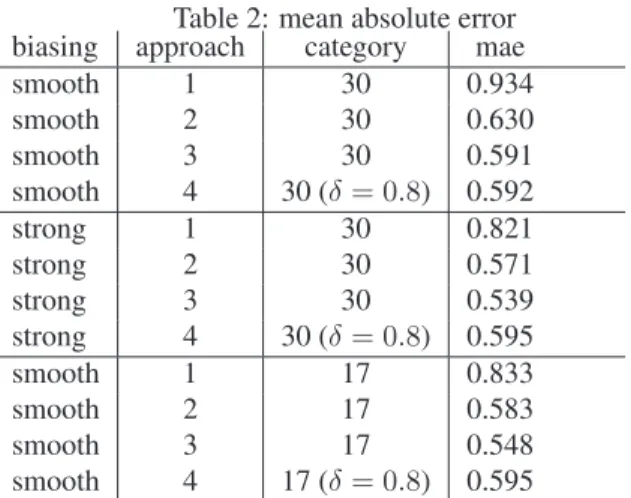
The simulation takes into account all Epinions users that wrote at least one review. Starting from jan 1, 2008 we look for all reviews and compare the expected value to the real one. Results are summarized in table 2, where thefi used
as the expected function is as follows:
1. expected value is calculated usingallexisting reviews starting from jan 1, 2008, i.e. the prediction of (11) is theu(o)defined in eq. (8); this is indicated as ap-proach 1 in table 2
2. expected value is calculated usingonlyusers that be-long to the neighbours of review’s author. This is the approach 2 in table 2 and asfiwe used the eq. (9)
3. expected value is calculated usingonlyusers that be-long to neighbours of review’s author as in previous case (eq. (9) is used), though in this case just neigh-bours with some expertise in the categoryobelongs to are considered (instead of considering all neighbours). This approach is named as approach 3 in table 2.
4. finally, in the approach 4 we used the eq. (10)
The experiments shown good results in all cases because the MAE is always less than 1 while rating ranges over the set{1,2,3,4,5}. This means that if an expected rate is 3 for instance, the real rate is in the worst case 2 or 4, which can be considered acceptable since it is not a com-plete turnover of the expressed opinion.
However different strategies highlight that base weighted average (i.e. approach 1) always performs worst
Table 2: mean absolute error biasing approach category mae
smooth 1 30 0.934
smooth 2 30 0.630
smooth 3 30 0.591
smooth 4 30 (δ= 0.8) 0.592
strong 1 30 0.821
strong 2 30 0.571
strong 3 30 0.539
strong 4 30 (δ= 0.8) 0.595
smooth 1 17 0.833
smooth 2 17 0.583
smooth 3 17 0.548
smooth 4 17 (δ= 0.8) 0.595
than the approches that also exploits local information, in-fact approches 2,3 and 4 select the user to ask for their reference among own neighbourood. The best results are about 0.5 that highlight that error is quite marginal. Unfor-tunately using only own neighbourhood limits the number of resources (products) that can be ranked, therefore in a real system both approaches should be used
5 Conclusion
In this work we introduced theexpertiseas a global prop-erty of a node and we performed an assessment on the Epin-ions dataset. Epinions.com. Expertise has been defined using a biased random walker model and its correspond-ing probabilistic interpretation and has been applied to a dataset extracted from Epinions website, where a mecha-nism of expertise evaluation based on products review has been introduced, together with a similarity function used to exploit topic similarity for a better global expertise rank as-sessment. Results confirmed that the expertise can be con-sidered a network property that depends on network struc-ture and direct (local) users experience.
Moreover, we applied the global expertise ranks in rec-ommender systems to predict the rating an user would as-sign to a given item based on other users reviews’ on the same item, mediating such reviews with the reviewers ex-pertise. The prediction aimed at integrating both local and global contributions, and simulations shown the effective-ness of such an approach.
Some questions still remains to be addressed:
– we have to investigate on different similarity functions (e.g. when more, different ontologies are present)
– we worked supposing that all information about prod-ucts ratings and expertise were available, but users may also somehow hide their personal preferences [28]
algorithms are tailored to the case of Java Forum; this suggests that a fundamental role is played by the spe-cific (possibily complex) network being considered and by its properties [18, 2]. hence we have to test the proposed approach in other networks, since net-work structure may have a significant impact on both the effectiveness and the efficiency of the approach
References
[1] Gediminas Adomavicius and Alexander Tuzhilin. To-ward the next generation of recommender systems: A survey of the state-of-the-art and possible extensions. IEEE Trans. on Knowl. and Data Eng., 17(6):734– 749, 2005.
[2] Reka Albert and Albert-Laszlo Barabasi. Statistical mechanics of complex networks. Reviews of Modern Physics, 74:47, 2002.
[3] Marko Balabanovic and Yoav Shoham. Fab: Content-based, collaborative recommendation. Communica-tions of the ACM, 40:66–72, 1997.
[4] Satanjeev Banerjee and Ted Pedersen. An adapted lesk algorithm for word sense disambiguation using wordnet. Computational Linguistics and Intelligent Text Processing, pages 117–171, 2002.
[5] Pavel Berkhin. A survey on pagerank computing. In-ternet Mathematics, 2:73–120, 2005.
[6] Hui Fang and ChengXiang Zhai. Probabilistic models for expert finding. InECIR, pages 418–430, 2007.
[7] Peter Fishburn. Utility Theory for Decision Making. Robert E. Krieger Publishing Co., 1970.
[8] Norman Foo, Brian J. Garner, Anand Rao, and Eric Tsui. Semantic distance in conceptual graphs. Ellis Horwood, Upper Saddle River, NJ, USA, 1992.
[9] Jared Freeman, Webb Stacy, Jean Macmillan, and Georgiy Levchuk. Capturing and building expertise in virtual worlds. InFAC ’09: Proceedings of the 5th In-ternational Conference on Foundations of Augmented Cognition. Neuroergonomics and Operational Neu-roscience, pages 148–154, Berlin, Heidelberg, 2009. Springer-Verlag.
[10] B.J. Garner, D. Lukose, and E. Tsui. Parsing natu-ral language through pattern correlation and modifi-cation. InProc. of the 7th International Workshop on Expert Systems & Their Applications, pages 1285– 1299, Avignon, France, 1987.
[11] T. Grandison and M. Sloman. A survey of trust in internet application. IEEE Communication Surveys and Tutorials, 4(4):2–16, 2000.
[12] A. John and D. Seligmann. Collaborative tagging and expertise in the enterprise. Proc WWW 2006, 2006.
[13] Henry Kautz, Bart Selman, and Mehul Shah. Re-ferralweb: Combining social networks and collabora-tive filtering.Communications of the ACM, 40:63–65, 1997.
[14] Jon M. Kleinberg. Authoritative sources in a hyper-linked environment.Journal of ACM, 46(5):604–632, 1999.
[15] Francisco J. Martin. Top 10 lessons learned devel-oping, deploying, and operating real-world recom-mender systems. In Proceedings of 3rd ACM Con-ference on Recommender Systems, 2009.
[16] D.W. McDonald and M. S. Ackerman. Expertise Rec-ommender: A flexible recommendation system and architecture. InProc. Int. Conf. on CSCW, 2000.
[17] Rajeev Motwani and Prabhakar Raghavan. Random-ized algorithms. Cambridge University Press, New York, NY, USA, 1995.
[18] M. E. J. Newman. The structure and function of com-plex networks.SIAM Review, 45:167, 2003.
[19] John O’Donovan and Barry Smyth. Trust in rec-ommender systems. InIUI ’05: Proceedings of the 10th international conference on Intelligent user in-terfaces, pages 167–174, New York, NY, USA, 2005. ACM.
[20] Lawrence Page, Sergey Brin, Rajeev Motwani, and Terry Winograd. The pagerank citation ranking: Bringing order to the web. Technical report, Stanford InfoLab, 1999.
[21] Philip Resnik. Using information content to evaluate semantic similarity in a taxonomy. InIJCAI, pages 448–453, 1995.
[22] G. Salton, A. Wong, and C. S. Yang. A vector space model for automatic indexing. Communications of ACM, 18(11):613–620, November 1975.
[23] Hector Garcia-Molina Sepandar D. Kamvar, Mario T. Schlosser. The eigentrust algorithm for reputa-tion management in P2P networks. In proceedings of the Twelfth International World Wide Web Confer-ence, 2003., 2003.
[24] Upendra Shardanand and Patti Maes. Social infor-mation filtering: Algorithms for automating “word of mouth”. InProceedings of ACM CHI’95 Conference on Human Factors in Computing Systems, volume 1, pages 210–217, 1995.
[26] Loren Terveen, Will Hill, Brian Amento, David Mc-Donald, and Josh Creter. Phoaks: a system for sharing recommendations.Communications of ACM, 40(3):59–62, 1997.
[27] Loren Terveen and David W. McDonald. So-cial matching: A framework and research agenda. ACM Trans. Comput.-Hum. Interact., 12(3):401–434, 2005.
[28] Frank E. Walter, Stefano Battiston, and Frank Schweitzer. A model of a trust-based recommen-dation system on a social network. Journal of au-tonomous agents and multi-agent systems, 16:57, 2008.
[29] Frank Edward Walter, Stefano Battiston, and Frank Schweitzer. Personalised and dynamic trust in so-cial networks. In Lawrence D. Bergman, Alexander Tuzhilin, Robin D. Burke, Alexander Felfernig, and Lars Schmidt-Thieme, editors, RecSys, pages 197– 204. ACM, 2009.
[30] Wolfram MathWorld.
http://mathworld.wolfram.com/periodicmatrix.html -http://mathworld.wolfram.com/reduciblematrix.html, 1999-2010.
[31] Jing Zhang, Jie Tang, and Juanzi Li. Expert Finding in a Social Network. LNCS, 2008.