Evaluation of a Prototype Developed for Information Dissemination related to
Mushroom Farming for different parameters
Y. Gautam
Scientist
ICAR-Directorate of Mushroom Research Chambaghat, Solan HP 173213
Abstract
Mushroom farming is a complex technical process involving many sub processes like compost preparation, spawn production, crop management, crop protection, harvesting, processing and marketing. XML was utilized to develop and test a prototype for information dissemination related to mushroom farming. XML was employed for the purpose as it simplifies sharing, data transport, platform changes, makes handling of data more easier and efficient for describing document content, validating the correctness, defining data facets and converting data between different data types. The results of the prototype testing are presented in this paper
Keywords: prototype, XML, mushroom, testing, results
Introduction
In this paper the results of the testing of a prototype developed for dissemination of mushroom cultivation related information are discussed. The research objectives of the study included identifying the farmers’ priorities for information and services and then utilizing XML (Extensible Markup Language) to develop and test a prototype for the mushroom production sector. Mushroom was taken as a candidate example as mushroom farming is a complex process involving many sub processes like compost preparation, spawn production, crop management, crop protection, harvesting, processing and marketing. In addition to these activities involved, farm design plays a very important role in mushroom production as the environmental parameters of the mushroom house (temperature, humidity, carbon dioxide content ) have to be kept under specific range depending upon the mushroom species being grown. All these activities make mushroom growing a highly technical enterprise which requires expert technical guidance[1,2,3].
The prototype development and implementation was based on the Microsoft Windows 2003 operating system, MySQL, XMLSpy, the Java 2 Enterprise Edition integrated platform and the Apache-Tomcat web server. The Microsoft Access simulates the database management system. Various XML Editors such as “XMLSpy,” “XMLMind” and Web browsers, such as the Internet Explorer and Netscape Navigator were tested and used to develop and test the system. Java platform, Apache web server and Netscape are freeware and open-source products making them easily customized to the specific needs of every application. Almost all of them (except Microsoft Access) have adequate capabilities to support general requirements to manipulate, distribute and store XML documents[6].
XML simplifies sharing, data transport, platform changes, makes handling of data more easier and efficient for describing document content, defining data facets and converting data between different data types [5]. XML has many additional features when compared with HTML.
Evaluation parameters
The characteristics of efficient databases [4], that it should be “scalable”, in both performance capacity and incremental data volume growth, must have a “powerful” design in order to support complex decisions with multi-users, must be “manageable” which allows one to create and implement the new tables at any time, must have a high “availability” in terms of down time (repair and maintenance), must have “flexible”and “extensible” architecture to keep pace with evolving business requirements and should have “interoperability” i.e should support multiple applications from different business units, were kept in mind for evaluation of the prototype.
In addition to these, the qualities of learnability (the system should be easy to learn so that the user can rapidly start getting some work done) and memorability (the system should be easy to remember, so that the casual user is able to return to the system after some period of not having used it, without having to learn everything all over again), mentioned by Nielsen [7] as influencing criteria for usability were also taken into consideration.
The system was test run for the above mentioned features and the results were well appreciated by the users. The results of the performance, as judged by the computer literate and computer illiterate audience is shown in the Results section.
Results
The approach followed in this study is the Alpha testing approach wherein the prototype was test run for two categories of users. One was the computer literate category (mushroom growers as well as non-growers) and the second was the computer illiterate category (only mushroom growers).
The platform was a Windows 2003 Server machine with 4 GB RAM and internet facility. For the computer literate category the prototype was run at NIC (National Informatics Centre) Solan where 20 personnel had gathered for a Seminar. After test running, the personnel were given a questionnaire which contained questions relating to the performance of the prototype.
For the computer illiterate (mushroom growers) category, the prototype was run at the Directorate of Mushroom Research, Solan where 35 farmers had assembled for a Training session. They were also given a questionnaire which contained questions related to the response of the prototype for various options.
Testing of computer literate audience
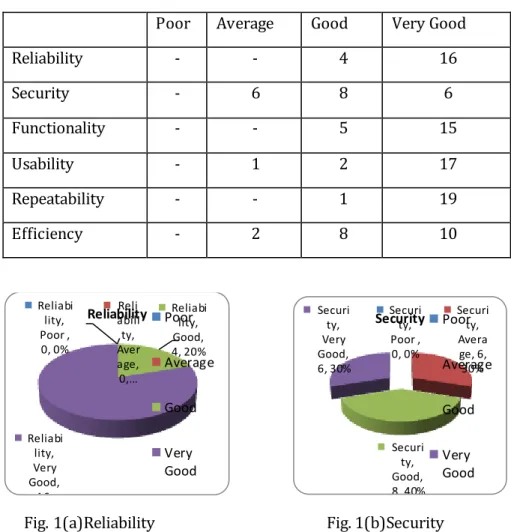
Table 1 Testing results for computer literate audience
Poor Average Good Very Good
Reliability - - 4 16
Security - 6 8 6
Functionality - - 5 15
Usability - 1 2 17
Repeatability - - 1 19
Efficiency - 2 8 10
Fig. 1(a)Reliability Fig. 1(b)Security
The prototype was got tested among the computer literate faculty for the parameters related to reliability and security. The reliablity (Fig. 1(a)) aspect was checked by running the system and gave predictable results. Testing against the security (Fig. 1(b))parameter gave good results as the users were unable to access the backend database.
Fig. 1(c)Functionality Fig. 1(d)Usability
Reliabi lity, Poor , 0, 0% Reli abili ty, Aver age, 0, … Reliabi lity, Good, 4, 20% Reliabi lity, Very Good, 16, 80%
Reliability Poor
Average Good Very Good Securi ty, Poor , 0, 0% Securi ty, Avera ge, 6, 30% Securi ty, Good, 8, 40% Securi ty, Very Good, 6, 30%
Security Poor
For the functionality aspect (Fig. 1(c)) 75% of the users gave very good to the system. The aspects like the “help” availability and the awareness of the user in operating it were taken into consideration. Regarding the usability (Fig. 1(d)) the system was tested in relation to the ease of use and whether users can operate is intuitively, and whether the system was consistent in behaviour. 75% of the respondents gave “very good” for the functionality and for the usability,
85 % respondents gave “very good”.
Fig. 1(e) Repeatability Fig.1(f) Efficiency
Similarly the aspects related to repeatability (Fig. 1(e)) and efficiency (Fig. 1(f))were tested. Repeatability gave very good results with 95% of the users responding with “very good” as the system gave identical results when any command was repeated. For the efficiency parameter 10% gave average, 40% good and 50% very good.
Fig. 2(a)Scalability Fig. 2(b) Manageability
The scalability (Fig. 2(a)) and manageability (Fig. 2(b)) aspects gave very good results. More data was entered and the performance was found to be the same. Respondents were satisfied after adding new tables when tested for the manageable parameter.
Efficien cy, Poor
, 0, 0%
Efficien cy, Average , 2, 10%
Efficien cy, Good, 8, 40% Efficien
cy, Very Good, 10, 50%
Efficiency
Poor
Average
Good
Very Good
Scalabilit y, Poor, 0, 0%
Scalabilit y, Average,
0, 0% Scalabilit y, Good , 2, 10%
Scalabilit y, Very
Good, 18, 90% Scalability
Poor
Average
Good
Very Good
Ma na g eab i l ity , Poo r, 0, 0%
Ma nag ea bilit
y, Avera g
e, 0, 0%
Ma na ge a bi lity, Good , 2, 10%
Ma na ge a bi lity, Very Good, 18, 90%
Manageability
Poor
Average
Good
Very Good Repeatabilit
y, Poor , 0, 0% Repeatabilit y, Average, 0, 0%
Repeatabilit y, Good, 1,
5%
Repeatabilit y, Very Good, 19,
95%
Repeatability
Poor
Average
Good
Fig. 2(c)Availability Fig. 2(d) Flexibility
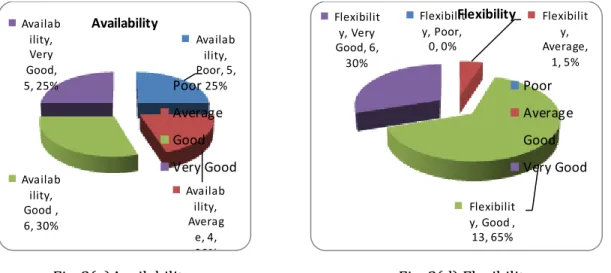
The availability (Fig. 2(c)) feature received some setback as the backup was not available for longer period when electricity went off. Also, there was no alternative abailable in the event of the system crash. It was suggested to make alternative arrangements to improve this aspect so that the system is available 24 hours a day. The users expressed satiffaction with the flexibility (Fig. 2(d)) aspect that new features could be incremented into the system when desired.
Fig. 2(e) Interoperability.
The interoperability (Fig. 2(e))aspect also received good response from the users with 75% saying “very good” and 15% very good. Data in different formats was tested for the same.
Table 2 Testing results for computer literate audience
Poor Average Good Very Good
Scalability - - 2 18
Manageability - 2 3 15
Availability 5 4 6 5
Flexibility - 1 13 6
Interoperability - 2 15 3
Availab ility, Poor, 5,
25%
Availab ility, Averag
e, 4, 20% Availab
ility, Good , 6, 30% Availab ility, Very Good, 5, 25%
Availability
Poor
Average
Good
Very Good
Flexibilit y, Poor, 0, 0%
Flexibilit y, Average,
1, 5%
Flexibilit y, Good ,
13, 65% Flexibilit
y, Very Good, 6,
30%
Flexibility
Poor
Average
Good
Very Good
Interop era bilit y, Poor,
0, 0%
Interop era bilit
y, Avera g
e, 2, 10%
Interop era bilit y, Good
, 15, 75% Interop era bilit y, Very Good, 3, 15%
Interoperability
Poor
Average
Good
Testing of computer illiterate audience
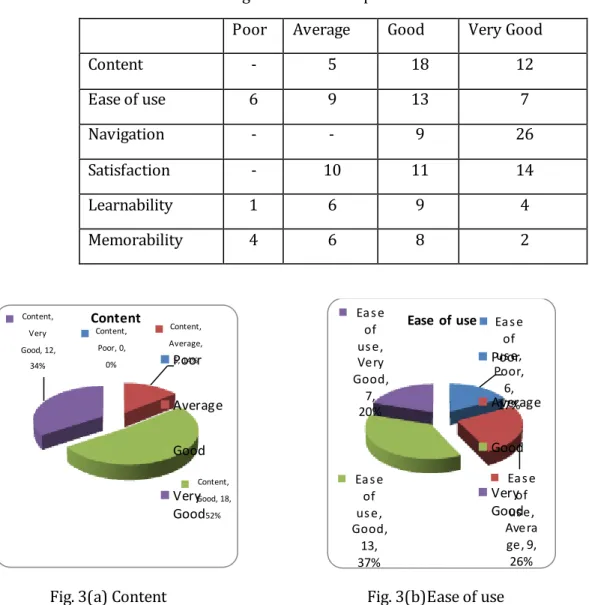
Table 3 shows the data for the computer illiterate or the mushroom growers who are not conversant with computers. While a majority of them were satisfied with the content, navigation, some were uneasy with the “ease of use” and “memorability”. This was because many of them had worked on a computer for the first time. Also, a majority of them were not comfortable with english language. They desired the information in hindi. The data of table has also been shown in the form of pie charts in figures 3(a-e).
Table 3 Testing results for computer illiterate audience
Poor Average Good Very Good
Content - 5 18 12
Ease of use 6 9 13 7
Navigation - - 9 26
Satisfaction - 10 11 14
Learnability 1 6 9 4
Memorability 4 6 8 2
Fig. 3(a) Content Fig. 3(b)Ease of use
The results show that the farmers were satisfied with the content. Those having some doubt desired that marketing related information be also included in the system. Regarding “ease of use”, Fig. 3 (b) shows that only 20% responded with “good” because they were not conversant with the computers.
Content, Poor, 0, 0%
Content, Average, 5, 14%
Content, Good, 18, 52% Content,
Very Good, 12,
34%
Content
Poor
Average
Good
Very Good
Ea s e of us e, Poor, 6, 17%
Ea s e of us e, Avera ge, 9, 26% Ea s e
of us e, Good,
13, 37% Ea s e
of us e, Very Good,
7, 20%
Ease of use
Poor
Average
Good
Fig. 3(c) Navigation Fig. 3(d) Satisfaction
Farmers were satisfied with the navigation (Fig. 3 (c)) as it was a menu driven experience for them. Overall they were satisfied. The satisfaction ranged from average to very good. They were excited that something was being done to give them quick information in time of need.
Fig. 3(e) Learnability Fig. 3(f) Memorability
Regarding Learnability (Fig. 3(e) and Mermorability (3 (f)), the response ranged from poor to very good. Only 20% gave very good for learnability and 10% for memorability because most of them did’nt have much experience with computers.
Overall, the farmers were satisfied and when asked whether they would subscribe to the services, once the AgDIS (Agricultural Information Dissemination System) was fully implemented, the farmers were very enthusiastic and said that it depended upon what information they would be getting and in what form.
Regarding the specific tools an end user must use, such as web browsers or XML Editors, most of the commercial products tested were found to provide acceptable performance.
Conclusion
Farmers are being given a lot of information which they do not desire. They desire information related to growing, post harvest practices and marketing The overall analysis of the results of the study showed that the farmers can acquire high level of fluency with the latest technology, in this case an information technology based information dissemination system. The appropriation of technology will empower them to access the information they desire with ease.
Navigat ion, Poor, 0, 0% Navigat ion, Averag e, 0, 0%
Navigat ion, Good, 9, 26% Navigat ion, Very Good, 26, 74% Navigation Poor Average Good Very Good Satisfa ction, Poor, 0, 0% Satisfa ction, Averag e, 10, 29% Satisfa ction, Good, 11, 31% Satisfa ction, Very Good, 14, 40% Satisfaction Poor Average Good Very Good Learnab ility, Poor, 1, 5% Learnab ility, Average , 6, 30%
References
[1] Backus JWM, Roestel AJJ van, Griensven LJLD van and Maher MJ, 1991. Mushroom Science XIII: 791-798.
[2] Dhar BL, Verma RN, and Gautam Y, 2000. NRCM Annual Report.
[3] Dhar BL, Verma RN, Kapoor P, Prasad B and Gautam Y, 2002. In Recent Trends in Automation of Agriculture & Agro-based Industries at Aurangabad. Feb 25-26’ 2002.
[4] Hector Garcia-Molina, Jeff Ullman, and Jennifer Widom. Database Systems: The Complete Book (DS:CB)
[5] Navarro, A., et al, 2000, Mastering XML, Alameda: Sybex
[6] http://httpd.apache.org/docs/2.0/