“Thinking Child” Program: Effects on Parenting Styles and Family
Problem-Solving Skills
Mohsen Shokoohi-Yekta
1, Joseph F. Rath
2, Maryam Mahmoudi
31Department of Psychology and Education of Exceptional Children, Faculty of Psychology and
Educational Sciences, University of Tehran, Tehran, Iran
2Department of Rehabilitation Medicine, New York University School of Medicine 3University of Allameh Tabatabaei, Tehran, Iran
Submitted: 17 June 2018 Accepted: 22 July 2018
Int J Behav Sci. 2018; 12(2): 59-64
Corresponding Author: Mohsen Shokoohi-Yekta, Department of Psychology and Education of Exceptional Children, Faculty of Psychology and Educational Sciences,
University of Tehran, Iran
E-mail: [email protected]
Abstract
Introduction: This study, which was framed within the context of a developing country, aimed to evaluate the impact of the Thinking Child problem-solving program on parenting styles and family problem solving skills.
Methods: A hundred and four mothers in Tehran voluntarily participated in the Thinking Child sessions, conducted weekly by experienced trainers for 9 sessions. A single group pre- and post-test pilot design was executed. Outcome measures included the Parenting Style Questionnaire and Family Problem Solving Scale.
Results: The findings bolstered the effectiveness of the program on problem-solving processes and parents’ relationships with their children specifically, showed a significant reduction in authoritative and authoritarian parenting styles and also revealed an increase in permissive parenting style. Conclusion: The Thinking Child intervention displays promising results for trainings involving problem-solving skills in parents. However, it should be used in conjunction with a complementary intervention while parent training is executed.
Keywords: Problem Solving, Parenting Training, Family Problem Solving
Introduction
“Thinking Child” Program:
Effects on Parenting Styles and Family Problem-Solving Skills
Healthy family environments can reduce environmental risks and increase the likelihood of positive adjustment throughout the life span [1]. Despite the increased attention to the role of family environment in healthy child development, little is understood about the factors associated with promoting healthy family environments in developing countries, such as Iran [2]. The paucity of data is a matter of concern, as such data are essential to the development of public health interventions and policy for developing countries.
Family systems theory [3] asserts that a family unit’s closeness, ability to communicate, and adaptability to change are important in an individual’s well-being. In a family, parents play a vital role in shaping their children’s behavior and decision making skills [4, 5]. For example, parental conflict, a lack of parent-child intimacy, insecure attachment between the child and parent, a strict parental disciplinary style, insufficient monitoring of the child, and psychological disorders in parents increase the risk of behavioral and emotional problems in children [6].
children discovered a positive relationship between negative parenting practices (severe punishment and inconsistent discipline) and child internalizing and externalizing problem behavior. Conversely, the results displayed a negative relationship between such problems and supportive parenting behaviors, such as a use of problem-solving skills and cooperation with the child [15]. Moreover, another study investigated the effects of Positive (warm and supportive) maternal behavior on structural brain development in boys and girls, using longitudinal structural MRI. They found that aggressive behavior of mothers predicted raised growth of the right putamen, none of the effects seen for positive maternal behavior were better explained by rate of aggressive maternal behavior. Therefore, parenting styles and attitudes towards child rearing have been shown to effect children on a neuroanatomical level [16].
Early negative outcomes of parenting behavior are likely to continue as the child develops, leading to behavioral problems and mental disorders in adolescents [17-20].
Moffitt [21] noted that aggressive behaviors in children are
likely to continue into adolescence and become chronic behavioral problems. As parenting style as well as the quality of the parent-child relationship can predict an individual’s personality traits, psychological problems, and degrees of success, it is important that parents learn adaptive parenting and rearing methods [22].
Family Problem-Solving Training
Problem-Solving Training (PST) is an approach that can be applied to families in order to decrease maladaptive relational patterns and reinforce adaptive ones. Shure [23] defined problem solving as comprising two basic skills: (a) the ability to think about problems in a variety of ways (i.e., alternative solution thinking) and (b) the ability to anticipate outcomes (i.e., consequential thinking). Several researchers have investigated the relationship between poor problem-solving abilities and emotional disturbance [24, 25]. In one meta-analysis, Clarke [26] concluded that active forms of coping, such as problem solving, can have beneficial effects on mental health and adjustment, such as increasing stress tolerance in children. According to Connor-Smith et al. [27], avoidance or disengagement from problems is related to poor adjustment and emotional-behavioral problems in children while poor problem-solving abilities are related to more psychological distress. For example, social problem solving skills can predict aggressive behavior among children [28]. A review concluded that suicidal behavior is related to problem-solving impairments in adolescents [29]. Another study showed that delinquent youths have less effective problem-solving abilities than their peers [30]. In this regard, it seems plausible that early childhood training in problem-solving abilities might prevent later problems such as distress, suicide, or delinquency.
Shure [31] noted that the most important component of PST is teaching individuals how to think. The process of thinking is more important than the retention of knowledge as these processes can be applied to any problematic situation [32]. As a result, PST targets the
thinking process, rather than specific content [33].
In a meta-analysis derived from 31 studies and 2,895 participants using PST for mental or physical health problems, PST showed high effect sizes. PST was significantly more effective than any intervention, attention /placebo interventions, and intervention as usual, although it was not seen significant difference of being more effective than other bona fide interventions with which it has been compared. What’s more, when PST was compared to 16 legitimate alternative treatments, PST showed significant benefits above all [34]
.
Shokoohi-Yekta et al. [35] employed parental PST to improve family relationships. They found that teaching problem-solving skills to parents can increase cooperation between family members and lead to a decrease in relationship problems. Similarly, Faircloth et al. [36] found that the effects of a family-focused problem-solving paradigm targeted to marital conflict prevention, were maintained after two years.
Collaborative Problem-Solving Interventions for Parents and Children
Epstein et al. [37] applied a Collaborative Problem Solving (CPS) approach for parents of children with disruptive behaviors. Results showed a reduction in disruptive behavior and parenting stress, with fathers in particular demonstrating better functioning after treatment. They concluded that the parent’s increased understanding of the child’s perspective led to beneficial changes in parent-child interactions. Similarly, Edwards [38] investigated family problem solving and interactive processes in families with physically abused children. Findings showed that abusive parents employed problem-solving skills and nonverbal support less than controls. The researchers found that teaching problem-solving skills to abusive parents can play an important role in the adjustment of children.
Reid et al. [39] studied parental involvement in an intervention targeted towards school-aged children. In comparison to the control group, which included the intervention without parental involvement, children who received parental involvement displayed greater improvements in addition to a stronger bond with their parents. Other outcomes involved increases in parenting behavior and greater cooperation between the school and parents. These results were confirmed at a one-year follow-up.
Although there is no shortage in research on PST interventions in developed countries, there is a dearth of knowledge regarding how these interventions impact and work in those that are developing. Therefore, the aim of the current study is to investigate the effects of the PST program on parenting style and family problem solving, as well as the interactional effect of these variables. Additionally, this study seeks to investigate whether the Thinking Child program, can impact parenting styles and marital problem solving within an Iranian society.
Method
population of this study included all parents living in Tehran and having 4-7 year-old students in private schools. The study was ethically confirmed by the human subjects review board of the first author’s institution. Children and parents completed an informed consent and assent procedures. Following a call for participation in problem-solving workshops in the schools, parents were eager to participate and as a result, voluntarily attended all sessions. The age range of participants was 25 to 51 (M= 34, SD = 5.9), with 75% employed and 25% unemployed. Education levels of parents consisted of no diploma (1.9 %), diploma (38.9%), bachelor (39.8%), and master’s degree or higher (13%), with about 6.5 percent missing data; most parents were from a higher socioeconomic status. The inclusion criteria was having a child aging 4-7 and declaring intention to participate in the program. Parents who had more than three absences in the training sessions were excluded from the experiment but could still attend the program.
This pilot study used a single group pre- and post-test design. Parents voluntarily participated in workshops titled “Thinking Child Program” held once weekly for nine 2-hour sessions in two private schools. Experienced trainers under the supervision of the authors implemented the treatment plan. Parents completed the research instruments before and after the 9-session program.
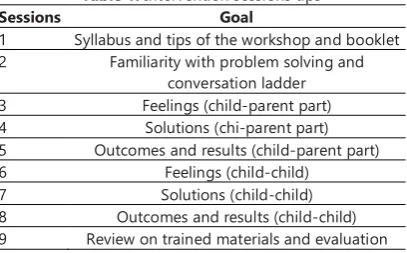
The aim of the “Raising a Thinking Child” program [40] is enhancement of the child’s skills in dealing with various problems in and out of the home environment. The main focus of the program (table 1) is training parents to use efficacious interactional strategies with their child in order to solve problems that occur between the parent and child or peers with the child. In the beginning of the program, parents are taught various interactional styles in regards to children. These styles are classified in four categories that are introduced to the parent as “stairs”. The first step is an ineffective style characterized by punishment and humiliation. The second step involves suggestion without explanation. In the third step, parents present their suggestions with an explanation, and the final step involves the most effective reciprocal interactional method: asking a question and having the child to think [40].
Table 1. Intervention sessions tips
Sessions Goal
1 Syllabus and tips of the workshop and booklet 2 Familiarity with problem solving and
conversation ladder 3 Feelings (child-parent part) 4 Solutions (chi-parent part) 5 Outcomes and results (child-parent part) 6 Feelings (child-child)
7 Solutions (child-child) 8 Outcomes and results (child-child) 9 Review on trained materials and evaluation
The instruments used in this study are as follows: Family Problem Solving Scale (FPSS) The FPSS was developed by Ahmadi et al [41] and has 30 items rated on
a five-level Likert scale (1= never to 5 = always). A high score is representative of a couple’s ability to effectively problem solve. This scale has two factors: Couple Relationship and Problem Solving Process. Couple Relationship refers to communication style and interaction when solving problems. On the other hand, Problem Solving Process refers to the couple’s communication style in problem solving, as well as the process of problem solving within their exchange.
Cronbach’s alpha for these two factors was .95 and 30-day test-retest reliability coefficient for total FPSS score was .91. Correlation between total FPSS score and the Couple Relationship and Problem Solving Process subscales were .78 and .89 respectively. Validity of this scale is substantial.
Parenting Style Questionnaire (PSQ): This questionnaire was generated by Buri [42] based on Baumrind’s three parenting styles. This 30-item scale assesses parenting patterns with 10 items related to each of the three styles: Permissive (parent is responsive, but not demanding), Authoritarian (parent is demanding, but not responsive), and Authoritative (parent is demanding and responsive). The items are rated on a 4-point Likert scale (strongly agree=4 to strongly disagree=0). According to Buri [42], the following test-retest reliability coefficients are: Permissive =.81, Authoritarian = .85, and Authoritative = .92. In terms of construct validity, Buri [42] reported that authoritative parents were found to be highest in mothers with parental nurturance (r =.56), authoritarian parenting in mothers was inversely related to nurturance (r = -.36), and parental permissiveness was unrelated to nurturance for both mothers (r = .04) and fathers (r = .13). Esfandiari [43] reported the following reliability coefficient for the subscales: Permissive = .69, Authoritarian = .77, and Authoritative = .73.
To analyze the statistically significant differences in subscales’ means for two phases of pre-posttests, repeated measure Multivariate Analysis of Variance (MANOVA) was used to the aforementioned questionnaires. Before analyzing, data screening was performed to identify outliers. Mahalanobis distance revealed the maximum value for parenting style questionnaire to be 10.64 which is less than the critical value (16.27) and for family problem solving subscales equal to 12.54 which is less than the critical value of 13.82, indicating that there are no substantial multivariate outlier data [44]. Generating a matrix of scatterplots showed no evidence of non-linearity, thus, the assumption of linearity was satisfied. For the multicollinearity and singularity, the strength of the correlations among the variables was checked and no correlation was observed higher than .6. This is while, correlations up around .8 or .9 are concerning [44], and therefore, this assumption was met, as well.
Results
significant increases in both the Couple Relationship and Problem Solving Process subscales.
Parenting Style: Repeated measure analysis for the three PSQ subscales revealed an overall significant difference in pre- to post-test means, W = 0.85; F (3, 101) = 5.24, p. < .002; η2 =.13). Between-subjects effects showed that all
three subscales (Permissive, Authoritative and Authoritarian) had significant changes at the .0001 level (see Table 3).
Family Problem Solving: Overall findings for FPSS indicated a significant difference, W = 0.03; F (2, 102) = 1.55, p. < .001; η2=.96, from pre- to post-test.
Between-subjects effects also demonstrated that from pre- to post-treatment, the means of both the Couple Relationship and Problem Solving Process subscales had significant differences at level of p. < .001 (see Table 3). Effect size analyses showed that this intervention has the same strong effect on the Couple Relationship and Problem Solving Process subscales, η2 = .99.
Discussion
Individuals are commonly confronted by challenging circumstances. Therefore, it is essential that children learn to effectively solve day-to-day problems. Parents, who play a central role in their children’s lives, can enhance this learning process by intervening at suitable times. According to family theories [45], one intervention in any familial facet can produce direct and indirect effects within the family unit. As a result, we hypothesized that the effects of the Thinking Child program would impact other familial domains, such as parenting styles, family problem solving, and the parent’s relationship with each other.
The PSQ showed unexpected, but interesting results. All three subscales showed significant changes in means. As expected, the Authoritarian Style subscale decreased significantly following the intervention. However, changes in the two other subscales were unexpected, with the Permissive subscale increasing and the Authoritative subscale decreasing. Although statistically significant, the effect sizes for all three subscales were small, implying little clinical applicability.
Consistent with our findings, researchers have indicated that parenting training leads to changes in parenting practices and parents’ perceptions. Letarte et al. [46] found that their parent training program, “Incredible
Years,” resulted in an increase in parents’ positive verbal statements and encouragement, less use of punishment, and better use of monitoring strategies.
Although the current intervention program led to positive changes, the parents may have showed excessive acceptance. That is, they may have given too much autonomy to their children, which can be observed in permissive style subscale items related to giving excessive allowance and freedom to the child. After training, parents may have thought that they could help their children make decisions autonomously by leaving them alone to problem solve. In fact, parents may have believed that after teaching problem-solving skills to their children, children can then make decisions independently. These results suggest that a complementary parental program in addition to PST is necessary in order to prevent parents from being over permissive.
Rinaldi et al.[47] investigated the relationship between parenting style and child’s behavioral outcome and concluded that permissive parenting style was not correlated with outcome (i.e., children's externalizing, internalizing, and adaptive behaviors). Their explanation was two-fold: (1) the PSQ Permissive Style subscale had too few questions to adequately assess the style and (2) the effects of permissive style are not likely expressed immediately. The lack of a relationship between permissive style and behavioral outcome is important in that it is indicative of a need for revising this scale and performing additional research. Perhaps for the purposes of the current study, a continuum scale may have been more effective in assessing permissive parenting style. Future research should aim to translate current categorical measures to scales based on a spectrum. Baumrind et al. [48] stated that authoritative parents are directive, supportive, and democratic, all seemingly positive characteristics. However, after participating in the Thinking Child program, the parents may have not interpreted this style in such a way. As a result, they may have thought to direct their children less, thus giving their child excessive autonomy. This could explain the results, which showed a reduction in the authoritative style and increase in the permissive style. The increase in permissive style scores may be relevant to declines in control and limited directions given to the child, two characteristics consistent with permissive style [49].
Table 2. Pre- and Post-Treatment Scores: Parenting Styles Questionnaire and Family Problem Solving Scale
Scale Subscale Pre-test Post-test
Mean (SD) Mean (SD)
Parenting Style Questionnaire
Permissive 17.38 (4.34) 18.43 (4.52) Authoritarian 11.53(5.13) 10.71 (4.49) Authoritative 32.13 (3.2) 30.74 (4.38) Family Problem
Solving Scale
Couple Relationship 28.55 (3.89) 42.37 (4.31) Problem Solving Process 36.55 (4.64) 53.97 (5.17)
Table 3. Between Subject Effects Statistics for Parenting Styles Questionnaire and Family Problem Solving Scale
Subscales Type III Sum of Squares df F Sig. η2
Permissive 66727.64 1 2.33 .0001 .95
Authoritarian 25721 1 690.04 .0001 .87
Authoritative 205569.81 1 1.077 .0001 .99
Couple Relationship 261635.23 1 1.01 .0001 .99
Increased scores in permissive style may have also been a consequence of this style’s strong association with an indulgent style. In more recent versions of the PSQ, Permissive Style is divided into two subscales: Indulgent and Rejecting/Neglecting [50]. Furthermore, Garcia et al. [51] revealed that both indulgent and authoritative styles were related to the greater behavioral outcomes in adolescents than authoritarian and rejecting/neglectful styles. This interpretation suggests that (1) permissive style is not always negative and (2) increases in this style within this study are related to indulgent items. For future research, it is suggested that the newer version of the PSQ be used to distinguish the effects of these two types of permissive parenting.
Scores on the second questionnaire, FPSS in accordance with its two subscales, Couple Relationship and Problem Solving Process, significantly improved after the intervention. In addition, large effect sizes on the two subscales indicated that the intervention was effective in improving both problem solving and the couple’s relationship. Therefore, it can be stated with high confidence that the current program’s effects were in accordance with its purpose.
Conclusion
Consistent with the findings of Shokoohi-Yekta et al. [35], problem-solving abilities showed substantial improvement, and better problem-solving abilities resulted in positive effects within the couple’s relationship.
Improvement in couple’s relationship may be related to the effect of PST in reducing behavior problems in children, which inherently causes parental and marital stress. This idea is consistent with a study by Schermerhorn et al. [52], who demonstrated that marital problems in parents of children with ADHD are correlated with the child’s ADHD symptoms.
This finding also suggests that learning problem-solving skills provides an opportunity for better marital communication in addition to improvements in parent-child interactions. Shokoohi-Yekta et al. [53], found that parents’ participation in PST was correlated with a decrease in children’s problematic behaviors, and increased problem solving and parenting strategies.
The strengths of the current pilot study include the relatively large sample and employing experienced trainers under professional supervision. Nonetheless, the work is limited by the lack of a comparison or control group and the use of a convenience sample. In addition, participants were of higher Socio Economic Status (SES), which may limit the ability to generalize these results to individualize of lower SES backgrounds. Future researchers should consider using a waitlist control group or a randomized comparison intervention and include individuals with a range of SES statuses.
Although the ultimate goal of the intervention is to improve child outcomes [54], this research studied more proximal parental variables as well as the functional effects on parents and their relationship. The lack of child-focused variables and lack of long-term follow-up on child
adjustment and outcome limits the research. Gathering and examining qualitative information about participants’ experiences and satisfaction with the intervention could also be useful in optimizing the intervention.
Overall, the Thinking Child program was effective in enhancing problem solving and the couple’s relationship. Our findings regarding the intervention’s effects on parenting style suggest the need for a complementary program that clarifies the extent to which parents need to support and direct their child to problem solving.
References
1. Heller S, Larrieu JA, D’Imperio R, Borisde NW. Research on resilience to child maltreatment: empirical considerations. Child Abuse Negl. 1999 Apr;23(4):321-38.
2. Stephenson R, Sheikhattari P, Assasi N, Eftekhar H, Zamani Q, Maleki B, Kiabayan H. Child maltreatment among school children in the Kurdistan Province, Iran. Child Abuse Negl. 2006 Mar 1;30(3):231-45.
3. Olson DH, Russell CS, Sprenkle DH. Circumplex model of marital and family systems: Vl. Theoretical update. Family process. 1983 Mar;22(1):69-83..
4. Abar B, Carter KL, Winsler A. The effects of maternal parenting style and religious commitment on self-regulation, academic achievement, and risk behavior among African-American parochial college students. Journal of adolescence. 2009 Apr 1;32(2):259-73. 5. Conger KJ, Williams ST, Little WM, Masyn KE, Shebloski B. Development of mastery during adolescence: The role of family problem-solving. Journal of Health and Social Behavior. 2009 Mar;50(1):99-114.
6. Sanders MR, Ralph A, Thompson R, Sofronoff K, Gardiner P, Bidwell K, Dwyer S. Every Family: A public health approach to promoting children’s wellbeing. Brisbane, Australia: University of Queensland. 2005.
7. Baumrind D, Black AE. Socialization practices associated with dimensions of competence in preschool boys and girls. Child development. 1967 Jun 1:291-327.
8. Besharat MA, Azizi K, Poursharifi H. The relationship between parenting styles and children's academic achievement in a sample of Iranian families. Procedia-Social and Behavioral Sciences. 2011 Jan 1;15:1280-3.
9. Turner EA, Chandler M, Heffer RW. The influence of parenting styles, achievement motivation, and self-efficacy on academic performance in college students. J Coll Stud Dev. 2009;50(3):337-46.
10. Baumrind D. The influence of parenting style on adolescent competence and substance use. J Early Adolesc. 1991 Feb;11(1):56-95.
11. Jahan A, Suri S. Parenting Style in Relation to Mental Health among Female Adolescents. Abnormal and Behavioural Psychology. 2016;2(3):1000125.
12. Zarra-Nezhad M, Aunola K, Kiuru N, Mullola S, Moazami-Goodarzi A. Parenting styles and children’s emotional development during the first grade: The moderating role of child temperament. J Psychol Psychother. 2015;5(5): 206. doi: 10.4172/2161-0487.1000206 13. Harris KM. The health status and risk behaviors of adolescents in
immigrant families. In D. J. Hernandez (Ed.), Children of immigrants: Health, adjustment, and public assistance. Washington, DC: National Academy Press; 2000. p. 286-347.
14. Jacobson KC, Crockett LJ. Parental monitoring and adolescent adjustment: An ecological perspective. J Res Adolesc. 2000 Jan 1;10(1):65-97.
15. Vanderfaeillie J, Van Holen F, Vanschoonlandt F, Robberechts M, Stroobants T. Children placed in long-term family foster care: A longitudinal study into the development of problem behavior and associated factors. Child Youth Serv Rev. 2013 Apr 1;35(4):587-93. 16. Whittle S, Simmons JG, Dennison M, Vijayakumar N, Schwartz O, Yap MB, Sheeber L, Allen NB. Positive parenting predicts the development of adolescent brain structure: a longitudinal study. Dev Cogn Neurosci. 2014 Apr 1;8:7-17.
17. Argys LM, Rees DI, Averett SL, Witoonchart B. Birth order and risky adolescent behavior. Econ Inq. 2006 Apr;44(2):215-33.
18. Brown AM, Whiteside SP. Relations among perceived parental rearing behaviors, attachment style, and worry in anxious children. J Anxiety Disord. 2008 Jan 1;22(2):263-72.
parenting in familial aggregation of anxiety disorders in children. J Anxiety Disord. 2009 Jan 1;23(1):46-53.
20. Osborne LA, McHugh L, Saunders J, Reed P. The effect of parenting behaviors on subsequent child behavior problems in autistic spectrum conditions. Res Autism Spectr Disord. 2008 Apr 1;2(2):249-63.
21. Moffitt TE. Life-course-persistent and adolescence-limited antisocial behavior: a 10-year research review and a research agenda. 2003. 22. Shokoohi-Yekta M, Parand A. The Effectiveness of Instruction Based
on Cognitive Approach on Family Relationship. Family Research. 2008;4(1):5-16.
23. Shure MB. Preventing Violence the Problem-Solving Way. Juvenile Justice Bulletin. 1999.
24. Kogos JL, Blumberg S, Youngstrom EA. Effectiveness of interpersonal cognitive problem solving and changes in emotions. annual meeting of the American Psychological Association; San Francisco1998
25. Richard BA, Dodge KA. Social maladjustment and problem solving in school-aged children. J Consult Clin Psychol. 1982 Apr;50(2):226.
26. Clarke AT. Coping with interpersonal stress and psychosocial health among children and adolescents: A meta-analysis. J Youth Adolesc. 2006 Feb 1;35(1):10-23.
27. Connor-Smith JK, Compas BE, Wadsworth ME, Thomsen AH, Saltzman H. Responses to stress in adolescence: measurement of coping and involuntary stress responses. J Consult Clin Psychol. 2000 Dec;68(6):976.
28. Takahashi F, Koseki S, Shimada H. Developmental trends in children's aggression and social problem-solving. Journal of Applied Developmental Psychology. 2009 May 1;30(3):265-72.
29. Speckens AE, Hawton K. Social problem solving in adolescents with suicidal behavior: A systematic review. Suicide Life Threat Behav. 2005 Aug 1;35(4):365-87.
30. McMurran M, Egan V, Richardson C, Ahmadi S. Social problem solving in mentally disordered offenders: a brief report. Crim Behav Ment Health. 1999 Nov;9(4):315-22.
31. Shure MB. How to think, not what to think: A cognitive approach to prevention. In L. A. Bond & B. M. Wagner (Eds.), Families in transition: Primary prevention programs that work. (pp. 170–199). Newbury Park, California: CA: Sage; 1988.
32. Carson J. A problem with problem solving: Teaching thinking without teaching knowledge. The mathematics educator. 2007;17(2):7-14.
33. Pellegrini DS. Social cognition and competence in middle childhood. Child Dev. 1985 Feb 1:253-64.
34. Malouff JM, Thorsteinsson EB, Schutte NS. The efficacy of problem solving therapy in reducing mental and physical health problems: a meta-analysis. Clin Psychol Rev. 2007 Jan 1;27(1):46-57. 35. Shokoohi–Yekta M, Parand A, Ahmadi A. Effects of teaching
problem solving strategies to parents of pre-teens: a study of family relationship. Procedia-Social Behavioral Sciences. 2011;15:957-60. 36. Faircloth WB, Schermerhorn AC, Mitchell PM, Cummings JS, Cummings EM. Testing the long-term efficacy of a prevention program for improving marital conflict in community families. J Appl Dev Psychol. 2011;32(4):189-97.
37. Epstein T, Saltzman-Benaiah J. Parenting children with disruptive behaviours: Evaluation of a collaborative problem solving pilot program. Journal of Clinical Psychology Practice. 2010;1(1):27-40. 38. Edwards AM. Parent child interactions in physically abusive
families: uga; 2005.
39. Reid MJ, Webster-Stratton C, Hammond M. Enhancing a classroom social competence and problem-solving curriculum by offering parent training to families of moderate-to high-risk elementary school children. J Clin Child Adolesc Psychol. 2007;36(4):605-20. 40. Shure MB, Digeronimo TF. Raising a thinking child workbook:
Teaching young children how to resolve everyday conflicts and get along with others. Pennsylvania State University: Research Press; 2001.
41. Ahmadi K, Fathi Ashtiani A, Etemadi A. Effect of family problem solving on decreasing couple's maladjustment. Iranian Journal of Psychology. 2005;8(4):389-403.
42. Buri J. Parental authority questionnaire. J Pers Assess. 1991;1(57):110-9.
43. Esfandiari G. Comparison of mothers’ parenting styles of children with behavioral problems and mothers with normal children [Master's thesis]. Tehran: Islamic Azad University; 1995. 44. Meyers LS, Gamst G, Guarino AJ. Applied multivariate research:
Design and interpretation. Sage publications; 2016 Nov 22. 45. Minuchin S. Families and Family Therapy. Cambridge, USA:
Harvard University Press; 2009.
46. Letarte MJ, Normandeau S, Allard J. Effectiveness of a parent training program “Incredible Years” in a child protection service. Child Abuse Negl. 2010;34(4):253-61.
47. Rinaldi C, Howe N. Mothers’ and fathers’ parenting styles and associations with toddlers’ externalizing, internalizing, and adaptive behaviors. Early Child Res Q. 2012;27(2):266-73.
48. Baumrind D, Larzelere RE, Owens EB. Effects of Preschool Parents' Power Assertive Patterns and Practices on Adolescent Development. Parenting: Science and Practice. 2010;10(3):157-201.
49. Crockett LJ, Hayes R. Parenting Practices and Styles. In Encyclopedia of Adolescence Vol 2 Elsevier Inc. 2011:241-8. 50. Gershoff E. Corporal punishment by parents and associated child
behaviors and experiences: A meta-analytic and theoretical review. Psychol Bull. 2002;128(4):539-79.
51. Garcia F, Garcia E. Is always authoritative the optimum parenting style? Evidence from Spanish families. Adolescence. 2009;44(173):101-31.
52. Schermerhorn AC, D'Onofrio BM, Slutske WS, Emery RE, Turkheimer E, Harden KP, et al. Offspring ADHD as a Risk Factor for Parental Marital Problems: Controls for Genetic and Environmental Confounds. Twin Res Hum Genet. 2012;15(6):700-13.
53. Shokoohi-Yekta M, Parand A, Zamani N, Lotfi S, Ayazi M. Teaching problem-solving for parents: effects on children’s misbehavior. Procedia - Social and Behavioral Sciences. 2011;30:163-6. 54. Forehand R, .Jones DJ, Parenta J. Behavioral parenting interventions