Lucrări ştiinţifice Zootehnie şi Biotehnologii, vol. 42(2) (2009), Timişoara
PERSPECTIVES REGARDING THE DEVELOPMENT OF
INTENSIVE REARING TECHNOLOGY FOR
SILURUS
GLANIS
SPECIES IN ROMANIA
PERSPECTIVE PRIVIND DEZVOLTAREA TEHNOLOGIEI
DE CRESTERE INTENSIVA A SPECIEI
SILURUS GLANIS
IN
ROMANIA
MARILENA TALPEŞ1, N. PATRICHE1, MAGDALENA TENCIU1, F. ARSENE1
1 Institute of Research-Development for Aquatic Ecology, Fishing and Aquaculture
Portului Street 54, Galaţi, România, email: [email protected]
This work represents the early development of a new rearing system of species Silurus glanis in Romania, meaning the growth cycle of biological material from 1 g/ex. - fry to 1.2 kg / ex. - average weight. These are achieved in the first phase of development into a "flow-through" system type, then during a cold season, within a recirculating system.
Keywords : aquaculture, catfish, intensive , "Flow-Through system recirculating system
,
Introduction
In Romania, the fish culture as a part of aquaculture, is still influenced by extensive or semi-intensive rearing systems using a large land surfaces and volumes of water to produce a unit of fishmeat. The most of activities are geared to produce fish species like East Asian cyprinids species which are not agreed in line with consumers preferences in European Community, either in the domestic market. The valuable fish species, as Silurus glanis (catfish) and Stizostedion lucioperca (pikeperch) is subject to fish culture only in a proportion of 15.8%, the difference being assured from commercial fishing practiced in natural stocks as results negative effects on wild populations.
Systems and intensive rearing technologies for Silurus glanis are a novelty in Romanian aquaculture. Currently, Silurus glanis species is reproduced in a controlled-natural conditions and is farmed as complementary species up to 5-10% in polyculture with cyprinids species. On the fish market this species produced in this systematic units, only provide a percentage of 15.8%, and the difference is provided from commercial fishing practiced in natural assets
.
This work represents the early development of a new rearing system of this species in Romania, meaning the growth cycle from 1 g / ex. fry to 1.2 kg / ex. - average weight of biological material, achieved in the first phase of development into a "flow-through" system type, then during a cold season, within a recirculating system.
Materials and Methods
The rearing experiments were conducted on the descendants of Silurus glanis which were obtained through natural-controlled reproduction by a team of researchers from ICDEAPA Galaţi.
The experiments lasted 365 days and began when catfish larva recorded 1g/ex. weight.
The rearing system for the first growth phase of biological material from 1 g / ex. to 33 g / ex. has been operated in open system, and then for the second phase - up to 1.2 kg / ex. an average mass of catfish’ juvenile – the operation has been realized by recirculation of technological water.
Configuration of the technological rearing system for Silurus glanis involved the integration of equipments for technological water treatment (mechanical and biological filters, chemical and bacteriological treatment units and climatization units of technological water) with rearing units as the figure shown below.
Components of the rearing system for Silurus glanis species has the following characteristics:
Nr.
crt. Type Technical characteristics
1 2 3
1. Rearing tanks in the stage
1g/ex – 33g/ex
Interior diameter of tank - 1,5 m;Height of tank - 0,4m ;
2. Rearing tanks in the stage
33g/ex – 1,2 kg/ex
Interior diameter of tank - 2 m; Height of tank - 0,8m ;
3. The supply of technological water
3.1 Tank supply Lenght - 230 cm; Wide - 70 cm; Height - 185 cm; Volume - 3 m3
3.2 Pumping group Output–3.6 m3/h;P -1,25 kw;Maximum
1 2 3 3.3 Filtration module with
sand bed FCV 03/T
Normal flow - 1,7 m3/h; Maximum flow - 3,4
m3/h; Wash reverse flow - 2,5 m3/h;
Speed of filtration at nominal flow - 20 m/h; 3.4 Filtration module based
on active charcoal
Nominal flow - 1,7 m3/h; Maximum flow -
3,4 m3/h; Wash reverse flow - 2,5 m3/h
Speed of filtration at nominal flow - 20 m/h 3.5 Buffer reservoir Diameter - 1 m ; Length - 3 m ; Volume
- 2,35m3
3.6 Sterilizing lamp Sterilizing lamp UV, type MINIREX 2000 Maximum flow - 2 m3/h
Maximum working pressure - 6 bar 3.7 Heat exchanger Capacity – 12000 l
3.8 The longitudinal horizontal decanter
Flow of waste water - 0,02 m3/s;
Suspensions in water - 250 mg/dm3; Speed of accumulation - 0,35mm/s; Length of decanter - 4,2 m
4. Automatic feeding device Capacity - 200g
Managing the system has achieved in a manner of efficient use of its capacity in the moment of populating and has pursued that the number and biomass quantity does not reach the threshold at which technological stress can be installed.
In respect with the two conditions presented above, the populating system, in line with the growth stages of biological material, has been following
:
Stage I - from 1 g / ex. to 33 g / ex - body weight o quantity of populated biomass – 0,84 kg/m2; o exchange flow of technological water - 7 l/min.
Stage II – from 33g/ex to 1.2 kg/ex. – body weight o quantity of populated biomass – 3,6 kg/m2;
o exchange flow of technological water - 10 – 15 l/min.
The process of rearing has been accomplished due to a feeding scheme that involved the administration of live food during the first 7-8 days of growth and then on a fodder diet.
Exclusive feeding with natural food was based on the use of either simple or combined of Artemia sp. and Tubifex sp. and Chironomus sp., organisms collected from the wild or obtained in culture.
For the growth period from 1g/ex to 2g/ex average weight - 25% -35% from lot’s weight;
For the growth period from 2g/ex to 5 g/ex average weight - 10% - 15% from lot’s weight;
For the growth period from 5g/ex to 33 g/ex average weight - 5% from lot’s weight;
For the growth period from 33 g/ex to 1,2 kg - 2,5% from lot’s weight.
Equal parts of rations have been distributed at every 3 hours during the day and during the night. Biotechnological indicators, average weight, gain of weight, daily growth rate and specific growth rate were set at regular intervals of 10 days by monitoring three samples with 15 exemplars each. Percentage of survival has been determined at the end of each stage of growth.
Results and Discussion
The results have enabled estimations, findings and assessments of biological material in the context of aquatic environment and its specific conditions
.
By analysis one can appreciate that the quality of water from rearing system was ranged, generally, within the admissible and recommended limits for water used in fish culture, respectively into the II-III(second-third) quality category according to Order MMGA No. 161/2006. Exceptions were recorded to the ammonium, nitrite and nitrate ions, which have slight overrun the requirements of II(second) quality category for fish waters, due to presence of a large quantity of nitrogen compounds (especially nitrates), which undergo changes as effect of biochemical processes taking place inside the rearing tank, plus the products of metabolism as effect of physiological activity.
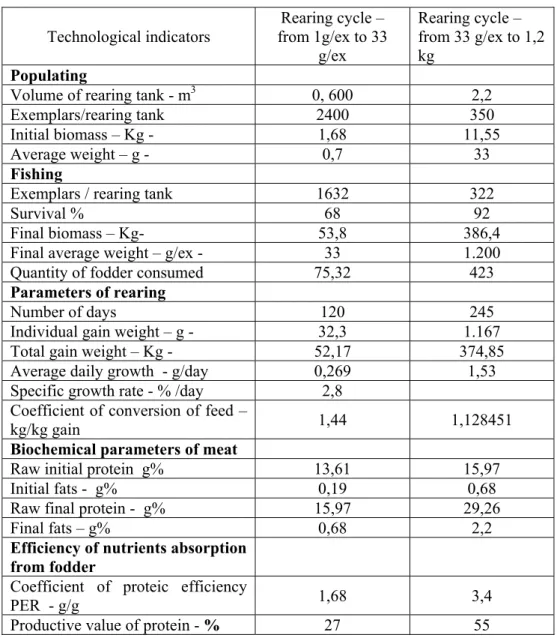
Biotechnological indicators obtained within these two experimental cycles (Table 1) on catfish reared one reveal the fact that technology applied within the system provide a juvenile catfish production by approximately 89,66 kg/m 3 and
170 kg/m 3 respectively, according to chemical conditions and type of fodder used.
Table no. 1 Biotechnological indicators obtained for juveniles of Silurus glanis
Technological indicators
Rearing cycle – from 1g/ex to 33
g/ex
Rearing cycle – from 33 g/ex to 1,2 kg
Populating
Volume of rearing tank - m3 0, 600 2,2
Exemplars/rearing tank 2400 350
Initial biomass – Kg - 1,68 11,55
Average weight – g - 0,7 33
Fishing
Exemplars / rearing tank 1632 322
Survival % 68 92
Final biomass – Kg- 53,8 386,4
Final average weight – g/ex - 33 1.200
Quantity of fodder consumed 75,32 423
Parameters of rearing
Number of days 120 245
Individual gain weight – g - 32,3 1.167
Total gain weight – Kg - 52,17 374,85
Average daily growth - g/day 0,269 1,53
Specific growth rate - % /day 2,8
Coefficient of conversion of feed –
kg/kg gain 1,44 1,128451
Biochemical parameters of meat
Raw initial protein g% 13,61 15,97
Initial fats - g% 0,19 0,68
Raw final protein - g% 15,97 29,26
Final fats – g% 0,68 2,2
Efficiency of nutrients absorption from fodder
Coefficient of proteic efficiency
PER - g/g 1,68 3,4
Conclusions
From researches and experiments made result that rearing Silurus glanis
must be seen, currently, as a potential alternative for intensive aquaculture in Romania, and the experimental results of this project highlights a number of issues which recommends this species for the fisheries sector in Romania
.
References
1. Cihar, J. 1993. Silure. Guide des poissons d’eau douce en Europe. Hatier Ed, pp. 146.
2. Gerard, J. P., 1990. Etude de faisabilité de l'élevage du silure dans les pays de la Loire. Service d'Aquaculture et de Pathologie Aquacole, Ecole Nationale Vétérinaire de Nantes, 101 p.
3. Haffray, P., C. Vauchez, M. Vandeputte, O. Linhart. 1998. Different growth and processing traits in males and females of European catfish, Silurus glanis. Aquatic Living Resour., 11 (5):341-345.
4. Hilge, V. 1985. The influence of the temperature on the growth of the European catfish (Silurus glanis L.). Z. angew. Ichthyol., I: 27-31.
5. Jeney, G., Z., Jeney, J., Olah. 1980. Susceptibility of sheatfish fry to malachite green, formalin and antibiotics. Aquacultura Hungarica (Szarvas), II: 124-130. 6. Justome, B., P., Renou, X., Cadiou. 1992. Etude bibliographique. Gestion en
continuu des productions en etangs et cannibalisme associe. Ecole Supériure d’Agriculture, U.F. Génie Agronomique, 16 p.