Joint Learning with Global Inference
for Comment Classification in Community Question Answering
Shafiq Joty,Llu´ıs M`arquez and Preslav Nakov ALT Research Group
Qatar Computing Research Institute — HBKU, Qatar Foundation {sjoty,lmarquez,pnakov}@qf.org.qa
Abstract
This paper addresses the problem of comment classification in community Question Answer-ing. Following the state of the art, we ap-proach the task with a global inference pro-cess to exploit the information of all com-ments in the answer-thread in the form of a fully connected graph. Our contribution com-prises two novel joint learning models that are on-line and integrate inference within learn-ing. The first one jointly learns twonode- and
edge-level MaxEnt classifiers with stochastic gradient descent and integrates the inference step with loopy belief propagation. The sec-ond model is an instance of fully connected pairwise CRFs (FCCRF). The FCCRF model significantly outperforms all other approaches and yields the best results on the task to date. Crucial elements for its success are the global normalization and an Ising-like edge potential.
1 Introduction
Online community fora have been gaining a lot of popularity in recent years. Many of them, such as Stack Exchange1, are quite open, allowing anybody
to ask and anybody to answer a question, which makes them very valuable sources of information. Yet, this same democratic nature resulted in some questions accumulating a large number of answers, many of which are of low quality. While nowa-days online fora are typically searched using stan-dard search engines that index entire threads, this is not optimal, as it can be very time-consuming for a user to go through and make sense of a long thread.
1http://stackexchange.com/
Q: hello guys and gals..could anyone of u knows where to buy a good and originals RC helicopters and toy guns here in qatar..im longin for this toys but its nowhere to find.. thanks
A1 Go to Doha city center you may get it at 4 floor. Local:Good, Human:Good
A2 “Hobby Shop” in City center has these toys with orig-inal motors. They are super cool.. U will love that shop..and will definetly buy one :) Have fun :) Local:Good, Human:Good
A3 IM selling all my rc nitro helicopters. call me at 5285113.. (1)TREX 600 new/ (1) TREX500 (1) SHUTTLERG (1) FUTABA ... [truncated]
Local:Good, Human:Bad
A4 Hobby Shop- City Centre Local:Bad, Human:Good
A5 OMG!! :— Guns and helicopters??!! Local:Good, Human:Bad
A6 Speed Marine- Salwa Road I think these guys r the best in town...
Local:Good, Human:Good
A7 City center, i’ve seen wonderful collection.. Its some wer besides the kids fun place..
Local:Bad, Human:Good
A8 try the shop in city center. they have many RC toys for sale there. and for the toy guns, in your talking baout airsoft i think its prohibited here. good luck Local:Good, Human:Good
Figure 1: Example answer-thread with human an-notations and automatic predictions by a local clas-sifier at the comment level.
Thus, the creation of automatic systems for Com-munity Question Answering (cQA), which could provide efficient and effective ways to find good an-swers in a forum, has received a lot of research atten-tion recently (Duan et al., 2008; Li and Manandhar, 2011; dos Santos et al., 2015; Zhou et al., 2015a; Wang and Ittycheriah, 2015; Tan et al., 2015; Feng et al., 2015; Nicosia et al., 2015; Barr´on-Cede˜no et al., 2015; Joty et al., 2015). There have been also re-lated shared tasks at SemEval-20152and
SemEval-20163(Nakov et al., 2015; Nakov et al., 2016).
In this paper, we focus on the particular problem of classifying comments in the answer-thread of a given question as good or bad answers. Figure 1 presents an excerpt of a real example from the Qatar-Living dataset from SemEval-2015 Task 3. There is a question on top(Q)followed by eight comments
(A1, A2,· · ·, A8). According to the human
annota-tions (‘Human’), all comments but 3 and 5 are good answers to Q. The comments also contain the predic-tions of agood-vs-badbinary classifier trained with state-of-the-art features on this dataset (Nicosia et al., 2015); its errors are highlighted in red. Many comments are short, making it difficult for the clas-sifier to make the right decisions, but some errors could be corrected using information in the other comments. For instance, comments 4 and 7 are sim-ilar to each other, but also to comments 2 and 8 (‘Hobby shop’, ‘City Center’, etc.). It seems rea-sonable to think that similar comments should have the same labels, so comments 2, 4, 7 and 8 should all be labeled consistently asgoodcomments.
Indeed, recent work has shown the benefit of us-ing varied thread-level information for answer clas-sification, either by developing features modeling the thread structure and dialogue (Barr´on-Cede˜no et al., 2015), or by applying global inference mecha-nisms at the thread level using the predictions of lo-cal classifiers (Joty et al., 2015). We follow the sec-ond approach, assuming a graph representation of the answer-thread, where nodes are comments and edges represent pairwise (similarity) relations be-tween them. Classification decisions are at the level of nodes and edges, and global inference is used to get the best label assignment to all comments.
2http://alt.qcri.org/semeval2015/task3/ 3http://alt.qcri.org/semeval2016/task3/
Our main contribution is to propose online mod-els for learning the decisions jointly, incorporat-ing the inference inside the joint learnincorporat-ing algo-rithm. Building on the ideas from papers coupling learning and inference for NLP structure prediction problems (Punyakanok et al., 2005; Carreras et al., 2005), we propose joint learning of two MaxEnt classifiers with stochastic gradient descent, integrat-ing global inference based on loopy belief propaga-tion. We also propose a joint model with global nor-malization, that is an instance of Fully Connected Conditional Random Fields (Murphy, 2012). We compare our joint models with the previous state of the art for the comment classification problem. We find that the coupled learning-and-inference model is not competitive, probably due to the label bias problem. On the contrary, the fully connected CRF model improves results significantly over all rivaling models, yielding the best results on the task to date. In the remainder of this paper, after discussing re-lated work in Section 2, we introduce our joint mod-els in Section 3. We then describe our experimental settings in Section 4. The experiments and analy-sis of results are presented in Section 5. Finally, we summarize our contributions with future directions in Section 6.
2 Related Work
The idea of using global inference based on lo-cally learned classifiers has been tried in various settings. In the family of graph-based inference, Pang and Lee (2004) used local classification scores with proximity information as edge weights in a graph-cut inference to collectively identify subjec-tive sentences in a review. Thomas et al. (2006) used the same framework to classify congressional tran-scribed speeches. They applied a classifier to pro-vide edge weights that reflect the degree of agree-ment between speakers. Burfoot et al. (2011) ex-tended the framework by including other inference algorithms such as loopy belief propagation and mean-field.
The framework has been applied to many NLP structure prediction problems, including shallow parsing (Punyakanok and Roth, 2000), semantic role labeling (Punyakanok et al., 2004), and joint learn-ing of entities and relations (Roth and Yih, 2004). Further work explored the possibility of coupling learning and inference in the previous setting. For instance, Carreras et al. (2005) presented a model for parsing that jointly trains several local decisions with a perceptron-like algorithm that gets feedback after inference. Punyakanok et al. (2005) studied empirically and theoretically the cases in which this
inference-based learningstrategy is superior to the decoupled approach.
On the particular problem of comment classifica-tion in cQA, we find some work exploiting thread-level information. Hou et al. (2015) used features about the position of the comment in the thread. Barr´on-Cede˜no et al. (2015) developed more elab-orated global features to model thread structure and the interaction among users. Other work exploited global inference algorithms at the thread-level. For instance, (Zhou et al., 2015c; Zhou et al., 2015b; Barr´on-Cede˜no et al., 2015) treated the task as se-quential classification, using a variety of machine learning algorithms to label the sequence of time-sorted comments: LSTMs, CRFs, SVMhmm, etc.
Finally, Joty et al. (2015) showed that exploiting the pairwise relations between comments (at any dis-tance) is more effective than the sequential informa-tion. Their results are the best on this task to date. In this paper, we assume the same setting (cf. Sec-tion 3) and we experiment with new models to do learning jointly with inference in the same manner as in (Punyakanok et al., 2005), and also using fully connected pairwise CRFs.
3 Our Model
Given a forum questionQand a thread of answers T = {A1, A2,· · · , An}, the task is to classify each
answer Ai in the thread into one of K possible
classes based on its relevance to the question. We represent each thread as a fully-connected graph, where each node represents an answer in the thread. Given this setting, there exist at least three funda-mentally different approaches to learn classification functions.
First, the traditional approach of learning a local classifier ignoring the structure in the output and us-ing it to predict the label of each nodeAiseparately.
This approach only considers correlations between the label ofAiand features extracted fromAi.
The second approach, adopted by Joty et al. (2015), is to first learn two local classifiers sepa-rately: (i) a node-level classifier to predict the label for each individual node, and (ii) an edge-level clas-sifier to predict whether the two nodes connected by an edge should have the same label or not (assuming a fully connected graph). The predictions of the lo-cal classifiers are then used in a global inference al-gorithm (e.g., graph-cut) to perform collective clas-sification by maintaining structural constraints in the output. There are two issues with this model: (i) the local classifiers are trained separately; (ii) by decou-pling learning from inference, this approach can lead to suboptimal solutions, as Punyakanok et al. (2005) pointed out.
The third approach, which we adopt in this pa-per, is to model the dependencies between the out-put variables while learning the classification func-tions jointly by optimizing a global performance cri-terion. The dependencies are captured using node-level and edge-node-level factors defined over a fully con-nected graph. The idea is that incorporating struc-tural constraints in the form of all-pair relations dur-ing traindur-ing can yield a better solution that directly optimizes an objective function for the target task.
Before we present our models in subsections 3.1 and 3.2, let us first introduce the notation that we will use. Each thread T = {A1, A2,· · ·, An} is
represented by a complete graphG= (V, E). Each nodei∈V in the graph is associated with an input vector xi, which represents the features of an
an-swerAi, and an output variableyi∈ {1,2,· · ·, K},
representing the class label. Similarly, each edge
(i, j)∈E is associated with an input feature vector φ(xi,xj), derived from the node-level features, and
an output variableyi,j∈ {1,2,· · · , L}, representing
the labels for the pair of nodes. We useψn(yi|xi,v)
and ψe(yi,j|φ(xi,xj),w) to denote the node-level
and the edge-level classification functions, respec-tively. We callψn andψefactors, which can be
3.1 Joint Learning of Two Classifiers with Global Thread-Level Inference
Our aim is to train the local classifiers so that they produce correct global classification. To this end, in our first model we train the node- and the edge-level classifiers jointly based on global feedback provided by a global inference algorithm. The global feed-back determines how much to adjust the local classi-fiers so that the classiclassi-fiers and the inference together produce the desired result. We use log-linear models (aka maximum entropy) for both classifiers:
ψn(yi=k|xi,v) = exp(v
T kxi)
PK
k0=1exp(vTkxi)
(1)
ψe(yi,j =l|φ(xi,xj),w) = exp(w
T
l φ(xi,xj))
PL
l0=1exp(wTl0φ(xi,xj)) (2)
The log likelihood (LL) for one data point(x,y)
(i.e., a thread) can be written as follows:
f(θ) =X
i∈V K X
k=1
yk i
vT
kxi−logZ(v,xi)+
X
(i,j)∈E L X
l=1
yl i,j
wT
l φ(xi,xj)−logZ(w,xi,xj) (3)
where yk
i and yli,j are the gold labels fori-th node
and(i, j)-th edge expressed in1-of-K (or 1-of-L) encoding, respectively, andZ(·)terms are the local normalization constants.
We give a pseudocode in Algorithm 1 that trains this model in an online fashion using feedback from the loopy belief propagation (LBP) inference algo-rithm (to be described later in Section 3.1.1). Specif-ically, the marginals from the LBP are used in a stochastic gradient descent (SGD) algorithm, which has the following (minibatch) update rule:
θt+1=θt−ηtN1f0(θt) (4) where θt and ηt are the model parameters and the
learning rate at step t, respectively, and 1
Nf0(θt)is
the mean gradient for the minibatch (a thread). For our maximum entropy models, the gradients become
f0(v) = X i∈V
[βn(yi)−yi].xi (5)
f0(w) = X
(i,j)∈E
[βe(yi,j)−yi,j].φ(xi,xj) (6)
Algorithm 1: Joint learning of local classifiers with global thread-level inference
1. Initialize the model parametersvandw; 2.repeat
foreach threadG= (V, E)do
a. Compute node and edge probabilities ψn(yi|xi,v)andψe(yi,j|φ(xi,xj),w);
b. Infer node and edge marginalsβn(yi)
andβe(yi,j)using sum-product LBP;
c. Update: v=v−|Vη|f0(v); d. Update: w=w−|Eη|f0(w);
end
untilconvergence;
In the above equations,β andyare the marginals and the gold labels, respectively.
Note that when applying the model to the test threads, we need to perform the same global infer-ence to get the best label assignments.
3.1.1 Inference Using Belief Propagation
Belief Propagation or BP (Pearl, 1988) is a mes-sage passing algorithm for inference in probabilis-tic graphical models. It supports (i) sum-product,
to compute the marginal distribution for each un-observed variable, i.e., p(yi|x, θ); and (ii)
max-product, to compute the most likely label configu-ration, i.e., argmaxyp(y|x, θ). We describe here the variant that operates on undirected graphs (aka Markov random fields) with pairwise factors, which uses the following equations:
µi→j(yj) = X
yi
ψn(yi)ψe(yi,j) Y
k∈N(i)\j
µk→i(yi) (7)
βn(yi) ≈ ψn(yi) Y
j∈N(i)
µj→i(yi) (8)
where µi→j is a message from node i to node j,
N(i)are the nodes neighbouringi, andψn(yi)and
ψe(yi,j)are the node and the edge factors.
The algorithm proceeds by sending messages on each edge until the node beliefs βn(yi) stabilize.
The edge beliefs can be written as follows:
y2
y3 y1
x1
x3 x2
(a)Locally normalized joint model
y2
y3 y1
x1
x3 x2
[image:5.612.127.493.61.241.2](b)Globally normalized joint model
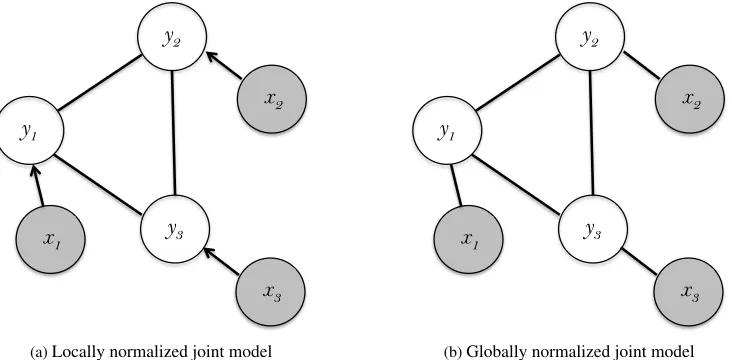
Figure 2: Graphical representation of our two joint models: (a) a joint model with locally normalized factors; (b) a joint model with global normalization, i.e., a fully connected conditional random field.
The node and the edge marginals are then com-puted by normalizing the node and the edge beliefs, respectively. By replacing the summation with a
max operation in Equation 7, we can get the most likely label configuration (i.e.,argmaxover labels). BP is guaranteed to converge to an exact solution if the graph is a tree. However, exact inference is in-tractable for general graphs, i.e., graphs with loops. Despite this, it has been advocated by Pearl (1988) to use BP in loopy graphs as an approximation scheme; see also (Murphy, 2012), page 768. The algorithm is then called “loopy” BP, or LBP. Although LBP gives approximate solutions for general graphs, it often works well in practice (Murphy et al., 1999), outper-forming other methods such as mean field (Weiss, 2001) and graph-cut (Burfoot et al., 2011).
It is important to mention that the approach presented above (i.e., subsection 3.1) is similar in spirit to the approach of Collins (2002), Car-reras and M`arquez (2003) and Punyakanok et al. (2005). The main difference is that they use a Perceptron-like online algorithm, where the up-dates are done based on the best label configuration (i.e.,argmaxyp(y|x, θ)) rather than the marginals.
One can use graph-cut (applicable only for binary output variables) or max-product LBP for the decod-ing task. However, this yields a discontinuous esti-mate (even with averaged perceptron) for the gra-dient (see Section 5). For the same reason, we use sum-product LBP rather than max-product LBP.
3.2 A Joint Model with Global Normalization
Although the approach of updating the parameters of the local classifiers based on the global inference might seem like a natural extension to train the clas-sifiers jointly, it suffers from at least two problems. First, since the node and the edge scores are nor-malized locally (see Equations 1 and 2), this ap-proach leads to the so-calledlabel biasproblem, pre-viously discussed by Lafferty et al. (2001). Namely, due to the local normalization, local features at any node do not influence states of other nodes in the graph. Second, the two classifiers use their own fea-ture sets. However, the same feafea-ture sets that give optimal results locally (i.e., when trained on local objectives), may not work well when the models are trained jointly based on the global feedback. In or-der to address these issues, below we propose a dif-ferent model.
In our second approach, we seek to build a joint model with global normalization. We define the fol-lowing conditional joint distribution:
p(y|v,w,x) =Z(v,1w,x)Y
i∈V
ψn(yi|x,v)· Y
(i,j)∈E
ψe(yi,j|x,w) (10)
whereψnandψeare the node and edgefactors, and
This model is essentially a fully connected condi-tional random field or FCCRF (Murphy, 2012). Fig-ure 2 shows the differences between the two models with the standard graphical model representation.4
The global normalization allows CRFs to take long-range interactions into account. Similar to our pre-vious model, we use a log-linear representation for the factors:
ψn(yi|x,v) = exp(vTφ(yi,x)) (11) ψe(yi,j|x,w) = exp(wTφ(yi,j,x)) (12)
whereφ(·)is a feature vector derived from the inputs and the labels. The LL for one data point becomes
f(θ) =X
i∈V vTφ(y
i,x) + X
(i,j)∈E wTφ(y
i,j,x)
−logZ(v,w,x) (13)
This objective is convex, so we can use gradient-based methods to find the global optimum. The gra-dients have the following form:
f0(v) = X i∈V
φ(yi,x)−E[φ(yi,x)] (14)
f0(w) = X
(i,j)∈E
φ(yi,j,x)−E[φ(yi,j,x)] (15)
whereE[φ(.)]terms denote the expected feature vec-tor. Traditionally, CRFs have been trained using of-fline methods like limited-memory BFGS. Online training of CRFs using SGD was proposed by Vish-wanathan et al. (2006). To compare our two meth-ods, we use SGD to train our CRF models. The pseudocode is very similar to Algorithm 1.
3.2.1 Modeling Edge Factors
One crucial aspect in the joint models described above is the modeling of edge factors. The tradi-tional way is to define edge factors, whereyi,jspans
over all possible state transitions, that isK2
differ-ent transitions, each of which is associated with a weight vector. This method has the advantage that it models transitions in a fine-grained way, but, in doing so, it also increases the number of model pa-rameters, which may result in overfitting.
4Edge level features and output variables are not shown in Figure 2 to avoid visual clutter.
Alternatively, one can defineIsing-likeedge fac-tors, where we only distinguish between two transi-tions: (i)same, whenyi =yjand (ii)different, when
yi6=yj. This modeling involves tying one set of
pa-rameters for allsametransitions, and another set for alldifferenttransitions.
4 Experimental Setting
In this section, we describe our experimental set-ting. We first introduce the dataset we use, then we present the features and the models that we compare.
4.1 Datasets and Evaluation
We experimented with the dataset from SemEval-2015 Task 3 on Answer Selection for Community Question Answering (Nakov et al., 2015). The dataset contains question-answer threads from the Qatar Living forum.5 Each thread consists of a
ques-tion followed by one or more (up to 143) comments. The dataset is split into training, development and test sets, with 2,600, 300, and 329 questions, and 16,541, 1,645, and 1,976 answers, respectively.
Each comment in the dataset is annotated with one of the following labels, reflecting how well it an-swers the question:Good,Potential,Bad,Dialogue,
Not English, andOther. At SemEval-2015 Task 3, the latter four classes were merged intoBADat test-ing time, and the evaluation measure uses a macro-averaged F1 over the three classes: Good, Poten-tial, andBAD. Unfortunately, thePotentialclass was both the smallest (covering about 10% of the data), and also the noisiest and the hardest to predict; yet, its impact was magnified by the macro-averaged F1.
Thus, subsequent work has further mergedPotential
underBAD(Barr´on-Cede˜no et al., 2015; Joty et al., 2015), and has used for evaluation F1with respect to
theGoodcategory (or just accuracy). For our exper-iments below, we also report F1 for theGood class
and the overall accuracy. We further perform sta-tistical significance tests using an approximate ran-domization test based on accuracy.6 We used SIGF
V.2 (Pad´o, 2006) with 10,000 iterations.
5http://www.qatarliving.com/forum
4.2 Features
For comparison, we use the features from our previ-ous work (Joty et al., 2015) to implement all classi-fiers in our models and baselines. There are two sets of features, corresponding to the two main classifi-cation problems in the models: node-level (i.e., clas-sifying a comment as goodorbad) and edge-level (i.e., classifying a pair of comments as having the
sameordifferentlabels).
The features for node-level classification include three types of information: (i) a variety of textual similarity measures computed between the ques-tion and the comment, (ii) several boolean features capturing the presence of certain relevant words or patterns, e.g., URLs, emails, positive/negative words, acknowledgements, forum categories, pres-ence of long words, etc., and (iii) a set of global features modeling dialogue and user interactions in the answer-thread. The features in the last two cate-gories are manually engineered (Nicosia et al., 2015; Barr´on-Cede˜no et al., 2015).
The features we use for edge-level classification include (i) all features from the node classification problem coded as the absolute value of the differ-ence between the two comments, (ii) a variety of text similarity features between the two comments, (iii) thegood/badpredictions of the node-level clas-sifier on the two comments involved in the edge de-cision. See (Joty et al., 2015) and (Barr´on-Cede˜no et al., 2015) for a detailed description of the features.
4.3 Methods Compared
We experimentally compare our above-described joint models to some baselines and to the state of the art for this problem. We briefly describe all models below, together with the names used in the tables of results.
Independent Comment Classification (ICC)
These are binary classifiers to label thread com-ments independently intogoodandbadcategories. The simplest baseline (Majority) classifies all examples with the most frequent category. We also train a MaxEnt classifier with stochastic gradient descent (SGD) and a voted perceptron (ICCME and
ICCP erc, respectively).
Learning-and-Inference Models (LI) This is the approach presented by Joty et al. (2015), who report the best results on the task. The model is explained in Section 3. We experiment with MaxEnt classifiers trained on-line with SGD and two different inference strategies, graph-cut and loopy BP (LIME−GC and
LIME−LBP, in our notation).
Joint Learning and Inference Models These are our new models. First, we experiment with the model for joint learning of two classifiers coupled with thread-level inference (Section 3.1). We have two versions, one using MaxEnt classifiers and the other using averaged Perceptron. The inference al-gorithm is loopy BP in both cases. We call these methods JointME−LBP and JointP erc−LBP,
respec-tively. Second, we experiment with the joint model with global normalization (cf. Section 3.2). We call it FCCRF, for fully connected CRF. We use the
Ising-likeedge factors defined in Section 3.2.1.
5 Evaluation
All results we report below are calculated in the test set, using parameters tuned on the development set.
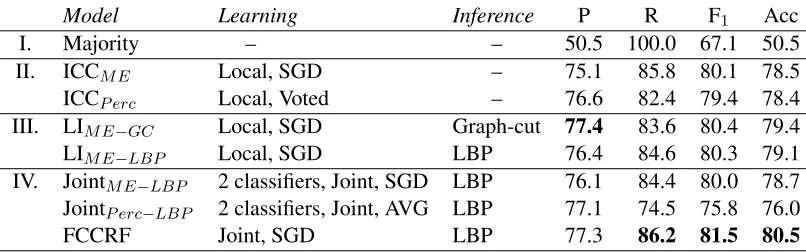
Our main results are shown in Table 1, where we report accuracy (Acc) as well as precision (P), recall (R) and F1-score (F1) for thegoodclass.
The models are organized in four blocks. On top, we see that the majority class baseline achieves ac-curacy of 50.5%, as the dataset is very well balanced between the classes.
In block II, we find the results for the local classi-fiers, ICCMEand ICCP erc, which achieve very
sim-ilar results. They are comparable to MaxEnt in Ta-ble 2, where we report the best published results on this dataset; yet, our classifiers are trained on-line.
Block III in the table reports results for models that train two local MaxEnt classifiers and then per-form thread-level inference using either graph-cut (LIME−GC) or loopy BP (LIME−LBP).7 This yields
improvements over the ICC models with the thread-level inference in block II, which is consistent with the findings of (Joty et al., 2015); however, the dif-ference in terms of accuracy is not statistically sig-nificant (p-value = 0.09).
Model Learning Inference P R F1 Acc
I. Majority – – 50.5 100.0 67.1 50.5
II. ICCME Local, SGD – 75.1 85.8 80.1 78.5
ICCP erc Local, Voted – 76.6 82.4 79.4 78.4
III. LIME−GC Local, SGD Graph-cut 77.4 83.6 80.4 79.4
LIME−LBP Local, SGD LBP 76.4 84.6 80.3 79.1
IV. JointME−LBP 2 classifiers, Joint, SGD LBP 76.1 84.4 80.0 78.7
JointP erc−LBP 2 classifiers, Joint, AVG LBP 77.1 74.5 75.8 76.0
[image:8.612.103.506.59.185.2]FCCRF Joint, SGD LBP 77.3 86.2 81.5 80.5
Table 1: Results of all compared models on the test set. The best results are boldfaced.
Model P R F1 Acc
[image:8.612.77.296.220.294.2]MaxEnt classifier 75.7 84.3 79.8 78.4 Linear CRF 74.9 83.5 78.9 77.5 MaxEnt+ILP 77.0 83.5 80.2 79.1 MaxEnt+GraphCut 78.3 82.9 80.6 79.8 Our method (FCCRF) 77.3 86.2 81.5 80.5
Table 2: Comparison to the best published results on the same datasets, as reported in (Joty et al., 2015).
Comparing our LIME−GC to MaxEnt+GraphCut
in Table 2, we see that we are slightly worse: -0.2 in F1-score, and -0.4 in accuracy. It turns out that this
is due to our on-line MaxEnt classifier for the pair-wise classification being slightly worse (-0.4 accu-racy points absolute), which could explain the lower performance after the graph-cut inference.
Next, block IV shows that the fully connected CRF model (FCCRF) improves over the models in block III by more than one point absolute in bothF1
and accuracy. The improvement is statistically sig-nificant (p-value = 0.04); especially noticeable is the increase in recall (+2.6 points). This result is also an improvement over the state of the art, as Table 2 shows.
Again in block IV, we can see that the two mod-els that perform joint training of two classifiers and then integrate inference in the training loop, JointME−LBP and JointP erc−LBP, do not work well
and fall below the learning and inference models from block III. As we explained above, these models have two major disadvantages compared to FCCRF: (i) the local normalization of node and edge scores is prone to label bias issues; (ii) each of the two clas-sifiers uses its own feature set, which might not be optimal when they are trained jointly based on the global feedback.
Notice that the version using Perceptron, JointP erc−LBP, works bad in this setting. Since
updates are done after each thread-level inference, we could not use a voted perceptron, but an aver-aged one (Collins, 2002). Moreover, it did not yield probabilities but real-valued scores, which we had to remap to the [0;1] interval using a sigmoid.
5.1 CRF Variants Analysis
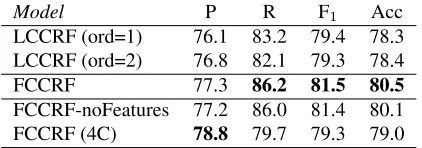
Table 3 compares different variants of CRF. The first two rows show the results for the commonly used linear-chain CRF (LCCRF) of order 1 and 2. We can see that these models fall two accuracy (and F1)
points below FCCRF, which indicates that the pair-wise relations between non-consecutive comments provide additional relevant information for the task. The fourth row shows the results when we eliminate the edge-level features and we consider state tran-sitions using the bias features only: the decrease in performance is tiny, which means that what matters is to model the interaction in the first place; the par-ticular features used are less important. More no-ticeable is the effect of using Ising-like modeling of the edge factors in our FCCRF model. If we use finer-grained edge factors for each of the four com-binations (Good-Good, Good-Bad, Bad-Good, and Bad-Bad), the performance decreases significantly, mostly due to a drop in recall (see ‘FCCRF (4C)’).
5.2 Error Analysis
Next, we get a closer look at the predictions made by our best Local (ICCME), Inference (LIME−GC),
Model P R F1 Acc LCCRF (ord=1) 76.1 83.2 79.4 78.3 LCCRF (ord=2) 76.8 82.1 79.3 78.4
FCCRF 77.3 86.2 81.5 80.5
[image:9.612.81.292.60.134.2]FCCRF-noFeatures 77.2 86.0 81.4 80.1 FCCRF (4C) 78.8 79.7 79.3 79.0
Table 3: Results for different variants of the joint CRF model on the test set.
The Local, the Inference, and the Joint mod-els made correct predictions for 78.7%, 79.1% and 80.4% of the comments, respectively. We can see that the Inference model behaves more like Local, and not so much like Joint. This is indeed further confirmed when we look at the agreement between each pair of models: Local vs. Inference has 6.0% disagreement, for Local vs. Joint it is 9.9%, and for Inference vs. Joint it is 8.8%.
Figure 3 compares the three models vs. the gold human labels on a particular test question (ID=Q2908; some long comments are truncated and the four omitted answers were classified correctly by all three classifiers). We can see that the Joint model is more robust than the Local one: while Joint cor-rects two of the three wrong classifications of Local, Inference makes two further errors instead.
6 Conclusion
We have proposed two learning methods for com-ment classification in community Question Answer-ing. We depart from the state-of-the-art knowl-edge that exploiting the interrelations between all the comments in the answer-thread is beneficial for the task. Thus, we take as our baseline the learn-ing and inference model from Joty et al. (2015), in which the answer-thread is modeled as a fully con-nected graph. Our contribution consists of moving the framework to on-line learning and proposing two models for coupling learning with inference.
Our first model learns jointly the two MaxEnt classifiers with SGD and incorporates the graph in-ference at every step with loopy belief propagation. This model, due to its local normalization, suffers from the label bias problem. The alternative we pro-posed is to use an instance of a Fully Connected CRF that operates on the same graph and considers the node and edge factors with a shared set of features.
Q: I have a female friend who is leaving for a teaching job in Qatar in January. What would be a useful portable gift to give her to take with her?
A1 A couple of good best-selling novels. [. . .] Loc:Good, Inf:Good, Jnt:Good, Hum:Good
A5 A big box of decent tea.... like “Scottish blend” or “Tetleys”.. [. . .]
Loc:Good, Inf:Good, Jnt:Good, Hum:Good
A6 Bacon. Nice bread, bacon, bacon, errmmm bacon and a pork joint..
Loc:Good, Inf:Bad, Jnt:Good, Hum:Good
A8 Go to Tesco buy some good latest DVD.. [. . .] Loc:Good, Inf:Good, Jnt:Good, Hum:Good
A9 Couple of good novels, All time favorite movies, .. Loc:Good, Inf:Bad, Jnt:Good, Hum:Good
A10 Agree I do the same Indorachel..But some time you get a good copy some time a bad one.. [. . .] Loc:Good, Inf:Good, Jnt:Good, Hum:Bad
A11 Ditto on the books and dvd’s. Excedrin. Loc:Bad, Inf:Bad, Jnt:Good, Hum:Good
A12 Ditto on the bacon, pork sausage, pork chops, ham,..can you tell we miss pork! [. . .]
Loc:Bad, Inf:Bad, Jnt:Good, Hum:Good
Figure 3: Sample test question with a thread of com-ments and, for each comment, decisions by the local (Loc), the global inference (Inf), and the global joint (Jnt) classifiers, as well as by the human annotators.
One of the main advantages is that the normalization is global. We experimented with the SemEval-2015 Task 3 dataset and we confirmed the advantage of the FCCRF model, which outperforms all baselines and achieves better results than the state of the art.
In the near future, we plan to apply the FCCRF model to the full cQA task, i.e., finding good an-swers to newly-asked questions using previously-asked questions and their answer threads. In this setting, we want to experiment with (i) ranking com-ments (instead of classifying them), (ii) exploiting the similarities between the new question and the questions in the database and also the relations be-tween comments across different answer-threads.
Acknowledgments
References
Alberto Barr´on-Cede˜no, Simone Filice, Giovanni Da San Martino, Shafiq Joty, Llu´ıs M`arquez, Preslav Nakov, and Alessandro Moschitti. 2015. Thread-level information for comment classification in community question answering. In Proceedings of the 53rd Annual Meeting of the Association for Computational Linguistics and the 7th International Joint Conference on Natural Language Processing, ACL-IJCNLP ’15, pages 687–693, Beijing, China.
Clinton Burfoot, Steven Bird, and Timothy Baldwin. 2011. Collective classification of congressional floor-debate transcripts. InProceedings of the 49th Annual Meeting of the Association for Computational Linguis-tics: Human Language Technologies - Volume 1, HLT ’11, pages 1506–1515, Portland, Oregon.
Xavier Carreras and Llu´ıs M`arquez. 2003. Online learn-ing via global feedback for phrase recognition. In
Proceedings of the 17th Annual Conference on Neural Information Processing Systems, NIPS ’03, Whistler, Canada. MIT Press.
Xavier Carreras, Llu´ıs M`arquez, and Jorge Castro. 2005. Filtering–ranking perceptron learning for partial pars-ing. Machine Learning, 60:41–71.
Michael Collins. 2002. Discriminative training meth-ods for hidden Markov models: Theory and experi-ments with perceptron algorithms. InProceedings of the 2002 Conference on Empirical Methods in Nat-ural Language Processing, EMNLP ’02, pages 1–8, Philadelphia, Pennsylvania, USA.
Cicero dos Santos, Luciano Barbosa, Dasha Bogdanova, and Bianca Zadrozny. 2015. Learning hybrid rep-resentations to retrieve semantically equivalent ques-tions. In Proceedings of the 53rd Annual Meeting of the Association for Computational Linguistics and the 7th International Joint Conference on Natural Lan-guage Processing (Volume 2: Short Papers), ACL-IJCNLP ’15, pages 694–699, Beijing, China.
Huizhong Duan, Yunbo Cao, Chin-Yew Lin, and Yong Yu. 2008. Searching questions by identifying ques-tion topic and quesques-tion focus. In Proceedings of the 46th Annual Meeting of the Association for Compu-tational Linguistics and the Human Language Tech-nology Conference, ACL-HLT ’08, pages 156–164, Columbus, Ohio, USA.
Minwei Feng, Bing Xiang, Michael R Glass, Lidan Wang, and Bowen Zhou. 2015. Applying deep learn-ing to answer selection: A study and an open task. In
Proceedings of the 2015 IEEE Workshop on Automatic Speech Recognition and Understanding, ASRU ’15, pages 813–820, Scottsdale, Arizona, USA.
Yongshuai Hou, Cong Tan, Xiaolong Wang, Yaoyun Zhang, Jun Xu, and Qingcai Chen. 2015.
HITSZ-ICRC: Exploiting classification approach for answer selection in community question answering. In Pro-ceedings of the 9th International Workshop on Seman-tic Evaluation, SemEval ’15, pages 196–202, Denver, Colorado, USA.
Shafiq Joty, Alberto Barr´on-Cede˜no, Giovanni Da San Martino, Simone Filice, Llu´ıs M`arquez, Alessandro Moschitti, and Preslav Nakov. 2015. Global thread-level inference for comment clas-sification in community question answering. In
Proceedings of the 2015 Conference on Empir-ical Methods in Natural Language Processing, EMNLP ’15, pages 573–578, Lisbon, Portugal. John Lafferty, Andrew McCallum, and Fernando Pereira.
2001. Conditional random fields: Probabilistic mod-els for segmenting and labeling sequence data. In Pro-ceedings of the Eighteenth International Conference on Machine Learning, ICML ’01, pages 282–289, San Francisco, California, USA.
Shuguang Li and Suresh Manandhar. 2011. Improv-ing question recommendation by exploitImprov-ing informa-tion need. In Proceedings of the 49th Annual Meet-ing of the Association for Computational LMeet-inguistics: Human Language Technologies - Volume 1, ACL ’11, pages 1425–1434, Portland, Oregon, USA.
Kevin P. Murphy, Yair Weiss, and Michael I. Jordan. 1999. Loopy belief propagation for approximate in-ference: An empirical study. In Proceedings of the Fifteenth Conference on Uncertainty in Artificial Intel-ligence, UAI’99, pages 467–475, Stockholm, Sweden. Kevin Murphy. 2012.Machine Learning A Probabilistic
Perspective. The MIT Press.
Preslav Nakov, Llu´ıs M`arquez, Walid Magdy, Alessan-dro Moschitti, Jim Glass, and Bilal Randeree. 2015. SemEval-2015 task 3: Answer selection in commu-nity question answering. In Proceedings of the 9th International Workshop on Semantic Evaluation, Se-mEval ’15, pages 269–281, Denver, Colorado, USA. Preslav Nakov, Llu´ıs M`arquez, Alessandro Moschitti,
Walid Magdy, Hamdy Mubarak, Abed Alhakim Frei-hat, Jim Glass, and Bilal Randeree. 2016. SemEval-2016 task 3: Community question answering. In Pro-ceedings of the 10th International Workshop on Se-mantic Evaluation, SemEval ’16, San Diego, Califor-nia, USA.
Sebastian Pad´o, 2006. User’s guide to sigf: Signifi-cance testing by approximate randomisation.
Bo Pang and Lillian Lee. 2004. A sentimental ed-ucation: Sentiment analysis using subjectivity sum-marization based on minimum cuts. In Proceed-ings of the 42nd Annual Meeting on Association for Computational Linguistics, ACL ’04, pages 271–278, Barcelona, Spain.
Judea Pearl. 1988.Probabilistic Reasoning in Intelligent Systems: Networks of Plausible Inference. Morgan Kaufmann Publishers Inc., San Francisco, California, USA.
Vasin Punyakanok and Dan Roth. 2000. Shallow parsing by inferencing with classifiers. InProceedings of the 2nd Workshop on Learning Language in Logic and the 4th Conference on Computational Natural Language Learning - Volume 7, ConLL ’00, pages 107–110, Lis-bon, Portugal.
Vasin Punyakanok, Dan Roth, Wen-tau Yih, and Dav Zi-mak. 2004. Semantic role labeling via integer linear programming inference. InProceedings of the 20th In-ternational Conference on Computational Linguistics, COLING ’04, Geneva, Switzerland.
Vasin Punyakanok, Dan Roth, Wen-tau Yih, and Dav Zi-mak. 2005. Learning and inference over constrained output. InProceedings of the 19th International Joint Conference on Artificial Intelligence, IJCAI’ 05, pages 1124–1129, Edinburgh, Scotland.
Dan Roth and Wen-tau Yih. 2004. A linear programming formulation for global inference in natural language tasks. InProceedings of the HLT-NAACL 2004 Work-shop: Eighth Conference on Computational Natural Language Learning, CoNLL ’04, pages 1–8, Boston, Massachusetts, USA.
Ming Tan, Bing Xiang, and Bowen Zhou. 2015. LSTM-based deep learning models for non-factoid answer se-lection. arXiv preprint arXiv:1511.04108.
Matt Thomas, Bo Pang, and Lillian Lee. 2006. Get out the vote: Determining support or opposition from con-gressional floor-debate transcripts. InProceedings of the 2006 Conference on Empirical Methods in Natural Language Processing, EMNLP ’06, pages 327–335, Sydney, Australia.
S. V. N. Vishwanathan, Nicol N. Schraudolph, Mark W. Schmidt, and Kevin P. Murphy. 2006. Accelerated training of conditional random fields with stochastic gradient methods. InProceedings of the 23rd Interna-tional Conference on Machine Learning, ICML ’06, pages 969–976, Pittsburgh, Pennsylvania, USA. Zhiguo Wang and Abraham Ittycheriah. 2015.
Faq-based question answering via word alignment. arXiv preprint arXiv:1507.02628.
Yair Weiss. 2001. Comparing the mean field method and belief propagation for approximate inference in MRFs.
Advanced Mean Field Methods.
Guangyou Zhou, Tingting He, Jun Zhao, and Po Hu. 2015a. Learning continuous word embedding with metadata for question retrieval in community question answering. InProceedings of the 53rd Annual Meet-ing of the Association for Computational LMeet-inguistics and the 7th International Joint Conference on Natural Language Processing (Volume 1: Long Papers), ACL-IJCNLP ’15, pages 250–259, Beijing, China.
Xiaoqiang Zhou, Baotian Hu, Qingcai Chen, Buzhou Tang, and Xiaolong Wang. 2015b. Answer sequence learning with neural networks for answer selection in community question answering. InProceedings of the 53rd Annual Meeting of the Association for Computa-tional Linguistics, pages 713–718, Beijing, China. Xiaoqiang Zhou, Baotian Hu, Jiaxin Lin, Yang Xiang,