http://www.sciencepublishinggroup.com/j/ajche doi: 10.11648/j.ajche.s.2017050301.13
ISSN: 2330-8605 (Print); ISSN: 2330-8613 (Online)
Evaluating The Effect of Temperature and Polymer
Concentration on Properties of Hydroxyethyl Cellulose
Gravel Pack Fluid
Anthony Okon John
1, *, Ogbonna Joel
2, Franklin Chukwuma
31
World Bank African Centre of Excellence, Institute of Petroleum Studies, University of Port Harcourt, Port Harcourt, Nigeria 2Centre for Petroleum Research and Training, University of Port Harcourt, Port Harcourt, Nigeria
3Department of Chemical Engineering, University of Port Harcourt, Port Harcourt, Nigeria
Email address:
[email protected] (A. O. John), [email protected] (O. Joel), [email protected] (F. Chukwuma) *Corresponding author
To cite this article:
Anthony Okon John, Ogbonna Joel, Franklin Chukwuma. Evaluating The Effect of Temperature and Polymer Concentration on Properties of Hydroxyethyl Cellulose Gravel Pack Fluid. American Journal of Chemical Engineering. Special Issue: Oil Field Chemicals and
Petrochemicals. Vol. 5, No. 3-1, 2017, pp. 21-27. doi: 10.11648/j.ajche.s.2017050301.13
Received: March 29, 2017; Accepted: March 31, 2017; Published: April 15, 2017
Abstract:
The commercial success of petroleum wells depends greatly on the type of completion, especially the choice of gravel packing fluid system for wells with gravel pack completions. Currently several polymers are in use to viscosify gravel pack fluids. These polymers are expected to exhibit acceptable properties such as good solubility, viscosity yield, rheology, sand carrying capacity, thermal stability, break profile, low residue content and others, to match the job requirements, in order not to jeopardize the sand control process or cause hydrocarbon production impairment. Hydroxyethyl cellulose (HEC), one of the most commonly used polymers used in formulating gravel pack fluids has so many good qualities, such as very low solid residues and easy clean out. In this paper, gel break time was investigated for 40lbs/1000gal and 60lbs/1000gal HEC polymer concentrations at 140°F, 160°F and 180°F, using Sodium Persulfate as gel breaker at concentrations of 1.0lbs/1000gal, 5.0lbs/1000gal, 10.0lbs/1000gal and 20.0lbs/1000gal. The proppant carrying capacity at different temperatures was also investigated. Test results indicated that gel break is a function of temperature, breaker and polymer concentrations. At higher temperatures and higher breaker concentrations, gel break is faster, but slower for higher polymer concentration.Keywords:
Gel Breaker, Gravel Pack, Hydroxyethyl Cellulose, Proppant, Sodium Persulfate1. Introduction
1.1. Well Completions
The reason for drilling oil and gas wells is to economically produce hydrocarbons from the reservoir, or in some cases, to inject fluids into the reservoir. Petroleum well construction involves major activities such as exploration, drilling, completions and production. Well completion is the overall process of preparing the well for a controllable and safe hydrocarbon production or fluids injection. This is achieved by providing a conductive flow path from the reservoir to the wellbore and to the surface equipment or vice versa [1].
Generally, wells completions in soft unconsolidated formations, with low compressive strength less than 1000psi,
usually produce formation sand [2]. According to [3], sand production is undesirable and could lead to problems such as low production, sand bridging in casings or tubing, erosion or damage of subsurface and downhole equipment, formation or casing collapse, environmental problem associated with sand disposal and high cost of workover.
1.2. Gravel Packing
Gravel packing is the most common and often preferred sand control techniques, which involves filtration of the formation sand or fines through selected graded medium of screen or slotted liner, placed inside the casing/liner or open-hole, with the annulus packed with gravels. A prepacked screen is sometimes used [3].
Alternate-path gravel packing technique, which utilises perforated shunts placed in the annulus and attached to the screen to provide alternate paths for the slurry flow, is very efficient in eliminating sand bridging and ensuring complete packing in highly deviated or horizontal wells [4]. A viscoelastic fluid with low gravel settling rate is recommended for use when adopting the Alternate-path gravel packing method [5].
1.3. Gravel-Carrier Fluids
Gravel packing operations requires a carrier fluid to help transport sand to the required interval in the wellbore. A good gravel-carrier fluid must exhibit good gravel suspension and transport capability, good leak-off or fluid loss property, good stability, controllable viscosity reduction, good break profile and minimal formation damage [6].
Historically, many fluids have been used for gravel packing and this includes brine, diesel, crude oil, foams, viscoelastic surfactant, crosslinked and viscous linear gels [2]. Polymers that are used to yield the high viscosity for viscous fluids include random-coil and the helical polymers. The random-coil polymers, which include guar, hydroxypropyl guar (HPG) and hydroxyethyl cellulose (HEC), are susceptible to severe viscosity loss at high temperatures; while helical polymers, which include xanthan, welan gum, diutan, and scleroglucan, are thermally stable [7]. The three most common used carrier fluids for gravel packing are Hydroxyethyl cellulose, Xanthan and Viscoelastic surfactant [8], [9].
HEC is the least damaging of all polymers as it leaves behind the least amount of residues when broken [9]. Shearing and filtration processes introduced into the process of preparing HEC has helped in eliminating fish eyes and micro-fish eyes usually formed as a result of incomplete polymer hydration [10], [11]. However, HEC system has no gel strength to aid gravel transport in situations such as highly deviated wells or in long intervals [12].
Other additives commonly used in formulating gravel-carrier fluids include salts, biocides, surfactants, iron chelating agent, acids, bases, breakers and others [13]. Salts function as clay stabilizers and also are used to increase the weight of the mix water for well control purposes. Biocides are used to preserve the polymer from bacteria effects. Iron chelating agents prevents iron precipitation and crosslinking of the gel. Surfactants lower the surface tension of the fluid system and prevent formation of stable emulsion with the formation fluid. Acids and basic buffers are used to adjust the pH of the fluid system to aid polymer dissolution, hydration, stability and break.
Gel breakers are usually added at the surface to the gravel packing fluids systems to reduce the viscosity downhole and facilitate good wellbore clean up [14], [15]. The gravel carrier fluid must not break too fast, to cause premature sand out and jeopardize the process, but must allow complete packing of the entire interval and break at the right time with little or no damaging effect on the permeability of the packed zone or formation. The known available breakers include oxidizers, acids and enzymes [16], [17]. The gel breaker reaction depends on temperature, type and concentration of breakers, type and concentration of polymer and pH [18], [19].
Selection of the right additives to prepare competent fluid systems is very vital to the successful execution of the gravel packing process. In this study, some properties, such as rheology, sand suspension capacity and break time, of HEC based gravel-carrier fluid system required for optimum gravel placement at different temperatures were investigated through laboratory experiments, to serve as a guide in determining the optimum concentration of additives required for a particular well condition.
2. Materials and Methods
2.1. Fluid Formulation and Preparation
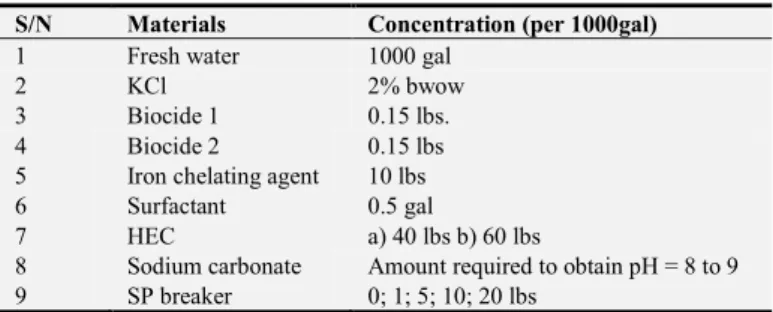
The HEC based gravel-carrier fluid system recipe used for the experiment is shown in Table 1. The amount of the additives required to mix 1000cc of the fluid system was determined. 2% by weight of water (bwow) potassium chloride (KCl) brine was used as base fluid for the experiment. 40lbs/1000gal (40ppt) and 60lbs/1000gal (60ppt) HEC polymer loadings were investigated, with varying concentration Sodium Persulfate (SP) oxidizer breaker.
Table 1. HEC Fluid Recipe.
S/N Materials Concentration (per 1000gal)
1 Fresh water 1000 gal
2 KCl 2% bwow
3 Biocide 1 0.15 lbs.
4 Biocide 2 0.15 lbs
5 Iron chelating agent 10 lbs
6 Surfactant 0.5 gal
7 HEC a) 40 lbs b) 60 lbs
8 Sodium carbonate Amount required to obtain pH = 8 to 9
9 SP breaker 0; 1; 5; 10; 20 lbs
2.2. Rheology
The rheological readings of the 40ppt and 60ppt HEC fluid systems were determined, using Fann model 35 viscometer at different temperatures of 80°F, 120°F, 140°F, 160°F and 180°F, after conditioning in a water bath, pre-set to the desired temperature.
2.3. Proppant Suspension Test
The capability of the 40ppt and 60ppt HEC fluid systems to suspend proppant was determined by mixing the hydrated gel with the required amount of mesh 20/40 resin coated proppant to form a 10ppa slurry, which was poured into a 100cc glass measuring cylinder, placed in a preheated water bath at the test temperature and the volume of clear free fluid formed at the top of the slurry bed was measured at 0, 1, 2, 3, 4, 5, 6, 8, 10, 15, 20, 25 and 30 minutes time intervals.
2.4. Break Test
Gel break test was performed for the 40ppt and 60ppt HEC fluid systems at different temperatures of 140°F, 160°F and 180°F, varying the concentration of SP Breaker at 1ppt, 5ppt, 10ppt, and 20ppt.
The required amount of breaker was measured and added to 200cc gel, while mixing. The mixture was thoroughly agitated, poured in an 8oz glass bottle, placed in a preheated water bath at the test temperature and rheological reading
periodically determine as specified above. The acceptable break time is fluid apparent viscosity of ≤ 10cP at 511 s-1 shear rate.
3. Results and Discussion
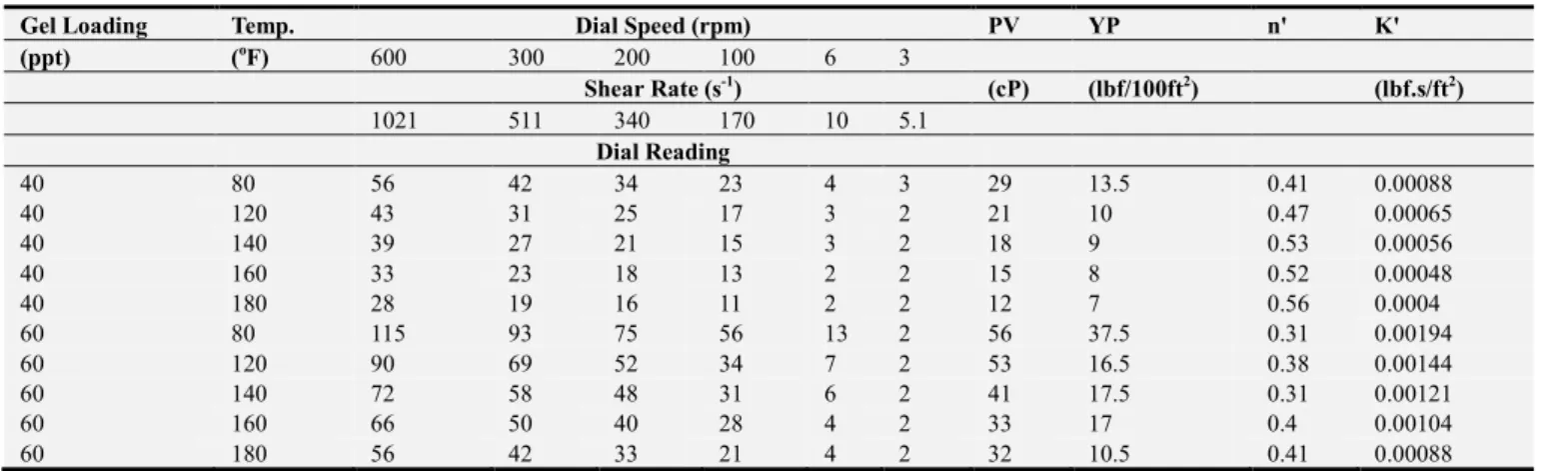
The gel hydration test result is summarized in Table 2. It showed that the 60ppt HEC fluid has about twice the apparent viscosity of the 40ppt HEC fluid at 511s-1 shear rate. Increasing the polymer concentration increases the viscosity and the rheological dial readings as evident in Table 3. The rheological reading for both polymer concentrations decreases with temperature, similar to the study as explained by [7]. During the preparation of the polymer fluid, the powder HEC was added to the mix fluid while agitating to encourage the process polymer hydration. The pH was lowered to about 2 before the addition of the polymer HEC to facilitate good dispersion of the powder and minimize formation of “fish eyes” as noted by [13].
Table 2. Gel hydration test.
Test 40ppt HEC 60ppt HEC
pH of mix brine 5.85 5.85
pH after adding iron chelating agent 1.96 1.71
Final pH of hydrated gel 8.1 8.03
Temperature (oF) 81 81
Apparent viscosity @ 511s-1 (cP) 43 98
Table 3. Rheology test.
Gel Loading Temp. Dial Speed (rpm) PV YP n' K'
(ppt) (oF) 600 300 200 100 6 3
Shear Rate (s-1) (cP) (lbf/100ft2) (lbf.s/ft2)
1021 511 340 170 10 5.1
Dial Reading
40 80 56 42 34 23 4 3 29 13.5 0.41 0.00088
40 120 43 31 25 17 3 2 21 10 0.47 0.00065
40 140 39 27 21 15 3 2 18 9 0.53 0.00056
40 160 33 23 18 13 2 2 15 8 0.52 0.00048
40 180 28 19 16 11 2 2 12 7 0.56 0.0004
60 80 115 93 75 56 13 2 56 37.5 0.31 0.00194
60 120 90 69 52 34 7 2 53 16.5 0.38 0.00144
60 140 72 58 48 31 6 2 41 17.5 0.31 0.00121
60 160 66 50 40 28 4 2 33 17 0.4 0.00104
60 180 56 42 33 21 4 2 32 10.5 0.41 0.00088
PV – Plastic Viscosity; YP – Yield Point; n’ – Flow behavior index; K’ – Consistency index.
For the same temperature, the flow behaviour index, n’, is higher for 40ppt HEC than for 60ppt HEC. n’ increases with temperature at constant polymer concentration as shown in Table 3. The lower the value of n’, the closer the flow regime of the fluid to plug flow as explained by [20]. Therefore, 40ppt HEC will be easier to be subjected to turbulence than 60ppt HEC and the higher the temperature the easier to achieve turbulence.
More so, Consistency index, K’, which describes the pumpability of the fluid, is higher for 60ppt HEC than for 40ppt HEC at the same temperature and the values decreases with increasing temperature. Therefore, 40ppt HEC will be easier to pump and will generate lower frictional pressure
and consequently will require lower treatment pressure than 60ppt HEC.
thereby reducing the frictional force and overall required treatment or pumping pressure.
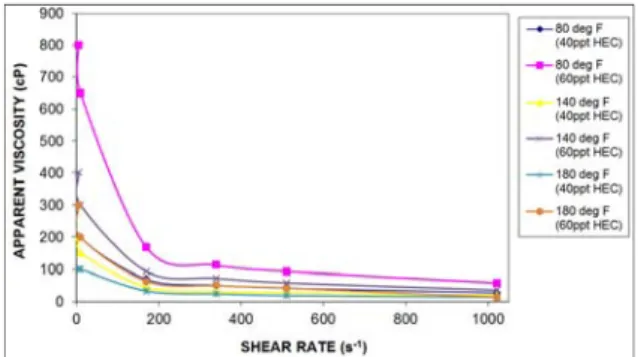
Figure 1. Apparent viscosity vs shear rate at different temperatures for 40ppt HEC.
Figure 2. Apparent viscosity vs shear rate at different temperatures for 60ppt HEC.
Figure 3. Apparent viscosity vs Shear rate comparison at different temperatures for 40ppt and 60ppt HEC.
The proppant suspension property of HEC is a function of temperature and polymer concentration as shown in Table 4. The gravel settling for 40ppt HEC begins almost immediately and intensifies with increasing temperature for both 40ppt and 60ppt HEC, confirming the notion that HEC is thermally unstable as mentioned by [7]. Increasing the concentration of the polymer from 40ppt to 60ppt improves the sand suspension property and thermal stability of the fluid system. More so, the higher values of Yield Point, YP, for 60ppt HEC as compared to 40ppt HEC suggests better particle suspension capability.
Table 4. Proppant suspension test.
Gel Loading (ppt)
40 40 40 40 60 60 60 60
Time Temperature (°F)
(min) 80 140 160 180 80 140 160 180
Volume of clear fluid above slurry (cc)
0 0 0 0 0 0 0 0 0
1 10 20 23 24 3 3 5 6
2 15 24 25 25 5 9 10 12
3 20 24 26 26 6 10 15 18
4 25 25 26 26 8 14 19 22
5 26 25 26 27 9 19 21 23
8 27 25 26 27 12 20 22 23
10 27 25 26 27 15 22 22 23
15 27 25 26 27 19 23 22 23
20 27 25 27 27 23 23 22 23
25 27 25 27 27 23 23 22 23
30 27 25 27 27 24 23 23 23
Table 5. Break Test for 40ppt HEC.
Time (min)
Temperature (°F)
180 180 180 180 160 160 160 160 140 140 140 140
SP Breaker Concentration (ppt)
20 10 5 1 20 10 5 1 20 10 5 1
Viscosity at 511 s-1 (cP)
0 43 43 43 43 43 43 43 43 43 43 43 43
10 10 18 21 24 20 22 23 26 27 28 28 29
20 7 8 10 18 10 15 17 20 22 23 26 26
30 6 6 7 13 9 10 13 15 19 19 20 21
Time (min)
Temperature (°F)
180 180 180 180 160 160 160 160 140 140 140 140
SP Breaker Concentration (ppt)
20 10 5 1 20 10 5 1 20 10 5 1
Viscosity at 511 s-1 (cP)
90 7 7 12 10 12 14 17
120 10 10 13 17
150 7 12 16
180 11 15
210 10 14
240 13
300 12
330 10
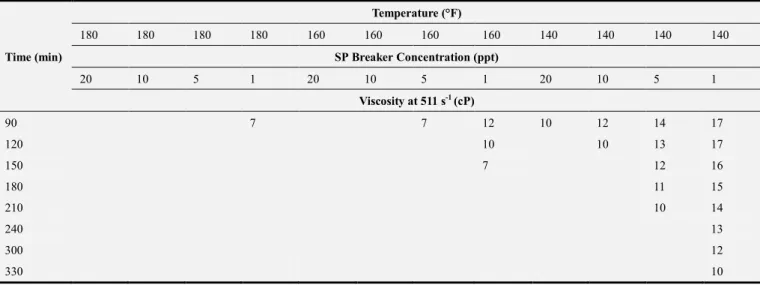
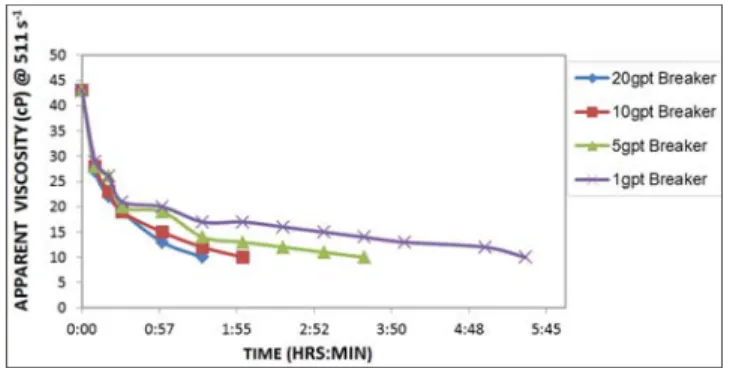
The break time for 40ppt and 60ppt HEC decreases with increasing concentration of SP breaker from 1ppt to 20ppt at the same temperature as shown in Tables 5 and 6, with the 60ppt gel far slower in breaking, similar to the result obtained by [13]. Break time for the HEC fluid is also affected by temperature. Tables 5 and 6 and Figures 6 and 7 show a rapid decrease in break time as temperature is increased from 140°F to 180°F for both the 40ppt and 60ppt
HEC for the same breaker concentration. The effect of temperature on break time is more pronounced at higher breaker concentrations than at lower concentrations.
The 40ppt HEC broke at about half of the time of the 60ppt HEC at the same temperature for the same concentration of breaker as seen in Figures 8 and 9. The rate of breaking is enhanced by temperature, confirming the results of the study by [18], [19].
Table 6. Break Test for 60ppt HEC.
Time (min)
Temperature (°F)
180 180 180 180 160 160 160 160 140 140 140 140
SP Breaker Concentration (ppt)
20 10 5 1 20 10 5 1 20 10 5 1
Viscosity at 511 s-1 (cP)
0 98 98 98 98 98 98 98 98 98 98 98 98
10 23 24 29 62 68 70 71 71 72 73 74 92
20 8 10 18 46 28 44 58 65 65 67 72 90
30 6 7 9 37 16 28 44 55 57 62 70 88
60 4 4 6 25 9 15 34 51 50 58 63 77
90 21 10 25 44 42 54 59 67
120 19 18 38 31 47 55 65
150 18 14 35 25 40 51 63
180 18 12 33 20 36 47 58
210 17 10 28 15 33 43 51
240 17 27 13 30 38 49
300 16 26 11 26 34 48
330 16 22 10 22 30 47
360 15 21 8 19 28 46
390 15 20 8 16 26 45
420 14 19 7 12 24 44
450 14 18 10 23 42
480 13 17 22 40
510 13 16 21 39
540 12 16 19 38
570 12 16 17 36
600 11 16 15 34
630 11 16 13 32
660 11 15 12 30
690 10 15 11 28
720 14 10 26
1080 14 21
1440 14 17
1800 13
Figure 4. Effect of breaker concentration on break time for 40ppt HEC at 140oF.
Figure 5. Effect of breaker concentration on break time for 60ppt HEC at 140oF.
Figure 6. Effect of Temperature on break time for 40ppt HEC with 5ppt SP breaker.
Figure 7. Effect of Temperature on break time for 60ppt HEC with 5ppt SP breaker.
Figure 8. Effects of gel loading on break time with 20ppt SP breaker at 140oF.
Figure 9. Effects of gel loading on break time with 20ppt SP breaker at 160oF.
4. Conclusion
HEC has a shear thinning property, which is very important for sand suspension and transport as the fluids moves into region of low shear rates in the wellbore. However, HEC is thermally unstable. Increase in polymer concentration improves the thermal stability.
Gravel settling begins immediately in HEC fluids; the gravel suspension improves with increase in polymer concentration but becomes poorer as temperature increases.
The HEC polymer fluid tends to break faster with increase in temperature and increase in concentration of breaker. The break time of HEC polymer increases with increase in polymer concentration. The effect of temperature on the rate of HEC polymer degradation is more pronounced at higher breaker concentrations.
n’ and K’ are very important parameters used in predicting the flow behaviour of fluids in tubing or pipeline and therefore used for engineering simulation and fluid properties optimization.
Acknowledgements
The authors which to thank the World Bank and the staff and management of World Bank Africa Centre of Excellence in Oilfield Chemical Research for all the support during this project.
Nomenclature
Bwow by weight of water cc cubic centimeter cP centipoise K’ Consistency Index n’ Flow behaviour index
ppa pounds of proppant additive per thousand gallons ppt pounds per thousand gallons
PV Plastic Viscosity rpm revolution per minute YP Yield Point
References
[1] N. J. Adams, “Drilling Engineering – A complete well planning approach”, Pennwell Books, 227-234, 454-455 (1985).
[2] L. W. Lake, J. D. Clegg and W. L. Penberthy, Petroleum Engineering Handbook – Sand Control, Chapter 5, Volume IV – Production Operations Engineering, SPE, 175-239 (2006).
[3] H. H. Abass, J. M. Wilson, J. J. Vendhitto and R. E. Voss, Stimulating weak formation using new hydraulic fracturing and sand control approaches. SPE 25494, Oklahoma city, OK, U.S.A., March 21- 23, 1993.
[4] L. G. Jones, C. S. Yeh, T. J. Yates, D. W. Bryant, M. Doolittle, J. C. Wand Healy (1991): Alternate path gravel packing. SPE 22796, Dallas, TX, October 6-9, 1991.
[5] M. Tolan, R. J. Tibbles, J. Alexander, P. Wassouf, L. Schafer and M. Paiar, Gravel packing Long openhole intervals with viscous fluids utilizing high gravel concentrations: Toe-to-Heel without the need for alternate flow paths. SPE 121912, Jarkata, Indonesia, 4-6 August, 2009.
[6] H. T. Nguyen and J. M. Lafontaine, Effect of various additives on the properties of the clarified XC polymer system. Paper SPE 19404-MS, Louisiana, February 22-23, 1990.
[7] B. R. Reddy, Viscosification-on-Demand: Chemical Modification of Biopolymer to Control Their Activity by Triggers in Aqueous Solutions. Paper SPE 141007, Woodlands, TX, 11-13 April, 2011.
[8] S. Jain, B. Gadiyar, B. Stamm, C. Abad, M. Parlar, and S. Shah, Friction Pressure Performance of Commonly used Viscous Gravel Packing Fluids. SPE 134386, Florence, Tuscany, Italy, 20-22 September, 2010.
[9] F. El-Dhabi and R. Bulgachev, Gravel packing depleted reservoirs. Paper SPE 143929 Noordwijk, The Netherlands, 7-10 June, 2011.
[10] R. C. Cole and S. A. Ali, A Comparative study of succinoglycan gravel pack gel properties to those of HEC. Paper SPE 28533, New Orleans, Louisiana, September, 25-28, 1994.
[11] D. P. Vollmer and D. J. Alleman, HEC no longer the preferred polymer. Paper SPE 65398, Houston, Texas, February 13-16, 2001.
[12] D. R. Underdown, A. L. Calvert and D. P. Newhouse, Comparison of HEC and XC Polymer Gravel Pack Fluids”. SPE 19751, San Antonio, Texas, October 8-11, 1989.
[13] O. F. Joel, O. F. F. T. Ademiluyi and M. C. Iyalla, Modelling break time on gravel pack fluid at different breaker concentrations and temperatures. ARPN Journal of Engineering and Applied Sciences, Vol. 4, NO. 7, 33-40. ISBN 1819-6608 (2009).
[14] C. Harris, “Fracturing fluid additives”. SPE Distinguished Author Series, Journal of Petroleum Technology, October, 1988. 1277-1279.
[15] M. U. Sarwar, K. E. Cawiesel and H. A. Nasr-El-Din, Gel degradation studies of oxidative and enzyme breakers to optimize breaker type and concentration for effective break profile at low and medium temperature ranges. Paper SPE 140520, Woodlands, TX, 24-25 Jan., 2011.
[16] A. R. Jennings Jr., Fracturing Fluids-Then and Now. SPE36166, Technology Today Series, JPT, 604-610 (1996).
[17] Montgomery, C. (2013): Fracturing Fluids. Paper presented at International Conference for Effective and Sustainable Hydraulic Fractioning. An ISRM Specialized Conference, Brisbane, Australia, May.
[18] R. F. Sheuerman, A new look at gravel pack carrier fluid. SPE Production Engineering, January. 9-15, 1986.
[19] G. A. Al-Muntashari, A critical review of hydraulic fracturing fluids over the last decade. SPE 169552 Denver, Colorado, U.S.A., 16-18 April, 2014.