© 2018 IJEDR | Volume 6, Issue 1 | ISSN: 2321-9939
IJEDR1801079
International Journal of Engineering Development and Research (
www.ijedr.org
)
460
Design Wind Power Generation System Using
Supercapacitor for Enlarge Battery Lifetime
Upasana Bavaskar, Anurag Khare
Mtech. Scholar, Assistant ProfessorDepartment of Electrical Engineering, Rajiv Gandhi Proudyogiki Vishwavidyalaya Mittal Institute of Technology Bhopal (M.P.), India
________________________________________________________________________________________________________
Abstract - A representative dynamic model of the general system, incorporating realistic wind-speed and load power
variations has been developed. An analysis is conferred of the potential improvement in battery time period that's possible by diverting short-run charge/discharge cycles to an excellent capacitor energy-storage system. This study introduces a way by that super capacitor energy storage systems and control algorithms are often evaluated and implemented within the application space thought of. The composition of a prototype test system is represented and experimental results are conferred to demonstrate system feasibleness.
Index Terms - tower shadow, hybrid wind-diesel-battery systems, microcycles, battery lifetime, off-grid, isolated,
renewable energy, experiment, modeling.
________________________________________________________________________________________________________
I.INTRODUCTION
Access to robust and reliable energy is critical to modern society and ways of life around the world. Cheap, readily available energy is one of the most significant factors contributing to overall quality of life. Presently its world feeds the desire for energy almost entirely from fossil resources such as coal, crude oil, and natural gas. These energy resources have been heavily exploited over the past 150 years and have led the world through an industrial revolution and into a modern era of rapidly evolving technologies.
For all of the benefits that fossil fuels have brought, they are not without negative externalities1. Fossil fuels are not equally distributed over the globe. A large portion of proven crude oil reserves are controlled by countries in the Middle East. It is no coincidence that this region has had serious conflicts and wars fought over these resources. Society values fossil resources and the quality of life they bring. Control and influence over these valuable resources is of paramount importance to countries around the world, such as the United States. Energy independence is sought by virtually every government, and those counties that cannot achieve this goal from their own resources seek energy security for their people from other countries, which often lead to conflict. This cycle has and will continue as countries continue to seek energy security.
Additionally, the combustion of fossil fuels leads to the emission of pollutants. A chief concern in today’s world is the heavy emissions of carbon dioxide, produced when fossil fuels, primarily made of carbon, are burned. Carbon dioxide is a greenhouse gas (GHG) so increasing atmospheric concentrations are expected to lead to increased trapping of solar radiation-borne heat, thus raising global atmosphere temperatures. Rapid increases (by geological time) in global temperature could lead to a variety of environmental and climate changes such as rising sea level, flooding, drought, extreme weather, and species extinctions. The extent to which human activity through burning fossil fuels is contributing to global warming and climate change is a hotly debated topic. Regardless of scientific opinion, the effects are very hard to measure, especially given such a short snapshot (150 years), geologically speaking. However, it is clear that burning fossil fuels is increasing the carbon dioxide content of Earth’s atmosphere. Preparations and research for worst-case scenarios should be undertaken.
Globally there has been a steady focus on developing and implementing renewable energy generation (wind and solar) technology. The motivation has been to reduce dependence on limited fossil fuel resources and to mitigate carbon dioxide emissions. Wind and solar are both robust energy sources which are accessible virtually anywhere, and at least one, if not both, can be plentiful nearly all regions. Renewable energy is also valuable in that they support small distributed generation facilities can easily be installed. This is especially true for solar, allowing residential, commercial, and industrial users to install supplemental generation in grid-connected scenarios. Additionally, renewable energy can be used to generate electricity remotely where the infrastructure costs of extending the grid are prohibitive. Renewable energy certainly has a key role in the global energy portfolio that is slowly reducing the fraction of fossil based energy usage.
II.HYBRID ENERGY STORAGE SYSTEMS (HESS)
Fig. 1 illustrates the relative power, energy ratings, efficiency and cycle-life characteristics of various battery cell chemistries and short-term energy storage technologies such as supercapacitors and flywheel.
IJEDR1801079
International Journal of Engineering Development and Research (
www.ijedr.org
)
461
Fig.1 Battery, capacitor and flywheel energy storage system attributes (a) Typical energy density vs. power density (b) Typicalefficiency vs. cycle-life.
Perhaps the simplest configuration is to connect the supercapacitor and battery (passively) in parallel with no active electronic interface. Research into the parallel-passive configuration has showed that the peak battery current can be reduced in applications such as automotive-traction, automotive starting and wind-power. However, the battery voltage range also dictates the supercapacitor usable voltage range in the passive-parallel connection and therefore limits its depth of discharge considerably. In the authors have provided comparison data of active and passive configurations of a relatively low energy lithium-ion cell (1.4Ah Sony 18650 series, commonly used in portable applications) and two 100F supercapacitors in series. The results show the active hybrid system has significant advantages over the passive configuration including increased power delivery capabilities and suggest that battery life could also be extended.
Fig.2 (a) Passive parallel connection (b) and (c) active series connections (d) connection via common bus (e) active parallel connections: with battery facing load and (f) supercapacitor facing load.
III.METHOD
Create a Proposed wind power generator system model file. We need to create following block diagram given in figure 3. Add blocks Such as Asynchronous Machine, Rectifier, Wind Turbine, Inverter, Battery, Three Phase V-I Measurement, Product, Add, Sum, Scope, Three phase series RLC Branch, Three phases Source, Derivative, Gain etc. Modify each block by double clicking and making changes in the property editor. To add labels to the signal, double click just above the connecting line and enter the name.
Double click the scope block and click the play button. Click the auto size button on the scope window and show the image.
Wind Turbine
© 2018 IJEDR | Volume 6, Issue 1 | ISSN: 2321-9939
IJEDR1801079
International Journal of Engineering Development and Research (
www.ijedr.org
)
462
The first input is the generator speed in per unit of the generator base speed. For a synchronous or asynchronous generator, the base speed is the synchronous speed. For a permanent-magnet generator, the base speed is defined as the speed producing nominal voltage at no load. The second input is the blade pitch angle (beta) in degrees. The third input is the wind speed in m/s.The output is the torque applied to the generator shaft in per unit of the generator ratings. The turbine inertia must be added to the generator inertia.
Parameters:-
Nominal mechanical output power = 3000W, Base power of the electrical generator = 3000/0.9 VA, Base wind speed = 12 m/s, Maximum power at base wind speed = 0.73, Base rotational speed = 1.2 (p.u of base generator speed), pitch angle (β) = 0.
Fig.3 Proposed wind power generator system modeling using MATLAB/SIMULINK
Three phase series RLC Branch
Implements a three-phase series RLC branch. Use the 'Branch type' parameter to add or remove elements from the branch. Parameters:-
Resistance (R) = 200 Ω;
Three phase Source
Three-phase voltage source in series with RL branch. Parameters:-
Phase to phase rms voltage = 230V, Phase angle of phase A = 0*, Frequency = 50, Source resistance = 25e3 Ω, Source inductance = 19.58*10-8, Base voltage = 230Vrms ph;
Asynchronous Machine
Implements a three-phase asynchronous machine (wound rotor, squirrel cage or double squirrel cage) modeled in a selectable dq reference frame (rotor, stator, or synchronous). Stator and rotor windings are connected in wye to an internal neutral point.
Parameters:-
Rotor type = Squirrel cage, Mechanical input = Torque Tm, Nominal power (Pan) = 10*746 VA, line to line voltage (Van) = 230Vrms, frequency (fn) = 50Hz, Inertia (J) = 8950 Kg.m2, damping factor (Kid) = 0.0, pairs of poles (p) = 2;
IV.CONCLUSION
IJEDR1801079
International Journal of Engineering Development and Research (
www.ijedr.org
)
463
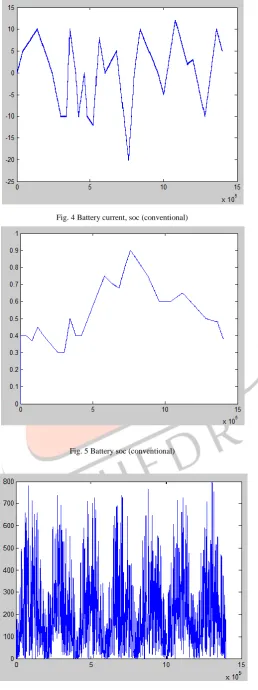
Fig. 4 Battery current, soc (conventional)
Fig. 5 Battery soc (conventional)
© 2018 IJEDR | Volume 6, Issue 1 | ISSN: 2321-9939
IJEDR1801079
International Journal of Engineering Development and Research (
www.ijedr.org
)
464
Fig.7 Wind power
V.CONCLUSION
As a result, system shut-down and compromised permeate quality because of reduced TMP were avoided. The uses of super capacitors to produce constant power resulted during a 40 to extend within the average flux and 15 august 1945 increase in permeate quality under intermittent operation over one hour. The enhancements within the average flux and permeate quality underneath fluctuating conditions because of increased power quality were 85 try to 40 the concerns, severally. Whereas the SOC of the super capacitance bank was higher than the minimum threshold price of 27 the concerns, the membrane system operated as underneath steady-state conditions regardless of the wind speed and power output from the turbine. In this paper planned has investigated the utilization of super capacitors to enhance expected battery life cycle over a representative weeklong power-profile typical of a little, remote-area wind-energy conversion system.
REFERENCES
[1] Gan, Leong Kit, Jonathan KH Shek, and Markus A. Mueller. "Analysis of Tower Shadow Effects on Battery Lifetime in Standalone Hybrid Wind-Diesel-Battery Systems." IEEE Transactions on Industrial Electronics (2017).
[2] Gee, Anthony M., Francis VP Robinson, and Roderick W. Dunn. "Analysis of battery lifetime extension in a small-scale wind-energy system using supercapacitors." IEEE transactions on energy conversion 28.1 (2013): 24-33.
[3] Li, Jianwei, et al. "Analysis of battery lifetime extension in a SMES-battery hybrid energy storage system using a novel battery lifetime model." Energy 86 (2015): 175-185.
[4] Kollimalla, Sathish Kumar, Mahesh Kumar Mishra, and N. Lakshmi Narasamma. "Design and analysis of novel control strategy for battery and supercapacitor storage system." IEEE Transactions on Sustainable Energy 5.4 (2014): 1137-1144. [5] Chotia, I., and S. Chowdhury. "Battery storage and hybrid battery supercapacitor storage systems: A comparative critical
review." Innovative Smart Grid Technologies-Asia (ISGT ASIA), 2015 IEEE. IEEE, 2015.
[6] Richa Prajapati and Vijay Kumar Garg “Heuristic Controller for Wind-Diesel System with Energy Storage For Standalone Application”, International Journal of Electronics, Electrical and Computational System IJEECS ISSN 2348-117X Volume 6, Issue 8 August 2017.
[7] Das, Himadry Shekhar, et al. "Feasibility analysis of standalone PV/wind/battery hybrid energy system for Rural Bangladesh." International Journal of Renewable Energy Research (IJRER) 6.2 (2016): 402-412.
[8] Semassou, Clarence, Gaston Edah, and Antoine Vianou. "Design and Optimization of a Wind System Using a Genetic Algorithm." environment 21: 22.
[9] Ugirimbabazi, Odax. Analysis of Power System Options for Rural Electrification in Rwanda. MS thesis. Universitetet i Agder; University of Agder, 2015.
[10] C. Ropeter, H. Wenzl, H. P. Beck, E. A. Wehrmann, J. W. Twidell, and D. U. Sauer, "The impact of microcycles on batteries in different applications," in Proceedings of the 18th Electric Vehicle Symposium (EVS18), Berlin, 20 October 2001. [11] A. Tani, M. B. Camara, and B. Dakyo, "Energy Management in the Decentralized Generation Systems Based on Renewable
Energy-Ultracapacitors and Battery to Compensate the Wind/Load Power Fluctuations," IEEE Transactions on Industry Applications, vol. 51, pp. 1817-1827, 2015.
IJEDR1801079
International Journal of Engineering Development and Research (
www.ijedr.org
)
465
[13] C. J. Zhan, X. G. Wu, S. Kromlidis, V. K. Ramachandaramurthy, M. Barnes, N. Jenkins, and A. J. Ruddell, "Two electricalmodels of the lead-acid battery used in a dynamic voltage restorer," IEE Proceedings - Generation, Transmission and Distribution, vol. 150, pp. 175-182, 2003.
[14] G. Lutzemberger, "Cycle life evaluation of lithium cells subjected to micro-cycles," in 5th International Youth Conference on Energy (IYCE), 2015, pp. 1-5.