Vol. 16, No. 2, 2018, 143-160
Identification, Extraction, Organization and Sharing of Personal Knowledge: Using Grounded Theory
Oranus Tajedini
Assistant Prof., Department of Knowledge and Information Science, Shahid Bahonar University
of Kerman, Kerman, Iran. tajedini @uk.ac.ir
Ali Sadatmoosavi
Assistant Prof., Neuroscience Research Center, Kerman University of Medical Sciences,
Kerman, Iran.
Corresponding author, [email protected]
Yousef Esfandiarpour
M.A. in knowledge and information science, Iran Public Libraries Foundation, Kerman.
Abstract
This study aimed at evaluating the feasibility of identification, extraction, organization and sharing of personal knowledge of Kerman public librarians. This study was a qualitative one based on grounded theory. The research population consisted of all knowledge and information science experts in public libraries in Kerman and snowball sampling was used to select participants. In-depth interview was the data collection tool in this study. In order to ensure the validity and reliability of this research, Lincoln and Guba's evaluative criteria was adopted and data collected from the interview, were coded and analyzed. Personal knowledge is shared through group discussions, question and answer meetings with experts and elites or even sending an email to co-workers. Knowledge and information science experts in public libraries in Kerman have no definite tool to be always used by all for identifying of personal knowledge. The method of extraction of personal knowledge mostly depends upon the manner of organization of personal knowledge. Knowledge and information science experts’ success in personal knowledge management depends on letting out the knowledge available in their minds. In this regard, knowledge sharing which includes the dissemination or transfer of knowledge from one individual to a group or an organization is the fundamental factor for achieving goals and filling knowledge gaps in organizations. Therefore, it is the task of public libraries to promote the culture of personal knowledge sharing, create an encouraging and rewarding environment and establish trust among knowledge and information science experts at work.
Keywords: Extraction of Personal Knowledge, Sharing of Personal Knowledge, Organization of Personal Knowledge, Identification of Personal Knowledge, Public Libraries, Kerman, Personal Knowledge Management.
Introduction
over time are considered as a valuable organizational capital, however, if such knowledge is not well circulated, this capital will be of no great value (Poursarrajian, Owlia & Soltani Aliabadi, 2013). The previous Just research or studies have shown that knowledge is of strategic value only if it is shared, combined and applied in a distinctively unique way (Nemati-Anaraki & Nooshinfard, 2014). Therefore, knowledge transfer and dissemination provide opportunities to maximize the power of organization to fulfill the requirements, enable efficient problem-solving and gain competitive advantage (Poursarrajian, Owlia & Soltani Aliabadi, 2013). In this regard, knowledge management is a modern approach to management, which is the secret of success in organizations in the 21st century and is divided by experts into two categories of organizational knowledge management and personal knowledge management.
Personal knowledge management is supposed to help combine information resources, improve the efficiency and enhance personal competitiveness. By virtue of personal knowledge management, all sorts of information can be exchanged and an easy access is provided to valuable information (Zhou & Fink, 2003). Personal information management, which is a very close concept to personal knowledge management, is introduced for tools whose function is to focus on organizing, searching and retrieving personal information. In this way, personal information management and defined personal knowledge management as an effort to let computers be extensively used to help information explosion management (Jackson, 2005). Knowledge management should be integrated with daily tasks and activities of the organization’s employees so implicitly and explicitly that they don’t feel like they are involved in a particular and new activity like knowledge management (Jones, 2009); as a result, the cooperation among employees to share knowledge is enhanced and knowledge management is integrated with other business activities. This is not possible without the application of personal knowledge management (Bishop et al., 2008). Organizations focus and invest more on the true potential of their employees rather than on technological solutions and processes, they will understand the real value of knowledge management and will be able to utilize it (Pauleen, 2009).
Since libraries are considered as the centers of knowledge production and dissemination, they are, more than any other organization, in need of creating and implementing knowledge (Sadatmoosavi, Tajedini, & Moghadam, 2010). This will locate libraries in a competitive environment and will promote their scientific status. Public libraries are not an exception to this rule since they must also make an attempt to preserve their position in today’s knowledge based competitive world. Moreover, the personal knowledge of individuals has entered a scientific cycle nowadays. The sharing, dissemination and utilization of personal knowledge, which are usually neglected, can be effective in the process of becoming more knowledge-based.
that useful and proper solutions are provided to improve knowledge management and the performance of experts as well as public libraries in Kerman.
It is worth mentioning that the selection of four categories in research questions was based on the theory by Jashapara (2004) in explaining knowledge management process, which was the theoretical framework of this study. In this theory, the mentioned categories were deemed necessary to complete the process of personal/organizational knowledge. Evidently, if these categories are derived from research results, it can be concluded that this process can be extended to personal knowledge of the research population.
Literature Review
In a study Noorrahmani, Mohamadi, Naseri Jahromi, and Rahmani (2014) indicated that faculty members’ average perception of organizational support was lower than desirable level but higher than minimum level. Faculty members’ average personal knowledge management skill in all dimensions was lower than desirable level but higher than minimum level and just creative and perception skills were higher than desirable level. There was a significantly positive relationship between faculty member’s perception of organizational support and all dimension of personal knowledge management and faculty member’s perception of organizational support was a significant and positive predictor of personal knowledge management
Akhavan, Jafari, Atashgah and Abasaltian (2013) carried out a study for Survey relationship between Psychological Traits of Individuals with Aspects of Personal Knowledge Management. All personality traits had a significantly positive relationship with personal knowledge management except nervousness. Nervousness had a significantly negative relationship with personal knowledge management. Moreover, the findings revealed that there was a significant relationship between five dimensions of personality and four dimensions of personal knowledge management.
Mittal (2008) showed that in a study modern organization, for being characterized by diverse local practices and for the increasing salience of professional work, is a complex mosaic of situated knowledge, grounded in process. Enabling organizations to capture, share and apply the situated knowledge is regarded as fundamental to competing in the knowledge economy. This study concentrated on various knowledge activities of faculty members to understand the extent of the influence of information systems on these activities and the way such activities contribute to value creation and knowledge management. The results of this study proved the presence of certain type of knowledge behaviors facilitating in knowledge management.
science experts in public libraries in Kerman which has not been taken into account in any other study.
Research questions
This research is also intended to provide the answer to the following questions:
1. Is it feasible to identify personal knowledge of knowledge and information science experts in public libraries in Kerman?
2. Is it feasible to extract personal knowledge of knowledge and information science experts in public libraries in Kerman?
3. Is it feasible to organize personal knowledge of knowledge and information science experts in public libraries in Kerman?
4. Is it feasible to share personal knowledge of knowledge and information science experts in public libraries in Kerman?
Methodology
This study was a qualitative one based on grounded theory because qualitative research is an approach in which the findings are not obtained through statistical methods or quantitative tools. Grounded theory is a qualitative research approach not committed to any specific data, research strategy or particular interests; in fact, it is derived from the collected data (Zakai, 2002). Grounded theory which is a strategy of qualitative research doesn’t infer theories, hypotheses and premises based on previous assumptions, researches or theoretical frame works, rather, these are achieved directly from data (Corbin & Strauss, 2008).
Table 1
The details of theresearch participants
Number Participant Gender Work
experience
1 Knowledge and information science expert number one Female 12
2 Knowledge and information science expert number two Male 7
3 Knowledge and information science expert number three Female 5
4 Knowledge and information science expert number four Male 6
5 Knowledge and information science expert number five Male 5
6 Knowledge and information science expert number six Male 4
7 Knowledge and information science expert number seven Female 8
8 Knowledge and information science expert number eight Male 13
9 Knowledge and information science expert number nine Female 15
10 Knowledge and information science expert number ten Female 7
11 Knowledge and information science expert number eleven Male 7
12 Knowledge and information science expert number twelve Female 8
13 Knowledge and information science expert number thirteen Male 5
14 Knowledge and information science expert number fourteen Female 7
15 Knowledge and information science expert number fifteen Female 3
In this study, in-depth interview was the data collection tool, which is one of the most common data collection methods in qualitative research. In-depth interview is based on the belief that people are the best sources of information about events and phenomena through sharing their experiences. If different people are interviewed on a certain event or phenomenon, diverse viewpoints can be collected about that topic.
In order to ensure the validity and reliability of this research, Lincoln and Guba's evaluative criteria (1985) were applied which is an equivalent to validity and reliability in quantitative researches. In this regard, three criteria of credibility, transferability and dependability were taken into account. In order to fulfill each criterion, the following tasks were performed:
Credibility: enough time was spent on research, interview data were confirmed by interviewees after implementation, research process was verified by several experts, uniform coding was ensured by using two other encoders for coding a sample of interviews, scope notes and reminders were included during the interview.
Transferability: some key researchers who did not participate in the study were asked for their opinions on research findings and confirmed them.
Dependability: all details in all steps of doing research and taking notes were recorded.
data are probably as varied as the number of qualitative researchers (Mohammadpour et al., 2010).
In order to analyze the collected data and develop a theory, Theoretical Coding was applied. This method was considered appropriate for being inductive and exploratory. Furthermore, through analyzing the text to precise components and concepts, this method would make it possible to define a theory or model (Corbin & Strauss, 2008; Locke, 2002). In this method, with a constant check via Strauss and Corbin’s grounded theory approach (2008), coding was done in three stages of open, axial and selective coding. First, after copying and saving the data, the appropriate codes were assigned to various parts of data and then classified as apparent categories via open coding. Then, axial coding was performed and finally, in selective coding, main categories were selected and linked to other categories.
Results
Figure 1. flow of data management concerning knowledge and information science experts in three coding stages
In this section, the statements derived from analysis of interviews with knowledge and information science experts in public libraries in Kerman with accordance to 4 categories resulted from data analysis are explained in detail.
Open coding stage: 74 conceptual statements
Knowledge acquisition (A2), knowledge discovery (A4), problem encounter (A6), memories (A7), need (A9),
knowledge utilization (A11), daily teachings (A12), information access (A13), need fulfillment (A15), opinion statement
(A18), efficient use of time (A21), personal creativity (A23), occupational development (A24), income acquisition (A26),
job creation (A28), information resource access (A29), useful reading (A31), in-service training (A32), nurturing known
information (A33), personal interests (A35), colloquial communication (A36), note taking (B1), timing (B3), providing
secondary memory (B4), recording personal skills (B6), information personal equipment (B7), establishing priorities
(B9), information integration (b11), proper analysis (B13), relationship discovery (B15), division of knowledge (B16),
systematic information (B17), notebook (B18), knowledge classification (B20), checklist (B23), organized signs (B25),
use of personal abilities (B27), information utilization (B29), purposeful knowledge representation (C5), information
analysis (C8), use of previous experience (C9), responding needs (C11) , quick access (C13), random retrieval (C15),
information search (C17), information assessment (C19), finding information (C21), reviewing known information
(C22), information acquisition (C24), remembering known information (C26), personal known information (C27), social
knowledge (C29), discussion and idea exchange (D1), fulfilling others’ needs (D3), social networks (D4),
communication facilitation (D6), consulting with others (D10), information promotion (D12), current awareness (D15),
interaction enhancement (D16), conversation (D17), cooperation improvement (D18), idea exchange (D19), research
objective realization (D20), sharing known information (D23), satisfaction (D25), exploiting (D27), cyberspace (D29),
experience transfer (D30), practical training (D32), cheerfulness (D34), self-confidence enhancement (D38), unique
experiences (D39), personal communication (D40).
Axial coding stage: 19 conceptual statements
Knowledge application (3 categories), knowledge discovery(3 categories), perceiving information resources and their application(5 categories), use of educational facilities(4 categories), information preservation (4 categories), knowledge coherence (6 categories), information ranking (4 categories), knowledge coding (4 categories), indexing (5 categories), information access (4 categories), information provision (5 categories), information evaluation (6 categories), knowledge retrieval (2 categories), extracting known information (3 categories), sharing specialized information (4 categories), communication media (4 categories), personal interactions (3 categories), information communication (2 categories), emotional engagement (3 categories).
Selective coding stage: 4 categories
personal knowledge identification, personal knowledge organization, personal knowledge extraction, personal knowledge sharing
Identification of personal knowledge in knowledge and information experts in public libraries in Kerman
The analysis of interviews suggested that there are a number of diverse and flexible procedures to identify personal knowledge and acquire it. Each of the experts in knowledge and information science can detect and acquire personal knowledge in skills, experiences and knowledge documents after fulfilling daily tasks and routines. Moreover, personal knowledge identification is a vital and fundamental factor in implementation of knowledge management in organizations since identification of personal knowledge is not merely a personal issue but an organizational one. Identification of personal knowledge in knowledge and information science experts leads to optimal and efficient knowledge application in the minds of experts and results in considering such knowledge services and competences to respond the needs of various users in public libraries. The results of analysis of interviews indicated that the experts Nevertheless, they have no particular tool to identify their knowledge and when encountered with problems in different occupational contexts as well as in their daily life or when faced with new different conditions, they get aware of their personal knowledge and make use of it. According to the viewpoint of knowledge and information science experts in public libraries in Kerman, no definite way can be adopted to constantly identify personal knowledge since the phenomena of the world are considerably diverse and undergo continuous change. In fact, individuals discover their personal knowledge and identify it whenever they come to a new and unknown problem or condition not previously experienced. In each condition, to identify personal knowledge, they resort to a different method or tool which is only specific to that condition. Furthermore, knowledge identification would lead to the identification of experiences and skills of individuals in performing tasks and these skills and experiences are applicable to a person and make him/her improve only when accompanied with awareness. As a matter of fact, this awareness makes people aware of changes in their way which helps them find solutions and reminds them that the recognition and identification of knowledge is efficient only if this knowledge turns into awareness; awareness is the operational and efficient strategies. Participant number 3 said, “It can simply be concluded that lack of awareness in individuals makes them perform not so well in their interactions and communication. These are the same people who perform poorly as managers and never help organizations improve. On the contrary, awareness makes people establish strong relationships with mutual benefits and sympathy. Relationships with such characteristics resulted from correct interactional techniques encourage altruism in organizations and benefit all beneficiaries”.
users rapidly instead of making use of predetermined rules and regulations to solve problems in a guided hierarchical manner. They have also compared personal knowledge with organizational knowledge in their opinions. Personal and organizational knowledge are two distinct yet mutually interdependent concepts. Personal knowledge is usually expressed through creativity and self-expression. Organizational knowledge is reflected in productions and services provided by the organization to the customers. Personal knowledge is a property and capital leading to enhancing the knowledge of the employees and creating organizational knowledge. Since knowledge is partly internalized by the organization and partly by the individuals, the control of knowledge activities is difficult on the contrary to productive activities. This discrepancy between personal knowledge and organizational knowledge emphasizes the need for different management strategies. Identification of personal knowledge is the process of creating new knowledge or replacing and improving the existing personal knowledge by means of personal and social relationships as well as organizational cooperation. This process can take place in individual and organizational levels consisting of different parts and stages through which and based on sociability, internalization, externalization and integration processes, the new knowledge is created explicitly and tacitly. People’s reserves facilitate the process of identifying and creating personal knowledge. Concerning this, the expert number 10 stated, “When I understand I can boost job creation and income generation and improve in my career, I recognize to have talent and knowledge in this field and I will accordingly identify my personal knowledge”. Knowledge and information science expert number 6 also believed, “Each person moves based on his/her interests and knowledge is gradually created based on the activities and tasks, thereafter, a person perceives such knowledge in him/herself”.
Organization of personal knowledge in knowledge and information experts in public libraries in Kerman
tools and machines are regarded as the developed form of human muscles enabling individuals to perform tasks with more power, knowledge organization is also the developed form of human mind particularly the memory and mental techniques to retrieve information. Moreover, knowledge and information science experts do their knowledge organization by means of two types of activities: first, by selecting the resources, from among all knowledge and knowledge resources available, which are worth being preserved i.e. selecting knowledge, which is more updated and usable. Second, by selecting from among such selective knowledge the one, which can be classified and adjusted easier. In addition, knowledge organization is a very important issue and has received more attention with recent digital developments. It is due to the point that previously stored knowledge might become outdated every day and lose its usability and be rapidly replaced by new knowledge organization. From the point of view of a number of knowledge and information science experts, subject is of great significance in organization of knowledge and information as well as in providing access to them. In fact, subject searching has been considerably increased. Other experts believe that several descriptive statements can be made for organization of personal knowledge, potentially, a characteristic or a set of characteristics can be utilized as a description to create various sets. Usually, those information elements being adopted to organize personal knowledge must be sufficient to achieve predetermined objectives and must exclude all unnecessary elements. However, every knowledge and information science expert has his/her own personal criteria to organize knowledge, which are different from those of other experts. The elements deeming unnecessary for one knowledge and information science expert might be considered as the main elements of knowledge organization for another knowledge and information science expert. Some knowledge and information science experts also use their occupational experiences to organize knowledge. For example, a number of knowledge and information science experts make a list of topics in which they are interested or are skillful and organize personal knowledge by card catalogs with each entry representing a topic. Some other knowledge and information science experts in public libraries of Kerman store and reserve knowledge in their mind and memory randomly. In other words, these experts have no particular method to organize knowledge and have no purpose in mind. Just when encountered with problems or when faced with new conditions, they randomly and based on their experience, gain access to the required knowledge. Participant number 7, for instance, said, “I store and organize my personal knowledge in my mind and memory. In fact, I have no particular plan to organize it”.
Some librarians also make use of a notebook to record important points, which can easily be forgotten or cannot be memorized. Participant number 10 said in this regard, “I classify my knowledge and experiences in my mind and sometimes write them in a notebook and order them alphabetically so that I can easily retrieve them when required”.
Extraction of personal knowledge in knowledge and information experts in public libraries in Kerman
libraries staff. Participant number 8 believed, “With taking certain measurements like holding seminars, some part of personal knowledge of knowledge and information science experts can turn into organizational knowledge since when knowledge is expressed and stated it is not hidden anymore and if it is recorded it can be published as a document available to all. Therefore, if it is possible to record audio or video of speeches, it can be claimed that organization is also turning personal knowledge into organizational knowledge through proper retrieval and extraction of personal knowledge”. Hence, extraction of personal knowledge in knowledge and information science experts can be a very important stage in knowledge management in libraries.
Sharing of personal knowledge in knowledge and information experts in public libraries in Kerman
of some decision-making processes and failure to use the experiences and decisions of others appropriately. Therefore, people attempt to collect knowledge from one another.
Knowledge and information science experts in public libraries in Kerman believed that personal knowledge is shared in order to optimize the relationship among employees and the management. Although knowledge can be acquired by individuals, in order for the knowledge to be useful, it needs to be shared among all group embers. Participant number 10 stated in this regard, “in knowledge management texts, it is strongly emphasized to promote organizational culture for knowledge sharing. One of the chief obstacles to personal knowledge sharing in organizations is organizational culture”. According to this expert, in the organizations where the maintenance and promotion of job status depends upon knowledge and the acquired knowledge is source of power, sharing of personal knowledge means a risk to job status. The organizational culture needs to be promoted so as to ensure the employees that their ideas are valuable and they don’t need to worry about having wrong ideas, losing their reputation or making other employees angry.
Discussion and conclusion
In each condition, a different method or tools is utilized to discover this knowledge, which is specific to that condition. In other words, there is no specific tool for personal knowledge identification to be always used by all. Moreover, the experts believed that personal knowledge depends fundamentally on the employees in organization, those who create knowledge and share it with others in their interactions. In fact, personal knowledge is the basis for knowledge creation in organizations. As a conclusion, all knowledge and information science experts having taken part in the interviews attempted to find ways to represent their personal knowledge and possess it. Furthermore, they tried to preserve the values of their knowledge in the dynamic ever-changing environment and to overcome the inevitable changes of this environment. Knowledge and information science experts in public libraries in Kerman believed that personal knowledge is expanded by pass of time through the experiences of training courses, reading books and informal education. Personal knowledge includes learnings and lessons from school and university, awareness, judgement, general rules and inspiration. To wit, personal knowledge is particular unique information placed after personal information in knowledge process model. The results of this research were not compatible with those of the study by (Noorrahmani et al., 2014) since they showed that average personal knowledge management skill in faculty members of human science department of Islamic Azad University of Bandar Abbas was lower than desirable level but higher than minimum level.
discovered. Through this process, the required knowledge is made available to people. Knowledge, which is extracted from the mind of knowledge and information science expert, must be developed based on standard rules and patterns so that it can be applicable for final user and be easily preserved. Personal knowledge extraction is an important branch of personal knowledge management since as people get retired or organizations become privatized, a great volume of valuable knowledge of the organization, which is in the minds of people, goes out of the organization. Knowledge extraction is the best solution to this problem. The personal knowledge in knowledge and information science experts in public libraries in Kerman can be extracted or codified as the prerequisite knowledge before doing the work, the required knowledge during the work, the knowledge resulted after the work and the general knowledge without a direct link to a particular work procedure. A great deal of information about users, information resources and etc. is stored in the minds of knowledge and information science experts. Such knowledge, however, is not utilized and stays hidden. If it is properly recognized and extracted, this knowledge can be extremely useful in public libraries and ideal services can be provided to users. Not unexpectedly, it is up to the knowledge and information science experts to analyze and interpret the information and recognize if the extracted knowledge is relevant to the needs and requirements of users. Appropriate extraction of knowledge in knowledge and information science experts makes it possible to gain access to users’ information and leads to successful management of the relationship with users resulting in the improvement of library activities. Accordingly, user satisfaction is achieved and the relationship with users is extended and expanded and better services are provided. The results of this study were not compatible with those of the study by (Verma, 2009). Verma demonstrated that personal knowledge management programs are tied to organizational objectives including improved performance, competitive advantage, innovation, developmental processes, lessons learnt transfer and the general development of collaborative practices. On the contrary, in public libraries in Kerman, extraction of personal knowledge, which is an important stage in personal knowledge management, is usually done to achieve personal objectives and is rarely in conjunction with organizational objectives.
and information science experts in public libraries in Kerman is a thought process through which the experts express the explicit knowledge concepts and organize these concepts in such a way that knowledge productions are produced to provide a comprehensive image of it, which can be constantly developed. As a result, the process of organization of personal knowledge helps knowledge and information science experts organize the diverse and scattered information identified in the first stage. This prevents the overflow of such diverse and scattered information and facilitates decision-making processes aimed at solving problems and providing knowledge. The results of this research were compatible with those of the study by Cheong and Tsui (2010). They indicated that among M.Sc. students in faculty of engineering in Alzahra University, preventing the overflow of personal information, awareness of searching techniques and the need for training personal knowledge management were all above average. Knowledge and information science experts in public libraries make use of tools like personal computer, flash memory, CD, email and etc. to preserve and store their personal knowledge.
The analysis of the results of interviews with knowledge and information science experts in public libraries in Kerman revealed that one of the objectives of personal knowledge management is to ensure the existing knowledge is collected in people’s minds and shared thereafter. Thus, their tendency for sharing knowledge as well as their interactivity is enhanced and they get used to providing their opinions, ideas and experiences. The system of personal knowledge sharing is composed of organized structure of knowledge, databases of documents and resources and the relationship among those who share knowledge. Therefore, professional knowledge and information science experts choose to adopt knowledge sharing. Knowledge sharing also involves social processes and informal activities besides formal ones (Tajedini, Azami, & Sadatmoosavi, 2018). In other words, the manner through which knowledge and information science experts in public libraries process and share knowledge depends upon their experience, creativity and personal expertise. Based on such experience and expertise, knowledge and information science experts decide who to interact with and what knowledge to share. The transfer of ideas and information, which is related to providing others with information via an appropriate and transferable plan, is one of the most important skills of personal knowledge management. Such collaboration in sharing ideas and information and their transfer is known as knowledge sharing which is the most important component of personal knowledge management. The results of this research were compatible with those of the study by (Mittal, 2008) who showed that modern organization is a complex mosaic of situated knowledge grounded in process since it is characterized by various local practices and also by the increasing salience of professional work.
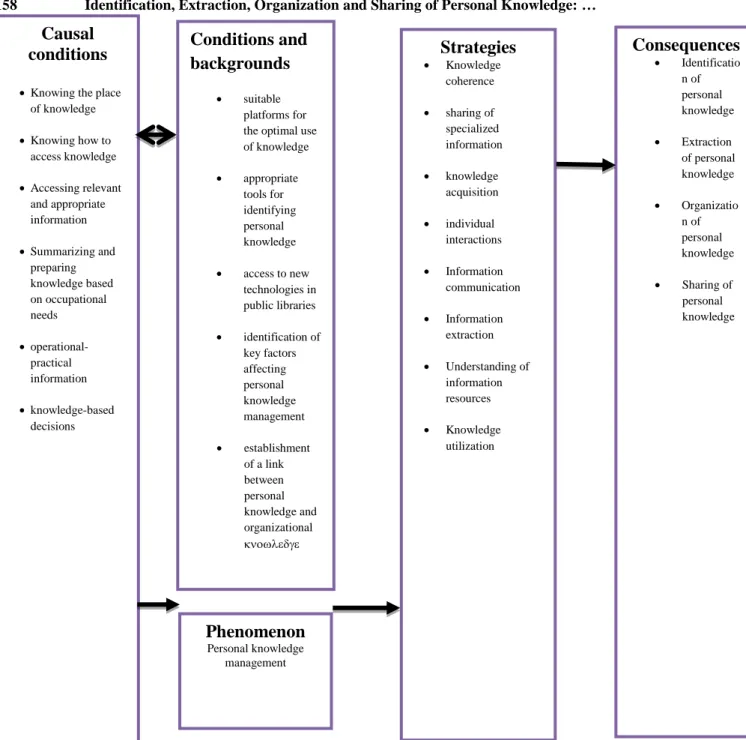
Figure 2. Personal Knowledge management model for knowledge and information science experts in public libraries in Kerman derived from codes
Causal conditions: Factors affecting personal knowledge management in public libraries which are essential for the management of personal knowledge include knowing the place of knowledge, knowing how to access knowledge, accessing relevant and appropriate information, summarizing and preparing knowledge based on occupational needs, operational-practical information and knowledge-based decisions made by knowledge and information science experts in these libraries. The conducted interviews and investigation of the activities of knowledge and information science experts in public libraries revealed that their activities were aimed at identification and operationalization of these factors and necessities. These activities lead to the management of personal knowledge, which was investigated as the main category of the research. Other related categories were also identified
Causal conditions
Knowing the place of knowledge
Knowing how to access knowledge
Accessing relevant and appropriate information
Summarizing and preparing knowledge based on occupational needs operational-practical information knowledge-based decisions Conditions and backgrounds suitable platforms for the optimal use of knowledge appropriate tools for identifying personal knowledge
access to new technologies in public libraries
identification of key factors affecting personal knowledge management establishment of a link between personal knowledge and organizational Phenomenon Personal knowledge management Strategies Knowledge coherence
sharing of specialized information knowledge acquisition individual interactions Information communication Information extraction
Understanding of information resources Knowledge utilization Consequences Identificatio n of personal knowledge Extraction of personal knowledge Organizatio n of personal knowledge
and presented in table 4.1. Analyzing the collected data indicated that appropriate tools for identifying personal knowledge, suitable platforms for efficient and effective use of knowledge, access to new technologies and markets, identification of key factors in the success of personal knowledge management and establishment of a link between personal knowledge and organizational knowledge in public libraries in Kerman provide better and more appropriate conditions for personal knowledge management among knowledge and information science experts.
Phenomenon: Personal knowledge management in knowledge and information science experts in public libraries in Kerman does not depend on their use of and presence in public libraries. In addition to their specialized knowledge in their occupation, they can have personal knowledge in a variety of fields and can implement a personal knowledge management process in these fields.
Conditions and backgrounds: suitable platforms for the optimal use of knowledge, appropriate tools for identifying personal knowledge, access to new technologies, identification of key factors affecting personal knowledge management and establishment of a link between personal knowledge and organizational knowledge in public libraries in Kerman are among conditions and backgrounds that affect causal conditions.
Strategies: The phenomenon of personal knowledge management in public libraries in Kerman is the result of various factors including knowledge coherence, sharing of specialized information, knowledge acquisition, individual interactions, information communication, knowledge extraction, understanding of information resources and their applications and knowledge utilization.
Consequences: The consequences are the results of strategies that are affected by causal conditions. They included identification of personal knowledge, organization of personal knowledge, extraction of personal knowledge and sharing of personal knowledge in public libraries in Kerman.
References
Bishop, J., Bouchlaghem, D., Glass, J., & Matsumoto, I. (2008). Ensuring the effectiveness of a knowledge management initiative. Journal of Knowledge Management, 12(4), 16-29. Cheong, R. K., & Tsui, E. (2010). The roles and values of personal knowledge management:
an exploratory study. Vine, 40(2), 204-227.
Corbin, J., & Strauss, A. (2008). Basics of qualitative research: Techniques and procedures for developing grounded theory: Sage publications, USA.
Jackson, M. C. (2005). Reflections on knowledge management from a critical systems perspective. Knowledge Management Research & Practice, 3(4), 187-196.
Akhavan, P., Jafari, M., Atashgah, R. H., & Abasaltian, A. (2013). A Study of the Relationship between Psychological Traits of Individuals with Aspects of Personal Knowledge Mana. Journal of Research in Human Resources Management, 4(2), 1-21. Jashapara, A. (2004). Knowledge management: An integrated approach. Pearson Education. Jones, R. (2009). Personal knowledge management through communicating. Online
information review, 33(2), 225-236.
Locke, K. (2002). The grounded theory approach to qualitative research. In F. Drasgow & N. Schmitt (Eds.), The Jossey-Bass business & management series. Measuring and analyzing behavior in organizations: Advances in measurement and data analysis (pp. 17-43). San Francisco, CA, US: Jossey-Bass.
Mittal, M. (2008). Personal knowledge management: A study of knowledge behaviour of academicians. Journal of Information & Knowledge Management, 7(2), 93-100.
Mohammadpour, A., Sadeghi, R., & Rezaei, M. (2010). Mixed Methods Research as Third Methodological Movement. Journal of Applied Sociology, 21(2), 77-100.
Nemati-Anaraki, L., & Nooshinfard, F. (2014). Effective Organizational Factors in Knowledge Sharing from The Viewpoint of Faculty Members. Journal of Health Administration, 17(56), 65-79.
Noorrahmani, M., Mohamadi, M., Naseri Jahromi, R., & Rahmani, H. (2014). The Relationship between Perceived Organizational Support and the Knowledge Management Skills of the Faculty Members of the Faculty of Humanities at Bandar Abbas Islamic Azad University. Educational Leadership & Administration, 28(8), 27-48. [In Persian] Pauleen, D. (2009). Personal knowledge management: putting the “person” back into the
knowledge equation. Online information review, 33(2), 221-224.
Poursarrajian, A., Owlia, M. S., & Soltani Aliabadi, M. (2013). Identifying and Prioritizing Barriers to Knowledge Sharing in Universities and Higher Education Centers: A Case Study of Imam Javad Higher Education Institution. Roshd -e- Fanavari, (34), 34-43. [In Persian].
Ranjbar, H., Haghdoost, A. A., Salsali, M., Khoshdel, A., Soleimani, M., & Bahrami, N. (2012). Sampling in qualitative research: A Guide for beginning. Journal of Army University: Annals of Military and Health Sciences Research, 10(3), 238-250. [In Persian]
Sadatmoosavi, A., Tajedini, O., & Moghadam, H. S. (2010). Assessing Accessibility in Four Library and Information Sciences Journals: A Comparative Study. Iranian journal of Information Processing & Management, 25(4), 617-633. [In Persian].
Strauss, A., & Corbin, J. (1998). Basics of qualitative research techniques: Sage publications, USA.
Tajedini, O., Azami, M., & Sadatmoosavi, A. (2018). The investigation of utilization of research findings in humanities: the effects of individual characteristics of faculty members on their viewpoints. Library Philosophy and Practice (e-journal),18(2), 17-38.
Verma, S. (2009). Personal knowledge management: a tool to expand knowledge about human cognitive capabilities. International Journal of Engineering and Technology, 1(5), 435-451.
Zakai, S. (2002). Theory and Method in Qualitative Research. Social Sciences, 9(17), 41-69. Zhou, A. Z., & Fink, D. (2003). The intellectual capital web: a systematic linking of