INTRODUCTION TO GAMES DESIGN
Nia Wearn, Staffordshire University
INTRODUCTORY ESSAY
This course has existed in some form since the Computer Games Design program at Staffordshire University began in 2004. I joined the program as a lecturer in 2006 and was given leadership of this course in 2008. Since then, it has adapted to different academic credit structures and student enrolment numbers as well as different delivery patterns (such as lectures, seminars, meetings, and so forth). Introduction to Games Design forms one of the trio of core required modules on most of our computer games-‐related award programs, the others being introductions to 3D Modelling for Games and 3D Games Engines. Due to its key nature, and the growth of the Games Design area in our institution in the last academic year of 2013/14, it had an enrollment of 170 students, five of whom were distance learning students.
In this paper, I cover not only the current syllabus but also some of the notable points of the course’s previous incarnations to better understand the course as it currently stands. In an effort to make sure students engage with Blackboard, our virtual learning environment, we no longer combine all of these elements into a single documentz; rather, we distribute them directly onto this online teaching tool, linking to university or faculty guidelines where appropriate.
SOME U.K. / STAFFORDSHIRE UNIVERSITY TERMINOLOGY
Award/Course: Degree program (either undergraduate or Postgraduate) that has its own title and defined set of modules. An undergraduate degree usually takes three years to complete.
For example: BSc (Hons) Computer Games Design
Module: The building blocks of our awards, with defined subjects of study that run concurrently (one year of our award = 4 x 30 credit modules). Each module is a contained unit of coursework-‐based assessment in our area. All of our awards are modular.
For example: Introduction to Games Design
Level: A part of our government education framework. Each academic year of study equals a level. This is a continuous structure encompassing all of post-‐16 education in the U.K. The final year of college courses is level 3, the first year undergraduate is level 4. The majority of our students on this module are aged eighteen to nineteen years old.
PREVIOUS INCARNATIONS FROM 2006 – 2012
As mentioned above, we developed and iterated the structure of the course over the years. We have also updated the content with the changing requirements of a fast-‐paced
computer games industry, an increase in students from more vocational backgrounds, and the requirements of resources within the faculty and the university. The content has been kept current in most cases. Areas such as the History of Computer Games have had to expand as our students have different experiences and key references to draw upon.
In the course’s first incarnation, when I took over its leadership, it was split into two distinct semesters of study: 1A and 1B. 1A focused on Design Documentation and 1B focused on Level Design. They were connected but did not overlap as they were distinct modules in the eyes of the university. Both were fifteen (15) credits, with Computer Games Design 1A running in the first semester and Computer Games Design 1B in the second.
COMPUTER GAMES DESIGN 1A: DESIGN DOCUMENTATION
As can be seen on the syllabus, students are asked to look at a variety of documentation aspects, such as the information you would give to motion capture actors, artificial intelligence information, and flow charts for programmers and the design specs for user interfaces. Each week, students look at a different aspect of Games Design related documentation. The assignment sent to students was to analyze and reverse engineer an industry standard design document of their favorite game. Students would then use a design document template to design a game of their own.
This change reflected the students’ desire and feedback from students, who asked to have more creative input into assignments. But in reality, this change varied the quality
significantly and made consistent marking and deciding what constituted a ‘good game’ difficult. For the most part, the majority of students didn’t engage well with the purely document-‐based assignment.
COMPUTER GAMES DESIGN 1B: LEVEL DESIGN
We designed this syllabus around aspects of level design for character-‐based games. The focus is on documentation and also elements to do with psychology and gameplay, how users respond to architecture within game levels, and a level design workflow.
Of all the assignment briefs the Level Design assignment went through the most iterations. The focus remained on paper-‐based level design, but the subject or specifics of the
create scale models of levels using cardboard and videoing the playthrough, and in later years, due to low quality of the videos, students were asked to produce annotated plans of the levels on graph paper.
While these assignments differ in content, the core elements of scale, transferring paper-‐ based designs to physical versions, and creativity within the confines of the brief were adhered to. The changing nature of the assignments mirrors the teams’ issues with finding the right balance in keeping the course agnostic of any specific software to promote a design focus while finding ways to assess technical skills.
CURRENT INCARNATION (PART I) – 2012
During the summer of 2012, Games Design 1A and 1B was converted from two 15-‐credit courses into a single, two-‐semester long, 30-‐credit module entitled, “Introduction to Games Design.” This was in line with the university’s revised undergraduate framework and was the first year of a three-‐year roll out of new 30-‐credit modules. Faculty in the Games Technology program took the opportunity to overhaul many of the modules within their awards.
Introduction to Games Design changed the least, incorporating many aspects of the two separate modules in the first year of running.
We did take the opportunity to be more flexible with the scheduling. Traditionally, we have twelve-‐week semesters for which we teach for eight weeks, allowing four weeks of study help at the end, which is necessary in practice-‐based teaching. We found, however, that students perceived this paper-‐based module as easy; therefore, students often
procrastinated and had to hurry to complete the paper prototype in the last four weeks. So while we still had eight weeks of lectures, they were interspaced with one-‐week breaks every two weeks to theoretically allow faculty to mark papers and provide feedback to students.
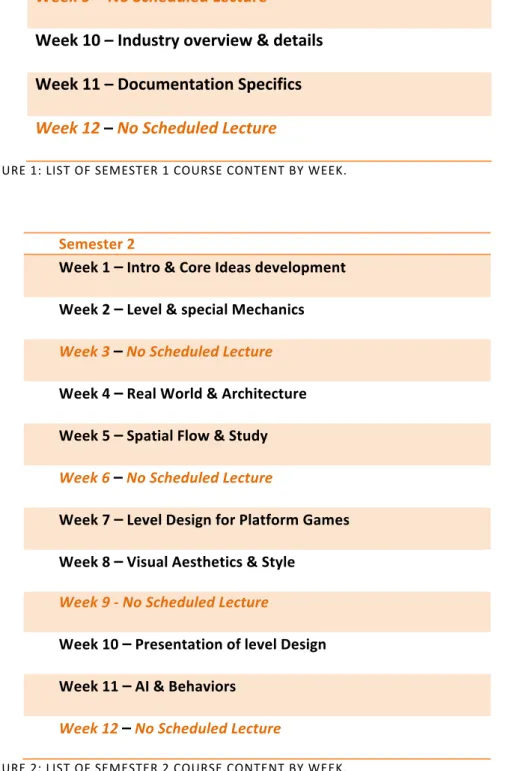
INTRODUCTION TO GAMES DESIGN – CONTENT
Semester 1
Week 1 – Intro & Core Ideas development
Week 2 – History of Games
Week 3 – No Scheduled Lecture
Week 4 – Marketing & Targeting
Week 5 – Audience Types
Week 6 – No Scheduled Lecture
Week 8 – Games Mechanics & Interface
Week 9 – No Scheduled Lecture
Week 10 – Industry overview & details
Week 11 – Documentation Specifics
Week 12 – No Scheduled Lecture
FIGURE 1: LIST OF SEMESTER 1 COURSE CONTENT BY WEEK.
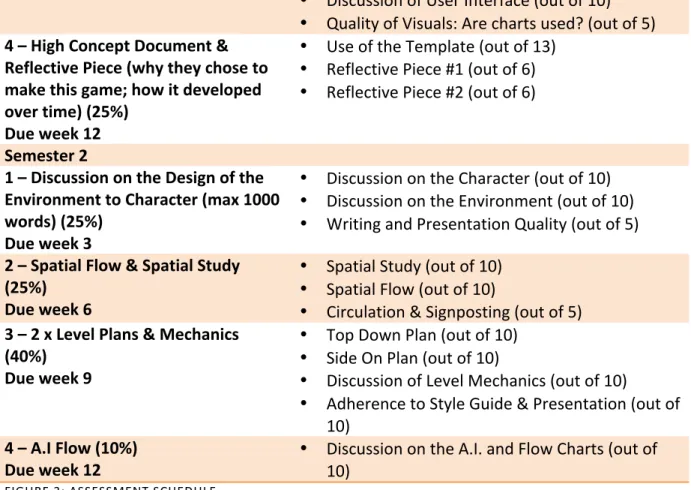
Semester 2
Week 1 – Intro & Core Ideas development
Week 2 – Level & special Mechanics
Week 3 – No Scheduled Lecture
Week 4 – Real World & Architecture
Week 5 – Spatial Flow & Study
Week 6 – No Scheduled Lecture
Week 7 – Level Design for Platform Games
Week 8 – Visual Aesthetics & Style
Week 9 -‐ No Scheduled Lecture
Week 10 – Presentation of level Design
Week 11 – AI & Behaviors
Week 12 – No Scheduled Lecture
FIGURE 2: LIST OF SEMESTER 2 COURSE CONTENT BY WEEK.
Apart from the milestone assignments detailed below, there were no other elements required of the students apart from attendance, which was closely monitored. Our
regulations state that if they miss two sessions, they are sent a warning; if they miss three, then they are withdrawn from the module. Students can appeal to be reinstated into the module if they do so in writing and attend a meeting with the module tutor.
LEARNING OUTCOMES
1) Understand the concepts and principles of current computer game structures 2) Communicate the principles of genre and competitive analysis
3) Evaluate and interpret the principles of character design regarding level design 4) Analyze workflow and evaluate the context of a level design
5) Apply the fundamentals of games design in the production of a design document for a computer game
SUGGESTED TEXTS
Bateman, Chris, and Richard Boon. 21st Century Game Design (Game Development Series). Charles River Media, Inc., 2005.
Davies, Mark. Designing Character-‐Based Console Games. Charles River Media, Inc., 2007.
Koster, Raph. Theory of fun for game design. " O'Reilly Media, Inc.", 2013.
Rogers, Scott. Level Up! The guide to great video game design. John Wiley & Sons, 2014.
Rollings, Andrew, and Ernest Adams. "Fundamentals of game design." New Challenges for Character-‐Based AI for Games. Chapter 20: Artificial Life and Puzzle Games. Prentice Hall (2006): 573-‐590.
Salen, Katie, and Eric Zimmerman. Rules of play: Game design fundamentals. MIT press, 2004.
ASSESSMENT
Even in its new format, we kept the assignments the same, requiring a games design
document in the first semester and level design documentation in the second semester. We continue to base the level design assignment on a random LEGO Minifigure.
We posted assignments to our university assessment forum, covering the following areas detailed below. In line with other assignments and the current desire by the team to ape industry workflows as much as possible, the assignment was also milestoned with numerous assessment points in each semester, each of which were required and had frequent
opportunities for formative feedback.
Semester 1 Rubric Breakdown
1 – Ideas, Concept & Development (25% )
Due week 3
• Clarity of Ideas: Do they make sense? (out of 10) • Concept & Development: How have they come
about? (out of 10)
• Writing Quality (out of 5)
2 – Marketing & Genre (25%)
Due week 6 •• Clarity of Marketing Ideas (out of 10) Definition of the Game Genre (out of 10) • Writing Quality (out of 5)
3 – Mechanics (25%)
• Discussion of User Interface (out of 10) • Quality of Visuals: Are charts used? (out of 5)
4 – High Concept Document & Reflective Piece (why they chose to make this game; how it developed over time) (25%)
Due week 12
• Use of the Template (out of 13) • Reflective Piece #1 (out of 6) • Reflective Piece #2 (out of 6)
Semester 2
1 – Discussion on the Design of the Environment to Character (max 1000 words) (25%)
Due week 3
• Discussion on the Character (out of 10) • Discussion on the Environment (out of 10) • Writing and Presentation Quality (out of 5)
2 – Spatial Flow & Spatial Study (25%)
Due week 6
• Spatial Study (out of 10) • Spatial Flow (out of 10)
• Circulation & Signposting (out of 5)
3 – 2 x Level Plans & Mechanics (40%)
Due week 9
• Top Down Plan (out of 10) • Side On Plan (out of 10)
• Discussion of Level Mechanics (out of 10)
• Adherence to Style Guide & Presentation (out of
10) 4 – A.I Flow (10%)
Due week 12 • Discussion on the A.I. and Flow Charts (out of 10) FIGURE 3: ASSESSMENT SCHEDULE
The fragmented nature of the assignment meant the two-‐person teaching team was quickly overwhelmed by the number of students—approximately 100 for that year. The criteria-‐ based assessment also led to higher marks overall, with an average mark over both semesters nearing 70%, far too high even for a Level 4 module (exceptional students earn approximately 70% in the British system). Another issue with the fragmented, criteria-‐based assessment was our struggle to give good guidance on feedback.
In most cases, student fatigue resulted in lower engagement and subsequently lower-‐quality work.
CURRENT INCARNATION (PART II) – 2013
Having been unhappy with the assessment in the previous year and keen to change the nature of the module, I decided that the teaching content was fine; however, we now had enough students who had previously studied a vocational Level 3 college course in Games Development, so we decided that, with enough time, they would be capable of making a game from scratch. Students had previously complained of having a Games Design module that doesn’t make games, and as a department, we were keen to showcase that students participated in creating a computer game at every level of study.
ASSESSMENT
With a radical change in direction, the assignment for the latest intake involved group work. Using the group generator on Blackboard, the 170 students were sorted randomly into groups of five or six (mixing the on campus and distance learning students) and told in September to make a game by the following May. They had agency over the particulars of how they made the game, including what kind of game, what engine they used, how they worked in the groups, etc. The instructors facilitated the assessment aspects and presented a series of lectures, which had topics related to a wide ranging aspects about game
development and the modern games industry.
The students’ only guidance in the first semester as to how to make their game was a series of guidelines jointly agreed upon in the first lecture. These included the following:
-‐ Victory conditions -‐ Rules
-‐ Actual games mechanics -‐ Be playable
-‐ Be fun
-‐ Reward for playing
-‐ Enjoyable for more than one person -‐ Clear motivation to finish the game -‐ Actually be possible to play
The assessment was still milestoned. However, the introduction of groups enabled the instructor to provide timely feedback and guidance to the teams. The shift to group marking also enabled part of individual scores to come from peer assessment. Ultimately, this switch acted as a training ground for the Level 5 & 6 group assignments, which use group marks and peer assessment. These differ only in that they have an individual component as well.
The assignment brief was handed out to students during the first lecture and was reiterated in the first week of the second semester. To achieve each milestone, a group had to create and upload a YouTube video. We chose YouTube because the platform eliminated issues with codex and upload sizes that had caused problems with previous video submissions. We also stipulated that students could keep the video unlisted if they wished.
All of the videos and documentation were team marked by the teaching staff.
• YouTube Video #1 (by Week 4)
– High Concept Video Pitch for your game • Rough draft or explanation for your
game
• Think creatively about how you can explain your game idea to others
Group Mark – 20 Marks
Mark out of 10 for explanation of the game design idea
Mark out of 10 for creativity of this message and video quality
• YouTube Video #2 (by Week 12)
– Formalized Basic Idea & Concept
• Developments on the game since October
• Gameplay footage where possible
Mark out of 10 for formalized idea and development since first video
Mark out of 10 for any use gameplay footage and its quality
• Peer Assessment Activity
Individual mark out of 10
FIGURE 4: GROUP YOUTUBE VIDEO ASSESSMENT OUTLINE.
In the second semester, students had to augment the YouTube video assignment with documentation. Furthermore, students had to adhere to a list of criteria, including credit screens, full sound, coherent scoring, and so forth. This tied the assignment back into the learning outcomes listed above in Figure 4.
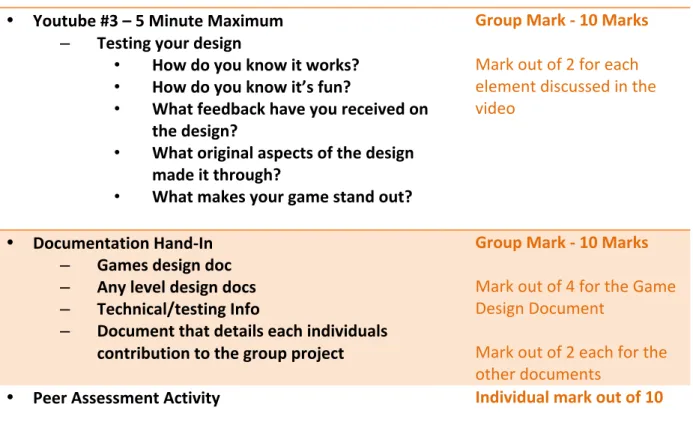
All of the following was due by Week 14 of Semester 2
• Youtube #3 – 5 Minute Maximum – Testing your design
• How do you know it works? • How do you know it’s fun?
• What feedback have you received on the design?
• What original aspects of the design made it through?
• What makes your game stand out?
Group Mark -‐ 10 Marks
Mark out of 2 for each element discussed in the video
• Documentation Hand-‐In – Games design doc – Any level design docs – Technical/testing Info
– Document that details each individuals contribution to the group project
Group Mark -‐ 10 Marks
Mark out of 4 for the Game Design Document
Mark out of 2 each for the other documents
• Peer Assessment Activity
Individual mark out of 10
FIGURE 5: GROUP YOUTUBE VIDEO DOCUMENTATION.
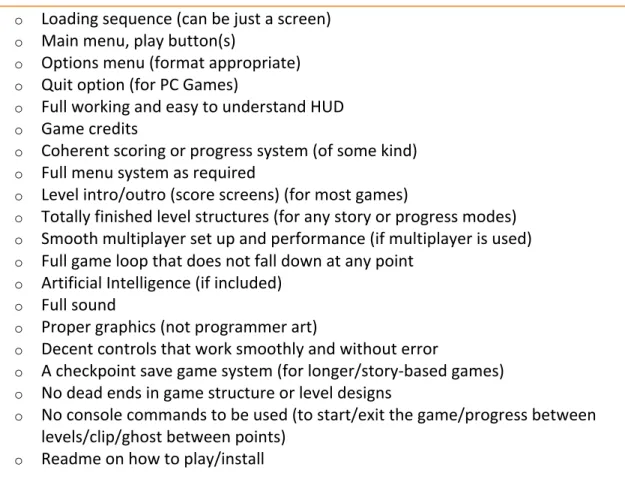
The following was worth a group mark out of 20, and this compliance forms the backbone of our quality control on a variety of group related game projects. Each tick is worth a single mark, and while there is some discussion on some of the definitions, it allows for speedy and objective marking of a student’s game.
COMPLIANCE CHECKLIST
o Loading sequence (can be just a screen) o Main menu, play button(s)
o Options menu (format appropriate) o Quit option (for PC Games)
o Full working and easy to understand HUD o Game credits
o Coherent scoring or progress system (of some kind) o Full menu system as required
o Level intro/outro (score screens) (for most games)
o Totally finished level structures (for any story or progress modes) o Smooth multiplayer set up and performance (if multiplayer is used) o Full game loop that does not fall down at any point
o Artificial Intelligence (if included) o Full sound
o Proper graphics (not programmer art)
o Decent controls that work smoothly and without error
o A checkpoint save game system (for longer/story-‐based games) o No dead ends in game structure or level designs
o No console commands to be used (to start/exit the game/progress between levels/clip/ghost between points)
o Readme on how to play/install
FIGURE 6: GAME DESIGN COMPLIANCE CHECKLIST.
GROUP WORK ISSUES
After the first semester, underperforming groups were disbanded and randomly assigned to other groups. This was also the case where students had dropped out, thus making groups no longer viable. This was done to reinforce the idea that the games industry could be a tumultuous place in which to work. These actions brought the number of groups down from thirty-‐four to twenty-‐eight, and the average team size up to seven.
There were surprisingly very few complaints from groups that had been disbanded, most agreeing they hadn’t worked to their fullest potential. The quality of the work from the other groups increased – however marks for individual students were maintained so a poor student moved at the Christmas break couldn’t benefit from good work done by the team they were assigned to in the second semester.
ASSIGNMENT RESULTS
FUTURE DEVELOPMENTS
For the next academic year, the module will be running in much the same way — with updated information in lectures and the group project element remaining as it was, along with the milestoned assignment. Since the results of the assignments far exceeded the expectations of the academic team and the feedback from the students was
overwhelmingly positive nothing much is set to change.