VOLUME 16 ISSUE 3 (2018) Page 261 – 273
ASSESSING A WALKABLE ENVIRONMENT IN JALAN TUANKU ABDUL RAHMAN, KUALA LUMPUR, MALAYSIA
Na’asah Nasrudin1, Muna Sarimin2 & Norhayati Ibrahim3
Faculty of Architecture, Planning and Surveying
UNIVERSITI TEKNOLOGI MARA, MALAYSIA
Abstract
There is currently a wide discussion on promoting a walkable environment and improving walkability especially in city centre. Walking in the city is meant to solve numerous problems ranging from the city vibrancy, traffic congestion, environmental injustice, social isolation to the human health issues related to obesity crisis. This paper aims to examine the walkable environment of Jalan Tuanku Abdul Rahman as one of the busiest pedestrian urban places in the city centre of Kuala Lumpur, the capital city of Malaysia. It investigates the pedestrians’ perception on their walking experience based on the walkable environment elements i.e. comfort, safety and levels of enjoyment. A participant observation and questionnaire survey technique were employed whereby the former involved with the researchers general physical evaluation of the site and the latter engaged a random sample of 120 pedestrians of Jalan Tuanku Abdul Rahman for a paper-based on street questionnaire survey. The findings suggested that the majority of the respondents were satisfied with the existing conditions of comfort and safety and hence, regarded Jalan Tuanku Abdul Rahman as a walkable area. However, their level of enjoyment was generally minimal suggesting that there are rooms for further improvement in the pedestrian area to create a better and more conducive walkable environment.
Assessing a Walkable Environment in Jalan Tuanku Abdul Rahman, Kuala Lumpur, Malaysia
INTRODUCTION
Recent studies have confirmed that car culture is on the decline in the city centre and that increasing attention is being paid to walkable spaces and walkability to make cities more vibrant and attractive, sustainable, healthier and safer. Walking is the elementary means of people moving around, integrating and living the urban space and accomplishing a salutary physical activity. Many benefits have also been associated with walking, ranging from reducing traffic congestion and pollution to controlling health crisis related to obesity. Walking can also be regarded as an essential factor in the creation of liveable communities. Walkability is usually linked to the quality of the built environment and connected by the quality of the pedestrian environment. A walkable environment is often attractive because it is lively and sociable, pleasant, clean and full of interesting people. Creating walkable environment for pedestrians can improve urban conditions. It is also seen such environment will be able to promote environmental preservation, maintaining social equity components of sustainable urban form as well as providing a more sustainable transportation options. These save energy and provide opportunities for those who cannot use cars because of age, income and disability. With such associated benefits, critical questions are normally posed to researchers, particularly the urban planners: how best to promote walking and to what extent our built environment is able to encourage people to walk. This paper, therefore, aims to examine the walkable environment of Jalan Tuanku Abdul Rahman as one of the busiest pedestrian urban places in the city centre of Kuala Lumpur, the capital city of Malaysia. This paper is structured into six sections. The subsequent section is the research background comprising the literature review of the study. Section three and four explains about the study area and research methodology respectively. They are then followed by the results and discussion section and finally, a section on conclusion and implications of the results.
RESEARCH BACKGROUND
A walkable environment is often multidimensional in terms of means and these dimensions are normally measureable. According to Rahaman, Lourenco and Viegas (2012), a pedestrian space should have some essential elements in order to meet the needs and comfort of people. Besides, it needs to be managed efficiently and effectively to promote a conducive environment, sustainable and eco-friendly to be used by multiple ages of users with a different ability. Meanwhile, Shamsuddin, Hassan and Bilyamin (2012), and Llewelyn-Davies (2000) argued that the street design must be a sign of its street activities whereby for a the specific commercial street, the design of the street must be able to reflect the on-going the commercial activity.
for evaluating how well streets can serve pedestrians. Both assigned grades to streets based on how successful they were in the following categories: safety and security, continuity of the pedestrian network, system coherence, convenience and comfort, and attractiveness. The enhancement of a liveable street will also able to promote a safer urban environment. From the environmental point of view, walking is a “green” mode of transport, as it has a low environmental impact, without air and noise pollution. The presence of a walkable environment and transit systems will create a smart alternative to private car usage, thus reducing traffic congestion, noise, and emissions.
One of the thrusts of development in a rapid city is to utilise resources in an efficient manner in order to achieve sustainable development. It is translated in the principles of sustainable urban design by creating a walkable environment to encourage and facilitate communities in the city to walk. To materialise the idea of a sustainable city, a network of safe and comfortable pedestrian area through physical design in cities should be planned, implemented and monitored (Shamsuddin et al., 2012).
Many factors have been considered to be limitations or constraints to walking in an urban area (Handy, Xinyu, & Mokhtarian, 2005). The limitation factors include stressors, like crowding, noise, traffic congestion, community violence and crime and physical features that reduce the sense of place. The safety factor (as in fear of crime) has been frequently cited as the highest constraint to walking by the more vulnerable groups and the people who rely more on walking (Evans 2009). Meanwhile, travel behaviour theories have been useful in understanding the factors that influence people to walk and what do people value most in any of their walking experience. Travel behaviour is influenced by situational and personal factors
(
Bouscasse, Joly, & Bonne, 2018). Socio-psychological factors like attitudes towards the environment and certain modes of transport or the importance of moral obligation and environmental beliefs are the main influencing variables for daily travel. People with high environmental concern have a better perception of “green” mode transport like cycling and walking.THE STUDY AREA
Assessing a Walkable Environment in Jalan Tuanku Abdul Rahman, Kuala Lumpur, Malaysia
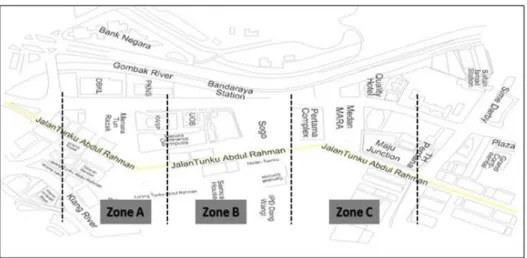
This promotes walking in the area to be safer, faster and more efficient, thereby helping to strengthen the economic viability of the city in terms of commercial activity, retailing and tourism. At present, there is a wide range of facilities available along the 1.9km length of the road including public transport system, shopping complexes, education and business centres offering a broad range of pedestrian activities including shopping, leisure, working and commuting transit. On the shoulders of this road are pre-war buildings, retail shops and modern shopping complexes (Sogo and Maju Junction). On Every Saturday between 5pm to 10pm, part of the road will be closed for vehicles to make room for the night market that offers a variety of domestic items, clothing and food at attractive prices. This Jalan TAR night market is now seen as one of the KL icon and valued as a tourist attraction in Malaysia. Figure 1 shows the location of the study area and the divisional zones for observation survey (explained in section 4).
Figure 1: Map of the study area
THE METHODOLOGY
For on-street questionnaire survey, a total of 120 respondents were selected randomly among the pedestrians around Jalan TAR sidewalk. The survey was carried out during afternoon peak hour on both working weekdays and weekends. The respondents were provided with a paper-based survey form with several sub-item tests to gauge their walking experience based on walkable and enjoyable elements. Respondents were also asked to assess the pedestrian facilities, security level, and accessibility linking to other various mode of transportation. They were also asked to provide their future recommendations on strategies to further encourage walking, making walking to be more attractive, efficient and enjoyable activity and more importantly, create a more conducive and walkable environment.
RESULTS AND DISCUSSION
Observation Analysis on Jalan TAR Walkable Environment
The pedestrian walkway and quality of sidewalk network is seen as comfortable enough to link users to and from adjacent places. The observation results indicates that the size of the pedestrian walkway was acceptable and at a satisfactory level to accommodate high number of pedestrian with minimal clashes during the non-peak hours. However, during non-peak hours, when the number of pedestrian increases and the situation gets busier, there was a slight obstruction in the walkway due to the existence of street vendors which often impedes pedestrian movements and creating conflicts between pedestrian space and walkways with vehicular movements. This also hampered the optimization of a walkable public space, which limits the size of sidewalk at both sides leading to other problems associated with the pedestrian traffic.
The result from the observation also shows that the street was generally safe with the presence of auxiliary police and security guards. At some points however, the pedestrians were at risk of petty crimes such as snatch theft as the walkway was located too close to the main road. However, at certain areas, improvements have been made to the pedestrian walkway like the provision of the guardrail as a safety element and crime prevention from vehicle and snatcher. In term of cleanliness, it could be considered as at moderate level whereby some areas were littered. Some areas of the pedestrian walkway had been vandalised and were not well maintained, and these could cause danger to the pedestrians.
Assessing a Walkable Environment in Jalan Tuanku Abdul Rahman, Kuala Lumpur, Malaysia
as petty traders, push carts, street vendors and street musicians have occupied most part of the pedestrian space. It was also observed that the area was highly used by people with disabilities. A number of people walking with walking sticks and crutches, and group of people who were visually impaired could be seen, benefitting the traffic free environment.
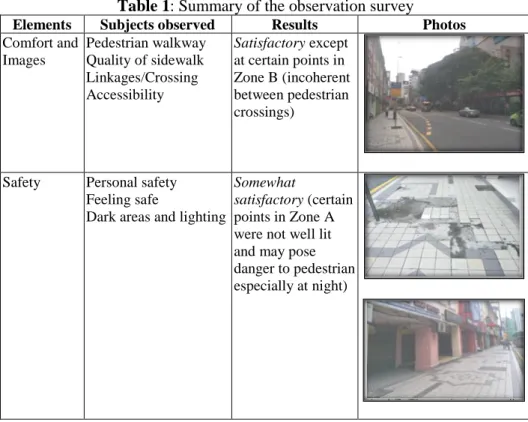
The road networks mainly serve the outer section of the area. A network of narrow alleys, approximately 1.5 to 3 meters wide, serves most of the area of Jalan TAR. However, on some days especially weekends and peak hour during weekdays, conflicts between pedestrians and vehicles could be traced at some parts of the pedestrian area. It was also observed that there was no sheltered walkway provided along the pedestrian walkway. The perennial heat and rainy conditions of Kuala Lumpur give rise to high humidity which makes strolling along the streets of Jalan TAR a “hot and sticky” affair. However, even without visible design landscape in the street, the observation concludes that users would still continue walking despite the weather affecting them. This clearly illustrates that the pedestrian walkway was functioning well and its physical characteristics act as a mode of movement for users (refer to the first photo in Table 1).
Table 1: Summary of the observation survey
Elements Subjects observed Results Photos
Comfort and Images
Pedestrian walkway Quality of sidewalk Linkages/Crossing Accessibility
Satisfactory except at certain points in Zone B (incoherent between pedestrian crossings)
Safety Personal safety Feeling safe
Dark areas and lighting
Somewhat
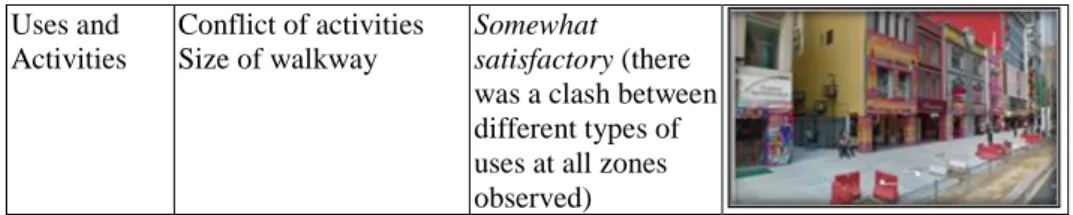
Uses and Activities
Conflict of activities Size of walkway
Somewhat satisfactory (there was a clash between different types of uses at all zones observed)
Pedestrians’ Perception on Jalan TAR Walkable Environment
Elements of Comfort
Comfortable walking has been associated with higher travel rates (Alfonzo, 2005). Slater (1985) described comfort as "the physiological, emotional and physical harmony between the human body and the environment." Facilitators of physical facilities (line, seating and adequate protection from the weather) can minimize the required effort. Sarkar and Janardhan (1997) defined comfort of walking as “to do activities and thus make the walk fun”.
Because comfort can create good and positive images in place (Lynch, 1960), providing comfort in the interior of the city is important for a tourist experience. It is said that the quality of the running environment affects people on foot (Southworth, 2005). Parks and Schofer (2006) mentioned that network design helps determine the ability of pedestrians to reach their destinations, which corresponds to the state of the built environment. The importance of connectivity has been discussed by Brown, Werner, Amburgey and Szalay (2007). They mentioned that walkable environment must be able to provide comfort for pedestrians, can be improved with stronger linkages and promote a better quality pedestrian network within the district as a whole.
A pleasant and exciting walking experience has a positive impact on the perception of urban dwellers. In measuring comfort, several assessments were used to examine visitors’ satisfaction over physical elements such as how well pedestrian elements can influence emotional comforts and how the visitors react to the qualities they experienced while walking.
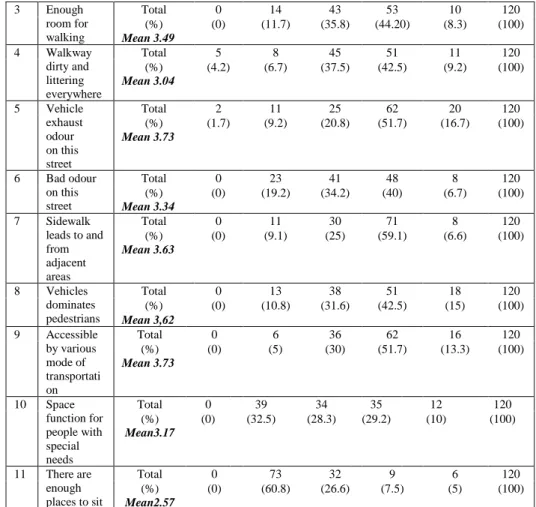
Table 2: Pedestrians perception on Jalan TAR comfort elements
Elements
(1) Strongly Disagree
(2) Disagree
(3) Average
(4) Agree
(5) Strongly
Agree
Total
Comfort
1 Condition of sidewalk are safe for walking
Total 3 19 45 47 6 120
(%) (2.5) (15.8) (37.5) (39.2) (5) (100)
Mean 3.28
2 Pedestrian walkway is well maintained
Total 6 15 61 36 2 120
(%) Mean 3.11
Assessing a Walkable Environment in Jalan Tuanku Abdul Rahman, Kuala Lumpur, Malaysia
3 Enough room for walking
Total 0 14 43 53 10 120
(%) Mean 3.49
(0) (11.7) (35.8) (44.20) (8.3) (100)
4 Walkway dirty and littering everywhere
Total 5 8 45 51 11 120
(%) Mean 3.04
(4.2) (6.7) (37.5) (42.5) (9.2) (100)
5 Vehicle exhaust odour on this street
Total 2 11 25 62 20 120
(%) Mean 3.73
(1.7) (9.2) (20.8) (51.7) (16.7) (100)
6 Bad odour on this street
Total 0 23 41 48 8 120
(%) Mean 3.34
(0) (19.2) (34.2) (40) (6.7) (100)
7 Sidewalk leads to and from adjacent areas
Total 0 11 30 71 8 120
(%) Mean 3.63
(0) (9.1) (25) (59.1) (6.6) (100)
8 Vehicles dominates pedestrians
Total 0 13 38 51 18 120
(%) (0) (10.8) (31.6) (42.5) (15) (100)
Mean 3,62 9 Accessible
by various mode of transportati on
Total 0 6 36 62 16 120
(%) Mean 3.73
(0) (5) (30) (51.7) (13.3) (100)
10 Space function for people with special needs
Total 0 39 34 35 12 120
(%) Mean3.17
(0) (32.5) (28.3) (29.2) (10) (100)
11 There are enough places to sit
Total 0 73 32 9 6 120
(%) Mean2.57
(0) (60.8) (26.6) (7.5) (5) (100)
deficiencies in the pedestrian sidewalk facilities that are physically challenging to the disabled and the elderly. Unlicensed vendors and hawkers use the pedestrian sidewalk for their business purposes and some building owners prohibiting public access across their properties have worsen this scenario (Rahaman et al., 2012). Reduction in total sidewalk width due to the vendor’s existence often impedes pedestrian movements. A city centre is not a pedestrian-friendly city if it lacked of pedestrian linkages and existence of major deficiencies such as poor maintenance, inefficient design and poor accessibility (Tarudin, Rashid, Kordi, Azmi, & Aziz, 2016).
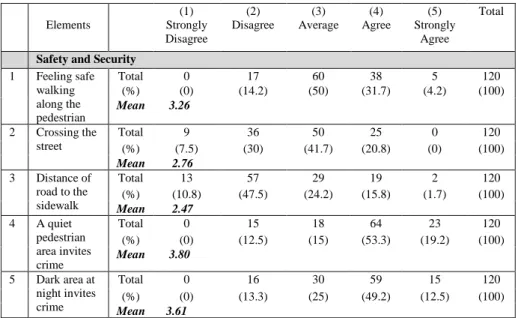
Elements of Safety and Security
Safety and security element is one of the determinants of a good and effective walkable environment. A safe pedestrian environment allows the pedestrians to walk comfortably and reduces the sense of fear of accident or crime (Zakaria & Ujang, 2015). The intensity of pedestrian is required to increase safety because the streets will be more alive and lively (Jacobs, 1969). The components of the pedestrian safety are also associated with motorist behaviour, and crossing exposure and security. As noted by Newman (2008), the urban designs are important to avoid the formation of hidden and obscured niches in order to reduce crime on the streets. Hidden and obscured niches can be criminal hideout and expose the user to crime especially at a place with low intensity of pedestrians.
Table 3: Pedestrians’ perception on Jalan TAR safety and security
Elements
(1) Strongly Disagree
(2) Disagree
(3) Average
(4) Agree
(5) Strongly
Agree
Total
Safety and Security
1 Feeling safe walking along the pedestrian
Total 0 17 60 38 5 120
(%) (0) (14.2) (50) (31.7) (4.2) (100)
Mean 3.26
2 Crossing the street
Total 9 36 50 25 0 120
(%) (7.5) (30) (41.7) (20.8) (0) (100)
Mean 2.76 3 Distance of
road to the sidewalk
Total 13 57 29 19 2 120
(%) (10.8) (47.5) (24.2) (15.8) (1.7) (100) Mean 2.47
4 A quiet pedestrian area invites crime
Total 0 15 18 64 23 120
(%) (0) (12.5) (15) (53.3) (19.2) (100)
Mean 3.80
5 Dark area at night invites crime
Total 0 16 30 59 15 120
(%) (0) (13.3) (25) (49.2) (12.5) (100)
Assessing a Walkable Environment in Jalan Tuanku Abdul Rahman, Kuala Lumpur, Malaysia
Table 3 shows the respondents’ perception on the pedestrian walkway safety and security elements at Jalan TAR. They were asked to value five main elements for safety and security i.e. feeling safe when walking along the pedestrian area, feeling safe when crossing the street, reasonable distance between the main road and the sidewalk, quietness of the street invites crime and inadequate night lighting invites crime. The result indicates that quietness and inadequate night lighting along the pedestrian area were their utmost concern on the safety elements. They highly perceived that both circumstances of quietness and inadequate lighting will affect their safety as they will invite crime (mean score of 3.80 and 3.61 respectively).
Meanwhile, majority of the respondents agreed that they generally feel safe and secure when walking at the pedestrian area with a mean score of 3.26. They feel slightly unsafe, however, when crossing the street (mean at 2.76) and walking at the walkway where the distance of the walkway was too near to the main road.
Elements of Enjoyment
Factors affecting the vibrancy of urban areas vary and are much influenced by such variables as aesthetical values, physical attractions and environmental excitement. This relates to how much of the environment gives aesthetically pleasing to the consumer, attracting traders using the space, and they are happy with the opportunities offered (Owen, Humpel, Leslie, Bauman, & Sallis, 2004; Shay, Spoon, & Khattak, 2003).
In Table 4, the majority of the respondents agreed that there is interesting view including heritage and historical building nearby Jalan TAR pedestrian walkway. They also agreed that the existence of art street music such as ‘busking’ will catch pedestrians’ attention resulting in them spending more time at the pedestrian walkway. The respondents also agreed that there is memorable character along Jalan TAR walkway that will attract people to come and spend their time in Jalan TAR. However, respondents averagely agreed that the pedestrian walkway has interesting wall street art and nice landscape along.
Table 4: Pedestrians perception on Jalan TAR enjoyment
Elements
(1) Strongly Disagree
(2) Disagree
(3) Average
(4) Agree
(5) Strongly
Agree
Total
Enjoyment
1 Interesting view such as heritage building
Total 4 11 40 61 4 120
(%) (3.3) (9.2) (33.3) (50.8) (3.3) (100)
Mean 3.42
2 Wall street art along pedestrian walkway
Total 2 27 47 40 4 120
(%) (1.7) (22.5) (39.2) (33.3) (3.3) (100)
3 Art street music along pedestrian walkway
Total 5 20 46 47 2 120
(%) (4.2) (16.7) (38.3) (39.2) (1.7) (100)
Mean 3.16
4 Good landscaping
Total 3 22 48 42 5 120
(%) (2.5) (18.3) (40) (35) (4.2) (100)
Mean 3.20 5 Has a
memorable character
Total 6 13 36 47 18 120
(%) (5) (10.8) (30) (39.2) (15) (100)
Mean 3.49
Respondents’ Agreement with the Proposed Walkable Environment Elements
Table 5 shows the results of the analysis on respondents’ level of agree or disagree with the proposed walkable environment enhancement measures. For this analysis, the respondents were given a list of proposed walkable environment enhancement measures and asked to provide an opinion to what extend were they agree or disagree with the suggestions.
The proposal to restrict the vendors and hawkers from using the pedestrian walkway and to provide more shady areas and shelter were the most popular proposals (with mean score of 4.61 and 4.52 respectively). These are then followed by the proposal to improve proper signage and warnings, restrict the streets beggar, provide better landscaping as well as maintain cleanliness along the pedestrian walkway. Meanwhile, providing murals and street arts to enhance the sense of welcoming to encourage people to walk and planting more trees along the pedestrian walkway were given the least priority.
Table 5: Mean Analysis of walkable environment enhancement
No. Proposal Mean Score of
agreement 1 Shade trees along the pedestrian walkway, provide a sense of
enclosure, privacy, and security
3.40
2 Soft and hard landscape to beautify and enhance the overall environment
3.96
3 Frequent maintenance and proper cleanliness along the pedestrian walkway
3.74
4 Provide more murals and street art to enhance the sense of welcoming environment.
3.65
5 Proper signage and warnings to create a safer environment 4.10 6 Provide shady trees and shelter where necessary 4.52 7 Restrict the vendors and hawkers using the pedestrian sidewalk
space
4.61
Assessing a Walkable Environment in Jalan Tuanku Abdul Rahman, Kuala Lumpur, Malaysia
CONCLUSION
This study concludes that Jalan TAR pedestrian walkway has comfort and enjoyable elements as it able to offer both emotional and physical harmony between the human body and the environment. However, majority respondents were quite sceptical on safety and security issues and did not give a positive feedback which limits the overall walkability values of the area. This suggests that improvement is needed to further enhance the walkable criteria. As walkability environment should be the asset of a city whereby tourists get attracted to experience the place, there is a need to create a pedestrian walkway that is walkable, distinctive with a strong identity and sense of place. A pedestrian walkway with good and quality design will encourage greater community participation in walking and can influence emotional comforts and experience while walking. Sheltered walkway should be provided where necessary to shield the pedestrians from the hot weather and rainy days, and tree planting is seen a natural solution to these problems. The design and provision of all important walkway elements and street furniture (including public art) should be coordinated, wherever possible, to make a positive contribution, avoid unnecessary clutter, and ensure a safe, informative and attractive walking environment.
ACKNOWLEDGEMENT
The authors would like to thank the Ministry of Higher Education, Malaysia for funding this research through the FRGS grant (FRGS/1/2016/SS07/UITM/02/5) and Universiti Teknologi MARA (UiTM) for supporting the research.
REFERENCES
Alfonzo, M. A. (2005). To walk or not to walk? The hierarchy of walking needs.
Environment and Behaviour,37, 808-836.
Bouscasse, H., Joly, I., & Bonne, P. (2018). How does environmental concern influence mode choice habits? A mediation analysis.Transportation Research Part D: Transport and Environment, 59, 205-222.
Brown, B. B., Werner, C. M., Amburgey, J. M., & Szalay, C. (2007). Walkable Route perception and Physical Features: Converging Evidence for En Route Walking Experience. Environment and Behaviour, 39, 34-61.
Evans, G. (2009). Accessibility, urban design and the whole journey environment. Built Environment, 35(3), 366-385.
Handy, S., Xinyu, C., & Mokhtarian, P. L. (2005). Correlation or causality between the built environment and travel behavior: Evidence from Northern California.
Transportation Research Part D: Transport and Environment, 10(6), 427-444.
Llewelyn-Davies (Firm). (2000). Urban design compendium. United Kingdom: English Partnership & The Housing Copporation, UK.
Lynch, K. (1960). A Imagem Da Cidade (The Image of the City) (1996th ed). Lisboa:
Edicoes 70.
Newman, O. (2008). Creating defensible space. Darby, PA: Diane.
Owen, N., Humpel, N., Leslie, E., Bauman, A., & Sallis, J. F. (2004). Understanding environmental influences on walking. American Journal of Preventive Medicine, 27(1), 67-76.
Parks, J. R., & Schofer, J. L. (2006). Characterizing neighborhood pedestrian environments with secondary data. Transportation Research Part D: Transport and Environment, 11(4), 250-263.
Rahaman, K. R., Lourenco, J. M., & Viegas, J. M. (2012). Perceptions of pedestrians and shopkeepers in European medium-sized cities: Study of Guimara-tildees, Portugal. Journal of Urban Planning and Development, 138(1) 26-34.
Sarkar, A. K., & Janardhan, K. S. V. S. (1997). A study on pedestrian flow characteristics. Proceedings Transportation Research Board, 368, 232-238. Washington: (n.p.). Shamsuddin S., Hassan N. R. A, & Bilyamin S. F. I. (2012). Walkable environment in increasing the liveability of a city. Procedia-Social and Behavioral Sciences, 50, 167-178.
Shay, E., Spoon, S. C., & Khattak, A. J. (2003). Walkable environment and walking activity. Chapel Hill: University of North Carolina.
Slater, K. (1985). Human comfort. Springfield, IL: Charles C. Thomas Publisher. Southworth, M. (2005). Designing the walkable city. Journal of Urban Planning and
Development, 131, 246-257.
Tarudin, N. F., Rashid, M. F. A., Kordi, N. E , Azmi, E. A., & Aziz, T. N. A. T. (2016). The Improvement on the Sidewalk in Commercial Areas at City Center in Malaysia. Journal of Applied Environmental and Biological Sciences. 6(9S)35-38.