Resources for Persuasion
Marco Guerini, Carlo Strapparava, Oliviero Stock
FBK-irst 38050 Povo, Trento, Italy
{guerini, strappa, stock}@fbk.eu
Abstract
This paper presents resources and strategies forpersuasive natural language processing. After the introduction of a specifically tagged corpus, some techniques for affective language processing and for persuasive lexicon extraction are provided together with prospective scenarios of application.
1.
Introduction
Persuasive communication is a concept that is becoming important in NLP. In order to automatically produce and analyze persuasive communication, specific resources and methodologies are needed. The paper is structured as fol-lows: Section 2 gives an overview of key concepts con-nected to persuasion and briefly describes the state of the art in related areas. Section 3 describes the resource we built for statistical acquisition of persuasive expressions. Sec-tion 4 describes how this approach can be used for various persuasive NLP tasks.
2.
Persuasion, emotions and related
concepts
According to Perelman and Olbrechts-Tyteca (Perelman and Olbrechts-Tyteca, 1969), persuasion is a skill that hu-man beings use - in communication - in order to make their partners perform certain actions or collaborate in various activities. Here below we introduce some related key con-cepts.
Argumentation and Persuasion. In AI the main approaches focus on the argumentative aspects of persuasion. Still, ar-gumentation is considered as a process that involves “ratio-nal elements”, while persuasion includes also elements like emotions. In our view, a better distinction can be drawn considering their different foci of attention: while the for-mer focuses on message correctness (its being a valid ar-gument) the latter is concerned with its effectiveness. The recent area of natural argumentation tries to bridge the two (Reed and Grasso, 2007).
Emotions and Persuasion. Since persuasion includes non-rational elements as well, it is a “superset” of argumenta-tion, but this does not rule out that there is a role for emotion within argumentation (Miceli et al., 2006): through arousal of emotions or through appeal to expected emotions. In-deed, emotional communication has become of increasing interest for Persuasive NL Generation.
Rhetorics. The study of how language can be used effec-tively. This area of studies concerns the linguistic means of persuasion (one of the main means, but not the only one). This is the area we are focusing on in this paper.
Irony. It refers to the practice of saying one thing whilst meaning another. Irony occurs when a word or phrase has
a surface meaning, but another contradictory meaning be-neath the surface. Irony is a widely used rhetorical artifice, especially in advertisement.
Persuasion and NLP. The first attempts in persuasive NLG were based mainly on knowledge-based techniques, e.g. Reiter (Reiter et al., 2003), Zukerman (Zukerman et al., 2000). Nowadays approaches to NLP instead are mainly statistically based, calling for collection of annotated texts. In order to explore persuasive NLG in an unrestricted do-main, knowledge-based techniques could not suffice: sta-tistical acquisition from large corpora is needed, especially for tasks such as lexical choice.
Another relevant aspect is the increasing importance of emotion and affect for persuasive NLP, e.g. there is a recent area of research called affective NLG - an annotated bibli-ography can be found in (Piwek, 2002). Affective NLG widens the scope of Opinion Mining (Carenini et al., 2005; Wilson et al., 2004) that only focuses on polarity (valence) recognition for evaluative language retrieval, regardless of any persuasive use of the text.
3.
CORPS: Corpora of tagged Political
Speeches
The aim of our research is to adopt persuasive expression mining techniques for persuasive NLG in an unrestricted domain. To our knowledge this is the first attempt to use statistical approaches to persuasive messages generation.
As for emotions, we restrict our focus on valenced expres-sions (i.e. those that have a positive or negative connota-tion). So the task of producing affective expressions for persuasive goals is treated as the task of changing appro-priately the valence of expressions. Specific resources for persuasive NLG are needed. We collected them according to the message characteristics we want to address:
• long and elaborated texts;
• short, high impact, sentences
• single word messages -e.g. brand
names-At present we collected the following resources:
Figure 1: Number of speeches per speaker
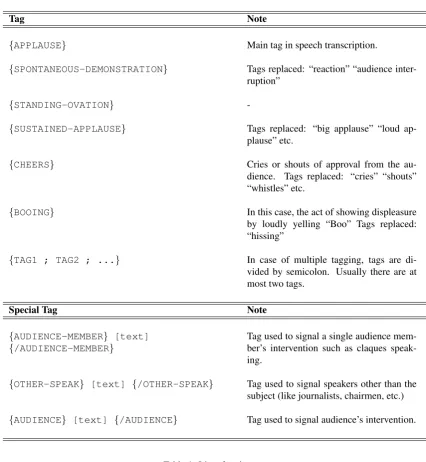
Tag Note
{APPLAUSE} Main tag in speech transcription.
{SPONTANEOUS-DEMONSTRATION} Tags replaced: “reaction” “audience inter-ruption”
{STANDING-OVATION}
-{SUSTAINED-APPLAUSE} Tags replaced: “big applause” “loud
ap-plause” etc.
{CHEERS} Cries or shouts of approval from the
au-dience. Tags replaced: “cries” “shouts” “whistles” etc.
{BOOING} In this case, the act of showing displeasure
by loudly yelling “Boo” Tags replaced: “hissing”
{TAG1 ; TAG2 ; ...} In case of multiple tagging, tags are
di-vided by semicolon. Usually there are at most two tags.
Special Tag Note
{AUDIENCE-MEMBER} [text] {/AUDIENCE-MEMBER}
Tag used to signal a single audience mem-ber’s intervention such as claques speak-ing.
{OTHER-SPEAK} [text] {/OTHER-SPEAK} Tag used to signal speakers other than the subject (like journalists, chairmen, etc.)
{AUDIENCE} [text] {/AUDIENCE} Tag used to signal audience’s intervention.
Table 1: List of main tags
• windows of different widthwn(wherewnis the num-ber of tokens considered) preceding audience reac-tions tags
• the typology of persuasive communication (audience
reaction).
Figure 2: Number of speeches per speaker
negative-focus-words, ironical-words and a persuasive-words list - computed by considering all tags together). An-alyzing the 100 top words of these lists (ordered according to theirpiscore) we found that the negative valence mean of positive-focus and negative-focus groups is the same, while for the negative-focus group the positive valence mean is about 1/4 with regard to the positive-focus group (t-test;α <0.01). These results can be explained by a high use of the
CONTRASTrelation (that brings negatively valenced words when talking about opponents) in the positive-focus group, while this is not the case for the negative-focus group. In fact aCONTRASTrelation is present in about 30% of the sentences precedingAPPLAUSE(Atkinson, 1984; Heritage and Greatbatch, 1986).
In Table 3 a comparison between the positive-focus and negative-focus top 50 most persuasive words is given (note that named entities have not been discarded).
It is a matter of debate whether these words are “univer-sally” persuasive (i.e. they could be biased by speaker stile, audience typology, context of use and so on). To partially overcome the problem the corpus has been balanced choos-ing speakers that are equally distributed within the two ma-jor parties in the US (Democratic and Republican). At present we do not address the problem of words context (e.g. if a word is preceded by a negation or a hypothetical clause) but we do believe that this does not invalidate the
piof a word. Let us hypothesize that the wordbad#ahas a highpiin the positive-focus list, but the word is mainly used in contexts like “not bad”. This does not imply that the wordbad#ashould be discarded from the positive-focus list, rather that it would be useful to have contextual infor-mation for the word (like the co-occurrence score with the wordno#r).
Analysis of public reaction can substantiate intuitions about the speakers’ rhetorical style. Given the formal annotation of the corpus together with the pimeasure we presented, this analysis can be made automatically on a large scale, al-lowing to gain interesting insights. In fact there are rhetor-ical phenomena that do not come into light with traditional approaches - based on wordsusage(counting of their oc-currences). Considering also words impact(their
persua-siveness coefficient pi) a much finer analysis is possible, for example:
How do political speeches change after key historical events? There are works such as (Bligh et al., 2004) that investigated Bush’s speeches lexicon before and af-ter September 11th with tools for automatic analysis of
political discourses (DICTION 5.0) focusing on charisma traits. Using CORPS, and analyzing some of the speeches of George W. Bush before and after September 11th (70 speeches before and 70 after, from 12 months before to 16 months after) at the lexical level we found that: while the positive valence mean remains totally unvaried, the nega-tive increases by 15% (t-test;α <0.001).
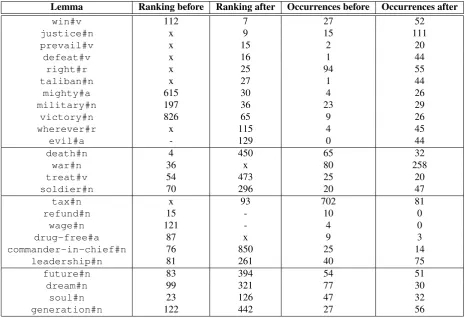
We drove a quantitative/qualitative analysis on Bush’s per-suasive words before and after9/11to understand how his rhetorics changed (making two lists of persuasive words, one for the speeches before 9/11 and another for the speeches after 9/11). We focused on some paradigmatic words and found some interesting results. The words are presented in Table 4. In the first column there is the
lemma#pos (word), in the second and third column its position (persuasiveness)2in the lists before and after9/11.
On the fourth and fifth columns the number of occurrences in the speeches. An “x” indicates that the word is not “per-suasive” (i.e. it appears in the corpus but never in proximity of an audience reaction, the persuasiveness ceases around position 2500 in the lists). An “-” indicates the word is not present in the corpus at all.
A simple approach based on words usage was followed in (Bligh et al., 2004). Here, instead, we adopted also wordsimpactand created a matrix - for every word - that records an increase/decrease of use compared with an in-crease/decrease of persuasiveness. Some interesting phe-nomena emerged. Let us consider the wordsmilitary#n
ortreat#v. Both words are used almost the same number of times before and after9/11(respectively 23 vs. 29 times and 25 vs. 20 times). So their “informativeness”, based on number of occurrences, is null. But considering the persua-siveness score we see that their impact vary a lot
(respec-2
Lemma Ranking before Ranking after Occurrences before Occurrences after
win#v 112 7 27 52
justice#n x 9 15 111
prevail#v x 15 2 20
defeat#v x 16 1 44
right#r x 25 94 55
taliban#n x 27 1 44
mighty#a 615 30 4 26
military#n 197 36 23 29
victory#n 826 65 9 26
wherever#r x 115 4 45
evil#a - 129 0 44
death#n 4 450 65 32
war#n 36 x 80 258
treat#v 54 473 25 20
soldier#n 70 296 20 47
tax#n x 93 702 81
refund#n 15 - 10 0
wage#n 121 - 4 0
drug-free#a 87 x 9 3
commander-in-chief#n 76 850 25 14
leadership#n 81 261 40 75
future#n 83 394 54 51
dream#n 99 321 77 30
soul#n 23 126 47 32
generation#n 122 442 27 56
Table 4: Bush’s words before and afterSeptember 11th. In the second and third column, the number represents the rank in the list of persuasive words; an “x” indicates api= 0; an “-” indicates the word is not present in the corpus at all. In the fourth and fifth columns the total number of occurrences.
5.
Conclusions and future work
We have presented the corpus CORPS that contains polit-ical speeches tagged with audience reactions. CORPS is freely available for research purposes (for further details see http://hlt.fbk.eu/corps) and we want to promote its scal-ing up. Along with the corpus we have described tech-niques for statistical acquisition of persuasive expressions (such as a measure of persuasive impact of words) with a view towards contributing to various persuasive NLP tasks.
Regarding lexical choice in text generation micro-planning, there are approaches, e.g. (Jing, 1998), which use corpus and domain information for choosing appropriate lemmata inside synsets. For persuasive NLG, the lists of words we collected allow us to decide, given a synset and an affec-tive/persuasive goal, which lemma to choose, to maximize the impact of the message. We implemented this approach inValentino(Guerini et al., 2008).
Valentino is a tool for increasing the persuasive impact of existing expressionsvia valence modification of the orig-inal expression. The novel expressions can then replace previous expressions in the text. Valentinouses a term ex-traction and transformation approach: given a term in the text to be modified, the system accesses the OVVT (briefly mentioned in Section 3) containing that term and chooses the most appropriate transformation in agreement with the valence shift for the persuasive goal and thepiof the words candidates for substitution.
In a complete application, when applied to a text, changes invoked by the strategic level can be of different types. For instance they can uniformly shift to the negative or to the positive polarity, or they can smooth all emotional peaks, or they can strengthen both positive and negative valence. More in general they can be introduced in combination with deeper rhetorical structure analysis, resulting in different types of changes for key parts of the texts.
6.
References
J.M. Atkinson, 1984. Structures of Social Action, chapter Public speaking and audience response: some techniques for inviting applause, pages 370–409. Cambridge: CUP. M. C. Bligh, J. C. Kohles, and J. R. Meindl. 2004. Charisma under crisis: Presidential leadership, rhetoric, and media responses before and after the september 11th terrorist attacks. The Leadership Quarterly, 15(2):211– 239.
P. Bull and M. Noordhuizen. 2000. The mistiming of ap-plause in political speeches. Journal of Language and Social Psychology, 19:275–294.
G. Carenini, R. Ng, and E. Zwart. 2005. Extracting knowl-edge from evaluative text. In Proceedings of the 3rd international conference on Knowledge Capture, pages 11–18.
San Antonio, Texas.
M. Guerini, O. Stock, and C. Strapparava. 2008. Valentino: A tool for valence shifting of natural language texts. In
Proceedings of LREC 2008, Marrakech, Morocco. J. Heritage and D. Greatbatch. 1986. Generating applause:
a study of rhetoric and response at party political confer-ences.American Journal of Sociology, 92:110–157. H. Jing. 1998. Usage of wordnet in natural language
gener-ation. In S. Harabagiu, editor,Proceedings of the confer-ence “Use of WordNet in Natural Language Processing Systems”, pages 128–134, Somerset, New Jersey. Asso-ciation for Computational Linguistics.
M. Miceli, F. deRosis, and I. Poggi. 2006. Emotional and non-emotional persuasion. Applied Artificial Intel-ligence, 20.
C. Perelman and L. Olbrechts-Tyteca. 1969. The new Rhetoric: a treatise on Argumentation. Notre Dame Press.
P. Piwek. 2002. An annotated bibliography of affective natural language generation. ITRI ITRI-02-02, Univer-sity of Brighton.
C.A. Reed and F. Grasso. 2007. Recent advances in com-putational models of argument. International Journal of Intelligent Systems, 22(1):1–15.
E. Reiter, S. Sripada, and R. Robertson. 2003. Acquir-ing correct knowledge for natural language generation.
Journal of Artificial Intelligence Research, 18:491–516. D. J. Stevenson. 2004. Laughter and leadership. presented
at The International Center for Studies in Creativity Buf-falo State College.
W. Weintraub. 1986. Personality profiles of american pres-idents as revealed in their public statements: The presi-dential news conferences of jimmy carter and ronald rea-gan. Political Psychology, 7(2):285–295.
T. Wilson, J. Wiebe, and R. Hwa. 2004. Just how mad are you? finding strong and weak opinion clauses. In
Proceedings of AAAI, pages 761–769.