VOLUME 16 ISSUE 4 (2018), Page 117 – 129
ACCEPTANCE TOWARDS TOURISM DEVELOPMENT: THE CASE OF PERHENTIAN ISLAND
Diana Mohamad1 & Badaruddin Mohamed2
1,2
School of Housing, Building and Planning
UNIVERSITI SAINS MALAYSIA
Abstract
Island tourism in Malaysia is gaining the globe’s attention and has attracted people from all over the world to come to Malaysia. Islands of Malaysia have been continuously developed for the purpose of providing the visitors’ with better and exclusive tourism experience. Perhentian Island is one of Malaysia’s premier tourism spots famous for its crystal clear water, uncrowded beaches in addition to turtle and baby shark snorkelling points. It is learned that intense development and steady growth of tourist arrivals to this island have somehow created various positive and negative impacts. It is realized that tourism development is pressured by the need to cater to the visitors’ demands while pays limited attention to the locals’ needs and acceptance level. This paper reports on the tourism development impacts on Perhentian Island, looking from the point of view of locals engaged in tourism sector. Employing quantitative research approach, self-administered questionnaire was developed with the aim of assessing the locals’ acceptance level pertaining changes in social structure of Perhentian Island and negative influences of tourism development on the environment. The findings showed immediate intervention is required for re-establishment of the social structure, followed by environmental management.
INTRODUCTION
In 2017 Malaysia has received approximately 26 million international tourists that contributed to RM82.2 billion to the country revenue (Tourism Malaysia, 2018). Given the ample benefits offered by tourism sector, notable investments were allocated which allows intense progress of tourism development especially for island tourism and Perhentian Island is no exception. Besides attractive and unique resources, successful tourism planning requires a well-established relationship between locals and tourism sector in the sense of changes in social phenomena (Liu & Halim, 2011). Kaplan, Tekinay and Ugurlu (2013) described social phenomenon as social event that happen between individuals, and the individuals’ perception towards this social event differs depending on their observations and experiences. Though complex and challenging, understanding social phenomena is fundamental in assessing acceptance level, which directly influences tourism management. As locals recognize the positive and negative consequences tourism would bring, this paper envisages understanding of the locals’ acceptance level as a lens to understand their acceptance towards tourism development. Acceptance level in general is a concept used to assess ones’ satisfaction in relation to frequency and/or intensity of objects/situation (Brown, Morris, & Murry, 1996). According to Gou, Lau and Ye (2014), acceptance level is something that involves the elimination of discomfort where more specifically, it is the state of mind when an individual reacts to the changes that occur. In the context of tourism; acceptance level is an assumption of behaviour and satisfying experiences, which plays a crucial part in predicting future intention (Ramkissoon & Mavondo, 2015). This paper looks at the Perhentian Islanders' acceptance towards tourism development, assessed from the perspective of changes in social structure and environmental impacts. It seeks to address the role played by a number of parameters namely safety issues, social issues, the intensity of tourism development, migration rate, locals' participation and quality of life.
LITERATURE REVIEW
Social Structure
of irregularities of social life as this process affected the proportions of the social demographic cohorts and more importantly, the inflow social mobility process effect was deemed stronger than the outflow social mobility process. This interlinked with Rasoolimanesh et al. (2017) argument in the sense that the inclusion of non-locals (for example tourists and foreign workers) in the existing organization of society (for example Perhentian Island’s community) gave impact on the economic and communication networks.
Changes in the social structure of a particular society in the forms of changes in layers of economic key players and social hierarchy could be contributed by development, which at a deeper level, influenced by types and intensity of the development undertaken (which could be used to measure acceptance towards changes in social structure). Literature on Perhentian Island presented several undesirable changes in social structure due to tourism development. For example, Bozetka (2013) put forward the ability of tourism development in influencing adaptation and/or creation of new modes of behaviour, habits and customs; and in return would contribute to the paradigm shift in social dimension (Gatewood & Cameron, 2009).Interestingly, according to Salmond (2010), while backpackers tourism may encourage cross-cultural exchange and positively manipulate the opinion relating to the economic imbalance between locals and tourists, it also triggers the cultural sensitivity in terms of backpackers’ dress code. The studies are examples of how tourism development had affected the local community of Perhentian Island (socially and culturally) and could be used as indicators in assessing the local community acceptance level towards tourism development. Though understanding the changes in social structure is challenging, it nevertheless crucial in managing the quality of life by which, influence the acceptance towards development in general and tourism development in particular.
Environmental Impacts of Island Tourism Development
environmental impact compared to non-island tourism destinations (Cater, 1987), it is becoming increasingly difficult to ignore the adversity effect of improper and ineffective management of environmental resource utilization (Bardolet & Sheldon, 2008). Echoing Bardolet and Sheldon’s (2008), Bozetka (2013) translated this as the continuous transformation of natural landscape into compact urbanized areas whereby, this was opposed to the central discipline of carrying capacity (Riley, 1995).
Though economic empowerment is desirable (Amir, Osman, Bachok, Ibrahim, & Zen, 2017), serious thoughts should be directed towards the environmental impact. It is learned that the development of chalets which first taken place along the coastal localities has sprawled to the hills (Tan & Teh, 2001), staggering number of visitors has placed pressure on sewage management and freshwater supply (Mohd Salleh, Othman, & Harun. 2010) along with the provision of infrastructure and amenities (Ramdas & Mohamed, 2014), and tourism activities have threatened the marine ecosystem (Comley et al., 2004); hence, signals the immediate attention for environmental conservation. This is in affirmative with Krippendorf’s (1982, cited by UKEssays, 2015) who claimed that environment is the reason for engagement in and economic force of island tourism. The studies are examples of how tourism development had affected the local community of Perhentian Island (environmentally) and could be used as indicators in assessing the local community acceptance level towards tourism development. In line with the gravity of the issues at hand, scholars looked at education program to stimulate the understanding and awareness of the environment significance (Tan & Teh, 2001) other than proposed the implementation of willingness to pay concept (Arabamiry, Abd. Rahim, Radam, Khademfar, & Yacob, 2013), for the purpose of environmental conservation.
RESEARCH BACKGROUND
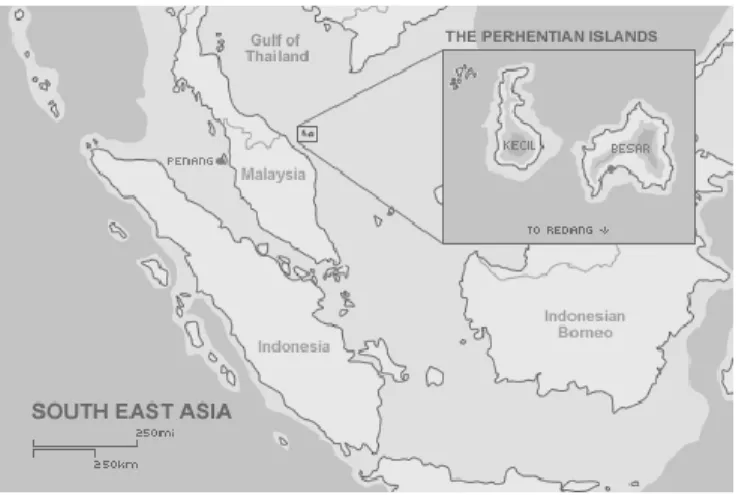
Figure 1: Location of Perhentian Island
Source: UKessays (2015)
RESEARCH METHOD
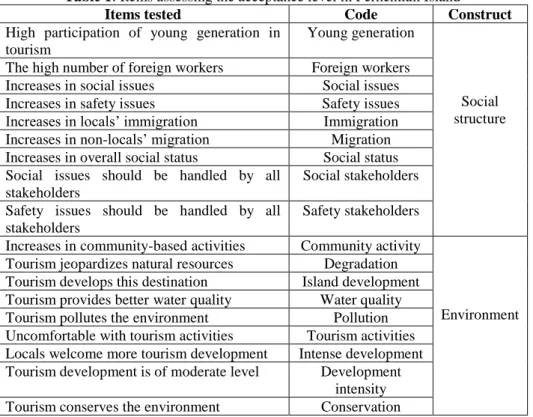
environment and social structure constructs using the literature presented as reference (Table 1).
Table 1: Items assessing the acceptance level in Perhentian Island
Items tested Code Construct
High participation of young generation in tourism
Young generation
Social structure The high number of foreign workers Foreign workers
Increases in social issues Social issues Increases in safety issues Safety issues Increases in locals’ immigration Immigration Increases in non-locals’ migration Migration Increases in overall social status Social status Social issues should be handled by all
stakeholders
Social stakeholders
Safety issues should be handled by all stakeholders
Safety stakeholders
Increases in community-based activities Community activity
Environment Tourism jeopardizes natural resources Degradation
Tourism develops this destination Island development Tourism provides better water quality Water quality Tourism pollutes the environment Pollution Uncomfortable with tourism activities Tourism activities Locals welcome more tourism development Intense development Tourism development is of moderate level Development
intensity Tourism conserves the environment Conservation
RESULTS
profile (age, gender, education level, marital status, tenure status, origins), excluding tenure status. Hence, the following discussion is strictly related to tenure status.
Findings for Social Structure
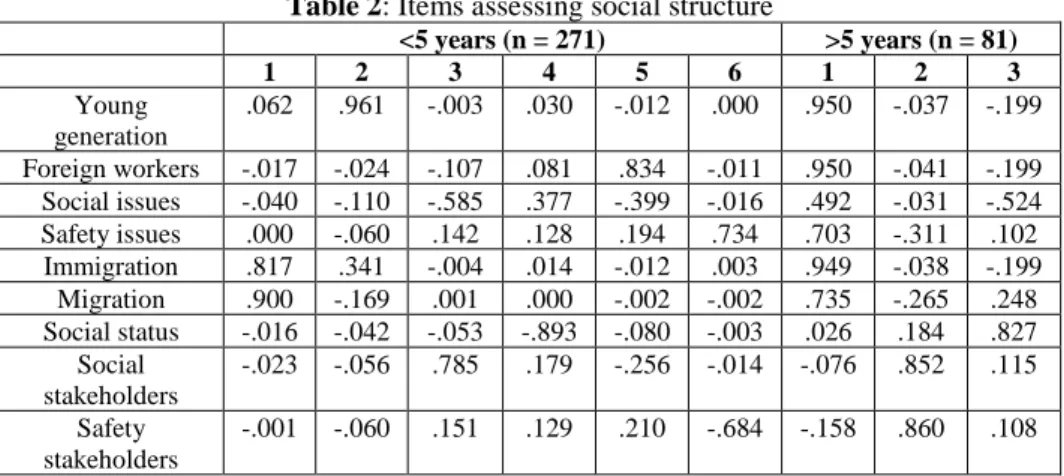
Kaiser-Meyer-Olkin values for a tenure of less than and more than 5 years were .541 and .793, with Bartlett's Test of Sphericity for both tenure types reached statistical significance. In case of tenure less than 5 years, it appeared that items were grouped into six components (73.6% of the total variance explained) where only component 1 could be regressed (Table 2). While component 1 addressed the origin cohort, the remaining components measured the following: locals' participation (component 2), management of culture-related issues (components 3 and 4), an influx of foreign workers (component 5) and safety issues (component 6). Other than indicating that the locals' acceptance level was moderately measured by high occurrences of social issues, analysis showed that the acceptance level was not influenced by the ability of tourism to improve the overall status standard and stakeholders' joint responsibility to handle safety issues. Looking at tenure more than 5 years (Table 2), items were factored into three components (76.2% of the total variance explained) where all items were valid to be regressed excluding component 3. Component 1 was formed by 6 items that evaluated organization cohort and component 2 focused on the issues management. Results emphasized the adverse gravity of changes in social structure is increasing over time especially for migration of locals and high occurrences of social issues.
Table 2: Items assessing social structure
<5 years (n = 271) >5 years (n = 81)
1 2 3 4 5 6 1 2 3
Young generation
.062 .961 -.003 .030 -.012 .000 .950 -.037 -.199
Foreign workers -.017 -.024 -.107 .081 .834 -.011 .950 -.041 -.199 Social issues -.040 -.110 -.585 .377 -.399 -.016 .492 -.031 -.524 Safety issues .000 -.060 .142 .128 .194 .734 .703 -.311 .102 Immigration .817 .341 -.004 .014 -.012 .003 .949 -.038 -.199 Migration .900 -.169 .001 .000 -.002 -.002 .735 -.265 .248 Social status -.016 -.042 -.053 -.893 -.080 -.003 .026 .184 .827
Social stakeholders
-.023 -.056 .785 .179 -.256 -.014 -.076 .852 .115
Safety stakeholders
-.001 -.060 .151 .129 .210 -.684 -.158 .860 .108
challenging their acceptance level. In case of locals with tenure more than 5 years, the organization cohort controlled by the number of foreign workers, high occurrences of safety issues and migration of non-locals. In addition, the locals' acceptance level was also contested by the joint responsibility between stakeholders to handle both safety and social issues. Table 3 in addition proposed that though in the beginning the acceptance level might be driven by items separately, the relationships between items become more intricate over time. This calls for the formation of thorough management strategies from all stakeholders.
Table 3: Regression on items assessing social structure Tenure less than 5 years
•immigration is 49.2% influenced by migration, ß = .492, t(271) = 9.280, p .000; and vice versa
Tenure less than 5 years
•young generation is 100% influenced by foreign workers, ß = .517, t(81) = 6.011, p .000; and vice versa
•social issues is not influenced by any items
•safety issues is 70.9% influenced by migration, ß = .489, t(81) = 4.932, p .000; and vice versa
•immigration is 100% influenced by young generation, ß = .610, t(81) = 5.625, p .000; and vice versa
•immigration is 100% influenced by foreign workers, ß = .393, t(81) = 3.624, p .001
•social stakeholders is 58.3% influenced by safety stakeholders, ß = .583, t(81) = 6.432, p .000; and vice versa
Findings for Environmental Impact
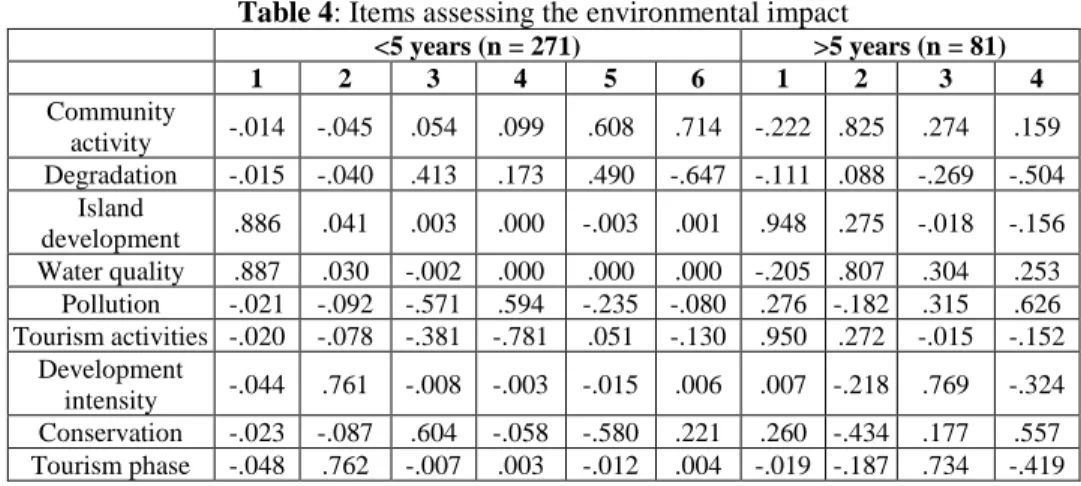
land infertility). Component 1 dealt with the locals' conflict of interests in relation to tourism development undertaken, component 2 related to environmental awareness and quality of life, component 3 assessed the practicality of tourism development and component 4 involved the environmental management practiced by tourism development. Results in addition suggested the suitability of pairing water quality with community activity as well as pollution with development intensity in examining acceptance level, rather than combined with intense development and conservation. When comparing results of tenures, items degradation and tourism activities were found interesting as they only applicable for either tenure. More importantly, results asserted that locals with tenure more than 5 years were more toward in agreement with tourism setback where Perhentian Island is slowly filled with concrete landscape.
Table 4: Items assessing the environmental impact
<5 years (n = 271) >5 years (n = 81)
1 2 3 4 5 6 1 2 3 4
Community
activity -.014 -.045 .054 .099 .608 .714 -.222 .825 .274 .159 Degradation -.015 -.040 .413 .173 .490 -.647 -.111 .088 -.269 -.504
Island
development .886 .041 .003 .000 -.003 .001 .948 .275 -.018 -.156 Water quality .887 .030 -.002 .000 .000 .000 -.205 .807 .304 .253 Pollution -.021 -.092 -.571 .594 -.235 -.080 .276 -.182 .315 .626 Tourism activities -.020 -.078 -.381 -.781 .051 -.130 .950 .272 -.015 -.152
Development
intensity -.044 .761 -.008 -.003 -.015 .006 .007 -.218 .769 -.324 Conservation -.023 -.087 .604 -.058 -.580 .221 .260 -.434 .177 .557 Tourism phase -.048 .762 -.007 .003 -.012 .004 -.019 -.187 .734 -.419
Table 5: Regression on items assessing environmental impact Tenure less than 5 years
•island development is 57.6% influenced by water quality, ß = .576, t(271) = 11.573, p .000; and vice versa
•intense development is 18.6% influenced by tourism phase, ß = .186, t(271) = 3.105, p .000; and vice versa
Tenure less than 5 years
•island development is 100% influenced by tourism activities, ß = 1.000, t(80) = 510.007, p .000; and vice versa
•community activity is 70.3% influenced by water quality, ß = .703, t(80) = 8.836, p .000; and vice versa
•intense development is 48.8% influenced by tourism phase, ß = .488, t(80) = 5.002, p .000; and vice versa
•pollution is 35.0% influenced by development intensity, ß = .350, t(80) = 3.347, p .000; and vice versa
DISCUSSION AND CONCLUSION
this Act should be expanded to cover individuals especially those who are promoting the practices of sustainable tourism.
Second, the locals’ acceptance level with reference to environmental impact was explained by the locals’ enjoying an improvement in the freshwater supply quality, with approximately 85% acceptance level observed. To the locals, the enjoyment was an outcome of their joint responsibility in managing and maintaining the cleanliness of Perhentian Island; rather than recognizing it as one of the benefits brought by tourism development and acknowledging the tourism development strategies undertaken for the island. Nevertheless, results indicated the decreases in quality over time, therefore, emphasized an urgent action to be executed. Third, the locals' acceptance level could also be measured through the level of environmental pollution experienced, which stands at 61% impact level. It is interesting to find that the locals' are accepting the parallel relationship between the intensity of tourism development and the adversity of pollution level. Nevertheless, to this paper, the positive reaction towards additional tourism development might be insinuated by the benefits experienced. Further compounding this is the realization of the non-linear relationship that exists between the positive reaction and the pragmatic tourism development approach practiced. Within this paper interests, both second and third points suggest the force of education and self-awareness crucially manoeuvres one's effort in attaining a better quality of life.
ACKNOWLEDGEMENT
The authors would like to extend their appreciation to the Universiti Sains Malaysia, Ministry of Higher Education, Malaysia under Trans Disciplinary Research Grant Scheme (TRGS) 2017 (Grant Name: Models of Urban Growth Tourism and Vitalization) (203/ppbgn/67611002) for granting the research grant that made this study and paper possible.
REFERENCES
Amir, S., Osman, M. M., Bachok, S., Ibrahim, M., & Zen, I. (2017). Community-based tourism in Melaka UNESCO World Heritage Area: A success in food and beverage sector? Planning Malaysia, 15(1), 89-108.
Arabamiry, S., Abd. Rahim, K., Radam, A., Khademfar, M., & Yacob, M.R (2013). Marine park visitors’ trade-off among marine ecological attributes in Malaysia. International Journal of Business and Social Science, 4(17), 218-228. Azman, A. G. (2001). Petrology and geochemistry of granite and syenite from Perhentian
Island, Peninsular Malaysia. Geosciences Journal, 5(2), 123-137.
Bardolet, E., & Sheldon, P. J. (2008). Tourism in archipelagos: Hawai’i and the Balearics. Annals of Tourism Research, 35(4), 900-923.
Brown, W. S., Morris, R. J., & Murry, T. (1996). Comfortable effort level revisited. Journal of Voice, 10(3), 299-305.
Cater, E. A. (1987). Tourism in the least developed countries. Annals of Tourism Research, 14, 202-226.
Comley, J., Walker, R., Wilson, J., Ramsay, A., Smith, I., & Raines, P. (2004). Malaysia coral reef conservation project: Pulau Redang. Report to the Department of Marine Parks, Malaysia. Retrieved May 12, 2014 from http://www.dmpm.nre.gov.my/
Gatewood, J. B., & Cameron, C. M. (2009). Belonger perceptions of tourism and its impacts in the Turks and Caicos Islands. Retrieved May 12, 2014 from http://www.lehigh.edu/
Gou, Z., Lau, S. S. Y., & Ye, H. (2014). Visual alliesthesia: The gap between comfortable and stimulating illuminance settings. Building and Environment, 82, 42-49 Hamzah, A., & Hampton, M. P. (2011). Tourism development and change in small
islands: Lessons from Perhentian Kecil, Malaysia. Skudai, Malaysia: Centre for Innovative Planning and Development, Universiti Teknologi Malaysia. Kaplan, Y., Tekinay, D., & Ugurlu, A. (2013). Social status of sport: Sport as a social
event, phenomenon and institution. International Journal of Science Culture and Sport, 1(4), 64-69.
Li, Q. (2013). A novel Likert scale based on fuzzy sets theory. Expert Systems with Applications, 40(5), 1609-1618.
Little, D. (2007). Understanding society: What is a social structure? Retrieved August 25, 2015 from http://understandingsociety.blogspot.com/
Liu, O. P., & Halim, S. A. (2011). Planning for heritage tourism: The Case of Langkawi Geopark. Planning Malaysia, 9,121-144.
Nasir, N. M., Ibrahim, M., Mahamod, L. H., & Othman, R. (2017). Challenges to implement carrying capacity framework: A case study of Pulau Perhentian Marine Park institutional framework. Planning Malaysia, 15(1), 163-168. Mohd Salleh, N. H., Othman, R., & Harun, N. F. A. (2010). The impact of marine park
gazettement to local community sustainable livelihood: A case study of Redang and Tioman Islands. Retrieved May 12, 2014 from http://mpra.ub.uni-muenchen.de/
NUS Dive Club (2013). Leisure trip to Perhentian Islands. Retrieved December 23, 2014 fromhttp://nusdiveclub.org/
Ramdas, M., & Mohamed, B. (2014). Visitor perceptions on the impacts of tourism activities, development and infrastructure on the environment of Perhentian Islands. SHS Web of Conferences 12, 010801 (2014).
Ramkissoon, H., & Mavondo, F. T. (2015). The satisfaction-place attachment relationship: Potential mediators and moderators. Journal of Business Research, 66(12), 2593-2602.
Rasoolimanesh, S. M., Jaafar, M., Marzuki, A., & Abdullah, S. (2017). Tourist’s perceptions of crowding at recreational sites: The case of the Perhentian Islands. An International Journal of Tourism and Hospitality Research, 28(1), 41-51
Salmond, J. L. (2010). The social relations of tourism on the Perhentian Islands (Doctorate dissertation). University of Kentucky, USA.
Smith, S. L. J. (1994). The tourism product. Annals of Tourism Research, 21(3), 582-595. Stylidis, D., Terzidou, M. & Terzidis, K. (2007, September). Island tourism and its
socio-economic impacts. MIBES. September 29-30, 2007, Larissa, Greece.
Tan, W. H., & Teh, T. S. (2001). Sustainability of island tourism resorts: A case study of the Perhentian Islands. Malaysia Journal Tropical Geography, 30(1&2), 51-68.
Tourism Malaysia (2018). Malaysia tourism statistics in brief. Retrieved October 15, 2018 from https://www.tourism.gov.my/
UKessays (2015). The environment of Perhentian Island, Malaysia. Available at http://www.ukessays.com/
Wilterdink, N. (2015). Social structure. Retrieved August 25, 2015 from http://global.britannica.com/ topic/social-structure
Wong, K. W. (2016, October 13). Langkawi remains a magnet for tourists. Retrieved from https://www.edgeprop.my/
Zaie, M. E., & Zaie, M. E. (2013). The impacts of tourism industry on host community. European Journal of Tourism Hospitality and Research, 1(2), 12-21