Design of Sequencing Medium Access
Control to Improve the Performance
of Wireless Networks
P. Venkata Krishna and N. Ch. S. N. Iyengar
School of Computing Sciences, VIT University, Vellore, IndiaThis paper presents a technique for accessing channel based on sequencing technique for 802.11 wireless net-works. The objective of this method is to reduce, as well as to avoid the number of collisions while accessing channel by many nodes at the same time. A concept of sequence number is introduced to avoid collisions. The transmission of a node takes place after checking the sequence number. MAC layer issues are very important while accessing channel over wireless networks. Simula-tion results show that the performance of sequence MAC is improved significantly when compared with legacy MAC.
Keywords: QoS, 802.11 MAC, DCF, sequencing etc.
1. Introduction
In wireless network, multiple stations contend for access to the shared channel. The cost of collision detection in wireless networks is much higher than in wired networks since sta-tions cannot detect the collision without explicit feedback from the receiver. For this reason, more efficient contention resolution algorithms are desired for wireless networks to reduce the collision probability among various contending stations. In wireless networks, a station usually can only learn about a collision when the trans-mission is finished and the expected acknow-ledgment does not come back. Consequently, a collision will cause for last of the entire packet transmission duration resulting in higher colli-sion cost in wireless networks compared with wired networks.
In wireless networks, the MAC protocol is the main element that determines the efficiency of
overheads by minimizing the backoff procedure intervals among the nodes.
This paper investigates the robustness of the se-quencing method and presents a study on its performance. The next section of the paper describes preliminaries of wireless MAC and its issues. The overview of existing approach is discussed in Section 3. Section 4 presents’ related works and Section 5 describes sequenc-ing MAC and its performance issues. Finally, Section 6 gives results and discussions on the sequencing technique followed by conclusions.
2. Preliminaries
Generally, MAC protocols are classified into two types i.e., centralized (reservation-based) and distributed (contention-based) protocols. Reservation-based protocols are used in access point-based networks (single hop networks). The access point uses polling concept before assigning channel to a node. These reserva-tion protocols have to provide quality of service (QoS)guarantees for real-time traffic. In Cen-tralized protocols, central controller is respon-sible for accessing wireless channel. 802.11e uses PCF (Point Coordination Function) for Centralized protocols. Contention-based proto-cols are distributed algorithms that allow nodes in an ad hoc network (multi hop network) to be able to communicate effectively over the shared channel and are largely based on Carrier Sense Multiple Access with Collision Avoid-ance (CSMA/CA). ALOHA, HIPERLAN, MACAW, and IEEE 802.11 Distributed Func-tion(DCF)are just some of the many contention-based protocols that have been proposed. In general, contention-based protocols are use-ful to increase channel capacity as reservation-based protocols underutilize the channel. Fur-thermore, contention-based protocols will be more able to meet dynamic requirements and demands of a wireless network along with QoS guarantees. The distributed protocol does not require any co-ordination for wireless channel access. CSMA protocol is the known method of channel access for distributed protocols. The IEEE 802.11 uses DCF (Distributed Coordina-tion FuncCoordina-tion)for distributed protocols[1][2][4] [6][7].
The IEEE 802.11 DCF supports two basic ac-cess methods i.e., acac-cessing the channels with and without RTS(Request To Send)/CTS(Clear To Send) handshake. The use of RTS/CTS handshake is avoiding the problems of hidden nodes and exposed nodes.
Hidden node: If a node is located within the transmission range of the receiver, but not of the sender, it will not hear the packet exchange and may start sending the packet to the same receiver. This results in costly data packet col-lisions. Such a node is called a hidden node. In a wireless network, every node has a signal receiving range and a carrier sensing range. A node cannot receive any packet from beyond its receiving range and cannot sense any neigh-boring transmission beyond the carrier sensing range. Assuming that these two ranges are equal, we can have a scenario where nodes are hidden from each other i.e. outside the range and cause costly data packet collisions.
Exposed node problem arises when the sens-ing mechanism prevents parallel transmission, from two or more terminals, toward receivers that would not observe collision, as the receivers are located far apart.
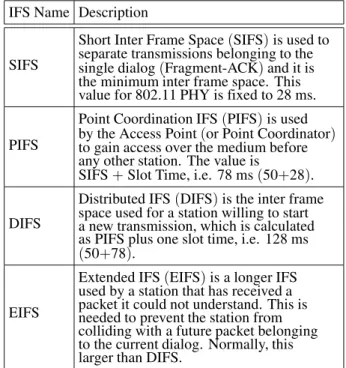
Inter Frame Space: The 802.11 DCF proto-col uses various time intervals between frames called Inter Frame Spaces (IFS). The 802.11
IFS Name Description
SIFS
Short Inter Frame Space(SIFS)is used to separate transmissions belonging to the single dialog(Fragment-ACK)and it is the minimum inter frame space. This value for 802.11 PHY is fixed to 28 ms.
PIFS
Point Coordination IFS(PIFS)is used by the Access Point(or Point Coordinator)
to gain access over the medium before any other station. The value is
SIFS+Slot Time, i.e. 78 ms(50+28).
DIFS
Distributed IFS(DIFS)is the inter frame space used for a station willing to start a new transmission, which is calculated as PIFS plus one slot time, i.e. 128 ms
(50+78).
EIFS
Extended IFS(EIFS)is a longer IFS used by a station that has received a packet it could not understand. This is needed to prevent the station from colliding with a future packet belonging to the current dialog. Normally, this larger than DIFS.
DCF protocol uses the IFS to determine the medium is idle through the use of the carrier-sense function for the interval specified. Four different IFSs are defined to provide priority levels for access to the wireless media and they are listed in the above Table 1.
3. Overveiw of the 802.11 DCF Protocol
The IEEE 802.11 MAC layer protocol provides asynchronous, time-bounded, and contention-free access control on top of physical layer. The basic access method in the IEEE 802.11 MAC protocol is the distributed coordination function (DCF) which is a CSMA/CA MAC protocol. In addition to the DCF, the IEEE 802.11 also in-corporates an alternative access method known as the point coordination function (PCF) – an access method that is similar to a polling system and uses a point coordinator to determine which station has the right to transmit.
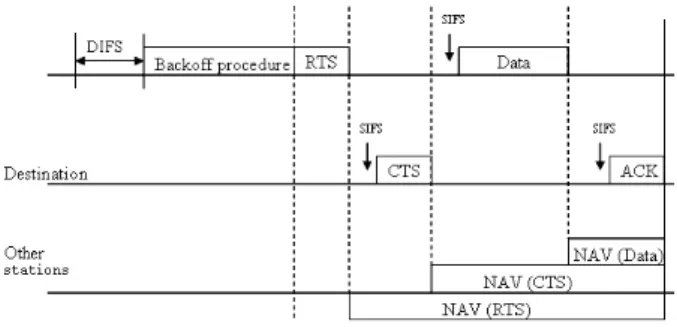
Figure 1.802.11 DCF protocol.
In DCF protocol, as shown in Figure 1, a node senses the channel for ongoing transmissions before sending a packet. If the channel is al-ready in use, the node waits for a free DIFS and a random backoff time before re-attempting the transmission. If another station is using the medium during the backoff time of the station, the backoff timer stops. On the other hand, if the channel is not currently in use i.e., if the channel is idle during DIFS, the node begins transmission.
This method uses only DATA frames and ACK frames. The station wishing to send a data frame first senses the channel and may proceed with transmission of a DATA frame if the medium is sensed to be idle for an interval larger than DIFS.
When the DATA frame is transmitted, all other stations hearing the frame set their network allo-cation vector, NAV, based on the duration field value in the data frame received. The duration field in the data frame includes the SIFS and the ACK frame transmission times following the DATA frame. By using this virtual carrier sensing mechanism, all stations that hear the DATA frame will refrain from transmitting dur-ing the ACK frame transmission, thus reducdur-ing the frame collisions. If the medium is busy, the transmitting station will wait until the end of the current transmission. It will then further wait for an additional DIFS time period, and then the station defers for a random backoff period before transmitting. Having received a DATA frame correctly, the destination station waits for a SIFS interval immediately following the re-ception of the DATA frame, and then transmits an ACK frame back to the source station, indi-cating that the DATA frame has been received correctly. As when a station becomes ready to transmit, it senses the medium for a period of DIFS. If the station senses that the medium is busy during this interval, it defers transmis-sion to later time which depends on the backoff time. The backoff time is calculated using the following relationship.
Backoff Time=Random()* aSlotTime(3.1)
Random() is a value in the interval [0,CW], where CW, Contention Window, takes a value between aCWmin and aCWmax i.e. aCWmin
<CW<aCWmax. The values of aCWmin and aCWmax are defined for Physical layer. aSlot-Time is the value of the defined by the physical layer(PHY characteristic) [6] [7].
frame)which initiates the transmission of an ac-knowledgment frame after a time interval, SIFS, which is less than the DIFS. If an acknowledg-ment is not received, the data frame is presumed to have been lost, and a retransmission will take place.
In IEEE 802.11 DCF all stations begin their contention resolution stage(i.e., random back-off stage) after the channel has become idle. Therefore, the chosen range of random backoff period is critical to the performance of the MAC protocol.
The DCF has another backoff procedure known as binary exponential backoff(BEB) [4][13]to resolve channel contention. In this, a station that wants to transmit a data packet must first carrier-sense the medium. If the channel is idle for at least DIFS duration, the node randomly picks a backoff counter value. This value is drawn from a uniform distribution over the in-terval [0, CW-1], where CW is the size of the node’s contention window. If the medium is sensed to be busy, the node must defer its trans-mission until the medium is idle for at least DIFS duration before selecting a backoff value. The backoff value represents the number of idle slots a node has to wait before it can transmit. For each idle slot it senses on the channel, the node decrements its backoff counter by one. If the channel is sensed to be busy, the node freezes its backoff counter until the channel is idle for at least the DIFS duration before it resumes decre-menting the counter.
When the backoff counter reaches 0, it transmits an RTS. If a node receives an RTS, it replies with CTS. Upon receiving the CTS, the node then transmits the data packet, which is then replied with an ACK. All the nodes that overhear either the RTS or the CTS set their Network Alloca-tion Vector (NAV) for this duration and defer transmitting while their NAV is set. As a conse-quence, this allows for the collision-free trans-mission of the data and ACK. This mechanism of deferring transmission based on the NAV is known as virtual carrier sensing and it effec-tively reserves the channel. The combination of the virtual and physical carrier sensing mecha-nisms ensures that collisions only occur when two nodes pick the same slot to transmit. Since
a node cannot sense the medium while trans-mitting, an absence of a reply(i.e., a CTS or an ACK)is taken as an indicator that a collision has occurred. When this happens, the node doubles its contention window and reselects a new back-off value. The nodes that sense the collision will set their NAV to the Extended Inter-frame Space(EIFS)duration. This duration is defined to allow an ACK to be successfully transmitted before other transmissions recommence. As the number of collisions increases, nodes exponen-tially increase their contention windows so as to reduce the probability of another collision. A node starts with its CW=CWmin and with each collision it doubles its backoff value until it reaches the maximum value of CWmax. The values of CWmin and CWmax depend on the physical layer used. Once the node is success-ful in its transmission attempt, it resets its CW back to the minimum value. The total duration of one successful packet transmission, which is the interval between the end of the last success-ful transmission and the reception of the ACK for the current packet, is known as one trans-mission cycle.
4. Related Works
the Sequencing Technique which reduces the number of collisions. The basic Sequencing Technique is explained in[14, 15]. In this paper, we present DCF-based channel access based on the Sequencing Technique. The proposed Se-quencing MAC minimizes the number of col-lisions by restricting the nodes from transmis-sion, if their sequence number saturates. Also, this paper presents the performance analysis of the Sequencing MAC over DCF protocol. We have done our simulations using NS-2 simula-tor and the results show that the performance of Sequencing MAC is good.
5. Sequencing MAC
The basic sequencing method sets a value called sequence number ‘K’ to all the nodes so that each node has to limit its transmissions to less than or equal to ‘K’ in a time slot. The sequenc-ing number will be assigned to every node be-fore it accesses the medium. As the number attempts are limited during a time slot, the se-quencing technique reduces number collisions. The cost of implementing sequencing technique will be minimal because use of the simple coun-ters is sufficient. The collisions are avoided by comparing the counter values of contending nodes. A node having a less counter value will be deferred from transmission. The sequenc-ing technique is significantly reducsequenc-ing number of collisions when compared with legacy MAC protocols.
There are two methods exist while accessing medium access i.e., i)With RTS/CTS ii) With-out RTS/CTS. The RTS/CTS mechanism is used to avoid the problems of hidden node and exposed nodes. In this, if a node wants to trans-mit a packet, first it sends RTS packet to the destination. There is only the need for control channel procedure before accessing the channel in the case without RTS/CTS method.
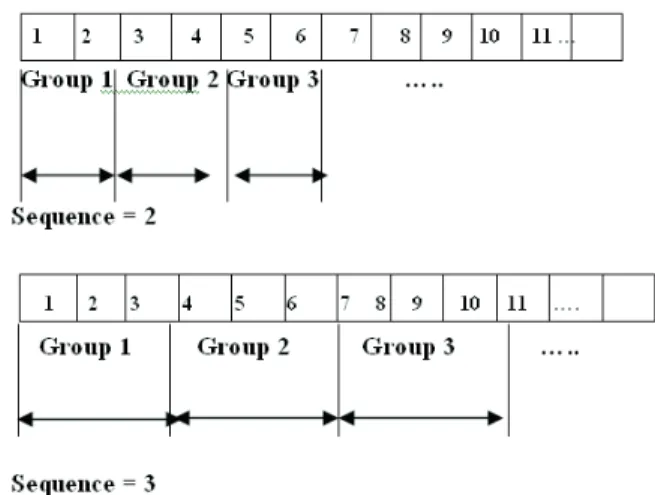
The following figure shows an example scenario of how the RTS packets are grouped for each se-quence value. The numbers 1 to 11 and so on refer to the RTS packet number transmitted by that particular node.
Figure 2.Example scenario for grouping of RTS.
The above discussed sequence value pairs are used to selectively drop RTS packets. The ques-tion that arises is how dropping of RTS packets, irrespective of the network conditions, results in improving the performance of the networks? The sequencing technique is used to drop pack-ets so that we refrain from initiating a data trans-fer from one node to another, which may later prove to be costly if a data packet collision oc-curs due to any of the problems elucidated in previous sections.
When a Data/Acknowledgement packet colli-sion occurs, the whole contention resolution phase followed by the RTS/CTS exchange is repeated. This leads to loss of time and the net throughput low.
Dropping RTS avoids such situations and the concept of sequencing is implemented for the above-mentioned reasons. With increasing value of sequence and number of nodes, lesser num-ber of RTS packets are dropped thereby making the system coverage a steady state.
Figure 3.Timeline Analysis.
It is observed from Figure 3 that the total num-ber of transmissions from three nodes is 24 and number of packets successful is 17. Also, the number of collisions is very minimal i.e., one, and the number of packets dropped is four. Re-ducing the number of collisions is the main ad-vantage of the sequencing technique. Number
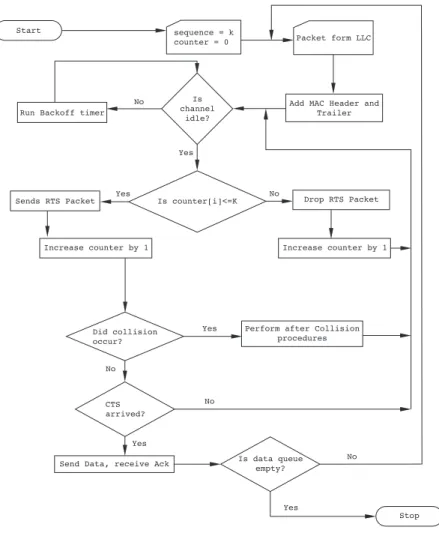
of collisions will increase to four if sequencing technique is not used and the number of packet losses will be 11 for the above example shown in Figure 3. Figure 4 shows the flow diagram for sequencing technique.
1) start
2) initialize seq = k, counter = 0; 3) add MAC header to the data
packet arrived from LLC 4) for i= 1 to n
5) {
6) if (channelaccess[n])
7) if(counter[n]<= K)send (RTS packet) 8) else drop (RTS packet);
9) counter = counter+1 10) }
11) if (collision == true){recovey(); goto 3} 12) if(cts){send(data); receive (ack);
if(queue == null) stop(); else goto 3;}
Sequencing Algorithm
The simulations are performed using NS2 and the performance of the sequencing technique is discussed in the next section.
6. Results and Discussions
In this section we present performance of se-quencing technique. The results are obtained using Network Simulator tool. The perfor-mance of sequencing technique is compared with 802.11 MAC DCF. The simulations are performed by increasing number of nodes as well as sequence number, K.
Figure 5.Comparison of throughput for MAC 802.11 and MAC 802.11Seq for Four Nodes.
Figure 6.Comparison of throughput for MAC 802.11 and MAC 802.11Seq for Six Nodes.
6.1. Four Node Scenario
Let us now consider the 4-node scenario shown in Figure 5. The performance analysis is done by taking different values of sequence numbers and the throughput of the system is estimated for 802.11Seq with the throughput for MAC-802.11.
The observation from Figure 5 is that the put for MAC-802.11Seq crosses the through-put line for MAC-802.11 at many places. The throughput for MAC-802.11Seq is 341 at the sequence value 34. The throughput for MAC-802.11 is 320.
6.2. Six Node Scenario
Let us now consider the 6-node scenario shown in Figure 6. The performance is shown by obtaining the throughput for MAC-802.11Seq with the throughput for MAC-802.11 while in-creasing sequence numbers.
It is observed from Figure 6 that the through-put for MAC-802.11Seq is 333 at the sequence value 51. The throughput for MAC-802.11 is 300.
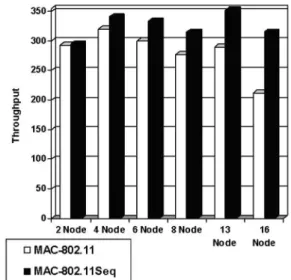
Finally, Figure 7 shows overall throughput com-parison of 802.11 seq and 802.11 at various nodes. It is observed that the throughput of the sequencing technique is improved signifi-cantly when compared with legacy system. Our
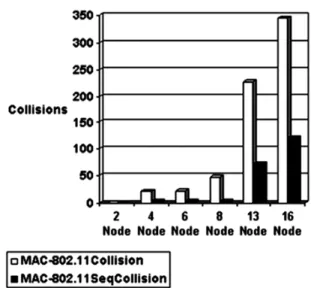
Figure 8.Comparison of collisions for different numbers of Nodes.
experiments show that the performance of se-quencing technique is increased to 79% when compared with legacy systems. And there is 50% minimum decrease in collisions.
Our simulation proves that the number of col-lisions can be reduced using MAC 802.11 seq method and the performance graph is shown in the following Figure 8.
7. Conclusion and Future Work
A sequencing medium access method is pre-sented in this paper. It is observed that a design of sequencing medium access protocol reduces the number of collisions and increases overall throughput of the network. The performance of the sequencing technique depends on the se-quence number as it is observed that throughout the system it improves when there is a increase in sequence number. Also, collisions are re-duced when sequence number is increased. Op-timal value of sequence number depends on net-work conditions. A study of Sequencing MAC on other wireless networks like sensor networks will be the scope for future work.
References
[1] J. CHOI, J. YOO, S. CHOI, C. KIM, EBA: An En-hancement of the IEEE 802.11 DCF via Distributed Reservation. IEEE Trans. On Mobile Computing,
4(4) (July/August 2005), pp. 378–390.
[2] N. VAIDYA, S. GUPTA, P. BAHL, Distributed Fair
Scheduling in Wireless LAN.IEEE Trans. On Mo-bile Computing,4(6) (November/December 2005), pp. 616–628.
[3] F. FITZEK, A. KOPSEL, A. WOLISZ, M. KRISHNAM,
M. REISSLEIN, Providing Application-Level QoS
in 3G/4G Wireless Systems: A Comprehensive Framework Based on Multirate CDMA.IEEE Wire-less Communications,(April 2002).
[4] W. PATTARA-ATIKOM, P. K. MURTHY, S. BANAR -JEE, Distributed Mechanisms for Quality of Service (QoS)in Wireless LANs.IEEE Wireless Communi-cations,(June 2003).
[5] V. MARQUES, R. L. AGUIAR, C. GARCIA, J. I.
MORENO, C. BEAUJEAM, E. MELIN, M. LIEBSCH,
An IP-based QoS Architecture for 4G Operator Scenarios.IEEE Wireless Communications, (June 2003).
[6] S. MANGOLD, S. CHOI, G. R. HIERTZ, O. KLEIN, B.
WALKE, Analysis of IEEE 802.11E for QoS Support
in Wireless LANs.IEEE Wireless Communications,
(December 2003).
[7] H. ZHU, M. LI, I. CHLAMTAC, B. PRABHAKARAN, A
Survey of Quality of Service in IEEE 802.11 Net-works. IEEE Wireless Communications, (August 2004), pp. 6–14.
[8] J. SCHILLER,Mobile Communications.Pearson
Ed-ucation Limited, 2001.
[9] NS2SIMULATOR,
http://www.isi.edu/nsnam/ns/tutorial/ ns.html
[10] K. TAKAHASHI, T. TSUBOI, A Backoff Algorithm for
Improving Saturation Throughput in IEEE 802.11 DCF.
http://www.eurasip.org/Proceedings/Ext/ IST05/papers/368.pdf
[11] Y. NISHIDA, Enhancing 802.11 DCF MAC for
TCP/IP Communication. Proc. of WCNC 2005, IEEE Communications Society,(2005), pp. 1620– 1625.
[12] H. KIM, J. C. HOU, Improving Protocol
Capac-ity with Model-based Frame Scheduling in IEEE 802.11-operated WLANs.Proc. of MobiCom 2003, ACM,(September 2003), pp. 190–204.
[13] P. KARN, MACA – A New channel access method
for packet radio. Proc. of 9th ARRL Computer Networking conference,(1990), pp. 134–140.
[14] P. V. KRISHNA, N. CH. S. N. IYENGAR, Sequencing
Technique: an enhancement to 802.11 medium access control to improve the performance of wire-less networks. Int. J on Computer Networks and Distributed Systems, (in press),(2007).
[15] P. V. KRISHNA, A Study of Quality of Service
Received:February, 2007
Accepted:November,2007
Contact addresses:
P. Venkata Krishna School of Computing Sciences VIT University Vellore TN India e-mail:[email protected]
N. Ch. S. N. Iyengar School of Computing Sciences VIT University Vellore TN India
P. VENKATAKRISHNAis a Senior Lecturer at School of Computing
Sciences, VIT University, Vellore, India. He received his B. Tech in Electronics and Communication Engineering from Sri Venkateswara University, Tirupathi, India, M. Tech in Computer Science & Engi-neering from REC, Calicut, India and he is doing his Ph.D. at VIT University, Vellore, India. His research interests include mobile and wireless systems and grid computing. He has published several pa-pers in national and international journals. He was the editor of 2003, 2004 and 2006 ObCom International conference proceedings and he is a founding member of ObCom International Conference. He has authored several books on Computer Networks and Programming Lan-guages. He is the reviewer for many reputed journals like IET Journal on Communications, International Journal of Security and Networks
(IJSN)etc.
DR. N. CH. S. N. IYENGARis a Professor at the School of Comput-ing Sciences at VIT University, Vellore India. He received his M.Sc