Aliso: A Journal of Systematic and Evolutionary Botany
Volume 14 | Issue 4
Article 6
1995
Does the Monocot Mode of Leaf Development
Characterize all Monocots?
Geeta Bharathan
University of California, Davis
Follow this and additional works at:
http://scholarship.claremont.edu/aliso
Part of the
Botany Commons
Recommended Citation
Bharathan, Geeta (1995) "Does the Monocot Mode of Leaf Development Characterize all Monocots?,"Aliso: A Journal of Systematic and Evolutionary Botany: Vol. 14: Iss. 4, Article 6.
© 1996, by The Rancho Santa Ana Botanic Garden, Claremont, CA 91711-3157
DOES THE MONOCOT MODE OF LEAF DEVELOPMENT CHARACTERIZE ALL MONOCOTS?
GEETA BHARATHAN
Agronomy and Range Science University of California Davis, California 95616
FAX: 916/152-4361 e-mail: grbharathan@ ucdavis. edu
ABSTRACT
Patterns of early leaf development in monocots are analyzed in a phylogenetic context. Recent developmental and phylogenetic studies enable this reevaluation of the leaf base model of the devel-oping monocot leaf. Two questions are addressed: a) is the presence of the Vorlauferspitze (fore-runner tip) invariably correlated with development of the lamina from the lower leaf zone? and b) was the ancestral monocot characterized by the leaf base mode of development? Scanning electron microscopic observations are made of young primorida using the mold and cast method. These data are combined with data from the literature and examined in a phylogenetic context using parsimony analysis. The results suggest that in some taxa the Vorlauferspitze may be associated with a lamina that is derived from the upper leaf zone, and that the ancestral monocot may not have been characterized by the leaf-base mode of development. It is concluded that the leaf-leaf-base model, in a strict sense, may apply to a nested subset, but not all, of the monocotyledons.
Key words: development, evolution, leaf, leaf-base model, monocotyledons, morphology, phylogeny, Vorlauferspitze.
INTRODUCTION
A key question in the study of monocot leaf mor-phology has been whether the linear parallel-veined lamina of the monocot leaf is homologous to the broad reticulate-veined leaf of the dicot leaf. Early anatom-ical and morphologanatom-ical studies suggested that the monocot blade is a bifacially flattened dicot petiole (Arber 1918). Developmental studies revealed differ-ences in the origin of the lamina in the two classes and led to the "leaf base" model of development for the monocot leaf (Troll 1939; Knoll 1948; Kaplan 1970, 1973). Dicots and monocots differ in the origin of the lamina, which develops from the upper leaf zone in dicots and from the lower leaf zone in monocots (Fig. 1). It was shown that the lamina of so-called unifacial leaves of monocots develops from the lower leaf zone, as do the laminae of linear leaves, e.g., San-sevieria, and broad leaves, e.g., Hosta. Both linear and broad leaves were associated with a unifacial structure at the tip, the Vorlliuferspitze, that was used as a di-agnostic feature for the leaf base mode of develop-ment. Since the Vorlliuferspitze occurs in several mon-ocots it was suggested that the lamina in most mono-cots is derived from the lower zone and is therefore not homologous to the lamina of dicots (Kaplan 1973). The assumption was that the Vorlliuferspitze is invari-ably associated with a lamina that develops from the lower leaf zone. At the same time, Kaplan noted that there exists a wide range of morphological variation
within the monocots that needed to be further studied in order to apply the model more generally.
The conclusion that the laminae in monocots and dicots are not homologous, based on a "biological" concept of homology (e.g., Roth 1988; Wagner 1989), was transferred to the evolutionary realm and taken to also imply "historical" (taxic) nonhomology (e.g., Dahlgren and Clifford 1983; Donoghue and Doyle, 1989). However, the original generalization was based on developmental studies of evolutionarily disparate taxa. Given this data base it is not clear that the "bi-ological" concept can be legitimately converted to the "historical" concept without making major assump-tions. One such assumption is that the ancestral mono-cot had the leaf base mode of development.
Nymphae-272
Dicotyledons
Leaf zones in cross section Upper, unifacial 0 Upper, bifacial a Lower, bifacial •
Monocotyledons
(al/:'/
0 •~
- / (b10
unifacial ./ A
{~)~
-Q
(Alli!im) lineart
0(d) a (c) •
bifacia:- •
(Sagittaria, Carludovica)
bifacial (J::!Qili.)
Fig 1. Morphological model of leaf development in monocoty-ledons. Early primordia consist of an unifacial upper zone (white) and a bifacial lower zone (stippled). In dicotyledons the upper zone differentiates into a lamina, the lower zone differentiates into the leaf base and stipules, and the petiole is intercalated later. In mon-ocots a greater variety of developmental patterns is seen. According to early formulations of the model (a~) the upper zone differenti-ated into unifacial laminae and the lower zone differentidifferenti-ated into bifacial laminae. Later formulations also included bifacial forms de-rived from the upper zone (d).
ales and putative early lineages such as the Dioscore-ales that have not so far featured in the discussion.
In this paper I examine two assumptions of the leaf base model of leaf development alluded to above, pos-ing them as two questions:
1) Is the Vorlliuferspitze invariably correlated with development of the lamina from the lower leaf zone?
2) Was the lamina of the ancestral monocot derived from the lower leaf zone?
MATERIALS AND METHODS
Plant Materials
Young shoot apices were obtained from plants growing in the greenhouses of the University of Cal-ifornia at Davis. The species sampled were
Aristolo-chia fimbriata Cham. (B90.073); A. labiata Willd.
(B82.152); Butomus umbellatus L. (GB127, UA
Her-barium); Calathea lietzii E. Morr. (B88.033); Cryptan-thus sp. (B90.051); Dioscorea discolor Kunth.
(B93.330); Dioscorea sp. (B00.069); Gloriosa superba
L. (B63.339); Lapageria rosea Ruiz and Pav.
(B63.11 ); Philodendron variifolium Schott (B81.603); Piper crocatum Ruix and Pav. (B89.235); P. nigrum L. (B74.003); P. hispidum H. B. and K. (B00.604); Scindapsus pictus (B00.763). Specimens of all except Butomus umbellatus have been deposited at either the John Tucker Herbarium, University of California, Da-vis, or the herbarium at the University of Arizona, Tuc-son. Numbers in parentheses are accession numbers of the Botany Collections Greenhouse. Except for Scin-dapsus pictus, whose juvenile stage is the one
culti-ALISO
vated, plants were mature and the shoots sampled were producing adult leaves. It is assumed that the early stages of development observed here are stages in de-velopment of adult leaves. Shoots were dissected un-der water using a binocular research microscope (Zeiss STEMI V8).
Mold and cast technique.-Molds were made using dental vinyl silicone and casts using epoxy resin (Wil-liams, Vesk and Mullins 1987; Williams and Green 1988; Jernstedt et al. 1992). Impressions were made of successive primordia on the same shoot. Observa-tion of primordial stages at plastrochrons one to three (p1-p3) provided the necessary information in most cases. Primordial stages of up to p7 were studied in taxa such as the Dioscorea spp. and Lapageria roseus in order to determine the origin of the lamina.
Scanning electron microscopy (SEM).-The casts ob-tained were mounted on stubs, sputter coated with gold, observed with a scanning electron microscope (SEM, Hitachi 450), and digital images captured and stored using the software package SEMICAPS.
Phylogenetic hypotheses.-Topologies used in this study were based on recent morphological and molec-ular studies (Bharathan 1993; Duvall et al. 1993a, b; Bharathan and Zimmer 1995; Chase et al. 1995a, b). The topologies were pruned to either eliminate taxa for which developmental data are not available, or to accommodate differences in taxon sampling among different phylogenetic studies. Analyses using the rbcL topology were done with and without the Cy-clanthaceae. The general pattern in all the phylogenetic studies (barring the studies of Chase et al., which had no bootstrap analyses) is one of relatively poor boot-strap support for deeper branches and strong support for nested clades in these studies. The differences
be-tween the morphological and molecular data lie largely in the rooting. The exemplar topologies used here may serve to take into account weakly supported branches in the different studies.
Character reconstruction.-Features of leaf primordia were encoded as binary traits. Parsimony reconstruc-tion of these traits was done on topologies of monocot relationships obtained from above using MacClade 3.0 (Maddison and Maddison 1992). Points of agreement between all reconstructions (including differences be-tween topologies and alternative reconstructions on a single topology) provided the basis for conservative conclusions regarding ancestral states. These conclu-sions were used to infer trends in character evolution.
RESULTS AND DISCUSSION
Variation in Development
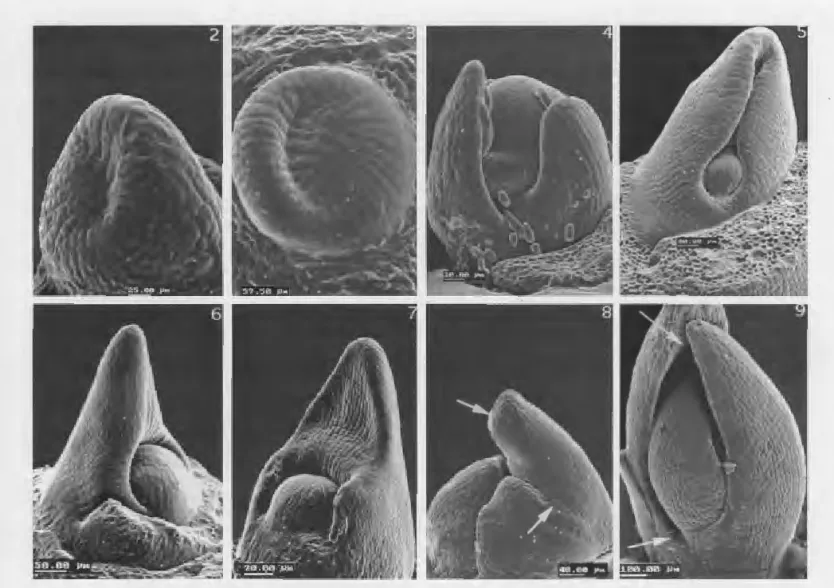
Fig. 2-9. SEM pictures of leaf primordia at plastochrons one through five (pl-p5).-2. Scindapsus pictus, pl. "Terminal," massive. -3. Tradescantia pendula, pl. Lateral, narrow.--4. Dioscorea sp., pl-p4. Base partially sheathing.-5. Calathea lietzii, p2. Base completely
sheathing.-6. Cryptanthus sp., p2. Apex thickened.-7. Piper crocatum, p2. Apex not thickened.-8. Smilax bona-nox, p3. Lamina
develops from upper leaf zone, above tendril-forming leaf base (between arrows).-9. Lapageria rosea, p5. Lamina develops from lower
zone, below thickened apical portion (between arrows).
of the upper and lower leaf zones may be classified into horizontal and vertical components. The horizon-tal component describes: a) the position of the pri-mordium-whether lateral (Fig. 3) or nearly terminal
(Fig. 2); b) the encirclement of the shoot apex by the
lower zone-whether partial (Fig. 4) or complete (Fig.
5); and c) the thickening of the upper leaf zone-whether present, as in unifacial leaves and leaves with
a VorHiuferspitze (Fig. 6), or absent (Fig. 7). The
ver-tical component describes a) development of the lower
zone-whether it develops into a stipule (Fig. 8), or
not, either undergoing limited growth (Fig. 7) or
de-veloping into a lamina (Fig. 9), and b) development
of the upper zone-whether it develops into a lamina (Fig. 8) or not (Fig. 9).
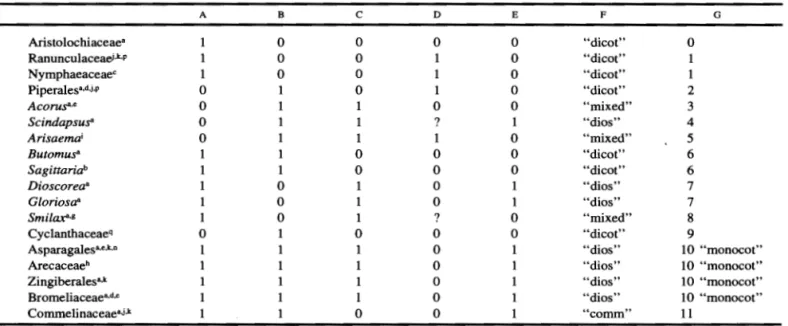
The data obtained were coded as binary traits. In-formation on monocotyledons obtained from other studies were similarly coded, and these data are
pre-sented as a matrix of 16 taxa and 5 characters
(Col-umns A-E, Table 1).
The lamina develops from the lower leaf zone in
most of the monocots studied, as expected from the
leaf base model of development. On the other hand,
the lamina develops from the upper leaf zone in
Smi-lax, Piper, Saururus, and Aristolochia. This pattern is
expected for dicots but not for the monocot, Smilax.
However, this pattern of development has been
de-scribed previously in some monocots (Wilder, 1976;
Bloedel and Hirsch, 1979), and may be inferred for
others (Arisaema: Figs. 12, 13 in Periasamy and
Mu-ruganathan 1986; and Smilax: Figs. 5, 6 in Martin and
Tucker 1985). The Araceae is apparently variable, as
seen from the two modes of development observed in
Scindapsus and Arisaema. However, sampling of this
large family is rather limited, and conclusions about
the possible ancestral state within the family cannot be
made with any certainty at this point.
The further surprising observation is that the pattern
of development where lamina is derived from the
Vor-274 ALISO
Table 1. Early development of the leaf in monocotyledons and outgroups. Horizontal growth: A, Position on shoot apex (0 = sub-terminal, 1 = lateral); B, Lower zone, encirclement (0 = partial, 1 = complete); C, Upper zone, thickening of tip (0 = not thickened, 1 = thickened). Vertical growth: D, Lower zone, intrapetiolar stipule (0 = no stipule, 1 = stipule). The "stipular" outgrowth in Smilax and Scindapsus are coded as ? since their development differs from that of intrapetiolar stipules in the dicots); E, Upper zone, lamina (0 = lamina, 1 = no lamina); Combined characters (see text): F, Leaf tip (combination of characters C, E); G, Primordial type (combination of characters A-E). Superscripts indicate sources: (a) this paper; (b) Bloedel and Hirsch, 1979; (c) Cutter, 1957; (d) Hagemann 1960; (e) Kaplan 1970, 1973; (f) Knoll 1948; (g) Martin and Thcker 1985; (h) Perisamy 1962, 1965; (i) Perisamy and Muruganathan 1986; (j) Rohweder and Endress 1983; (k) Roth 1949; (1) Rudall 1990; (m) Snow 1952; (n) Troll 1955; (o) Thielke 1948; (p) Weberling 1970; (q) Wilder 1976. In some cases a particular point was not discussed in the text, and coding had to be done on the basis of information derived from the figures.
A B c
Aristolochiaceae• 0 0
Ranunculaceaei·k,p 0 0
Nymphaeaceae• 0 0
Piperales•·•·i·P 0 0
Acorns•·• 0
Scindapsus" 0
Arisaema1 0
Butomus• 0
Sagittariab 1 0
Dioscorea• 0
Gloriosa• 0
Smilax"·• 0 1
Cyclanthaceaeq 0 0
Asparagales•·•.k.n 1
Arecaceae• Zingiberalesa.k Bromeliaceae•·•·•
Commelinaceae•J,k 0
lauferspitze. A similiar association has been described for juvenile leaves of the Cyclanthaceae (Wilder 1976). Clearly, the Vorlauferspitze may be associated with development from the upper leaf zone. This rep-resents a renewed understanding, if not redefinition, of this structure. The Vorlauferspitze can be considered to represent a combination of two atomized features of the upper leaf zone-vertical and horizontal growth. By treating the two traits of the upper region as a binary coded character four states are obtained that represent all pairwise combinations (Column F, Table 1). In the "dicot" type (0) the upper zone forms the lamina whose tip is not thickened; in the "mixed" type
(1
=
Vorlauferspitze) the upper zone forms a lamina whose tip is thickened; in the "dios" type (2=
Vor-lauferspitze) the upper zone does not form a lamina and is thickened; and finally, in the "comm" type (3) the upper zone neither forms the lamina nor is it thick-ened. In the past, the term Vorlauferspitze has been applied to leaves developing from both types of pri-mordia, the "mixed" and "dios" types. Although the term was applied first to mature morphological struc-tures without reference to development, in recent years it has usually been assumed that the Vorlauferspitze develops from primordia of the "dios" type. As noted here, this assumption may not hold universally. Given this historical association, and to avoid confusion, itD E F G
0 0 "dicot" 0
0 "dicot"
0 ''dicot'' 1
1 0 "dicot" 2
0 0 ''mixed'' 3
? 1 "dios" 4
1 0 "mixed" 5
0 0 "dicot" 6
0 0 "dicot" 6
0 "dios" 7
0 1 "dios" 7
? 0 ''mixed'' 8
0 0 "dicot" 9
0 "dios" 10 "monocot"
0 "dios" 10 "monocot"
0 "dios" 10 "monocot" 0 "dios" 10 "monocot"
0 ''comm'' 11
may be best to apply the term Vorlauferspitze to leaves developing from primordia of the "dios" type.
Character evolution
All five traits were optimized on different topologies and conclusions were drawn about character evolution in the conservative way described above. One trait is dicussed in detail below, and general conclusions drawn in other cases.
Vertical growth of the upper leaf zone.-The results
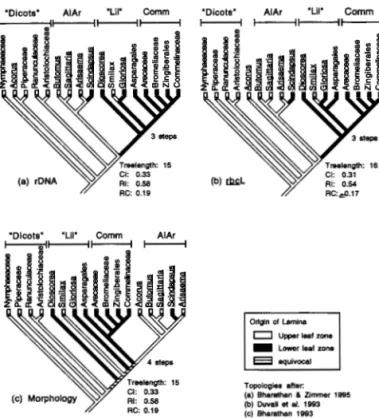
of optimization of this character on three topologies are illustrated in Fig. 10. According to the rDNA tree the ancestral leaf in monocots had a lamina that de-veloped from the upper leaf zone (Fig. lOa). The tran-sition to limited growth of the upper zone occurred once, and there were at least two reversals of this trait
within monocots (in Smilax and unifacial asparagoids,
'Dicots' AlAr 'Lil' Comm 'Dicots' AlAr 'Lil' Comm
1---11---i 1---i 1---i 1---i 1---i 1---i 1---i
I
~~
"
i.;l
IG!I
,
m.d
!Jl
iliiiJ~JlJ!IJ
il11JiiJIJ;JlJil1
(a) rONA
AlAr
1---i
(b)~L
Origin of Lamina c::J Upper leaf zone
- Lower leaf zona E3 equivocal
Topologies after: (a) Bharathan & Zimmer 1995
(b) Duvall et al. 1993
(c) Bharathan 1993
Fig. 10. Parsimony optimization of leaf developmental charac-ter, origin of lamina. Reconstructions on topologies from analyses of-(a). rDNA sequences.-(b). rbcL sequences.-( c). Morphology. ''Lil'' = Liliianae; AlAr= Alismatales-Araceae; Comm = Arecales, Bromeliales, Zingiberales, Commelinales. Tree statistics pertain to all five leaf developmental characters when optimized on the three topologies.
at least two independent origins of limited growth of the upper leaf zone, namely in the Oioscoreaceae, and in the rest of monocots with a reversal in the alismatid-aroid clade. According to the second scenario the de-velopmental pattern in Smilax is a retained feature of the paleoherb ancestor.
Thus, the ancestral monocot may have had a lamina that developed from the upper leaf zone according to molecular and morphological topologies (equivocal support in the latter case). A difference is that devel-opment of the lamina from the upper leaf zone in Smi-lax is a reversal according to the molecular topologies, but a retained ancestral feature according to the mor-phological topology.
Position of the primordium.-The ancestral monocot had lateral primordia and there were two or three or-igins of the subterminal position in the Piperales, Ar-aceae, Acorus and Cyclanthaceae depending upon the topology considered.
Stipule.-The evolutionary scenario varies with the coding adopted. If the monocot taxa with "stipules" are coded as being exstipulate or uncertain, the ances-tral monocot was not stipulate while the ancesances-tral pa-leoherb was probably stipulate. On the other hand, if the Araceae, Alismatales, Smilax, Dioscorea, and Cy-clanthaceae were coded as being stipulate, then the
ancestral monocot was stipulate, and this trait was sub-sequently lost in the clade consisting of commelinoids and asparagoids.
Horizontal growth of the lower leaf zone.-The leaf base was partially sheathing in the ancestral monocot according to the morphological and rONA topologies, suggesting that complete sheathing evolved within monocots. However, according to the rbcL topology the ancestral monocot may have had a completely sheathing base and there were reversals in the Oios-coreales and Liliales.
Horizontal growth of the upper leafzone.-The upper zone was thickened in the ancestral monocot according to the morphological and rONA topologies while the evolutionary trend is more uncertain according to the rbcL topology. This feature is the one commonly de-scribed as the VorHiuferspitze-however, as dede-scribed above, the VorHiuferspitze might be considered to rep-resent the combination of two aspects of the upper leaf zone, and the evolution of such a complex trait is de-scribed below.
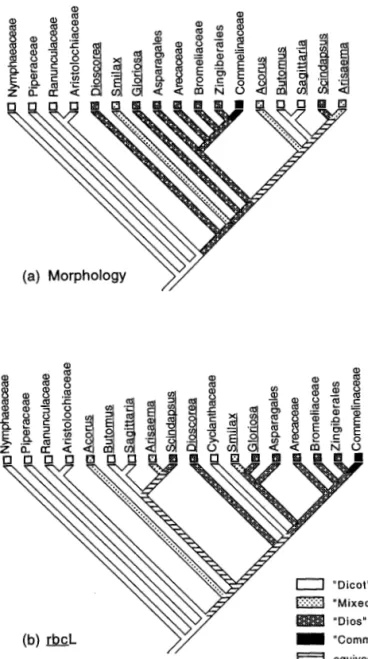
The Vorliiuferspitze and origin of the lamina.-This combined trait, coded in column F of Table 1, is op-timized on two hypotheses of relationships (Fig. 11). The "dios" type may have arisen either once or twice according to the morphology tree, and at least twice according to the rbcL tree. The "mixed" type may have arisen two or three times according to both mor-phology and rbcL trees, there may have been one re-versal to the "dicot" type according to the morphol-ogy tree. In other words, the association of the thick-ened tip with lamina development from lower leaf zone evolves few times, but may be lost several times. This latter tendency may lead to the evolution of leaves in which the thickened tip is associated with laminae developing from the upper leaf zone (e.g., Smilax, Arisaema), or there is no thickened tip asso-ciated with laminae developing from the lower leaf zone (e.g., Commelinaceae, unpub.).
276
tUIJ
I
~~~;::::
. E -o en
(a) Morphology
CJ "Dicot" l·:-:·:-:·:1 "Mixed"
IIRI "Dios"
(b) rbcl
-
"Comm"~ equivocal Fig. 11. Parsimony optimization of combined leaf developmen-tal character, Vorlliuferspitze. Reconstructions on topologies.-(a). Morphology.-(b). rbcL. Reconstruction on both topologies is
com-patible with a "Dios" type of Vorlliuferspitze for the ancestral monocot, with thickened upper leaf zone and lamina-forming lower leaf zone; but results for the rbcL topology are equivocal.
Taxonomic Scope of the Leaf-base Model
All character reconstructions done on different to-pologies were examined in order to arrive at a con-servative estimate of ancestral states of the five de-velopmental traits in particular clades (Table 2). There are several points of agreement as well as disagree-ment between the different topologies and reconstruc-tions. The state within the commelinoid ancestor is inferred unambiguously. However, due to uncertainty of early branching order and several alternative optim-izations of the characters, no unequivocal statements can be made regarding characteristics of these early branches. Given these uncertainties, and regardless of how narrowly defined the "monocot" primordium is,
ALISO
Table 2. Leaf developmental characters of ancestors of three monocot clades (Monocots; Commelinoids+ "Lilies"; Commeli-noids) inferred from parsimony reconstruction on three exemplar topologies. Commelinoids+"Lilies" = monocots on the morphol-ogy tree. Characters A to G as in Table 1.
Ancestor A B c D E F G MONOCOTS
Morphology 0 0/1 0/1 2 7
rRNA 0 0 0/1/2 l-7?
rbcL 0/1 0 0/l 1-7?
COMM+"LIL"
Morphology 0 0/1 0/1 2 7
rRNA 0 0 0 2 7
rbcL 0/1 0 0 2 7
COMM
Morphology 0 0 2 10
rRNA 0 0 2 10
rbcL 0 0 2 10
the most conservative conclusion is that the leaf-base model applies universally to just a subset of monocots, the commelinoids.
The "monocot" primordium described above ap-pears first in a group nested within the monocots-in the ancestor of a clade consisting of commelinoids (and asparagoids, according to the molecular topolo-gies). It appears that this type of primordium evolved within the monocots and did not characterize the an-cestral monocot or all monocots. If we were to redefine the "monocot" primordium to include forms with a partially sheathing base then the most inclusive taxo-nomic group characterized by the "monocot" primor-dium would be the clade of commelinoids and "lilies" (=all monocots, with reversals in the ALAR clade on the morphological topology).
and absence of a thickened tip suggests a basic simi-larity of leaf development in alismatoids and dicots as hypothesized here. In the Araceae the lamina develops
from either the upper (Arisaema) or lower
(Scindap-sus) leaf zones, suggesting that this difference in mode
may be more labile than generally considered. Another feature that sets the Araceae apart is the massive,
sub-terminal primordium that it shares with Acorus and
that is similar to the primordium seen in Piperales. However, the Cyclanthaceae have similar primordia, and this patchy phylogenetic distribution underlines the need to further examine the character in more taxa to get a clearer understanding of its significance.
Decoupling of Venation and Development
It is apparent from this study that mode of early
development and origin of the lamina have little to do with the pattern of venation. The Dioscoreales and some Liliales have venation patterns that are very di-cotlike, with major venation being reticulate and minor veins ending freely (Conover 1982, 1991); just three
traces enter the leaf in Dioscorea, a pattern that is
typical of dicots (Troll 1939). Arales and Alismatifto-rae have major venation that is reticulate, but minor veins that do not end freely; multiple traces enter the leaf forming a midrib from which secondaries arise-a more typicarise-ally monocot-type parise-attern (Troll 1939; Dahlgren and Clifford 1983). The typical linear leaf with its all-parallel and closed venation appears only
sporadically in early lineages (Acorus, Gymnostachys,
Butomus), but is characteristic of the more derived
lin-eage consisting of commelinoids and asparagoids (Bharathan 1993).
Reticulate venation occurs in laminae that originate from either the upper leaf zone (alismatoids, and some aroids) or the lower leaf zone (Dioscoreales, Liliales, some aroids). Similarly, free vein endings occur in laminae that develop from the upper leaf zone (Piper-ales) or the lower leaf zone (Dioscoreales, some Lili-ales). There is no correlation between mode of
devel-opment and venation pattern in these early lineages. It
is only in the derived group consisting of commeli-noids and asparagoids that the linear leaf with parallel, closed venation cooccurs with the lamina derived from the lower zone, a correlation that may be phylogenetic, rather than developmental.
Phylogenetic Implications
Parsimony analysis was used to assess how well leaf developmental characters "fit" alternative hypotheses of monocot relationships. The characters were
opti-mized on topologies based on other data (rDNA, rbcL,
morphology), and tree statistics used to assess whether one or other topology was favored by the develop-mental data (Fig. 10). Low values for these indices are
taken to imply high levels of homoplasy. The indices suggest that there is not much to choose between dif-ferent topologies as far as leaf developmental charac-ters are concerned, and that homoplasy is rampant among the few developmental traits studied.
Questions
Several questions remain regarding the evolution of leaf development in monocots and I discuss some of these questions. The Melanthiales are an enigmatic
group that may be polyphyletic according to rbcL data
(Duvall et al. 1993a, b; Chase et al. 1995a ,b). In rbcL
analyses Pleea (Tofieldiae, Melanthiaceae) is an early
branch that is allied with alismatoids-aroids. Since members of Tofieldiae have unifacialleaves, this close
proximity to the basal Acorus with similar leaves
sug-gests that the unifacial leaf may have been the ances-tral condition for monocots. Is the pattern of
devel-opment in Pleea similar to that in Acorus?
Develop-mental studies of Melanthiaceae are not yet available to answer this and other questions.
It has been assumed in this study that taxa, other
than Acorus, in which unifacial/ensiform leaves occur
are nested within the tree. The taxa concerned are in the Asparagales (e.g., Iridaceae, Phormiaceae, Alli-aceae), Bromeliiftorae (Philydraceae and Haemodora-ceae) and Commeliniftorae (Xyridaceae, some Junca-ceae, CentrolepidaJunca-ceae, Anarthiaceae). Recent analy-ses of the Asparagales suggest that with the possible exception of the Iridaceae the other taxa are nested well within the Asparagales (Chase et al. 1995a). This implies that the basal condition in Asparagales is to have linear leaves whose laminae are derived from the lower leaf zone. Similar assumptions are made with regard to the Bromeliiftorae and Commeliniftorae, but these assumptions remain to be tested explicitly.
Leaf development in the Cyclanthaceae and Pan-danaceae is of great interest because their phylogenetic position has been uncertain. A surprising result from
the rbcL data was that these two groups are closely
related to each other and allied with the Dioscoreales, not the Arecales (Duvall et al. 1993a). Analyses of morphological data that included the Cyclanthaceae and Pandanaceae suggested similar relationships (Chase et al., 1995b), while these two taxa were not included in the rDNA study. Data on leaf development
reveal that Carludovica (Cyclanthaceae) has
subter-minal primordia (Figs. 9-12 in Wilder 1976) that are similar to those found in the Araceae (Fig 1; Fig. 6 in Periasamy and Muruganathan 1986). Development in
Pandanus, on the other hand, appears to be similar to
that in Dioscorea (Kaplan, pers. comm.). This is
278
developmental and morphological data on a greater range of taxa will permit testing of the hypotheses of character evolution presented above.
Conclusions
The two questions raised at the beginning of the paper may be answered despite uncertainties in the ho-mology of characters and in relationships of mono-cotyledons. The developmental and phylogenetic anal-yses suggest that
1) The presence of the Vorlliuferspitze does not in-variably indicate development of the lamina from the lower leaf zone. In some taxa the upper leaf zone forms both lamina and thickened tip.
2) The lamina of the ancestral monocot may have been derived from the upper leaf zone. Development of the lamina from the lower leaf zone may be a fea-ture that evolved within the monocots.
The leaf base model has been an extremely useful heuristic tool. This paper demonstrates that, in a strict sense, it is applicable to a nested subset of the mon-ocots. It is now necessary to develop general versions of the model that apply to all monocots, and studies are in progress on this front. Apparently, the world of "old" morphology has not been fully explored and there are many surprises in store when we examine uncharted areas.
ACKNOWLEDGMENTS
I thank the organizers of the symposium, especially Liz Zimmer, for an invitation to speak that aided this paper into being; the Katherine Esau Fellowships Pro-gram, University of California at Davis, for a timely post-doctoral fellowship that enabled the study; Judy Jemstedt for multifarious and unstinting support; Tim Metcalf and his greenhouse staff for the plants that made the study a reality; and Jim Doyle and members of the Jemstedt and Rost laboratories for critical input. I especially thank Don Kaplan for his continued gen-erous input. While I owe these individuals a great debt for helpful discussions, all errors of interpretation are my own.
LITERATURE CITED
ARBER, A. 1918. The phyllode theory of the monocotyledonous leaf, with special reference to anatomical evidence. Ann. Bot. (London) 32: 465-501.
BHARATHAN, G. 1993. Phylogenetic relationships of monocots and the evolution of genome size. Ph. D. thesis, University of Arizona, Tucson. 246 p.
- - - , A N D E. A. ZIMMER. 1995. Early branching events in mono-cotyledons-partial 18S ribosomal DNA sequence analysis, pp. 81-108. In P. J. Rudall, P. J. Cribb, D. F. Cutler, C. J. Humphries [eds.], Monocotyledons-systematics and evolution. Royal Botan-ic Gardens, Kew, England.
BLOEDEL, C. A., AND A. M. HIRSCH. 1979. Developmental studies
ALISO
of the leaves of Sagittaria latifolia and their relationship to the leaf-base theory of monocotyledonous leaf morphology. Canad.
J. Bot. 57: 420-434.
CHASE, M. W., M. R. DUVALL, H. G. HILLS, J. G. CONRAN, A. V. Cox, L. E. EGUIARTE, J. HARTWELL, M. F. FAY, L. R. CADDICK, K
M. CAMERON, AND S. HooT. 1995a. Molecular phylogenetics of Lilianae, pp. 109-138. In P. J. Rudall, P. J. Cribb, D. F. Cutler, C. J. Humphries [eds.], Monocotyledons-systematics and evolution. Royal Botanic Gardens, Kew, England.
- - - , D. W. STEVENSON, P. WILKIN, AND P. J. RUDALL. 1995b. Monocot systematics: a combined analysis, pp. 685-730. In P. J. Rudall, P. J. Cribb, D. F. Cutler and C. J. Humphries [eds.], Mono-cotyledons-systematics and evolution. Royal Botanic Gardens, Kew, England.
CoNOVER, M. 1982. The vegetative morphology and development of the reticulate-veined Liliiflorae and their parallel-veined allies. Ph.D. thesis, University of Massachussets, Amherst. 313 p. - - - . 1991. Epidermal patterns of the reticulate-veined
Liliifto-rae and their parallel-veined allies. J. Linn. Soc. Bot. 107: 295-312.
CUTTER, E. 1957. Studies of morphogenesis in the Nymphaeaceae. I Introduction: some aspects of the morphology of Nuphar lutea (L)Sm and Nymphaea alba L. Phytomorphology: 7: 45-73. - - - , AND K. BREMER. 1988. Major clades of the angiosperms.
Cladistics 1: 349-368.
- - - , A N D H. T. CLIFFORD. 1983. The monocotyledons. A com-parative study. Academic Press, New York. 378 p.
DoNOGHUE, M. J., AND J. A. DOYLE. 1989. Phylogenetic analysis of angiosperms and the relationships of Hamamelidae, pp. 17-45. In P. Crane and S. Blackmore [eds.], Evolution, Systematics and Fos-sil History of the Hamamelidae. Clarendon Press, Oxford. DUVALL, M. R., M. T. CLEGG, M. W. CHASE, D. W. CLARK, W. J.
KREss, H. G. HILLs, L. E. EGUIARTE, J. F. SMITH, B. S. GAUT, E. A. ZIMMER, AND G. H. LEARN. 1993a. Phylogenetic hypotheses for the monocotyledons constructed from rbcL sequence data. Ann. Missouri Bot. Gard. 80: 607-619.
- - - , G. H. LEARN, L. E. EGUIARTE, AND M. T. CLEGG. 1993b. Phylogenetic analysis of rbcL sequences identifies Acarus cala-mus as the primal extant monocotyledon. Proc. Natl. Acad. U.S.A. 90: 4641-4644.
HAGEMANN, W. 1960. Kritische Untersuchungen iiber die Organi-sation des SproBscheitels dikotyler Pflanzen. Osterr. Bot. z. 107: 366-402.
JERNSTEDT, J. A., E. G. CUTTER, E. M. GIFFORD, AND P. Lu. Angle meristem origin and development in Selaginella martensii. Ann. Bot. 78:1694-1703.
KAPLAN, D. R. 1970. Comparative foliar histogenesis in Acarus calamus and its bearing on the phyllode theory of monocotyle-donous leaves. Amer. J. Bot. 57: 331-361.
- - - . 1973. The monocotyledons: their evolution and compara-tive biology. VII. The problem of leaf morphology and evolution in the monocotyledons. Quart. Rev. Bioi. 48: 437-457.
KNOLL, F. 1948. Bau, Entwicklung und morphogenetische Bedeu-tung unifazialer Vorliiuferspitzen an Monokotylenblattem. Osterr. Bot. Z. 95: 163-193.
MARTIN, B. F., AND S. C. TUCKER. 1985. Developmental studies in Smilax (Liliaceae). I. Organography and the shoot apex. Amer. J.
Bot. 72: 66-74.
MADDISON, W. P., AND D. R. MADDISON. 1992. MacClade: interac-tive analysis of phylogeny and character evolution. Sinauer As-sociates, Sunderland, Massachusetts.
PERIASAMY, K. 1962. Morphological and ontogenetic studies in palms. I. Development of the plicate condition in the palm leaf. Phytomorphology 12: 54-64.
- - - . 1965. Morphological and ontogenetic studies in palms. V.
---,AND E. A. MVRUGANATHAN. 1986. Ontogeny of palmately compound leaves in angiosperms. 3. Arisaema spp. Proc. Indian Acad. Sci. (Plant Sci.) 96: 475-486.
RoHWEDER, 0., AND P. K. ENDRESS. 1983. Samenpflanzen: Mor-phologie und Systematik der Angiospermen und Gyrnnospermen. Thieme, Stuttgart. 391 p.
RoTH, I. 1949. Zur Entwicklungsgeschichte des Blattes, mit beson-derer Beriicksichtigung von Stipular und Ligular bildungen. Plan-ta 37: 299-336.
RoTH, V. L. 1988. The biological basis of homology, pp. 1-26. In
C. J. Humphries [ed.], Ontogeny and Systematics. Columbia Uni-versity Press, New York.
RuDALL, P. 1990. Comparative leaf morphogenesis in Iridaceae. Bot.
Jahrb. Syst. 112:241-260.
SNOW, R. 1952. On the shoot apex and phyllotaxis of Costus. New Phytol. 51: 359-363.
SwoFFORD, D. L. 1990. PAUP: Phylogenetic analysis using parsi-mony 3.0. Illinois Natural History Survey, Champaign, Illinois. THIELKE, C. 1948. Beitrage zur Entwicklungsgeschichte unifacialer
Blatter. Planta 36: 154-177.
TROLL, W. 1939. Vergleichende Morphologie der hoheren Pflanzen. Bd. I. Vegetationsorgane. Gebrueder Bomtraeger, Berlin. 2736 p. - - - . 1955. Uber den morphologishen Wert der sogenannten Vorliiuferspitze von Monokotylen Bliittem. Beitr. Bioi. Pflanzen
31: 525-558.
WAGNER, G. P. 1989. The origin of morphological characters and the biological basis of homology. Evolution 43: 1157-1171.
WEBERLING, R 1970. Weitere Untersuchungen zur Morphologie des Unterblattes bei den Dikotylen. Beitr. Bioi. Pflanzen 46: 403-434.
WILDER, G. J. 1976. Structure and development of leaves in Car-ludovica palmata (Cyclanthaceae) with reference to other
Cyclan-thaceae and Palmae. Amer. J. Bot. 63: 1237-1256.
WILLIAMS , M. H., M. VESK, AND M. G. MULLINS. 1987. Tissue preparation for scanning electron microscopy of fruit surfaces: comparison of fresh and cryo preserved specimens and replicas of banana peel. Micron and Microscopical Acta 18: 27-31.
WILLIAMS , M. H., AND P. B. GREEN. 1988. Sequential scanning electron microscopy of a growing plant meristem. Protoplasma