Research Quality Matters
Ray J. Paul
Department of Information Systems and Computing, Brunel University, West London, United Kingdom
This paper discusses issues that arise when considering what is meant by the expression ‘research quality’ in universities. Popular measures of research quality are often based on determining the quality of a published journal paper, or of using these to publish journal league tables based on the assumption that the journal quality represents the quality of the papers published by the journal. This paper argues that measuring the quality of a research publication cannot be done. Therefore a journal league table also has no meaning. The issue of the use of the surrogate of Journal League Tables is used to exemplify some of the issues that need to be addressed by the community to avoid the inequality quality trap. A number of suggestions are made to establish a sounder basis for dealing with real quality properly. This is not an information systems crisis paper or similar nonsense, but one possible positive way forward.
Keywords: information systems, quality, publishing, good practice
1. Information Systems Publications
Dissemination is the bedrock of academic re-search, for without it, the research undertaken may as well not have been undertaken. Since publication is the main observable output of academic endeavour, a thinking-free approach to the question concerning quality, value for money, etc popularly points to the measuring of the quality of a research publication as though this could be meaningful in some way. I have argued against the absurdity of such a view, and will doubtless need to continue to do so
(see Paul’s papers [1] to[17] for comments on these matters as well as anything to do with change). Without attempting to be comprehen-sively damning about the issue, I observe • We have no criteria for evaluating the quality
of a paper other than peer review. • Peer review is notoriously conservative.
• Research progress comes from disestablish-ing the accepted beliefs of the research com-munity, not by merely trying to show that the accepted beliefs are in some sense “correct”. • The impact of any research result has a vari-able life span, sometimes immediate, some-times with a very long fuse.
• What is believed to be good or bad qual-ity is a dependency of too many variables: state of the world, fashionable research di-rections, reputation of the researcher, what people want to believe etc.
open debate amongst interested parties, from which one might expect a gradual improve-ment in understanding (cf On Giant’s Shoul-ders). Such a debate is to my mind indivisible, and major contributions are, I suggest, less dis-cernible in the general debating hubbub than some would like to assume.
To summarise, research publication is essen-tial to research progress, but associating quality value(of a positive kind)can only be pretence.
2. Journal League Tables
Measuring the research quality of a research publication, whilst impossible, would be te-dious if the method of evaluation is to read the paper, would it not? So, would it not be de-sirable to find an easier-to-use surrogate? It is currently considered that one can assume that the place of publication has some two-way re-flected glory with the papers published. If so, it would then be a good idea to believe that you can ascertain the quality of a paper just from the place of publication, would it not? Then, all you have to do is produce a ranking of the journals and hey presto, now you know the quality of the paper. All very conveniently easy, not requir-ing much intellectual effort and easily regulated. And nonsense. And you can use the league ta-bles to put pressure on employees to produce “better” research by mandating which journals they should publish in. In this way, the issue of research quality is entirely the responsibility of the individual – publish in these journals at such and such a rate or you have contractually failed.
But what if the recommended journals are the same for so many institutions that the combined desired research output of these institutions ex-ceeds the combined capacities of the journals selected? Well, that is what competition is all about, supposedly good for you! That would ensure that research operators, people with an ability to judge how to write an acceptable pa-per from a peer review point of view, rise to the top. Well, you never know, they might co-incidentally have something worth reporting on! I hope this makes quite clear my view about journal league tables. But maybe I am being too critical. People like league tables, a sense of winning and losing. I am one of the editors
of theEuropean Journal of Information Systems
(EJIS). I have no regard for league tables, but given the fact that they exist, I want to be high up the table, preferably number one. And I enjoy real games. So, let us play games with league tables to see how meaningful they might or might not be.
3. Fun and Games: Measuring Measures
3.1. AIS league table
Whose table shall we start with? How about the AIS MIS Journal Rankings that should be respectable enough. I shall restrict my fun and games to the basket of eight journals recom-mended by AIS’s Senior Scholars. This gives the league table shown in Table 1.
Journal Position in AIS table Relative Position
MISQ 1 1
ISR 2 2
JMIS 5 3
EJIS 11 4
JAIS 26 5
ISJ 32 6
JSIS 46 7
JIT 78 8
Table 1.AIS League Table.
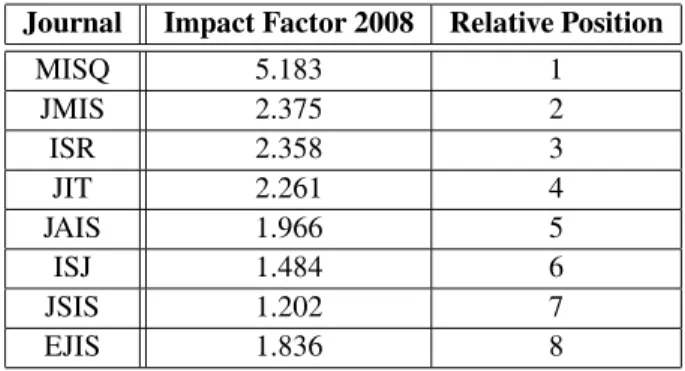
So EJIS is the fourth, the first amongst non-North American journals. Biased? OK, let us look at the flavour of the moment, Impact Fac-tors, shown in Table 2.
3.2. Impact factors
Journal Impact Factor 2008 Relative Position
MISQ 5.183 1
JMIS 2.375 2
ISR 2.358 3
JIT 2.261 4
JAIS 1.966 5
ISJ 1.484 6
JSIS 1.202 7
EJIS 1.836 8
What does this show? EJIS is the last. No, the table shows the need to translate impact factor movements over time, and not just take a snap-shot view. The highlights of the 2008 Impact Factors for IS journals show:
1. MISQ, down slightly at 5.183, number one IS journal, number 3 amongst all manage-ment journals.
2. ISR, crashing down at 2.261 from previous high values.
3. EJIS eighth at 1.202, 28thamongst all
man-agement journals. 4. Now some observations:
• EJIS made a gain in Impact Factor of over 0.4 since 2007.
• EJIS was one of the top two journals with more papers listed in the 2008 RAE than any other IS journals.
• EJIS’s Impact Factor is distorted by the following deliberate policy of the EJIS editors.
a) EJIS was a four issues a year jour-nal four or five years ago, publishing about 24 papers a year or about 300 pages.
b) It was decided to use its reputation to go for a larger market by switching to six issues a year and increasing pagi-nation per issue. EJIS now publishes about 50 papers per year in 700 pages over 6 issues.
c) The way the Impact Factor is counted
(citations divided by number of pa-pers)means that if the number of pa-pers goes up, the Impact Factor goes down. And vice versa. So EJIS went down for 3 years(there was a 5 issue interim year as well), but is now going up.
• EJIS is substantively advancing and is be-ginning to be seen as the journal of first choice to publish in amongst most au-thors(hence its popularity in RAE 2008). So, there you have it, EJIS is top 28, and the most published in, and in the steady state, at least the third or even the second ranked IS jour-nal.
If we take MISQ and ISR as the ‘quality’ jour-nals, the 3 to 4 year publication turnaround time will not reflect quality, merely who has con-ducted research in these journals between 1997 and 2005. Let us look at another ranking crite-rion.
3.3. Number of papers published
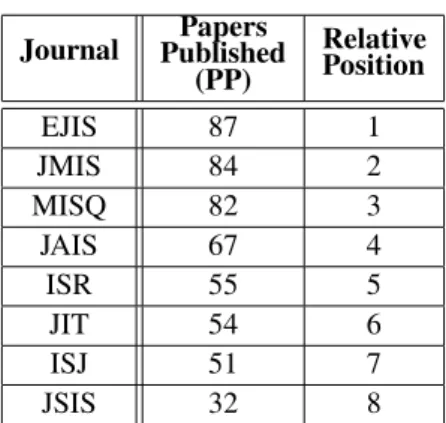
Where would authors like to publish? In qual-ity journals. So wouldn’t the number of papers published in a journal each year indicate relative quality? See Table 3.
Journal PublishedPapers (PP)
Relative Position
EJIS 87 1
JMIS 84 2
MISQ 82 3
JAIS 67 4
ISR 55 5
JIT 54 6
ISJ 51 7
JSIS 32 8
Table 3.Number of papers published in last 2 years.
That’s a good result for EJIS! No? You dis-agree, size isn’t everything. But EJIS’s accep-tance rate is now at an all time low of 8-9% of submissions, and is the same for special issues as for general submissions. EJIS has 33 Asso-ciate Editors and Seniors, mostly well known, but all active and enthusiastic. The quality of published papers is obviously high.
If you don’t like this argument, let us try popu-larity combined with impact, to give some im-pression of the ‘force’ of the journal.
3.4. Popularity and impact factors
The combined papers published times impact factor gives a measure of strength of impact or force(see Table 4).
Journal ImpactFactor (IF)
Papers Published
(PP) IF×PP Relativeposition
MISQ 5.183 82 425 1
JMIS 2.358 84 198 2
ISJ 1.660 51 85 =3
JIT 1.966 54 106 =3
ISR 2.261 55 124 =3
EJIS 1.202 87 105 =3
JAIS 1.836 67 122 =3
JAIS 1.484 32 48 8
Table 4.Number of papers published in last 2 years, times impact factor.
3.5. Thefiddling-with-violins (cf Nero) league table
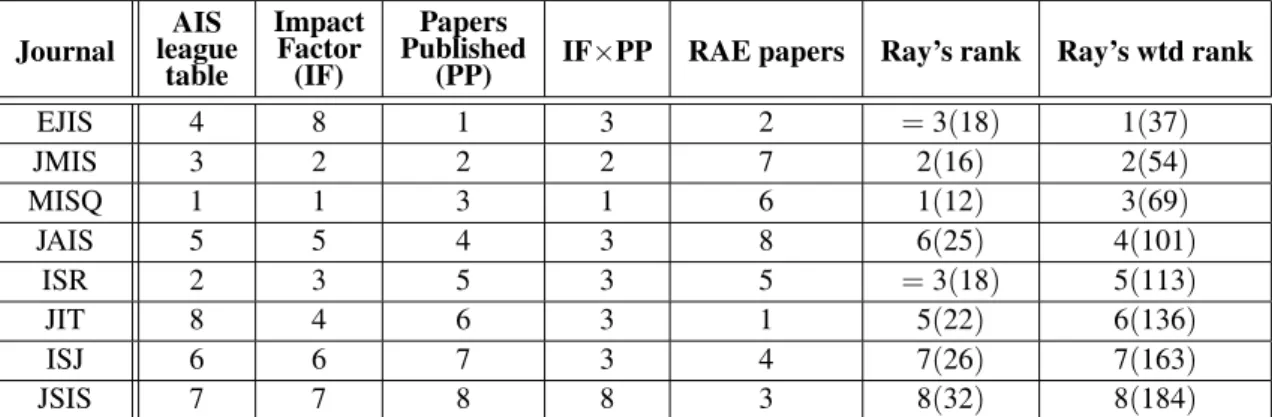
But why be so conservative? Many league ta-bles are weighted combinations of other league tables(see Table 5).
To get EJIS to be number one, all that has to be done is putting a high enough weight on the measure of performance it is best in. So we can see that most journals can be number one in a league table built to seek that outcome.
4. Quality Matters
What has the above got to do with quality? Nothing, of course, although many would like to pretend it does. Why? The measured per-son knows exactly what will and what will not
get him/her promotion in the system; the mea-surer person has a relatively easy task of record-ing quality usrecord-ing just the journal’s league table ranking.
If one is concerned with quality, then the follow-ing advice by, Paul[15, 16]is worth repeating. As Paul mentioned before in theEuropean Jour-nal of Information Systems [15], you could do worse than making sure your paper would pro-vide ‘obvious’ answers to the four questions below. In fact, very few published papers meet all four questions obviously. But they would be better papers if they did.
Assuming the paper is an appropriate paper for the journal it is being submitted to, then: 1. What story are you trying to tell the reader?
One story, note, not many. There may be two or three major points to the story, but much more than that confuses readers. A story written for the reader can be under-stood in 10 years time by the author if they need to revisit the paper. A story written for the writer(the majority published)will leave the authors as perplexed in 10 years time as readers are now.
2. What will the reader know after reading your story that they did not know before reading the story?
The whole point of the paper one presumes. 3. Why should anyone believe you?
This is the downfall of many papers, but if not believable, then that is the end of the paper.
4. Why should anyone care about the story be-ing told?
What value will the reader attach to the point
Journal leagueAIS table
Impact Factor (IF)
Papers Published
(PP) IF×PP RAE papers Ray’s rank Ray’s wtd rank
EJIS 4 8 1 3 2 =3(18) 1(37)
JMIS 3 2 2 2 7 2(16) 2(54)
MISQ 1 1 3 1 6 1(12) 3(69)
JAIS 5 5 4 3 8 6(25) 4(101)
ISR 2 3 5 3 5 =3(18) 5(113)
JIT 8 4 6 3 1 5(22) 6(136)
ISJ 6 6 7 3 4 7(26) 7(163)
JSIS 7 7 8 8 3 8(32) 8(184)
of the story? If none, you will find that re-viewers tend to disguise this problem under the rubric ‘significance of the contribution’. 5. What is the essence of your paper in one
sen-tence?
I know I said four questions, but the fifth question has nothing to do with whether your paper is published or not. Answering this question readily enables readers to attach the idea to you, the author, and hence is likely to push your citation index up and enhance your reputation.
6. What motivated your research and the paper you have written?
Again, I know I said four questions, but the sixth question may have nothing to do with whether your paper is published or not. Putting this information in your paper is likely to make the paper more interesting, and therefore it might be more widely read than otherwise.
So it should be clear from the above that if we would like what is published in our journals to change, then we, the research community, have to change how we go about our business. There is no one else to do it. I look forward to a flood of well-written publishable papers submitted to EJIS in the near future.
5. Paul’s Seven Success Factors for I.S.
But this is all rather narrow, a part of the I.S. communities activities. There is talk of crisis in I.S. which I have no time for. I see a positive future for I.S., driven by the continuing saga of big system ‘disappointments’, which shows the huge need for help from us. What should we do? I think I have hinted at all the necessities for success in this short study of journal league tables. So let me present them, Paul’s Seven Success Factors for I.S.Please note that this for me is not a list to choose from, success depends on all seven factors being addressed, since they all interact with each other.
1. Integrity
If we cannot be trusted, we shall not be used. Sometimes we have to say unpalatable things, but this is necessary for long-term trust. We should constantly ask ourselves concerning our activities “What good is it?”.
2. Dissemination
Research quite simply may as well as not have occurred if the benefits are not dissem-inated. All researchers should ensure that their work is in the public domain(but see 6 in particular).
3. Experience
How can we research into I.S. unless we have considerable experience of practice, which we continuously maintain? Research into theory may be fun, but if the theory is of a fantasia, it hardly enhances our integrity.
4. Confidence
First, you should believe in yourself. If you don’t, why should anyone else? But what if you are not self-confident? Tal-leyrand, Napoleon’s and the Restoration’s Foreign Minister was a noted self-confident man. When asked by a brave soul why he had such self-confidence, he is reported to have said something like: “When I examine myself, I worry. When I compare, I am re-assured!”
We should be confident about I.S. The lat-ter is a new subject with a poor body of knowledge and many difficulties in practice. Great, lots of opportunities to make major contributions early on, as in other subjects when they started up. Who wants to research into a mature academic discipline, with an excess of well formed knowledge and only room to make largely insignificant contribu-tions. Other new subjects, management etc? Puffs of wind, 2 by 2 matrices, the 4 or 5 P’s and other rigorous trivia. My work in I.S. is potentially ground breaking, fun, and if successful, would help society. What more could I want?
5. Quality
Quality could be greater in any organisation if Quality Assurance and its related para-phernalia were not applied, because the time saved would be made available. Quality is not about benchmarks and standards, which assume a ‘stopping’ point, it is about im-proving what you do all the time – forever!
6. Simple
20 years of vain attempts, I now have a def-inition of I.S. which succinctly captures the essence of what it is, is easily explained to the uninitiated and is only 7 words:
I.S. is I.T. in Use
In Use implies users, so it’s the combination of I.T. and users in Use that implies a time dimension, so an I.S. has a time associated with it. Hence the combination of users us-ing I.T. plus any ad hoc decisions gives the I.S at that point in time. Can you do better?
7. Determination
In my experience, whilst academics can be tenacious about their pet ideas, when it comes to matters of the world, they tend to bore easily if the argument is sustained. So if we want to establish I.S. we need a concerted community determination to make it hap-pen. Then it will. If you cannot be bothered to defend your subject, don’t be surprised if your disciplinary home disappears about you.
6. Conclusions
This paper shows that almost any journal can be top of a league table using the current methods of league table construction. If anyone believes in such tables, they are a victim of their model and should be kept away from management.
References
[1] R. J. PAUL, Time, changes and paradoxes.European Journal of Information Systems, 12, p. 77(2003).
[2] R. J. PAUL, More changes and responses.European Journal of Information Systems, 12, p. 167(2003).
[3] R. J. PAUL, Time, experience and change.European Journal of Information Systems, 13(2004), pp. 93–94.
[4] R. J. PAUL, Time, change and beliefs. European Journal of Information Systems, 13, p. 165(2004).
[5] R. J. PAULTime, change and EJIS.European Jour-nal of Information Systems, 13(2004), pp. 245–246.
[6] R. J. PAUL, Editor’s view: an opportunity for editors of IS journals to relate their experiences and offer advice. The Editorial View of Ray J Paul. First in a series.European Journal of Information Systems, 14(2005), pp. 207–212.
[7] R. J. PAUL, Changing issues: sixes and specials. Eu-ropean Journal of Information Systems, 15(2006), pp. 1–3.
[8] R. J. PAUL, Views, change and changing views. Eu-ropean Journal of Information Systems, 15(2006), pp. 239–240.
[9] R. J. PAUL, Making the changes.European Journal of Information Systems, 15(2006), pp. 525–526.
[10] R. J. PAUL, Change strikes back.European Journal of Information Systems, 16(2007), pp. 1–2.
[11] R. J. PAUL, Changes to information systems: time to
change.European Journal of Information Systems, 16(2007), pp. 193–195.
[12] R. J. PAUL, Changing the challenge: To challenge makes you larger and being challenged makes you small. European Journal of Information Systems, 16(2007), pp. 299–302.
[13] R. J. PAUL, Changeover and celebrating change: 20 reasons for celebrating 20 years.European Journal of Information Systems, 16(2007), pp. 525-526.
[14] R. J. PAUL, Time for a change.European Journal of Information Systems, 16(2007), pp. 667–668.
[15] R. J. PAUL, What is published in our journals
can-not change unless we do. European Journal of Information Systems, 18(2009), pp. 189–191.
[16] R. J. PAUL, Editorial. Journal of Computing and Information Technology, 18, pp. i-iv(2010).
[17] R. J. PAUL, Loose change. European Journal of Information Systems19(2010), pp. 379–381.
Received:June, 2010 Accepted:November, 2010
Contact address: Ray J. Paul Department of Information Systems and Computing Brunel University West London UB8 3PH United Kingdom e-mail:[email protected]