On the Performance of Latent Semantic
Indexing-based Information Retrieval
Ch. Aswani Kumar
1and S. Srinivas
21Intelligent Systems Division, School of Computing Sciences, VIT University, Vellore, India 2Fluid Dynamics Division, School of Science, VIT University, Vellore, India
Conventional vector-based Information Retrieval (IR)
models: Vector Space Model(VSM) and Generalized Vector Space Model(GVSM)represents documents and queries as vectors in a multidimensional space. This high dimensional data places great demands on com-puting resources. To overcome these problems, Latent Semantic Indexing(LSI), a variant of VSM, projects the documents into a lower dimensional space. It is stated in IR literature that LSI model is 30% more effective than classical VSM models. However, statistical significance tests are required to evaluate the reliability of such com-parisons. Focus of this paper is to address this issue. We discuss the tradeoffs of VSM, GVSM, LSI and evaluate the difference in performance on four testing document collections. Then we analyze the statistical significance of these performance differences.
Keywords: dimensionality reduction, generalized vector space model, latent semantic indexing, singular value decomposition, vector space model
1. Introduction
Information Retrieval(IR)deals with the repre-sentation, storage, organization of and access to information items. The models for text retrieval can be primarily divided into two categories: keyword oriented and matrix oriented[1]. Key-word based models uses certain data structures and searching algorithms. Matrix oriented mod-els changes the keyword representation of docu-ments into a matrix format. Vector Space Model
(VSM)is a conventional IR model, which repre-sents a document collection by a term-document matrix. VSM views documents as vectors in a high dimensional space with inter document similarity measured by the corresponding vec-tor cosine[2]. Generalized Vector Space Model
(GVSM) attempts to improve VSM by alter-ing the axes of information space to account
for inter-term correlation. With the correlation matrix, GVSM mitigates the error introduced to the VSM by assuming term independence [3]. Since term-document matrices are usually high dimensional and sparse, they are susceptible to noise. Dimensionality reduction is a way to overcome these problems. Latent Semantic In-dexing(LSI)attempts to improve GVSM model of term correlations by means of dimensionality reduction. Features of the derived LSI space are orthogonal and convey most of the variance of observed data using relatively few dimensions.
2. Vector Space Model (VSM)
VSM depends on the assumption that the mean-ing of a document can be derived from the doc-ument’s constituent terms. A vector is used to represent each document in collection. Each component of vector reflects a term associated with the document. The value assigned to that component reflects the importance of the term in representing semantics of the document. Each document is represented by a weight vector
−→d
j = (w1j,w2j, ...,wtj)T wherewzjis the weight
or importance of the termzin representation of the document−→dj , tis the size of the indexing
term set. A collection of d documents is then represented by a term-document matrix witht rows andd columns. Query vector representa-tion is given as,−→qi = (q1i,q2i, ...,qti)T where qzi is the weight of term z in representation of
the query−→qi. A variety of models is available
in the literature for weighting the document and query vector elements[6]. We measure the co-sine similarity between a document and a query. Since the individual terms and keywords are not adequate discriminations of the semantic con-tent of documents and queries, performance of the VSM suffers from two classical problems of synonymy and polysemy[2, 7]. The preva-lence of synonymy tends to decrease the recall performance of retrieval systems. Polysemy is one factor for poor precision performance.
3. Generalized Vector Space Model (GVSM)
In VSM, the term-document matrix A is as-sumed to be the term occurrence frequency ma-trix obtained from automated indexing. How-ever, it ignores term correlations. Use of a co-occurrence matrix can be justified only if the documents and term vectors are assumed to be orthogonal. GVSM proposed by Wong represent term vectors explicitly in terms of chosen set of orthonormal basis vectors [3]. GVSM modifies VSM by introducing some ad-hoc schemes for including the important effect of term correlation. The correlation matrix pro-vides a model of the relationships that obtain among the corpus indexing terms. The correla-tion between any two index terms depends on
the number of documents in which two terms appear together.
For a term-document matrix A of dimension tXd, GVSM calculates the term correlation ma-trixRof dimensiontXt by multiplyingAwith its transposeATmatrix. Then GVSM calculates
similarity between a query vector and document collection as the dot product between query vec-tor, correlation matrix and term-document ma-trix.
4. Latent Semantic Indexing (LSI)
Domains such as text have large amounts of redundancies and ambiguities among the at-tributes that result in considerable noise effects which leads to higher dimensionality. Even though the data are lying in a high dimensional space, it is beneficial to reduce the dimension of the data to improve efficiency and accuracy of data analysis [8, 9]. In IR applications di-mensionality reduction is able to effectively im-prove the data representation by understanding the data in terms of concepts rather than words, where a concept is a linear combination of terms
[10]. Latent Semantic Indexing(LSI)is a vari-ant of VSM, which maps a high dimensional space into a low dimensional space. LSI tries to take advantage of the conceptual content of documents. Instead of searching on individual terms, a search is performed on concepts. To approximate a source space with fewer di-mensions, LSI uses a matrix algebra technique termed Singular Value Decomposition (SVD)
[2, 11]. SVD takes advantage of the implicit higher order structure in association of terms within documents by largest singular vectors. Vectors representing the documents and queries are projected in new, low dimensional space obtained by truncated SVD. LSI starts with a term-document matrixAof dimensiontXdand rankr and uses the SVD to factor it into three matrices A = USVT, where U and V are
ma-trices whose columns are left and right singular vectors of A, Sis a diagonal matrix whose di-agonal elements are non-negative and arranged in decreasing order. The elements on the main diagonal of S are known as singular values of
Aand are the square roots of the eigenvalues of
ATAandAAT [12, 13]. Computationally, a k -dimensional SVD ofAreturnsAk = UkSkVT
whereUk,Vkare firstkcolumns ofUandV. In
this way the rank ofA has been lowered from rto k. Using this low rank approximation, we project high dimensional documents and query vectors into a low dimensional space. In this new space it is reasoned that underlying struc-ture of the collection is revealed, thus enhancing the retrieval performance. To date, several the-oretical explanations and results have appeared in the literature and these studies have provided a better understanding of LSI[7, 10, 14].
5. Experimental Analysis
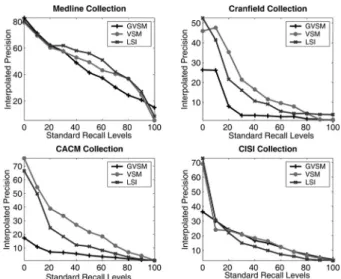
Table 1 summarizes some characteristics of the datasets we have used in our experiments. These datasets are widely used in IR and text mining research. All the document collections are pre-processed by removing stopwords and perform-ing stemmperform-ing usperform-ing Porter stemmperform-ing algorithm. Performance in IR systems is often summarized in two parameters precision and recall[15, 16]. Precision is the portion of relevant documents in the set returned to the user and recall is the por-tion of all relevant documents in the collecpor-tion that are retrieved by the system. To evaluate ranked lists, precision can be plotted against recall after each retrieved document. The pre-cision figures at 11 standard recall levels are interpolated by the rule which states that the interpolated precision at thejth standard recall
level is the maximum known precision at any recall level between thejth recall level and the
(j+1)threcall level.
The success or failure of VSM heavily depends upon the term weighting schemes. We have evaluated various term weighting schemes in the context of both VSM and LSI. Through these experiments we have identified the suit-able weighting scheme for each of these collec-tions. A detailed discussion about these
weight-ing methods and their appropriateness for re-spective testing collection can be found in our recent work [6]. Also, we have explored the best rank approximation for these document collections. Based on these experiments, 100 dimensions for Medline, CACM, CISI and 300 dimensions for Cranfield are retained. Figure 1 presents the comparison of the performance of VSM, GVSM and LSI models on the above mentioned document collections. On Medline collection, all the three models produced similar results at lower recall levels. But at higher recall levels, LSI exhibited a marginal superiority over VSM and GVSM. Among VSM and GVSM, only at higher recall levels is VSM able to re-trieve more relevant documents than GVSM. On Cranfield collection VSM exhibited better re-sults than other models at recall levels between 10 and 70. However, at recall levels 10, 90 and 100 LSI exhibited its superiority. GVSM exhib-ited poor performance on this collection at all recall levels. On CACM collection, VSM per-formed fairly well over all recall levels. LSI has performed similar to VSM at lower and higher recall levels. GVSM performed equally to VSM and LSI only at higher recall levels. On CISI collection, VSM performed well better at lower recall levels only. But at higher recall levels both GVSM and VSM have performed better than LSI.
Curves for Cranfield, CACM and CISI collec-tions display a fairly typical pattern that illus-trates well known tradeoff between precision and recall: high precision at low levels of recall with a relatively rapid drop in precision as recall is increased. The curves for Medline collection illustrate an abnormally high level of perfor-mance with relatively high levels of precision maintained across wide range of recall levels. This appearance is likely a result of the way that the document set was created.
Identifier Description Terms Documents Queries
Medline Medical Abstracts 5735 1033 30
Cranfield Aeronautical Collection 4563 1398 225
CACM Communications of ACM 5763 3204 52
CISI Information Science abstracts 5544 1460 76
Figure 1.Interpolated precision analysis for VSM, GVM and LSI models.
5.1. Statistical Significance Tests
The next step for the evaluation is to analyze values of the interpolated precision obtained by different models. An important question is whether the difference in the precision values is really meaningful or by chance. In order to make such a distinction, it is necessary to apply a statistical test. One-way Analysis of Vari-ance (ANOVA) performs comparison of two or more columns of data in the matrix where each column represents an independent sam-ple containing mutually independent observa-tions[17]. It returns a p-value for the null hy-pothesis that all samples in the data are drawn from same population or from different popu-lations with same mean. The null hypothesis
H0will be that all retrieval models being tested are equivalent in terms of performance. The significance test will attempt to disprove this hypothesis by determining a p-value. If the p-value is near zero, ANOVA suggests that at least one sample mean is significantly different than other sample means. It is common to de-clare that a result is significant if the p-value is less than 0.05 [18]. ANOVA table displays the following information: Source of Variabil-ity, Sum of Squares(SS), Degrees of Freedom
(DF), Mean Squares (MS) which is the ratio SS/DF, F-statistic which is ratio of the MS’s and p-value is derived from F. Figure 2 presents the ANOVA results for the document collections using GVSM, VSM and LSI models of IR.
Figure 2. ANOVA test for VSM, GVSM and LSI
models.
Very small p-value of CACM collection in-dicates that the differences between column means are significant. Probability of this out-come supports the alternate hypothesis that one or more of the samples are drawn from popula-tion with different means. Hence performance difference between GVSM, VSM and LSI mod-els on this collection is statistically significant. However large p-values from ANOVA table of Medline, Cranfield and CISI collections indi-cate that differences in performances of GVSM, VSM and LSI are supporting the null hypothesis that differences in performances are statistically not significant.
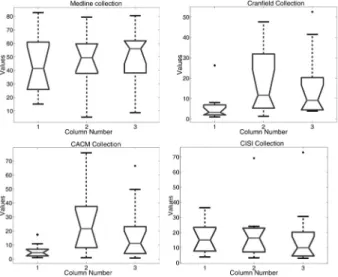
A box plot is a graphical data analysis technique for determining if differences exist between var-ious levels of ANOVA. A box plot produces a box and whisker plot for each column of X. The box has lines at the lower quartile, mean and upper quartile values. The whiskers are lines extending from each end of the box to show the extent of the rest of the data. Outliers are data with values beyond the ends of the whiskers. If there is no data outside the whisker, a dot is placed at the bottom whisker. Boxes at the same Y axis elevation for all categories indicate little difference among groups. Each box contains a horizontal red line indicating the mean.
different elevations on the Y-axis are indicat-ing that differences in performances of GVSM, VSM and LSI are significant. A set of mild outliers are visible for GVSM and LSI models on Cranfield collection, CACM collection and set of extreme outliers for VSM and LSI models on CISI collection. Outliers on column 3 reveal that LSI model is able to retrieve more relevant documents at lower recall levels.
Figure 3.Box plots of ANOVA results.
A valuable point made by Keen[19]is that dif-ferences that are not statistically significant can still be important if they occur repeatedly in many different contexts. From these experi-ments we can conclude that LSI model can al-most always be found that can match the per-formance of classical VSM models rather than outperform: a result which was not confirmed in the earlier literature. According to Deer-wester [10], overcoming the lexical mismatch problems is the main benefit that LSI provides. More specifically they claim that the primary objective of LSI is to increase precision at higher levels of recall. This pattern is clearly visible on Medline, Cranfield and CISI collections. The reason behind this pattern is that VSM handles well the relevant documents with a high de-gree of term overlap, leaving little room for LSI to improve. Relevant documents for a query, that have little or no term overlap, can be im-proved by LSI. Also, ability of handling dimen-sionality curse by reducing the dimendimen-sionality through SVD makes LSI attractive for IR appli-cations. The major concern in LSI computation is the number of dimensions to be retained[20].
Success of LSI heavily depends on it. Further research should focus on devising a methodol-ogy for selecting the number of dimensions to be retained. Other measures of retrieval effec-tiveness such as fallout ration, average search length etc. can also be applied. In recent liter-ature, researchers have applied non-parametric tests: Wilcoxon signed rank test and Friedman test for comparison of various classifiers [21]. Comparisons of IR models performance can be made using these tests too. Many empirical studies show that good retrieval performance is closely related to the use of various retrieval heuristics [6]. It is expected that optimizing these heuristics will improve the performance of the LSI-based IR systems.
6. Conclusions
It is mentioned in the IR literature that LSI model of IR outperforms classical VSM models by an average of 30%. Primary concern of this paper is to evaluate the significance of the per-formance tradeoffs between LSI and classical VSM-based IR. Our analysis has revealed that performance improvement of LSI over classical VSM models is not statistically significant, a result which was not confirmed in the literature. However, unlike VSM and GVSM models, LSI model has the ability to handle the higher di-mensionality.
7. Acknowledgment
Authors gratefully acknowledge the financial support from Dept of Science and Technol-ogy, Govt. of India under the grant number SR/S3/EECE/25/2005. Also, authors are thankful to the anonymous reviewers for their useful comments.
References
[1] E. R. JESSUP, J. H. MARTIN, Taking a New Look at
the Latent Semantic Analysis Approach to Infor-mation Retrieval. Computational Information Re-trieval, SIAM Publishers, 121–144, 2001.
[2] M. W. BERRY, Z. DRMAC, E. R. JESSUP, Matrices,
[3] S. K. M. WONG, W. ZIARKO, C. N. P. WONG, Gener-alized Vector Space Model in Information Retrieval,
Proceedings of 8th ACM SIGIR Conference on Re-search and Development in Information Retrieval, 18–25, 1985.
[4] Y. HUA, Techniques for improved LSI text retrieval,
Ph.D Thesis, Wayne State University, 2006.
[5] P. SUWANNAJAN, Predicting the performance of LSI compared to that of vector space model. Ph.D Thesis, University of Colorado, 2004.
[6] S. SRINIVAS, CH. ASWANIKUMAR, Optimising the
Heuristics in Latent Semantic Indexing for Effective Information Retrieval.Journal of Information and Knowledge Management, 5, 97–105, 2006.
[7] A. KONTOSTHATHIS, W. M. POTTENGER, A
Frame-work for Understanding Latent Semantic Indexing Performance. Journal of Information Processing and Management, 42, 56–73, 2006.
[8] CH. ASWANIKUMAR, A. GUPTA, S. TREHAN, M. BA
-TOOL, Latent Semantic Indexing-based Intelligent Information Retrieval System for Digital Libraries.
Journal of Computing and Information Technology, 14, 191–196, 2006.
[9] L. XIAO, J. SUN, S. BOYD, A Duality View of
Spectral Methods for Dimensionality Reduction.
Proceedings of 23rd International Conference on Machine Learning, 1041–1048, 2006.
[10] S. DEERWESTER, S. T. DUMAIS, G. W. FURNAS, T. K. LANDAUER, R. HARSHMAN, Indexing by latent semantic analysis.Journal of the American Society for Information Science, 41, 391–407, 1990.
[11] CH. ASWANIKUMAR, S. SRINIVAS, Latent
Seman-tic Analysis Using Eigenvalue Analysis for Effi-cient Information Retrieval. International Journal of Applied Mathematics and Computer Science, 16, 551–558, 2006.
[12] G. GOLUB, C. F. VANLOAN, Matrix Computations.
The John Hopkins University Press, 1996.
[13] J. E. TOUGAS, R. J. SPITERI, Updating the partial
singular value decomposition in latent semantic in-dexing.Computational Statistics and Data Analysis, 52, 174–183, 2007.
[14] J. C. VALLE-LISBOA, E. MIZZAJI, The uncovering
of hidden structures by latent semantic analysis.
Information Sciences, 177, 4122–4147, 2007.
[15] M. SANDERSON, J. ZOBEL, Information Retrieval
System Evaluation: Effort, Sensitivity and Relia-bility.Proceedings of28thACM SIGIR Conference on Research and Development in Information Re-trieval, 62–169, 2005.
[16] R. B. YATES, B. R. NETO, Modern Information
Re-trieval.Pearson Education, New Delhi, 1999.
[17] D. HULL, Using Statistical Testing in the Evaluation of Retrieval Experiments.Proceedings of16thACM SIGIR Conference on Research and Development in Information Retrieval, 329–338, 1993.
[18] J. SAVOY, Statistical Inference in Retrieval Effec-tiveness Evaluation. Information Processing and Management, 33, 495–512, 1997.
[19] M. E. KEEN, Presenting Results of
Experimen-tal Retrieval Comparisons.Information Processing and Management, 28, 491–502, 1992.
[20] CH. ASWANIKUMAR, S. SRINIVAS, Identifying the
Number of Dimensions for Dimensionality Selec-tion in Latent Semantic Indexing.Proceedings of
2nd International Conference on Information Pro-cessing, 64–70, 2008.
[21] J. DEMSAR, Statistical comparisons of classifiers
over multiple data sets.Journal of Machine Learn-ing, 7, 1–30, 2006.
Received:April, 2008 Accepted:December, 2008
Contact address: Ch. Aswani Kumar Intelligent Systems Division School of Computing Sciences VIT University Vellore India e-mail:[email protected]
CH. ASWANIKUMARis Assistant Professor(Selection Grade)in Intelli-gent Systems Division, School of Computing Sciences, VIT University, Vellore, India. He obtained his Masters Degree in Computer Science from Nagarjuna University, India and doctorate degree from VIT Uni-versity, India. He has research interests in information retrieval, text mining and machine intelligence. He has published 24 refereed research papers in various national and international journals and conferences. He is Principal Investigator to a major research project sponsored by the Department of Science and Technology, Government of India. He is a member of various professional socities including ACM, CSI, ISTE.