Original Research Article
Effectiveness and tolerability of formoterol plus glycopyrronium
combination in patients with chronic obstructive
pulmonary disease: FINE registry
Bharat Gopal
1,2, K. S. Satish
3, Samir Garde
4, Niranjan Kumar Sit
5, Dipali Kamdar
6,
Sameer Muchhala
7, Ashwin V. Jadhav
7*
ABSTRACT
Background: Long-term therapy for chronic obstructive pulmonary disease (COPD) is progressing fast. Dual bronchodilation with long-acting muscarinic antagonist (LAMA) and long-acting β2-agonist (LABA) fixed dose combinations (FDC) have been available over the past few years. To evaluate the real-world tolerability and effectiveness of formoterol plus glycopyrronium FDC inhaler, a post-marketing surveillance study was conducted in Indian population.
Methods: This was an open-label, observational registry in which COPD patients, who were prescribed forglyn (a brand of FDC of glycopyrronium 25 mcg and formoterol fumarate dihydrate 6 mcg dry powder inhalation). The effectiveness, safety and tolerability of this LAMA/LABA combination were evaluated for 4, 8 and 12 weeks. The safety and tolerability was assessed based on the incidence of adverse events (AEs). Effectiveness was evaluated based on change in total symptom score from baseline to end of 12 weeks. The forced expiratory volume in 1 second (FEV1) was performed at baseline and end of 12 weeks.
Results: Total COPD patients enrolled were 605, of which 78.5% were males and 21.5% were females. Patients showing improvement of symptoms at week 4 were 587 (97.02%).
Overall, at the end of 8 week and 12 week 98.34 % and 99.49% patients showed improvement in the total symptoms respectively. About 0.49% did not show any improvement. AEs were reported in 64 (10.64%) patients with no serious AEs. Mean FEV1 of 476 patients before treatment was 1.53±0.68 L at baseline which changed to 1.85±4.74 L at the end of 12 weeks, with was statistically significant (p<0.05).
Conclusions: In real-life clinical practice in India, formoterol and glycopyrronium FDC dry powder inhaler was well tolerated in COPD patients, and can be regarded as an effective option for maintenance treatment.
Keywords: Glycopyrronium, Formoterol fumarate, LAMA, LABA, COPD
1Department of Respiratory and Sleep Medicine, Maharaja Agrasen Hospital, India
2National Chest Centre, New Delhi, India
3Chest and Maternity Centre, Fortis Hospital and Vikram Hospital, Bengaluru, Karnataka, India
4Interventional Pulmonology and Critical Care, Wockhardt Hospital, Dhanwantari Hospital and Global Hospital,
Mumbai, Maharashtra, India
5Department of Pulmonary Medicine, Rampurhat Government Medical College and Hospital, Burdwan, West Bengal,
India
6Jaydeep Hospital, Ahmedabad, Gujarat, India
7Medical Services, Zydus Healthcare Ltd., Mumbai, Maharashtra, India
Received: 29 June 2020
Revised: 06 August 2020
Accepted: 05 September 2020
*Correspondence:
Dr. Ashwin V. Jadhav,
E-mail: [email protected]
Copyright: © the author(s), publisher and licensee Medip Academy. This is an open-access article distributed under the terms of the Creative Commons Attribution Non-Commercial License, which permits unrestricted non-commercial use, distribution, and reproduction in any medium, provided the original work is properly cited.
INTRODUCTION
Chronic obstructive pulmonary disease (COPD) is a progressive lung disease manifested by persistent airflow restriction, which is associated with cough, sputum production and difficulty breathing secondary to an increased chronic inflammatory response to noxious
particles or gases.1,2 As per the World Health Organization
(WHO) estimates, 65 million patients suffer from moderate-to-severe COPD worldwide. In 2005, COPD-related mortality accounted for 5% of total deaths; the data is certainly underestimated as the most epidemiological data that originate is exclusively from high-income countries. According to current estimates, WHO predicts a 30% rise in COPD deaths over the next decade, making COPD the third leading cause of death worldwide by
2030.3 In India, the prevalence of COPD has been reported
at 3.49% (ranging from 1.1% in Mumbai to 10% in
Thiruvananthapuram).4,5
Bronchodilators continue to be the keystone of pharmacological treatment in patients with COPD. For the management of stable COPD; long-acting β2-agonists (LABA) and long-acting muscarinic antagonists (LAMA) are often preferred. The fixed dose combinations (FDC) of LAMA and LABA can be delivered via single inhaler because of the convenience.
The choice of therapy always depends on the disease
manifestation, symptoms, previous therapies and
responses to them, health status, and individual patient preference. Therefore, the optimal treatment is decided based on the medical history of every patient. Nevertheless, clinical trials data, clinical practice, and guidelines are indispensable for an evidence-based
medicine approach.6
The earlier global initiative for chronic obstructive lung disease (GOLD) guidelines recommended LABA+inhaled corticosteroid (ICS) as the first line treatment for managing stable COPD in high risk people of categories C and D. However, the current GOLD 2020 guidelines recommend LAMA+LABA should be preferred over
LABA+ICS.7
The combination treatment with LABA/LAMA upsurges forced expiratory volume in 1 second (FEV1) and
decreases COPD symptoms compared with monotherapy.6
Benefits of LABA/LAMA FDCs are widely reported; however, the availability of different FDC options approved for the treatment of COPD and the absence of
head-to-head studies between all the available
LABA/LAMA FDCs make choosing the most appropriate
option difficult.8-10
This post-marketing observational study was conducted to determine the tolerability/safety and effectiveness of formoterol plus glycopyrronium FDCs in COPD in real world scenario.
METHODS Study design
This was a post marketing, observational study conducted between February 2019 to November 2019, in which the
eligible patients were treated with forglyn
(glycopyrronium 25 mcg and formoterol fumarate dihydrate 6 mcg dry powder inhaler) in its approved indication at the discretion of treating physician according to the routine medical practice, over a 12-week duration. We established a registry, which was conducted in order to demonstrate the effectiveness, safety, and tolerability of formoterol/glycopyrronium in patients with COPD in real-life clinical practice in India.
Study population
In this observational study, 700 patients of COPD, age more than 18 years were treated with formoterol and glycopyrrolate FDC by treating physician as a maintenance therapy. The treatment was given at the discretion of treating physician.
Assessments
The total COPD symptom scores were evaluated by treating physician at the baseline, 4, 8 and 12 weeks post formoterol and glycopyrrolate combination therapy. The number of exacerbation at the end of 4, 8 and 12 weeks were recorded. The pulmonary function tests (FEV1) were performed at the baseline and end of 12 week.
Statistical analysis
The data obtained were recorded in a Microsoft Excel sheet, and statistical analysis was performed using Statistical Package for Social Sciences (SPSS) (version 17). Results are presented as drawings, frequency and percentages. Categorical variables were compared using chi square test, Quantitative results were compared with Mann Whitney U test. For all tests, significant change was achieved at p<0.05.
The AEs were assessed as the number of patients reporting the adverse events. Patients excluded from the safety analysis set were those who ‘did not take the study drug’ and ‘who were lost to follow-up. Adverse events were reported as the percentage of patients experiencing AE.
RESULTS Patient disposition
Of the 700 enrolled patients, 605 were included in the effectiveness, safety and tolerability analysis. Ninety five patients’ data were not included in the analysis because they were noncompliant to the recommended treatment or were lost to follow-up. All patients received the daily treatment dose of formoterol fumarate dihydrate 6 mcg and glycopyrronium 25 mcg and the mean±standard deviation (SD) duration of therapy (weeks) was 12.43±2.152.
Patient demographics and baseline characteristics
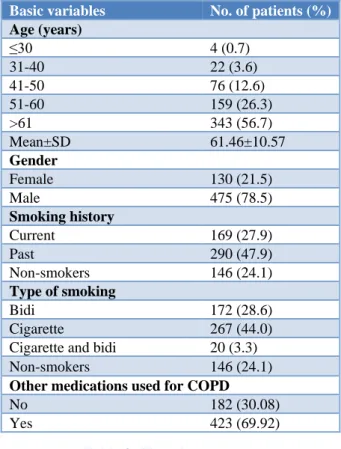
Patient demographics and baseline characteristics are presented in Table 1. Of the total number of patients evaluated in the study, 78.5% were males and 21.5% were females. The mean patient age was 61.46±10.57 years and weight was 62.84±13.64 kg. The mean duration of COPD was 9.49 ±7.199 years.
There were 169 (27.9%) current smokers, 290 (48%) past smokers and 146 (24.15%) non- smokers. The mean total duration of smoking amongst smokers was 19.31±15.06 years and mean number of units smoked/day was 12.14±14.46. Most patients were followed up at outpatient clinic. The percentage of COPD patients reporting exacerbations in the total study duration were 46.3%, 32.1% and 21.5% at the end 4, 8 and 12 week respectively.
In our study 33.6%, patients had co-morbidities. The most common co-morbidities were hypertension (15.2%), diabetes (7.1%), acid-peptic disease (2.5%) and allergic rhinitis (0.8%).
Effectiveness assessments
Physicians subjectively evaluated the patient's overall status. Patients showing improvement of symptoms at week 4 were 587 (97.02%).
Overall, at the end of 8 week and 12 week 98.34% and 99.49% patients showed improvement in the total
symptoms respectively. There was consistent
improvement throughout study in 116 (19.2%) patients. About 0.49% of patients did not show any improvement.
Table 1:Patient demographics and baseline characteristics.
Basic variables No. of patients (%)
Age (years)
≤30 4 (0.7)
31-40 22 (3.6)
41-50 76 (12.6)
51-60 159 (26.3)
>61 343 (56.7)
Mean±SD 61.46±10.57
Gender
Female 130 (21.5)
Male 475 (78.5)
Smoking history
Current 169 (27.9)
Past 290 (47.9)
Non-smokers 146 (24.1)
Type of smoking
Bidi 172 (28.6)
Cigarette 267 (44.0)
Cigarette and bidi 20 (3.3)
Non-smokers 146 (24.1)
Other medications used for COPD
No 182 (30.08)
Yes 423 (69.92)
Table 2: The adverse events.
Adverse event No. of patients (%)
Dry mouth 16 (2.6)
Breathlessness 10 (1.6)
Cough + cold 9 (1.5)
Irritation in throat 5 (0.9)
Headache 3 (0.5)
Constipation 2 (0.3)
Diarrhea 2 (0.3)
Tachycardia 2 (0.3)
Urinary retention 2 (0.3)
Vomiting 2 (0.3)
Gastritis 2 (0.3)
Disguise 3 (0.5)
Giddiness 1 (0.2)
Tremors 2 (0.3)
Palpitation 3 (0.5)
Figure 1. Majority patients showed an improvement in symptom score except three (0.49%) patients. The total symptom score decreased from 9.19 at baseline to 2.3 at the end of 12 weeks follow up (p<0.001) (Figure 2).
Mean value of FEV1 collected from 476 patients before drug administration was 1.53±0.68 L at baseline which changed to 1.85±4.74 L at the end of 12 weeks, with the difference being statistically significant (p<0.05). Global assessment of efficacy by the clinician at end of therapy
showed that majority (70%) of the patient showed good improvement in the symptoms (Figure 3).
Safety assessments
Overall, 64 patients (10.6%) reported at least one AE during entire duration of study (Table 2). The most common AEs were dry mouth (2.6%) followed by breathlessness (1.6%), cold and cough (1.5%), (no serious AEs were reported).
Figure 1: Efficacy assessment of individual symptom scores.
Figure 2: Assessment of total score of all symptoms.
Figure 3: Global assessment of efficacy by the clinician at end of therapy.
The global assessment of tolerability by the clinician showed that 88.3%, 8%, 3.3% and 0.3% patient had excellent, good, fair and poor tolerability respectively at end of therapy.
DISCUSSION
In this registry, of the total number of COPD patients evaluated, 78.5% were males. Traditionally COPD is more
prevalent in males.11
COPD is an age-related disorder, and several evidences
suggested a relationship with a rapidly increasing age.12,13
The mean patient age was 61.46±10.57 years and 56.7% of patients were above 60 years of age. This distribution can be explained by the physiological decrease in FEV1 with age where the slope becomes steeper when
aggravated by risk factors, particularly smoking.5 The
mean duration of COPD was 9.49±7.199 years.
Good nutritional status is considered an independent factor influencing the course of COPD. Body weight could be one of the indicator of good nutritional status. In our study, the mean weight of the patients was 62.84±13.64 kg that is considered good. A study by Wilson et al demonstrated that factors related to nutritional status have an
independent influence on the course of COPD.14 This
could be one of the reasons for better response to therapy.
2.58
1.72
1.12
0.71 2.75
1.82
1.18
0.81
1.96
1.24
0.73
1.91
1.2
0.66
0.47 P<0.001 0
0.5 1 1.5 2 2.5 3
Week 0 Week 4 Week 8 Week 12
Individua
lsymptom
score
(mea
n
va
lues)
Time (weeks)
Cough
Breathlessness
Sputum
Sleep disturbance
0 2 4 6 8 10
Week 0 Week 4 Week 8 Week 12 9.19
5.79
3.4 2.3
p<0.001
Tota
l
sy
mpto
m
score
(mea
n
v
alues)
Time (weeks)
Excellent 20%
Good 70%
Fair 9% Poor
Smoking is conclusively the most common risk factor of
COPD.15 About 75.9% of the evaluated patients in our
study were smokers, of which, current smokers were 27.9% while the ex-smokers were 48%. The mean total duration of smoking was 19.31±15.06 years and mean number of units smoked/day was 12.14±14.46. The odds of having COPD is nine and 4 times in the current and
ex-smokers, respectively compared to the nonsmokers.15,16
Higher quantity of cigarette smoking increases the risk, i.e. each pack-year of smoking increases 15% risk for COPD. Moreover, lesser risk of COPD in the ex-smoker compared
60% to current smokers.15
Most patients were followed up at outpatient clinic. With continuation of therapy the number of COPD exacerbations in the intervening periods week 0 to end of week 4, week 5 to end of week 8 and week 9 to end of week 12 were 280 (46.3%), 194 (32.1%) and 130 (21.5%) respectively.
The mainstay of COPD treatment has been long-acting bronchodilators including LAMAs and LABAs, the latter is frequently combined with inhaled corticosteroid. Now it is established that grading COPD severity and determining treatment according to spiro metric values are one-dimensional approach, as patients exhibit a wide spectrum of spiro metric values when highly symptomatic and at risk of exacerbations. Clinical evidence suggests that inhalation corticosteroid is useful in lowering frequent exacerbations. It comes with its own risks but can be withdrawn safely in patients who are unlikely to have exacerbations. The use of LAMA–LABA combination is emerging as a safe and effective choice in this category of patients and some studies have shown superiority of this combination to LABA-ICS combination in symptom control and reduction in exacerbations. The WISDOM study demonstrated that by withdrawing inhaled steroids from the regimen of stable patients with COPD there was no worsening of symptoms or increased exacerbation
rate.17 Currently, five fixed-dose LAMA–LABA
combinations are available, including
formoterol/aclidinium, indacaterol/glycopyrronium,
olodaterol/tiotropium, umeclidinium/vilanterol, and
formoterol/glycopyrronium. Formoterol/glycopyrronium is a new LAMA-LABA combination that has been recently approved in several countries globally, including India.
The registry elucidates safety, tolerability and
effectiveness of formoterol/glycopyrronium in patients with COPD in real-life clinical practice in India.
Unlike salmeterol, formoterol has a rapid onset of action. The relative water solubility of formoterol enables it to diffuse rapidly to the β2-adrenergic receptors and produces bronchodilation within 1 to 3 minutes. Moreover, formoterol is a full agonist whereas salmeterol is a partial
agonist, suggesting formoterol to be a better
bronchodilator with higher potency. Formoterol has rapid
onset of action, which provides quick relief of symptoms.18
Glycopyrronium has a sustained 24-hour bronchodilator effect and higher selectivity for the muscarinic (M) M3 receptor than the M2 receptor. Dissociation from the M3 receptor occurs four times faster than tiotropium and almost twice as fast as aclidinium. This suggests that
glycopyrronium would have a more rapid onset of action.18
In this study, effectiveness of LAMA–LABA combination was proved by improvement in the individual symptom scores as well as the total score at week 4, 8 and 12. Almost 97.02% patients showed improvement of symptoms at week 4. Overall, at the end of 8 week and 12 week 98.34% and 99.49% patients showed improvement in the total symptoms respectively. About 0.49% did not show any improvement. There was also improvement observed in the FEV1 value at 12 week from baseline. Our study
results are similar to the trends in the earlier studies.19-21
Several studies including a Cochrane database review have revealed an increased risk of pneumonia with the use of
inhaled steroids.22 Hence, inhaled steroids should be
avoided in COPD patients. Patients who have severe activity limitation but are not frequent exacerbations, can achieve maximum bronchodilation and improved quality of life by using LAMA-LABA combination. However, steroids should be withdrawn carefully in patients who have been stable on LABA-ICS combination because a statistically significant decline in FEV1 was demonstrated after withdrawal of inhaled steroids in WISDOM and
GLUCOLD studies.17,23
In our study, symptom score assessment was used for the evaluation of effectiveness as the focus of COPD management is shifting from FEV1-based treatment
escalation to symptoms and risk-based treatment.24 This
will be the paradigm shift in COPD treatment with early introduction of LAMA-LABA combination as a single inhaler.
The first LAMA–LABA (FDC) studied was
umeclidinium/vilanterol. This combinations has shown
non-inferiority to fluticasone propionate/salmeterol
(FP/SAL) in control of symptoms and superiority in one
trial.25 In 2015, a Cochrane database review revealed that
there was a modest increase in mean FEV1 and in health-related quality-of-life with addition of LABA to LAMA
therapy.26 Since then, several LAMA-LABA FDCs have
been developed, including glycopyrrolate/indacaterol, tiotropium/olodaterol, and aclidinium/formoterol. All of these FDCs were formulated either as dry-powder inhalers (DPIs) or as soft mist inhaler.
PINNACLE 1 and 2 were both double blind, placebo-controlled phase III, 24-week trials that evaluated the safety as well as efficacy of the combination
glycopyrronium/formoterol fumarate (GFF). The
only: open-label active comparator).19 GFF combination showed significant improvement versus placebo and mono-components in morning pre-dose trough FEV1 at 24 weeks (p<0.0001) as well as in 2-hour post-dose FEV1 (p<0.0001). Pooled St. George’s respiratory questionnaire score (SGRQ) data showed a statistically significant decrease in total score with GFF at week 24 versus placebo (p=0.0051) and GP (p<0.0094) in PINNACLE-1. Hazard ratio (HR) of time to first exacerbation was lower with GFF compared to placebo (HR 0.736, p<0.002) and glycopyrronium (HR 0.781, p<0.002), but not formoterol. Patients also needed less rescue inhaler medication use compared to placebo (p<0.0001) or GP (p<0.0001). In this study, 10.6% patients reported at least one AE, The most common AEs were dry mouth (2.6%) followed by breathlessness (1.6%), The incidence of cold and cough (1.5%), which were in congruence with those reported by PINNACLE 1 and 2. No serious AEs were reported. In PINNACLE 1 and 2, treatment emergent adverse events were similar across all the active-treatment groups. Adverse events with higher rate than the placebo were cough, sinusitis, COPD, back pain, and bronchitis. Adverse events leading to discontinuation were highest in the placebo group. Cardiovascular (CV) side effects were
low and comparable in all groups at 0.4-0.7%.19 All cause
deaths were also comparable in all groups. In our study palpitation was reported in 0.5% of patients which was the only the cardiac adverse event.
PINNACLE 3 was extension of the previous two studies in which 892 patients who completed the original studies continued the same treatment, including mono-components and open-label tiotropium for another 52
weeks.27 No unexpected safety findings were observed.
Overall incidence of AEs was similar across all groups (60-69%). The most frequent AE’s reported were nasopharyngitis (6.8%), cough (4.3%), and upper respiratory tract infection (3.8%). GFF showed significant improvement in trough and 2-hour post-dose peak FEV1 versus FF (65 and 88 ml, respectively), GP (57 and 129 ml, respectively), and tiotropium (25 and 93 ml, respectively). GFF also showed significant improvement versus GP (p<0.0001) and open-label tiotropium (p=0.0002) for
average daily use of rescue medication.28 Our study results
had similar efficacy and safety trends as in PINNACLE 3 study.
Glycopyrronium/formoterol was generally well tolerated in patients with moderate to very severe COPD, with most
AEs of mild or moderate severity.20 Long-acting
bronchodilators have been found to be relatively safe in COPD patients in multiple other studies. In the study by Hanrahan et al, 1429 patients treated with LABA are formoterol and salmeterol underwent Holter monitoring. Although atrial tachycardia was relatively frequent at baseline, there was only minimal rise in atrial tachycardia with the use of beta agonists. None of the study participants had increased risk of serious arrhythmias such
as ventricular tachycardia.29 A randomized
placebo-controlled trial by Campbell et al, evaluated cardiac safety
in COPD patients given formoterol 12 μg twice daily demonstrated low evidence of ventricular arrhythmia in both groups, with no significant difference between the
active and placebo groups.30 Wise et al demonstrated that
inhaled tiotropium was safe in several studies including the
large-scale TIOSPIR trial.31 Our study did not find any
cardiovascular AE, wherein our findings were in congruence with the cardiac safety of glycopyrronium demonstrated in several randomized controlled trials, with
no increase in cardiac side effects over placebo.32,33 The
PINNACLE studies demonstrated acceptable safety profile of the GFF combination compared to its mono-components. In our study 88.3%, clinicians rated the tolerability of Formoterol and glycopyrroium combination to be good to excellent.
The GOLD guidelines suggested that the addition of ICS to dual bronchodilation should be reserved mainly for patients with symptomatic disease and history of frequent exacerbations (two or more in the previous year or one or
more exacerbations leading to hospitalization).34 In our
study the concomitant medication was required for 8.2% patients. The ICS was most common medication used in this study. The recent clinical evidence indicates that triple therapy is the most effective treatment in moderate/severe symptomatic patients with COPD at risk of exacerbations, with marginal if any risk of side effects including
pneumonia.34
Real-world studies such as registries demonstrate a more realistic picture of effectiveness and safety of an approved drug in clinical-practice across different populations. Since a registry is an observational study in which there are no placebo or comparators, one must be cautious in interpreting the results as confounding factors may influence the AEs and the effectiveness of the study drug. The limitation of this registry could be inherent reporting bias, stability of concomitant medications, and physician's subjective evaluation. However, proven effectiveness and lower number of reported AEs and SAEs along with glycopyrronium and formoterol combination, in this study confirms the outcomes of clinical trials, indicating FDC of glycopyrronium and formoterol DPI as an effective and well-tolerated bronchodilator option for the maintenance treatment of COPD patients.
CONCLUSION
Forglyn (a brand of FDC of glycopyrronium 25 mcg and formoterol fumarate dihydrate 6 mcg dry powder inhalation) is found to be effective in controlling COPD symptoms and exacerbation episodes in patients of moderate to severe COPD patients and the treatment was found to be safe and well tolerated in real world clinical scenario.
Funding: No funding sources Conflict of interest: None declared
REFERENCES
1. Yum HK, Kim HR, Chang YS, Shin KC, Kim S, Oh
YM. Safety and Effectiveness of Indacaterol in Chronic Obstructive Pulmonary Disease Patients in
South Korea. Tuberc Respir Dis (Seoul).
2017;80(1):52-9.
2. Rabe KF, Hurd S, Anzueto A, Barnes PJ, Buist SA,
Calverley P, et al. Global strategy for the diagnosis, management, and prevention of chronic obstructive pulmonary disease: GOLD executive summary. Am J Respiratory Critical Care Med. 2007;176(6):532-55.
3. Organization WH OW. Chronic respiratory diseases.
Burden of COPD. 2020. Available at:
https://wwwwhoint/respiratory/copd/burden/en/. Accessed on: 24 February 2020.
4. Jindal SK, Aggarwal A, Gupta D, Agarwal R, Kumar
R, Kaur T, et al. Indian study on epidemiology of asthma, respiratory symptoms and chronic bronchitis in adults (INSEARCH). Int J Tuberculosis Lung Dis. 2012;16(9):1270-7.
5. Sinha B, V, Singla R, Chowdhury R. An
epidemiological profile of chronic obstructive pulmonary disease: A community-based study in Delhi. J Postgraduate Med. 2017;63(1):29-35.
6. Rogliani P, Calzetta L, Braido F, Cazzola M, Clini E,
Pelaia G, et al. LABA/LAMA fixed-dose
combinations in patients with COPD: a systematic review. Int J Chron Obstruct Pulmon Dis. 2018;13:3115-30.
7. Vogelmeier CF, Criner GJ, Martinez FJ, Anzueto A,
Barnes PJ, Bourbeau J, et al. Global Strategy for the Diagnosis, Management, and Prevention of Chronic Obstructive Lung Disease 2017 Report. GOLD Executive Summary. Am J Respir Crit Care Med. 2017;195(5):557-82.
8. Calzetta L, Matera MG, Cazzola M. Pharmacological
interaction between LABAs and LAMAs in the airways: optimizing synergy. Eur J Pharmacol. 2015;761:168-73.
9. Rodrigo GJ, Price D, Anzueto A, Singh D, Altman P,
Bader G, et al. LABA/LAMA combinations versus LAMA monotherapy or LABA/ICS in COPD: a systematic review and meta-analysis. International journal of chronic obstructive pulmonary disease. 2017;12:907.
10. Cazzola M, Calzetta L, Ora J, Puxeddu E, Rogliani
P, Matera MG. Searching for the synergistic effect between aclidinium and formoterol: from bench to bedside. Respiratory medicine. 2015;109(10):1305-11.
11. Soriano JB, Maier WC, Egger P, Visick G, Thakrar
B, Sykes J, et al. Recent trends in physician diagnosed COPD in women and men in the UK. Thorax. 2000;55(9):789-94.
12. Feenstra TL, van Genugten ML, Hoogenveen RT,
Wouters EF, Rutten-van Molken MP. The impact of aging and smoking on the future burden of chronic obstructive pulmonary disease: a model analysis in
the Netherlands. Am J Respir Crit Care Med. 2001;164(4):590-6.
13. Kim EJ, Yoon SJ, Kim YE, Go DS, Jung Y. Effects
of Aging and Smoking Duration on Cigarette Smoke-Induced COPD Severity. J Korean Med Sci. 2019;34(1):90.
14. Wilson DO, Rogers RM, Wright EC, Anthonisen
NR. Body weight in chronic obstructive pulmonary
disease. The National Institutes of Health
Intermittent Positive-Pressure Breathing Trial. Am Rev Respir Dis. 1989;139(6):1435-8.
15. Sinha B, Singla R, Chowdhury R. An
epidemiological profile of chronic obstructive pulmonary disease: A community-based study in Delhi. J Postgrad Med. 2017;63(1):29-35.
16. Orozco-Levi M, Garcia-Aymerich J, Villar J,
Ramirez-Sarmiento A, Anto J, Gea J. Wood smoke exposure and risk of chronic obstructive pulmonary disease. Eur Respiratory J. 2006;27(3):542-6.
17. Magnussen H, Disse B, Rodriguez-Roisin R, Kirsten
A, Watz H, Tetzlaff K, et al. Withdrawal of inhaled glucocorticoids and exacerbations of COPD. New Engl J Med. 2014;371(14):1285-94.
18. Ejiofor S, Turner AM. Pharmacotherapies for COPD.
Clin Med Insights Circ Respir Pulm Med. 2013;7:17-34.
19. Martinez FJ, Rabe KF, Ferguson GT, Fabbri LM,
Rennard S, Feldman GJ, et al. Efficacy and safety of glycopyrrolate/formoterol metered dose inhaler formulated using co-suspension delivery technology in patients with COPD. Chest. 2017;151(2):340-57.
20. Al-Salama ZT, Frampton JE.
Glycopyrronium/Formoterol: A Review in COPD. Drugs. 2019;79(13):1455-66.
21. Fakih F, Spangenthal S, Sigal B, Darken P, Maes A,
Siddiqui S, et al. Randomized study of the effects of Aerochamber Plus(R) Flow-Vu(R) on the efficacy,
pharmacokinetics and safety of
glycopyrronium/formoterol fumarate dihydrate
metered dose inhaler in patients with chronic obstructive pulmonary disease. Respir Med. 2018;138:74-80.
22. Kew KM, Seniukovich A. Inhaled steroids and risk
of pneumonia for chronic obstructive pulmonary disease. Cochrane Database of Systematic Reviews. 2014(3).
23. Kunz LI, Postma DS, Klooster K, Lapperre TS, Vonk
JM, Sont JK, et al. Relapse in FEV1 decline after
steroid withdrawal in COPD. Chest.
2015;148(2):389-96.
24. Dhungana S, Criner GJ. Spotlight on
glycopyrronium/formoterol fumarate inhalation
aerosol in the management of COPD: design, development, and place in therapy. Int J Chron Obstruct Pulmon Dis. 2017;12:2307-12.
25. Singh D, Worsley S, Zhu C-Q, Hardaker L, Church
26. Farne HA, Cates CJ. Long‐acting beta 2‐agonist in addition to tiotropium versus either tiotropium or
long‐acting beta 2‐agonist alone for chronic
obstructive pulmonary disease. Cochrane Database of Systematic Reviews. 2015(10).
27. Hanania NA, Tashkin DP, Kerwin EM, Donohue JF,
Denenberg M, O'Donnell DE, et al. Long-term safety and efficacy of glycopyrrolate/formoterol metered dose inhaler using novel Co-Suspension Delivery Technology in patients with chronic obstructive pulmonary disease. Respir Med. 2017;126:105-15.
28. Hanania NA, Tashkin DP, Kerwin E, Donohue J,
Denenberg M, O’Donnell D, et al. Safety and efficacy of a novel LAMA/LABA co-suspension technology glycopyrrolate/formoterol fixed-dose combination delivered by MDI: results of a one-year extension study in patients with COPD (PINNACLE-3). D36 COPD: LABA, LAMA, ICS, AND COMBINATIONS: American Thoracic Society. 2016;6791.
29. Hanrahan JP, Grogan DR, Baumgartner RA, Wilson
A, Cheng H, Zimetbaum PJ, et al. Arrhythmias in patients with chronic obstructive pulmonary disease (COPD): occurrence frequency and the effect of treatment with the inhaled long-acting beta2-agonists
arformoterol and salmeterol. Medicine.
2008;87(6):319-28.
30. Campbell SC, Criner GJ, Levine BE, Simon SJ,
Smith JS, Orevillo CJ, et al. Cardiac safety of
formoterol 12 μg twice daily in patients with chronic
obstructive pulmonary disease. Pulmonary
pharmacology Therapeutics. 2007;20(5):571-9.
31. Wise RA, Anzueto A, Cotton D, Dahl R, Devins T,
Disse B, et al. Tiotropium Respimat inhaler and the risk of death in COPD. N Engl J Med. 2013;369(16):1491-501.
32. Van de Maele B, Fabbri LM, Martin C, Horton R,
Dolker M, Overend T. Cardiovascular safety of QVA149, a combination of Indacaterol and NVA237, in COPD patients. COPD. 2010;7(6):418-27.
33. Vogelmeier C, Verkindre C, Cheung D, Galdiz JB,
Guclu SZ, Spangenthal S, et al. Safety and tolerability of NVA237, a once-daily long-acting muscarinic antagonist, in COPD patients. Pulm Pharmacol Ther. 2010;23(5):438-44.
34. Vanfleteren L, Fabbri LM, Papi A, Petruzzelli S,
Celli B. Triple therapy (ICS/LABA/LAMA) in COPD: time for a reappraisal. Int J Chron Obstruct Pulmon Dis. 2018;13:3971-81.