78
SAJCH SEPTEMBER 2010 VOL. 4 NO. 3
ARTICLE
Thewodros Zewde Shay,
BSc, MPH
PO Box 28907, Addis Ababa, EthiopiaJemal Haidar,
MD, MSc, DRM
School of Public Health, Addis Ababa UniversityWambui Kogi-Makau,
PhD
Applied Human Nutrition Programme, University of Nairobi, Kenya
Corresponding authors:W Kogi-Makau ([email protected]) or J Haidar ([email protected])
Magnitude of and driving factors for
female genital cutting in schoolgirls
in Addis Ababa, Ethiopia: A
cross-sectional study
S
A
J
ou
ea
lth
S
A
J
ou
rna
l of Child H
ea
lth
S
A
J
ou
rna
l of Child H
ea
lth
Background. Female genital cutting (FGC) is practised throughout the world, and is common in many Asian and African
countries. Although FGC in Ethiopia has decreased, the practice is still very widespread.
Methods. A cross-sectional study design with an analytical component was used to study girls attending randomly sampled
primary schools in Addis Ababa between August and June 2008. A total of 407 girls, selected from four primary schools, and their respective families were recruited. Data were collected through self-administered and open-ended questionnaires and analysed using bivariate and multivariate models.
Results. In this group of schoolgirls, 26.0% had undergone FGC at a median age of 4 years. FGC had most commonly been
performed at age 1 - 5 years, when 50.9% of the total group had been circumcised. Of the girls attending government schools, 36.6% had undergone FGC. The majority of the procedures had been performed by traditional circumcisers (62.3%), followed by health workers (22.6%). The decision to subject the girl to FGC was most frequently made by mothers (38.7% of the FGC group), the remainder of the decisions being made by fathers (24.5%), both parents (22.6%) and relatives (14.2%). There was a significantly higher prevalence of FGC among girls attending government schools, girls of Guraghe ethnicity, and girls whose mothers had no knowledge about the harm of FGC. A smaller proportion of girls living with both parents than of those living with relatives had undergone FGC.
Conclusions. FGC is prevalent in primary schoolgirls in the capital city of Ethiopia, despite improved availability of health
information. This situation underscores the need to reinforce the national law against FGC. Creation of awareness should be focused on parents of Guraghe ethnicity and on government schools. Parental education should be promoted, and empowerment of women is required to fight FGC.
Female genital cutting (FGC) is practised throughout the world, but is commonest in Asia and Africa. Although it occurs in most developing countries, there is no definitive evidence documenting when or why this ritual began.1 In spite
of many years of effort on the part of both international bodies and individual countries, about 8 - 10 million women and girls in the Middle East and Africa are at risk of undergoing some form of genital cutting.2-3 Each year worldwide about 2 million
girls are circumcised in their early years.4 FGC is practised
in both Muslim and non-Muslim countries and is known to occur among the Coptic Christians of Egypt, several Christian groups in Kenya and the Falasha Jews of Ethiopia, suggesting that there is no definite link between religion and prevalence.5
Despite a global campaign highlighting the harmful effects of FGC, as many as 93% of girls in developing countries such as Yemen, Nigeria and particularly Sudan are circumcised.6 On
the other hand, some African countries such as Burkina Faso have managed to lower the incidence of FGC through multiple interventions such as media broadcasting and use of mobile police and army forces.7
Some countries perform FGC for a variety of cultural reasons such as maintaining cleanliness and discouraging promiscuity, for aesthetic reasons, and as a means of preservation and proof of virginity. In many societies FGC is regarded as a prerequisite for honourable marriage.8-9 In Ethiopia a girl
who is not circumcised is considered ‘unclean’ by some, and uncircumcised girls have a reduced chance of getting married.10
have shown changes in attitude11-15 and a lower prevalence
of FGC than the previously reported figure of 65.7%. Even this is unacceptable in places where the health information system is reasonably good. While there are some reports on the magnitude of FGC in reproductive-age women aged 15 - 49 years, there is a scarcity of information on the younger age group living in the capital city. The present study aimed to fill this gap and provide evidence-based information on the prevalence of and driving factors behind FGC among girls currently attending primary school. We hoped that our findings would help improve Ethiopia’s reproductive health programme.
Methods
Study area and population
A descriptive cross-sectional design with an analytical component was used to study primary school girls from heterogeneous school communities in Addis Ababa. Addis Ababa was selected because it is the capital city, and because the principal investigator had noted the existence of this problem while practising in one of city’s health centres.
Addis Ababa is a cosmopolitan city that is home to people from all ethnic groups and races in Ethiopia. The city is clustered into 10 sub-cities with an estimated population of 4 million. At the time of the study it had a total of 656 primary schools, distributed as follows: 262 government, 195 public community, 113 private and 86 faith-based schools.
Sample size and sampling method
A list of all primary schools together with their respective numbers of students was prepared to constitute the sampling frame. The sample size was estimated to be 442 subjects based on a single population proportion formula. The schools with eligible study subjects were randomly selected through lottery methods. Accordingly, 215 subjects from a government school, 109 from a public school, 80 from a private school and 38 from a faith-based school were recruited and their respective families were identified by household numbers.
Data collection
Two supervisors (one male and one female, teachers) and four data collectors (from the school community) were recruited and trained for 3 days by the principal investigator. The data collectors distributed the questionnaire to the respondents of each household and assisted them when they had difficulties filling it in. The respondents were parents or families of the study subjects. Data were collected using a pre-tested self-administered questionnaire, initially prepared in English and translated into the local language at household level. In order to maintain consistency in the process of data collection, only self-reported information on FGC was recorded and no inspection of the genitalia was made, as this would have been intrusive and the issue is sensitive.16
Data analysis
Statistical Package for the Social Sciences version 15 was used for data entry and cleaning, and any inconsistencies detected were addressed. In addition, standards tabulations were generated in which the outliers were identified before subjecting the data to analysis. The chi-square test was performed to determine the differentials of FGC by explanatory variables. A stepwise backward logistic regression model was applied to test the observed significant variables in the bivariate models as contributory factors. A p-value of less than 0.05 denoted that a difference was significant.
Ethical considerations
The Research and Ethical Clearance Committee of the medical faculty of Addis Ababa University cleared the study with regard to its methodological and scientific merit. Permission was obtained from the Addis Ababa education bureau and the primary school heads. Informed parental consent and child assent were obtained after the nature of the study had been fully explained to the subjects in their local languages. Confidentiality and anonymity were maintained throughout.
Results
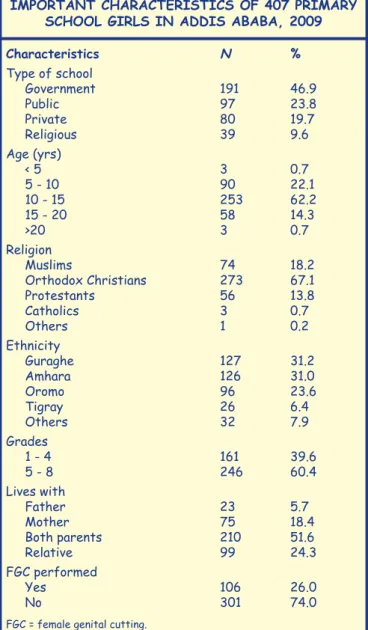
Of the 442 families, only 407 (92.1%) adequately completed the questionnaires. The socio-demographic characteristic of the girls are set out in Table I. The majority (62.2%) were in the age group 10 - 15 years, the median age being 9 years. Most (191, 46.9%) were from government schools, followed by public schools (97, 23.8%) and religious schools (80, 19.7%). Most of the girls (273, 67.1%) were Orthodox Christians, followed by Muslims (74, 18.2%). The Guraghe and Amharas ethnic groups constituted about two-thirds (62.2%) of the subjects. The majority of them (60.4%) were in Grades 5 - 8, and about half (51.6%) lived with both their parents. The overall reported prevalence of FGC was 26.0%.
TABLE I. SOCIO-DEMOGRAPHIC AND OTHER IMPORTANT CHARACTERISTICS OF 407 PRIMARY
SCHOOL GIRLS IN ADDIS ABABA, 2009
Characteristics N %
Type of school
Government 191 46.9
Public 97 23.8
Private 80 19.7
Religious 39 9.6
Age (yrs)
< 5 3 0.7
5 - 10 90 22.1
10 - 15 253 62.2
15 - 20 58 14.3
>20 3 0.7
Religion
Muslims 74 18.2
Orthodox Christians 273 67.1
Protestants 56 13.8
Catholics 3 0.7
Others 1 0.2
Ethnicity
Guraghe 127 31.2
Amhara 126 31.0
Oromo 96 23.6
Tigray 26 6.4
Others 32 7.9
Grades
1 - 4 161 39.6
5 - 8 246 60.4
Lives with
Father 23 5.7
Mother 75 18.4
Both parents 210 51.6
Relative 99 24.3
FGC performed
Yes 106 26.0
No 301 74.0
80
SAJCH SEPTEMBER 2010 VOL. 4 NO. 3
The ages at which FGC had been performed ranged from under 1 to 12 years (Fig. 1). About half (50.9%) of the 106 girls who had undergone the procedure had done so between the ages of 1 and 5 years, the next most common age being below 1 year (20.8%). The median age at FGC was 4 years. The majority of the girls who had undergone FGC (62.3%) had been circumcised by traditional circumcisers, with health workers (24, 22.6%) and close relatives (16, 15.1%) accounting for only small proportions (Fig. 2).
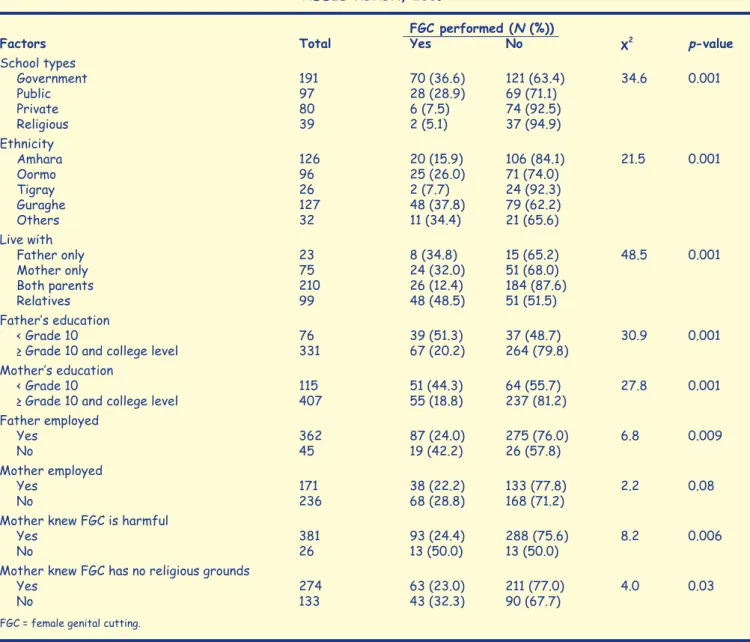
Table II sets out the characteristics of the subjects’ families, and Table III various factors associated with FGC. The prevalence of FGC was significantly higher in girls attending government schools, of Guraghe ethnicity, and from families in which the mother did not know about the harm of FGC. Of girls living with both parents 12.4% had been circumcised, compared with 48.5% of those living with relatives. The adjusted odds ratio (AOR) of FGC in girls living with relatives was 3.4 times higher than in girls living with both parents (AOR 3.4, 95% confidence interval (CI) 1.73 - 6.83), implying that living with both parents is protective (data not shown).
Discussion
Despite the various interventions that have been attempted in Ethiopia, the practice of FGC has continued. In this study in the capital, 1 in 4 schoolgirls were circumcised. Most of the subjects who had undergone FGC were below the age of 15, suggesting that the practice is continuing even in areas where reasonable health information is available. However, when the current figure is compared with the 2005 Ethiopian Demographic Health Survey report for the same region but different age groups (15 - 19 years), our study showed a better result overall (26.0% v. 65.7%).12
Interestingly, the prevalence of FGC was lower in religious and private schools than in government and public schools. This suggests that the reasons for FGC are traditional and cultural rather than religious. A similar observation was documented for Guinea and Sudan.17 On the other hand,
another study documented Islamic faith to be the major driving motive for FGC among homogeneous Somali refugees settled in the eastern part of Ethiopia.18 The fact that
over 80% of the subjects who had been subjected to FGC in our study were non-Muslim suggests that FGC was driven by cultural and traditional reasons rather than religion, and
Fig. 1. Ages at which the subjects had undergone FGC (%) (N=106), Addis Ababa, 2009.
Fig. 2. People who had performed FGC on the subjects (%) (N=106), Addis Ababa, 2009.
TABLE II. SOCIO-DEMOGRAPHIC AND OTHER
IMPORTANT VARIABLES OF THE SCHOOLGIRLS’
FAMILIES, ADDIS ABABA, 2009
Characteristics N %
Educational level of father
No formal schooling 76 18.7
Grade 1 - 8 126 31.0
Grade 9 - 12 108 26.5
College and above 97 23.8
Educational level of mother
No formal schooling 115 28.3
Grade 1 - 9 136 33.4
Grade 10 - 12 111 27.3
College and above 45 11.1
Occupation of father
Government employee 92 22.6
Work in private organisations 210 51.6
No work 45 11.1
Daily labourer 60 14.7
Occupation of mother
Government 55 13.5
Work in private organisations 116 28.5
No work 236 58.0
Decision about FGC was made by (N=106)
Fathers 26 24.5
Mothers 41 38.7
Both parents 24 22.6
Relatives/neighbours 15 14.2
Support FGC
Yes 16 3.9
No 391 96.1
Member of family supporting FGC
Father 2 8.7
Mother 4 5.7
Both 3 1.4
Relatives 7 7.1
Reasons for supporting FGC (N=16)*
To maintain the tradition 15 93.7
Keeps virginity 14 87.5
Keeps dignity and an opportunity to
get husband 12 75.0
Hygiene and beauty 16 100.0
Oppose FGC (N=391)*
Against human rights and harmful to girls 389 99.4
Has risk of HIV transmission 375 95.9
FGC is illegal and should be abandoned 380 97.2
Painful, decreases sexual desire and
complicates delivery 346 88.5
SAJCH SEPTEMBER 2010 VOL. 4 NO. 3
81
furthermore when we tabulated religion against ethnicity two times more non-Moslems than Moslems of the same ethnicity had undergone FGC. This again demonstrates traditional and cultural rather than religious reasons for FGC, and suggests that legal action should be taken to fight deeply rooted traditional practices to improve the reproductive health of the community.
Another window of opportunity to minimise FGC is to focus on primary government and public schools, as the majority of the circumcised girls were found in these schools. Targeting the schools will have dual benefits, as when the students are taught that FGC is affecting their reproductive health the message will be passed on to their families, which may ultimately reduce the practice. A concerted effort of the ministries of education, health and justice is therefore needed, assisted by women’s associations and legal enforcement, as the act is a form of violence against women and has debilitating and long-lasting health hazards.19
One reason for the persistence of FGC observed in our study is the dominant role played by fathers in influencing other family members. This is in concordance with another study done in
Ethiopia20 and underscores the need to change attitudes among
fathers as well as in the community.
In the present study, although some health workers (midwives) performed FGC, the majority of the girls were circumcised by traditional circumcisers who may be less familiar with the anatomy of female genitalia and could easily cause damage because of crude tools, poor light or poor eyesight, compounded by the struggles of the girls or women during the procedure.
TABLE III. FACTORS RELATED TO GENITAL CUTTING AMONG THE STUDY SUBJECTS, ADDIS ABABA, 2009
FGC performed (N (%))
Factors Total Yes No χ2 p-value
School types
Government 191 70 (36.6) 121 (63.4) 34.6 0.001
Public 97 28 (28.9) 69 (71.1)
Private 80 6 (7.5) 74 (92.5)
Religious 39 2 (5.1) 37 (94.9)
Ethnicity
Amhara 126 20 (15.9) 106 (84.1) 21.5 0.001
Oormo 96 25 (26.0) 71 (74.0)
Tigray 26 2 (7.7) 24 (92.3)
Guraghe 127 48 (37.8) 79 (62.2)
Others 32 11 (34.4) 21 (65.6)
Live with
Father only 23 8 (34.8) 15 (65.2) 48.5 0.001
Mother only 75 24 (32.0) 51 (68.0)
Both parents 210 26 (12.4) 184 (87.6)
Relatives 99 48 (48.5) 51 (51.5)
Father’s education
< Grade 10 76 39 (51.3) 37 (48.7) 30.9 0.001
≥ Grade 10 and college level 331 67 (20.2) 264 (79.8)
Mother’s education
< Grade 10 115 51 (44.3) 64 (55.7) 27.8 0.001
≥ Grade 10 and college level 407 55 (18.8) 237 (81.2)
Father employed
Yes 362 87 (24.0) 275 (76.0) 6.8 0.009
No 45 19 (42.2) 26 (57.8)
Mother employed
Yes 171 38 (22.2) 133 (77.8) 2.2 0.08
No 236 68 (28.8) 168 (71.2)
Mother knew FGC is harmful
Yes 381 93 (24.4) 288 (75.6) 8.2 0.006
No 26 13 (50.0) 13 (50.0)
Mother knew FGC has no religious grounds
Yes 274 63 (23.0) 211 (77.0) 4.0 0.03
No 133 43 (32.3) 90 (67.7)
FGC = female genital cutting.
S
A
J
ou
rna
l of Child H
ea
lth
S
A
J
ou
rna
l of Child H
ea
lth
rna
l of Child H
The act is a form of violence
against women and has
82
SAJCH SEPTEMBER 2010 VOL. 4 NO. 3
Although the majority of families did not support FGC, a few families were still in favour of it because they felt that their daughter would maintain the tradition and dignity of her family and get a husband. These ideas were notably expressed by mothers who had experienced the pain and health consequences of FGC themselves. Conversely, the majority of the interviewed families who were against FGC stated that the act was harmful to girls, exposes them to HIV transmission, decreases their libido and complicates delivery. A strong campaign through all available media is necessary to eliminate incorrect perceptions and change the attitudes of mothers and other relatives involved in these ruthless acts, which are against human rights.
Some of the major factors responsible for the continuation of FGC were identified. Attending government schools, being of Guraghe ethnic origin, living with a family other than the parents, fathers with low grades of schooling and mothers who did not have knowledge about the harm of FGC were the major determining factors. However, this information should be interpreted with caution.
The association of mothers’ knowledge and fathers’ education with FGC once again demonstrated that education is one of the most vital factors in eradicating FGC, underlining the need for gender equality and empowering parents to aim at a higher level of schooling in successfully eliminating harmful traditional practices. This need has been expressed by others.21 Our finding that FGC was associated with Guraghe
ethnicity provides another area of opportunity. Dialogue with community elders, thereby convincing them that FGC is a harmful tradition, could result in this information cascading and ultimately help make the anti-FGC campaign a success.
One of the limitations of this study is that our urban population is not representative of the rural population. Secondly, the fact that the findings were based on self-reporting and were not accompanied by clinical examinations may also have biased the information.
Conclusions
Despite a high level of knowledge regarding the complications of FGC and a high level of awareness, FGC continues to be prevalent in Addis Ababa. Focused creation of awareness, specifically targeting the government schools and people of Guraghe ethnicity, increased gender equity, and empowering both parents and the community through ministries such as education, health and justice, women’s associations and community elders are recommended.
Competing interests. The authors declare that they have no competing interests.
Authors’ contributions. TZS organised this study when he was doing his master’s in public health, conducted statistical analysis and drafted the manuscript, while JH contributed to the design, data analysis and interpretation and revised the manuscript for intellectual content. Both authors read and approved the submitted manuscript. WK-M meticulously reviewed the manuscript for intellectual content.
Acknowledgement. This study was funded by the Addis Ababa School of Public Health. We also express our gratitude to those personnel from the Addis Ababa Education Bureau, the respective heads of sub-cities, primary schools directors, unit leaders, and the study subjects and their families for their support.
References
1. Mona S. Female genital cuttings. Afr J Reprod Health 2006;10(2):24-36. 2. Mohamed A, Mohsen A, Mahmoud N, et al. Prevalence of FGC among
Egyptian girls. WHO Bulletin 2008;384(86):269-274.
3. Marianne S. Female genital cutting: An introduction, FGC education and networking project. 2007. www.informaworld.com or www. fgmnetwork.org (accessed 1 September 2010).
4. Hosken F. The Hosken Report: Genital and Sexual Mutilation of Females. 4th rev. ed. Lexington, MA: Women’s International Network News, 1994: 439.
5. Nahid T. Female circumcision as public health issue. N Engl J Med 1994;331:712-716.
6. Berggren V, Musa AS, Hernlund Y, Johannson E, Habbani B, Edberg AK. Being victims or beneficiaries? Perspectives of female genital cutting and reinfibulation in Sudan. Afr J Reprod Health 2006;10(2):24-36. 7. Heidi J, Nafissatou D, Ian A, et al. Female genital cutting and its
negative health outcomes in Burkina Faso and Mali. Stud Fam Plan 1999;30(3):219-230.
8. De Silva S. Obstetric sequels of female circumcision. Eur J Obstet Gynecol Reprod Biol 1989;32:233-240.
9. Gebremichael T. Female genital mutilation and birth complications, Jijiga town, Eastern Ethiopia. Ethiopian Journal of Health Development 2000;14(3):69-276.
10. Federal Ministry of Health (FMoH). Report on Safe Motherhood Community-based Survey. Addis Ababa: Family Health Department, FMoH, Ethiopia, March 2006.
11. Central Statistical Agency, Addis Ababa, and ORC Macro. Ethiopia Demographic and Health Survey 2000. Calverton, Md: ORC Macro, 2000:156-157.
12. Central Statistical Agency, Addis Ababa, and ORC Macro. Ethiopia Demographic and Health Survey 2005. Calverton, Md: ORC Macro, 2006: 252-254.
13. National Committee on Traditional Practices for Ethiopia (NCTPE). Harmful Traditional Practices in Ethiopia. Addis Ababa: NCTPE, 2003. 14. Save the Children Norway. Follow up National Survey on Harmful
Traditional Practices in Ethiopia. Addis Ababa: Norwegian Embassy, 2008. 15. Klouman E, Manongi R, Klepp K. Self-reported and observed female genital cutting in rural Tanzania: associated demographic factors, HIV and sexually transmitted infections. Trop Med Int Health 2005;10:105-115. 16. Sami I. Female circumcision with special reference to the Sudan, 2007.
Ann Trop Paediatr 1986;6:99-115.
17. Mitike G, Deressa W. Prevalence and associated factors of female genital mutilation among Somali refugees in eastern Ethiopia. BMC Public Health 2009;9:264.
18. Population Council Report. Facts about Adolescents from the Demographic and Health Survey. Statistical tables for program planning. Ethiopia, 2005.
19. Amusan O, Asekun O. Knowledge, beliefs, and attitudes to FGM in Shao community of Kware state, Nigeria. Int Q Community Health Educ 1981;27(4):337-349.
20. Missailidis K, Gebre-Medhin M. Female genital mutilation in Eastern Ethiopia. Lancet 2000;356:137.