Background
Neonatal sepsis may be categorised as early or late onset. Eighty-five per cent of newborns with early-onset infection present within 24 hours, 5% present at 24 - 48 hours, and a smaller percentage of patients present between 48 hours and 6 days of life.1 Onset is most rapid in premature neonates. Early-onset neonatal sepsis (EONS) is associated with acquisition of micro-organisms from the mother, either transplacentally or by passage through a colonised birth canal at delivery. The micro-organisms most commonly associated with early-onset infection include group B Streptococcus (GBS), Escherichia coli, Haemophilus influenzae, and Listeria monocytogenes.1
In addition, a number of host factors predispose the newborn infant to sepsis. These factors are especially prominent in the premature infant and involve all levels of host defence, including cellular immunity, humoral immunity, and barrier function.1 Neonatal sepsis presents a diagnostic problem as the signs are nonspecific, and to date no single reliable marker of infection at the time of presentation has been identified. Rapid diagnosis and treatment of systemic bacterial infections
is essential in neonates since a delay in treatment may lead to a poorer outcome2 and the mortality rate in untreated neonatal sepsis can be as high as 50%.1
A positive blood culture result is the currently used ‘gold standard’ in the definitive diagnosis of sepsis as it has a high specificity, but because it lacks sensitivity and the results are only available after 24 - 48 hours, studies are ongoing to find an earlier and better marker. Many neonates are therefore evaluated and treated for presumed sepsis with empiric parenteral antibiotics while awaiting other markers of sepsis and final blood culture results. Less than 10% of these babies actually have culture-proven sepsis.3 In view of this diagnostic and therapeutic dilemma, a more unequivocal test, at the time of presentation, for the differential diagnosis of infection and sepsis is of paramount importance.4 Early detection or exclusion of infection would have a significant impact on reducing health care costs by preventing unnecessary admission, hospitalisation and over-treatment with antibiotics, which is of relevance in developing countries like South Africa with limited hospital beds and resources.
Debbie White,
MB BCh, FCPaed (SA), MMed (Paed)
Daynia Ballot,
MB BCh, FCPaed (SA), PhD
Peter Cooper,
MB ChB, FCPaed (SA), PhD
Department of Paediatrics, University of the Witwatersrand, Johannesburg
Olga Perovic,
MD, DTM&H, FCPath (SA)
Department of Clinical Microbiology and Infectious Diseases and National Health Laboratory Service, University of the Witwatersrand
Jacky Galpin,
BSc, PhD
Department of Statistics and Actuarial Science, University of the Witwatersrand
Can a negative procalcitonin level guide
antibiotic therapy in early-onset
neonatal sepsis?
S
A
Jo
ea
lth
S
A
Jo
ur
nal
of Child
H
ea
lth
S
A
Jo
ur
nal
of Child
H
ea
lth
146 SAJCH DECEMBER 2007 VOL. 1 NO. 4
Background. Procalcitonin (PCT) has been used in the diagnosis of early-onset neonatal sepsis (EONS) in conjunction with other markers of infection, and levels are highest at the onset of infection and decline over time. This study evaluated whether an initial negative PCT level could be used to withhold antibiotics in neonates presenting with suspected EONS and whether PCT levels differed between premature and term babies.
Methods. Neonates undergoing evaluation for suspected sepsis in the Neonatal Unit, Johannesburg Hospital, within 24 hours of birth between July and September 2004 were included. Patients were categorised into various categories of infection using risk factors for infection, white cell count, platelet count, C-reactive protein and blood culture results. Babies were started on empiric parenteral antibiotics as per unit protocols. PCT was correlated with infection categories.
Results. The final analysis included 194 babies, 131 premature and 63 term; 145 had ‘no infection’, 47 ‘probable infection’ and 2 ‘definite infection’. The mean PCT levels (and ranges) for the three categories were 1.6 ng/ml (range 0.5 - 37.5 ng/ml), 11.9 ng/ml (0.5 - 150.4) and 6.7 ng/ml (0.5 - 12.9), respectively. Using a cut-off of 0.5 ng/ml, the negative predictive value (NPV) of PCT was 80% and the positive predictive value (PPV) 39%. Increasing the cut-off of PCT had no effect on the NPV. Receiver operating characteristic (ROC) analysis had an area under the curve of 0.631.
ARTICLE
SAJCH DECEMBER 2007 VOL. 1 NO. 4
147
A better understanding of the pathophysiology of sepsis and cytokine release has led to the development of new diagnostic and therapeutic strategies.5 Various markers of inflammation such as IL-1β, tumour necrosis factor (TNF), IL-6, IL-8 and C-reactive protein (CRP) have all been studied as markers of neonatal sepsis. These markers are well recognised to correlate with disease severity in sepsis. However, the cytokines are neither sensitive nor specific enough, and their measurement is time consuming and expensive.2
Procalcitonin
More recently, procalcitonin (PCT) has gained favour as a marker of bacterial sepsis in both adult and paediatric patients.6,7 PCT is a 116-aminoacid peptide and one of the precursors of calcitonin (CT). Most CT precursor peptides, including PCT, are found in the serum of normal healthy persons. In sepsis, both pro-inflammatory mediators and bacterial toxins induce a ubiquitous increase in CT-messenger RNA, resulting in a subsequent constitutive release of several calcitonin precursors, including PCT but not mature calcitonin, from all parenchymal tissues and differentiated cell types (including liver, lung, kidney, adipocytes and muscle) throughout the body.4
PCT is preferentially induced in patients with sepsis, especially in severe bacterial sepsis or septic shock, and patients with systemic inflammation of non-bacterial origin generally have low PCT levels.8 PCT is closely related to the severity of systemic inflammation and has reliable kinetics of induction and elimination;8 therefore levels have been shown to be highest at time of onset of sepsis and decline over a period of time with appropriate antibiotic therapy. Increases in PCT occur more rapidly than increases in CRP, and PCT can be detected in the plasma 2 hours after the injection of endotoxins. Within 6 - 8 hours, PCT concentrations rise and a plateau is reached after approximately 12 hours, with levels then decreasing to normal values after 2 - 3 days with appropriate management.9 This has enabled PCT to be used as a valuable marker for diagnosis, evaluating prognosis and response to therapy.10,11
The value of PCT as a marker for bacterial infection in neonates is complicated by a physiological increase of PCT during the first days of life. An increase in PCT concentrations has been reported in healthy newborn neonates, in the absence of relevant bacterial infection, with a peak at 24 - 36 hours of life, thereafter reverting to normal by 48 hours.12 The adult reference range applies from 3 days after birth.9
A negative PCT test on presentation has been used to rule out sepsis and accurately predict the absence of bacteraemia in patients presenting with fever without localising signs of infection in both adult and paediatric patients.13,14 Our unit has previously shown that PCT measurement at the time of presentation with symptoms of neonatal sepsis had an excellent negative predictive value.15 This concurs with other authors, who suggest that a negative PCT test may be used to exclude bacterial infection in neonates.16
Objectives
This study had two aims. Firstly, it evaluated whether an initial negative PCT test could be used to withhold antibiotics in neonates presenting with suspected EONS. Secondly, it aimed to determine at which level of PCT neonatal sepsis could safely be ruled out, and whether this level differed between premature and term babies.
Methods
This was a prospective observational study conducted in the Neonatal Unit at Johannesburg Hospital between July and September 2004. Ethical clearance for the study was obtained from the Human Research Ethics Committee of the University of the Witwatersrand, Johannesburg, and no baby was entered onto the study until written informed consent had been obtained from the parent or guardian.
All neonates being evaluated for early-onset sepsis within 24 hours of birth were eligible for inclusion. Criteria for the evaluation of sepsis included the presence of a maternal risk factor for sepsis or clinical signs of neonatal sepsis (see ‘Categories of infection’ below).
On presentation, a septic work-up was done which included a full blood count (FBC) with a white cell count (WCC) and platelet count, a blood culture and a PCT level, within 24 hours of birth. PCT was measured with a quantitative immunoluminometric assay (Brahms Diagnostica, Berlin, Germany). Cerebrospinal fluid and urine cultures were done as clinically indicated and babies were started on empiric parenteral antibiotics. The CRP level was measured after 24 - 48 hours, and if this was negative and the baby clinically well, antibiotics were discontinued and the baby was discharged if eligible. If the CRP level was abnormal or the baby clinically unwell, antibiotic therapy was continued until negative blood culture results were obtained at 72 hours, or as necessary if sepsis was proven.
Categories of infection
Babies were grouped into different categories of infection (similar to previous studies conducted in our unit by Magudumana et al.3 and Ballot et al.15) prior to obtaining the PCT results, as follows:
• No infection. Any baby with any one of the following maternal risk factors: a history of maternal chorioamnionitis, premature rupture of membranes (PROM), fever or urinary tract infection OR at least one of the following clinical signs: respiratory distress, temperature instability, feed intolerance, irritability, lethargy or seizures in the presence of a normal WCC, platelet count and CRP level and a negative blood culture. A single low platelet count or abnormal WCC was not considered to be significant as there is a high prevalence of pregnancy-induced hypertension and maternal HIV infection in our population and such babies were classified as having no infection.
• Probable infection. Any baby who presented with a maternal risk factor for sepsis OR at least one clinical sign of sepsis (as above), who had at least one of an abnormal WCC, platelet count or CRP level, together with a negative blood culture.
• Definite infection. Any baby who presented with a maternal risk factor for sepsis OR at least one clinical sign of sepsis (as above), who had at least one of an abnormal WCC, platelet count or CRP level, together with a positive blood culture.
• Unclassified. Any baby who did not fit into any of the above categories.
Statistical analysis
Descriptive statistics included mean and standard deviation for continuous variables and proportions for categorical variables. Sensitivity, specificity, positive predictive value (PPV) and negative predictive value (NPV) were determined across a range of cut-offs of PCT. Receiver operating characteristic (ROC) curves were constructed for the whole group and were compared between premature and term babies. In this study, ‘probable infection’
and ‘definite infection’ patients were regarded as positive, whereas the ‘no infection’ group was regarded as negative.
Cost analysis
The cost of admission to the neonatal high care unit of R 2 400 per day was weighed up against the cost of a single quantitative PCT assay of R272.20 (Brahms Diagnostica, Berlin, Germany).
Results
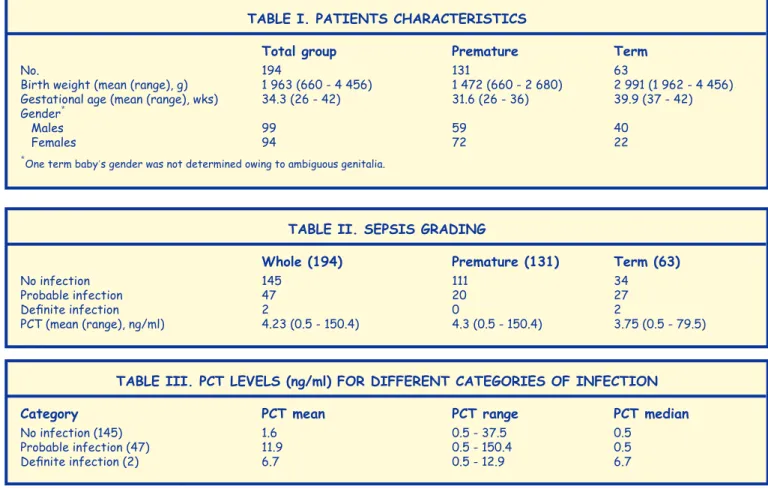
Two hundred and twelve babies were enrolled in the study. Eighteen babies were excluded: no consent was obtained within the time limits necessary for the study in 7; 3 had incomplete data, e.g. missing blood results; 7 had positive blood cultures that were considered to be contaminants; and 1 baby’s infection category was unclassified. The contaminants included 4 coagulase-negative staphylococci, 2 Corynebacterium and 1 Micrococcus. Each of these cases was reviewed together
with the microbiologist and the PCT result in all 7 cases was less than 1.0 ng/ml. The unclassified patient was born with severe hydrops fetalis for which no cause could be found and had a high PCT level. The final analysis therefore included 194 babies (Table I).
There were 2 babies with ‘definite’ early-onset sepsis, 47 babies with ‘probable infection’ and 145 babies with ‘no infection’. The sepsis grading and differences between premature and term babies are shown in Table II.
The 2 babies with confirmed culture-positive EONS were both term and grew S. agalactiae and E. coli respectively. Their PCT levels were 12.9 ng/ml and <0.5 ng/ml respectively.
The PCT levels for the different categories of infection are shown in Table III.
The PCT range in the ‘probable infection’ group showed an upper limit of 150.4 ng/ml, but this in fact was an isolated case, as the majority of the PCT results in this group were <80 ng/ml.
Sensitivity, specificity, PPV and NPV for various cut-off values of PCT are shown in Table IV.
Overall, using a cut-off of 0.5 ng/ml, the NPV of PCT was 80% and the PPV 39%. Increasing the cut-off to 10.1 ng/ml had no effect on the NPV but improved the PPV (78% v. 79%, respectively). Specificity of PCT using a cut-off of 0.5 ng/ ml was 74% cf. a sensitivity of 48%, and increasing the cut-off to 10.1 ng/ml improved the specificity but worsened the sensitivity (98% v. 22%, respectively). PCT using a cut-off of
The mortality rate in
untreated neonatal
sepsis can be as high
as 50%.
148 SAJCH DECEMBER 2007 VOL. 1 NO. 4
S
A
Jo
ur
H
ea
lth
S
A
Jo
ur
nal
of Child
H
ea
lth
S
A
Jo
ur
nal
of Child
H
ea
lth
ARTICLE
TABLE II. SEPSIS gRAdIng
Whole (194) Premature (131) Term (63)
No infection 145 111 34
Probable infection 47 20 27
Definite infection 2 0 2
PCT (mean (range), ng/ml) 4.23 (0.5 - 150.4) 4.3 (0.5 - 150.4) 3.75 (0.5 - 79.5)
TABLE I. PATIEnTS ChARACTERISTICS
Total group Premature Term
No. 194 131 63
Birth weight (mean (range), g) 1 963 (660 - 4 456) 1 472 (660 - 2 680) 2 991 (1 962 - 4 456)
Gestational age (mean (range), wks) 34.3 (26 - 42) 31.6 (26 - 36) 39.9 (37 - 42)
Gender*
Males 99 59 40
Females 94 72 22
*One term baby,s gender was not determined owing to ambiguous genitalia.
TABLE III. PCT LEvELS (ng/ml) fOR dIffEREnT CATEgORIES Of InfECTIOn
Category PCT mean PCT range PCT median
No infection (145) 1.6 0.5 - 37.5 0.5
Probable infection (47) 11.9 0.5 - 150.4 0.5
0.5 ng/ml had a NPV of 86% for premature babies v. 65% for those born at term.
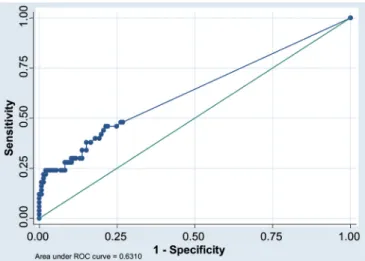
ROC analysis to evaluate the ability of PCT to predict ‘no infection’ v. ‘infection (probable and definite)’ throughout the range of cut-off values was done. The ROC AUC for the whole group was 0.63 (Fig. 1).
For the whole group, the number of babies in the ‘no infection’ group was 145 and in the ‘infection (probable and definite)’ group it was 47+2=49. For the premature babies the ROC AUC was 0.59 and the numbers of babies in the two infection groups were 111 v. 20+0=20. For the term babies the ROC AUC was 0.65 and the numbers of babies in the two groups were 34 v. 27+2=29 (Fig. 2).
Fourteen of the babies were classified as having birth asphyxia. Of these, 11 were graded as ‘no infection’ and 3 as ‘probable infection’; there were none with ‘definite infection’. The mean PCT level in these babies was 0.89 ng/ml (range 0.5 - 3.7 ng/ml).
discussion
Our study confirms the low incidence of culture-proven EONS. There were only two babies with clinically significant culture-proven sepsis and both had been born at term. The proportion of infected babies (definite and probable) was
much higher the term than in the premature group (46% v. 15%), which was surprising, as prematurity is well described as a risk factor for sepsis. This may be because only sick term babies are admitted, while premature babies are often admitted empirically just because of low birth weight. We thought that the high incidence of birth asphyxia in our term babies may have contributed to falsely elevated numbers of babies in the ‘probable infection’ group, but in fact 11 out of the 14 babies classified as having birth asphyxia were graded as ‘no infection’.
Procalcitonin has been shown to be a valuable marker for the diagnosis, evaluation of prognosis and response to therapy in neonatal sepsis.11 A study by Distefano et al. showed a sensitivity of 96% and a specificity of 84% using a PCT cut-off of 0.7 ng/ml in the diagnosis of EONS.17 Our results differ from this study and show that PCT in our patient population is not a very good predictor of early-onset sepsis even when using higher cut-offs of PCT, to account for the physiological increase in PCT after birth.
PCT was poorly sensitive, with overall sensitivity using a cut-off of 0.5 ng/ml of only 48%, but had a better specificity of 74%. Increasing the cut-off of PCT to 10.1 ng/ml improved the specificity to 98% but worsened the sensitivity to 22%. Using a cut-off of 0.5 ng/ml, the NPV of 80% was much better than the PPV of 39% and even though increasing the cut-off to 10.1 ng/ml improved the overall PPV, it had no effect on the NPV. The NPV of PCT using a cut-off of 0.5 ng/ml was better in premature babies than in terms (86% v. 65%).
SAJCH DECEMBER 2007 VOL. 1 NO. 4
149
ARTICLE
TABLE Iv. PREdICTIvE vALuES fOR vARIOuS CuT-OffS Of PCT
PCT (ng/ml) Sensitivity Specificity PPV NPV
Premature 0.5 0.38 0.75 0.22 0.86
2.5 0.29 0.87 0.30 0.87
5.1 0.29 0.91 0.38 0.87
10.1 0.29 0.97 0.67 0.88
Term 0.5 0.55 0.71 0.62 0.65
2.5 0.38 0.82 0.65 0.61
5.1 0.21 0.97 0.86 0.59
10.1 0.17 1.00 1.00 0.59
Overall 0.5 0.48 0.74 0.39 0.80
2.5 0.34 0.86 0.46 0.79
5.1 0.24 0.92 0.52 0.78
10.1 0.22 0.98 0.79 0.78
Fig. 1. ROC curve of PCT for ‘no infection’ v. ‘infection (probable and definite)’ – whole group.
Overall, ROC AUC for the whole group was 0.63 (better than random chance) and showed no difference between premature and term babies (0.59 v. 0.65).
One of the babies graded as ‘definite infection’ who had growth of E. coli on blood culture and was clinically symptomatic, had a PCT of <0.5 ng/ml which shows that even though the NPV is reasonable, PCT on its own is not sufficiently reliable to exclude neonatal sepsis. This is in disagreement with Guibourdenche et al., who suggested that a negative PCT on presentation may be useful to rule out sepsis in neonates, since their NPV of PCT was 93%.16
Since the mortality rate in untreated neonatal sepsis can be as high as 50%1 and no single reliable marker of infection at the time of presentation has been identified, many neonates are evaluated and treated for presumed sepsis with empiric parenteral antibiotics while awaiting final blood culture results. In our study, 77% of premature babies were admitted and treated empirically with parenteral antibiotics when, in fact, they were classified as having ‘no infection’ (only 10 premature babies who were admitted for low birth weight were not treated on antibiotics). The fact that it costs R2 400 per day to admit a baby to our neonatal high-care unit, which has an extremely high bed occupancy, highlights the importance of finding an accurate and suitable marker of infection in neonates to prevent this unnecessary expense, especially in our resource-poor setting.
Conclusion
This study confirms the low occurrence of culture-proven EONS. A negative PCT level on admission for suspected EONS is not sufficiently reliable to exclude the presence of sepsis, even when using higher cut-off values to account for the physiological rise in PCT after birth. PCT levels do not differ significantly between premature and term babies. The diagnosis of bacterial infections in neonates will continue to require a careful patient history, a critical clinical awareness, dedicated physical examination and appropriate cultures.4 The expense incurred in admitting and empirically treating neonates with suspected EONS highlights the need for identification of a reliable marker of infection.
This research was approved for the degree of Master of Medicine in the branch of Paediatrics by the Faculty of Health Sciences, University of the Witwatersrand, Johannesburg, in June 2007.
References
1. Anderson-Berry AL, Bellig LL. Neonatal sepsis. 18 August 2006. http:// www.emedicine.com/PED/topic2630.htm (last accessed 27 October 2006).
2. Carrol ED, Thomson AP, Hart CA. Procalcitonin as a marker of sepsis. Int J Antimicrob Agents 2002; 20(1): 1-9.
3. Magudumana MO, Ballot DE, Cooper PA, et al. Serial interleukin 6 measurements in the early diagnosis of neonatal sepsis. J Trop Pediatr 2000; 46(5): 267-271.
4. Christ-Crain M, Muller B. Procalcitonin in bacterial infections – hype, hope, more or less? Swiss Med Wkly 2005; 135(31-32): 451-460.
5. Horner C, Bouchon A, Bierhaus A, et al. Role of the innate immune response in sepsis. Anaesthetist 2004; 53(1): 10-28.
6. Luzzani A, Polati E, Dorizzi R, et al. Comparison of procalcitonin and C-reactive protein as markers of sepsis. Crit Care Med 2003; 31(6): 1737-1741.
7. Resch B, Gusenleitner W, Muller WD. Procalcitonin and interleukin-6 in the diagnosis of early onset sepsis of the neonate. Acta Paediatr 2003; 92(2): 243-245.
8. Meisner M. Pathobiochemistry and clinical use of procalcitonin. Clin Chim Acta 2002; 323(1-2): 17-29.
9. Van Rossum AM, Wulkan RW, Oudesluys-Murphy AM. Procalcitonin as an early marker of infection in neonates and children. Lancet Infect Dis 2004; 4(10): 620-630.
10. Casado-Flores J, Blanco-Quiros A, Asensio J, et al. Serum procalcitonin in children with suspected sepsis: a comparison with C-reactive protein and neutrophil count. Pediatr Crit Care Med 2003; 4(2): 190-195. 11. Athhan F, Akagunduz B, Genel F, et al. Procalcitonin: a marker of
neonatal sepsis. J Trop Pediatr 2002; 48(1): 10-14.
12. Sachse C, Dressler F, Henkel E. Increased serum procalcitonin in newborn infants without infection. Clin Chem 1998; 44(6 Pt 1): 1343-1344.
13. Chirouze C, Schuhmacher H, Rabaud C, et al. Low serum procalcitonin level accurately predicts the absence of bacteremia in adult patients with acute fever. Clin Infect Dis 2002; 35(2): 156-161.
14. Galetto-Lacour A, Zamora SA, Gervaix A. Bedside procalcitonin and C-reactive protein tests in children with fever without localizing signs of infection seen in a referral center. Pediatrics 2003; 112(5): 1054-1060. 15. Ballot DE, Perovic O, Galpin J, et al. Serum procalcitonin as an early
marker of neonatal sepsis. S Afr Med J 2004; 94(10): 851-854.
16. Guibourdenche J, Bedu A, Petzold L, et al. Biochemical markers of neonatal sepsis: value of procalcitonin in the emergency setting. Ann Clin Biochem 2002; 39(Pt 2): 130-135.
17. Distefano G, Curreri R, Betta P, et al. Procalcitonin serum levels in perinatal bacterial and fungal infection of preterm infants. Acta Paediatr 2004; 93(2): 216-219.