DLM Sample Acceptance Policy Page 1 of 15 See the Intranet for the latest version. Version Number:- 009
DOCUMENT CONTROL PAGE
Ti
tl
e Title: Directorate of Laboratory Medicine Sample Acceptance Policy
Version: 009
Reference Number: OPS PROC-067
S
up
ersedes
Supersedes: Version 008
Changes: Introduction of ICE and District Number, Inclusion of Trafford, change of wording ‘Specimen’ changed to ‘Sample’
M ino r A m en dment Date: 20th October 2015
Notified To DLM Board, ratified by DLM Laboratory Managers Date: 20th October 2015
Summary of amendments – Introduction of ICE and District Number, Inclusion of Trafford, change of wording ‘Specimen’ changed to ‘Sample’
A
uthor
Originated / Modified By: Rebecca Whitehouse/Joyce Nelson
Designation: Central Specimen Reception Manager/DLM Quality Manager
R
atifica
ti
on Ratified by: DLM Laboratory Managers
Date of Ratification: 20th October 2015
A pp licatio n All Staff C ir cul atio n Issue Date: 26.10.15
Circulated by: Rebecca Whitehouse
dissemination and Implementation: Refer to section 11
R
evi
ew Review Date: October 2017
Responsibility of: Rebecca Whitehouse Date placed on the Intranet:
26th October 2015
Please enter your EqIA Registration Number here: 263/11
DLM Sample Acceptance Policy Page 2 of 15 See the Intranet for the latest version. Version Number:- 009
Table of Contents
1. Introduction ... 5
2. Purpose ... 5
3. Roles and Responsibilities ... 6
4. Procedure ... 6
5 Mandatory Labelling Criteria for Samples and Request Forms ... 9
6. Specific Departmental requirements ... 10
7. Rejection of Samples ... 11
8. ICE ... 12
9. Trafford Samples ... 13
10. Equality Impact Assessment. ... 13
11. Consultation, Approval and Ratification Process ... 13
12. Dissemination and Implementation ... 14
13. Monitoring Compliance of the Sample acceptance procedure ... 14
14. Standards and Key Performance Indicators ‘KPIs’ ... 14
15. References and Bibliography ... 15
DLM Sample Acceptance Policy Page 3 of 15 See the Intranet for the latest version. Version Number:- 009
Table 1: Sample acceptance criteria for Central Site, CMFT
Good practice demands the provision of more than
the minimum of information
CENTRAL SITE Mandatory Labelling Requirement Action by Laboratory if requirement not met
Samples MUST be labelled with 4 unique
identifiers which are as follows: District Number
Surname Forename Date of birth
No analysis will be performed. The event will be reported as an incident on Ulysses if appropriate.
Where the sample is repeatable/ reproducible, no analysis will be performed and the sample will be discarded.
Where the sample is unrepeatable/ unreproducible, the risk to the patient of rejection of the sample must be weighed against the risk of
acceptance of a wrongly labelled sample, local procedures will be followed.
Laboratory Medicine will accept no responsibility for samples analysed which initially failed to meet the acceptance criteria and will issue a disclaimer on such reports.
The request form (if required) data MUST match the above
information on the sample.
Multiple samples taken at different times on a patient MUST
be labelled on the sample container with the time (24 hr. clock) when the sample is taken.
See section 6 for additional department specific requirements
If a request form is required then the request form data MUST match the above sample information
District Number Surname Forename Date of birth
Request forms SHOULD also contain:
the patient’s location/destination for the report (or a location code)
Tests required
Name of Consultant or GP
Name of the requester and contact number (bleep or extension)
Patient gender
Date and time of sample collection
Anatomical site and type of sample (where relevant)
All relevant clinical information
Patient address for GP requests
For Blood Transfusion – Forms MUST be signed
A lack of patient or sample information may result in the
laboratory not conducting the analysis / examination
Examples could include: no swab site indicated
no dates and times of sampling no clinical details given
location for report delivery not given
It may not be possible to issue a report or to interpret results.
Appropriate comments will be made on the report where this can be issued.
DLM Sample Acceptance Policy Page 4 of 15 See the Intranet for the latest version. Version Number:- 009
Table 2: Sample acceptance criteria for Trafford Site, CMFT
Good practice demands the provision of more than
the minimum of information.
TRAFFORD SITE Mandatory Labelling Requirement Action by Laboratory if requirement not met
Samples MUST be labelled with 4 unique
identifiers which are as follows: EPMI Number
Surname Forename Date of birth
No analysis will be performed. The event will be reported as an incident on Ulysses
Where the sample is repeatable/ reproducible, no analysis will be performed and the sample will be discarded.
Where the sample is unrepeatable/ unreproducible, the risk to the patient of rejection of the sample must be
weighed against the risk of acceptance of a wrongly labelled sample, local procedures will be followed. Laboratory Medicine will accept no responsibility for samples analysed which initially failed to meet the acceptance criteria and will issue a disclaimer on such reports.
The request form data MUST match the above information on
the sample.
Multiple samples taken at different times on a patient MUST
be labelled on the sample container with the time (24 hr clock) when the sample is taken.
See section 6 for additional department specific requirements
If a request form is required then the request form data MUST match the above sample information
EPMI Number Surname Forename Date of birth
Request forms SHOULD also contain:
the patient’s location/destination for the report (or a location code)
Tests required
Name of Consultant or GP
Name of the requester and contact number (bleep or extension)
Patient gender
Date and time of sample collection
Anatomical site and type of sample (where relevant)
All relevant clinical information
Patient address for GP requests
For Blood Transfusion – Forms MUST be signed
A lack of patient or sample information may result in the laboratory not
conducting the analysis / examination Examples could include:
no swab site indicated
no dates and times of sampling no clinical details given
location for report delivery not given It may not be possible to issue a report or to interpret results.
Appropriate comments will be made on the report where this can be issued.
DLM Sample Acceptance Policy Page 5 of 15 See the Intranet for the latest version. Version Number:- 009
1. Introduction
This policy sets out Central Manchester Foundation NHS Trust’s policy for the acceptance process for samples requiring analysis by Directorate of Laboratory Medicine. It provides a robust framework to ensure that all samples are correctly & unambiguously identified.
This policy aims to provide an overarching process to sample rejection to help balance the ‘requirement to process’ against the ‘risk to patient safety’
2. Purpose
The purpose of this document is to ensure that the Trust meets best practice to ensure patient safety and the effective reporting of Laboratory Medicine results and reports, ensuring compliance with ISO 15189 standard clause 5.4.6 and the British Committee for Standards in Haematology Guidelines for administration of blood products and Guidelines on Pre Transfusion Compatibility Procedures in Blood Transfusion Laboratories.
This document also takes into account other appropriate national guidelines such as the Royal College of Pathologists, the Association of Clinical Biochemists and the Institute of Biomedical Science, The blood Safety and Quality regulations 2005 and Safer Practice Notice 14, Right Patient, Right Blood.
The policy applies to all Trust staff and departments that use the Trusts Directorate of Laboratory Medicine Services. There is a separate guidance procedure for external referral organisations.
Implementation of this policy will ensure that:
Laboratory Medicine samples are unequivocally traceable/identified to a patient
Results are reported to the requester at the correct location
DLM Sample Acceptance Policy Page 6 of 15 See the Intranet for the latest version. Version Number:- 009
3. Roles and Responsibilities
The responsibility for requesting a laboratory service/test lies with an authorised and trained practitioner.
Where the requesting practitioner is not directly able to label samples and request forms and package them for transportation themselves, these tasks will be
considered to have been delegated to a person within the requesting practitioner’s team. However the requesting practitioner has overall responsibility for:-
Ensuring that samples have been labelled according to this policy
Ensuring that the request form where used is completed correctly, in full, according to this policy
Ensuring that the electronic requesting of a service/test for this patient is correct
Ensuring that the samples are packaged and transported to the laboratory according to the guidance given and relevant legislation in force.
Ensuring that where samples have been rejected, repeat samples are collected
It is the responsibility of the person taking the sample to identify the patient, label the sample and ensure that the information supplied on the request form/electronic request and sample are accurate and match in each case. Trust staff must adhere to the Trust Patient Identification Policy, RM011.
Laboratory staff have the responsibility for conducting analyses only on samples that have been correctly identified and can be unequivocally traceable to a patient
Getting it right first time will ensure that there is minimum waste of
resources and improved patient safety
4. Procedure
4.1 Labelling of Samples
All samples MUST be clearly and unequivocally identified with a minimum of four key identifiers (see tables 1 and 2) which must be correct and if a request form is required, the information on the sample MUST match the information given on the request form. It is best practice to use more than the minimum key identifiers.
Sample containers must be labelled at the time of collection, with cross-checking to positively identify the patient and ensure patient safety. Pre-labelling of blood collection tubes/sample tubes and pots is poor practice, increases risks of misidentification and is not acceptable.
DLM Sample Acceptance Policy Page 7 of 15 See the Intranet for the latest version. Version Number:- 009
4.2 Neonatal Samples
When requesting investigations on new born babies, to prevent sample rejection the baby’s district number, date of birth and name must be used, not the mother’s details. Request forms (if required) and samples must be labelled with the baby’s current details (as on ICE) at the time of sampling. Pre-printed forms with earlier details which have been superseded will not be accepted.
For neonates, three patient identifiers must be used; the surname, DOB & District number.
For multiple births, the mandatory requirements are surname, DOB, District number PLUS twin/triplet number.
For some national testing schemes for neonates NHS number is also often required.
4.3 Completing Request Forms
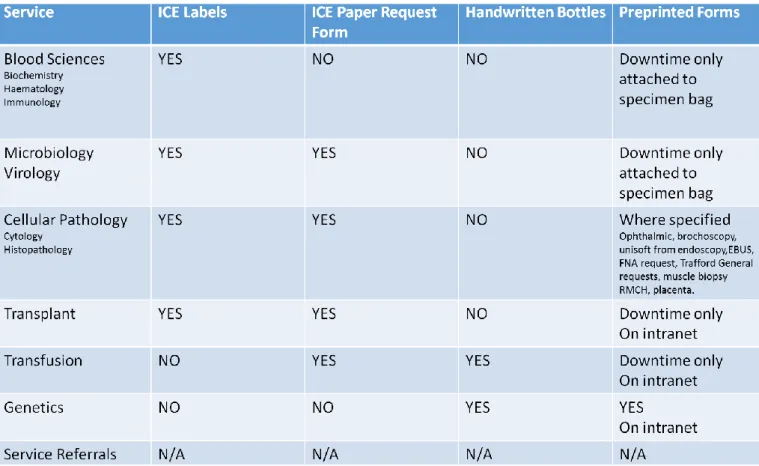
Upon the introduction of ICE in June 2015, the use of request forms on the central site is now limited to Blood Transfusion, Cellular Pathology, Microbiology and Virology and Transplant.
Laboratory Medicine on the central site requires the use of the electronic order communication systems wherever possible. Sunquest ICE communications systems is in operation. The ICE system interfaces with, the trust patient administration system and therefore the request form and sample label will print with full demographic and request details.
Barcoded ICE labels MUST be printed at the time of sample collection using the WOW station at the patient’s bedside, (see the trust standard operating procedure for ICE). This ensures that the time on the sample is the time of collection and NOT the time the request was made and importantly that it is the correct patient who has the correct sample taken preventing ‘wrong blood in tube, (WBIT)’ incidents.
Adequate and relevant clinical information must be provided by the requestor. This can be fully electronic. It is a valuable aid in ensuring patient safety as Biomedical and Clinical Scientists in the laboratory are trained to be aware of the importance of relevant clinical information when validating and authorising results, especially when cumulative records are available.
An unexpected test result can highlight the need for immediate further testing, the need for a result to be communicated urgently or may indicate the possibility of an incorrectly labelled sample or request form. The correct clinical information on the patient is also an essential aid in the identification of High risk samples which require additional biosafety measures for safe handling and processing,
DLM Sample Acceptance Policy Page 8 of 15 See the Intranet for the latest version. Version Number:- 009
Request forms, if required, MUST be signed by the person collecting the sample. Blood Transfusion requests WILL be rejected if the request form is not signed. Request forms should include the contact details (e.g. bleep number) of a responsible clinician if this is not the person collecting the sample. GP samples should include the patient address.
Table 3. Sample/Form requirements for ICE
4.4 General requirements
Patient details on sample and accompanying request form (if required), including ICE barcodes, MUST match. ICE labels will include the date & time of collection on all samples, it is therefore imperative that ICE labels are generated at the time of sample collection using the WOW station and not in advance.
Multiple samples taken at different times on a single patient MUST be labelled on the tube with the time (24 hour clock) when the sample is taken e.g. oral glucose tolerance test.
Drug administered, dose, time of last dose, time of sample relation to dose for therapeutic drug monitoring should be provided.
The procedure for correct identification of samples requires that each sample and the request form (if required) for each patient are kept together in a single bag for inspection.
DLM Sample Acceptance Policy Page 9 of 15 See the Intranet for the latest version. Version Number:- 009
Remember One Bag One Patient, where multiple patient samples are received in one bag samples will be rejected, as we cannot ensure that the samples were collected correctly and are from the right patient.
Sequential samples on the same patient, e.g. glucose tolerance test, may be transported in one bag. Samples which are unstable e.g. insulin, free fatty acids should be sent immediately to the laboratory. Each sample should be identified with a time in addition to the other items.
The following tables show the correct bag type to be used for each ward and pathology discipline.
Table 4. Bag Types for different samples
SAMPLE TYPE
BAG TYPE
Biochemistry/Haematology/Immunology (Blood Sciences)
without pouch, no request form
All Other Sample types with pouch, request form placed in pouch
Table 5. Bag colours for different sample types
LOCATION
BAG COLOUR
RMCH Purple Bags
Adult A&E including Childrens A&E Yellow Bags All Other Areas Clear Bags
5 Mandatory Labelling Criteria for Samples and Request Forms
The mandatory four key identifiers are: • District Number
• Forename (First Name) • Surname (Family Name) • Date of birth
A single identifier may be used in exceptional circumstances for instance during a major incident, or unknown A&E patient. This must be a unique identification number. In certain circumstances, patient identification details are intentionally hidden or substituted with particular ID numbers (e.g. Sexual Health, Clinical trials, donor samples) in such instances, a properly coded identifier must be used.
The key points are summarised in tables 1 and 2.
The use of NHS number is becoming more prevalent and will be considered as an essential key identifier in future policy.
DLM Sample Acceptance Policy Page 10 of 15 See the Intranet for the latest version. Version Number:- 009
6. Specific Departmental requirements 6.1 Blood Transfusion requirements
The Hospital transfusion team recommends best practice outlined by the BCSH guidelines for administration of blood products (BCSH, 2009) and Guidelines on Pre Transfusion Compatibility Procedures in Blood Transfusion Laboratories, (BCSH, 2004). Blood transfusion samples require additional information;
CMFT staff, please see the Trust Transfusion Policy. GPs, please contact Blood Transfusion for guidance.
ICE labels on transfusion samples are NOT acceptable; transfusion sample labels
MUST be handwritten.
Transfusion samples MUST be accompanied by forms. Transfusion Request forms
MUST be signed by the requestor.
Failure to comply with these requirements will result in the rejection of the sample.
6.2 Histopathology requirements
Samples from High Risk patients MUST be identified (Refer to the Paediatric Histopathology User Guide or the Adult Histopathology User Guide as appropriate) Histopathology pots are labelled with ICE labels which contain fields with prompts for Specimen Site and Specimen type. These require the clinician to complete these details by hand.
6.3 Cytopathology Requirements Cervical Cytology
The department applies a Zero Tolerance Policy for cervical samples as detailed in the British Society for Clinical Cytology (BSCC) Recommended Code of Practice for Laboratories Participating in the UK Cervical Screening Programme (2010).
Non- Gynaecological Cytology
The department has additional requirements detailed in the policy ‘Manchester Cytology Centre Non gynaecological cytology service User Manual – January 2011’, available on the laboratory website
Synovial Fluid Analysis Service
Requirements for sample acceptance are available in the document ‘Manchester Cytology Centre Synovial fluid analysis service User Manual – April 2011’ which is viewable on the laboratory website
DLM Sample Acceptance Policy Page 11 of 15 See the Intranet for the latest version. Version Number:- 009
7. Rejection of Samples
Samples will be rejected by Laboratory Medicine if they do not comply with the criteria detailed above. The final decision to accept or reject a sample rests with Laboratory Medicine.
For repeatable/reproducible samples that do NOT meet the mandatory requirements: Laboratories will not process unlabelled or mislabelled samples which are reproducible or repeatable.
Local laboratory procedures will be followed for issuing a report and notifying requesting clinician/ward that repeat sample collection is necessary.
For regulations applying to Blood Transfusion samples please refer to the Blood Transfusion Policy.
For unrepeatable/unreproducible samples that do NOT meet the mandatory requirements (with the exception of Blood Transfusion):
In a number of circumstances, it would not be possible to repeat the collection of the sample. The laboratory would classify these as ‘Unrepeatable/unreproducible
samples’ or unique samples. Please note in general that samples of Blood would not normally be classified as ‘Unrepeatable’.
For regulations applying to Blood Transfusion samples please refer to the Trust Blood Transfusion Policy.
Examples of unrepeatable/ unreproducible samples would include:
All histology and non-gynae cytology samples.
Bone marrow, CSF samples, tissues and other fluids obtained by invasive procedures (NOT blood samples).
Dynamic function test samples.
Post mortem samples where recollection is not possible
Samples collected in an acute situation where the clinical status of the patient may have changed e.g. drug overdose, hypoglycaemic episode, commencing anti-coagulant therapy, mast cell tryptase.
Samples for culture from normally sterile sites where antibiotic therapy has been subsequently started e.g. blood cultures
DLM Sample Acceptance Policy Page 12 of 15 See the Intranet for the latest version. Version Number:- 009
Laboratory procedure when acceptance criteria are not met in the case of unrepeatable/unreproducible samples:
The sample may only be processed once the risk of accepting an
incorrectly labelled sample has been evaluated against and considered to be greater than the risk of potential harm to the patient, by a senior
member of the laboratory staff in conjunction with the Clinician (or responsible deputy) in charge of the patient.
The event will be reported as an incident on Ulysses
Patient reports will be identified clearly with the non-compliance and that correct patient identification cannot be guaranteed
8. ICE
For the correct procedure for sample collection from a patient and requesting a test using ICE, please refer to the trust standard operating procedure for ICE which can be found on the trust intranet ICE page and click the ‘useful downloads’ tab.
Please ensure you have complied with the following before sending your samples to the laboratory:
ICE barcodes are test/tube specific. Please ensure the haematology barcode is attached to the haematology sample and the biochemistry barcode isattached to the biochemistry sample. We are unable to remove barcodes or reprint barcodes, failure to do this will result in sample rejection
Please attach the barcodes vertically and NOT horizontally. The barcodes are read by the analysers in the laboratory and they are unable to read anything other than a vertical barcode.
Please only attach one barcode per sample. If you need to add on a test, please phone the laboratory.
Please be careful not to smudge/damage the barcode label and ensure it has not been cut off and therefore missing important sample
information as it may fail the sample acceptance policy and be rejected. Also, smudged labels cannot be read by the laboratory analysers.
If the sample requires a request form, please ensure it is sent with the sample, it is completed correctly and that the form is signed.
If after printing ICE barcodes, a decision is made not to take a sample off the patient, then the ICE barcodes should be discarded so as to prevent them being accidently used for another patient.
Please note that incorrectly adhering the ICE barcode to the sample in a way that prevents identification of the sample, prevents analysis of the sample on the analysers or requires manipulation of the label in order to perform analysis on the sample may result in the sample being rejected.
DLM Sample Acceptance Policy Page 13 of 15 See the Intranet for the latest version. Version Number:- 009
9. Trafford Samples
The same sample acceptance identifiers apply with the exception of the DISTRICT number as Trafford patients have an EPMI number instead. Please see the table below.
All Trafford samples must have a request form.
See table 2 for a full description.
10. Equality Impact Assessment.
The Trust is committed to promoting Equality, Diversity and Human Rights in all areas of its activities.
It is important to address, through consultation, the diverse needs of our community, patients, their carers and our staff. This will be achieved by working to the values and principles set out in the Trust's Equality, Diversity and Human Rights Strategic
Framework.
To enable the Trust to meet its legislative duties and regulatory guidance, all new and revised procedural documents, services and functions are to undertake an equalities impact assessment to ensure that everyone has equality of access, opportunity and outcomes regarding the activities. Contact the Service Equality Team (SET) on Ext 66897 for support to complete an initial assessment. Upon completion of the assessment, SET will assign a unique EqIA Registration Number
The Trust undertakes Equality Impact Assessments to ensure that its activities do not discriminate on the grounds of:
Before any committee, group or forum validate a policy or procedural document an EqIA Registration Number will be required.
11. Consultation, Approval and Ratification Process
The document was sent to the following groups for review: DLM Board
Lead Nurses/Ward Managers and Directorate Managers via the Divisional Manager for Clinical and Scientific Services
The Policy will be ratified by the DLM Board in Religion or belief Age
Disability Race or ethnicity Sex or gender Sexual orientation Human Rights Socio economic
DLM Sample Acceptance Policy Page 14 of 15 See the Intranet for the latest version. Version Number:- 009
12. Dissemination and Implementation 12.1. Dissemination
The information will be disseminated by the Lead Nurses/Ward Managers and Directorate Managers via the Divisional Manager for Clinical and Scientific Services.
12.2. Implementation of Procedural Documents
The guideline will be placed on the Laboratory Medicine website and appear on the latest Trust news and Team brief.
13. Monitoring Compliance of the Sample acceptance procedure
Any shortfalls identified will have an action plan put in place to address which will have timescales included for re-audit / monitoring.
Sample acceptance failures can involve many factors from individual staff requiring further training to a communication problem with an area/clinic.
It is necessary to record the SAP failures to find trends and possible solutions to multiple SAP failures.
Recording the information needs to be done in a way which allows trend analysis. This can be done on paper or via an electronic system. See local procedures.
Trends showing a problem with a user can be reported to the user in a constructive way, with the laboratory liaising with the user to solve problems. For example: tours around the laboratory or at liaison and MDT meetings.
The laboratory should keep the user guide as up to date as possible showing specific details such as transport media, labelling guides and time sensitive tests.
14. Standards and Key Performance Indicators ‘KPIs’
The standard is ISO 15189:2012 clause 5.4.6
Specimen rejection information will be relayed to users were possible through various forums such as audit reports and clinical liaison meetings.
DLM Sample Acceptance Policy Page 15 of 15 See the Intranet for the latest version. Version Number:- 009
15. References and Bibliography
Institute of Biomedical Sciences: (July 09) Professional Guidance: Patient Sample and Request Form Identification Criteria www.ibms.org/publications
The Good Laboratory Practice Regulations 1999 (SI 1999 3106)
The Good Laboratory Practice (Codification Amendments Etc.) Regulations 2004 (SI 2004 No. 994)
BCSH Guidelines
• BCSH Guideline on Administration of Blood Components (2009)
• BCSH Guidelines on Pre Transfusion Compatibility Procedures in Blood Transfusion Laboratories (2004)
Royal College of Pathologists (May 2005)
• May 2005 Code of Practice for Haematology departments • May 2005 Code of Practice for Histopathology
• May 2005 Code of Practice for Clinical Biochemistry CMFT Trust Blood Transfusion Policy
16. Associated Trust Documents
CL 007 Blood Transfusion Policy
RM011Trust Patient Identification Policy