Max Grossman
Department of Computer Science Rice University
Programming GPUs with CUDA
Why GPUs?
•
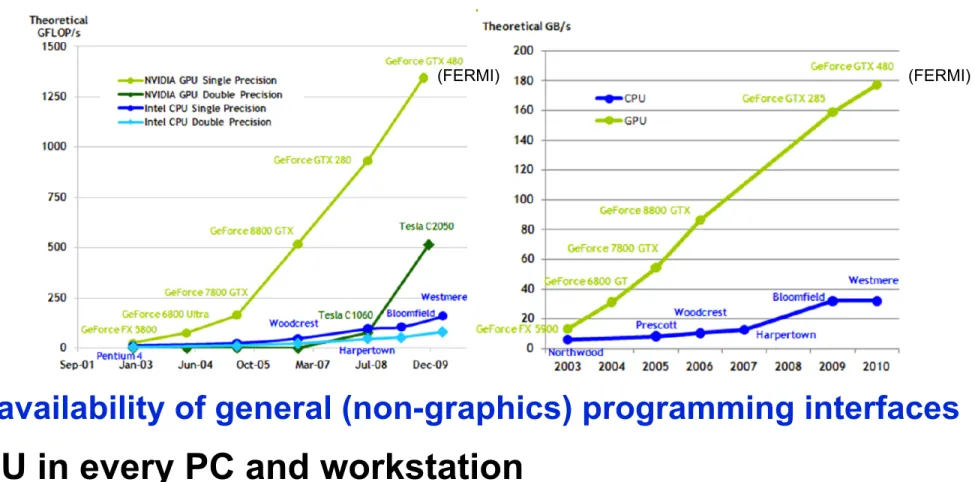
Two major trends
—GPU performance is pulling away from traditional processors
—availability of general (non-graphics) programming interfaces
•
GPU in every PC and workstation
—massive volume, potentially broad impact
2
Figure Credits: NVIDIA CUDA Compute Unified Device Architecture Programming Guide 3.1
Power and Area Efficiency
3 http://www.realworldtech.com/compute-efficiency-2012/2
GPGPU?
•
General Purpose computation using GPU
—applications beyond 3D graphics
—typically, data-intensive science and engineering applications
•
Data-intensive algorithms leverage GPU attributes
—large data arrays, streaming throughput
—fine-grain “single instruction multiple threads” (SIMT) parallelism —low-latency floating point computation
GPGPU Programming in 2005
•
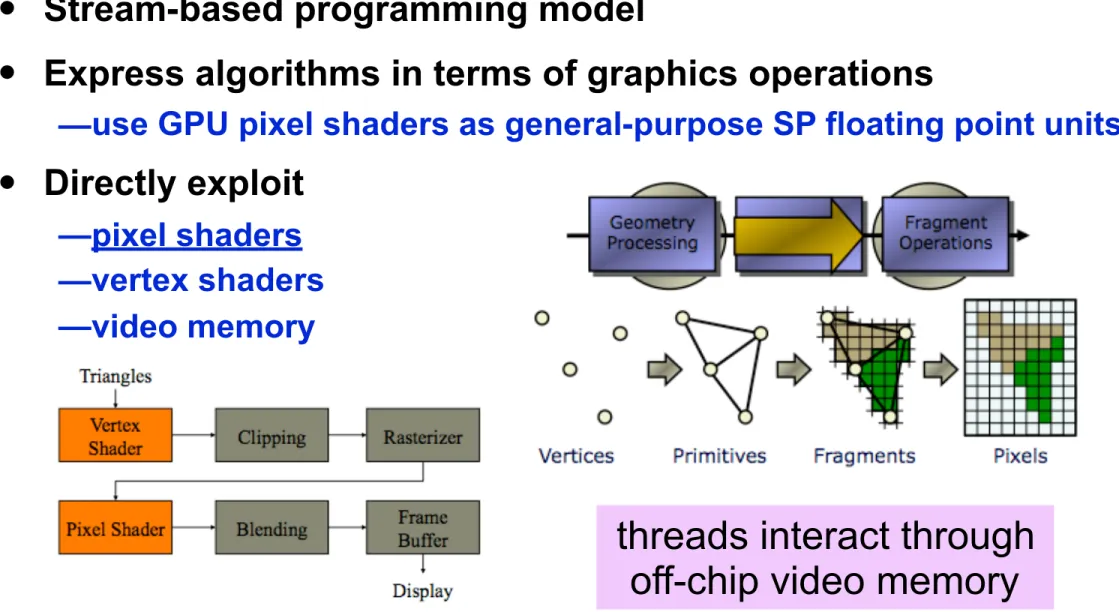
Stream-based programming model
•
Express algorithms in terms of graphics operations
—use GPU pixel shaders as general-purpose SP floating point units
•
Directly exploit
—pixel shaders —vertex shaders —video memory
•
Example: GPUSort (Govindaraju, Manocha; 2005)
5
Figure Credits: Dongho Kim, School of Media, Soongsil University
threads interact through
off-chip video memory
Fragment from GPUSort
//invert the other half of the bitonic array and merge
glBegin(GL_QUADS);
for(int start=0; start<num_quads; start++){ glTexCoord2f(s+width,0); glVertex2f(s,0); glTexCoord2f(s+width/2,0); glVertex2f(s+width/2,0); glTexCoord2f(s+width/2,Height); glVertex2f(s+width/2,Height); glTexCoord2f(s+width,Height); glVertex2f(s,Height); s+=width; } glEnd(); 6
(Govindaraju, Manocha; 2005)
CUDA
CUDA = Compute Unified Device Architecture
•
Software platform for parallel computing on Nvidia GPUs
—introduced in 2006
—Nvidia’s repositioning of GPUs as versatile compute devices
•
C plus a few simple extensions
—write a program for one thread
—instantiate for many parallel threads
—familiar language; simple data-parallel extensions
•
CUDA is a scalable parallel programming model
—runs on any number of processors without recompiling
7
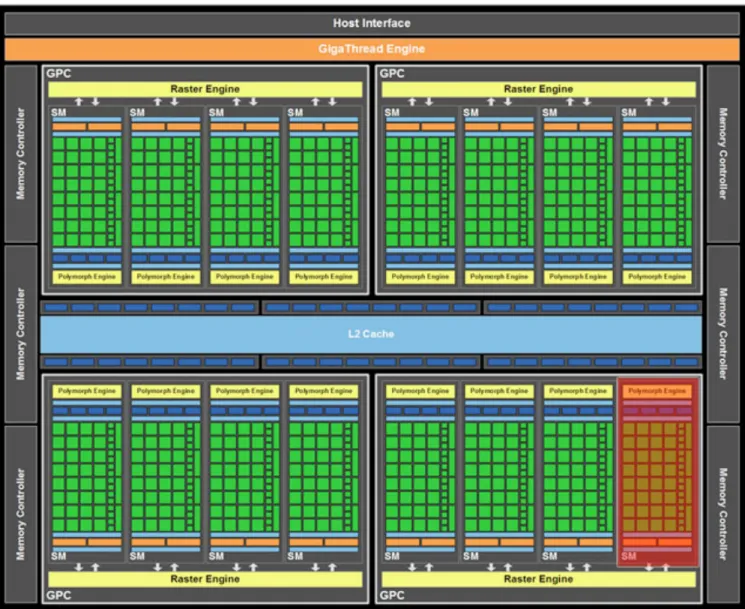
NVIDIA Fermi GPU (2010)
•
3.0B transistors
•
15 SMs; 1 SM
disabled for yield
•
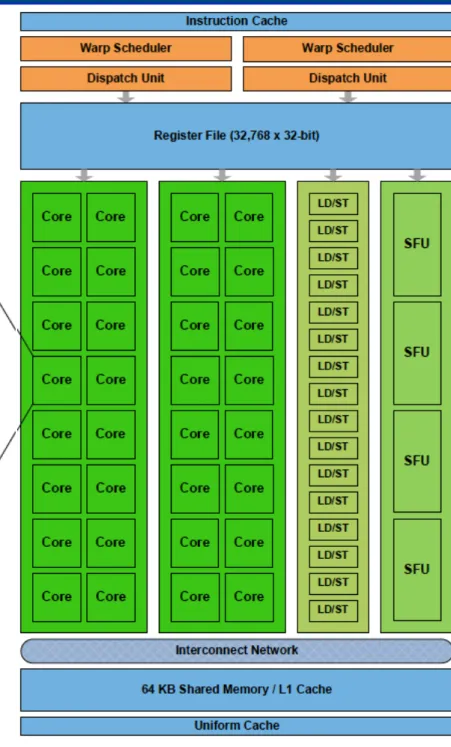
32 CUDA cores
per SM
—CUDA core = programmable shader•
480 cores total
8NVIDIA’s Fermi GPU
•
Configurable L1 data cache—48K shared memory / 16K L1 cache —48K L1 cache / 16K shared memory
•
768K L2 cache•
4 SFU (transcendental math andinterpolation) per SM
•
16 LD/ST units per SM•
16 DP FMA per clock per SM•
GigaThread Engine—execute up to 16 concurrent kernels
•
Unified address space—thread local, block shared, global —supports C/C++ pointers
•
ECC support9
Figure Credit:
http://www.nvidia.com/content/PDF/fermi_white_papers/
NVIDIA GPU Stats Through Fermi
10
Figure Credit: http://www.nvidia.com/content/PDF/fermi_white_papers/NVIDIA_Fermi_Compute_Architecture_Whitepaper.pdf
NVIDIA Kepler GK110 (May 2012)
•
28nm chip, 7.1B transistors
•
15 Streaming Multiprocessors
—192 CUDA cores
– fully pipelined FP and INT units
– IEEE 754-2008; fused multiply add
—four warp schedulers
– 32-thread groups (warps)
– 4 warps issue and execute concurrently
– 2 inst/warp/cycle —64 DP FP units —32 SFU —32 LD/ST units
•
6 64-bit memory
controllers
11 http://www.nvidia.com/content/PDF/kepler/NVIDIA-Kepler-GK110-Architecture-Whitepaper.pdfWhy CUDA?
•
Business rationale
—opportunity for Nvidia to sell more chips – extend the demand from graphics into HPC
—insurance against uncertain future for discrete GPUs
– both Intel and AMD integrating GPUs onto microprocessors
•
Technical rationale
—hides GPU architecture behind the programming API – programmers never write “directly to the metal”
insulate programmers from details of GPU hardware
– enables Nvidia to change GPU architecture completely, transparently
preserve investment in CUDA programs
—simplifies the programming of multithreaded hardware – CUDA automatically manages threads
CUDA Design Goals
•
Support heterogeneous parallel programming (CPU + GPU)
•
Scale to hundreds of cores, thousands of parallel threads
•
Enable programmer to focus on parallel algorithms
—not GPU characteristics, programming language, scheduling ...
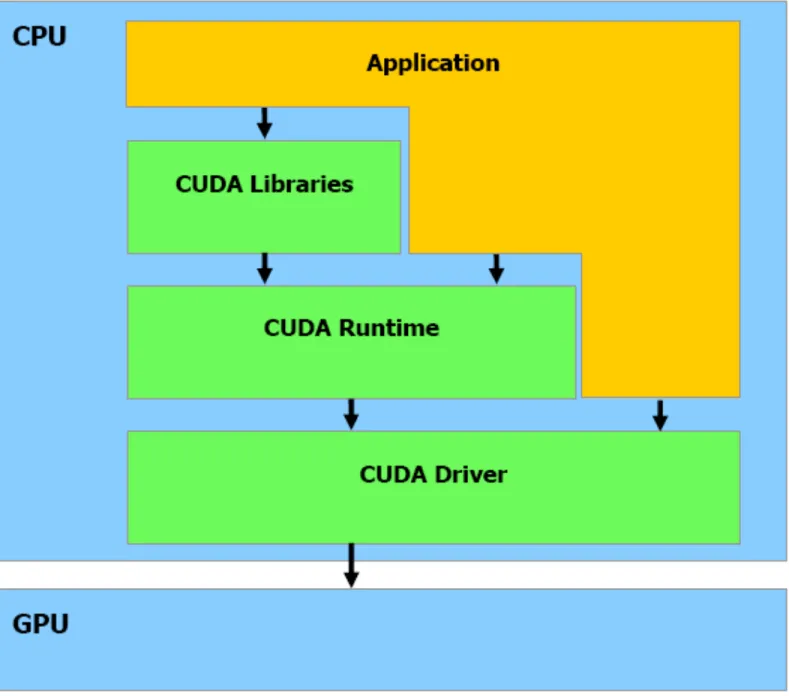
CUDA Software Stack for Heterogeneous Computing
14
Key CUDA Abstractions
•
Hierarchy of concurrent threads
•
Lightweight synchronization primitives
•
Shared memory model for cooperating threads
Hierarchy of Concurrent Threads
•
Parallel kernels composed of many
threads
—all threads execute same sequential program
—use parallel threads rather than sequential loops
•
Threads are grouped into
thread blocks
—threads in block can sync and share memory
•
Blocks are grouped into
grids
—threads and blocks have unique IDs – threadIdx: 1D, 2D, or 3D
– blockIdx: 1D or 2D
16
Slide credit: Patrick LeGresley, NVidia —simplifies addressing
—when processing
CUDA Programming Example
17
void saxpy_serial(int n, float alpha, float *x, float *y) { for (int i = 0; i< n; i++)
y[i] = alpha * x[i] + y[i]; }
// invoke serial saxpy kernel
saxpy_serial(n, 2.0, x, y)
Computing y = ax + y with a serial loop
Host code
__global__
void saxpy_parallel(int n, float alpha, float *x, float *y) {
int i = blockIdx.x * blockDim.x + threadIdx.x;
if (i < n) y[i] = alpha * x[i] + y[i]; }
Computing y = ax + y in parallel using CUDA
// invoke parallel saxpy kernel (256 threads per block)
int nblocks = (n + 255)/256
saxpy_parallel<<<nblocks, 256>>>(n, 2.0, x, y)
Device code
Host code
Synchronization and Coordination
•
Threads within a block may synchronize with barriers
—... step 1 ...
—__syncthreads();
—... step 2 ...
•
Blocks can coordinate via atomic memory operations
—e.g. increment shared counter with atomicInc()
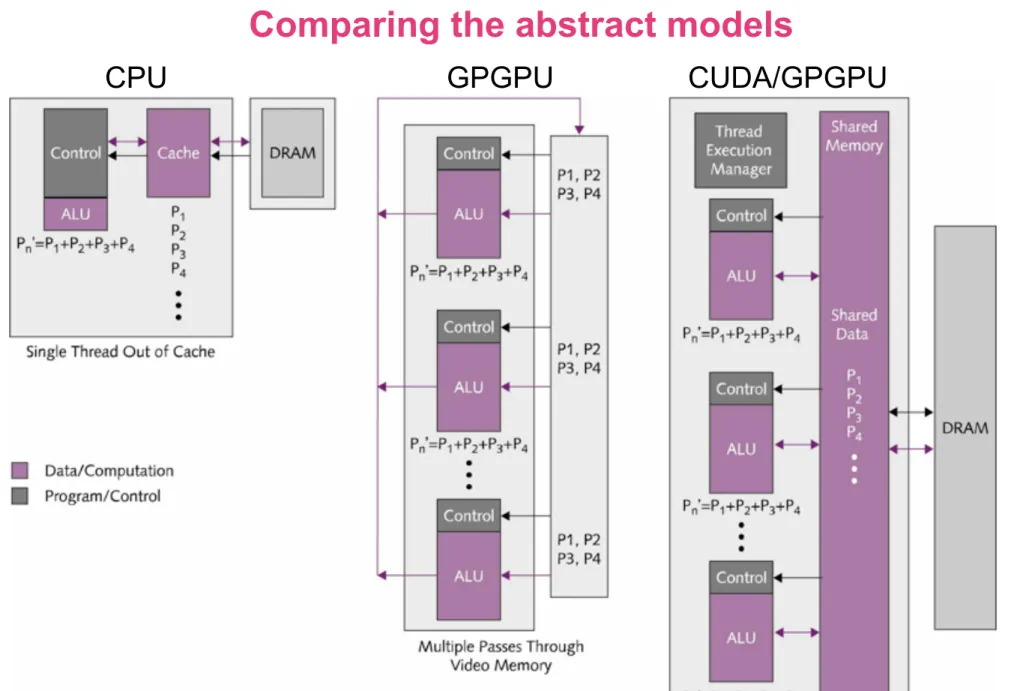
CPU vs. GPGPU vs. CUDA
Comparing the abstract models
19 CPU
CPU GPGPU CUDA/GPGPU
CUDA Memory Model
20
Memory Model (Continued)
21
Memory Access Latencies (FERMI)
•
Registers: each SM has 32KB of registers—each thread has private registers —max # of registers / kernel: 63
—latency: ~1 cycle; bandwidth ~8,000 GB/s
•
L1+Shared Memory: on-chip memory that can be used either as L1 cache to share data among threads in the same thread block—64 KB memory: 48 KB shared / 16 KB L1; 16 KB shared / 48 KB L1 — latency: 10-20 cycles. bandwidth ~1,600 GB/s
•
Local Memory: holds "spilled" registers, arrays•
L2 Cache: 768 KB unified L2 cache, shared among the 16 SMs—caches load/store from/to global memory, copies to/from CPU host, and texture requests
—L2 implements atomic operations
•
Global Memory: Accessible by all threads as well as host (CPU). High latency (400-800 cycles), but generally cachedMinimal Extensions to C
•
Declaration specifiers to indicate where things live
—functions
—__global__ void KernelFunc(...); // kernel callable from host
– must return void
—__device__ float DeviceFunc(...); // function callable on device
– no recursion
– no static variables within function
—__host__ float HostFunc(); // only callable on host —variables (later slide)
•
Extend function invocation syntax for parallel kernel launch
—KernelFunc<<<500, 128>>>(...); // 500 blocks, 128 threads each
•
Built-in variables for thread identification in kernels
—dim3 threadIdx; dim3 blockIdx; dim3 blockDim;
Invoking a Kernel Function
•
Call kernel function with an execution configuration
•
Any call to a kernel function is asynchronous
—explicit synchronization is needed to block
•
cudaThreadSynchronize()
forces runtime to wait until all
preceding device tasks have finished
Example of CUDA Thread Organization
25
•
Grid as 2D array of blocks
•
Block as 3D array of threads
__global__ void KernelFunction(...); dim3 dimBlock(4, 2, 2);
dim3 dimGrid(2, 2, 1);
CUDA Variable Declarations
•
__device__ is optional with __local__, __shared__, or
__constant__
•
Automatic variables without any qualifier reside in a register
—except arrays: reside in local memory
•
Pointers
—allocated on the host and passed to the kernel – __global__ void Kernelfunc(float *ptr)
—address obtained for a global variable: float *ptr = &GlobalVar
Using Per Block Shared Memory
•
Share variables among threads in a block
with shared memory
—__shared__ int scratch[blocksize];
—scratch[threadIdx.x] = arr[threadIdx.x]; —// ...
—// … compute on scratch values —// ...
—arr[threadIdx.x] = scratch[threadIdx.x];
•
Communicate values between threads
—scratch[threadIdx.x] = arr[threadIdx.x]; —__syncthreads();
—int left = scratch[threadIdx.x - 1];
Features Available in GPU Code
•
Special variables for thread identification in kernels
—dim3 threadIdx; dim3 blockIdx; dim3 blockDim;
•
Intrinsics that expose specific operations in kernel code
—_syncthreads(); // barrier synchronization
•
Standard math library operations
—exponentiation, truncation and rounding, trigonometric functions, min/max/abs, log, quotient/remainder, etc.
•
Atomic memory operations
—atomicAdd, atomicMin, atomicAnd, atomicCAS, etc.
Runtime Support
•
Memory management for pointers to GPU memory
—cudaMalloc(), cudaFree()
•
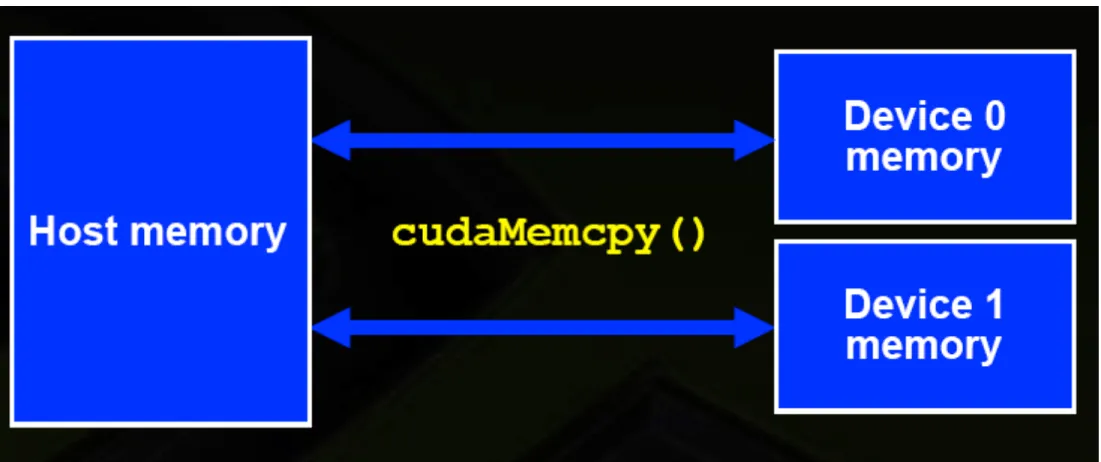
Copying from host to/from device, device to device
—cudaMemcpy(), cudaMemcpy2D(), cudaMemcpy3D()
More Complete Example: Vector Addition
30
...
Vector Addition Host Code
Extended C Summary
Compiling CUDA
Ideal CUDA programs
•
High intrinsic parallelism
—e.g. per-element operations
•
Minimal communication (if any) between threads
—limited synchronization
•
High ratio of arithmetic to memory operations
•
Few control flow statements
—SIMT execution
– divergent paths among threads in a block may be serialized (costly)
– compiler may replace conditional instructions by predicated operations to reduce divergence
CUDA Matrix Multiply: Host Code
CUDA Matrix Multiply: Device Code
Concurrent Kernel Execution in Fermi
37
Optimization Considerations
•
Kernel optimizations
—make use of shared memory
—minimize use divergent control flow
– SIMT execution must follow all paths taken within a thread group
—use intrinsic instructions when possible – exploit the hardware support behind them
•
CPU/GPU interaction
—use asynchronous memory copies
•
Key resource considerations for Fermi GPU’s
—max dimensions of a block (1024, 1024, 64) —max 1024 threads per block
—32K registers per SM —16 KB / 48KB cache
—48 KB / 16KB shared memory
—see the programmer’s guide for a complete set of limits for
CUDA Resources
•
General information about CUDA
—www.nvidia.com/object/cuda_home.html
•
Nvidia GPUs compatible with CUDA
—www.nvidia.com/object/cuda_learn_products.html
•
CUDA sample source code
—www.nvidia.com/object/cuda_get_samples.html
•
Download the CUDA SDK
—www.nvidia.com/object/cuda_get.html
Portable CUDA Alternative: OpenCL
•
Framework for writing programs that execute on
heterogeneous platforms, including CPUs, GPUs, etc.
—supports both task and data parallelism
—based on subset of ISO C99 with extensions for parallelism —numerics based on IEEE 754 floating point standard
—efficiently interoperated with graphics APIs, e.g. OpenGL
•
OpenCL managed by non-profit Khronos Group
•
Initial specification approved for public release Dec. 8, 2008
—specification 1.2 released Nov 14, 2011
OpenCL Kernel Example: 1D FFT
OpenCL Host Program: 1D FFT
43
References
•
Patrick LeGresley, High Performance Computing with CUDA, Stanford University Colloquium, October 2008, http://www.stanford.edu/dept/ICME/ docs/seminars/LeGresley-2008-10-27.pdf•
Vivek Sarkar. Introduction to General-Purpose computation on GPUs(GPGPUs), COMP 635, September 2007
•
Rob Farber. CUDA, Supercomputing for the Masses, Parts 1-11, Dr. Dobb’sPortal, http://www.ddj.com/architect/207200659, April 2008-March 2009.
•
Tom Halfhill. Parallel Processing with CUDA, Microprocessor Report, January 2008.•
N. Govindaraju et al. A cache-efficient sorting algorithm for database and data mining computations using graphics processors. http://gamma.cs.unc.edu/SORT/gpusort.pdf