U.Saravanakumar et al, International Journal of Computer Science and Mobile Applications, Vol.2 Issue. 1, January- 2014, pg. 36-42 ISSN: 2321-8363
©2014, IJCSMA All Rights Reserved, www.ijcsma.com 36
A Novel Scheme for Live Streaming
Evolution Networks
Mr.U.Saravanakumar
1, Mr.S.Dilip kumar
2 1PG Student, 2Assistant Professor , Department of Computer Science and Engineering, PRIST University, Trichy District, India
Abstract
As live streaming keep to permeate into our daily lives, it is flattering all the time more important that Internet live brook networks provide reliable presentation, in spite of such set of connections becoming more intricate, to operate in the increasingly more complex Internet. A key capacity to make sure that live torrent networks provide reliable presentation is to subject them to major, sensible presentation assessment. Existing evaluation scheme including lab testing, simulation, and theoretical modeling, lack either scale or realism. The main difficulty in internet procedure television is streaming of audio and video signals.
A quantity of profitable organism are construct to study and study the performance of live torrent of audio and video signals. Peer to Peer multiplexing provides a good solution for this crisis. In this term paper a dissimilarity of P2P multiplexing is proposed which is called as recipient based P2P multiplexing. To analyze the performance of the proposed multiplexing techniques the very famous European network “Zatto” is considered. This paper also illustrates the network construction of Zatto and uses the data composed from the provider to evaluate the presentation of the proposed variation in P2P multiplexing. This paper mostly focuses on humanizing video density technologies have make a payment to the emergence of these IPTV services and exposed that error-correcting code and small package retransmission can help improve network stability by isolating packet losses and preventing transient congestion from resulting in peer division multiplexing reconfigurations.
Index Terms
—
Optimal content assignment, Peer-to-Peer Streaming, Cache management, Content distributionnetworks, Video-On-Demand.
I.INTRODUCTION
Peer-to-peer (P2P) technology presents a scalable resolution in multimedia tributary. Countless streaming relevance, such as IPTV and video conferencing, has meticulous constriction on end-to-end delays. Achieve pledge on gathering those delay restraint in lively and assorted network surroundings is a challenge. In this article, we work out a torrent scheme which curtails the maximum end-to-end streaming delay for a mesh-based overlay network paradigm. We first put together the minimum-delay P2P watercourse problem, called the MDPS problem, and prove its NP-completeness. We then near a polynomial occasion rough calculation algorithm to this problem, and explain that the presentation of our algorithm is restricted by a ratio. Our duplication study reveals the effectiveness of our algorithm, and shows a levelheaded communication visual projection.
U.Saravanakumar et al, International Journal of Computer Science and Mobile Applications, Vol.2 Issue. 1, January- 2014, pg. 36-42 ISSN: 2321-8363
©2014, IJCSMA All Rights Reserved, www.ijcsma.com 37
storage management, and logging Sterling promotion and realization establishment point out data caching is put into function by a local, simple, loading, asynchronous-refresh hoard executive. The cache manager is a lazy-loader in the wisdom that it does not read in the cacheable reference tables at start up but would instead only cache records as they are being read. The profit of the lazy-loading strategy is that data is only cached where they are needed.
Video-on-demand has turn out to be an tremendously all the rage overhaul in the Internet. For example, YouTube, a video-sharing overhaul which torrent its videos to users on-demand. Most of the VoD being torrent over the Internet today is encoded in the 200-400 kbps range. At these rates, ISPs typically charge video publishers 0.1 to 1.0 cent per video minute. These costs are feasible to go up, as domination expand and advanced dominance videos with rates up to 3 Mbps or more are made obtainable. At present, none of the Internet VoD contributor earns noteworthy revenues from their services.
Internet VoD providers will likely attempt to monetize their services in the near future using embedded video advertisements, subscriptions, or pay-per-views. But given the enormous costs associated with client-server delivery due both to the increasing video quality and to the enormous demand, the revenues extremely perhaps will not cover the cost of as long as the service. In other words, although VoD has become one of the most popular Internet services today, the service is, and will probably carry on to be, offensive with client-server distribution.
II. RELATED WORK
2.1
Project overview
The rapid increase in the Video-on-demand library size, it will soon become infeasible to replicate the entire library at each arrangement. To overcome this problem introducing methods are Distributed Server Networks
and Pure P2P Networks. For both scenarios are considering a loss networkmodel of performance and determine
asymptotically optimal content placement strategies in the case of a limited content catalog. Then turn to an alternative “large catalog “scaling where the catalog size scales with the peer population. Under this scaling, we establish that storage space per peer must necessarily grow unboundedly if bandwidth utilization is to be maximized. In this paper proposed to increasing the bandwidth utilization, make available luggage compartment space per peer grows unboundedly, although arbitrarily leisurely, with system size.
2.1.1
Scope of project
Main scope of this project Bandwidth utilization is Maximize.
Storage space per peer must necessarily grow unboundedly.
Provide arbitrarily slowly with system size.
This project used in two methods.
First method is Distributed Server Networks
Second method is Pure P2P Networks.
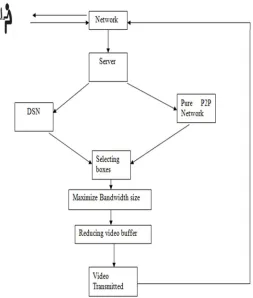
Finally reducing buffering delay problem in video and video transmitted through server to client.
2.2
Existing system
U.Saravanakumar et al, International Journal of Computer Science and Mobile Applications, Vol.2 Issue. 1, January- 2014, pg. 36-42 ISSN: 2321-8363
©2014, IJCSMA All Rights Reserved, www.ijcsma.com 38
2.2.1 Disadvantages
Frame losses in Internet to client
Less Bandwidth size
High cost
2.3
Proposed system
Our proposed technique is Distributed Server Networks (DSNs) and Pure P2P Networks (PP2PNs).In this method whereby peers contribute resources to support service of such traffic, holds the promise to support such growth more cheaply than by scaling up the size of data centers. The main aim of in this method is maximize the bandwidth size and reducing buffer losses through video transmitted to client. In the P2P system we are considering, there are two kinds of peers: boxes and pure users. There are no pure users in the system, and boxes do generate content requests, which can be regarded as internal.
2.4
DATA FLOW DIAGRAM
U.Saravanakumar et al, International Journal of Computer Science and Mobile Applications, Vol.2 Issue. 1, January- 2014, pg. 36-42 ISSN: 2321-8363
©2014, IJCSMA All Rights Reserved, www.ijcsma.com 39
2.5
USE CASE DIAGRAM
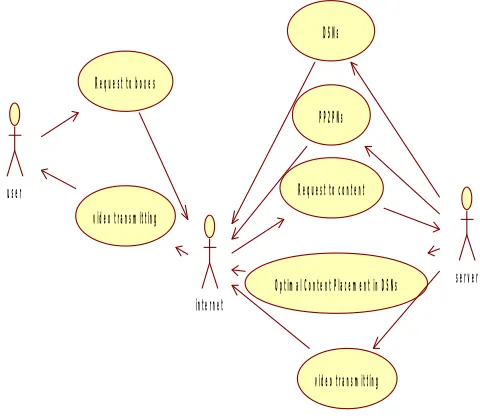
Fig 2 Use case diagram
Use case Diagrams overview the usage requirements for a system. They are useful for presentations to management and/or project stakeholders, but for actual development you will find that use cases provide significantly more value because it describes the actual requirements.
2.6 STEPS
Distributed Server Networks (DSN)
Pure P2P Networks (PP2PN)
Optimal Content Placement in Distributed Server Networks
Large Catalog Model
Sampling Based Pre-allocation
user
server Request to boxes
internet
DSNs
PP2PNs
Request to content
Optimal Content Placement in DSNs
U.Saravanakumar et al, International Journal of Computer Science and Mobile Applications, Vol.2 Issue. 1, January- 2014, pg. 36-42 ISSN: 2321-8363
U.Saravanakumar et al, International Journal of Computer Science and Mobile Applications, Vol.2 Issue. 1, January- 2014, pg. 36-42 ISSN: 2321-8363
©2014, IJCSMA All Rights Reserved, www.ijcsma.com 41
IV. CONCLUSION
U.Saravanakumar et al, International Journal of Computer Science and Mobile Applications, Vol.2 Issue. 1, January- 2014, pg. 36-42 ISSN: 2321-8363
©2014, IJCSMA All Rights Reserved, www.ijcsma.com 42
system, or consistently, make the most of the exploitation of peers’ uplink bandwidth possessions. In focused on P2P systems where the number of users is large. For the not enough content catalog-size scenario, we proved the optimality of a proportional-to-product comfortable assignment approach in the Distributed Server Network architecture and proved optimality of “Hot-Warm-Cold” content placement strategy in the Pure P2P Network architecture. For the large content catalog scenario, it also documented that proportional-to-product tactic leads to optimal routine in the Distributed Server Network.
ACKNOWLEDGEMENT
I sincerely thanks to all authors in reference section. All papers in the reference section are very useful for my proposal. Their concepts, algorithms and techniques are very useful for my research.
REFERENCES
[1] J. M. Almeida, D. L. Eager, M. K. Vernon, and S. J. Wright, “Minimizing delivery cost in scalable streaming content distribution systems,”IEEE Trans. Multimedia, vol. 6, no. 2, pp. 356–365, Apr. 2004.
[2] M. Draief and L. Massoulie, “Epidemics and rumours in complex networks,”in The London Mathematical Society Lecture Note Series.Cambridge, U.K.: Cambridge Univ. Press, 2010.
[3] J. Kangasharju, K. W. Ross, and D. A. Turner, “Optimizing file availability in peer-to-peer content distribution,” in Proc. IEEE INFOCOM,2007, pp. 1973–1981
[4] K. Suh, C. Diot, J.Kurose, L. Massoulie, C.Neumann, D. Towsley, and. Varvello, “Push-to-peer video-on-demand system: Design and evaluation,”IEEE J. Sel. Areas Commun., vol. 25, no. 9, pp. 1706–1716,Dec. 2007 [5] S. Tewari and L. Kleinrock, “On fairness, optimal download performance and proportional replication in peer-to-peer networks,” in IFIP Lecture Notes Compute. Sci. (LNCS), 2011, vol. 3462, pp. 709–717.
[6] S. Tewari and L. Kleinrock, “Proportional replication in peer-to-peer networks,” in Proc. IEEE INFOCOM, 2006, pp. 1–12.
[7] V. Valancius, N. Laoutaris, L. Massoulie, C. Diot, and P. Rodriguez,“Greening the internet with nano data centers,” in Proc. 5th CoNEXT,2009, pp. 37–48.
[8] J.Wu and B. Li, “Keep cache replacement simple in peer-assisted VoD systems,” in Proc. IEEE INFOCOM Mini-Conf., 2009, pp. 2591–2595.
[9] X. Zhou and C.-Z. Xu, “Efficient algorithms of video replication and placement on a cluster of streaming servers,” J. Newt. Comput. Appl., vol. 30, no. 2, pp. 515–540, Apr. 2007.
[10] Y. Boufkhad, F. Mathieu, F. de Montgolfier, D. Perino, and L. Viennot,“Achievable catalog size in peer-to-peer video-on-demand systems,” inProc. 7th IPTPS, 2008, pp. 4–4.
[11] T. Silverston and O. Fourmaux, “Measuring P2P IPTV Systems,” in Proc. ACM NOSSDAV, November 2008. [12] L. Vu et al., “Measurement and Modeling of a Large-scale Overlay for Multimedia Streaming,” in Proc. Int’l Conf. on Heterogeneous Networking for Quality, Reliability, Security and Robustness, 2007.
[13] S. Lin and D. J. Costello, Jr., Error Control Coding, 2nd ed. Pearson Prentice-Hall, 2004.
[14] S. Xie, B. Li, G. Y. Keung, and X. Zhang, “CoolStreaming: Design, Theory, and Practice,” IEEE Trans. on Multimedia, vol. 9, no. 8, December 2007.
[15] K. Shami et al., “Impacts of Peer Characteristics on P2PTV Networks Scalability,” in Proc. IEEE INFOCOM Mini Conference, April 2009.
[16] Bandwidth-test.net, “Bandwidth test statistics across different countries,” http://www.bandwidth-test.net/stats/country/.
[17] X. Hei, C. Liang, J. Liang, Y. Liu, and K. W. Ross, “Insights into PPLive: A Measurement Study of a Large-Scale P2P IPTV System,” in Proc. IPTV orkshop, International World Wide Web Conference, 2006.