APES year in review
2010, The
year
Chapter 1: Introduction
Understand how natural world works
Understand how human systems
interact with natural system
Accurately determine environmental
problems
Easter Island
Sustainability
- A system/process can continue
indefinitely without depleting
resources used.
*no sacrifice to future
generations*
Stewardship
Caring for something that does
not belong to you
Sound Science
A. Human population growth
More than 6.8 billion people currently
U.S. 300,000,000 people
last 25 yrs population grew by 2 billion
projected that population will be 10 billion by 2050
B. Soil degradation
Demand for food destroys the soil
erosion
minerals in soil are depleted
salinization
increased use of pesticides
C. Global Atmospheric Changes
Global Warming
CO2 produced from fossil fuel burning
Plants take CO2 out of the atmosphere through
photosynthesis
6CO2 +6H2O => 602 + C6H12O6 Other GH gases: CH4 N2O CFC’s Ozone depletion
Chemicals (CFC’s)released from the surface of
the earth destroy our ozone shield.
No stratospheric ozone, no protection from the
D. Loss of Biodiversity
Habitat destruction leads to a loss of many
species starting with the plants
exact # of species lost is unknown because
not all species are identified
strong ecosystems need biodiversity
1959-1980 25% of all prescription drugs
from natural resources
Wild species keep domestic species vigorous
HIPPCO
Habitat destruction
Invasive Species
Pollution
Population
•Rachel Carson wrote Silent Spring in 1962.
•It addressed the growing use of pesticides (DDT)
and their unpredicted effects on song birds.
•Original users of pesticides did not know that the
poisons used to kill insects would accumulate in
other living things and kill them too.
More Cool Environmentalist
John Muir – Sierra Club
Ansel Adams – Photography (Yosemite)
Aldo Leopold – Sand County Almanac
Henry David Thoreau – Walden
Ch 2:
Ecosystems
Levels of organization of matter
Universe
Ecosphere/biosphere
Ecosystems
Communities
Populations
Organisms
Cells
Plants and animals interacting with their
abiotic environment. Ecosystems exist in
biomes.
Climate – avg temperature/precip over
time
*Weather – daily variations in temp and
precipitation
Microclimate and Other Abiotic Factors
* light intensity
* Soil type
* topography
Trophic Relationship
Food webs
Trophic levels
* producers
* consumers
herbivore
Biomass and Biomass Pyramid
All biomass gets its energy from the sun
On the average, only 10% of energy from
one trophic level moves to the next trophic
level
Energy released is high potential energy
molecules (like glucose) then converted to
low potential energy molecules (like carbon
dioxide)
Relationships
Mutualism
* Flowers & insects
Commensalism
Parasitism
Predator/prey
Limiting Factors
Temperature, light, oxygen,
carbon dioxide, precipitation
Optimum levels
Zones of stress
Limits of Tolerance
Range of Tolerance
Synergistic effects – The interaction of two
or more factors is greater than the sum
of the effects when each acts alone.
Ch 3:
Ecosystems, how they work
•Recycle or Die
•All matter is recycled through the
lithosphere, hydrosphere, and
atmosphere.
•Nothing is created nothing is
destroyed
Physics
Energy is measured in calories
Calorie – amount of heat needed to raise 1 gram
of water 1 degree Celsius.
Kilocalorie = 1,000 calories
1
stlaw of thermodynamics
Energy cannot be created nor destroyed, only
change forms (light to chemical)
2
ndlaw of thermodynamics
Energy transformation increases disorder
(entropy) of the universe.
Chemistry
Atoms – basic units of matter
Electron Proton Neutron
Chemical bonds - how atoms are held together
Ionic
Covalent
Molecule/compound – two or more atoms
bonded together
pH scale
Organic Compounds
C-C bonds and/or C-H bonds
They can be natural or synthetic
Natural:
compounds that make up living
systems
Photosynthesis
Very inefficient (Only 1% of the energy from
the sun is used)
Chlorophyll – absorbs light to drive
photosynthesis
Plants use glucose to:
Construct other molecules Build their cell wall
Store energy
Carbon cycle
Photosynthesis!
Moving fossil fuels (which took
millions of years to form) to the
atmosphere (in hundreds of years)
is a major component of global
warming.
Nitrogen cycle
Main reserve in the atmosphere
Living things must get N from ammonium (NH
4+)
or nitrate (NO
3-)
N from the atm must be fixed
Change N2 into ammonium or nitrate
Rhizobium (bacteria living in roots of legumes) Industrial
Lightning
Phosphorus cycle
No gas phase, only solid and liquid
Man-made fertilizers contain organic
phosphates
Because P is a limiting factor in
aquatic systems, it leads to
eutrophication
The rain forest is very good at
element
Main nonliving reservoir
Main living
reservoir nonliving Other reservoir Human-induced problem Carbon C Atmo CO2 Carbohydrate s (CH2O)n And all organic molecules Hydro Carbonate (CO3-2) Bicarbonate (HCO3-) Litho minerals Global warming
Carbon from fossil fuels underground are burned and released into the air as CO2 Nitrogen N Atmo N2 Proteins and other N- containing organic molecules Hydro Ammonium NH4+ Nitrate NO3-Nitrite NO2-Eutrophication Fertilizers contain human-made nitrates that end up in the water
Ch 4: Population and Succession
•Top 6 most abundant elements in living things
(not in order)
* NCHOPS
•Top 8 elements in the earths crust (in order)
* O, Si, Al, Fe (iron), Ca, Na (sodium), P, Mg
Fires in Ecosystem
Maintain balance of species and energy in
ecosystems over the long run.
Beneficial b/c provide nutrients for soil
We avoid natural fires, but the problems like Crown
Fires- (not natural) kill the whole tree
1988 Yellowstone fires changed climax ecosystems of
Succession - One species gradually
replaced by another in an ecosystem
Primary – new ecosystem
where there were no
living things before.
Cooled lava, receded
glacier
Secondary- ecosystem
used to be there. Fire,
humans clear an area
Aquatic – lakes taken
over by terrestrial
ecosystem
Climax ecosystem- in
Primary succession
•Must create new soil for plants to grow
•The first plants to come in are called pioneer
species
•Lichen
•Moss
Ch 5:
Ch 5: Evolutionary Change
Vocabulary that you need to know
* DNA
* Chromosome
* Gene
* allele
Central Dogma:
DNA- blueprint
RNA- carpenter
Mutations
Mutations are naturally random
events
* Normal variation
* Chemical
* UV
* Radiation
Why do species change?
Environmental resistance and
biotic potential
Selective pressure on mutations
Speciation
•World population trends
•Calculations
•Demographic transition
•Age structure diagrams
•Developed vs. developing
countries
(b) crude birth rate= number birth per 1000 individuals
(d) crude death rate= number death per 1000 individuals
(r) growth rate = natural increase in population expressed as percent
per years (If this number is negative, the population is shrinking.)
equation:
rate = birth – death
Population growth rates
increase population decrease population
births deaths
immigration emigration (exit)
r = (birth - death)+ (immigration-emigration)
immigration = migration of individuals into a population from another area or country
r = (birth - death)+ (immigration-emigration)
B D I E
r=( 10/1000) – (5/1000) + (1/1000) – (10/1000)
r=(0.01-0.005) + (0.001 – 0.01)
r = 0.005 – 0.009 = -0.004 or –0.4% per year
example: population of 10,000 has
100 births (10 per 1000)
50 deaths (5 per 1000)
10 immigration (1 per 1000)
100 emigration (10 per 1000)
If the growth rate is 1% and the population size is
10,000, how many years will it take to get to a
population of 40,000?
Population doubling:
In 140 years, the population will be 40,000 people.
SHOW YOUR WORK!!!!!!!!!
(70 years)(2) =140 years
2 D.T.
40,000
1 D.T.
20,000
Bottom Line= as countries develop, first their death rate
drops and then their birth rate drops
Reasons for the phases:
Phase II:
medical care
nutrition (births still high)
technology
Phase III:
birth control
education (of women)
lower mortality rate of infants
Developed Countries
Canada, U.S., Australia, Western Europe
(Denmark)
Developing Countries
Latin America, China, Africa (Kenya)
1/5 of the world’s pop. Lives in absolute
poverty, illiterate, lack clean H2O and don’t have enough food
80% of world’s pop. Lives in developing co. and
Total fertility= avg. # of children born per
woman
For developed countries = 2.1
For developing countries = 2.6
Fertility of 2.0= replacement level
Under 2.0 = shrinking population Over 2.0 = growing pop.
For developed countries = 2.1
Special agency of the United Nations
Receives $$ from developed co. and loans $$ to
developing co.
Sometimes this backfires by increasing debt
Oversees all types of issues, not just environmental
issues
Ch 8: Soil
Texture
Sand 2.0-.02 mm
Silt .02-.002 mm
Clay.002mm ≥
LOAM:
Classes of Soil
Mollisols- very fertile, dark, found in
temperate grasslands, best agricultural soil,
Deep A horizon
Oxisols- soil of tropical and subtropical
rainforest layer of iron and Al oxides in B
horizon, little O horizon
Alfisols- weathered forest soil, not deep, but
developed OAE+B typical of most temperate
forest biome. Need fertilizer for agriculture
Aridsols- dry lands + desert, lack of vegetation, lack of
rain
unstructured vertically, irrigation leads to
Figure 9-1 Earth’s water supply
Water Facts
The primary use for fresh water in
U.S. is for agriculture.
In our homes, we use the most fresh
water to wash, clean and flush.
The typical person in an
Human effects on the
Hydrologic Cycle
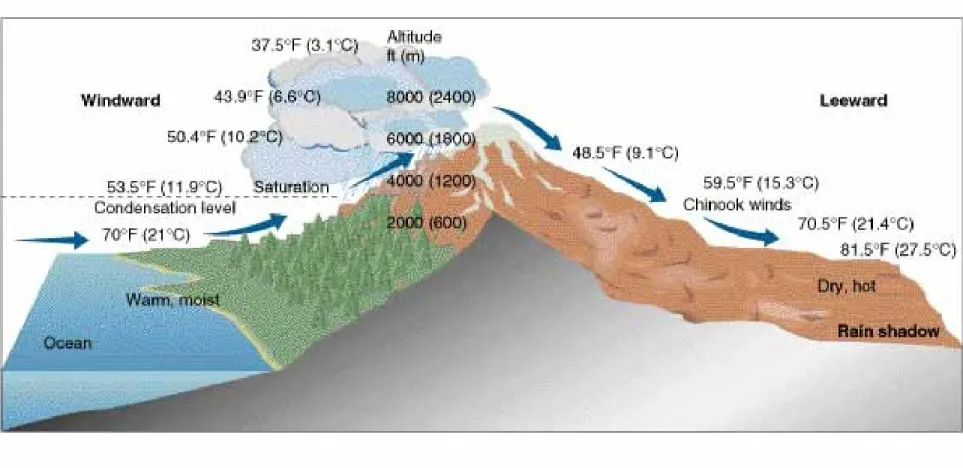
Rain shadow
The Ogallala Aquifer
Mono Lake
Excellent example of human interference
with the water supply.
The water in the lake was diverted from
the lake to the city of Los Angeles. It
became a salt bed.
↑
Salt concentration due to evaporation
Three Gorges Dam in China
China needs to meet the growing demand
for energy
Huge environmental impact
Hundreds of thousands of people will be
Genetically altered food, Irish
Potato Famine
Soil
• Erosion
• Loss of fertility
• Salinization
• Waterlogging
• Desertification
Water
•Aquifer depletion
•Increased runoff and flooding from land cleared to grow crops •Fish kills from pesticide runoff •Surface and groundwater
pollution from pesticides and fertilizers
•Over fertilization of lakes >> eutrophication
Air
•Greenhouse gas emissions from fossil fuels •Other air pollutants from fossil fuels
•Pollutions from pesticide sprays
Major Environmental Effects of Food
Production
Biodiversity Loss
Loss and degradation of habitat
from clearing grasslands and forests and draining wetlands
Fish kills from pesticide runoff Killing of wild predators to
protect live stock
Loss of genetic diversity from
replacing thousands of wild crop strains with a few
monoculture strains
Human Health
•Nitrates in drinking water
•Pesticide residues in
drinking water, food, and air
•Contamination of
drinking and swimming water with disease
The Green Revolution
To eliminate hunger by improving crop performance
Movement to increase yields by using:
New crop cultivars
Irrigation
Fertilizers
Pesticides
Mechanization
Results:
Did not eliminate famine
Population still increasing
Increase cost of production
An increased negative environmental impact
Ch 11 and 12:Protection of
Biodiversity and Ecosystems
• Threatened – if the trend continues, the species will be endangered.
•Endangered – if the trend continues, the species will go extinct.
•Pharmaceuticals and native plants Approximately 25%
of drugs used as medicines come from natural plant sources.
•The Exxon Valdez Oil Spill (1989) 300,000 birds died as
Know Specific Details about…
These Endangered animals (and check Barron’s examples):
Wild Turkey – a success story
Whooping Crane- Eggs raised by sandhill cranes led to
problems, but the efforts proved successful overall.
Peregrine Falcon- DDT
Spotted Owl- deforestation
Fish living in George’s Bank (off New England)-The
Endocrine Disrupters
Interfere with normal hormone action
Can interfere with development
Are often connected to cancer
Can interfere with sexual activity
(alligators)
Are found in plastics and some
Coal-several (400) hundred
years
Oil- about a decade until
supplies peak
Natural Gas – at least a 50
year supply in the United
States
Chapter 13: Fossil Fuels
Important energy facts
Brief history of energy
*
1700-1800 Fire wood
*
1900-1920 Coal
*
1950- now crude oil
“production of crude oil” = with drawing it
from reserves
OPEC (pg 319) organization of petroleum
More Energy Facts
We get 50% of our crude oil from
foreign sources
Alaska pipeline built to help increase
production of domestic crude oil
Types of coal:
Oil: The Most Important Fossil Fuel
in the American Economy
Environmental Consequences
1.
Production: local
ecosystems damage
possible
2.
Transport: oil spills cause
local and regional
ecosystem damage
3.
Use: photochemical smog,
particulates, acid
Coal
Environmental Consequences
1.
Production: ecosystem damage, reclamation
difficult, acid mine runoff, mine tailings,
erosion, black lung, radon
2.
Transport: energy intensive because of
weight and number of train cars needed
3.
Use: fossil fuel with largest source of carbon
dioxide and greatest quantity of
Natural Gas
Environmental
Consequences:
1.
Production: local ecosystem
damage possible if oil or
coal is part of the deposit
2.
Transport: can be explosive
3.Use: produces the least air
pollutants of all the fossil
fuels
Electricity
1. Electricity is a secondary energy source because it relies on
another energy source to create the electricity.
2. Basic production of electricity-boil water to produce steam to
turn turbines to generate electron flow through a wire.
3. Examples of primary sources for electrical production
1. 20% from nuclear
2. 57% from coal
3. Oil, geothermal,
solar, wind, hydroelectric (no boiling
water required for these sources)
A.
Pros: No CO
2emissions, no particulate
emissions
B.
Cons: Radiation can lead to damaged DNA,
costs, radioactive waste, thermal pollution
C.
Basically- the splitting of uranium’s
nucleus gives off heat that can be used to
boil water and turn a turbo generator to
create electricity.
D.
Naturally occurring Uranium is mined.
Nuclear important facts
Fusion- the combination of 2 atoms
to form a larger atom
Fission- splitting an atom
Nuclear Regulatory Commission is
the US governmental Agency that
regulates nuclear power plants
Uranium
Uranium 235 has 92 protons and 143
neutrons. It is radioactive and used as
fuel in nuclear reactors.
When U235 is hit by a neutron, it is split
(fission) into two smaller elements such
as Kr and Ba plus three neutrons which
sustain the chain reaction.
Most (99.3%) of the naturally occurring
uranium is U238.
For a nuclear reactor, this must be
a. Water moderator: slows down neutrons
b. Neutron-absorbing material- control rod c. Fuel Rods-
approximately one third replaced each year
d. Heat transfer system e. Cooling system
f. Redundant safety systems
Waste Disposal
All fuel rods are still in cooling ponds at commercial nuclear facilities
Proposed site for disposal - Yucca Mountain in SE Nevada
Concerns: Geological active area,
Intrusion of water table, distances for wastes travel,
Accidents
Chernobyl:
4/26/86 Ukraine
complete meltdown.
Three Mile Island:
3/28/79
Pennsylvania (Harrisburg)
Chapter 15: Renewable Energy
Indirect Solar power
How does it affect…
Wind?
Hydropower?
Firewood?
Hydro carbon fuels?
Solar Energy
Passive solar
Large south-facing windows, heavy drapes to trap
heat at night, interior bricks to trap heat
Shade windows in summer
Even though back up systems are required, and
solar heating may only lessen the need for heating oil a few %, it will help us adapt to diminishing oil supplies.
Active solar
Photovoltaic (PV) panels can be used to convert
the energy from the sun into electricity.
Electrons from the silicon in the PV panel are
Ch 16 &17: Risks and Pests
Borneo (DDT), MTBE
Hazard - Anything that causes:
1. Injury, disease, or death to humans
2. Damage to property
3. Destruction of the environment
Cultural hazard - a risk that a person
chooses to engage in
Risk
The probability of suffering (1, 2, or 3)
as a result of a hazard
Perception
Cigarette Smoking
Leading cause of cancer in U.S.
Can cause cancer, lung disease, a
bigger risk of death in addition with
other types of air pollution.
Insecticides/Pesticides
Integrated pest management includes:
adjusting environmental conditions
chemical pesticides
disease resistant varieties
crop rotation
biological controls
Insecticides kills plants, mammals, fish,
birds
A broad spectrum pesticide is effective
DDT accumulates in fat
body tissues of animals
DDT was not used for
handling weeds
DDT is, persistent,
synthetic organic
Diseases
Lyme disease can be
processed to humans
through a bite from an
infected tick
Mosquitoes causes
Malaria, the vector for
Plasmodium
The protozoan of the
Diseases cont’d
Lack of access to safe drinking water
is a major cause of disease
transmission in developing countries.
Epidemiology is the study of the
presence, distribution and control of
a diseases in a population
Morbidity is the incidence of disease
in a population
Mortality is the incidence of death in
Ch 18: Water Pollution
Sewage treatment is a common practice
In the 1970’s many cities were still
dumping raw sewage into waterways
In 1972, the Clean water act provided
funding for upgrading sewage treatment
plants
Currently water ways are the much better
1°, 2° use preliminary but no more
Test for sewage contamination in drinking
Sewage Treatment
Raw sewage (99% H2O)
Preliminary Treatment- allow grit to
settle
1° separating Raw Sludge from H2O
2° AKA Biological Treatment-
bacteria feeds on the organic
material
Trickling filters contain bacteria
remove raw sludge from the H2O
Raw Sludge May contain heavy metals
Home Septic Systems:
do not use Chlorine
Do use settling tank to settle
organic solids
Ch 19: Municipal Solid Waste
210,000,000 tons of municipal solid waste (MSW) are
disposed of annually in the United States.
Most of that waste is paper.
Fifty-five percent of MSW is disposed of in landfills.
17% of MSW is combusted, mostly in waste-to-energy
(WTE) combustion facilities. What are the advantages and disadvantages of WTE combustion?
The best solution to solid waste problems is to reduce waste
at its source.
More than 75% of MSW is recyclable. What role is recycling
playing in waste management, and how is recycling best promoted?
Much more can be done to move MSW management in a
more sustainable direction. What are some
Ch 20: Hazardous Waste
Halogenated hydrocarbons
Organic compounds with a halogen
(bromine, iodine, ect.) replacing a
hydrogen
Used as pesticides
Used to make plastic
Chlorinated hydrocarbons
Chlorinated hydrocarbons
Are synthetic organic compounds
Dioxin
Mainly caused by burning PVC pipe
(medical waste)
Linked to cancer.
Love Canal, NY
The government allowed housing to be build over the
toxic waste dump and people got sick
Problem first discovered in 1978
First national emergency in the US because of toxic
waste
Led to the superfund legislation.
Superfund sites:
Ch 21:Layers of the Atmosphere
Troposphere
---Tropopause
Stratosphere
--- Stratopause
Mesosphere
--- Mesopause
Composition of the troposphere
• 78% N
2• 20% O
2• Less than 2%
• H
2O vapor (.01%-4%)
• Argon gas (1%)
Global warming
Global warming occurs when humans
contribute too much of these greenhouse
gases leading to a small (1-3 degree C)
but significant rise in the global average
temperature.
Analogy – Car on a sunny day
The greenhouse effect is natural and
Ozone (O
3)
Stratospheric ozone is GOOD
It shields us from the harmful UVB rays of
the sun.
Ozone depletion is the thinning of the
stratospheric ozone shield (mostly over the
South Pole, Australia story)
Analogy – Stratospheric O
3
is like sunscreen
for the earth.
Tropospheric ozone is BAD
Chapter 22 Air pollution
Expensive: health care costs, human lives -acute
- Chronic
- Carcinogenic
Damages buildings, bridges, statues, books Aesthetics
Damage to Plants
Acids and Bases
pH-log of hydrogen ions in a solution.
Therefore each number higher on the pH
scale is 10X more basic
Basic- OH- (hydroxyl ions) over 7 on the
pH scale
Acidic-H+ ions under 7 on the pH scale
Neutral- pure water is 7 on the pH scale
Normal rain is slightly acidic-pH 6.4
Acid rain is defined as less than a pH of
Indoor Air Pollutants
1. Types: benzene, formaldehyde,
radon, cigarette smoke
2. Sources: off gassing from
furniture, rugs and building
materials, dry cleaning, cleaning fluids, disinfectants, pesticides, heaters
3. Buildings with too many indoor
air pollutants are called “sick buildings” because more than
Major Outdoor Air Pollutants
Primary – direct products of combustion and
evaporation
Secondary – when primary pollutants undergo
further reactions in atmosphere
1. Suspended particulate matter (primary)
2. Volatile Organic Compounds (secondary)
3. Carbon Monoxide (primary)
4. Nitrogen Oxides (can be both)
5. Sulfur Oxides(primary from combustion of coal)
6. Ozone and other photochemical oxidants
Sources of air pollution
Natural:
a. Sulfur: Volcanoes, sea spray, microbial
b. Nitrogen oxides: lightening, forest fires,
microbial
Anthropogenic (human caused)
a. Sulfur oxides: coal burning plants, industry,
fossil fuels.
b. Nitrogen oxides: power plants, industrial fuel
combustion, transportation
c. Effect areas hundreds of miles from the
Solutions: Reducing Emissions
Best way = Conservation, just use
less!
Input Control
a.
Cleaner burning gasoline
b.increased fuel efficiency
c.alternative modes of
transportation
d.