Density functional embedding for periodic and nonperiodic diffusion Monte Carlo calculations
Katharina Doblhoff-Dier*and Geert-Jan KroesLeiden Institute of Chemistry, Gorlaeus Laboratories, Leiden University, Post Office Box 9502, 2300 RA Leiden, Netherlands
Florian Libisch
Institut for theoretische Physik, Technische Universität Wien, Austria
(Received 25 April 2018; revised manuscript received 3 July 2018; published 23 August 2018)
We present density functional embedding for diffusion Monte Carlo calculations (DMC). Using two test systems, an H chain and a Be slab, we demonstrate the feasibility and show that the approach can give high-quality results. DMC embedded in potentials from density functional embedding theory thus presents an alternative to conventional embedded quantum chemical methods, such as embedded complete active space calculations. This is especially true for cases in which the cluster size becomes too large for accurate wave-function theory based methods or for cases in which basis-set superposition errors become dominant. Furthermore, we show that embedded DMC can easily be used for systems in which the cluster of interest is a one-dimensional or two-dimensional periodic object and cannot be described as isolated impurity. This extends the applicability of the embedding approach to new fields.
DOI:10.1103/PhysRevB.98.085138
I. INTRODUCTION
In the effort to accurately assess the electronic properties of atomic and molecular systems of ever increasing sizes, two obvious strategies exist: one can either try to improve the numerical scaling of high-level methods or increase the accuracy of low-level methods. Examples of the former in-clude massively parallel implementations of coupled cluster approaches [1], linear scaling coupled cluster [2], and quan-tum Monte Carlo (QMC) methods [3–5]. The latter strategy strongly targets the improvement of density functional theory approaches and includes the development of more accurate exchange-correlation functionals, including improved semilo-cal functional [6–11], van der Waals functionals [12–15], improved hybrid functionals [16,17], and the use of machine-learning algorithms [13,18].
A third, promising, alternative is to combine the advantages of several methods in one calculation, by partitioning the sys-tem of interest into a (small) site of interest and an environment. The site of interest is then treated with a high-level approach and is embedded in an environment that can be considered sufficiently well described at a lower level of theory. Apart from the choice of the two methods, crucial questions are how to choose the partitioning and how to manage the interaction between cluster and environment. Different types of systems typically require a different treatment of the environment: for ionic crystals, an embedding in point charges is typically suf-ficient [19,20]; for biochemical systems, combined quantum mechanics/molecular mechanics (QM/MM) [21] will often be the method of choice, while solid-state systems may be better described using density functional embedding [22–26]. More involved schemes such as density-matrix embedding
*Corresponding author: [email protected]
[27–29] or projection-based methods [30–33] allow for a more exact treatment of the cluster-environment interaction, in particular the kinetic energy. However, such schemes require additional operators in the Hamiltonian of the embedded cluster, instead of merely a local potential, possibly making their implementation for different electronic structure methods more challenging.
In spite of the improvements offered by modern embedding methods, the size of the cluster described at a higher level of theory remains a crucial “parameter” that needs to be converged. Often, the cluster sizes required become too large to allow for a highly accurate description with conventional quantum chemistry methods. The exploration of new methods to be used inside an embedding calculation therefore becomes of interest. In this paper, we will discuss and investigate the combination of diffusion Monte Carlo (DMC), a quantum Monte Carlo method, with embedding theories.
In the past, diffusion Monte Carlo has been coupled to the reaction field of classical polarizable dipoles in a QMC/MMpol [34] approach, to continuum solvation from joint density functional theory [35] and, for molecular systems, to wave function in DFT embedding schemes [26]. Here, we will demonstrate the successful use of embedding potentials from density functional embedding theory (DFET) [36] in DMC cal-culations, also including periodic DMC calculations embedded in DFT.
Density functional embedding has previously been used in conjunction with clusters described by second-order multiref-erence many-body theory [37], complete active space (CAS), CASPT2, and configuration interaction (CI) calculations [38]. Briefly, DFET employs a single, local embedding potential
density functional theory, the embedded cluster can be solved using high-level methods such as DMC. The use of DMC in conjunction with DFET would allow for the treatment of larger clusters due to the better scalability of DMC compared to the previously employed quantum chemical methods.
Embedding DMC calculations is of particular interest for the solid state, including metals and their interfaces, since both DMC and DFET are well suited for treating periodic boundary conditions. One may thus treat systems in which the clus-ter of inclus-terest is one-dimensional (1D) and two-dimensional (2D) periodic instead of an isolated impurity, yielding an important extension to conventional density functional embed-ding. As an example thereof, we consider a Be slab in this paper.
Furthermore, DMC could overcome problems faced by conventional quantum chemistry methods with respect to finite basis-set errors, which can be particularly large in metallic systems. Since DMC is quasi-basis-set free, it will typically not suffer from excessive basis-set related errors (compare Refs. [39,40]).
On a more general level, the integration of DFET embedding potentials into DMC may thus provide the possibility to access properties of systems that are otherwise hard to determine at sufficiently high accuracy, such as reaction barriers for dis-sociative chemisorption [41–43] and molecular chemisorption energies [15,44] on metals.
There is, however, one concern when using DMC to describe a cluster embedded in a density functional embed-ding potential: the problematic convergence of the optimized effective potential approaches [45] involved in determining the DFET embedding potential results in numerical noise that manifests as small-scale oscillations. These nonphysical oscillations in the embedding potential will likely not influence the cluster calculation if the cluster is described with methods that use a finite basis set (e.g., a Gaussian basis) since the basis set will generally not be flexible enough to resolve them. By contrast, DMC has no basis-set related restrictions, other than those entering the fixed-node approximation and the locality approximation. Hence, a DMC wave function can follow all oscillations no matter how small. In this paper, we thus not only present the implementation of potential functional embedding for the QMC codeCASINO, but also test the actual applicability of the approach for two simple test systems, a hydrogen chain and a Be slab, thus validating the approach.
The paper is structured as follows: First, we give a short overview of the methods used, including diffusion Monte Carlo (Sec.II A) and density functional embedding theory (Sec.II B). Then, we present our results, first for the H chain (Sec. III) and then for the cohesive energy of Be as computed from 2D periodic slab calculations (Sec.IV). The paper concludes with a summary and outlook.
II. METHODS A. Diffusion Monte Carlo
Diffusion Monte Carlo belongs to a class of methods that aim at solving the electronic Schrödinger equation for the ground state using stochastic methods. In particular, DMC makes use of the imaginary-time Schrödinger equation.
Since excellent reviews on the DMC method have been published elsewhere [3,4,46,47], we will only give a very brief description here.
In DMC, the imaginary-time Schrödinger equation is recast into a drift diffusion and branching equation of a set of elec-tronic configurations (“walkers”). At every point in imaginary time, the walkers stochastically represent the distribution
f({r}, t)=T({r})·({r}, t), (1)
whereT({r}) is an initial trial wave function depending on the
electronic coordinates{r}and({r}, t) is the imaginary-time propagation of T({r}) subject to the fixed-node constraint,
i.e., the nodes of the wave function remain fixed in the 3N -dimensional configuration space (withNbeing the number of electrons in the system). After the equilibration of({r}, t), i.e., fort > tequil, such that
({r}, t)≈({r}, t→ ∞)≡0fn({r}) ∀ t > tequil, (2)
the fixed-node ground-state energy corresponding to the ground state under the fixed-node constraintfn
0 ({r}) is given
by
Efn0 = EL({r}), (3)
withEL({r})= ˆ H({r})
({r}) , where ˆH is the electronic
Hamilto-nian.
The propagation of the walkers is performed in finite time stepsτ, the converged length of which depends on the system and the quality of the trial wave function T({r}). The trial
wave functionT({r}) is typically given by
T({r})=S({r})·eJ({r}), (4)
where S({r}) is a wave function expressed in one or more [40,48–50] Slater determinants (for example, from a Hartree-Fock calculation, a DFT calculation or a CI calculation) and
eJ({r})is the Jastrow factor. The Jastrow functionJis a function
of electron-electron distances rij and ion-electron distances
(rI iandrIj) and serves to introduce many particle correlation
effects. This function is typically parametrized by tens to a few hundreds of parameters, which are optimized in a variational Monte Carlo calculation prior to a DMC calculation by either minimizing the variance of the local energiesEL[51,52] or by
minimizing the variational energyELitself [53,54].
For our calculations, we use a Jastrow function given by a sum of electron-electron terms u, electron-nucleus termsχ, and, for the H4 chain, electron-electron-nucleus three-body
termsf:
J({ri},{rI})=
I,i
χ(riI)+
i,j =i
u(rij)
+
I,i,j =i
fI(riI, rj I, rij), (5)
whereiandjenumerate electrons,Ienumerates ions, andrxy
is the distance in real space between particlexand particley. The functionsχ(riI) andu(rij) are parametrized by
poly-nomials of degreeN multiplied by a smooth cutoff function
where PN(x) is a polynomial of degree N, Lx denotes the
cutoff length, andis the Heaviside theta function [46]. In case of theuterm, the polynomial coefficients are restricted to satisfy the electron-electron cusp condition. The three-body functionf(rij, riI, rj I) is given equivalently as a polynomial
in the three independent variables multiplied with a cutoff function inriI andrj I.
For the present calculations, we useN =5 for theuandχ
terms andN=2 in thef term, if used. Different parameters are used for spin-up and -down electrons in theχ term and for the different spin pairs in the u term. The optimizable parameters (i.e., the cutoff lengths Lx and the polynomial
coefficients) are optimized by minimizing the variance of the local energies.
For all quantum Monte Carlo calculations, we use the software package CASINO [46]. The extension to allow for embedding potentials has been added to the code by us and will shortly become available in the beta version ofCASINO. To allow for an interpolation of the potential, it is reexpressed in cubic splines.
B. Density functional embedding theory
Density functional embedding theory (DFET) [24] belongs to the group of orbital free embedding schemes, in which only the density is partitioned into two or more systems. In contrast to previously developed orbital free embedding schemes, such as the frozen density embedding by Wesolowski and Warshel [22], DFET does not employ any kinetic energy density functionals. Furthermore, for every choice of electronic and nuclear partitioning, DFET guarantees a unique partitioning of the densities by requiring that the two subsystems share the same embedding potentialVemb(r) with
ρ1[Vemb]+ρ2[Vemb]=ρfull, (7)
whereρ1 andρ2 are the densities of the first and the second
subsystems (i.e., the cluster and the environment) obtained under the influence of the embedding potential Vemb. The densityρfull is the density of the total system. (Here and in
most of the following, we omit the dependence ofρandVemb
onrto improve readability.)
The embedding potential is optimized self-consistently on the density functional theory level by maximizing the extended Wu-Yang functional [55] as function ofVemb:
W[Vemb]=E1[ρ1]+E2[ρ2]
+
Vemb(ρ1+ρ2−ρfull)dr+w[Vemb]. (8)
(Note thatρ1+ρ2−ρfullis not zero as long as the embedding
potential is not converged and thatWandware not explicitly rdependent.) The penalty termw[Vemb] is introduced into the
Wu-Yang functional to regularize the potential by penalizing wild oscillations in the embedding potential
w[Vemb]= −λ
Vemb∇2Vembdr, (9)
where λ is a constant that scales the weight of the penalty function.
The resulting embedding potential can then be used to determine the ground-state energyEX
cluster[Vemb] of subsystem
1 (the cluster) in the presence ofVemb, at a different level of
theoryX. The total energyEDFET
tot is then given by
EtotDFET=EfullDFT−EDFTcluster[Vemb]+EclusterX [Vemb], (10)
where EiM denotes the energy obtained for the system i,
i∈{full, cluster} at the level of theoryM, and the functional dependence E[Vemb] indicates the fact that the ground-state
energy is calculated in the presence of the embedding potential. This definition of EDFET
tot automatically includes a first-order
correction to the interaction energy, thus accounting for the change of the cluster density fromρclusterDFT toρclusterX , as shown in Ref. [24].
Overall, DFET is very similar to the DFT in DFT (DFT/DFT) freeze and thaw algorithm proposed for frozen density embedding (FDE) [56], albeit without the need of an approximate kinetic energy functional or the need to deduce the orbitals from an optimized effective potential [23]. Using the algorithm presented above, a relatively stable optimization of the embedding potential can be achieved. Furthermore, the only change in evaluating the ground-state energy of the cluster is the additional scalar embedding potentialVemb,
making the connection with different high-level approaches comparatively easy. It should be kept in mind, however, that DFET calculations are not self-consistent in the sense that the embedding potentialVembdoes not react to the improved cluster densityρclusterX [except for a first-order correction, see Eq. (10)]. Instead, the embedding potential is only determined once, at a pure DFT level. This is in contrast to iterative wave-function/DFT schemes, which have been proposed as an extension to freeze and thaw FDE algorithms [57]. In these wave-function/DFT schemes, the embedding potential is constructed self-consistently for a cluster described by a wave-function method and an environment described by DFT. Extending these wave-function/DFT schemes to DMC/DFT might, however, be nontrivial since the system density, which enters the iteratively improved embedding potential in these schemes, is only sampled stochastically in DMC. Although smooth representations of the density can be obtained by projecting onto basis functions [58] or by sampling in discrete Fourier space, it remains questionable and a matter of future in-vestigation whether these representations can be made accurate enough. Previous “DMC”/DFT applications were therefore based on embedding potentials that were self-consistently created at a mixed CASPT2/DFT level [26] making the extension to periodic systems challenging. Similar concerns also hold true for potential functional embedding theory [25], which would also allow for a self-consistent embedding at a wave-function/DFT level. At present, and in spite of its restrictions, we therefore view DFET to be the most suitable embedding scheme if a connection to DMC is sought for solid-state systems.
All embedding potentials used in this work have been created with the embedding code for ABINITavailable from the group of E. Carter with some minor modifications.
III. H4CHAIN
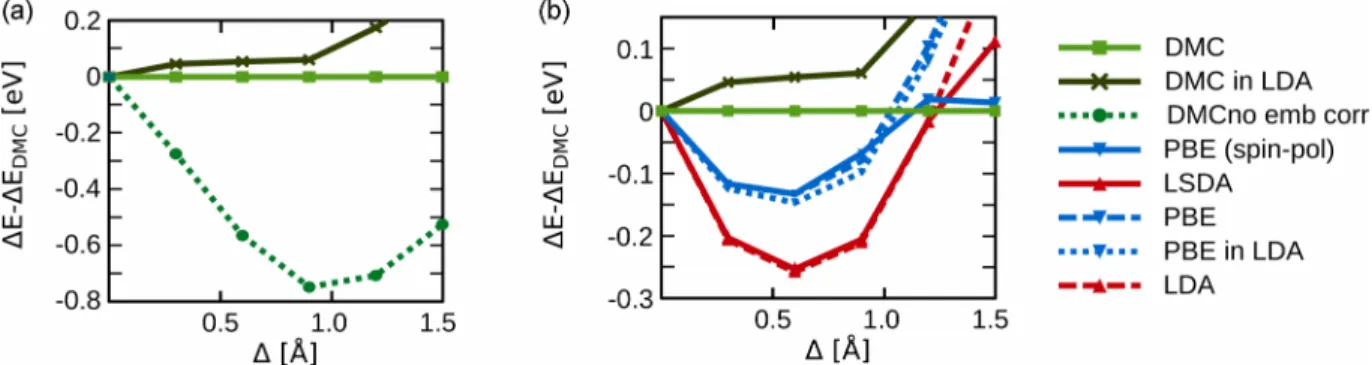
FIG. 1. (a) Sketch of the H4 chain. The light gray atom is replaced by an embedding potential in the embedded cluster calculations. (b) Change in binding energy for different values of, whereis defined in subplot (b). The error bars of the DMC results are not shown, but they are all smaller than 10 meV and are thus negligible.
energy when one of the outermost bonds is stretched by an amount as shown in Fig. 1(a). Before considering results in which the atom farthest from the bond stretch is replaced by an embedding potential, we will briefly discuss the results obtained when treating the full system at one level of theory.
Figure1(b)shows the change in energy for (spin-polarized and non-spin-polarized) DFT calculations using different func-tionals when stretching the outermost bond by an amount. For the DFT calculations, spin polarization clearly becomes important for bond stretches larger than =1.2 ˚A [see Fig.1(b)]. Figure 1(b) also shows the corresponding DMC energies. The DMC caclulations were thereby performed using a time step ofτ =0.02 au. The Slater part of the trial wave functionS({r}) is given by a single Slater determinant taken from spin-unpolarized calculations with the LDA functional [59] and the three-dimensional (3D) periodicity of the box is kept for consistency with the DFT results. Due to the relatively large box size, this can be expected to have little effect. The DMC calculations agree very well with results of spin-polarized calculations using the PBE functional [60], despite the fact that they are based on a spin-unpolarized
S({r}). Apparently, the DMC calculations can recover the effects of spin polarization to a certain extent.
To test the embedding implementation for DMC, the H atom farthest from the stretched bond was replaced by an embedding potential. Both fragments were thereby kept neutral and the embedding potential was based on spin-unpolarized LDA calculations and a smoothing parameter ofλ=5×10⁻⁵. The
calculations were considered converged when the maximum density difference was less than 1×10⁻³a.u.
Since there are concerns about the possible harmfulness of the “wiggles” in the embedding potential to accurate DMC calculations, we first investigate this possibility in more detail: The concerns just mentioned are rooted in the fact that DMC is quasi-basis-set free [apart from influences of the basis set used to construct S({r}) on the fixed-node approximation] and can thus easily respond to short-range oscillations in the embedding potential. We can simulate this effect in a pure DFT approach, thus allowing for a cheap proof of principle. To this end, we proceed a follows: first, we construct embedding potentials for several values of 01.2 ˚A at a plane-wave cutoff ofEcut=2000 eV. At thisEcut, the DFT calculations are
highly converged (total energies converged to about 20 meV). We then use these embedding potentials in DFT calculations with a higher plane-wave cutoff of Ecut=3100 eV, thus
simulating the effect of having a full basis. The integrated density differenceρ drof
ρ=ρcluster
Eicut+ρenv
Ecuti −ρfull
Ecuti , (11)
the maximum density difference, the total energy of the cluster
EclusterDFT [Vemb] [i.e., the energy of the clusterplusits interaction
with the embedding potential as defined in Eq. (10)] and the energy of the cluster ˜EclusterDFT [Vemb]:
˜
EclusterDFT [Vemb]=EclusterDFT [Vemb]−
Vemb(r)ρcluster(r)dr
(12)
were then examined. Hereby,ρx(Ecuti ) denotes the density of
the embedded cluster, the embedded environment, and the full system computed at a given plane-wave cutoff energyEi
cut, for
x ∈ {cluster, env, full}, respectively.
Using this approach, the maximum density difference increases from below 1×10⁻³au (the value to which it
was converged at Ecut1 =2000 eV) to about 2×10⁻³au at
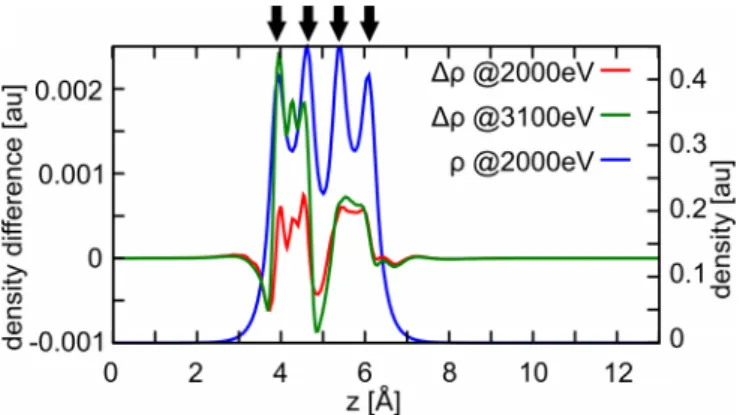
Ecut2 =3100 eV for all values of (see Fig. 2 and Table I for the case =0 ˚A). The integrated density difference also increases with increasing Ecut, but not as much as the
maximum density difference (see Table I for the case = 0 ˚A). The largest density differences arise close to the nucleus replaced by the embedding potential (see Fig. 2). Such a
FIG. 2. Cut of the density differencesρbetween the sum of the cluster density and the environment density, and the density of the full calculation along the chain of H atoms for different values ofEcut(left
TABLE I. Density differences as computed from Eq. (11) for the H4chain separated into cluster and environment at=0 ˚A.
Ecut=2000 eV Ecut=3100 eV
max(ρ) 0.8×10⁻³au 2.4×10⁻³au
ρ dr 2.3×10⁻²au 2.4×10⁻²au
behavior can be expected: since the embedding potential was constructed atE1
cut, the refined ground-state density for the
cluster+environment calculations atE2
cut> Ecut1 will react to
the low spatial resolution of Vemb. Short-length oscillations observed in the density of the full system will not be captured in the cluster+environment calculations resulting in the observed increase in maximum density difference. While this behavior likely introduces an additional basis-set effect in the DMC cal-culations, we do not observe qualitative changes in the ground-state density at higherEcutthat are caused by oscillations in the
embedding potential. This is likely due to the suppression of sharp oscillations in the density by corresponding high kinetic energy contributions. We conclude that the quasi-basis-set free nature of our QMC calculations poses no fundamental obstacle towards embedded QMC-in-DFT approaches.
As a second test, we also consider the basis-set effects on the total energy of the clusterEclusterDFT [Vemb] as defined in Eq. (10).
This value is of particular interest since it directly enters the evaluation of the total energyEDFET
tot of the embedded system.
ForEDFT
cluster[Vemb], we observe very small changes of less than
5 meV when increasingEcut from 2000 to 3100 eV. This is
curious since these changes are significantly smaller than the changes of∼20 meV that were observed for the total energy of the full system. To shed more light on this, we also consider the energy of the cluster only ˜EDFT
cluster[Vemb]:
˜
EclusterDFT [Vemb]=EDFTcluster[Vemb]−
Vemb(r)ρcluster(r)dr.
(13)
The changes in ˜EDFT
cluster[Vemb] are in the range of 20 to 30 meV,
in good agreement with the energy changes observed for the total system. Apparently, there is a certain amount of error cancellation in the change of the total cluster energy
EDFT
cluster[Vemb] when going from smallEcutto largeEcut. Overall,
the small changes observed for an increased basis set size are reassuring. We thus proceed to actually use the embedding potential obtained at Ecut=2000 eV in embedded DMC
calculations.
Figure3(a) shows a comparison of the DMC energy ob-tained for the full system with the DMC energy obob-tained in an embedded cluster calculation. Since we do not consider spin effects in the embedding, we do not expect the embedding framework to be able to capture the spin effects that become important at large values of [see Fig.1(a)]. We therefore focus on the region with small0.9 ˚A.
The energy difference of the embedded calculation to the benchmark full DMC calculations shows remarkable agree-ment up to the point were spin contributions become essential (at a spacing >0.9 ˚A) [see Fig. 3(b)]. In this range of bond lengths, the embedded DMC calculations also perform considerably better than LDA or PBE calculations for the full system [see Fig.3(b)]. To prove that this agreement is, indeed, due to the embedding formalism, we also consider a naive “embedding” scheme that neglects any interaction of the cluster to its environment
Ecorrtot =EDFTfull −EclusterDFT [Vemb=0]+EclusterDMC[Vemb=0].
(14)
The DMC calculation EDMC
cluster[Vemb=0] is thereby based on
Slater wave functions from DFT calculations of the cluster without embedding. If this scheme were to give similar results to DMC embedded in a DFET(LDA) potential, this would clearly indicate that no elaborate DFET embedding is needed for this system, making statements about the role of the wiggles inVemb useless. Any agreement of embedded DMC with the
full DMC results could then not be viewed as a sign that DFET of DMC can provide high-quality results. In the present case, the nonembedded DMC calculations perform significantly worse than DFET, clearly indicating the need of an embedding potential.
The attentive observer may have noticed that it is only the embedded DMC calculation that seems to suffer from spin-polarization effects, while the full DMC calculations closely follow spin-polarized PBE for this system. We explain this by the reduced flexibility of the wave function in the embedded DMC calculations as compared to the full calculation: by
FIG. 4. Sketch of the geometries used to determine the cohesive energy [see Eq. (15)] of Be. The slabs are periodic in thex-yplane.
replacing one of the electrons with a DFT-based embedding potential, the flexibility of this electron is lost in DMC, which can no longer relax towards the true (fixed-node) solution.
Overall, this example demonstrates the applicability of DFET to DMC. The deviation of the embedded DMC calcu-lation from the full DMC calcucalcu-lations for>0.9 ˚A is most likely due to spin effects, as corroborated by the comparison between LDA and LSDA (as well as PBE and spin-polarized PBE) and the embedded DMC results in Fig. 3(b). Within the range of applicability (which is limited by the embedding potential being computed for a non-spin-polarized system), embedded DMC thus seems to be capable of giving good results (on an accuracy scale of better than 65 meV for 0.9 ˚A).
IV. COHESIVE ENERGY OF BERYLLIUM
As mentioned in the Introduction, an advantage of em-bedded DMC calculations over other emem-bedded correlated wave-function approaches (embedded complete active space or embedded configuration interaction) is that in addition to the fact that the cluster may be chosen larger, DMC is naturally capable of performing periodic calculations. It thus becomes possible to embed 1D or 2D periodic structures in a DFT environment. As a proof of principle, we compute the cohesive energy of bulk beryllium from
Ecoh=
E(n1)−E(n2) (n1−n2)Nat
−Eatom, (15)
whereE(n) is the energy of ann-layer slab,Eatomis the energy
of a single Be atom,Natis the number of atoms per layer, and
n1> n2 (see Fig.4). This expression should converge to the cohesive energy ifn1andn2 are large enough, such that the slab mimics a bulk system.
Although the cohesive energy is of course a bulk property, the above definition ofEcoh requires the accurate description
of a 2D “impurity.” It should be noted though, that cohesive energies could of course be computed from a bulk and a single-atom calculation in DMC without the need of embedding. We use the above definition though to allow for a proof of principle that embedded DMC calculations of 2D periodic systems are possible.
TABLE II. Cohesive energies computed with DFT and DMC with and without embedding. When embedding is used, the cluster layers are in the center of the slab and the number of layers of the cluster is stated as ˜ni. The experimental value is given for comparison. The error bars in the DMC calculations stem nearly exclusively from the fit to differentkpoints and not from statistical sampling. The statistical error bars from sampling are below 2 meV for all calculations.
n2 n1 n˜2 n˜1 Ecoh(eV)
DFT 10 12 3.72
DFT 10 11 3.72
DFT (emb) 11 12 1 2 3.72
DFT 1 2 3.63
DMC 10 12 3.39±0.01
DMC (emb) 11 12 1 2 3.39±0.02
DMC (emb,λ=1×10⁻⁶) 11 12 1 2 3.40±0.02
DMC 1 2 3.30±0.01
DFT(PW91) [63] 3.74
Expt. [64] 3.32
The slabs are cut with a (0001) surface termination from the hcp bulk of Be using 10 ˚A for vacuum between adjacent images. We use pseudopotentials by Trail and Needs to describe the Be atoms. The DFT calculations are based on the PBE functional. We use periodic boundary conditions in all three spatial directions, and 20×20 k points in the
x−yplane (i.e., plane of the slab) fork-point averaging. We employ the experimental lattice parametersa=2.2866 ˚A and
c=3.5833 ˚A from Ref. [61], as well as a measured surface interlayer dilatation of 5.8% [62] for the top and bottom layers (except for slabs with only one or two layers, see below).
For the DMC calculations we use periodic boundary con-ditions in thex−y plane only, and a 3×3 slab supercell to limit finite-size effects. Additionally, we sample overkpoints by using 5–7 randomk-point shifts (twists) in thex−yplane (i.e., in the plane of the slab).1We obtain an approximation to
thek-point converged DMC result ¯EDMCfrom a linear fit
EDMC(ki)=E¯DMC+b(EDFT(ki)−E¯DFT) (16)
of the DFT data obtained at akpointki to the DMC energies
obtained at the samekpoint via the fit parameters ¯EDMCand
b, where ¯EDFT is thek-point converged DFT result. This is similar to the correction scheme previously used for example in Ref. [43].
For the computation of the energy of a single atom Eatom
needed for Eq. (15), we used a box of 14×14×14 ˚A in DFT. In DMC, no periodicity was used for the atom in a box calculations. The DMC time step was 0.025 au in all cases.
First, we compute DFT and DMC reference values from slabs withn1 =12 andn2=10. The resulting cohesive
ener-giesEcohare shown in TableII. The resulting DFT cohesive
1The number of twists used per geometry varies since some
cal-culations were marked as outliers, either because the ratioEVMC−EHF EDMC−EHF was clearly worse than for other calculations, or because a certain twist clearly did not follow a linear relation betweenEDFT(ki) and
FIG. 5. Absolute values of the maximum density differences between the full and the embedded system obtained for a 6 layer Be slab at different values ofλ.
energies Ecoh (see Table II) correspond well to previous
DFT(PW91) results by Wachowitzet al. [63]2while the DMC calculations agree much better with the experiment.
The next step is to find a converged embedding potential for Be slabs. Since we want to use the embedding in DMC, “converged” in this case also means transferable to higher
Ecut. In order to investigate the convergence of the embedding
potential, we first use two different toy systems. The first has three layers only, where the two outermost layers belong to the environment and the central layer constitutes the cluster. The second toy system has six layers, with the center two layers belonging to the cluster. The electronic partitioning is, in all cases, chosen such that the fragments remain neutral. For these toy systems, we find that, at fixedEcut, untypically low values
ofλ[see Eq. (9)] lead to a better convergence of the maximum density difference. Ported to higherEcut, however, the same embedding potential typically gives much higher maximum and integral density differences (Fig.5). Using higher values of Ecut right away when designing the embedding potential
seems to alleviate the problem to a certain extent, but this again becomes a question of computational cost.
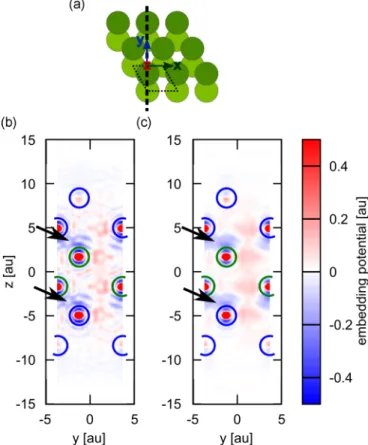
One can understand the better convergence of the embed-ding potential with decreasingλ by looking at the resulting embedding potential shown in Fig.6. The broad regions of negative embedding potential (indicated by arrows in Fig.6) induce binding between the cluster and the environment layers. In addition to these broad structures, however, strong local fluctuations are apparent at the Be-atom sites close to the clus-ter - environment boundary: a positive peak in the embedding potential pushes density away from the nuclei to regions above
2Note that the PBE functional was designed to reproduce PW91
results, such that we may expect similar results for PW91 and PBE for the Be system too.
FIG. 6. 2D cut through the optimized embedding potential for a six-layer slab of beryllium, where the two outermost layers on the top and the two outermost layers on the bottom are described by the environment and the two central layers are cluster atoms. (a) Sketch of the geometry. The direction of the 2D cut used in (b) and (c) is indicated by a bold dashed line. Dark green balls indicate first-layer atoms, light green balls second-layer atoms. The thin dotted line shows the unit cell. (b) Embedding potential obtained usingλ=1×10⁻⁶; black arrows indicate the region in the embedding potential expected to be responsible to replicate the binding between the cluster and the environment. (c) Same as (b) but using anr-dependentλfunction withλi=1×10⁻⁷, λo =1×10⁻⁵, andrcut=1.0 ˚A. The blue and green circles represent the positions of the environment and cluster atoms in the cut plane, respectively.
and below the atoms, characterized by negative values in the embedding potential. It seems likely that these pronounced structures in the embedding potential are not due to numerical noise, but rather represent a change of orbital structure due to the binding (fromslike to moreplike).
A large value of λ will not only suppress nonphysical oscillations in the potential, but will also penalize physical
inter-FIG. 7. Maximum and integrated density difference for a three- and a six-layer slab of beryllium for different values ofλ. Since the density differences at high and at low plane-wave cutoff should both be low, we only report the larger of the differences obtained forEcut=600 eV or for an embedding potential computed atEcut=600 eV and used atEcut=1720 eV, unless noted otherwise. Horizontal lines: values obtained for constant values ofλ(λo=λi); dotted horizontal lines: result obtained atEcut=600 eV (shown for reference atλ=1×10⁻⁸andλ=1×10⁻⁶ only); thick black line: results obtained for different combinations ofλi, λo, andrcut(Bohr).
action between subsystems dictates strong density variations, while still sufficiently penalizing nonphysical oscillations deep within the cluster, we modify the embedding code to allow for anrdependentλthat varies smoothly fromλiin the area close
to the atoms toλoaway from the atom:
λ(r)=λf(˜rat2)
i λ 1−f(˜r2
at)
o , (17)
˜
rat(r)= rna(r)
rcut
, (18)
wherernadefines the distance fromrto the nearest atom and
the cutoff functionf is defined as
f(x)=
e−1−xx, x <1
0, x 1. (19)
Using the three- and the six-layer systems, we performed extensive tests using different values ofrcut, λi, andλo, also
accounting for the changes in the density difference when going to a higher value ofEcut. Judging from the maximum and
the integrated density differences, ther-dependentλapproach can improve the convergence of the embedding potential (see Fig. 7): In general, the combination of relatively large λo
values of 1×10⁻⁵withλ
ivalues a few orders of magnitudes
smaller gives good results, as characterized by maximum and integrated density differences generally smaller than those obtained for the best result for constant λ. Furthermore, compared to a constantλ=1×10⁻⁶, which yields relatively
good results in terms of maximum and integrated density differences at both low and highEcut(see Fig.7), a spatially
varying λadditionally allows for an efficient suppression of oscillations in the intermediate region (see Fig. 6). Larger constant values of λ1×10⁻⁵ would also suppress these
embed-ding potential. We choosercut=1.0 a.u., λo=1×10⁻⁵, and
λi =1×10⁻⁷, allowing for small maximum and integrated
density differences, while also resulting in an embedding potential with strongly suppressed nonphysical oscillations far away from the atomic cores [Figs.7and6(c)]. While prob-ably not unique (compare Fig.7), these parameters appeared appropriate for both systems under investigation (three-layer and six-layer slab). They were therefore subsequently used to create a DFT embedding potential replacing the outermost five layers on the top and on the bottom and leaving the central layers as active cluster (Fig.4).
Using slabs with n2 =11 and n1=12, and ˜n2=1 and ˜
n1=2 active layers, respectively, we recalculated the cohesive
energy for both DFT and DMC. The resulting DFT calculations fit perfectly to the previous calculations for n2=10 and
n1=12 (see TableII) (note that the embedded DFT calculation
per definition gives the same energy as the full system, so this result simply shows that the cohesive energy does not depend on whether n1=12 or 11). By contrast, DFT calculations
based on thin slabs with n2=1 and n1=2 underestimate
the cohesive energy by 0.1 eV compared to the converged DFT calculations withn2 =11 andn1=12 orn2=10 and
n1=12. This clearly indicates that the embedding potential is necessary in order to obtain correct results and that, if a match is observed in DMC, this is not purely coincidental. Indeed, the results of the embedded DMC calculations for ˜
n2=1 and ˜n1 =2 agree very well with the DMC calculation
of the full system with n2 =10 or n1=12. We can thus obtain correct results from a much cheaper computational setup with the number of atoms reduced by an order of magnitude.
As a cross-check of whether the embedding potential is actually necessary, we performed DMC calculations forn2 =
1 andn1=2. As for the DFT results, we observe a shift in cohesive energy by 0.1 eV, clearly showing the necessity of embedding (note that for a fair comparison, the reference has to be the converged DMC calculation withn2 =10 andn1=12
and not the experimental results).
As a final check for the sensitivity of the embedded DMC results on the exact embedding potential, we also calculated the DMC energy for an embedding potential constructed at a constant damping factor ofλ=1×10⁻⁶. The resulting DMC
cohesive energy (see Table II) lies within error bars of the previously obtained DMC value, indicating that the DMC is not overly sensitive to “wiggles” in the embedding potential. As discussed above, this agreement may be rationalized based on the argument that fast oscillations in the wave function will be suppressed due to the associated high kinetic energy contri-butions. It should be noted, however, that such an agreement may well depend on the plane-wave cutoff used in the initial
construction of the embedding potential since the spatial extent of the fluctuations in the embedding potential may depend on this parameter.
Overall, our results show that periodic embedding is possi-ble in DMC and that it can give excellent and reliapossi-ble results with much reduced computational cost.
V. SUMMARY AND CONCLUSION
We have implemented a potential functional embedding for quantum Monte Carlo in theCASINOcode. The applicability of potential functional embedding to DMC was tested using two simple test systems: an H chain and a Be slab. We show that high-quality results are obtainable when using the embedding approach in DMC in spite of the “ripples” that are typically present in such embedding potentials. The embedded DMC results were especially good for the Be slab for which the embedded DMC calculations reproduced the experimental value and the DMC result for the cohesive energy very well. Embedded DMC thus presents an alternative to embedded wave-function methods in cases where the necessary cluster size is too large for conventional quantum chemistry or where basis-set superposition errors become too large to be efficiently corrected. This may be of particular interest when studying the interaction of molecules with metal surfaces, such as dissociative adsorption reactions.
Furthermore, we have shown how embedded DMC can be used for systems in which the cluster of interest is periodic. This approach is of great interest when studying, for example, quasi-2D superconducting materials, overlayer structures, and other phenomena that explicitly require periodicity in one or two dimensions. This possibility to treat periodic, embedded systems is new, since conventional wave-function-based quan-tum chemistry codes typically do not allow for periodicity (although exceptions exist [5,33,65]).
Along the way, we have also developed a slightly altered stabilization for the self-consistent development of embedding potentials. We believe that the proposed setup is suitable for systems in which the binding strongly influences the electronic structure and may thus provide a general improvement of the embedding optimization.
ACKNOWLEDGMENTS
We thank E. Carter and her group for providing us with their embedding codes used in this work. Furthermore, we thank P. López for checking our coding for the CASINO code and preparing it for inclusion into theCASINOprogram package. The authors acknowledge financial support from the European Research Council through an ERC-2013 Advanced Grant (No. 338580) and from FWF (Austria) Grant No. SFB-041 ViCoM.
[1] T. Janowski, A. R. Ford, and P. Pulay,J. Chem. Theory Comput.
3,1368(2007).
[2] M. Schütz and H.-J. Werner,J. Chem. Phys.114,661(2000). [3] W. A. Lester, Jr., L. Mitas, and B. Hammond,Chem. Phys. Lett.
478,1(2009).
[4] W. M. C. Foulkes, L. Mitas, R. J. Needs, and G. Rajagopal,Rev. Mod. Phys.73,33(2001).
[5] G. H. Booth, A. Grüneis, G. Kresse, and A. Alavi, Nature (London)493,365(2013).
[6] J. P. Perdew, A. Ruzsinszky, G. I. Csonka, L. A. Constantin, and J. Sun, Phys. Rev. Lett. 103, 026403 (2009).
[8] J. Sun, R. Haunschild, B. Xiao, I. W. Bulik, G. E. Scuseria, and J. P. Perdew,J. Chem. Phys.138,044113(2013).
[9] J. Sun, A. Ruzsinszky, and J. P. Perdew,Phys. Rev. Lett.115, 036402(2015).
[10] J. Tao and Y. Mo,Phys. Rev. Lett.117,073001(2016). [11] H. S. Yu, X. He, and D. G. Truhlar,J. Chem. Theory Comput.
12,1280(2016).
[12] M. Dion, H. Rydberg, E. Schröder, D. C. Langreth, and B. I. Lundqvist,Phys. Rev. Lett.92,246401(2004).
[13] J. Wellendorff, K. T. Lundgaard, A. Møgelhøj, V. Petzold, D. D. Landis, J. K. Nørskov, T. Bligaard, and K. W. Jacobsen,Phys. Rev. B85,235149(2012).
[14] A. Tkatchenko, R. A. DiStasio, R. Car, and M. Scheffler,Phys. Rev. Lett.108,236402(2012).
[15] K. T. Lundgaard, J. Wellendorff, J. Voss, K. W. Jacobsen, and T. Bligaard,Phys. Rev. B93,235162(2016).
[16] J. Paier, B. G. Janesko, T. M. Henderson, G. E. Scuseria, A. Grüneis, and G. Kresse,J. Chem. Phys.132,094103(2010). [17] B. G. Janesko, G. Scalmani, and M. J. Frisch,J. Chem. Phys.
141,034103(2014).
[18] J. C. Snyder, M. Rupp, K. Hansen, K.-R. Müller, and K. Burke, Phys. Rev. Lett.108,253002(2012).
[19] S. E. Derenzo, M. K. Klintenberg, and M. J. Weber,J. Chem. Phys.112,2074(2000).
[20] E. R. Batista and R. A. Friesner,J. Phys. Chem. B106,8136 (2002).
[21] A. Warshel and M. Levitt,J. Mol. Biol.103,227(1976). [22] T. A. Wesolowski and A. Warshel,J. Phys. Chem. 97, 8050
(1993).
[23] S. Fux, C. R. Jacob, J. Neugebauer, L. Visscher, and M. Reiher, J. Chem. Phys.132,164101(2010).
[24] C. Huang, M. Pavone, and E. A. Carter,J. Chem. Phys.134, 154110(2011).
[25] C. Huang and E. A. Carter,J. Chem. Phys.135,194104(2011). [26] C. Daday, C. König, J. Neugebauer, and C. Filippi,Chem. Phys.
Chem.15,3205(2014).
[27] G. Knizia and G. K.-L. Chan,J. Chem. Theory Comput.9,1428 (2013).
[28] I. W. Bulik, W. Chen, and G. E. Scuseria,J. Chem. Phys.141, 054113(2014).
[29] I. W. Bulik, G. E. Scuseria, and J. Dukelsky,Phys. Rev. B89, 035140(2014).
[30] F. R. Manby, M. Stella, J. D. Goodpaster, and T. F. Miller, J. Chem. Theory Comput.8,2564(2012).
[31] J. D. Goodpaster, T. A. Barnes, F. R. Manby, and T. F. Miller III,J. Chem. Phys.140,18A507(2014).
[32] F. Libisch, M. Marsman, J. Burgdörfer, and G. Kresse,J. Chem. Phys.147,034110(2017).
[33] D. V. Chulhai and J. D. Goodpaster,J. Chem. Theory Comput.
14,1928(2018).
[34] R. Guareschi, H. Zulfikri, C. Daday, F. M. Floris, C. Amovilli, B. Mennucci, and C. Filippi,J. Chem. Theory Comput.12,1674 (2016).
[35] K. A. Schwarz, R. Sundararaman, K. Letchworth-Weaver, T. A. Arias, and R. G. Hennig,Phys. Rev. B85,201102(2012).
[36] F. Libisch, C. Huang, and E. A. Carter, Acc. Chem. Res.47, 2768(2014).
[37] F. Libisch, C. Huang, P. Liao, M. Pavone, and E. A. Carter,Phys. Rev. Lett.109,198303(2012).
[38] S. Mukherjee, F. Libisch, N. Large, O. Neumann, L. V. Brown, J. Cheng, J. B. Lassiter, E. A. Carter, P. Nordlander, and N. J. Halas,Nano Lett.13,240(2013).
[39] N. Nemec, M. D. Towler, and R. J. Needs,J. Chem. Phys.132, 034111(2010).
[40] F. R. Petruzielo, J. Toulouse, and C. J. Umrigar,J. Chem. Phys.
136,124116(2012).
[41] G.-J. Kroes,J. Phys. Chem. Lett.6,4106(2015).
[42] S. Mallikarjun Sharada, T. Bligaard, A. C. Luntz, G.-J. Kroes, and J. K. Nørskov,J. Phys. Chem. C121,19807(2017). [43] K. Doblhoff-Dier, J. Meyer, P. E. Hoggan, and G.-J. Kroes,
J. Chem. Theory Comput.13,3208(2017).
[44] A. J. R. Hensley, K. Ghale, C. Rieg, T. Dang, E. Anderst, F. Studt, C. T. Campbell, J.-S. McEwen, and Y. Xu,J. Phys. Chem. C121,4937(2017).
[45] C. R. Jacob,J. Chem. Phys.135,244102(2011).
[46] R. J. Needs, M. D. Towler, N. D. Drummond, and P. L. Ríos, J. Phys.: Condens. Matter22,023201(2010).
[47] J. Kolorenˇc and L. Mitas,Rep. Prog. Phys.74,026502(2011). [48] C. Filippi and S. Fahy,J. Chem. Phys.112,3523(2000). [49] E. Giner, A. Scemama, and M. Caffarel,J. Chem. Phys.142,
044115(2015).
[50] M. C. Per and D. M. Cleland, J. Chem. Phys. 146, 164101 (2017).
[51] C. J. Umrigar and C. Filippi, Phys. Rev. Lett. 94, 150201 (2005).
[52] N. D. Drummond and R. J. Needs, Phys. Rev. B72, 085124 (2005).
[53] J. Toulouse and C. J. Umrigar, J. Chem. Phys.126, 084102 (2007).
[54] C. J. Umrigar, J. Toulouse, C. Filippi, S. Sorella, and R. G. Hennig,Phys. Rev. Lett.98,110201(2007).
[55] Q. Wu and W. Yang,J. Chem. Phys.118,2498(2003). [56] J. Cheng, Embedding Theory: Applications and Development,
Ph.D. thesis, Princeton University, 2016.
[57] C. Daday, C. König, O. Valsson, J. Neugebauer, and C. Filippi, J. Chem. Theory Comput.9,2355(2013).
[58] L. K. Wagner,Phys. Rev. B92,161116(2015).
[59] J. P. Perdew and A. Zunger,Phys. Rev. B23,5048(1981). [60] J. P. Perdew, K. Burke, and M. Ernzerhof,Phys. Rev. Lett.77,
3865(1996).
[61] D. R. Schwarzenberger,Philos. Mag.4,1242(1959).
[62] H. L. Davis, J. B. Hannon, K. B. Ray, and E. W. Plummer,Phys. Rev. Lett.68,2632(1992).
[63] E. Wachowicz and A. Kiejna, J. Phys.: Condens. Matter13, 10767(2001).
[64] C. Kittel,Introduction to Solid State Physics, 8th ed. (John Wiley & Sons, New York, 2005), p. 50.
![FIG. 4. Sketch of the geometries used to determine the cohesive energy [see Eq. (15)] of Be](https://thumb-us.123doks.com/thumbv2/123dok_us/8170948.2166067/6.884.77.411.86.311/fig-sketch-geometries-used-determine-cohesive-energy-eq.webp)