Ada for Software Engineers
M. Ben-Ari
Originally published by John Wiley & Sons, Chichester, 1998. Copyright c2005 by M. Ben-Ari.
Contents
Preface x
1 The Language for a Complex World 1
1.1 Programming or software engineering? . . . 1
1.2 Reliable software engineering . . . 1
1.3 Language in software engineering . . . 2
1.4 Ada for software engineering . . . 2
1.5 The development of Ada . . . 3
1.6 From Ada 83 to Ada 95 . . . 4
1.7 The Ada Reference Manual . . . 5
2 A Simple Ada Program 8 2.1 Case study: country of origin . . . 8
2.2 Structure of a program . . . 9
2.3 Statements . . . 10
2.4 Predefined exceptions . . . 10
2.5 Types . . . 11
2.6 Subtypes . . . 16
2.7 Lexical elements . . . 18
3 Arrays 20 3.1 Case study: fill and justify text . . . 20
3.2 Array types . . . 24
3.3 Constrained array subtypes and objects* . . . 29
3.4 Type conversion* . . . 30
3.5 Operations on one-dimensional arrays* . . . 30
3.6 The context of array aggregates** . . . 31
Contents vi
3.7 Parameter modes . . . 32
4 Elementary Data Structures 34 4.1 Case study: array priority queue . . . 34
4.2 Records . . . 36
4.3 Parameter associations and overloading . . . 37
4.4 Declaring and raising exceptions . . . 39
4.5 Case study: tree priority queue . . . 42
4.6 Access types . . . 45
5 Packages and Abstract Data Types 48 5.1 Modularization . . . 48
5.2 Case study: priority queue package . . . 49
5.3 Private types . . . 58
5.4 Limited types . . . 61
6 Type Extension and Inheritance 66 6.1 Case study: discrete event simulation . . . 66
6.2 Tagged types . . . 67
6.3 Primitive operations . . . 71
6.4 Overriding an operation . . . 73
6.5 Class-wide types . . . 77
6.6 Dynamic dispatching . . . 81
6.7 Encapsulation and child packages . . . 84
6.8 Type conversion* . . . 89
6.9 Objects of class-wide type* . . . 92
6.10 Abstract types* . . . 94
6.11 Implementation of dispatching** . . . 95
6.12 Multiple controlling operands** . . . 97
6.13 Dispatching on the function result** . . . 98
7 Generics 100 7.1 Generic declaration and instantiation . . . 100
7.2 The contract model . . . 104
7.3 Generic formal subprograms . . . 106
Contents vii
7.5 Generic formal tagged private types* . . . 109
7.6 Generic formal derived types* . . . 112
7.7 Generic formal objects* . . . 116
7.8 Indefinite and abstract parameters** . . . 117
7.9 Formal package parameters** . . . 118
7.10 Generic children* . . . 122
7.11 Limitations of the contract model** . . . 123
8 Types Revisited 126 8.1 Characters and strings . . . 126
8.2 Discriminants . . . 134
8.3 Variant records . . . 135
8.4 Representation items . . . 138
8.5 Deeper into discriminants . . . 139
8.6 Untagged derived types* . . . 142
9 Access Types 145 9.1 General access types . . . 145
9.2 Access-to-subprogram types . . . 146
9.3 Case study: callback . . . 146
9.4 Accessibility rules . . . 148
9.5 Access parameters* . . . 150
9.6 Storage pools* . . . 152
9.7 Controlled types* . . . 152
9.8 Access discriminants** . . . 157
10 Numeric Types 160 10.1 Principles of numeric types . . . 160
10.2 Integer types . . . 162
10.3 Types versus subtypes . . . 163
10.4 Modular types . . . 163
10.5 Real types . . . 165
10.6 Floating point types . . . 166
10.7 Fixed point types . . . 168
Contents viii
11 Input–output 179
11.1 Libraries for input–output . . . 179
11.2 Package Exceptions* . . . 180
11.3 Streams** . . . 182
12 Program Structure 186 12.1 Compilation and execution . . . 186
12.2 Subunits . . . 187
12.3 Pragmas* . . . 189
12.4 Elaboration* . . . 189
12.5 Renamings . . . 191
12.6 Use type clause . . . 193
12.7 Visibility rules** . . . 193
12.8 Overloading** . . . 195
13 Concurrency 197 13.1 Concepts . . . 197
13.2 Tasks and protected objects . . . 199
13.3 Rendezvous . . . 204
13.4 Case study: the CEO problem . . . 210
13.5 Entry families . . . 217
13.6 Protected subprograms . . . 217
13.7 The requeue statement . . . 218
13.8 Rules for entries of protected types* . . . 220
14 Advanced Concurrency 223 14.1 Activation and termination . . . 223
14.2 Exceptions . . . 226
14.3 Time . . . 226
14.4 Periodic tasks . . . 227
14.5 Timed and conditional entry calls . . . 230
14.6 Asynchronous transfer of control* . . . 232
14.7 Alternatives for selective accept . . . 233
14.8 Case study: concurrent simulation . . . 234
Contents ix
15 Systems Programming* 242
15.1 Implementation dependencies . . . 242
15.2 Annex B Interface to Other Languages . . . 243
15.3 Annex C Systems Programming . . . 247
15.4 Hardware interfacing . . . 248
15.5 Low-level tasking** . . . 250
16 Real-Time and Distributed Systems* 256 16.1 Annex D Real-Time Systems . . . 256
16.2 Scheduling . . . 256
16.3 Monotonic Time . . . 262
16.4 More on real-time systems** . . . 263
16.5 Annex E Distributed Systems . . . 265
16.6 Annex H Safety and Security . . . 271
A Tips for Transition 274 A.1 Pascal . . . 274
A.2 C . . . 276
A.3 C++ . . . 277
A.4 Java . . . 278
B Glossary of ARM Terms 280 C Source Code 298 D Quizzes 299 E Hints 323 F Answers 325 G Further Reading 331 G.1 Hard copy . . . 331
G.2 Electronic . . . 331
Index ofARMSections 334
Preface
Albert Einstein once said that ‘things should be as simple as possible, but not simpler’. Einstein could have been talking about programming languages, as the landscape is strewn with ‘simple’ languages that, several versions later, have 500-page reference manuals!
The truth is that we expect a lot of our programming languages. Turing machines just aren’t sophisticated enough for modern software development; we demand support for encapsulation and abstraction, type checking and exception handling, polymorphism and more. Ada, unlike other languages which grew by gradual addition of features, was designed as a coherent programming language for complex software systems. As if to justify Einstein’s saying, Ada is no more complex than thefinalversions of ‘simpler’ languages.
However, the complexity of modern programming languages leaves textbook writers with a painful dilemma: either gloss over the gory details, or write books that are heavy enough to be classified as lethal weapons. Is there another way?
Strange as it may seem, you can get an excellent concise description of Ada 95 for free: the
Ada Reference Manual (ARM)(Taft & Duff1997), which is the document defining the language standard. TheARMhas a reputation for being ponderous reading meant for ‘language lawyers’. Nevertheless, I believe that, with a bit of guidance, software engineers can learn to read most of the ARM.Ada for Software Engineersis written to equip you with the knowledge necessary to use the Ada 95 programming language to develop software systems. I will try to teach you how the individual language constructs are used in actual programs, and I will try to explain the terminology and concepts used in the language standard.
The book is intended for software engineers making the transition to Ada, and for upper-level undergraduate and graduate students (including those who have had the good fortune to study Ada as their first programming language!). No specific Ada knowledge is assumed; the prerequisites are a basic knowledge of computer science and computer systems, and significant programming experience (not necessarily in Ada). As the title implies, this book is for you if you are a software engineer or training to become one.
The Ada language will be taught using a few—relatively large—case studies, rather than a large number of small examples each crafted to demonstrate a particular construct or rule. Experienced programmers know that the key to mastering a programming language is not to memorize the syntax and semantics of individual constructs, but to learn how to integrate the constructs into language-specific paradigms. We will need to gloss over details when explaining a case study; rest assured that everything will eventually be explained, or you will find a pointer to the explanation
Preface xi
in the ARM. Certain sections marked with one or two asterisks should be omitted during your initial study of Ada. This material is not necessarily more difficult, but you can’t learn everything at once, and these are topics that can be left for your second and third reading of the book. After an introductory chapter, Chapters 2–4 quickly cover elementary language constructs such as statements, subprograms, arrays, records and pointers that should be familiar from your previous programming experience. The core of the book is the progressive development a of case study demonstrating the Ada constructs for object-oriented programming: packages and private types (Chapter 5), type extension, inheritance, class-wide types and dynamic polymorphism (Chapter 6) and generics (Chapter 7). Chapters 8–12 cover specialized topics: the type system in depth, input– output and program structure.
Chapters 13–16 form a second core of the book, discussing topics broadly covered by the term sys-tems programming: multitasking, hardware interfaces, syssys-tems programming, and real-time and distributed systems. Most of these chapters are relatively independent of the material following Chapter 5 on packages.
Appendix A Tips for Transition will help Pascal, C, C++and Java programmers relate constructs in those languages to the constructs of Ada. A special feature of the book is the Glossary (Ap-pendix B), which explains the ARMterminologywith examples. In addition, discussions in the text are cross-referenced to the relevant paragraphs in theARM.
Appendix D contains a set of quizzes: these are programs designed to demonstrate lesser-known rules of the language. The best way to approach them is to use the hints in Appendix E, which are references to the relevantARMparagraph, and to look up the answers in Appendix F only after you believe that you have solved a quiz. I have not included programming exercises; my suggestion is that you modify, extend and improve the case studies.
Preface xii
Acknowledgements
I would not have been able to learn Ada 95 without the GNAT compiler from the NYU/ACT team led by Robert Dewar and Edmond Schonberg. In particular, they deserve thanks not so much for fixing the bugs I uncovered, but for their patience with me when I tried to pass offmy own misunderstandings as bugs in their compiler.
I would like to thank Michael Feldman, Kevlin Henney, Richard Riehle, Reuben Sumner, Tucker Taft and Peter Wegner for reviewing the manuscript, Tucker Taft for helping me with the fine points of the Ada language, and my editor Simon Plumtree for his support and assistance.
M. Ben-Ari Rehovot, 1998
Preface to the online edition
This edition contains the same text as the printed book, except that: a few minor errors have been corrected; the case study in Section 16.5 has been revised; the documentation of the contents of the CD-ROM in Appendix C has been removed, as have two of the web sites listed in Appendix G. The document has been reset in a different font and with dimensions suitable for office printers.
1
The Language for a Complex World
1.1
Programming or software engineering?
Successful computer science students often extrapolate from their demonstrated ability to write programs, and believe that the same methods and techniques will enable them to develop large software systems. Only later, when they gain experience and mature into competent engineers, do they realize that the real world does not correspond to the ideal setting of a classroom exercise. Modern software systems are built by tens, even hundreds, of software engineers, not all of whom are as talented as you are. Even if your company has been successful in recruiting a team of highly competent engineers, a large team will suffer from inconsistencies caused by growth and rapid turnover. Throw in human personality traits such as ambition and envy, and it is a wonder that a large system can even be built!
The work of a software engineer is often the most complex in the entire project. The reason is that tasks that are implemented in software rather than hardware are precisely those that concern the entire system. Other engineers typically work on individual components and subsystems which are then integrated into a software-controlled project. For example, a mechanical engineer who designs the landing gear of an airplane is not doing a system-wide task. But the software engineer who writes the control program of the aircraft must understand the general principles of all the subsystems. Even in fields not traditionally considered engineering, the same situation holds: the software engineer working on a stock exchange must be familiar with the basic principles of the in-struments being traded, together with the communications system and requirements of the traders using the system. Software engineering is significantly more complex than just programming, and it should not be surprising that different tools are needed.
1.2
Reliable software engineering
It is socially acceptable for a reporter to miss his deadline because his word-processor refused to save his article. It is socially acceptable for a saleswoman to falter during a long-sought meeting with a client’s top executive because the operating system on her laptop crashed. Just blame the computer.
The structure of the software market for personal computers has caused reliability to be con-sciously neglected. Software packages are compared by lists of features (201 or just 200), perfor-mance (46 seconds is better than 47 seconds), and occasionally price. Vendors feel pressured to
1.3 Language in software engineering 2
bring new versions to market, regardless of the reliability of the product. They can always promise to fix the bug in the next version.
But word-processors, presentation graphics and interactive games are not the only type of software being developed. Computers are now controlling the most complex systems in the world: airplanes and spacecraft, power plants and steel mills, communications networks, international banks and stock markets, military systems and medical equipment. The social and economic environment in which these systems are developed is totally different from that of packaged software. Each project pushes back the limits of engineering experience, so delays and cost overruns are usually inevitable. A company’s reputation for engineering expertise and sound management is more im-portant in winning a contract than a list of features. Consistent, up-to-date, technical competence is expected, not the one-time genius of a startup.
Above all, system reliability cannot be compromised. The result of a bug is not just a demoted reporter or the loss of a sales commission. A bug in a medical system can mean loss of life. The crash of a communications system can disrupt an entire economy. The failure of a spacecraft can cost hundreds of millions of dollars. In fact, all these have occurred because of software faults.
1.3
Language in software engineering
Software engineering is the term used to denote the ensemble of techniques for developing large software projects. It includes, for example, managerial techniques such as cost estimation, docu-mentation standards, configuration management and quality assurance procedures. It also includes notations and methodologies for analysis, design and testing of the software itself. There are many of us who believe that programming languages play an essential role in software engineering. In the end, a software system is successful if it—the ‘code’ of the program—executes reliably and performs according to the system requirements. The best-managed project with a superb design is a failure if the delivered ‘code’ is no good. Thus, managerial techniques and design methodologies must be supplemented by the use of a programming language that supports reliable programming. The alternative to language support for reliability is ‘bureaucracy’. The project manager must write conventions for interfaces and specifications of data representations, and each convention must be manually checked in code inspections. The result is that all the misunderstandings, to say nothing of cases where conventions were ignored by clever programmers, are discovered at best when the software components are integrated, and at worst after the software is delivered. Why can’t these conventions be formalized in the programming language and checked by the compiler? It is strange that software engineers, who make their living from automating systems in other disciplines, are often resistant to formalizing and automating the programming process itself.
1.4
Ada for software engineering
1.5 The development of Ada 3
then, will you have to face numerous dilemmas, and you will be grateful for the Ada constructs that help you resolve them:
• How can I decompose the system? Into packages that can be flexibly structured using contain-ment, hierarchial or client-server architectures.
• How can I specify interfaces? In a package specification that is separate from its implementa-tion.
• How can I describe data? With Ada’s rich type system.
• How can I ensure independence of components of my system? By using private types to define abstract data types.
• How can data types relate to one another? Either by composition in records or by inheritance through type extension.
• How can I reuse software components from other projects? By instantiating generic packages.
• How can I synchronize dozens of concurrent processes? Synchronously through rendezvous or asynchronously through protected actions.
• How can I get at the raw machine when I need to? By using representation specifications.
• How can I make the most efficient use of my expensive testing facility? By testing as much of the software as possible on a host machine using a validated compiler that accepts exactly the same standard language as the target machine.
Programming in Ada is not, of course, a substitute for the classical elements of software engineer-ing. Ada is simply a better tool. You design your software by drawing diagrams of the package structure, and then each package becomes a unit of work that you assign to an engineer. The effects caused by incompetent engineers, or by personnel turnover, can be localized. Many, if not most, careless mistakes are caught by type checking during compilation, not after the system is deliv-ered. Code inspections can focus on the logical structure of the program, because the consistency of the conventions and interfaces is automatically checked by the compiler. Software integration is effortless, leaving you more time to concentrate on system integration.
Though Ada was originally intended for critical military systems, it is now the language of choice for any critical system. As off-the-shelf software packages become themselves more complex and are used in critical applications, I hope that Ada will eventually be used to make them more reliable.
1.5
The development of Ada
1.6 From Ada 83 to Ada 95 4
deployment. Choosing a standard language would significantly simplify and reduce the cost of these logistical tasks.
A survey of existing languages showed that none would be suitable, so it was decided to develop a new language based on an existing language such as Pascal. The ensuing competition was won by a team led by Jean Ichbiah, and the language published as an ANSI/MIL standard in 1983 and as an ISO standard in 1987.
There were several unique aspects of the development of Ada:
• The language was developed to satisfy a formal set of requirements. This ensured that from the very beginning the language included the necessary features for its intended applications.
• The language proposal was published for scientific review before it was fully implemented and used in applications. Many mistakes in the design were corrected before they became entrenched by widespread use.
• The standard was finalized early in the history of the language, and facilities were established to validate compilers against the standard. Adherence to the standard is especially important for training, software reuse and host/target development and testing.
A decade later, a second round of language design was performed by a team led by S. Tucker Taft. This design followed the same principles as the previous one: proposals by the design team were published and critiqued, and finally accepted as an international standard in 1995. This language is called Ada 95 when it is necessary to distinguish it from the previous version called Ada 83. Ada 95 supersedes Ada 83, and almost all Ada 83 programs will run unchanged in Ada 95. Aside from the following short section, this book will present the Ada language as defined in 1995.
1.6
From Ada 83 to Ada 95
For the benefit of readers familiar with Ada 83, we summarize the major differences between that language and Ada 95.
• Derived types were of limited expressive power and use in Ada 83. In Ada 95,taggedderived types are the basis for type extension and dynamic polymorphism, which are the constructs required for object-oriented programming.
• Packages in Ada 83 could be nested, but this introduced excessive dependencies among the packages. Child packages in Ada 95 can be used to construct subsystems as flexible hierarchies of packages that share abstractions (private types).
• The rendezvous is an extremely successful construct for task-to-task communication, but is rather inefficient for mutual exclusion. Ada 95 introduces protected objects that are far more efficient for simple synchronization.
• New numeric types have been introduced: modular types for unsigned arithmetic and decimal fixed point types for financial calculations.
1.7 The Ada Reference Manual 5
with libraries and modules written in Fortran, Cobol and C.
• Libraries for character and string handling, and for mathematical function are now standardized, and international character sets are supported.
• The language is divided into a core that must be supported by all implementations and into special-needs annexes that are optional. The core language is of a reasonable size; extensions which are of interest in specialized applications only can be implemented as needed. There are annexes for systems programming, real-time systems, distributed systems, information sys-tems, numerics (scientific computation), and for systems with additional safety and security requirements.
Aside from these major extensions, many local improvements have been made to Ada. These include relaxing rules that were overly stringent and improving the explanations in the standard.
1.7
The Ada Reference Manual
The Ada 95 programming language is defined by a document calledAda 95 Reference Manual: Language and Standard Libraries, International Standard ISO/IEC-8652:1995, published in book form as (Taft & Duff1997). Henceforth we will refer to this document as theARM. TheARMis intended to serve as acontractbetween software engineers writing applications in Ada and com-piler implementors. If you write your program according to the rules in theARM, the executable file generated by the compiler will execute as described in theARMon any computer, running any operating system. In other words, an Ada program is portable. In practice, theARM does not specify every aspect of the language so as not to overly constrain the implementors of a compiler, but even this freedom is carefully documented.
The Ada approach of creating a standard as early as possible should be contrasted with the situa-tion in other languages such as Fortran or C which were extensively used before standardizasitua-tion. By then, quirks of the first implementations had become part of the language, and the spread of dialects made it extremely difficult to port existing programs. The danger of early standardization is that constructs that are of little use or are difficult to implement may be required by the standard. The Ada 95 development process dealt with this danger by arranging for compiler developers and applications software engineers to study and test constructs before the standard was finalized. Like any contract, theARMis written in very precise language, and the term ‘language lawyer’ is often used for people who are experts at interpreting the document. Like any contract, however, the rules are binding upon you even if you don’t exactly understand the text of the rule! Fortunately, many of the most difficult parts of theARMare intended for compiler implementors, and you don’t need to understand them in order to write applications. For example:
§3.2.2
8 . . . The typedetermined byasubtype_markis the type of the subtype denoted by thesubtype_mark.
1.7 The Ada Reference Manual 6
§2.4.1
6 . . . The letter E of an exponent can be written either in lower case or in upper case, with the same meaning.
is a rule which needs neither explanation nor paraphrasing.
TheARMconsists of thirteen sections, fourteen annexes and an index. The sections and annexes are divided into clauses and subclauses, which are in turn divided into numbered paragraphs. We use the notation §C(P)to refer to paragraph(s) Pwithin clause or subclauseC. Framed extracts from the ARM are identified by the clause number in the margin and the paragraph number(s) within the text. An ellipsis (. . . ) indicates omissions from a paragraph. The extracts from the
ARM are intended to simplify your initial understanding. Always read the fullARMparagraphs when you start to program in Ada.
Most of the text of theARMisnormative, meaning that an implementation must conform to the text. The last five annexes and the index are informative, meaning that they are not part of the contract. For example, Annex §K ‘Language-Defined Attributes’ is a convenient list of all the attributes defined throughout the text. It is useful if you are searching for an attribute, but the rules of the language are determined by text where the attribute is defined. In addition, the text contains
Notes andExamples which are informative. The examples are usually too simple to be useful, but the notes are quite important because they describe rules that areramificationsof other rules, meaning that they can be deduced from other rules. Sometimes you have to be an experienced language lawyer to understand the ramification; for all practical purposes you will be not be led astray if you trust the notes.
The clauses and subclauses have a common structure §1.1.2, starting with the syntax of constructs in BNF. (The complete syntax is collected in Annex §P.) For an Ada programmer, the most im-portant clauses are:
Legality rules These rules prescribe what it means for a program to belegal, that is, to compile successfully. For example, the statement:
caseC of
when ’A’ => Proc1(Z);
when ’A’ => Proc2(Y);
when others => null;
end case;
is not legal because:
§5.4
10 Two distinctdiscrete_choicesof acase_statementshall not cover the same value.
Static semantics These clauses define the compile-time effect of a construct and are also used extensively for defining terms. A large part of §3 on declarations and types consists of semantics rules that define compile-time properties of types. An example of a static-semantics rule is that in a for-loop statement:
for Nin 1 .. 10loop
. . .
1.7 The Ada Reference Manual 7
the loop parameterNis implicitly declared at compile-time:
§5.5
6 Aloop_parameter_specificationdeclares aloop parameter, . . .
Dynamic semantics Here is where the action is. These clauses tell you what a construct does at run-time. The following clause should come as no surprise:
§5.3
5 For the execution of an if_statement, the condition specified after if, and any conditions specified afterelsif, are evaluated in succession (treating a final else as elsif True then), until one evaluates to True or all conditions are evaluated and yield False. If a condition evaluates to True, then the corresponding se-quence_of_statementsis executed; otherwise none of them is executed.
The other clauses are mostly of interest to implementors, though you will eventually want to study them for a full understanding of a construct. Beware of theName resolution rules. These are a subset of the legality rules which are used to disambiguate multiple possible interpretations. Since they come right after the syntax clauses, you may tend to start reading them, but they can be quite complex and common sense will serve in most cases. For example, the name resolution rule of an if-statement is:
§5.3
4 Aconditionis expected to be of any boolean type.
This means that if the condition in an if-statement is a function callFunc(X,Y)and there are two such functions, one returningBooleantype and one returningIntegertype, the compiler will select the one returningBoolean. But you could have guessed that anyway!
Do not attempt to read the ARM serially from start to finish, as it is arranged in a logical order regardless of level of difficultly. For example, §3.4is extremely difficult, while §5 and §6 are relatively easy. When you develop a familiarity with theARMstyle, you will be able to display selections in hypertext format alongside your source code as you program.
2
A Simple Ada Program
The purpose of this chapter is to present the constructs of Ada used for writing simple programs. Even if you are already familiar with Ada, or if the language seems to be just another version of Pascal, I suggest that you carefully read the sections on types and subtypes.
2.1
Case study: country of origin
The case study used in this chapter is a program that reads the name of a car manufacturer and prints the country of origin. The program is admittedly artificial and incomplete,1but it will serve its purpose of presenting the basics of Ada.
- - File: COUNTRY1
1
-2 - - Read the manufacturer of a car and write the country
3 - - of origin of the car.
4
-5 withAda.Text_IO; use Ada.Text_IO;
6 procedure Country1is
7
8 type Carsis
9 (Ford, Chevrolet, Pontiac, Chrysler, Dodge,
10 Rover, Rolls_Royce,
11 Peugeot, Renault, Citroen,
12 BMW, Volkswagen, Opel,
13 Honda, Mitsubishi, Toyota,
14 Daewoo, Hyundai
15 );
16
17 type Countriesis(US, UK, France, Germany, Japan, Korea);
18
19 functionCar_to_Country(C: Cars)returnCountriesis
20 - - Associate country with car using a case statement
21 begin
22 caseC is
23 whenFord | Chevrolet..Pontiac | Chrysler..Dodge => returnUS;
24 whenRover | Rolls_Royce => returnUK;
1My car is designed in one country and assembled in a second by a company based in a third country!
2.2 Structure of a program 9
25 whenPeugeot..Citroen => returnFrance;
26 whenBMW..Opel => returnGermany;
27 whenHonda..Toyota => returnJapan;
28 whenDaewoo | Hyundai => returnKorea;
29 end case;
30 endCar_to_Country;
31
32 S: String(1..80); - - Input string
33 Last: Integer; - - Last character of input string
34 Car: Cars;
35
36 begin
37 loop
38 Put("Enter the make of the car: ");
39 Get_Line(S, Last); 40 exit whenLast = 0;
41 Car := Cars’Value(S(1..Last));
42 Put_Line(Cars’Image(Car) & " is made in " &
43 Countries’Image(Car_to_Country(Car)));
44 end loop;
45 exception
46 whenConstraint_Error =>
47 Put_Line(S(1..Last) & " is not recognized");
48 endCountry1;
2.2
Structure of a program
Ada uses the termsubprogramto refer to either a procedure or a function. The main subprogram §10.2(7), hereCountry1, is a subprogram that is not nested within any other unit.
A subprogram §6.3(2) consists of a specification, followed by a declarative partand ahandled sequence of statements. The specification‡62declares the subprogramCountry1. The declarative part ‡7–35 consists of two type declarations Cars and Countries, the declaration of a function
Car_to_Countryand three variable declarations:S,LastandCar. There is no required order for the declaration of entities, except that a declaration must appear before it is used. The executable part of the subprogram is a sequence of statements ‡37–44: in this case a single loop statement with other statements nested within.
Non-nested units such as a main subprogram are calledlibrary units§10.1.1. Acompilation unit
is a library unit,3 optionally preceded by a context clause §10.1.2. The context clause‡5 lists packages that are imported into the unit. Packages—the Ada construct for creating modules— will be discussed in depth in Chapter 5; until then we will only use a context clause to import input–output packages, in particular,Ada.Text_IO§A.10for characters and strings.
2.3 Statements 10
There are no input–output statements in Ada; instead, standard libraries are provided that use gen-eral language constructs such as subprograms. For example,Get_Line ‡39is a procedure which is specified in §A.10.7(18–20). Note here the use of the operator "&"for string concatenation
‡42.
2.3
Statements
Ada has the usual simple and compound executable statements §5.1: assignment, if, case, loop (both for-loop and while-loop) and even a goto statement §5.8.
Note that a loop need not have a termination condition; this is particularly useful when writing servers that are not intended to terminate. The exit statement §5.7may be used to leave a loop at any point within its execution. There is a special syntax exit whenthat makes the termination condition particularly readable‡40. If you want to leave a nested loop, you can use a loop identifier §5.5(2), §5.7(2).
For-loops are used when you can compute the number of iterations in advanced. The following statement will print the country of origin of all the cars declared by the type:
for C in Carsloop
Put_Line(Cars’Image(C) & " is made in " & Countries’Image(Car_to_Country(C)));
end loop;
The loop parameterCis a constant §3.3(19), which is implicitly declared §5.5(6) and its scope is restricted to the loop statement §8.1(4).
A return statement‡23–28§6.5may be used to leave a procedure or function, even from within a loop.
It is often claimed—as a legacy of Pascal programming—that the exit from a loop should be either at its beginning or at its end. I believe that the position of the exit is not as important as the clarity of the termination condition; see Ben-Ari (1996a).
There is a rich syntax for case statements §5.4, as (artificially) demonstrated in the case study
‡22–29. The basic rule is that each possible value of the expression must be covered by exactly one of the alternatives. An othersalternative is allowed if you do not want to explicitly list an action for all alternatives.
2.4
Predefined exceptions
§11
2.5 Types 11
The main subprogram in the case study has an exception handler‡45–47. The predefined exception
Constraint_Error§11.1will be raised if you enter a string that is not the name of a car declared in the type declaration. If this occurs, the normal execution will be abandoned and the sequence of statements‡47in the exception handler will be executed instead. The exception handler in this program prints an error message; then the execution of the program will terminate.
There are four predefined exceptions: Constraint_Error, which you will encounter frequently, as any run-time violation of the type system will raise this exception;Program_Error, which is raised in unusual situations, such as ‘falling-off’ the end of a function without executing a return statement;Storage_Errorif the program runs out of memory;Tasking_Error, which is raised for errors in the multitasking constructs (Chapter 13).
2.5
Types
Types are the heart and soul of Ada. The executable statements of the language are almost indis-tinguishable from those of other languages, but the type system is rich and, yes, complex. After introductory material on types in Ada, we will return to the use of types in the case study.
Why types?
Why are types so important? Experience has shown that the key to good software design is not in the algorithms—however complex they may be—but in the data. You can write small programs to manipulate raw hardware memory such as numbers and bytes, but any large program is necessarily modelling some complex applications area such as banking, medicine or transportation. The only way to write software that can be understood, validated and maintained is to model the application within the program. In Chapter 5 we will discuss how to decompose the program to reflect the structure of the application; in this section we will discuss types which are used to model the data of the application. Chapter 6 is on object-oriented programming, which is a method of modelling both the data itself and the operations on the data.
Types are not merely descriptive. The Ada language provides fortype checking. Since each type is modelling a different kind of real-world data, you cannot assign a value of one type to a variable of another type. IfAcontains a number of typeApplesandOcontains a number of typeOranges, the statementA := A+Oalmost certainly contains an error, and an Ada compiler is required to reject such statements.
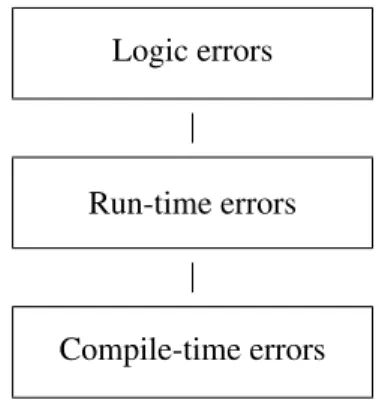
The advantage of type checking is a significant reduction in the number of logic and run-time errors in the software. Figure 2.1 shows a hierarchy of errors:
2.5 Types 12
Logic errors
Run-time errors
Compile-time errors
Figure 2.1: Hierarchy of errors
Run-time errors These are errors that cause the program to stop running and to display an error message.4Examples are trying to index an array beyond its bounds and trying to dereference a null pointer. In a language that supports run-time checking, these errors are relatively easy to diagnose because you know where the program stopped and why. If the error is not caught when it occurs, it can cause memory assigned to unrelated variables to be ‘smeared’. The run-time error is then disguised as a logic error, and can be exceedingly difficult to diagnose because the code that accesses the smeared variables is likely to be correct.
Logic errors This is the term used for errors that manifest themselves as incorrect functioning of a running program. For example, you might compute a thermostat setting that has no physical meaning even though the value is within the range of an integer variable. These are extremely serious because they are often found only after the system is delivered and installed.
The philosophy of Ada is to push errors down the hierarchy: to turn logic errors into run-time errors and if possible into compile-time errors. For critical software systems, logic errors are not merely embarrassing and expensive, they can be truly dangerous. Because it helps prevent logic errors, the Ada type system is an excellent technological tool for producing safe and reliable software.
Effective use of the Ada type system requires an investment of effort on your part:
• During the design of the software system, you must select types that best model the data in the system and that are appropriate for the algorithms to be used. If you write a program in which every variable is declared asInteger,FloatorCharacter, you might as well use a simpler language than Ada.
• Occasionally, type checking rules simply must be ignored. For example, a sequence of raw bytes received from a communications line is to be interpreted as a structured message. You must learn to carefully use the Ada constructs for bypassing type checking (Sections 4.6, 8.3).
• Certain language rules are checked at run-time and the overhead must be taken into account in the project design when you select the hardware. Optimizing compilers can reduce this
2.5 Types 13
overhead to a minimum; in extreme cases, run-time checks can be suppressed in critical inner loops (Section 4.4).
The latter two points are often raised as objections to type checking, but in practice they turn out to be of relatively minor importance. My advice is to invest time in a comprehensive study of the Ada type system, an investment that will repay you many times over in lower rates of logic and run-time errors in your programs.
Definition of types
§3.2
1 Atypeis characterized by a set of values, and a set ofprimitive operationswhich implement the fundamental aspects of its semantics. . . .
Some types, like Integer, are predefined by the language. The set of values of the type Integer
is implementation-defined. Primitive operations will not be fully explained until Chapter 6, but they include the predefined operations. Assignment is defined for all types (except limited types as described in Chapter 5). Other predefined operations ofIntegertype are the usual arithmetical and relational operations as described in §4.5. In addition to the predefined types, types likeCars
can be explicitly defined by the programmer.
Types are collected intoclasses, which group together types with similar properties.
Enumeration types
TypeCars ‡8–15is anenumeration type§3.5.1. The names listed in the type declaration are the
enumeration literals, which are the values of the type. Predefined operations on enumeration types are assignment, the relational operations such as"="and"<"andattributes§4.1.4. These are predefined operations, usually values or functions, associated with each type in the family. A list of all predefined attributes is given in §K; some attributes that are defined for enumeration and integer types are given in the following table, whereTis a type,Vis a value of the type,Nis an integer andSis a string:
T’First First value ofT T’Last Last value ofT
T’Pred(V)∗ Previous value beforeV
T’Succ(V)∗ Next value afterV
T’Pos(V) Position of V
T’Val(N)∗ Value whose position isN
T’Min(V1,V2) Minimum of V1,V2 T’Max(V1,V2) Maximum ofV1,V2 T’Image(V) String denoting the valueV T’Value(S)∗ Value denoted byS
T’Width Maximum length ofT’Image
Attributes marked with an asterisk may raiseConstraint_Error. (In certain circumstances, Pos
2.5 Types 14
In the case study we used the attributeCars’Image ‡42, which is a function that converts a value of typeCarsinto a string.5 The converse attributeCars’Value ‡41is a function that converts strings to values. The notationS(1..Last)in‡41selects the characters ofSup to indexLast. If the function parameter is not a string that can converted to a value of typeCars, the exceptionConstraint_Error
will be raised.
The fundamental principle of type checking is that a value of one type may not be assigned to a variable (or parameter) of another type §5.2(4), §6.4.1(3). This violation of type checking results in a compile-time error. Thus we cannot write:
Last := Chevrolet;
because we are attempting to assign a value of typeCarsto a variable of typeInteger. Similarly, we cannot write the following function call:
Car_to_Country(63);
because the assignment of an actual parameter of typeIntegerto a formal parameter of typeCars
is not legal.
Objects
§3.2
1 . . . Anobjectof a given type is a run-time entity that contains (has) a value of the type.
§3.3
13 An object is either aconstant object or avariableobject. The value of a constant object cannot be changed between its initialization and its finalization, whereas the value of a variable object can be changed. . . .
All objects must be declared and explicitly given a type. An initial value is optional for a variable, but is required for a constant §3.3.1(5-6):
Current_Car: Cars := Opel;
The_Car_I_Want: constant Cars := Rolls_Royce;
Elaboration*
§3.1
11 The process by which a construct achieves its run-time effect is calledexecution. This process is also calledelaborationfor declarations andevaluationfor expres-sions. . . .
While we normally don’t think of a declaration as being executed, it is clear that it may have a run-time effect. For example, since memory must be allocated for a variable, every variable declaration may potentially raise the predefined exceptionStorage_Errorwhen memory is exhausted. In this 5For extensive input–output of enumeration types, it is more convenient to instantiate the generic package
2.5 Types 15
case, we say that the exception is raised when the variable declaration is elaborated, and there are rules governing the handling of such exception occurrences.
In a language that allows initial values for objects, the declaration may be associated with an arbitrarily complex computation:
B: Boolean := Is_Prime(2e30 + 1);
Declarations are elaborated in order of their appearance:
§3.11
7 The elaboration of a declarative_partconsists of the elaboration of the declara-tive_items, if any, in the order in which they are given in thedeclarative_part. Once a declaration is elaborated, it can be used in subsequent declarations:
B1: Boolean := Is_Prime(2e30 + 1); B2: Boolean :=not B1;
There is one syntactical problem that must be resolved. In Ada, as in most programming lan-guages, it is possible to declare more than one object in a single declaration. The question arises whether the initial value is evaluated once for all objects, or once for each object:
A1, A2, A3: A_Type := Get_Initial_Value_From_User;
§3.3.1
7 Any declaration that includes adefining_identifier_listwith more than one defin-ing_identifieris equivalent to a series of declarations each containing one defin-ing_identifierfrom the list, with the rest of the text of the declaration copied for each declaration in the series, in the same order as the list. . . .
In the example, the user would be prompted three times for initial values, as if the declarations were written:
A1: A_Type := Get_Initial_Value_From_User; A2: A_Type := Get_Initial_Value_From_User; A3: A_Type := Get_Initial_Value_From_User;
Name equivalence*
Given the declarations:
type American_Carsis (Ford, Chevrolet, Pontiac, Chrysler, Dodge);
type US_Carsis (Pontiac, Chevrolet, Chrysler, Ford, Dodge); AC: American_Car;
UC: US_Car;
we cannot assignACtoUCor vice versa. Each type declaration defines a separate type. Thename, rather than the structure, of the type determines type equivalence.
In this example, we see an example ofoverloading, where the same name is used to denote two or more entities. Context (or qualification—see Section 4.6) can be used to disambiguate the name:
2.6 Subtypes 16
2.6
Subtypes
Pascal was the first language based on the concept of programmer-defined types and compile-time type checking. However, it became apparent that the Pascal rules were too restrictive. Consider a procedure to sort an array:
type Array_Type = array[1..100] of Integer;
procedure Sort(var A: Array_Type);
The procedure is restricted to sorting integer arrays of exactly 100 elements. Even passing the lower and upper bounds of the array would make no difference, because the actual parameter must be of typeArray_Type.
Definition of a subtype
§3.2
8 Asubtypeof a given type is a combination of a type, a constraint on the values of the type, and certain attributes specific to the subtype. . . .
The constraint, that puts a restriction on the values of the type, ischecked at run-time. In the next chapter, we will see that the specific bounds of an array are considered to be a constraint, so a single procedureSortcan be called with arrays of different sizes. In this section, we will look at subtypes in the context of enumeration types.
First a bit of syntax and terminology. When declaring an object, we supply asubtype_indication:6 §3.3.1
2 object_declaration ::=
defining_identifier_list : [constant] subtype_indication [:= expression];
§3.2.2
3 subtype_indication ::= subtype_mark [constraint] 4 subtype_mark ::=subtype_name
When creating an object, we can append a constraint to a subtype name (called the subtypemark) and thus restrict the values that can be contained in the object. For an enumeration type, the appropriate constraint is arange constraint:
Car: Cars;
French_Car: Carsrange Peugeot..Citroen; German_Car: Cars range BMW..Opel;
When executing an assignment statement, constraints are checked:
§5.2
11 The value of the expression is converted to the subtype of the target. The conversion might raise an exception (see 4.6).
2.6 Subtypes 17
Thus:
French_Car:= Car; - - Might raise Constraint_Error French_Car:= German_Car; - - Will raise Constraint_Error Car := French_Car; - - OK
Note that appending a constraint does not affect thetypeof an object. The second statement above is not a compile-time error, nor isFrench_Car := BMW! The compiler checks only that the types are the same: in this case, both variables are of typeCars. It is left to the executable code to check that the constraints are satisfied. An Ada compiler is allowed to diagnose the situation as one that necessarily raises an exception, and to emit machine code that simply raises the exception without doing the superfluous check. A friendly Ada compiler will also warn you of the inevitable error.
Declaration of a subtype
If you are planning to declare many objects with the same subtype indication, you can simply declare a subtype and then use its name §3.2.2(2). An alternate way of implementing the function associating countries with cars is:
- - File: COUNTRY2
1 functionCar_to_Country(C: Cars)returnCountriesis
2 - - Associate country with car using subtypes
3 subtypeUS_Car isCars rangeFord..Dodge;
4 subtypeUK_Car isCars rangeRover..Rolls_Royce;
5 subtypeFrench_Car isCars rangePeugeot..Citroen;
6 subtypeGerman_Car isCars rangeBMW..Opel;
7 subtypeJapanese_Car isCars rangeHonda..Toyota;
8 subtypeKorean_Car isCars rangeDaewoo..Hyundai;
9 begin
10 caseC is
11 whenUS_Car => returnUS;
12 whenUK_Car => returnUK; 13 whenFrench_Car => returnFrance;
14 whenGerman_Car => returnGermany;
15 whenJapanese_Car => returnJapan;
16 whenKorean_Car => returnKorea;
17 end case;
18 endCar_to_Country;
‡3–8contain declarations of subtypes for each country by constraining the range of values of the type. A choice of a case statement can be a subtype mark; see §5.4(3), §3.8.1(4–5), §3.6.1(3). Note that a formal parameter must be a subtype mark and not a subtype indication §6.1(15):
functionKorean_Car_to_Country(C: Korean_Cars)
returnCountriesis - - OK, subtype mark
functionKorean_Car_to_Country(C: Cars range Daewoo..Hyundai)
2.7 Lexical elements 18
Membership tests
A membership test can be used to ask if an expression isina subtype §4.5.2: ifC in French_Car then. . .
If you want to check membership in a range, a subtype mark need not be given, and there is a convenient syntax for negations:
ifC in Peugeot..Citroenthen . . .
if not (Cin French_Car) then. . . - - OK
ifC not in French_Carthen . . . - - OK, nicer syntax
First subtype**
§6.1(15) requires that formal parameters be subtypemarks. What about type marks? In order to simplify the presentation of the language, the phrase ‘type or subtype’ is avoided by defining types to be nameless. Instead, the identifier in a type declaration is the name of thefirst subtype
§3.2.1(1) of the type. Additional (named) subtypes may of course be declared as we saw above. In normal usage, no confusion will result if we talk about the typeCars; in fact, such usage is sanctioned by the standard §3.2.1(7).
2.7
Lexical elements
We conclude this chapter with an overview of the lexical elements of an Ada program §2. An Ada program is written in free-format:
§2.2
1 . . . The text of eachcompilationis a sequence of separatelexical elements. . . . The meaning of a program depends only on the particular sequence of lexical elements that form itscompilations, excluding comments.
Upper/lower case is not significant §2.3(5). There are reserved words such asbeginthat cannot be used for any other purpose §2.9. This book follows the style recommended in theARM: reserved words in lower case and identifiers in mixed case. Certain identifiers such asIntegerandString
are predefined (in packageStandard§A.1); they can be redefined, but normally you wouldn’t do that. Comments are denoted by two minus signs and extend to the end of the line §2.7.
2.7 Lexical elements 19
Numeric literals §2.4, as well as identifiers, can use the underscore character. Integer literals can have an exponent, and both integer and real literals can be written in any base from 2 to 16. Each of the following columns shows three equivalent numeric literals:
1000000 15 3.75
1_000_000 2#1111# 0.375E1
3
Arrays
In this chapter and the next one, we present the basic concepts of composite types (arrays and records) and access types (pointers). The main conceptual innovation in Ada is the use of types and subtypes to separate compile-time from run-time aspects of data structures.
3.1
Case study: fill and justify text
The case study is to implement a core algorithm used in word-processors:
Read a text file and write it with the text filled (as many words as possible on a line) and justified (set flush with both margins). A word is a maximal sequence of non-space characters. Assume that the file name, the output line width and the margin size are fixed.
The following example shows (1) the input data, (2) the text after filling and (3) the text after justifying in a line of length 25:
The quick brown fox
jumped over the lazy dog The quick brown fox jumped over the lazy dog The quick brown fox jumped over the lazy dog
In this and other relatively long programs, we will give the source code in chunks with consecutive line numbers. The program begins with declarations of subtypes and constants and a file object
Input:
- - File: JUSTIFY
1
-2 - - Read text from a file and write it filled and justified.
3
-4 withAda.Text_IO; use Ada.Text_IO;
5 procedure Justifyis
6
7 subtypeLines isString(1..80); - - A line of text
3.1 Case study: fill and justify text 21
8 subtypeIndex isInteger range0..Lines’Last; - - Extra zero value
9
10 - - Constant file name and margins.
11 File_Name: constantString := "example.tex";
12 Margin: constantString(1..10) := (others => ’ ’);
13
14 - - Compute number of characters in printed line.
15 Width: constantIndex := Lines’Length - 2*Margin’Length;
16
17 Input: File_Type;
Get_Word reads the next word from the input file; it will not be difficult to understand if you study it together with the specification ofAda.Text_IO§A.10.
18 procedure Get_Word( - - Get next word from input
19 Word:out Lines; - - The next word
20 Length:out Index; - - Its length
21 EOF: out Boolean)is - - True if eof encountered
22 C: Character; - - Character buffer
23 begin
24 Length := 0;
25 EOF := False;
26 loop - - Skip leading ends-of-line, blanks
27 ifEnd_Of_File(Input) then
28 EOF := True;
29 return;
30 elsif End_Of_Line(Input)then Skip_Line(Input);
31 else
32 Get(Input, C);
33 exit whenC /= ’ ’;
34 end if;
35 end loop;
36
37 loop - - Read characters until space or EOL
38 Length := Length + 1;
39 Word(Length) := C;
40 ifLength > Width then - - Truncate word longer than line
41 Skip_Line(Input);
42 Length := Width;
43 return;
44 end if;
45 exit whenEnd_Of_Line(Input);
46 Get(Input, C);
47 exit whenC = ’ ’;
48 end loop;
3.1 Case study: fill and justify text 22
The most difficult part of the program is the functionInsert_Spaces, which performs the justi-fication. The function receives the output bufferLine, theLengthof the valid data in the buffer and aWordcount. It returns a string containing the justified line. The algorithm is implemented by creating an arraySof the spaces‡59–60, 67–74to be insertedaftereach word. This array is initialized‡60to the minimum one space, plus the number of extra spaces that can be evenly dis-tributed among the words. Any remaining spaces are then disdis-tributed between successive words, starting from the left or right on alternate lines ‡68to avoid excessive space on one side of the page. The new line is built inBuffer ‡76–85. The slice construct‡81–82is explained in the next section.
50 functionInsert_Spaces( - - Insert extra spaces in output line
51 Line: Lines; - - Current output line
52 Length: Index; - - Length of current output line
53 Words: Index) - - Number of words in line
54 returnLinesis - - Return modified line
55
56 Spaces: Natural := Width-Length; - - Extra spaces
57 - - S is number of spaces after each word
58 - - Initially, divide extra spaces evenly among words
59 S: array(1..Words)of Natural :=
60 (others=> (Spaces / (Words-1)) + 1);
61 Buffer: Lines := (others=> ’ ’); - - Build new line here
62 K1, K2: Index := 1; - - Indices for copying line
63 L: Index; - - Length of word
64
65 begin
66 - - Distribute remaining spaces alternately left and right.
67 forNin 1 .. Spaces mod(Words-1) loop
68 ifAda.Text_IO.Linemod 2 = 1then
69 S(Words-N) := S(Words-N) + 1;
70 else
71 S(N) := S(N) + 1;
72 end if;
73 end loop;
74 S(Words) := 0; - - Zero spaces after last word
75
76 forW in 1..Words loop
77 L := 1;
78 while Line(K1+L) /= ’ ’loop - - Search for end of word
79 L := L + 1;
80 end loop;
81 Buffer(K2 .. K2+L + S(W)) := - - Move word and extra spaces
82 Line(K1 .. K1+L) & (1..S(W) => ’ ’);
83 K1 := K1 + L + 1;
3.1 Case study: fill and justify text 23
85 end loop;
86 returnBuffer;
87 endInsert_Spaces;
Put_Wordimplements the fill operation by inserting aWordinto the output bufferLineat index
Position ‡109. If there is no room for the new word,Insert_Spacesis called‡100to justify the line, and then the buffer is reset‡103–105before inserting the word.
88 procedure Put_Word( - - Put word input output line
89 Word: in Lines; - - The word to insert
90 Word_Length:inIndex; - - Its length
91 Words: in outIndex; - - Current number of words
92 Line: in outLines; - - Output line buffer
93 Position: in outIndex) is - - Position to insert word
94 begin
95 - - Note that Position points past the trailing space
96 - - Print full line
97 ifPosition - 1 + Word_Length > Width then
98 ifWords >= 2then
99 - - Make sure there are at least two words for inserting spaces
100 Line := Insert_Spaces(Line, Position-2, Words); 101 end if;
102 Put_Line(Margin & Line(1..Width));
103 Line := (others => ’ ’);
104 Position := 1;
105 Words := 0;
106 end if;
107
108 - - Append word to line and update counters
109 Line(Position..Position+Word_Length) := Word(1..Word_Length) & ’ ’;
110 Position := Position + Word_Length + 1;
111 Words := Words + 1;
112 endPut_Word;
The main subprogram ‡129–133 opens the input file, calls the main loop and then closes the input file. The main loop‡113–127was written as a separate procedure so that its variables are encapsulated in a local, rather than in a global, scope. The main loop is very simple: it gets the nextWord ‡122and then places it in the outputBuffer ‡124. IfEOFis returned fromGet_Word ‡123, the current line is flushed before returning from the procedure‡126.
113 procedure Main_Loop is
114 Word: Lines; - - Word buffer
115 Word_Length: Index; - - Its length
116 EOF: Boolean; - - True if EOF encountered
117 Buffer: Lines := (others=> ’ ’); - - Output line buffer
118 Position: Index := 1; - - Next position to insert
3.2 Array types 24
120 begin
121 loop
122 Get_Word(Word, Word_Length, EOF);
123 exit whenEOF;
124 Put_Word(Word, Word_Length, Word_Count, Buffer, Position);
125 end loop;
126 Put_Line(Margin & Buffer(1 .. Position-1)); - - Flush last line
127 endMain_Loop;
128 129 begin
130 Open(Input, In_File, File_Name);
131 Main_Loop;
132 Close(Input);
133 endJustify;
We now discuss the array constructs used in the program.
3.2
Array types
Unconstrained arrays
An array is defined by giving the number of dimensions, their types and bounds, and the subtype of the component. All these characteristics, except the bounds of the dimensions, are declared in an unconstrained array definition§3.6(3,15). For example, the unconstrained array subtype1
Stringis predefined §A.1(37) as follows:
type String is array(Positive range <>)of Character;
The type Stringhas one dimension whose type isInteger, constrained to positive values by the subtypePositive §3.4.5(13); the component type isCharacter. (The type is also declared to be
Packed, see §13.2.) The bounds of any particular string arenotpart of its type. This is indicated by the syntax range <>, where the last two symbols are pronounced ‘box’. For example, the declaration of the predefined procedurePutfor strings §A.10.1(48) is:
procedure Put(Item : in String);
The procedure can be called with any string as its actual parameter.
To create a string object, you must give anindex constraint§3.6.1which specifies the bounds for each dimension. There are three ways that you can specify the index constraint:
• Explicitly append an index constraint as part of the subtype indication in an object declaration:
S: String(1..80); - - See Country1
• Declare a (constrained) subtype‡7and then declare a object of the subtype‡61: subtypeLinesis String(1..80);
Buffer: Lines := (others => ’ ’);
3.2 Array types 25
• If an initial value is given for an array‡11(not necessarily a constant array), the compiler will determine the index constraint §3.3.1(9) from the number of characters in the initial value:
File_Name: constantString := "example.tex"; Current_File_Name: String := File_Name;
Operations on arrays
Assignment and the equality operators are defined for array types; that is, you can assign an array object to another one, or compare two array objects, provided, of course, that they are of the same subtype. Anindexed component§4.1.1is obtained by appending a parenthesized expression (or sequence of expressions for multi-dimensional arrays) to the name of an array object.
For any array objectAthe following attributes are defined §3.6.2:
A’First The lower bound of the index ofA A’Last The upper bound of the index ofA A’Range The rangeA’First..A’Last
A’Length The number of components inA
Note thatA’FirstandA’Lastare indices, not components:
A( (A’First + A’Last) / 2 ); - - Middle element of the array ( A(A’First) + A(A’Last) ) / 2; - - Average of first and last elements
These attributes are also defined for constrained array subtypes like Lines, but not, of course, for unconstrained subtypes like String. There are also versions for multi-dimensional arrays §3.6.2(4,6,8,10).
It is impossible to over-emphasize the importance of using attributes. Once a constrained array subtype or an array object has been declared, subsequent declarations and statements should use the attributes so that changes in the array bounds are automatically reflected in the source code. For example, given the following declarations‡7,8,15:
subtypeLines isString(1..80);
subtypeIndex isInteger range 0..Lines’Last;
Width: constant Index := Lines’Length - 2*Margin’Length;
changing 80 to 120 in the declaration ofLinesdoes not require any additional change to the source code.
As a matter of style, I do not recommend using the following Pascal-like sequence of declarations, even though it is legal:
Line_Width: constant Integer := 80;
subtypeLine_Indexis Integerrange 1..Line_Width;
subtypeLines isString(Line_Index);
3.2 Array types 26
Aggregates
Recall that a type consists of a set of values and a set of operations on those values. Strangely enough, most programming languages have no way of denoting avalueof an array type! You are required to work explicitly in terms of components:
type Vector is array(Integerrange <>)of Float;
subtypeSamples isVector(0..255); Zero_Sample: Sample;
for Sin Samples’Rangeloop
Zero_Sample(S) := 0.0;
end loop;
An aggregate denotes a value of a composite type. Array aggregates have a very rich syntax §4.3.3. The simplest form is to useothersto give every component the same value‡12:
Margin: constantString(1..10) := (others => ’ ’); Zero_Sample: Samples := (others=> 0.0);
Named array aggregatescan be used to explicitly associate index values with component values: - - File: COUNTRY3
1 Car_to_Country: constant array(Cars) of Countries :=
2 ( Ford..Dodge => US,
3 Rover..Rolls_Royce => UK,
4 Honda..Toyota => Japan,
5 Peugeot | Renault | Citroen => France,
6 BMW | Volkswagen | Opel => Germany,
7 Daewoo..Hyundai => Korea);
Note that parentheses are used delimit both parameters and indices2 so the function Car_to_-Countrycan be replaced with anarraywithout otherwise modifying the program.
When named aggregates are used, the order in which the component associations are written is not significant;othersis allowed as a final component association to cover index values not explicitly named:
Step: Samples := (32..63 => 0.5, 0..31 => 1.0,others => 0.0);
Positional array aggregatesassociate component values according to the sequence in which they appear. You cannot mix positional and named notation, but anothers choice is allowed as the final component in a positional aggregate §4.3.3(3):
Initial_Sample: Samples := (0.1, 0.2, 0.3, 0.4, others=> 0.0);
The examples we have shown use aggregates for initial values; however, it is important to under-stand that, syntactically, aggregates are expressions and can be used in any context that an expres-sion is allowed, such as in an assignment statement, a return statement or as an actual parameter. Furthermore, the components of the aggregate are also expressions and can be dynamically com-puted. In the following function, the sequence of statements is a single return statement whose expression is a positional array aggregate, all of whose components are dynamic expressions that depend on the formal parameters:
3.2 Array types 27
subtypeVector3 is Vector(1..3);
function"+"(Left, Right: Vector3) returnVector3 is begin
return( Left(1)+Right(1), Left(2)+Right(2), Left(3)+Right(3) );
end"+";
Aggregates for n-dimensional arrays are constructed from subaggregates of n−1-dimensional arrays §4.3.3(6):
type Matrix is array(Integerrange <>, Integerrange <>)of Float; M: Matrix(1..3, 0..2) :=
((1.0, 2.0, 1.0), (2=>1.0, 1=>0.5, 0=>0.0), (others=> 0.0));
Aggregates are always to be preferred over explicit loops because of the check that the number of components of the aggregate matches the context in which it is used:
function"+"(Left, Right: Vector3) returnVector3 is
Temp: Vector3;
begin
for Nin 1..2 loop - - Sorry !! Temp(N) := Left(N)+Right(N);
end loop;
returnTemp;
end"+";
Slices and sliding
Slices reduce the need for explicit loops.
§4.1.2
2 slice ::= prefix(discrete_range)
5 A slicedenotes a one-dimensional array formed by the sequence of consecutive components of the array denoted by theprefix, corresponding to the range of values of the index given by thediscrete_range.
‡81–82show the assignment of a string obtained by concatenating a slice ofLineand an aggregate to a slice ofBuffer.
3.2 Array types 28
- - File: PALIN
1
-2 - - Create a palindrome from a string.
3
-4 withAda.Text_IO; use Ada.Text_IO;
5 procedure Palinis
6 functionPalindrome(S:in String)returnString is
7 T: String(1..2*S’Length);
8 begin
9 T(1..S’Length) := S; - - Slice as a variable
10 forNin S’Range loop
11 T(T’Length - (N-S’First)) := S(N);
12 end loop;
13 returnT;
14 endPalindrome;
15
16 S1: String := "Hello world";
17 S2: String(100..100+2*S1’Length-1) := Palindrome(S1);
18 S3: String(1..2*S2’Length) := Palindrome(S2);
19 20 begin
21 Put_Line(S1);
22 Put_Line(S2);
23 Put_Line(S3);
24 endPalin;
A slice can be used either as a variable which is the target of an assignment as shown above, or as an expression. Consider the following program for swapping the halves of an even-length array:
- - File: SWAP
1
-2 - - Swap halves of a string.
3
-4 withAda.Text_IO; use Ada.Text_IO;
5 procedure Swapis
6 S: String := "HelloWorld";
7 Temp: String := S(1..S’Length/2);
8 begin
9 S(1..S’Length/2) := S(S’Length/2+1..S’Length);
10 S(S’Length/2+1..S’Length) := Temp;
11 Put_Line(S);
12 endSwap;