Educational Mobility Across Generations and Depressive Symptoms Over 10
Years Among US Latinos
Julia B. Ward, Whitney R. Robinson, Brian W. Pence, Joanna Maselko, Sandra S. Albrecht, Mary N. Haan, and Allison E. Aiello*
*Correspondence to Dr. Allison E. Aiello, Department of Epidemiology, Gillings School of Global Public Health, University of North Carolina, 135 Dauer Drive, 2101C McGavran-Greenberg Hall CB #7435, Chapel Hill, NC 27599-7435 (e-mail: [email protected]. edu).
Initially submitted September 20, 2017; accepted for publication March 9, 2018.
Few studies have collected intergenerational data to assess the association between educational mobility across multiple generations and offspring depression. Using data from the Sacramento Area Latino Study on Aging (1998–2008), we assessed the influence of intergenerational education on depressive symptoms over 10 years among 1,786 Latino individuals (mean age=70.6 years). Educational mobility was classified as stable-low (low parental/low offspring education), upwardly mobile (low parental/high offspring education), stable-high (high parental/ high offspring education), or downwardly mobile (high parental/low offspring education). Depressive symptoms were measured with the Center for Epidemiological Studies–Depression Scale (CES-D); higher scores indicated more depressive symptoms. To quantify the association between educational mobility and CES-D scores over follow-up, we used generalized estimating equations to account for repeated CES-D measurements and adjusted for identified confounders. Within individuals, depressive symptoms remained relatively stable over follow-up. Compared with stable-low education, stable-high education and upward mobility were associated with significantly lower CES-D scores (β=−2.75 and−2.18, respectively). Downwardly mobile participants had slightly lower CES-D scores than stable-low participants (β=−0.77). Our results suggest that sustained, low educational attainment across genera-tions may have adverse mental health consequences, and improved educational opportunities in underresourced communities may counteract the adverse influence of low parental education on Latino depression.
depressive symptoms; education; family; Latinos; mental health; Mexican Americans; social mobility; socioeconomic factors
Abbreviations: CES-D, Center for Epidemiological Studies–Depression Scale; DFD, depression-free day; PHQ-9, Patient Health Questionnaire–9; SALSA, Sacramento Area Latino Study on Aging; SEP, socioeconomic position.
Depression in late life is widespread and may worsen outcomes of other illnesses and increase suicide risk among the elderly (1). In the United States, elderly Latinos in particular suffer a dispro-portionate burden of depression; indeed, elderly Latinos are up to twice as likely as elderly non-Latino white persons to suffer from elevated depressive symptoms (2–10).
Socioeconomic disadvantage has long been associated with increased depression prevalence (11–14). Individuals of lower socioeconomic position (SEP) may lack access to the personal andfinancial resources that protect against depression (13,14). Certain populations, however, such as the US Latino population, may be more highly exposed to these socioeconomic risk factors
(15–17). Latinos face immense socioeconomic disparities in the United States, with lower overall educational attainment and high school graduation rates than those identifying as white, black, or Asian (18). Consequently, Latinos may be at greater risk of the adverse consequences of low educational attainment on long-term mental health.
Depression Scale (CES-D) (32). This scale was administered at baseline and each follow-up visit. The CES-D is a 20-item, 4-point Likert-type scale assessing the extent to which individuals experienced depressive symptoms during the prior week (32). This scale has been validated in Spanish-speaking populations (33–35) and used with older Latinos (36,37). While not designed for clinical diagnoses, the CES-D is based on clinical depression symptoms and correlates well with other depression scales (32). The total score ranges from 0 to 60, with higher scores indicating more depressive symptoms. CES-D scores were also dichoto-mized using a standard cutoff of≥16 to classify individuals with high depressive symptoms (32).
Depression-free days (DFDs) were used as an additional out-come measure to create an aggregate assessment of depression-free time over the 10-year follow-up period. This valid, clinically relevant depression measure integrates both occurrence and dura-tion of time free of depressive symptoms (38). DFDs reflect symptom change over time by estimating the time spent in various stages of depression and the cycling between remission and relapse that commonly occurs with depression (39).
To calculate DFDs, we converted CES-D scores into Patient Health Questionnaire–9 (PHQ-9) scores (40). PHQ-9 scores are preferable for estimating DFDs because PHQ-9 cutpoints distin-guish between fully symptomatic, partially symptomatic, and asymptomatic depressive states (41). We classified PHQ-9 scores of<5 as asymptomatic and scores of>14 as fully symptomatic (42). Asymptomatic and fully symptomatic days received respec-tive scores of 1 and 0, and linear interpolation was used to convert scores between the upper and lower cutpoints into proportions between 0 and 1 (38). To determine total DFDs over the study period, scores for 2 consecutive assessments were averaged and multiplied by the average number of days between assessments; the values for all intervals were then totaled (43,44). Finally, we transformed DFDs into“percentage of follow-up time spent depression-free”to account for differing follow-up periods between participants.
Educational attainment across generations. Intergenerational
educational mobility was the exposure of interest. For parents of SALSA participants,“high”educational attainment was defined as completing≥6 years of education (i.e., completed elementary school) and“low”as completing<6 years (45). As done in prior literature, where SALSA participants reported education for both parents, the education of the more highly educated parent was used (45–47). For SALSA participants,“high”educational attain-ment was defined as completing≥12 years (i.e., completed high school) and“low”as completing<12 years (45). As done in pre-vious SALSA studies, we used a lower education cutpoint for par-ents than participants to account for age- and location-related differences in educational norms between the 2 generations (45). Finally, we classified participants into one of 4 educational mobil-ity categories: 1) stable-low (low parental and participant educa-tion), 2) upwardly mobile (low parental but high participant education), 3) stable-high (high parental and participant edu-cation), and 4) downwardly mobile (high parental but low participant education).
Time. A recent review of longitudinal depression trajectories
indicated that most elderly individuals have stable depressive symptoms over time (48). In US studies, 82%–100% of elderly participants belonged to categories characterized by stable factorsduetoobstructedopportunitiesforupwardsocialmobility
acrossgenerations(21,22).Socioeconomicdisadvantage,both withinandacrossgenerations,mayinfluencedepressionbyacting asachronicstressor,disruptingcomponentsofthebody’s stress systemthathavebeenlinkedtomentalhealthanddepression spe-cifically(23–25).Thepropensityofthesestressorstoaccumulate overgenerationsamongLatinosmayleadtolong-termsustained disruptionofthestresssystem,resultinginpoorermentalhealth. Additionally,elderlyLatinoswithlowSEPmaybeespecially vul-nerabletodepressiongiventhatstressinducedbysocioeconomic disadvantagemayhaveaccumulatedbothovermultiple genera-tionsandalsothroughoutthelifecourse.Afewstudieseven sug-gestthatsomeearly-lifeexposuresmaynotshowtheirhealth impactuntiladulthoodorlatelife(26,27).
Thesocioeconomicmeasuresusedinmostpreviousstudies havelackedanintergenerationalperspective.Theseprevious stud-iesexaminedtheindependentsocioeconomicinfluenceofone generation,eitherthatoftheparent(17,28)ortheoffspring(15– 17),onoffspringdepression.Thesestudiesdonotconsiderthe interdependenceofparentalandoffspringeducationwhen asses-singoffspringmentalhealth.Thus,despitethepotential impor-tanceofmeasuresofsocioeconomicmobility,suchaseducational mobility,acrossgenerationsforLatinomentalhealth,studies examiningsuchassociationsamongthispopulationarevirtually nonexistent.Further,nopriorresearchonthistopichascollected longitudinaldatatoexaminehowsocioeconomicfactorsinfl u-encedepressivesymptomsovertime.
ThisstudyuseddatafromthelongitudinalSacramentoArea LatinoStudyonAging(SALSA)toexaminetheassociation betweeneducationalmobilityacross2generationsofLatinos anddepressivesymptomsovera10-yearperiod.We hypothe-sizedthatparticipantswithstable-loweducationalattainment across2generationswouldhavehigherprevalenceofdepressive symptomsovera10-yearperiodcomparedwiththoseclassified asstable-high,upwardlymobile,ordownwardlymobileacross generations.
METHODS
Study population
ParticipantsinthisanalysisweremembersoftheSALSA cohort,whichhad7wavesoffollow-upoccurring12–15months apartfrom1998to2008(29).SALSAisalongitudinalstudy of1,789elderlyLatinos,predominantlyofMexicanorigin. SAL-SA’sstudydesignhasbeendescribedpreviously(29–31). Eligi-bleparticipantswere self-identifiedLatinosaged≥60yearsat baselineandresidinginCalifornia’s Sacramento Valley (29,30). ThesamplewasrepresentativeofolderLatinosresidinginthe tar-getarea.Duringhomevisits,participantsreportedhealth condi-tions,lifestyle,andsociodemographicfactors;trainedbilingual interviewerscollectedclinicaldata.Informedconsentwas ob-tainedfromallparticipants,andstudyprocedureswereapproved byinstitutionalreviewboardsatparticipatinginstitutions.
Measures
Depressive symptoms. Depressivesymptomswere
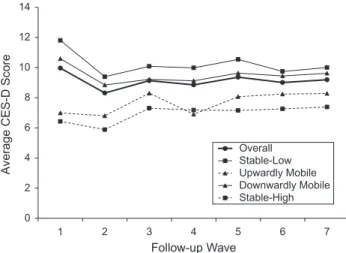
depression over periods ranging 8–20 years (48). While the studies reviewed pertained largely to non-Hispanic populations (49–51), a growing body of latent class analysis literature has indi-cated that most elderly Latinos also belong in classes characterized by stable depressive symptoms over time (52,53). Additionally, longitudinal studies suggest a negligible association between time and depressive symptoms among elderly Latinos (54,55). For thoroughness, we examined the association between time and CES-D scores in our sample. These preliminary analyses indi-cated that CES-D scores remained largely stable over follow-up (Figure1); thus, ourfinal models did not include a main effect for time. However, we did employ generalized estimat-ing equations to account for the correlation of repeated CES-D measurements collected from the same individual and to correct standard errors (56). We specified an autoregressive correlation matrix because we believed that the correlation between 2 conse-cutive CES-D measurements would be greater than that between measurements occurring farther apart in time.
Statistical analysis
Sociodemographic and depressive characteristics according to generation werefirst summarized with descriptive and graphical analyses. We created a directed acyclic graph based on the litera-ture to identify potential confounders and adjusted in ourfinal models for baseline age, sex, and offspring and parental nativity (US-born or foreign-born). We considered several other parental and offspring cultural factors, including location of education,
acculturation, and immigrant generation. However, these factors were collinear with parent and offspring nativity. Thus, variabil-ity in depressive symptoms due to cultural factors was captured by adjusting for nativity.
To quantify the association between intergenerational educa-tional mobility and continuous CES-D scores over the follow-up period, wefitted a marginal model using generalized estimating equations with PROC GENMOD in SAS, version 9.4 (SAS Institute, Inc., Cary, North Carolina), to estimate the CES-D score differences among the 4 educational mobility catego-ries (56). We used stable-low education as the referent group. As done in previous SALSA analyses, time was operationa-lized as visit number (31).
We replicated the above analysis using dichotomous high depressive symptoms (CES-D score of≥16) as the outcome. Given the dichotomous nature of this outcome, we used log-binomial and linear-log-binomial models to estimate the prevalence ratios and prevalence differences, respectively, of high depres-sive symptoms, comparing educational mobility categories(57). As afinal step, we examined the association between educa-tional mobility and DFDs over the study period. We used linear regression to estimate the difference in percentage of time spent depression-free between educational mobility categories.
The average annual attrition rate in the SALSA study was 5%. Approximately half of this loss was due to death (49.5%) and the other half to dropout. We addressed the issue of missing data due to dropout or response refusal through the multiple imputation approach described in detail in previous SALSA analyses (27,31, 45). A statistical team used a sequential regression multivariate imputation approach for the entire SALSA data set using the Imputation and Variance Estimation Software (58). This approach conditioned on all data set variables as predictors in a sequence of multiple regressions (58,59). All available variables were used to improve statistical efficiency and provide unbiased estimates compared with other analytical approaches such as complete-case analysis (58,60). Five imputed data sets that included all study variables were produced for the SALSA study and used for our analysis.
Finally, we assessed potential survivor bias with a sensitivity analysis examining whether average CES-D scores changed over time due to attrition from mortality and whether these changes differed by educational mobility category.
RESULTS
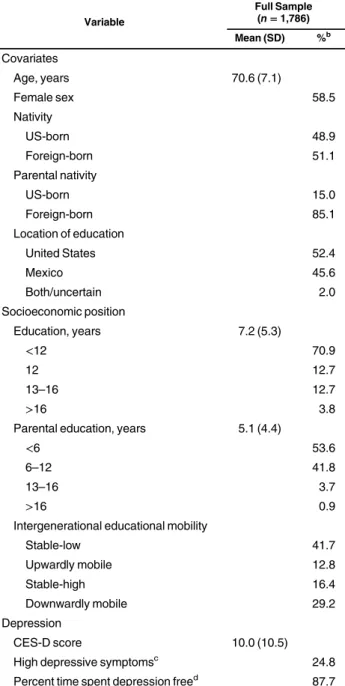
Table1displays participant and parent baseline characteristics. Participants had an average age of 70.6 years, and 58.5% were female. Additionally, 48.9% of participants were US-born com-pared with 15.0% of parents. Participants were more highly edu-cated than parents; 83.6% of participants completed<12 years of education compared with 95.4% of parents. In terms of inter-generational education, 41.7% of participants had stable-low educational mobility, 16.4% were classified as stable-high, 12.8% were upwardly mobile, and 29.2% were downwardly mobile. The average baseline CES-D score was 10.0, and participants with base-line CES-D scores≥16 comprised 24.8% of the sample. On aver-age, participants spent 87.7% of follow-up time depression-free.
Table2displays theβestimates and 95% confidence inter-vals for the association between educational mobility and 0
2 4 6 8 10 12 14
1 2 3 4 5 6 7
Average CES-D Score
Follow-up Wave Overall Stable-Low Upwardly Mobile Downwardly Mobile Stable-High
upward educational mobility were associated with lower CES-D scores (β=−2.75 and−2.18, respectively). Downwardly mobile participants had slightly lower CES-D scores compared with stable-low participants (β=−0.77), although the confidence in-terval included the null. A sensitivity analysis examining modi-fication by offspring nativity showed no evidence that the association varied by nativity status. Further analyses adjust-ing for specific birth country and immigrant generation also did not affect our results.
Tables3and4show prevalence ratios and differences, re-spectively, for high depressive symptoms (CES-D score≥16) according to educational mobility among SALSA participants over the follow-up period. These results were similar to those using continuous CES-D scores. In the full-adjustment model, prevalence of high depressive symptoms was lower among those with stable-high education and the upwardly mobile pat-tern than among those with stable-low education, with respec-tive prevalence ratios of 0.66 and 0.68 and respecrespec-tive prevalence differences of−0.068 and−0.067. Downward mobility also ap-peared to protect against high depressive symptoms compared with stable-low education (prevalence ratio=0.89; prevalence difference=−0.023), but these confidence intervals included the null.
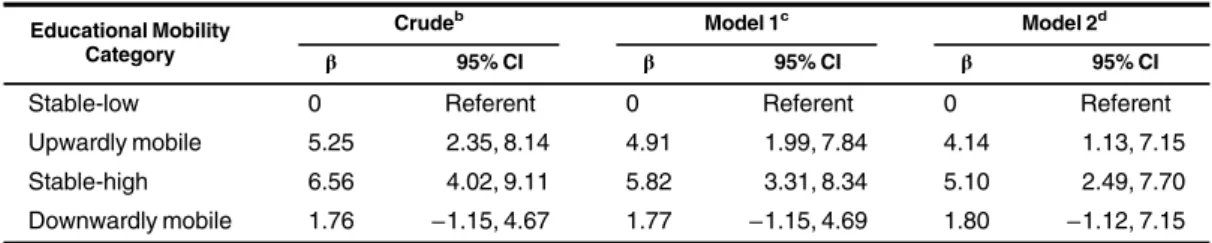
Table5shows the differences in percent change of follow-up time spent free of depressive symptoms among educational mobility categories. In the full-adjustment model, stable-high edu-cation was associated with a 5.10% (95% confidence interval: 2.49, 7.70) increase in average depression-free time over the follow-up period compared with stable-low education. Upward mobility was similarly beneficial for depression-free time (β= 4.14, 95% confidence interval: 1.13, 7.15) compared with stable-low education. Downwardly mobile participants also had a higher percentage of DFDs compared with stable-low participants (β= 1.80, 95% confidence interval:−1.12, 7.15), although the confi -dence interval included the null.
Regarding potential survivor bias, we found higher mortality among those with higher CES-D scores. These individuals dispro-portionately belonged to the stable-low and downwardly mobile categories, resulting in slight overall decreases in CES-D scores over time in these categories (Figure 1). The average baseline CES-D scores for those who died and those who remained alive were 11.6 and 9.5, respectively. Further, the 10-year mortality risk was>26% for the stable-low and downwardly mobile categories and<20% for the stable-high and upwardly mobile categories. Thus, two cells, the stable-low and downwardly mobile partici-pants with high depressive symptoms, were more rapidly depleted than other cells. As a result, average CES-D scores of the stable-low and downwardly mobile categories decreased over time, causing the different educational mobility categories to look more similar over time.
DISCUSSION
This study assessed the association between intergenerational educational mobility and depressive symptoms over a 10-year period among a sample of elderly Latinos, predominantly of Mexican origin. Prevalence of high depressive symptoms (CES-D scores≥16) was 24.8% in our population; this is comparable to larger, representative samples of US Latino adults, where Table 1. Baseline Descriptive Characteristics of the Population,
Overall and According to Nativity, Sacramento Area Latino Study on Aging, Sacramento, California, 1998–2008a
Variable
Full Sample (n=1,786)
Mean (SD) %b
Covariates
Age, years 70.6 (7.1)
Female sex 58.5
Nativity
US-born 48.9
Foreign-born 51.1
Parental nativity
US-born 15.0
Foreign-born 85.1
Location of education
United States 52.4
Mexico 45.6
Both/uncertain 2.0
Socioeconomic position
Education, years 7.2 (5.3)
<12 70.9
12 12.7
13–16 12.7
>16 3.8
Parental education, years 5.1 (4.4)
<6 53.6
6–12 41.8
13–16 3.7
>16 0.9
Intergenerational educational mobility
Stable-low 41.7
Upwardly mobile 12.8
Stable-high 16.4
Downwardly mobile 29.2
Depression
CES-D score 10.0 (10.5)
High depressive symptomsc 24.8
Percent time spent depression freed 87.7
Abbreviations: CES-D, Center for Epidemiological Studies–Depression Scale, SD, standard deviation.
aConducted with imputed data to account for missingness. bPercentages may not add to 100 due to rounding. cDefined as CES-D score≥16.
dCreated from the depression-free day measure.
high depressive symptom prevalence has been shown to be 27% (3). Our study supports an association between intergenerational educational mobility and depressive symptoms among elderly individuals of Mexican origin, whereby stable-high education and upward educational mobility were similarly protective against depressive symptoms. Additionally, high parental education ap-peared to somewhat counteract the adverse mental health conse-quences of low educational attainment in offspring.
Ourfindings support extant literature demonstrating higher depression prevalence among those with low education (14,23), especially within Latino communities (15–17), while providing a novel intergenerational perspective. Socioeconomic factors may influence Latino mental health through several mechanisms. Ex-posure to chronic stressors, such as socioeconomic disadvantage, can disrupt the body’s biological stress system and affect mental health (61–63). Stress exposure leads to hyperactivity of the amyg-dala and hypothalamic-pituitary-adrenal axis and increases secre-tion of cortisol and corticotropin-releasing hormone, all of which are components of the physiological stress system that have been individually associated with depression (24,62,64). Further, low-SEP individuals may lack access to social and economic resources
that buffer the impacts of chronic stress on depression (13,14). The Latino community may be especially vulnerable to the adverse mental-health influences of low SEP given that this population experiences lower overall educational attainment, income, and high school graduation rates than all other US racial/ethnic groups (18).
Recent immigrants make up a large proportion of the Latino community (18); thus, many Latinos may be raised in socioeco-nomic and cultural contexts that differ greatly from those of their parents and grandparents. Considering how these contexts change across generations is necessary to understanding the pathways that shape mental health. Nevertheless, measures used in most previous studies have been limited to a single generation. To our knowledge, only one study has examined the association between intergenerational socioeconomic trajectories and depres-sive symptoms in a US Latino population. Consistent with our re-sults, that study found that participants with stable-high education and upward mobility had fewer depressive symptoms than partici-pants with stable-low education (47). However, unlike our study, that study was limited by its cross-sectional nature and relatively small sample size.
Table 2. Estimates From Generalized Estimating Equations Predicting Differences in Scores on the Center for Epidemiological Studies–Depression Scale Over a 10-Year Period According to Educational Mobility, Sacramento Area Latino Study on Aging, Sacramento, California, 1998–2008a
Educational Mobility Category
Crudeb Model 1c Model 2d
β 95% CI β 95% CI β 95% CI
Stable-low 0 Referent 0 Referent 0 Referent
Upwardly mobile −2.73 −3.39,−2.06 −2.50 −3.13,−1.87 −2.18 −2.81,−1.54
Stable-high −3.41 −3.94,−2.87 −3.06 −3.60,−2.52 −2.75 −3.29,−2.20
Downwardly mobile −0.80 −1.68, 0.07 −0.80 −1.64, 0.04 −0.77 −1.61, 0.06
Abbreviations: CES-D, Center for Epidemiological Studies–Depression Scale; CI, confidence interval. aAccounting for missingness with multiple imputation.
bCrude model. Score statistic for educational mobility:P<0.0001.
cAdjusted for age and sex. Score statistic for educational mobility:P<0.0001.
dAdjusted for age, sex, child nativity, and parental nativity. Score statistic for educational mobility:P<0.0001.
Table 3. Prevalence Ratios From Generalized Estimating Equations for High Depressive Symptoms Over a 10-Year Period According to Educational Mobility, Sacramento Area Latino Study on Aging, Sacramento, California, 1998–2008a
Educational Mobility Category
Crudeb Model 1c Model 2d
PR 95% CI PR 95% CI PR 95% CI
Stable-low 1.00 Referent 1.00 Referent 1.00 Referent
Upwardly mobile 0.61 0.50, 0.74 0.64 0.53, 0.77 0.68 0.56, 0.81
Stable-high 0.58 0.50, 0.67 0.62 0.54, 0.73 0.66 0.57, 0.77
Downwardly mobile 0.89 0.74, 1.06 0.89 0.75, 1.05 0.89 0.75, 1.06
Abbreviations: CI, confidence interval; PR, prevalence ratio.
aAccounting for missingness with multiple imputation. High depressive symptoms were defined as a score of≥16
on the Center for Epidemiological Studies–Depression Scale. bCrude model. Score statistic for educational mobility:P<0.0001.
cAdjusted for age and sex. Score statistic for educational mobility:P<0.0001.
Our study advances the results of previous single-generation studies by examining how educational attainment of both the parent and offspring may interact to influence offspring depres-sive symptoms. In our analysis, the association between parental education and depressive symptoms appeared to depend upon off-spring education, as indicated by ourfinding that stable-high edu-cation and upward mobility were similarly protective against depressive symptoms compared with stable-low educational attainment. Further, at every follow-up wave we observed fewer depressive symptoms among downwardly mobile participants compared with stable-low participants. While thesefindings were only marginally significant, they suggest that the adverse consequence of low offspring education may be somewhat offset by high parental education. Thus, the association between off-spring education and mental health may depend on parental education. Our results therefore provide some support for the
“accumulation of risk”hypothesis, whereby multiple genera-tions of low educational attainment cumulatively influence depression, and any break in generational cycles of socioeco-nomic disadvantage may benefit the mental health of subse-quent generations (65–67).
An intergenerational framework provides novel insight into the importance and sustained power of inheritance of social stres-sors on mental health. Maternal psychosocial stress during preg-nancy has been shown to alter offspring cortisol excretion and hypothalamic-pituitary-adrenal activity (68,69), both of which are associated with depression (24,62,64). Continued low-SEP exposure in subsequent generations may then result in persistent disruption of the body’s physiological stress response and thereby affect depression (61–63). Studies have further shown that accumulated strain from coping with daily life challenges while lacking adequate resources, over time, leads to more physi-ological damage than does a single dramatically stressful event (70). Accordingly, downstream mental health may be especially influenced when the chronic stress associated with poor socioeco-nomic conditions has accumulated over multiple generations.
Our study has a number of strengths, including use of inter-generational and longitudinal data collected from a population-based sample representative of Latinos residing in Sacramento, California. To our knowledge, the present study was thefirst to examine the association between educational mobility and depressive symptoms over time in Mexican-origin individuals.
Table 5. Percent Change of Follow-up Time Spent Depression-Free According to Educational Mobility, Sacramento Area Latino Study on Aging, Sacramento, California, 1998–2008a
Educational Mobility Category
Crudeb Model 1c Model 2d
β 95% CI β 95% CI β 95% CI
Stable-low 0 Referent 0 Referent 0 Referent
Upwardly mobile 5.25 2.35, 8.14 4.91 1.99, 7.84 4.14 1.13, 7.15
Stable-high 6.56 4.02, 9.11 5.82 3.31, 8.34 5.10 2.49, 7.70
Downwardly mobile 1.76 −1.15, 4.67 1.77 −1.15, 4.69 1.80 −1.12, 7.15
Abbreviation: CI, confidence interval.
aAccounting for missingness with multiple imputation.
bCrude model. Likelihood ratio test for educational mobility:P<0.0001.
cAdjusted for age and sex. Likelihood ratio test for educational mobility:P<0.0001.
dAdjusted for age, sex, child nativity, and parental nativity. Likelihood ratio test for educational mobility:P<0.001. Table 4. Prevalence Differences From Generalized Estimating Equations for High Depressive Symptoms Over a 10-Year Period According to Educational Mobility, Sacramento Area Latino Study on Aging, Sacramento, California, 1998–2008a
Educational Mobility Category
Crudeb Model 1c Model 2d
PD 95% CI PD 95% CI PD 95% CI
Stable-low 0 Referent 0 Referent 0 Referent
Upwardly mobile −0.089 −0.121,−0.056 −0.076 −0.107,−0.046 −0.067 −0.097,−0.037
Stable-high −0.094 −0.118,−0.071 −0.076 −0.102,−0.051 −0.068 −0.094,−0.042
Downwardly mobile −0.026 −0.063, 0.012 −0.025 −0.062, 0.013 −0.023 −0.060, 0.014
Abbreviations: CI, confidence interval; PD, prevalence difference.
aAccounting for missingness with multiple imputation. High depressive symptoms were defined as a score of≥16
on the Center for Epidemiological Studies–Depression Scale. bCrude model. Score statistic for educational mobility:P<0.0001.
cAdjusted for age and sex. Score statistic for educational mobility:P<0.0001.
We used trained bilingual interviewers and validated surveys to collect sociodemographic and depression data. Further, while most previous studies report odds ratios of socioeconomic asso-ciations, in our study we estimated prevalence ratios and differ-ences of high depressive symptoms and absolute differdiffer-ences in CES-D scores. Given the prevalence of high depressive symptoms in our population, odds ratios could have greatly overstated the asso-ciation. Additionally, prevalence ratios and differences are more directly interpretable than odds ratios and allow for better esti-mation of public health burden (71). We believe our study was also thefirst to employ DFDs in relation to educational mobility. Our study also had limitations. First, given the advanced base-line age of SALSA participants and the established literature documenting the association between depression and mortality (72–76), survivor bias may have affected our results by infl uenc-ing who survived to be eligible to participate in SALSA. How-ever, sensitivity analyses indicated that selective attrition due to death caused the populations in the different educational mobility categories to look more similar over time, suggesting that educa-tional mobility may actually have a larger influence than observed. Despite this limitation, we still detected sizeable differences in CES-D scores and depression-free time between educational mobility groups.
Second, study participants were predominantly elderly Mexican-origin individuals living in California’s Sacramento Valley. Consequently, we cannot draw conclusions regarding depressive symptom prevalence among all US Latinos across all ages, given that ourfindings may not apply to other Latino sub-populations, communities, or age groups. However, Mexican Americans are the largest and fastest growing Latino subgroup in the United States (18), and elderly Latinos carry a dispropor-tionate burden of depression (9); therefore, examining factors associated with depression in these groups holds particular importance.
Finally, education is a limited measure of SEP. SALSA did collect participant income data; however, income and education were highly correlated in our data set. Moreover, education is often preferred because it predicts occupation and wages and is less influenced by age-related changes in these characteristics (11, 77). The elderly SALSA participants may be retired and therefore not have incomes representative of their earlier occupations. Fur-ther, use of educational attainment, a key measure of SEP, is con-sistent with other studies examining socioeconomic associations among Latino populations (45,78). Nevertheless, ourfindings may be unique to educational mobility; education may influence depression through pathways that do not hold for other SEP mea-sures, such as through its more direct influence on cognitive reserve and health or through stress-related epigenetic alterations (79–82).
In conclusion, we observed a strong association between educational mobility and depressive symptoms among elderly Latinos, predominantly of Mexican origin. Our study suggests that parental and offspring educational attainment may jointly influence mental health over and above the independent effect of either generation alone. Over the follow-up period, we con-sistently found the highest depressive symptoms among those with stable-low educational mobility, indicating that the health impacts of socioeconomic disadvantage may accumulate over time and influence subsequent generations. Our study contri-butes to a more comprehensive and contextual understanding
of depression etiology and the dynamic socioeconomic pathways that shape Latino mental health. The accumulation of socioeco-nomic risk factors within Latino families has been influenced by years of discrimination, segregation, exclusionary policies, and unequal allocation of resources. If ourfindings are causal, improv-ing educational opportunities in underresourced communities may counteract the adverse influence of low parental education on the mental health of individuals residing in these communi-ties and that of their future offspring. Future work should aim to identify the key social and environmental stressors and medi-ating biological pathways by which accumulation of low educa-tional attainment may influence mental health among Latinos and other at-risk populations.
ACKNOWLEDGMENTS
Author affiliations: Department of Epidemiology, Gillings School of Global Public Health, University of North
Carolina, Chapel Hill, North Carolina (Julia B. Ward, Whitney R. Robinson, Brian W. Pence, Joanna Maselko, Allison E. Aiello); Carolina Population Center, University of North Carolina, Chapel Hill, North Carolina (Julia B. Ward, Whitney R. Robinson, Joanna Maselko, Sandra S. Albrecht, Allison E. Aiello); Lineberger Comprehensive Cancer Center, University of North Carolina, Chapel Hill, North Carolina (Whitney R. Robinson); Department of Nutrition, Gillings School of Global Public Health, University of North Carolina, Chapel Hill, North Carolina (Sandra S. Albrecht); and Department of Epidemiology and Biostatistics, University of California, San Francisco, San Francisco, California (Mary N. Haan).
This work was supported by the National Institute of Diabetes and Digestive and Kidney Diseases (grant
R01DK087864 to A.E.A.), National Institute on Drug Abuse (grant R01DA022720 to A.E.A. and P60 MD 002249 (Project 5 to A.E.A.)), National Cancer Institute (grant K01CA172717 to W.R.R.), and National Institute on Aging (grant R01AG012975 to M.N.H.). We also acknowledge support from theEunice Kennedy ShriverNational Institute of Child Health and Human Development (grants
T32HD007168 and P2C HD050924).
The authors thank the members of the Aiello Research Group and Anne Lee at UCSF for their assistance with data management and analysis.
Conflict of interest: none declared.
REFERENCES
1. Conwell Y. Suicide in later life: a review and recommendations for prevention.Suicide Life Threat Behav. 2001;31(suppl): 32–47.
2. Alegría M, Mulvaney-Day N, Torres M, et al. Prevalence of psychiatric disorders across Latino subgroups in the United States.Am J Public Health. 2007;97(1):68–75.
backgrounds: results from the Hispanic Community Health Study/Study of Latinos.Ann Epidemiol. 2014;24(11):822–830. 4. Humes K, Jones N, Ramirez R. Overview of Race and
Hispanic Origin: 2010. Washington, DC: US Department of Commerce; 2011.https://www.census.gov/prod/cen2010/ briefs/c2010br-02.pdf. Accessed March 6, 2018.
5. Fiscella K, Franks P, Doescher MP, et al. Disparities in health care by race, ethnicity, and language among the insured: findings from a national sample.Med Care. 2002;40(1):52–59. 6. Brennan M, Vega M, Garcia I, et al. Meeting the mental health
needs of elderly Latinos affected by depression: implications for outreach and service provision.Care Manag J. 2005;6(2): 98–106.
7. Howell EA, Mora PA, Horowitz CR, et al. Racial and ethnic differences in factors associated with early postpartum depressive symptoms.Obstet Gynecol. 2005;105(6): 1442–1450.
8. Siegel JM, Aneshensel CS, Taub B, et al. Adolescent depressed mood in a multiethnic sample.J Youth Adolesc. 1998;27(4): 413–427.
9. Sadule-Rios N. A review of the literature about depression in late life among Hispanics in the United States.Issues Ment Health Nurs. 2012;33(7):458–468.
10. Falcón LM, Tucker KL. Prevalence and correlates of
depressive symptoms among Hispanic elders in Massachusetts.
J Gerontol B Psychol Sci Soc Sci. 2000;55(2):S108–S116. 11. Adler NE, Newman K. Socioeconomic disparities in health:
pathways and policies.Health Aff (Millwood). 2002;21(2): 60–76.
12. Szádóczky E, Rózsa S, Zámbori J, et al. Predictors for 2-year outcome of major depressive episode.J Affect Disord. 2004; 83(1):49–57.
13. Walker JL, Ruiz RJ, Chinn JJ, et al. Discrimination, acculturation and other predictors of depression among pregnant Hispanic women.Ethn Dis. 2012;22(4):497–503. 14. Lorant V, Deliège D, Eaton W, et al. Socioeconomic
inequalities in depression: a meta-analysis.Am J Epidemiol. 2003;157(2):98–112.
15. Fernández-Niño JA, Manrique-Espinoza BS, Bojorquez-Chapela I, et al. Income inequality, socioeconomic deprivation and depressive symptoms among older adults in Mexico.PLoS One. 2014;9(9):e108127.
16. Gavin AR, Walton E, Chae DH, et al. The associations between socio-economic status and major depressive disorder among Blacks, Latinos, Asians and non-Hispanic Whites: findings from the Collaborative Psychiatric Epidemiology Studies.Psychol Med. 2010;40(1):51–61.
17. Nicklett EJ, Burgard SA. Downward social mobility and major depressive episodes among Latino and Asian-American immigrants to the United States.Am J Epidemiol. 2009;170(6): 793–801.
18. Motel S, Patten E. Statistical Portrait of Hispanics in the United States, 2011. Washington, DC: Pew Research Center; 2013. http://assets.pewresearch.org/wp-content/uploads/sites/7/ 2013/02/Statistical-Portrait-of-Hispanics-in-the-United-States-2011_FINAL.pdf. Accessed March 6, 2018.
19. Schhneider B, Martinez S, Ownes A. Barriers to educational opportunities for Hispanics in the United States. In: Tienda M, Mitchell F, eds.National Research Council (US) Panel on Hispanics in the United States. Washington, DC: National Academies Press (US); 2006.http://www.ncbi.nlm.nih.gov/ books/NBK19909/. Accessed March 6, 2018.
20. Luo Y, Waite LJ. The impact of childhood and adult SES on physical, mental, and cognitive well-being in later life.
J Gerontol B Psychol Sci Soc Sci. 2005;60(2):S93–S101.
21. Portes A, Zhou M. The new second generation: segmented assimilation and its variants.Ann Am Acad Pol Soc Sci. 1993; 530(1):74–96.
22. Viruell-Fuentes EA, Miranda PY, Abdulrahim S. More than culture: structural racism, intersectionality theory, and immigrant health.Soc Sci Med. 2012;75(12):2099–2106. 23. Fisher M, Baum F. The social determinants of mental health:
implications for research and health promotion.Aust N Z J Psychiatry. 2010;44(12):1057–1063.
24. Chrousos GP, Gold PW. The concepts of stress and stress system disorders. Overview of physical and behavioral homeostasis.JAMA. 1992;267(9):1244–1252.
25. Gold PW, Chrousos GP. Organization of the stress system and its dysregulation in melancholic and atypical depression: high vs low CRH/NE states.Mol Psychiatry. 2002;7(3): 254–275.
26. Bassey E, Aihie Sayer A, Cooper C. A life course approach to musculoskeletal ageing: muscle strength, osteoporosis, and osteoarthritis. In: Kuh D, Hardy R, eds.A Life Course Approach to Women’s Health. Oxford, England: Oxford University Press; 2002:141–160.
27. Zeki Al Hazzouri A, Haan MN, Kalbfleisch JD, et al. Life-course socioeconomic position and incidence of dementia and cognitive impairment without dementia in older Mexican Americans: results from the Sacramento area Latino study on aging.Am J Epidemiol. 2011;173(10):1148–1158.
28. Park AL, Fuhrer R, Quesnel-Vallée A. Parents’education and the risk of major depression in early adulthood.Soc Psychiatry Psychiatr Epidemiol. 2013;48(11):1829–1839.
29. Haan MN, Mungas DM, Gonzalez HM, et al. Prevalence of dementia in older Latinos: the influence of type 2 diabetes mellitus, stroke and genetic factors.J Am Geriatr Soc. 2003; 51(2):169–177.
30. González HM, Haan MN, Hinton L. Acculturation and the prevalence of depression in older Mexican Americans: baseline results of the Sacramento Area Latino Study on Aging.J Am Geriatr Soc. 2001;49(7):948–953.
31. Haan MN, Zeki Al-Hazzouri A, Aiello AE. Life-span socioeconomic trajectory, nativity, and cognitive aging in Mexican Americans: the Sacramento Area Latino Study on Aging.J Gerontol B Psychol Sci Soc Sci. 2011;66(suppl 1): i102–i110.
32. Radloff LS. The CES-D scale: a self-report depression scale for research in the general population.Appl Psychol Meas. 1977; 1(3):385–401.
33. Salgado-de Snyder VN, Maldonado M. Características psicométricas de la escala de depresión en el Centro de Estudios Epidemiológicos en mujeres mexicanas adultas de áreas rurales [in Spanish].Salud Publica Mex. 1994;36(2): 200–209.
34. Caraveo J, Medina-Mora ME, Villatoro J, et al. La depresión en el adulto como factor de riesgo en la salud mental de los niños [in Spanish].Salud Ment. 1994;17:56–60.
35. González-Forteza C, Torres CS, Tapia AJ, et al. Confiabilidad y validez de la escala de depresión CES-D en un censo de estudiantes de nivel medio superior y superior, en la Ciudad de México [in Spanish].Salud Ment. 2011;34(1):53–59. 36. Black SA, Goodwin JS, Markides KS. The association
between chronic diseases and depressive symptomatology in older Mexican Americans.J Gerontol A Biol Sci Med Sci. 1998;53(3):M188–M194.
38. Vannoy SD, Arean P, Unützer J. Advantages of using estimated depression-free days for evaluating treatment efficacy.Psychiatr Serv. 2010;61(2):160–163.
39. McMakin DL, Olino TM, Porta G, et al. Anhedonia predicts poorer recovery among youth with selective serotonin reuptake inhibitor treatment-resistant depression.J Am Acad Child Adolesc Psychiatry. 2012;51(4):404–411.
40. Choi SW, Schalet B, Cook KF, et al. Establishing a common metric for depressive symptoms: linking the BDI-II, CES-D, and PHQ-9 to PROMIS depression.Psychol Assess. 2014; 26(2):513–527.
41. Smarr KL, Keefer AL. Measures of depression and depressive symptoms: Beck Depression Inventory-II (BDI-II), Center for Epidemiologic Studies Depression Scale (CES-D), Geriatric Depression Scale (GDS), Hospital Anxiety and Depression Scale (HADS), and Patient Health Questionnaire-9 (PHQ-9).
Arthritis Care Res (Hoboken). 2011;63(suppl 11): S454–S466.
42. Kroenke K, Spitzer RL, Williams JB. The PHQ-9: validity of a brief depression severity measure.J Gen Intern Med. 2001; 16(9):606–613.
43. Lave JR, Frank RG, Schulberg HC, et al. Cost-effectiveness of treatments for major depression in primary care practice.Arch Gen Psychiatry. 1998;55(7):645–651.
44. Pence BW, Gaynes BN, Adams JL, et al. The effect of antidepressant treatment on HIV and depression outcomes: results from a randomized trial.AIDS. 2015;29(15): 1975–1986.
45. Zeki Al Hazzouri A, Haan MN, Robinson WR, et al. Associations of intergenerational education with metabolic health in US Latinos.Obesity (Silver Spring). 2015;23(5): 1097–1104.
46. Harper S, Lynch J, Hsu WL, et al. Life course socioeconomic conditions and adult psychosocial functioning.Int J Epidemiol. 2002;31(2):395–403.
47. Ward JB, Haan MN, Garcia ME, et al. Intergenerational education mobility and depressive symptoms in a population of Mexican origin.Ann Epidemiol. 2016;26(7):461–466. 48. Musliner KL, Munk-Olsen T, Eaton WW, et al. Heterogeneity
in long-term trajectories of depressive symptoms: patterns, predictors and outcomes.J Affect Disord. 2016;192:199–211. 49. Andreescu C, Chang CC, Mulsant BH, et al. Twelve-year
depressive symptom trajectories and their predictors in a community sample of older adults.Int Psychogeriatr. 2008; 20(2):221–236.
50. Kuchibhatla MN, Fillenbaum GG, Hybels CF, et al. Trajectory classes of depressive symptoms in a community sample of older adults.Acta Psychiatr Scand. 2012;125(6):492–501. 51. Hybels CF, Bennett JM, Landerman LR, et al. Trajectories of
depressive symptoms and oral health outcomes in a community sample of older adults.Int J Geriatr Psychiatry. 2016;31(1): 83–91.
52. Rote S, Chen NW, Markides K. Trajectories of depressive symptoms in elderly Mexican Americans.J Am Geriatr Soc. 2015;63(7):1324–1330.
53. Liang J, Xu X, Quiñones AR, et al. Multiple trajectories of depressive symptoms in middle and late life: racial/ethnic variations.Psychol Aging. 2011;26(4):761–777. 54. Monserud MA, Peek MK. Functional limitations and
depressive symptoms: a longitudinal analysis of older Mexican American couples.J Gerontol B Psychol Sci Soc Sci. 2014; 69(5):743–762.
55. Xu X, Liang J, Bennett JM, et al. Ethnic differences in the dynamics of depressive symptoms in middle-aged and older Americans.J Aging Health. 2010;22(5):631–652.
56. Liang K-Y, Zeger SL. Longitudinal data analysis using generalized linear models.Biometrika. 1986;73(1):13–22. 57. Spiegelman D, Hertzmark E. Easy SAS calculations for risk or
prevalence ratios and differences.Am J Epidemiol. 2005; 162(3):199–200.
58. Raghunathan TE, Lepkowski JM, Van Hoewyk J, et al. A multivariate technique for multiply imputing missing values using a sequence of regression models.Surv Methodol. 2001; 27:85–95.
59. Rubin DB.Multiple Imputation for Nonresponse in Surveys. New York, NY: John Wiley & Sons; 1987.
60. Raghunathan TE. What do we do with missing data? some options for analysis of incomplete data.Annu Rev Public Health. 2004;25:99–117.
61. Ehlert U, Gaab J, Heinrichs M. Psychoneuroendocrinological contributions to the etiology of depression, posttraumatic stress disorder, and stress-related bodily disorders: the role of the hypothalamus-pituitary-adrenal axis.Biol Psychol. 2001; 57(1–3):141–152.
62. Tafet GE, Bernardini R. Psychoneuroendocrinological links between chronic stress and depression.Prog
Neuropsychopharmacol Biol Psychiatry. 2003;27(6):893–903. 63. Vyas A, Pillai AG, Chattarji S. Recovery after chronic stress
fails to reverse amygdaloid neuronal hypertrophy and enhanced anxiety-like behavior.Neuroscience. 2004;128(4): 667–673.
64. Drevets WC. Neuroimaging and neuropathological studies of depression: implications for the cognitive-emotional features of mood disorders.Curr Opin Neurobiol. 2001;11(2):240–249. 65. Ben-Shlomo Y, Kuh D. A life course approach to chronic
disease epidemiology: conceptual models, empirical challenges and interdisciplinary perspectives.Int J Epidemiol. 2002;31(2):285–293.
66. Kuh D, Ben-Shlomo Y, Lynch J, et al. Life course
epidemiology.J Epidemiol Community Health. 2003;57(10): 778–783.
67. Singh-Manoux A, Ferrie JE, Chandola T, et al. Socioeconomic trajectories across the life course and health outcomes in midlife: evidence for the accumulation hypothesis?Int J Epidemiol. 2004;33(5):1072–1079.
68. Yehuda R, Bierer LM. Transgenerational transmission of cortisol and PTSD risk.Prog Brain Res. 2008;167:121–135. 69. Worthman CM, Kuzara J. Life history and the early origins of
health differentials.Am J Hum Biol. 2005;17(1):95–112. 70. McEwen BS. Protective and damaging effects of stress
mediators: central role of the brain.Dialogues Clin Neurosci. 2006;8(4):367–381.
71. Lynch J, Davey Smith G, Harper S, et al. Explaining the social gradient in coronary heart disease: comparing relative and absolute risk approaches.J Epidemiol Community Health. 2006;60(5):436–441.
72. Saint Onge JM, Krueger PM, Rogers RG. The relationship between major depression and nonsuicide mortality for US adults: the importance of health behaviors.J Gerontol B Psychol Sci Soc Sci. 2014;69(4):622–632.
73. Gathright EC, Goldstein CM, Josephson RA, et al. Depression increases the risk of mortality in patients with heart failure: a meta-analysis.J Psychosom Res. 2017;94:82–89.
74. Carney RM, Freedland KE. Depression and coronary heart disease.Nat Rev Cardiol. 2017;14(3):145–155.
75. Liang X, Margolis KL, Hendryx M, et al. Effect of depression before breast cancer diagnosis on mortality among
postmenopausal women.Cancer. 2017;123(16):3107–3115. 76. Bengtson AM, Pence BW, Moore R, et al. Relationship
mortality in a cohort of HIV-infected adults in routine care.
AIDS. 2017;31(7):1009–1016.
77. Laaksonen M, Rahkonen O, Martikainen P, et al.
Socioeconomic position and self-rated health: the contribution of childhood socioeconomic circumstances, adult
socioeconomic status, and material resources.Am J Public Health. 2005;95(8):1403–1409.
78. Albrecht SS, Gordon-Larsen P. Socioeconomic gradients in body mass index (BMI) in US immigrants during the transition to adulthood: examining the roles of parental education and intergenerational educational mobility.J Epidemiol Community Health. 2014;68(9): 842–848.
79. Cagney KA, Lauderdale DS. Education, wealth, and cognitive function in later life.J Gerontol B Psychol Sci Soc Sci. 2002; 57(2):P163–P172.
80. Farmer ME, Kittner SJ, Rae DS, et al. Education and change in cognitive function. The Epidemiologic Catchment Area Study.
Ann Epidemiol. 1995;5(1):1–7.
81. Uddin M, Koenen KC, Aiello AE, et al. Epigenetic and inflammatory marker profiles associated with depression in a community-based epidemiologic sample.Psychol Med. 2011; 41(5):997–1007.