Concise Notes on Data
Structures and Algorithms
Ruby Edition
Christopher Fox
James Madison University
Contents
1 IntroductIon 1
What Are Data Structures and Algorithms? . . . . 1
Structure of the Book . . . . 3
The Ruby Programming Language . . . . 3
Review Questions . . . . 3
Exercises . . . . 4
Review Question Answers . . . . 4
2 BuIlt-In types 5 Simple and Structured Types . . . . 5
Types in Ruby . . . . 5
Symbol: A Simple Type in Ruby . . . . 5
Review Questions . . . . 9
Exercises . . . . 9
Review Question Answers . . . . 9
3 ArrAys 10 Introduction . . . . 10
Varieties of Arrays . . . . 10
Arrays in Ruby . . . . 11
Review Questions . . . . 12
Exercises . . . . 12
Review Question Answers . . . . 13
4 AssertIons 14 Introduction . . . . 14
Types of Assertions . . . . 14
Assertions and Abstract Data Types . . . . 15
Using Assertions . . . . 15
Assertions in Ruby . . . . 16
Review Questions . . . . 17
Exercises . . . . 17
Review Question Answers . . . . 19
5 contAIners 20 Introduction . . . . 20
Contents
A Container Taxonomy . . . . 20
Interfaces in Ruby . . . . 21
Exercises . . . . 22
Review Question Answers . . . . 23
6 stAcks 24 Introduction . . . . 24
The Stack ADT . . . . 24
The Stack Interface . . . . 25
Using Stacks—An Example . . . . 25
Contiguous Implementation of the Stack ADT . . . . 26
Linked Implementation of the Stack ADT . . . . 27
Summary and Conclusion . . . . 28
Review Questions . . . . 28
Exercises . . . . 29
Review Question Answers . . . . 29
7 Queues 31 Introduction . . . . 31
The Queue ADT . . . . 31
The Queue Interface . . . . 31
Using Queues—An Example . . . . 32
Contiguous Implementation of the Queue ADT . . . . 32
Linked Implementation of the Queue ADT . . . . 34
Summary and Conclusion . . . . 35
Review Questions . . . . 35
Exercises . . . . 35
Review Question Answers . . . . 36
8 stAcksAnd recursIon 37 Introduction . . . . 37
Balanced Brackets . . . . 38
Infix, Prefix, and Postfix Expressions . . . . 39
Tail Recursive Algorithms . . . . 44
Summary and Conclusion . . . . 44
Review Questions . . . . 45
Exercises . . . . 45
Contents
9 collectIons 47
Introduction . . . . 47
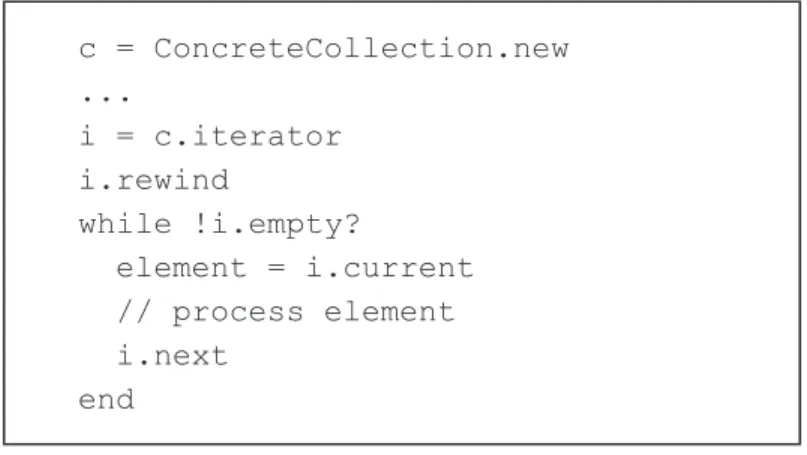
Iteration Design Alternatives . . . . 47
The Iterator Design Pattern . . . . 48
Iteration in Ruby . . . . 49
Collections, Iterators, and Containers . . . . 50
Summary and Conclusion . . . . 51
Review Questions . . . . 52
Exercises . . . . 52
Review Question Answers . . . . 52
10 lIsts 54 Introduction . . . . 54
The List ADT . . . . 54
The List Interface . . . . 55
Using Lists—An Example . . . . 55
Contiguous Implementation of the List ADT . . . . 56
Linked Implementation of the List ADT . . . . 56
Implementing Lists in Ruby . . . . 58
Summary and Conclusion . . . . 58
Review Questions . . . . 58
Exercises . . . . 58
Review Question Answers . . . . 59
11 AnAlyzIng AlgorIthms 61 Introduction . . . . 61
Measuring the Amount of Work Done . . . . 61
Which Operations to Count . . . . 62
Best, Worst, and Average Case Complexity . . . . 63
Review Questions . . . . 65
Exercises . . . . 66
Review Question Answers . . . . 66
12 FunctIon growth rAtes 68 Introduction . . . . 68
Definitions and Notation . . . . 68
Establishing the Order of Growth of a Function . . . . 69
Applying Orders of Growth . . . . 70
Contents
Review Questions . . . . 70
Exercises . . . . 70
Review Question Answers . . . . 71
13 BAsIc sortIng AlgorIthms 72 Introduction . . . . 72
Bubble Sort . . . . 72
Selection Sort . . . . 73
Insertion Sort . . . . 74
Shell Sort . . . . 76
Summary and Conclusion . . . . 77
Review Questions . . . . 78
Exercises . . . . 78
Review Question Answers . . . . 78
14 recurrences 80 Introduction . . . . 80
Setting Up Recurrences . . . . 80
Review Questions . . . . 83
Exercises . . . . 83
Review Question Answers . . . . 84
15: mergesortAnd QuIcksort 85 Introduction . . . . 85
Merge Sort . . . . 85
Quicksort . . . . 87
Summary and Conclusion . . . . 91
Review Questions . . . . 91
Exercises . . . . 91
Review Question Answers . . . . 92
16 trees, heAps, And heApsort 93 Introduction . . . . 93
Basic Terminology . . . . 93
Binary Trees . . . . 94
Heaps . . . . 94
Heapsort . . . . 95
Summary and Conclusion . . . . 97
Contents
Exercises . . . . 97
Review Question Answers . . . . 98
17 BInAry trees 99 Introduction . . . . 99
The Binary Tree ADT . . . . 99
The Binary Tree Class . . . . 100
Contiguous Implementation of Binary Trees . . . . 102
Linked Implementation of Binary Trees . . . . 102
Summary and Conclusion . . . . 103
Review Questions . . . . 103
Exercises . . . . 104
Review Question Answers . . . . 104
18 BInAry seArchAnd BInAry seArch trees 106 Introduction . . . . 106
Binary Search . . . . 106
Binary Search Trees . . . . 108
The Binary Search Tree Class . . . . 109
Summary and Conclusion . . . . 110
Review Questions . . . . 110
Exercises . . . . 111
Review Question Answers . . . . 112
19 sets 113 Introduction . . . . 113
The Set ADT . . . . 113
The Set Interface . . . . 113
Contiguous Implementation of Sets . . . . 114
Linked Implementation of Sets . . . . 114
Summary and Conclusion . . . . 114
Review Questions . . . . 115
Exercises . . . . 115
Review Question Answers . . . . 116
20 mAps 117 Introduction . . . . 117
The Map ADT . . . . 117
The Map Interface . . . . 118
Contents
Linked Implementation of the Map ADT . . . . 118
Summary and Conclusion . . . . 119
Review Questions . . . . 120
Exercises . . . . 120
Review Question Answers . . . . 120
21 hAshIng 122 Introduction . . . . 122
The Hashing Problem . . . . 122
Collision Resolution Schemes . . . . 124
Summary and Conclusion . . . . 127
Review Questions . . . . 127
Exercises . . . . 127
Review Question Answers . . . . 128
22 hAshed collectIons 129 Introduction . . . . 129
Hash Tablets . . . . 129
HashSets . . . . 130
Implementing Hashed Collections in Ruby . . . . 130
Summary and Conclusion . . . . 131
Review Questions . . . . 131
Exercises . . . . 131
Review Question Answers . . . . 132
1: I
ntroductIonWhat Are Data Structures and Algorithms?
If this book is about data structures and algorithms, then perhaps we should start by defining these terms . We begin with a definition for “algorithm .”
Algorithm: A finite sequence of steps for accomplishing some computational task . An algorithm must
• Have steps that are simple and definite enough to be done by a computer, and • Terminate after finitely many steps .
This definition of an algorithm is similar to others you may have seen in prior computer science courses . Notice that an algorithm is a sequence of steps, not a program . You might use the same algorithm in different programs, or express the same algorithm in different languages, because an algorithm is an entity that is abstracted from implementation details . Part of the point of this course is to introduce you to algorithms that you can use no matter what language you program in . We will write programs in a particular language, but what we are really studying is the algorithms, not their implementations .
The definition of a data structure is a bit more involved . We begin with the notion of an abstract data type .
Abstract data type (ADT): A set of values (the carrier set), and operations on those values .
Here are some examples of ADTs:
Boolean—The carrier set of the Boolean ADT is the set { true, false } . The operations on these values are negation, conjunction, disjunction, conditional, is equal to, and perhaps some others .
Integer—The carrier set of the Integer ADT is the set { . . ., -2, -1, 0, 1, 2, . . . }, and the operations on these values are addition, subtraction, multiplication, division, remainder, is equal to, is less than, is greater than, and so on . Note that although some of these operations yield other Integer values, some yield values from other ADTs (like true and false), but all have at least one Integer value argument .
String—The carrier set of the String ADT is the set of all finite sequences of characters from some alphabet, including the empty sequence (the empty string) . Operations on string values include concatenation, length of, substring, index of, and so forth .
Bit String—The carrier set of the Bit String ADT is the set of all finite sequences of bits, including the empty strings of bits, which we denote λ: { λ, 0, 1, 00, 01, 10,
1: Introduction
The thing that makes an abstract data type abstract is that its carrier set and its operations are mathematical entities, like numbers or geometric objects; all details of implementation on a computer are ignored . This makes it easier to reason about them and to understand what they are . For example, we can decide how div and mod should work for negative numbers in the Integer ADT without having to worry about how to make this work on real computers . Then we can deal with implementation of our decisions as a separate problem . Once an abstract data type is implemented on a computer, we call it a data type .
Data type: An implementation of an abstract data type on a computer .
Thus, for example, the Boolean ADT is implemented as the boolean type in Java, and the bool type in C++; the Integer ADT is realized as the int and long types in Java, and the Integer class in Ruby; the String ADT is implemented as the String class in Java and Ruby .
Abstract data types are very useful for helping us understand the mathematical objects that we use in our computations, but, of course, we cannot use them directly in our programs . To use ADTs in programming, we must figure out how to implement them on a computer . Implementing an ADT requires two things:
• Representing the values in the carrier set of the ADT by data stored in computer memory, and
• Realizing computational mechanisms for the operations of the ADT .
Finding ways to represent carrier set values in a computer’s memory requires that we determine how to arrange data (ultimately bits) in memory locations so that each value of the carrier set has a unique representation . Such things are data structures .
Data structure: An arrangement of data in memory locations to represent values of the carrier set of an abstract data type .
Realizing computational mechanisms for performing operations of the type really means finding algorithms that use the data structures for the carrier set to implement the operations of the ADT . And now it should be clear why we study data structures and algorithms together: to implement an ADT, we must find data structures to represent the values of its carrier set and algorithms to work with these data structures to implement its operations .
A course in data structures and algorithms is thus a course in implementing abstract data types . It may seem that we are paying a lot of attention to a minor topic, but abstract data types are really the foundation of everything we do in computing . Our computations work on data . This data must represent things and be manipulated according to rules . These things and the rules for their manipulation amount to abstract data types .
1: Introduction
other applications . Knowing how to do such evaluations to make good design decisions is an essential part of becoming an expert programmer .
Structure of the Book
In this book we will begin by studying fundamental data types that are usually implemented for us in programming languages . Then we will consider how to use these fundamental types and other programming language features (such references) to implement more complicated ADTs . Along the way we will construct a classification of complex ADTs that will serve as the basis for a class library of implementations . We will also learn how to measure an algorithm’s efficiency and use this skill to study algorithms for searching and sorting, which are very important in making our programs efficient when they must process large data sets .
The Ruby Programming Language
Although the data structures and algorithms we study are not tied to any program or programming language, we need to write particular programs in particular languages to practice implementing and using the data structures and algorithms that we learn . In this book, we will use the Ruby programming language .
Ruby is an interpreted, purely object-oriented language with many powerful features, such as garbage collection, dynamic arrays, hash tables, and rich string processing facilities . We use Ruby because it is a fairly popular, full-featured object-oriented language, but it can be learned well enough to write substantial programs fairly quickly . Thus we will be able to use a powerful language and still have time to concentrate on data structures and algorithms, which is what we are really interested in . Also, it is free .
Ruby is weakly typed, does not support design-by-contract, and has a somewhat frugal collection of features for object-oriented programming . Although this makes the language easier to learn and use, it also opens up many opportunities for errors . Careful attention to types, fully understanding preconditions for executing methods, and thoughtful use of class hierarchies are important for novice programmers, so we will pay close attention to these matters in our discussion of data structures and algorithms, and we will, when possible, incorporate this material into Ruby code . This often results in code that does not conform to the style prevalent in the Ruby community . However, programmers must understand and appreciate these matters so that they can handle data structures in more strongly typed languages such as Java, C++, or C# .
Review Questions
1 . What would be the carrier set and some operations of the Character ADT?
2 . How might the Bit String ADT carrier set be represented on a computer in some high level language?
1: Introduction
4 . What do your answers to questions two and three above have to do with data structures and algorithms?
Exercises
1 . Describe the carrier sets and some operations for the following ADTs: (a) The Real numbers
(b) The Rational numbers (c) The Complex numbers (d) Ordered pairs of Integers (e) Sets of Characters
(f) Grades (the letters A, B, C, D, and F)
2 . For each of the ADTs in exercise one, either indicate how the ADT is realized in some programming language, or describe how the values in the carrier set might be realized using the facilities of some programming language, and sketch how the operations of the ADT might be implemented .
Review Question Answers
1 . We must first choose a character set; suppose we use the ASCII characters . Then the carrier set of the Character ADT is the set of the ASCII characters . Some operations of this ADT might be those to change character case from lower to upper and the reverse, classification operations to determine whether a character is a letter, a digit, whitespace, punctuation, a printable character, and so forth, and operations to convert between integers and characters .
2 . Bit String ADT values could be represented in many ways . For example, bit strings might be represented in character strings of “0”s and “1”s . They might be represented by arrays or lists of characters, Booleans, or integers .
3 . If bit strings are represented as characters strings, then the bit string concatenation operation is realized by the character strings concatenation operation . If bit strings are represented by arrays or lists, then the concatenation of two bit strings is a new array or list whose size is the sum of the sizes of the argument data structures consisting of the bits from the fist bit string copied into the initial portion of the result array or list, followed by the bits from the second bit string copied into the remaining portion . 4 . The carrier set representations described in the answer to question two are data
2: B
uIlt-I
nt
ypesSimple and Structured Types
Virtually all programming languages have implementations of several ADTs built into them, thus providing the set of types provided by the language . We can distinguish two sorts of built-in types:
Simple types: The values of the carrier set are atomic, that is, they cannot be divided into parts . Common examples of simple types are integers, Booleans, floating point numbers, enumerations, and characters . Some languages also provide strings as built-in types .
Structured types: The values of the carrier set are not atomic, consisting instead of several atomic values arranged in some way . Common examples of structured types are arrays, records, classes, and sets . Some languages treat strings as structured types .
Note that both simple and structured types are implementations of ADTs, it is simply a question of how the programming language treats the values of the carrier set of the ADT in its implementation . The remainder of this chapter considers some Ruby simple and structured types to illustrate these ideas .
Types in Ruby
Ruby is a pure object-oriented language, meaning that all types in Ruby are classes, and every value in a Ruby program is an instance of a class . This has several consequences for the way values can be manipulated that may seem odd to programmers familiar with languages that have values that are not objects . For example, values in Ruby respond to method calls: The expressions 142.even? and “Hello”.empty? are perfectly legitimate (the first expression is true and the second is false) .
The fact that all types in Ruby are classes has consequences for the way data structures are implemented as well, as we will see later on .
Ruby has many built-in types because it has many built-in classes . Here we only consider a few Ruby types to illustrate how they realize ADTs .
Symbol: A Simple Type in Ruby
Ruby has many simple types, including numeric classes such as Integer, Fixnum, Bignum, Float, BigDecimal, Rational, and Complex, textual classes such as String, Symbol, and Regexp, and many more . One unusual and interesting simple type is Symbol, which we consider in more detail to illustrate how a type in a programming language realizes an ADT .
2: Built-In Types
implementations of two String ADTs—we consider the simpler one, calling it the Symbol
ADT for purposes of this discussion .
The carrier set of the Symbol ADT is the set of all finite sequences of characters over the Unicode characters set (Unicode is a standard character set of over 109,000 characters from 93 scripts) . Hence this carrier set includes the string of zero characters (the empty string), all strings of one character, all strings of two characters, and so forth . This carrier set is infinite . The operations of the Symbol ADT are the following .
a==b—returns true if and only if symbols a and b are identical .
a<=b—returns true if and only if either symbols a and b are identical, or symbol
a precedes symbol b in Unicode collating sequence order .
a<b—returns true if and only if symbol a precedes symbol b in Unicode collating sequence order .
empty?(a)—returns true if and only if symbol a is the empty symbol .
a=~b—returns the index of the first character of the first portion of symbol
a that matches the regular expression b . If there is not match, the result is undefined .
caseCompare(a,b)—compares symbols a and b, ignoring case, and returns -1 if
a<b, 0 if a==b, and 1 otherwise .
length(a)—returns the number of characters in symbol a.
capitalize(a)—returns the symbol generated from a by making its first character uppercase and making its remaining characters lowercase .
downcase(a) —returns the symbol generated from a by making all characters in a
lowercase .
upcase(a)—returns the symbol generated from a by making all characters in a
uppercase .
swapcase(a)—returns the symbol generated from a by making all lowercase characters in a uppercase and all uppercase characters in a lowercase .
charAt(a,b)—returns the one character symbol consisting of the character of symbol a at index b (counting from 0); the result is undefined if b is less than 0 or greater than or equal to the length of a .
charAt(a,b,c)—returns the substring of symbol a beginning at index b (counting from 0), and continuing for c characters; the result is undefined if b is less than 0 or greater than or equal to the length of a, or if c is negative . If a+b is greater than the length of a, the result is the suffix of symbol a beginning at index b .
2: Built-In Types
If a has no letters or digits, then the right-most character of a is incremented, with carries to the left as necessary .
toString(a)—returns a string whose characters correspond to the characters of symbol a .
toSymbol(a)—returns a symbol whose characters correspond to the characters of string a .
The Symbol ADT has no concatenation operations, but assuming we have a full-featured String ADT, symbols can be concatenated by converting them to strings, concatenating the strings, then converting the result back to a symbol . Similarly, String ADT operations can be used to do other manipulations . This explains whey the Symbol ADT has a rather odd mix of operations: The Symbol ADT models the Symbol class in Ruby, and this class only has operations often used for Symbols, with most string operations appearing in the String class .
The Ruby implementation of the Symbol ADT, as mentioned, hinges on making Symbol class instances immutable, which corresponds to the relative lack of operations in the Symbol ADT . Symbol values are stored in the Ruby interpreter’s symbol table, which guarantees that they cannot be changed . This also guarantees that only a single Symbol instance will exist corresponding to any sequence of characters, which is an important characteristic of the Ruby Symbol class that is not required by the Symbol ADT, and distinguishes is from the String class .
All Symbol ADT operations listed above are implemented in the Symbol class, except
toSymbol(), which is implemented in classes (such as String), that can generate a Symbol instance . When a result is undefined in the ADT, the result of the corresponding Symbol class method is nil . The names are sometimes different, following Ruby conventions; for example, toString() in the ADT becomes to_s() in Ruby, and charAt() in the ADT is []() in Ruby .
Ruby is written in C, so carrier set members (that is, individual symbols) are implemented as fixed-size arrays of characters (which is how C represents strings) inside the Symbol class . The empty symbol is an array of length 0, symbols of length one are arrays with a single element, symbols of length two are arrays with two elements, and so forth . Symbol class operations are either written to use these arrays directly, or to generate a String instance, do the operation on the string, and convert the result back into a Symbol instance .
Range: A Structured Type in Ruby
Ruby has a several structured types, including arrays, hashes, sets, classes, streams, and ranges . In this section we will only discuss ranges briefly as an example of a structured type . The Rangeof T ADT represents a set of values of type T (called the base type) between two extremes . The start value is a value of type T that sets the lower bound of a range, and the
2: Built-In Types
A range can be inclusive, meaning that it includes the end value, or exclusive, meaning that it does not include the end value . Inclusive ranges are written with two dots between the extremes, and exclusive ranges with three dots . Hence the Range of Integers from 1 to 10 exclusive is the set {1, 2, 3, . . ., 9} .
A type can be a range base type only if it supports order comparisons . For example, the Integer, Real, and String types support order comparisons and so may be range base types, but Sets and Arrays do not, so they cannot be range base types .
The carrier set of a Range of T is the set of all sets of values v∈T such that for some start
and end values s∈T and e ∈T, either s ≤ v and v ≤ e (the inclusive ranges), or s ≤ v and v
< s (the exclusive ranges), plus the empty set . For example, the carrier set of the Range of Integer is the set of all sequences of contiguous integers . The carrier set of the Range of Real is the set of all sets of real number greater than or equal to a given number, and either less than or equal to another, or less than another . These sets are called intervals in mathematics . The operations of the Range of T ADT includes the following, where a, b∈T and r is a
value of Range of T:
a..b—returns a range value (an element of the carrier set) consisting of all v ∈T
such that a ≤ v and v ≤ b .
a...b—returns a range value (an element of the carrier set) consisting of all v ∈
T such that a ≤ v and v < b .
a==b—returns true if and only if a and b are identical .
min(r)—returns the smallest value in r . The result is undefined if r is the empty set .
max(r)—returns the largest value in r . The result is undefined if r has no largest value (for example, the Range of Real 0 . . .3 has no largest value because there is no largest Real number less than 3) .
cover?(r, x)—returns true if and only if x∈r.
The Range of T ADT is a structured type because the values in its carrier set are composed of values of some other type, in this case, sets of value of the base type T .
Ruby implements the Range of T ADT in its Range class . Elements of the carrier set are represented in Range instances by recording the type, start, and end values of the range, along with an indication of whether the range is inclusive or exclusive . Ruby implements all the operations above, returning nil when the ADT operations are undefined . It is quite easy to see how to implement these operations given the representation elements of the carrier set . In addition, the Range class provides operations for accessing the begin and end values defining the range, which are easily accessible because they are recorded . Finally, the Range class has an include?()operation that tests range membership by stepping through the values of the range from start value to end value when the range is non-numeric .
2: Built-In Types
Review Questions
1 . What is the difference between a simple and a structured type? 2 . What is a pure object-oriented language?
3 . Name two ways that Symbol instances differ from String instances in Ruby . 4 . Is String a simple or structured type in Ruby? Explain .
5 . List the carrier set of Range of {1, 2, 3} . In this type, what values are 1 . .1, 2 . .1, and 1 . . .3? What is max(1 . . .3)?
Exercises
1 . Choose a language that you know well and list its simple and structures types .
2 . Choose a language that you know well and compare its simple and structured types to those of Ruby . Does one language have a type that is simple while the corresponding type in the other language is structured? Which language has more simple types or more structured types?
3 . Every Ruby type is a class, and every Ruby value is an instance of a class . What advantage and disadvantages do you see with this approach?
4 . Write pseudocode to implement the cover?() operation for the Range class in Ruby . 5 . Give an example of a Ruby String range r and String instance v such that
r.cover?(v) and r.include?(v) differ .
Review Question Answers
1 . The values of a simple type cannot be divided into parts, while the values of a structured type can be . For example, the values of the Integer type in Ruby cannot be broken into parts, while the values of a Range in Ruby can be (the parts are the individual elements of the ranges) .
2 . A pure object-oriented language is one whose types are all classes . Java and C++, for example, are not pure object-oriented languages because they include primitive data types, such as int, float, and char, that are not classes . Smalltalk and Ruby are pure object-oriented languages because they have no such types .
3 . Symbol instances in Ruby are immutable while String instances are mutable . Symbol instances consisting of a particular sequence of characters are unique, while there may be arbitrarily many String instances with the same sequence of characters .
4 . String is a simple type in Ruby because strings are not composed of other values—in Ruby there is no character type, so a String value cannot be broken down into parts composed of characters . If s is a String instance, then s[0] is not a character, but another String instance .
3: A
rrAysIntroduction
A structured type of fundamental importance in almost every procedural programming language is the array .
Array: A fixed length, ordered collection of values of the same type stored in contiguous memory locations; the collection may be ordered in several dimensions .
The values stored in an array are called elements . Elements are accessed by indexing into the array: an integer value is used to indicate the ordinal value of the element . For example, if
a is an array with 20 elements, then a[6] is the element of a with ordinal value 6 . Indexing may start at any number, but generally it starts at 0 . In the example above a[6] is the seventh value in a when indexing start at 0 .
Arrays are important because they allow many values to be stored in a single data structure while providing very fast access to each value . This is made possible by the fact that (a) all values in an array are the same type, and hence require the same amount of memory to store, and that (b) elements are stored in contiguous memory locations . Accessing element a[i] requires finding the location where the element is stored . This is done by computing
b+ (i × m,) where m is the size of an array element, and b is the base location of the array a . This computation is obviously very fast . Furthermore, access to all the elements of the array can be done by starting a counter at b and incrementing it by m, thus yielding the location of each element in turn, which is also very fast .
Arrays are not abstract data types because their arrangement in the physical memory of a computer is an essential feature of their definition, and abstract data types abstract from all details of implementation on a computer . Nonetheless, we can discuss arrays in a “semi-abstract” fashion that abstracts some implementation details . The definition above abstracts away the details about how elements are stored in contiguous locations (which indeed does vary somewhat among languages) . Also, arrays are typically types in procedural programming languages, so they are treated like realizations of abstract data types even though they are really not .
In this book, we will treat arrays as implementation mechanisms and not as ADTs .
Varieties of Arrays
In some languages, the size of an array must be established once and for all at program design time and cannot change during execution . Such arrays are called static arrays . A chunk of memory big enough to hold all the values in the array is allocated when the array is created, and thereafter elements are accessed using the fixed base location of the array . Static arrays are the fundamental array type in most older procedural languages, such as Fortran, Basic, and C, and in many newer object-oriented languages as well, such as Java .
3: Arrays
a segment of memory for element storage . Thereafter the array may shrink or grow . If the array shrinks during execution, then only an initial portion of allocated memory is used . But if the array grows beyond the space allocated for it, a more complex reallocation procedure
must occur, as follows:
1 . A new segment of memory large enough to store the elements of the expanded array is allocated .
2 . All elements of the original (unexpanded) array are copied into the new memory segment .
3 . The memory used initially to store array values is freed and the newly allocated memory is associated with the array variable or reference .
This reallocation procedure is computationally expensive, so systems are usually designed to minimize its frequency of use . For example, when an array expands beyond its memory allocation, its memory allocation might be doubled even if space for only a single additional element is needed . The hope is that providing a lot of extra space will avoid many expensive reallocation procedures if the array expands slowly over time .
Dynamic arrays are convenient for programmers because they can never be too small— whenever more space is needed in a dynamic array, it can simply be expanded . One
drawback of dynamic arrays is that implementing language support for them is more work for the compiler or interpreter writer . A potentially more serious drawback is that the expansion procedure is expensive, so there are circumstances when using a dynamic array can be dangerous . For example, if an application must respond in real time to events in its environment, and a dynamic array must be expanded when the application is in the midst of a response, then the response may be delayed too long, causing problems .
Arrays in Ruby
Ruby arrays are dynamic arrays that expand automatically whenever a value is stored in a location beyond the current end of the array . To the programmer, it is as if arrays are unbounded and as many locations as are needed are available . Locations not assigned a value in an expanded array are initialized to nil by default . Ruby also has an interesting indexing mechanism for arrays . Array indices begin at 0 (as in many other languages) so, for example, a[13] is the value in the 14th position of the array . Negative numbers are the
indices of elements counting from the current end of the array, so a[-1] is the last element, a[-2] is the second to last element, and so forth . Array references that use an out-of-bound index return nil . These features combine to make it difficult to write an array reference that causes an indexing error . This is apparently a great convenience to the programmer, but actually it is not because it makes it so hard to find bugs: many unintended and erroneous array references are legal .
The ability to assign arbitrary values to arrays that automatically grow arbitrarily large makes Ruby arrays behave more like lists than arrays in other languages . We will discuss the List ADT later on .
3: Arrays
every value in Ruby is an instance of Object, the super-class of all classes, or one of its sub-classes . Arrays hold Object values, so any value can be stored in any array! For example, an array can store some strings, some integers, some floats, and so forth . This appears to be a big advantage for programmers, but again this freedom has a price: it much harder to find bugs . For example, in Java, mistakenly assigning a string value to an array holding integers is flagged by the compiler as an error, but in Ruby, the interpreter does not complain .
Ruby arrays have many interesting and powerful methods . Besides indexing operations that go well beyond those discussed above, arrays have operations based on set
operations (membership, intersection, union, and relative complement), string operations (concatenation, searching, and replacement), stack operations (push and pop), and queue operations (shift and append), as well as more traditional array-based operations (sorting, reversing, removing duplicates, and so forth) . Arrays are also tightly bound up with Ruby’s iteration mechanism, which will be discussed later .
Review Questions
1 . If an array holds integers, each of which is four bytes long, how many bytes from the base location of the array is the location of the fifth element?
2 . Is the formula for finding the location of an element in a dynamic array different from the formula for finding the location of an element in a static array?
3 . When a dynamic array expands, why can’t the existing elements be left in place and extra memory simply be allocated at the end of the existing memory allocation?
4 . If a Ruby array a has n elements, which element is a[n-1]? Which is element a[-1]?
Exercises
1 . Suppose a dynamic integer array a with indices beginning at 0 has 1000 elements and the line of code a[1000] = a[5] is executed . How many array values must be moved from one memory location to another to complete this assignment statement?
2 . Memory could be freed when a dynamic array shrinks . What advantages or disadvantages might this have?
3 . To use a static array, data must be recorded about the base location of the array, the size of the elements (for indexing), and the number of elements in the array (to check that indexing is within bounds) . What information must be recorded to use a dynamic array? 4 . State a formula to determine how far the from base location of a Ruby array an element
with index i is when i is a negative number .
5 . Give an example of a Ruby array reference that will cause an indexing error at run time . 6 . Suppose the Ruby assignment a=(1 .. 100).to_a is executed . What are the values
of the following Ruby expressions? Hint: You can check your answers with the Ruby interpreter .
3: Arrays
(c) a[5, 4] (d) a[-5, 4] (e) a[100..105] (f) a[5..-5]
(g) a[0, 3] + a[-3, 3]
7 . Suppose that the following Ruby statement are executed in order . What is the value of array a after each statement? Hint: You can check your answers with the Ruby interpreter .
(a) a = Array.new(5, 0) (b) a[1..2] = []
(c) a[10] = 10
(d) a[3, 7] = [1, 2, 3, 4, 5, 6, 7] (e) a[0, 2] = 5
(f) a[0, 2] = 6, 7
(g) a[0..-2] = (1..3).to_a
Review Question Answers
1 . If an array holds integers, each of which is four bytes long, then the fifth element is 20 bytes past the base location of the array .
2 . The formula for finding the location of an element in a dynamic array is the same as the formula for finding the location of an element in a static array . The only difference is what happens when a location is beyond the end of the array . For a static array, trying to access or assign to an element beyond the end of the array is an indexing error . For a dynamic array, it may mean that the array needs to be expanded, depending on the language . In Ruby, for example, accessing the value of a[i] when i ≥ a.size produces nil, while assigning a value to a[i] when i ≥ a.size causes the array a to expand to size i+1 .
3 . The memory allocated for an array almost always has memory allocated for other data structures after it, so it cannot simply be increased without clobbering other data structures . A new chunk of memory must be allocated from the free memory store sufficient to hold the expanded array, and the old memory returned to the free memory store so it can be used later for other (smaller) data structures .
4: A
ssertIonsIntroduction
At each point in a program, there are usually constraints on the computational state that must hold for the program to be correct . For example, if a certain variable is supposed to record a count of how many changes have been made to a file, this variable should never be negative . It helps human readers to know about these constraints . Furthermore, if a program checks these constraints as it executes, it may find errors almost as soon as they occur . For both these reasons, it is advisable to record constraints about program state in assertions .
Assertion: A statement that must be true at a designated point in a program .
Types of Assertions
There are three sorts of assertions that are particularly useful:
Preconditions—A precondition is an assertion that must be true at the initiation of an operation . For example, a square root operation cannot accept a negative argument, so a precondition of this operation is that its argument be non-negative . Preconditions most often specify restrictions on parameters, but they may also specify that other conditions have been established, such as a file having been created or a device having been
initialized . Often an operation has no preconditions, meaning that it can be executed under any circumstances .
Post conditions—A post condition is an assertion that must be true at the completion of an operation . For example, a post condition of the square root operation is that its result, when squared, is within a small amount of its argument . Post conditions usually specify relationships between the arguments and the result, or restrictions on the arguments . Sometimes they may specify that the arguments do not change, or that they change in certain ways . Finally, a post condition may specify what happens when a precondition is violated (for example, that an exception will be thrown) .
Class invariants—A class invariant is an assertion that must be true of any class instance before and after calls of its exported operations . Usually class invariants specify properties of attributes and relationships between the attributes in a class . For example, suppose a Bin class models containers of discrete items, like apples or nails .
The Bin class might have currentSize, spaceLeft, and capacity attributes . One of its
class invariants is that currentSize and spaceLeft must always be between zero and capacity; another is that currentSize + spaceLeft = capacity .
4: Assertions
under any circumstances . For example, the cases in a switch statement often exhaust the possible values of the switch expression, so execution should never reach the default case . An unreachable code assertion can be placed at the default case; if it is every executed, then the program is in an erroneous state . A loop invariant is an assertion that must be true at the start of a loop on each of its iterations . Loop invariants are used to prove program correctness . They can also help programmers write loops correctly, and understand loops that someone else has written .
Assertions and Abstract Data Types
Although we have defined assertions in terms of programs, the notion can be extended to abstract data types (which are mathematical entities) . An ADT assertion is a statement that must always be true of the values or the operations in the type . ADT assertions can describe many things about an ADT, but usually they are used to help describe the operations of the ADT . Especially helpful in this regard are operation preconditions, which usually constrain the parameters of operations, operation post conditions, which define the results of the operations, and axioms, which make statement about the properties of operations, often showing how operations are related to one another . For examples, consider the Natural ADT whose carrier set is the set of non-negative integers and whose operations are the usual arithmetic operations . A precondition of the mod operation is that the modulus not be zero; if it is zero, the result of the operation is undefined . A post-condition of the mod operation is that the result is between zero and the modulus less one . An axiom of this ADT is that for all natural numbers a, b, and m > 0,
(a+b) mod m = ((a mod m) + b) mod m
This axiom shows how the addition and mod operations are related .
We will often use ADT assertions, and especially preconditions, in specifying ADTs . Usually, ADT assertions translate into assertions about the data types that implement the ADTs, which helps insure that our ADT implementations are correct .
Using Assertions
When writing code, programmer should state pre- and post conditions for public operations of a class or module, state invariants for classes, and insert unreachable code assertions and loop invariants wherever appropriate .
Some languages have facilities to directly support assertions and some do not . If a language does not directly support assertions, then the programmer can mimic their effect . For
4: Assertions
Often efficiency issues arise . For example, the precondition of a binary search is that the array searched is sorted, but checking this precondition is so expensive that one would be better of using a linear search . Similar problems often occur with post conditions . Hence many assertions are stated in comments and are not checked in code, or are checked during development and then removed or disabled when the code is compiled for release .
Languages that support assertions often provide different levels of support . For example, Java has an assert statement that takes a boolean argument; it throws an exception if the argument is not true . Assertion checking can be turned off with a compiler switch . Programmers can use the assert statement to write checks for pre- and post conditions, class invariants, and unreachable code, but this is all up to the programmer .
The languages Eiffel and D provide constructs in the language for invariants and pre- and post conditions that are compiled into the code and are propagated down the inheritance hierarchy . Thus Eiffel and D make it easy to incorporate these checks into programs . A compiler switch can disable assertion checking for released programs .
Assertions in Ruby
Ruby provides no support for assertions whatever . Furthermore, because it is weakly typed, Ruby does not even enforce rudimentary type checking on operation parameters and return values, which amount to failing to check type pre- and post conditions . This puts the burden of assertion checking firmly on the Ruby programmer .
Because it is so burdensome, it is not reasonable to expect programmers to perform type checking on operation parameters and return values . Programmers can easily document pre- and post conditions and class invariants, however, and insert code to check most value preconditions, and some post conditions and class invariants . Checks can also be inserted easily to check that supposedly unreachable code is never executed . Assertion checks can raise appropriate exceptions when they fail, thus halting erroneous programs .
For example, suppose that the operation f(x) must have a non-zero argument and return a positive value . We can document these pre- and post conditions in comments and incorporate a check of the precondition in this function’s definition, as shown below .
# Explanation of what f(x) computes # @pre: x != 0
# @post: @result > 0 def f(x)
raise ArgumentError if x == 0 ...
end
Figure 1: Checking a Precondition in Ruby
4: Assertions
We will use assertions frequently when discussing ADTs and the data structures and algorithms that implement them, and we will put checks in Ruby code to do assertion checking . We will also state pre- and post-conditions and class invariants in comments using the following symbols .
Use Symbol
Mark precondition @pre:
Mark post condition @post:
Mark class invariant @inv:
Return value @result
Value of @attr after operation @attr Value of @attr before operation old.@attr
Review Questions
1 . Name and define in your own words three kinds of assertions . 2 . What is an axiom?
3 . How can programmers check preconditions of an operation in a language that does not support assertions?
4 . Should a program attempt to catch assertion exceptions?
5 . Can assertion checking be turned off easily in Ruby programs as it can in Eiffel or D programs?
Exercises
1 . Consider the Integer ADT with the set of operations { +, -, *, div, mod, = } . Write preconditions for those operations that need them, post conditions for all operations, and at least four axioms .
2 . Consider the Real ADT with the set of operations { +, -, *, /, n√x, xn }, where x is a real number and n is an integer . Write preconditions for those operations that need them, post conditions for all operations, and at least four axioms .
4: Assertions
NUM_LOCKERS = 138 class Storage
# Set up the locker room data structures def initialize
@lockerIsRented = new Array(NUM_LOCKERS, false) @numLockersAvailable = NUM_LOCKERS
end
# Find an empty locker, mark it rented, return its number def rentLocker
... end
# Mark a locker as no longer rented def releaseLocker(lockerNumber) ...
end
# Say whether a locker is for rent def isFree(lockerNumber)
... end
# Say whether any lockers are left to rent def isFull?
... end end
This class keeps track of the lockers in a storage facility at an airport . Lockers have numbers that range from 0 to 137 . The Boolean array keeps track of whether a locker is rented . Use this class for the following exercises . 3 . Write a class invariant comment for the Storage class .
4 . Write precondition comments and Ruby code for all the operations that need them in the Storage class . The precondition code may use other operations in the class .
5 . Write post condition comments for all operations that need them in the Storage class . The post-condition comments may use other operations in the class .
4: Assertions
Review Question Answers
1 . A precondition is an assertion that must be true when an operation begins to execute . A post condition is an assertion that must be true when an operation completes execution . A class invariant in an assertion that must be true between executions of the operations that a class makes available to clients . An unreachable code assertion is an assertion stating that execution should never reach the place where it occurs . A loop invariant is an assertion true whenever execution reaches the top of the lop where it occurs .
2 . An axiom is a statement about the operations of an abstract data type that must always be true . For example, in the Integer ADT, it must be true that for all Integers n,
n * 1 = n, and n + 0 = n, in other words, that 1 is the multiplicative identity and 0 is the additive identity in this ADT .
3 . Preconditions can be checked in a language that does not support assertions by using conditionals to check the preconditions, and then throwing an exception, returning an error code, calling a special error or exception operation to deal with the precondition violation, or halting execution of the program when preconditions are not met .
4 . Programs should not attempt to catch assertion exceptions because they indicate errors in the design and implementation of the program, so it is best that the program fail than that it continue to execute and produce possibly incorrect results .
5 . Assertion checking cannot be turned off easily in Ruby programs because it is
5: c
ontAInersIntroduction
Simple abstract data types are useful for manipulating simple sets of values, like integers or real numbers, but more complex abstract data types are crucial for most applications . A category of complex ADTs that has proven particularly important is containers .
Container: An entity that holds finitely many other entities .
Just as containers like boxes, baskets, bags, pails, cans, drawers, and so forth are important in everyday life, containers such as lists, stacks, and queues are important in programming .
Varieties of Containers
Various containers have become standard in programming over the years; these are distinguished by three properties:
Structure—Some containers hold elements in some sort of structure, and some do not . Containers with no structure include sets and bags . Containers with linear structure include stacks, queues, and lists . Containers with more complex structures include multidimensional matrices .
Access Restrictions—Structured containers with access restrictions only allow clients to add, remove, and examine elements at certain locations in their structure . For example, a stack only allows element addition, removal, and examination at one end, while lists allow access at any point . A container that allows client access to all its elements is called traversable, enumerable, or iterable .
Keyed Access—A collection may allow its elements to be accessed by keys . For example, maps are unstructured containers that allows their elements to be accessed using keys .
A Container Taxonomy
It is useful to place containers in a taxonomy to help understand their relationships to one another and as a basis for implementation using a class hierarchy . The root of the taxonomy is Container . A Container may be structured or not, so it cannot make assumptions about
element location (for example, there may not be a first or last element in a container) . A
Container may or may not be accessible by keys, so it cannot make assumptions about
element retrieval methods (for example, it cannot have a key-based search method) . Finally, a Container may or may not have access restrictions, so it cannot have addition and removal
operations (for example, only stacks have a push() operation), or membership operations .
The only things we can say about Containers is that they have some number of elements .
Thus a Container can have a size() operation . We can also ask (somewhat redundantly)
whether a Container is empty . And although a Container cannot have specific addition
and removal operations, it can have an operation for emptying it completely, which we call
5: Containers
A Container is a broad category whose instances are all more specific things; there is never
anything that is just a Container . In object-oriented terms, a Container is an interface, not a
class . These considerations lead to the UML class diagram in Figure 1 below .
«interface» Container
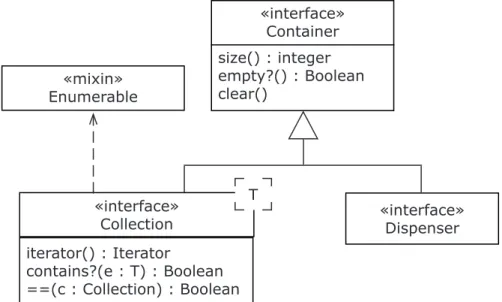
There are many ways that we could construct our container taxonomy from here; one way that works well is to make a fundamental distinction between traversable and non-traversable containers:
Collection: A traversable container .
Dispenser: A non-traversable container .
Collections include lists, sets, and maps; dispensers include stacks and queues . With this
addition, our container hierarchy appears in Figure 2 .
size() : integer empty?() : Boolean clear()
Figure 1: The Container Interface
«interface» Container size() : integer empty?() : Boolean clear()
Figure 2: Top of the Container Taxonomy «interface» Dispenser «interface»
Collection
Dispensers are linearly ordered and have access restrictions . As noted, Dispensers include
stacks and queues . We turn in the next chapter to detailed consideration of these non-traversable containers .
Interfaces in Ruby
5: Containers
operations in the pseudo-interface so that they raise exceptions if they are called . This forces sub-classes to override the operations in these pseudo-interface classes before they can be used .
This is the approach we will take in implementing interfaces in Ruby: we will make super-classes whose operations raise NotImplementedError exceptions . Classes implementing a pseudo-interface will then have to inherit from it and override its operations .
Review Questions
1 . Are sets structured? Do sets have access restrictions? Do sets have keyed access? 2 . If c is a Container and c.clear() is called, what does c.empty?() return? What does
c.size() return?
3 . What would happen if you tried to instantiate a pseudo-interface class implemented as suggested above in Ruby?
Exercises
1 . Consider a kind of Container called a Log that is an archive for summaries of
transactions . Summaries can be added to the end of a Log, but once appended, they
cannot be deleted or changed . When a summary is appended to a Log, it is
time-stamped, and summaries can be retrieved from a Log by their time stamps . The
summaries in a Log can also be examined in arbitrary order .
(a) Is a Log structured? If so, what kind of structure does a Log have?
(b) Does a Log have access restrictions?
(c) Does a Log provide keyed access? If so, what is the key?
(d) In the container hierarchy, would a Log be a Collection or a Dispenser?
2 . Consider a kind of Container called a Shoe used in an automated Baccarat program .
When a Shoe instance is created, it contains eight decks of Cards in random order . Cards can be removed one at a time from the front of a Shoe . Cards cannot be placed in
a Shoe, modified, or removed from any other spot . No Cards in a Shoe can be examined .
(a) Is a Shoe structured? If so, what kind of structure does a Shoe have?
(b) Does a Shoe have access restrictions?
(c) Does a Shoe provide keyed access? If so, what is the key?
(d) In the container hierarchy, would a Shoe be a Collection or a Dispenser?
3 . Consider a kind of Container called a Randomizer used to route packets in an
anonymizer . Packets go into the Randomizer at a single input port, and come out
randomly at one of n output ports, each of which sends packets to different routers . Packets can only go into a Randomizer at the single input port, and can only come out
one of the n output ports . Packets come out of a single output port in the order they enter a Randomizer . Packets cannot be accessed when they are inside a Randomizer .
(a) Is a Randomizer structured? If so, what kind of structure does a Randomizer have?
(b) Does a Randomizer have access restrictions?
(c) Does a Randomizer provide keyed access? If so, what is the key?
5: Containers
Review Question Answers
1 . Sets are not structured—elements appear in sets or not, they do not have a position or location in the set . Sets do not have access restrictions: elements can be added or removed arbitrarily . Elements in sets do not have keys (they are simply values), so there is no keyed access to elements of a set .
2 . When a Container c is cleared, it contains no values, so c.empty?() returns true, and c.size() returns 0 .
3 . A pseudo-interface class implemented in Ruby with operations that raise
6: s
tAcksIntroduction
Stacks have many physical metaphors: shirts in a drawer, plates in a plate holder, box-cars in a dead-end siding, and so forth . The essential features of a stack are that it is ordered and that access to it is restricted to one end .
Stack: A dispenser holding a sequence of elements that can be accessed, inserted, or removed at only one end, called the top .
Stacks are also called last-in-first-out (LIFO) lists . Stacks are important in computing because of their applications in recursive processing, such as language parsing, expression evaluation, runtime function call management, and so forth .
The Stack ADT
Stacks are containers, and as such they hold values of some type . We must therefore speak of the ADT stack of T, where T is the type of the elements held in the stack . The carrier set of this type is the set of all stacks holding elements of type T . The carrier set thus includes the empty stack, the stacks with one element of type T, the stacks with two elements of type T, and so forth . The essential operations of the type are the following (where s is a stack of T, and e is a T value) .
push(s,e)—Return a new stack just like s except that e has been added at the top of s .
pop(s)—Remove the top element of s and return the resulting (shorter) stack .
Attempting to pop an empty stack gives an undefined result . Thus, a precondition of the pop() operation is that the stack s is not empty .
empty?(s)—Return the Boolean value true just in case s is empty .
top(s)—Return the top element of s without removing it . Like pop(), this operation has the precondition that the stack s is not empty .
Besides the precondition assertions mentioned in the explanation of the stack ADT operations above, we can also state some axioms to help us understand the stack ADT . For example, consider the following axioms .
For any stack s and element e, pop(push(s,e)) = s . For any stack s and element e, top(push(s,e)) = e .
For any stack s, and element e, empty?(push(s,e)) = false .
6: Stacks
specification of ADTs, though we may use some axioms from time to time to explain some ADT operations .
The Stack Interface
The stack ADT operations map stacks into one another, and this is done by having stacks as operation arguments and results . This is what one would expect from mathematical functions that map values from the carrier set of an ADT to one another . However, when implementing stacks in an object-oriented language that allows us to create a stack class with stack instances, there is no need to pass or return stack values—the stack instances hold values that are transformed into other values by the stack operations . Consequently, when we specify an object-oriented implementation of the stack ADT, all stack arguments and return values vanish . The same thing occurs as we study other ADTs and their
implementations throughout this book: ADT carrier set arguments and return values will vanish from operation signatures in ADT implementation classes, and instead instances will be transformed from one carrier set value to another as operations are executed .
A Stack interface is a sub-interface of Dispenser, which is a sub-interface of Container, so
it already contains an empty?() operation that it has inherited from Container . The Stack
interface need only add operations for pushing elements, popping elements, and peeking at the top element of the stack . The diagram in Figure 1 shows the Stack interface .
Note that a generic or type parameter is used to generalize the interface for any element type, shown in UML as a dashed box in the upper right-hand corner of the class icon . Note also that the preconditions of operations that need them are shown as UML properties enclosed in curly brackets to the right of the operation signatures . Finally, because pop() no
longer needs to return a stack, it can return nothing, or as a convenience, it can return the element that is popped from the stack, which is what the operation in the Stack interface is
designed to do .
Using Stacks—An Example
When sending a document to a printer, one common option is to collate the output, in other words, to print the pages so that they come out in the proper order . Generally, this means printing the last page first, the next to last next, and so forth . Suppose a program sends several pages to a print spooler (a program that manages the input to a printer) with the instruction that they are to be collated . Assuming that the first page arrives at the print spooler first, the second next, and so forth, the print spooler must keep the pages in a container until they all arrive, so that it can send them to the printer in reverse order . One
«interface» Stack push( e : T )
pop() : T { not empty? } top() : T { not empty? }
Figure 1: The Stack Interface
6: Stacks
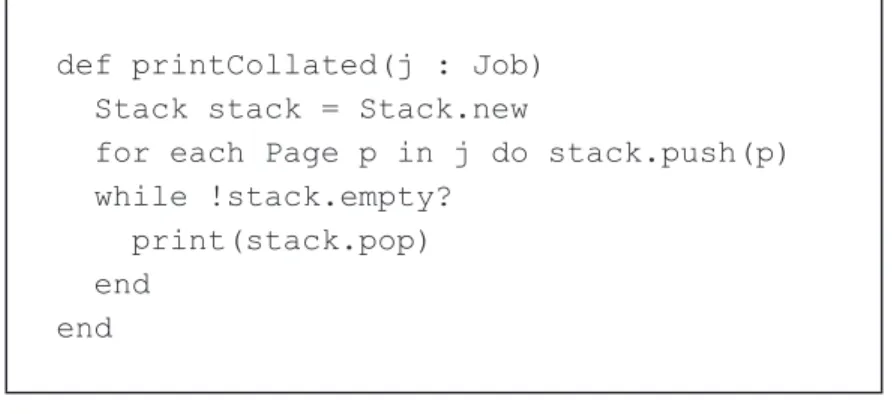
way to do this is with a Stack . Consider the pseudocode in Figure 2 describing the activities
of the print spooler .
def printCollated(j : Job) Stack stack = Stack.new
for each Page p in j do stack.push(p) while !stack.empty?
print(stack.pop) end
end
Figure 2: Using A Stack to Collate Pages for Printing
A Stack is the perfect container for this job because it naturally reverses the order of the
data placed into it .
Contiguous Implementation of the Stack ADT
There are two approaches to implementing the carrier set for the stack ADT: a contiguous implementation using arrays, and a linked implementation using singly linked lists; we consider each in turn .
Implementing stacks of elements of type T using arrays requires a T array to hold the contents of the stack and a marker to keep track of the top of the stack . The marker can record the location of the top element, or the location where the top element would go on the next push() operation; it does not matter as long as the programmer is clear what the
marker denotes and writes code accordingly .
If a static (fixed-size) array is used, then the stack can become full; if a dynamic (resizable) array is used, then the stack is essentially unbounded . Usually, resizing an array is an expensive operation because new space must be allocated, the contents of the old array copied to the new, and the old space deallocated, so this flexibility is acquired at a cost .
0 1 2
capacity-1
2 count
store
6: Stacks
We will use a dynamic array called store to hold stack elements, and a marker called count
to keep track of the top of the stack . Figure 3 below illustrates this data structure . The marker is called count because it keeps track of the array location where the top
element will go on the next push, and the array grows from index 0 upward, so the marker also records how many elements are in the stack .
The store array is allocated to hold capacity elements; this is the maximum number of
items that can be placed on the stack before it must be expanded . The diagram shows two elements in the stack, designated by the cross-hatched array locations, and the value of the
count variable . Note how the count variable also indicates the array location where the next
element will be stored when it is pushed onto the stack . The stack is empty when count is 0
and must be expanded when count equals capacity and another element is pushed on the
stack .
Implementing the operations of the stack ADT using this data structure is quite
straightforward . For example, to implement the push() operation, a check is first made to
see whether the store must be expanded by testing whether count equals capacity . If so,
the store is expanded . Then the pushed value is assigned to location store[count] and then count is incremented .
A class realizing this implementation might be called ArrayStack(T) . It would implement
the Stack(T) interface and have the store array and the count variable as private attributes
and the stack operations as public methods . Its constructor would create an empty stack . The capacity variable could be maintained by the ArrayStack class or be part of the
implementation of dynamic arrays in the implementation language .
Linked Implementation of the Stack ADT
A linked implementation of a stack ADT uses a linked data structure to represent values of the ADT carrier set . Lets review the basics of linked data structures .
Node: An aggregate variable composed of data and link or reference fields .
Linked (data) structure: A collection of nodes formed into a whole through its constituent node link fields .
Nodes may contain one or more data and link fields depending on the need, and the
references may form a collection of nodes into linked data structures of arbitrary shapes and sizes . Among the most important linked data structures are the following .
Singly linked list: A linked data structure whose nodes each have a single link field used to form the nodes into a sequence . Each node link but the last contains a reference to the next node in the list; the link field of the last node contains null (a special reference value that does not refer to anything) .