30
Chemistry
2015 – 2016 Diploma Examinations Program
Information
This document was written primarily for:
Students
Teachers of Chemistry 30 Administrators
Parents
General Audience Others
Distribution: This document is posted on the Alberta Education website at education.alberta.ca.
Copyright 2015, the Crown in Right of Alberta, as represented by the Minister of Education, Alberta Education, Provincial Assessment Sector, 44 Capital Boulevard, 10044 108 Street NW, Edmonton, Alberta T5J 5E6, and its licensors. All rights reserved.
Please note that if you cannot access one of the direct website links in this document, you can find *NEW
Contents
Diploma Examination Weighting ...1
Time Limits on Diploma Examinations ...1
Online Field Testing ...1
Special-Format Practice Tests ...3
Course Objectives ...3
Performance Expectations ...3
Trends in Student Performance ...8
Clarifications ...10
All Units ...10
Unit A ...12
Unit B ...14
Unit C ...17
Unit D ...20
Diploma Examinations Program Calculator Policy ...24
Changes to WHMIS 1988 ...25
Examination Specifications and Design ...26
Diploma Examinations: Multiple Forms ...29
Assessment of Skills and STS Connections ...30
Machine-Scored Questions ...30
Diploma Examination Instructions Pages ...33
Examination Development and Teacher Involvement ...36
Examination Security ...36
Maintaining Consistent Standards over Time on Diploma Examinations ...37
Data Booklet...37
Field Tests ...38
Publications and Support Documents ...39
Contacts 2015–2016 ...40 *NEW
*NEW *NEW
*NEW
Diploma Examination Weighting
As of September 1, 2015, the diploma examination weighting will shift from a 50/50 weighting to a 70/30 weighting, where the school-awarded grades will be worth 70 percent. For further information, please refer to http://education.alberta.ca/admin/testing/diplomaexams/.
Time Limits on Diploma Examinations
The section of the diploma examination instructions pages describing the time students are allowed for writing has been simplified. Previously, this section mentioned the time within which the examination had been designed to be completed, and the additional half hour allowed for students who needed it. Now this section simply states the total allowed writing time, which includes the additional half hour. No changes have been made to the design of any diploma examination.
As of the November 2015 session, all science diploma examinations (Biology 30, Chemistry 30, Physics 30, and Science 30) will have a time limit of 3 hours. The time limits of other diploma examinations have not changed.
Online Field Testing
All Grade 12 science and mathematics field tests are offered exclusively through an enhanced Quest A+ online delivery system. In addition to digital field tests, hybrid field tests are also
available this school year. With a hybrid field test, students receive a paper copy of the readings or sources. However, students must respond to the questions online.
Students should use paper data booklets, data pages, or formula sheets for all science and mathematics field tests. These resources will also appear in the online delivery system. Students should also have scrap paper, which may be accessed and downloaded from the “Teacher Resources” section on the home page of the Field Test Request System: http://public.education. alberta.ca/FieldTestScheduler. All paper data sheets or scrap paper with markings must be securely shredded at the end of the field test administration.
Enhanced digital and hybrid field tests offer many advantages over conventional paper field tests and earlier online field tests. Above all, the new tests are much more useful as a formative measurement of student progress and achievement.
Teachers have a 24-hour window to peruse the digital or hybrid field test and are provided with data on how their students performed. These data include the proportion of students who chose each alternative on multiple-choice items and the proportion who left a numerical-response item blank. Test items are blueprinted to program of studies outcomes. This allows teachers to use field test results to learn more about their students’ strengths and weaknesses.
*NEW
Once logged into the digital or hybrid field test, teachers have the same length of time to peruse the test as their students did to write it. Teachers might choose to log into the field test, submit the confidentiality form, and then log out of the test, so that they can finish perusing the test after receiving their students’ data.
In addition, teachers have greater flexibility in selecting the time and date when students write, rather than being bound to a pre-determined date.
Finally, online administration enables every school, large or small, to participate. Historically, it was impractical to send field test administrators to remotely located schools, or schools with small classes. Now, all Alberta schools can participate in field tests.
It is important to note that the security of field test items remains vital to the administration of diploma examinations. Participating teachers must commit to maintaining the security of field test items. In the case of hybrid field tests, paper copies are mailed to schools and the questions are accessed in the same format as digital-format field tests. Prior to the hybrid field test, the paper copies must be kept secure by the school principal. After the administration of a hybrid-format field test, teachers must mail all paper copies back to Alberta Education.
Further Information
Teachers requesting field tests must have a Public Authentication System (PAS) account. All requests are made through the Field Test Request System. Further information, including the closing dates to request a field test, may be obtained by contacting [email protected], or from the General Information Bulletin at http://education.alberta.ca/admin/testing/diplomaexams/diplomabulletin/. Practice items are available at https://questaplus.alberta.ca/.
For more information, contact
Deanna Shostak
Director, Diploma Programs
780-422-5160 or [email protected]
or
Dan Karas
Special-Format Practice Tests
To provide students an opportunity to practice diploma examination-style questions and content in Braille, audio, large print, or coloured print versions, Alberta Education is making special-format practice tests available. Tests are offered in all subjects with a corresponding diploma
examination. Alberta schools with registered Alberta K-12 students may place orders for these tests. Braille tests are available in English, and by request in French. All tests are provided free of charge, but limits may be placed on order volumes to ensure access for everyone.
For more information or to place an order, contact
Laura LaFramboise
Distribution Coordinator, Examination Administration 780-415-2485 or [email protected]
Course Objectives
Chemistry 30 is intended to develop students’ understanding of the interconnecting ideas and chemistry principles that transcend and unify the natural-science disciplines and their relationship to the technology that students use in their daily lives. It is of utmost importance to remember that Chemistry 30 is an experimental discipline that develops the knowledge, skills, and attitudes to help students become capable of and committed to setting career and/or life goals, make informed choices, and act in ways that will improve the level of scientific awareness essential for a scientifically literate society. Laboratory experience is an essential component of the Chemistry 30 course.
Students of Chemistry 30 are expected to develop an aptitude for collecting data, observing, analyzing, forming generalizations, hypothesizing, and making inferences from observations. The course is designed to promote students’ understanding of chemistry concepts, and their ability both to apply these concepts to relevant situations and to communicate in the specialized language of chemistry.
Success in Chemistry 30 requires the successful completion of Science 10, Chemistry 20, and concurrent mathematics courses that develop the requisite knowledge and skills.
Performance Expectations
Curriculum Standards
Acceptable Standard
Students who meet the acceptable standard in Chemistry 30 will receive a final course mark of 50% to 79%. These students demonstrate a basic understanding of the nature of scientific investigation by designing, observing, performing, and interpreting simple laboratory tests. They can readily interpret data that are presented in simple graphs, tables, and diagrams, and can translate symbolic representations into word descriptions. They are able to recognize and provide definitions for key chemical terms, and can predict the physical and chemical properties of compounds. They are able to balance simple equations (combustion, formation, neutralization, or oxidation–reduction) and can solve standard, single-step, stoichiometric problems based upon these equations. Following laboratory procedures does not present a problem for these students, nor does using the data booklet to extract relevant information. These students compose clear and logical descriptive or explanatory statements to answer closed-response questions that involve individual chemistry concepts.
Examples of Acceptable-Standard Questions
Use the following information to answer question 1.
Dr. Richard Trotter has developed what could be the first cost-effective process for limiting methane emissions from underground coal mines. In this process, methane and oxygen are reacted at 800 °C in the presence of a catalyst. The products of this process are carbon dioxide gas and liquid water.
1. Which of the following enthalpy diagrams represents both the catalyzed (----) and uncatalyzed reactions (—) for this process?
Use the following information to answer question 2.
To determine the concentration of a Sn2+(aq) solution, a student titrated a 50.00 mL sample of acidified Sn2+(aq) with 1.44 mmol/L KMnO
4(aq). The titration required 24.83 mL of KMnO4(aq) in order to reach a pale pink endpoint.
2. The balanced net ionic equation for this titration reaction is
*A. 2 MnO4–(aq) + 16 H+(aq) + 5 Sn2+(aq) → 2 Mn2+(aq) + 8 H
2O(l) + 5 Sn4+(aq) B. 2 MnO4–(aq) + 16 H+(aq) + 5 Sn2+(aq) → 2 Mn2+(aq) + 8 H
2O(l) + 5 Sn(s) C. MnO4–(aq) + 8 H+(aq) + Sn2+(aq) → Mn2+(aq) + 4 H
2O(l) + Sn4+(aq) D. MnO4–(aq) + 8 H+(aq) + Sn2+(aq) → Mn2+(aq) + 4 H
2O(l) + Sn(s)
Standard of Excellence
Examples of Standard of Excellence Questions
Use the following information to answer numerical-response question 1.
Four Reaction Equations
In(s) + La3+(aq) → no reaction Np(s) + La3+(aq) → Np3+(aq) + La(s) Np(s) + Nd3+(aq) → Np3+(aq) + Nd(s)
La(s) + Nd3+(aq) → no reaction
Key
1 In(s) 5 In3+(aq) 2 Np(s) 6 Np3+(aq) 3 Nd(s) 7 Nd3+(aq) 4 La(s) 8 La3+(aq)
Numerical Response
Arranged in order from strongest to weakest, the oxidizing agents above are numbered , , , and .
(Record all four digits of your answer in the numerical-response section on the answer sheet.)
Answer: 5876 1.
Use the following information to answer question 3.
CO2(g) + H2(g) ⇌ CO(g) + H2O(g) Kc = 0.137
3. If the temperature of the system at equilibrium is increased, then the concentration of the carbon dioxide and the value of Kc will
A. decrease and stay the same, respectively B. increase and stay the same, respectively C. increase and decrease, respectively *D. decrease and increase, respectively
Linking Program Some expectations require students to recall facts or identify
Expectations to characteristics. The Provincial Assessment Sector classifies these as Cognitive Expectations “knowledge” level expectations. Examples of these expectations are
listed in the yellow column below. Some expectations require students to apply their knowledge and skills in conventional situations. The Provincial Assessment Sector classifies these as “comprehension and application” expectations. Examples of these expectations are listed in the green column below. Some
expectations require students to build new connections, to create relationships between concepts, to apply models to new and unusual situations. The Provincial Assessment Sector classifies these as “higher mental activities.” Examples of these expectations are in the blue column below.
The Chemistry 20–30 Program of Studies, 2007(Updated 2014) also contains attitude and skill expectations that are listed in the pink row at the bottom of the chart. The attitudes and skills are foundations of a science education.
Cognitive Expectations
Knowledge
Comprehension and
Application Higher Mental Activities Choose, classify, define,
describe, identify*, label, list, match, name, outline,
predict*, recall, select, state, what, when, who
Use memorized or algorithmic methods to solve problems
Analyze*, apply, calculate, change, compare*, contrast, determine, estimate
(extrapolate or interpolate), explain*, generalize, identify*, infer, interpret*, predict*, relate, solve, translate
Design a procedure for a known experiment
Analyze*, assess, compare*, differentiate, compile, compose, conclude, create, defend, evaluate, explain*, interpret*, judge, justify, organize, plan, summarize
Transfer methods from one area to another
Use generalized methods to solve problems
Design a new procedure for an unfamiliar experiment Attitudes and Skills
Appreciate, collect, conduct, develop, gather, measure, observe, plot, work collaboratively
* These expectations are ambiguous because they have multiple connotations. The cognitive expectation is communicated by the context. If it is a familiar context, the expectation is knowledge or
Trends in Student Performance
In the thermochemistry unit, students show a basic competence in those questions that assess the calculations of enthalpies of formation and reaction, using either Hess’s law or data from a calorimetry experiment. Students should be aware that calculated values of reactions using Hess’s law will always have one decimal place if the calculation’s input values are taken from the Table of Standard Molar Enthalpies of Formation found in the data booklet. A significant minority of students write an answer such as 78.0 kJ/mol as 78 kJ/mol. This answer would be marked wrong in a numerical-response context. Students are able to interpret enthalpy diagrams that either include or exclude representations of the activation energy. However, they have more difficulty in relating these enthalpies to the breaking and forming of bonds.
In the electrochemistry unit, students can identify redox reactions, and produce balanced equations for the overall reactions where there is no disproportionation. They can identify oxidizing and reducing agents, but have difficulty producing equations for half-reactions when presented with an overall reaction involving species that are not in the Table of Standard Electrode Potentials found in the data booklet. They can calculate concentrations involved in redox titrations when the overall reaction equation is given, as well as the potential differences associated with overall reactions whose constituent half-reactions are in the Table of Standard Electrode Potentials. However, when half-reactions are not in the table, or a different reference half-reaction is used, students are much less successful in calculating electrode potentials or potential differences. Calculations involving Faraday’s Law are successful for most students if the relevant mole ratio is 1:1, but success is far less common when the mole ratio differs from 1:1.
The organic chemistry unit is divided into three sections: the naming and classifying of
compounds, the physical properties of organic compounds, and some chemical reactions involving selected organic compounds. Students are very successful at naming and classifying compounds, somewhat successful at questions involving physical properties, and less successful at questions involving chemical properties. Students also have difficulty relating variations in boiling point to differences in intermolecular bonding. There is still confusion between elimination reactions and esterification reactions. Water can be removed from ethanol, as well as from a mixture of ethanol and methanoic acid. However, the first reaction is classified as elimination because the organic product, ethene, contains a carbon-carbon double bond. The second reaction is classified as esterification because the organic product, ethyl methanoate, contains an ester linkage and not a carbon–carbon double bond.
In the equilibrium unit, students are very successful in using Le Châtelier’s Principle to make predictions if the stresses are explicitly stated. They are less successful if the stresses are stated implicitly, as in the use of hydroxide ions as a means of removing hydronium ions, or the use of silver ions to remove chloride or bromide ions. In questions involving the use of ICE tables, students were able to use them to calculate equilibrium concentrations, but could not use them to calculate initial concentrations, especially for weak acids and bases whose pH and either Ka or Kb
or bases, respectively. From a graphical perspective, students can identify the regions of a titration curve, but find it difficult to make qualitative predictions of the pH at the equivalence points associated with weak acid–strong base and strong acid–weak base titrations.
In chemistry, experiments are performed, observations and measurements are made, and then either an inference is drawn, or values are calculated. Many students do not distinguish between an observation and an inference when they are asked to analyze a laboratory experiment. For example, if asked to list the observations made during the electrolysis of aqueous sodium bromide, NaBr(aq), students would list as observations that hydrogen gas was released at the cathode, that bromine liquid was formed at the anode, and that the hydroxide ion concentration in the electrolyte increased. These are not observations; these are inferences drawn from the observations of a gas being released at one electrode, an orange liquid being formed at the other electrode, and the solution turning red litmus paper blue.
When identifying the variables required to investigate a given problem statement or to test a given hypothesis, students often choose quantities that were derivable from measured quantities, rather than quantities that are directly measurable. For example, when testing a hypothesis related to acid–base equilibrium, students choose quantities such as Ka, Kb, or hydronium ion concentration as an appropriate responding variable, rather than pH. The variables Ka, Kb, and hydronium ion concentration are not directly measurable, as they have to be calculated from the observed pH. Thus pH is the responding variable in this investigation.
Students understand that controlled variables take on constant values during the course of an experiment. However, they do not understand the concept that a controlled variable is a variable that the experimenter could have varied, but chose not to. For example, in an experiment
investigating the boiling points of alcohols as a function of the molar mass, one possible
Outcomes being assessed: C1.3k, C1.1s
Use the following information to answer question 4.
A student looked at the structural formulas of different hydrocarbons and proposed the following hypothesis:
The more unsaturated a hydrocarbon is, the more carbon dioxide is released when the hydrocarbon is burned.
4. To test this hypothesis, the best set of hydrocarbons to use is
A. propane, butane, and pentane B. butane, pent-1-ene, and hex-1-yne C. butane, but-1-ene, and but-1-yne
D. pentane, 2-methylbutane, and 2,2-dimethylpropane
Rationales:
For A, longer chains will give more carbon dioxide, but cannot be used for testing this hypothesis about saturation levels, as all three are saturated hydrocarbons.
For B, these have different degrees of saturation, but the length of the carbon chain is not controlled.
For C, this is correct, with the control variable of equal lengths of carbon chain.
For D, these hydrocarbons are all isomeric forms of each other, so they have the same degree of saturation.
Clarifications
All Units
• Chemistry is a laboratory science, and an essential part of laboratory activity is the design of effective tests for different hypotheses. The truth of some hypotheses will be within the scope of the program of studies, while the truth of others may be slightly beyond the program of studies. However, for all hypotheses, the design elements of the laboratory experiment will be within the program of studies. An example of a multiple-choice item and an example of a numerical-response item follow.
Outcomes being assessed: D1.4k, D1.1s
Use the following information to answer numerical-response question 2.
A student wants to test the following hypothesis about the strength of chlorinated carboxylic acids:
If the number of chlorine atoms in a chlorinated carboxylic acid increases, then so does the strength of the acid.
She identifies the following possible variables:
1 The pH of the acid sample 2 The molar mass of the acid 3 The mass of acid in the sample 4 The volume of acid in the sample
5 The molar concentration of the acid sample 6 The number of carbon atoms in the acid molecule 7 The number of chlorine atoms in the acid molecule
Numerical Response
In an effective experimental design for testing this hypothesis,
the manipulated variable is numbered (Record in the first column)
the responding variable is numbered (Record in the second column)
one controlled variable is numbered (Record in the third column)
another controlled variable is numbered (Record in the fourth column) (Record your answer in the numerical-response section on the answer sheet.)
Answer: 7156 or 7165
• A controlled variable is defined as a quantity that could be varied in the context of the given experimental design or hypothesis statement, but which the experimenter chose to hold constant, as any changes in the variable could affect the validity of any final conclusions.
• Observations made during an experiment must be distinguished from conclusions and inferences made as a result of the observations. For an example such as the electrolysis of aqueous sodium iodide, NaI(aq), the observation of drops of a brown liquid close to one electrode leads to the inferences that the aqueous iodide ion, I–(aq), has been oxidized to iodine, I2(aq), at that electrode, and that the electrode is the anode.
• Evidence collected during an experiment must be distinguished from data used in calculations. For example, during a calorimetry experiment, the temperature change of the calorimeter water would be data required to calculate a molar enthalpy of reaction. However, the evidence collected in the lab would be the initial and final temperatures of the calorimeter water, and this information would be used to produce the data necessary for the calculation.
Unit A
In the assessment of outcomes A1.8k and A1.1s:
• The term calorimeter does not always refer to a bomb calorimeter. Students should be familiar with different designs that can be used for the measurement of energy changes in a chemical system. These include designs where the temperature change of the container is accounted for, not just that of its contents.
• Some detailed calculations will include the temperature change of the calorimeter, but many should be answered qualitatively. As one example, a calorimeter composed of a material with a large specific heat capacity will undergo a smaller temperature change than a
calorimeter composed of a material with a significantly lower specific heat capacity. Another example relies on the insulating properties of polystyrene to predict that any temperature change of the cup calorimeter can be assumed to be negligible.
• In experiments using polystyrene calorimeters, the limiting measurement is the measurement of temperature using liquid-in-glass thermometers, where the errors can be of the order of 10%. When measuring volumes of liquids used in calorimetry, any error reduction due to the precision obtained by using a volumetric pipette rather than a graduated cylinder is of less consequence than error introduced due to temperature measurements. Accordingly, the use of a volumetric pipette is not necessary and is not considered standard practice for calorimetry experiments.
• When a small amount (less than 10% of the mass of the solvent) of solute is added to a solvent, the mass m in the formula Q = mc∆T or ∆H = mc∆T can be taken as the mass of the solvent, and c taken as the specific heat capacity of the solvent. Answers that use the mass of the solution for m require the use of the specific heat capacity of the solution for c, and this quantity may or may not be similar to the specific heat capacity of the solvent.
In the assessment of outcomes A1.8k and A1.9k:
• On diploma examinations, the general principle that will be followed is that if combustion reactions are performed empirically in a bomb calorimeter, liquid water will be the product; and if the combustion occurs in an ambient environment and a theoretical enthalpy of combustion is to be determined, the product will be water vapour. Students are not required to have existing knowledge or exposure to a bomb calorimeter.
In the assessment of outcomes A2.3k, A1.3s, and A2.3s:
• On the diploma examination, enthalpy diagrams will be similar to the two figures shown below. Enthalpy diagrams can be used to indicate relative positions for exothermic or endothermic reactions (refer to Figure 1). We cannot determine an exact value for the potential energy of a substance, but we can determine values for enthalpies of reaction, using enthalpies of formation (refer to Figure 2). For the French translation of the diploma examination, the term évolution de la réaction will be used on the x-axis of enthalpy diagrams.
In the assessment of outcome A2.3s:
• Students will be expected to calculate the efficiency of a thermal energy source and to
explain the discrepancies between theoretical and measured values obtained from calorimetry experiments. They are expected to predict whether a given source of error will lead to a lower or to a higher calculated value for an enthalpy of reaction, as well as to predict whether an observed enthalpy or temperature change is lower or higher than the theoretical enthalpy or temperature change.
• Teachers should use all the approved resources to cover this outcome, and not rely wholly on any single source for information.
In the assessment of outcome A2.4k:
Unit B
In the assessment of outcome B1.2k:
• Only the term disproportionation will be used to describe a substance undergoing both an oxidation and a reduction. For the French translation of the diploma examination, the term
dismutation will be used.
In the assessment of outcomes B1.2k and B1.7k:
• The term oxidation number will be the only term used.
• For assigning oxidation numbers, the Provincial Assessment Sector will use the following guidelines:
– Oxygen always has an oxidation number of –2, except for peroxides, where its oxidation number is –1.
– Hydrogen always has an oxidation number of +1, except for hydrides of metals in Groups 1 and 2 of the Periodic Table, where its oxidation number is –1.
– Carbon can have fractional oxidation numbers, and the oxidation number of carbon in any of its compounds will represent an average oxidation number. For example, in the
case of propane, C3H8, the oxidation number is taken as 3 8
- . Considering the oxidation
number of each of the two end carbons as –3, and of the middle carbon as –2, is beyond the scope of the Program of Studies.
In the assessment of outcome B1.7k:
• Students are expected to devise a balanced half-reaction in an acidic or neutral, but not basic, solution. They are expected to balance chemical equations that occur in basic environments given the species, but not to devise their own half-reactions. Students are expected to balance disproportionation reaction equations.
In the assessment of outcome B1.2s:
• Students are expected to select glassware as it is used in standard best-practice volumetric analysis. Shortcuts, such as the use of burettes or graduated cylinders in place of volumetric pipettes, are not considered best practice.
In the assessment of outcomes B2.1k and B2.3k:
In the assessment of outcome B2.1s:
• In addition to a labelled diagram, students are expected to predict the observations (e.g., pH changes and colour changes in the electrolyte, mass changes and colour changes of the electrodes) for the electrochemical cell that they design.
In the assessment of outcome B2.3k:
• For half-cells containing acidified solutions (such as acidified potassium permanganate and an inert electrode), each half-cell should include all the active components in their standard state; that is, 1.0 mol/L H+(aq) and 1.0 mol/L MnO
4– (aq). Together with an iron–iron(II) half-cell, the line notation is represented as
Fe(s)
|
Fe2+(aq)||
MnO4– (aq), H+(aq)
|
Pt(s) In the assessment of outcome B2.4k:• One of the most common and demonstrable examples to illustrate this objective is the chloride anomaly. It is reasonable to expect students to be familiar with this. For further clarification please review the explanation below (taken from the
Archived Chemistry 30 Information Bulletin).
• Students are expected to recognize that predicted reactions do not always occur; for
example, the chloride anomaly occurs during the electrolysis of solutions containing chloride ions and water as the strongest reducing agents. A common misconception is that if the minimum voltage for the electrolysis of water were applied, then the oxidation of water would occur rather than the oxidation of chloride ions. This is not correct. The reduction potentials found on the reduction potential table are determined by comparing the reduction potential of a given half-cell to the standard hydrogen half-cell. The standard hydrogen reduction potential is the reference potential against which all half-reaction potentials are assigned. This is how the reduction potentials for oxygen and hydrogen ions (+1.23 V) and chlorine (+1.36 V) half-cells are obtained. During electrolysis, the theoretical minimum voltage is the difference in reduction potential between the oxidizing agent and the reducing agent. An excess voltage, called the overvoltage, is required in order for a reaction to occur. For example, as the voltage to a standard sodium chloride electrolytic cell is increased, the chloride ions are oxidized first. The reason for this is that the overvoltage for the oxidation of water is greater than the overvoltage for the oxidation of chloride ions. A much higher potential than expected is required to oxidize water. Basically, the phenomenon is caused by difficulties in transferring electrons from the species in the solution to the atoms of the electrode across the electrode-solution interface. Because of this situation, E° values must be used cautiously when one is predicting the actual order of oxidation or reduction of species in an electrolytic cell.
In the assessment of outcomes B2.5k and B2.6k:
In the assessment of outcomes B2.5k and B2.3s:
• Standard state conditions and corresponding potential difference values imply the use of 1.0 mol/L reagents. The larger the concentration of the reactants, the larger the potential difference value. The Nernst equation would be required to calculate potential difference values as a function of reactant and product concentrations in a redox reaction and is beyond the scope of the Chemistry 30 Program of Studies, 2007(Updated 2014). However, students should know that as the reaction proceeds, the voltage generated will decrease as reactants are converted to products until reaching equilibrium, at which point the battery does not deliver any noticeable current.
• Biological systems involve species that are not at 25 °C and 1.0 mol/L. Therefore, the
Unit C
Questions in all units of the course may include contexts involving organic compounds.
In the assessment of outcome C1.3k:
• The term hydrocarbon should be strictly limited to describing molecules composed of only carbon and hydrogen atoms. For organic molecules composed of other atoms, including oxygen and halogens, the term hydrocarbonderivative is appropriate.
• For all halogenated hydrocarbons, the halogen atoms will be considered as substituents on the parent hydrocarbon. Using the endings -chloride and -bromide, as in vinyl chloride or ethyl bromide, gives the impression that the chemistry of the compound is dominated by the halogen atom, even though the type of hydrocarbon is the dominant factor. For example, 3-chloropentane has one chlorine substituted for hydrogen at the third carbon atom of the chain; 3-chloropropene has a three-carbon parent chain, with a double bond between the first and second carbon atoms, and one chlorine substituted for hydrogen at the third carbon atom of the chain.
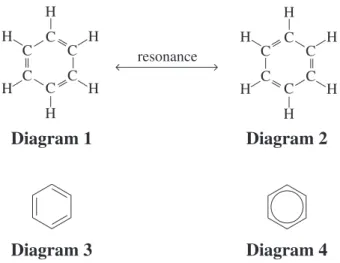
• An aromatic molecule is a molecule containing one or more benzene rings. The benzene ring may be represented in any of four ways, and students are expected to recognize any of the four representations shown in Diagrams 1–4 below as being a diagram of a benzene molecule. However, students are not expected to know the strengths and weaknesses of each representation.
Diagram 1 Diagram 2
Diagram 3 Diagram 4
– Diagram 1 uses a ring structure, and the bonding capacity of four for each carbon atom is satisfied by having alternating double and single bonds. As it stands, this compound would be named cyclohexa-1,3,5-triene, and the compound would undergo addition reactions easily. The compound, if it existed in this single form, would be highly unstable.
– Diagram 3 is a line diagram that is most commonly used in reference indexes and outside publications when showing representations of aromatic compounds.
– Diagram 4 is a line diagram that is used in both approved resources. This
representation does indicate that all bonds in the ring are equivalent and are distinct from single bonds or double bonds. However, up to now, its use has been limited in outside publications and reference indexes.
• When naming esters such as methyl pentanoate, a space is left between methyl and
pentanoate, whereas for the organic compound methylcyclohexane, no space is left between methyl and cyclohexane. This is done because, with the ester methyl pentanoate, methyl is not considered a prefix but part of the naming system for this class of organic compounds.
• When one of the hydrogen atoms in a hydrocarbon is replaced by a hydroxyl group, either an alcohol or a phenol may be produced. The term alcohol will be used whenever the original hydrocarbon is aliphatic. The term phenol will be used whenever the hydroxyl group is attached directly to the benzene ring. Benzyl alcohols, where there is both a benzene ring and a hydroxyl group attached to a straight side chain, and not to the benzene ring, are outside the scope of the Program of Studies.
• For the Chemistry 30 Diploma Examination, when determining whether a compound is saturated or unsaturated, only the presence of carbon-carbon double or triple bonds makes a compound unsaturated. Double bonds in a functional group will not characterize a compound as being unsaturated. For example, propanoic acid is classified as a saturated compound because all of its carbon atoms are joined to each other by single bonds. The double bond between carbon and oxygen does not make propanoic acid unsaturated.
• The bromine test will be negative for cyclohexane, C6H12(l), and positive for cyclohexene, C6H10(l), where the double bond is carbon–carbon, but will be negative for ethanoic acid, CH3COOH(aq), where the double bond is carbon–oxygen, not carbon–carbon.
• A negative bromine test with a saturated organic compound does not mean that there is no reaction with bromine. It means that there is no immediate or fast reaction between the saturated compound and the bromine. However, there will be a slow substitution reaction if the bromine reacts in the presence of sunlight. For most saturated compounds, this substitution reaction will take 24 hours or more.
• Aromatic compounds are not considered to be either saturated or unsaturated. Compounds with both benzene rings and carbon-carbon double bonds, such as phenylethene, are outside the scope of the Program of Studies.
In the assessment of outcome C1.4k:
• R represents any saturated chain of carbon and hydrogen atoms. For example, propanol can be represented by R–OH; R–OH could also represent any other alcohols containing a saturated chain of carbon and hydrogen atoms.
In the assessment of outcome C1.5k:
• Formulas such as C2H6(g), C2H5Cl(l), and C6H6(l) will be referred to as molecular formulas. In the assessment of outcome C1.6k:
• For an organic compound to be highly soluble in water, there must be significant hydrogen bonding present. It is not sufficient for the molecule to be polar. For example, the polar molecule 1-chloropropane cannot form hydrogen bonds, so it will not be soluble in water. The solubility rules based on an empirical generalization, such as like is soluble in like, are reasonable only with a three-way classification such as nonpolar, polar, and hydrogen-bonded. However, on the diploma examinations students are expected to predict the solubility of organic molecules only in nonpolar solvents such as hexane and in hydrogen-bonded solvents such as water.
In the assessment of outcomes C2.1k and C2.2k:
• For the diploma examination, elimination is considered a type of chemical reaction in which atoms are removed from adjacent carbons in a single reactant. The organic product of an elimination reaction will have a carbon-carbon double bond. Cracking reactions, in which alkanes are reduced to alkenes, are included as elimination reactions, as the alkenes all have carbon-carbon double bonds. The definition distinguishes this reaction type from a condensation reaction, in which two molecules react and their interaction produces a water molecule.
In the assessment of outcome C2.2k:
• For the diploma examination, students are expected to know two types of substitution reaction. The first is a reaction in which a hydrogen atom in a hydrocarbon or a hydrocarbon derivative is replaced by another atom or by a functional group. One such example is the production of chloromethane and hydrogen chloride from the reaction of methane and chlorine. The second is a reaction in which an atom or functional group in a hydrocarbon derivative is replaced by another atom or functional group. One such example is the
hydrolysis of 1-bromoethane in alkaline solution to produce ethanol and hydrogen bromide.
• The term nucleophilicsubstitution given to this second type of reaction will not be part of the diploma examination.
In the assessment of outcome C2.3k:
• Knowledge of both types of polymerization reaction (addition and condensation) will be tested, either by identifying the monomers involved in the production of a given polymer or by identifying the polymer formed from given monomers.
Unit D
In the assessment of outcome D1.3k:
• There is some confusion about the ways in which pressure can be increased and how it will affect an equilibrium system. Three methods to increase pressure are reducing the volume of the reaction container, adding an inert gas, and adding a reactant or product gas.
– Increasing the pressure by reducing the volume of the container causes the system to alleviate the increased pressure by reducing the total number of gaseous molecules in the system. Equilibrium will therefore shift to the side with the lesser number of gas molecules.
– Adding an inert gas increases the total pressure but has no effect on the concentration or partial pressures of the individual reactants or products. Therefore, there is no shift in the equilibrium.
– Adding a reactant or product gas will shift the equilibrium away from what is added, whereas removing a reactant or product gas will shift the equilibrium toward what is removed.
• If the total volume available to an equilibrium system is adjusted, the value of the
equilibrium constant for that system will not change, provided there is not a corresponding change in temperature. The only stress that can change the value of the Kc for an equilibrium is a change in the system temperature. Although the equilibrium constant does not change when a system undergoes a change in pressure due to a change in volume, the position of the equilibrium can still change. A particular equilibrium set of reactant and product equilibrium concentrations is called an equilibrium position. At any particular temperature, there are many equilibrium positions but only one value for Kc.
• A change in temperature of an equilibrium system changes the value of the equilibrium constant, which is a measure of the extent to which a given reaction occurs. If the temperature of the equilibrium system below is decreased, the equilibrium constant value will increase.
A(g) + B(g) ⇌ C(g) + energy
If the temperature of the equilibrium system above is increased, the equilibrium constant value will decrease.
In the assessment of outcomes D1.3k and D1.4k:
In the assessment of outcome D1.4k:
• Students are expected to predict how a wide range of factors affect equilibrium and/or the equilibrium constant.
• Students are expected to write equilibrium constant expressions for homogeneous and heterogeneous (Brønsted–Lowry acids and bases) equilibria. The diploma examination will employ the convention of including in equilibrium expressions only substances that can vary in concentration. Gases must be included since the concentration of a gas can be altered by varying the pressure on it. For example,
CO(g) + H2O(g) ⇌ CO2(g) + H2(g)
Kc =
CO(g) H O(g) H (g) CO (g)
2 2 2 8 8 8 8 B B B B
• Aqueous ions and/or gases in solution must be included since the concentration of aqueous ions and/or gases can be altered by varying the volume of solvent.
• Pure liquids are not included since the concentration (density) cannot be varied. For example,
CH3COOH(aq) + H2O(l) ⇌ CH3COO–(aq) + H
3O+(aq)
Kc =
CH COOH(aq) CH OO (aq) H O (aq)
3
3 - 3 +
8
8 8
B
B B
Mixtures of liquids must be included since the concentration can be varied by changing the relative amounts of the mixed liquids. For example,
C6H6(l) + Br2(l) ⇌ C6H5Br(l) + HBr(l)
Kc =
C H (1) Br (1) C H Br(1) HBr(1)
6 6 2 6 5
7 7
7 7
A A A A
• When predicting whether reactants or products are favoured in reversible reactions, the magnitude of the Kc value is only a general guideline. In a number of chemistry textbooks, there is a statement to the effect that a value of Kc greater than 1 means that the products are favoured and a Kc less than 1 means reactants are favoured. This is valid if a reaction has the same number of reactant and product molecules in the balanced chemical equation. When the numbers of reactant and product molecules are not the same, the value of the Kc may be misleading in determining the extent of reaction. An analysis of the extent to which reactants are converted to products may be a better indication of whether reactants or products are favoured.
In the assessment of outcome D1.6k:
• The terms monoprotic and polyprotic need to be used with care with amphiprotic species, as such a species may be polyprotic as an acid yet monoprotic as a base. For example, the dihydrogen phosphate ion H2PO4–(aq) is polyprotic as an acid, capable of donating two protons, yet monoprotic as a base, because it can accept only one proton. In contrast, the hydrogen phosphate ion HPO42–(aq) is monoprotic as an acid, capable of donating one proton, yet polyprotic as a base, because it can accept two protons. In diploma examinations, every attempt will be made to define the context in which amphiprotic species are reacting, so that it can be determined precisely whether a species is monoprotic or polyprotic. The terms monobasic and polybasic, although less ambiguous than the terms monoprotic and
polyprotic, will not be used on any diploma examination.
• Some titrations between polyprotic acids and polyprotic bases may go to completion, and stoichiometric methods can then be used to calculate concentrations of acids and bases from the volumes at the equivalence points. Other such titrations do not go to completion, as the acid may not be strong enough to complete all possible proton donations. The words titrated to completion will be used in diploma examinations to indicate that all possible proton donations have been made.
• Quantitative calculations of the pH of a buffer using the Henderson–Hasselbalch equation are beyond the program of studies and will not be asked. A qualitative understanding that the Ka value of the buffer must approximate the desired Ka value of the environment to be buffered is required.
In the assessment of outcome D1.7k:
• The terms amphiprotic substances and amphoteric substances are used synonymously to describe substances that can act as either proton acceptors or proton donors. In the diploma examinations, the term amphiprotic will be used.
• Amphiprotic species are species that have an ability to act as either an acid or a base: for example, H2PO4–(aq) or HCO
3–(aq). Because of this property, the pH of an amphiprotic species cannot be determined with the simple Ka expression used to determine the pH of a weak acid. Students are not expected to determine the pH of an amphiprotic species, and will not be asked to do so on the diploma examination.
In the assessment of outcome D1.8k:
In the assessment of outcomes D1.8k and D1.3s:
• On a titration curve representing the titration of a weak acid with a strong base (or a strong acid with a weak base), one or more buffer regions occur. This is the flatter portion of the titration curve that occurs before the equivalence point when a buffer is present. In this region, the acid and its conjugate base are present in similar concentrations. Prior to this region, as strong base is added to the weak acid, the acid is converted to its conjugate base, until both are present in similar concentrations. The buffer region does not occur at the start of the titration, but only when a significant amount of strong base has been added to convert the weak acid to its conjugate base (the flat portion of the titration curve).
• Originally, a buffer was defined operationally as being any area on a pH graph where the titration graph of pH as a function of added titrant was essentially flat. With that definition, a strong monoprotic acid–strong monoprotic base titration would exhibit buffering regions at the beginning of the titration and at the end, separated by a near-vertical portion containing the single equivalence point. However, the only reason that these are flat is that pH is a logarithmic scale. If we have 50.0 mL of 1.00 mol/L NaOH, the pH is essentially 14, and adding 10.0 mL of 1.00 mol/L HCl will produce a pH of 13.82 as the molar concentration of NaOH is now (40.0 mL/60.0 mL) mol/L as 10.0 mL of the NaOH has been neutralized, and the new total volume is 60.0 mL. There is no equilibrium established near the reaction equivalence point, and the pH change is strictly a dilution effect.
• Following the Brønsted–Lowry approach to acid–base equilibrium, the buffer was redefined in terms of requiring the presence of a conjugate acid–base pair that is in an equilibrium state, and which reacts to the stresses applied in the form of small amounts of a strong base or a strong acid. With this more modern and complete definition of buffering, there would be no buffering regions in any strong monoprotic acid–strong monoprotic base titration.
In the assessment of outcomes D2.1k, D2.2k, and D2.4s:
• The values of Ka provided in the Relative Strengths of Acids and Bases at 298.15 K table in the data booklet are experimental values that have two significant figures. As a result, calculated values resulting from the use of these data will generally only be good to two significant figures for a calculation of Kb and to two decimal places for a calculation of pH or pOH. • Teachers may find it necessary to review the proper use of scientific notation, and the use
of the quantities millimoles and millimoles per litre, when completing calculation-based problems.
In the assessment of outcome D2.2k:
• Students are expected to be as familiar with calculations involving Kb as they are for calculations involving Ka.
In the assessment of outcome D2.3k:
• Students will not be expected to solve questions involving the pH of weak acids and bases by using the quadratic equation. When such questions are asked in numerical-response form, the question will be double-keyed, so both the exact answer and the approximate answer would be marked as correct.
• The use of the approximation to solve acid–base equilibrium expressions is acceptable only when solving the equilibrium law equation results in a quadratic expression and the original concentration of the acid or base is one-thousand-fold greater than the value of Ka or Kb. • If the student is given the pH or pOH of an acid or base whose value of Ka or Kb is known,
both the equilibrium concentration and the initial concentration can be calculated exactly. To find the equilibrium concentration, the equilibrium law expression is used. To find the initial concentration, the equilibrium concentration is calculated first, and the ICE table is then used to determine the initial concentration.
• The approximation may be considered when calculating the pH or pOH of a solution; it is never a factor when the pH or pOH is known and any of Ka, Kb, equilibrium concentration, or initial concentration have to be determined.
In the assessment of outcome D1.3s:
• Students are expected to know the terms equivalence point and endpoint. Equivalence point
refers to the point at which stoichiometric amounts of reactants are added together. Thus, students may be asked to indicate on a graph where the equivalence point for a reaction occurs. The term endpoint will be used within the context of an indicator; for example, 40.2 mL was used to titrate a sample to the bromothymol blue (indicator) endpoint.
• Students are expected to know that the pH at the equivalence point is not always equal to 7. They should be able to explain when and why the pH at the equivalence point will be equal to 7 (strong acid–strong base), greater than 7 (weak acid–strong base), and less than 7 (strong acid–weak base). The computation of the exact pH at the equivalence point is beyond the scope of the Program of Studies.
Diploma Examinations Program Calculator Policy
Using Calculators
Changes to WHMIS 1988
The Workplace Hazardous Materials Information System (WHMIS) has been used in Canada since 1988 for the labelling and classification of hazardous workplace chemicals. The Globally Harmonized System of Classification and Labelling of Chemicals (GHS) is being adopted by countries around the world in order to enable a consistent international chemical classification and labelling system. In Canada, WHMIS 1988 was amended in February 2015 to incorporate GHS. The new system will be called WHMIS 2015. The transition period for compliance is in effect over the next three years until 2018. Both WHMIS 1988 and WHMIS 2015 will be in effect during this time.
Examination Specifications and Design
Each Chemistry 30 Diploma Examination is designed to reflect the core content outlined in the
Chemistry 30 Program of Studies, 2007 (Updated 2014).
General Outcomes (GOs)
Unit A (GO 1 and 2) Thermochemical Changes Unit B (GO 1 and 2) Electrochemical Changes
Unit C (GO 1 and 2) Chemical Changes of Organic Compounds
Science, Technology, and Society Connections (STS)
Students will
• explain that technological problems often require multiple solutions that involve different designs, materials, and processes, and that have both intended and unintended consequences
• explain that scientific knowledge may lead to the development of new technologies and new technologies may lead to or facilitate scientific discovery
• explain that the goal of technology is to provide solutions to practical problems
• explain that scientific knowledge and theories develop through hypotheses, the collection of evidence, investigation, and the ability to provide explanations • explain that the goal of science is knowledge about
the natural world
• explain that the products of technology are devices, systems, and processes that meet given needs; however, these products cannot solve all problems • explain that the appropriateness, risks, and benefits
of technologies need to be assessed for each potential application from a variety of perspectives, including sustainability
• describe science and technology applications that have developed in response to human and environmental needs
• explain that science and technology have influenced, and have been influenced by, historical development and societal needs
• explain how science and technology are developed to meet societal needs and expand human capability • explain how science and technology have both
intended and unintended consequences for humans and the environment
• explain that technological development may involve the creation of prototypes, the testing of prototypes, and the application of knowledge from related scientific and interdisciplinary fields
Scientific Process and Communication Skills
Students will
• formulate questions about observed relationships and plan investigations of questions, ideas, problems, and issues • conduct investigations
into relationships among observable variables and use a broad range of tools and techniques to gather and record data and information • analyze data and apply
mathematical and conceptual models to develop and assess possible solutions • work collaboratively in
Examination Specifications
Question Format Number of Questions Percentage Emphasis
Multiple Choice 44 73%
Numerical Response 16 27%
Performance Standards Approximately 45% of the items are designed to assess at the acceptable standard and approximately 25% of the items are designed to assess at the standard of excellence. The remaining items are designed to assess at an intermediate standard, between the acceptable standard and the standard of excellence.
Program of Studies The design supports the integration of all Chemistry 30 general Outcomes outcomes (GOs) as mandated in the Chemistry 20–30 Program of
Studies, 2007 (Updated 2014).
Emphasis
The approximate emphasis of each unit in the examination is given below. The examination is limited to those expectations that can be measured by a machine-scored paper-and-pencil test. Therefore, the percentage weightings shown below will not necessarily match the percentage of class time devoted to each unit.
Machine-Scored Content Range of Percentage Emphasis
Thermochemical Changes 20%–22%
Electrochemical Changes 29%–32%
Chemical Changes of Organic Compounds 18%–20%
Chemical Equilibrium Focusing on Acid–Base Systems 29%–32%
Diploma Examinations: Multiple Forms
As part of Alberta Education’s commitment to fairness to students, and to expand flexibility in the writing of diploma examinations, the number of distinct examination forms (versions) has
increased. There are now two forms of diploma examinations in some subjects during major administrations (January and June). The two forms are equated to baseline examinations to ensure that the same standard applies to both forms. Both forms adhere to the established blueprint specifications and are thoroughly reviewed by a technical review committee.
To facilitate the analysis of school-level results, each school receives only one examination form per subject. In subjects offering a translated French-language examination, both forms are administered in English and in French.
For more information, contact
Deanna Shostak
Director, Diploma Programs
780-422-5160 or [email protected]
or
Dan Karas
Assessment of Skills and STS Connections
Chemistry 30 Diploma Examination questions are intended to measure students’ understanding of chemistry concepts. It is important to remember that some questions will measure students’ understanding and use of skills associated with scientific inquiry, and some questions have been designed to measure students’ understanding of the connections between science and technology, and between science, technology, and society. As a result, many questions measure how well students can apply the skills and knowledge they have acquired in science to everyday life.
Teachers may find it helpful to use the following acronym when interpreting the program of studies document and planning instruction.
A – attitudes (for learning and inquiry in chemistry, skills, and knowledge) S – skills
K – knowledge
Specific skills and STS concepts that can be tested are identified within the program of studies in regular typeface.
Teachers and individuals in industries, businesses, and post-secondary institutions have been helpful both in providing real-life contexts for STS questions and in making connections between real life and the program of studies. The development of test questions, from the writing stage until they appear on an examination, may take a number of years.
Machine-Scored Questions
Each examination contains both multiple-choice and numerical-response questions.
Some examination questions are organized into sets that relate to broad contexts; therefore, a set of questions may assess students’ ability to integrate several GOs. Some questions will measure achievement of knowledge and/or skills; some will also measure achievement of scientific process and communication skills outcomes and/or STS outcomes.
Answers for multiple-choice questions are recorded in the first section of the machine-scored answer sheet, and answers for numerical-response questions are recorded in the second section on the same side of the same machine-scored answer sheet.
Multiple-choice questions are of two types: discrete and context dependent. A discrete question stands on its own without any additional directions or information. It may take the form of a question or an incomplete statement. A context-dependent question provides information separate from the question stem. Many of the multiple-choice questions are context dependent. A particular context may be used for more than one multiple-choice question as well as for one or more
Numerical-response questions are of three types: calculation of numerical values, selection of numbered events or structures from a list or diagram, and determination of the sequence of listed events. Students should remember that in some numerical-response questions, a number may be used more than once in an answer and there may be more than one correct answer. Please refer to the questions below as examples of changes to existing NR question types.
Outcomes being assessed: B1.5k, B1.3s
Use the following information to answer numerical-response question 3.
Reduction Half-Reaction
Am4+(aq) + e– ⇌ Am3+(aq) E° = +2.60 V Tl3+(aq) + 2 e– ⇌ Tl+(aq) E° = +1.25 V Ac3+(aq) + 3 e– ⇌ Ac(s) E° = –2.20 V Cs+(aq) + e– ⇌ Cs(s) E° = –3.03 V
Species
1 Am4+(aq) 5 Am3+(aq)
2 Tl3+(aq) 6 Tl+(aq)
3 Ac3+(aq) 7 Ac(s)
4 Cs+(aq) 8 Cs(s)
Numerical Response
Match the species numbered above with the descriptors given below. You may use a number more than once.
Strongest oxidizing agent (Record in the first column)
Weakest reducing agent (Record in the second column)
Species with the greatest attraction for electrons (Record in the third column)
Species that loses three electrons (Record in the fourth column) (Record your answer in the numerical-response section on the answer sheet.)
Outcome being assessed: C1.1k
Use the following information to answer numerical-response question 4.
Carbon-Containing Compounds
1 CCl4(l) 5 CO(g)
2 Fe3C(s) 6 C3H8(g) 3 C2H2(g) 7 NaCN(s) 4 C2H5OH(l) 8 MgCO3(s)
Numerical Response
The compounds above that can be classified as organic are numbered _____, _____, _____, and _____.
(Record all four digits of your answer in any order in the numerical-response section on the answer sheet.)
Answer: 1346 (These digits can be recorded in any order.) 4.
Outcome being assessed: D2.2k
Use the following information to answer numerical-response question 5.
Chorophenol red is an indicator used to determine the amount of chlorine dioxide disinfectant present in drinking water. The colour change of the indicator allows for an accurate determination of the amount of chlorine dioxide present.
Numerical Response
The value of Kb for the conjugate base of chlorophenol red, Ch–(aq), expressed in scientific notation, is a.b × 10–c. The values of a, b, and c are ____, ____, and ____.
(Record all three digits of your answer in the numerical-response section on the answer sheet.)
Answer : 188
Note: The value of Ka found in the data booklet sets a limit of two significant digits for any calculated value of Kb. As a result, only three boxes can be filled.
January 2016
Chemistry 30
Grade 12 Diploma Examination
Description
Time: 3 hours. You have a total of 3 hours to
complete this closed-book examination.
• This examination consists of 44 multiple-choice and 16 numerical-response questions, of equal value.
• This examination contains sets of related questions. A set of questions
may contain multiple-choice and/or numerical-response questions.
• A chemistry data booklet is provided for your reference.
Instructions
• Turn to the last page of the examination booklet. Carefully fold and tear out the machine-scored answer sheet along the perforation.
• Use only an HB pencil for the answer sheet. • Fill in the information on the back cover
of the examination booklet and the answer sheet as directed by the presiding examiner.
• You are expected to provide your own calculator. You may use any scientific calculator or a graphing calculator approved by Alberta Education.
• You must have cleared your calculator of all information that is stored in the programmable or parametric memory. • You may use a ruler and a protractor. • Read each question carefully.
• Consider all numbers used in the examination to be the result of a measurement or an observation.
• When performing calculations, use the values of the constants provided in the data booklet.
• If you wish to change an answer, erase all traces of your first answer.
• Do not fold the answer sheet.
• The presiding examiner will collect your answer sheet and examination booklet and send them to Alberta Education.
• Now turn this page and read the detailed instructions for answering machine-scored questions.
Note: The perforated pages at the back of this booklet may be torn out and used for your rough work. No marks will be given for
Copyright 2016, the Crown in Right of Alberta, as represented by the Minister of Education, Alberta Education, Provincial Assessment Sector, 44 Capital Boulevard, 10044 108 Street NW, Edmonton, Alberta T5J 5E6, and its licensors. All rights reserved.
Duplication of this examination in any manner or its use for purposes other than those authorized and scheduled by Alberta Education is strictly prohibited.
Multiple Choice
• Decide which of the choices best completes the statement or answers the question.
• Locate that question number on the separate answer sheet provided and fill in the circle that corresponds to your choice.
Example
This examination is for the subject of
A. chemistry B. biology C. physics D. science
Answer Sheet
Numerical Response
• Record your answer on the answer sheet provided by writing it in the boxes and then filling in the corresponding circles. • If an answer is a value between 0 and 1 (e.g., 0.25), then be sure to record the 0 before the decimal place.
• Enter the first digit of your answer in the left-hand box. Any boxes on the right that are not needed are to remain blank.
Examples
Calculation Question and Solution
The average of the values 21.0, 25.5, and 24.5 is _________.
(Record your three-digit answer in the numerical-response section on the answer sheet.)
Average = (21.0 + 25.5 + 24.5)/3 = 23.666…
= 23.7 (rounded to one decimal place)
0 0 0 0 1 1 1 1 2 2 2 2 3 3 3 3 4 4 4 4 5 5 5 5 6 6 6 6 7 7 7 7 8 8 8 8 9 9 9 9
. .
Record 23.7 on the
Correct-Order Question and Solution
Four Subjects 1 Physics
2 Biology
3 Science
4 Chemistry When the subjects above are arranged in alphabetical order, their order is ____, ____, ____, and ____.
(Record all four digits of your answer in the numerical-response section on the answer sheet.) Answer: 2413
Selection Question and Solution
Five Elements 1 Carbon
2 Iron
3 Nitrogen
4 Potassium
5 Tin
The metals in the list above are numbered ___, ___, and ___.
(Record all three digits of your answer in any order in the numerical-response section on the answer sheet.)
Answer: 245
0 0 0 0 1 1 1 1 2 2 2 2 3 3 3 3 4 4 4 4 5 5 5 5 6 6 6 6 7 7 7 7 8 8 8 8 9 9 9 9
. .
Record 245 on the
answer sheet
2 4 5
Scientific Notation Question and Solution
X(g) + Y(g) → XY(g) ∆H° = +1.61 × 10⁹ kJ
The energy transferred when 1.00 mol of X(g) is consumed during the reaction represented by the equation above is a.bc × 10d kJ. The values of