Advertising to Status-Conscious Consumers
Nick Vikander
July 2015
Abstract
This paper develops a simple, social, theory of advertising, in a setting where
con-sumers value social status. Concon-sumers differ in their wealth and all want to be perceived
as wealthy. Wealth is unobservable, but a monopolist sells a conspicuous good that
can allow consumers to signal their wealth through their purchases. I show that in
this setting, advertising can help exploit stigma, facilitate commitment, and promote
recognition. The results suggest how informative advertising can have persuasive
ef-fects, how the ability to target ads may reduce profits, and why a firm may intentionally
advertise to consumers who are unwilling to buy.
JEL Classification: M37, D21, D11, D31
Keywords: advertising, social status, stigma, recognition, targeting
Department of Economics, University of Copenhagen. Email: [email protected]. Section 5 of
this paper supersedes Section 3 of “Targeted Advertising and Social Status” (2010). I would like to thank Ed
Hopkins, Jozsef Sakovics, Maarten Janssen, Tore Ellingsen, Jose Luis Moraga-Gonzalez and Bauke Visser
for helpful comments. I am also grateful for discussions at the University of Aberdeen, the University of St.
Andrews, Carlos III University of Madrid, the University of Copenhagen, the University of Edinburgh, Lund
University, NHH Bergen, the University of Southern Denmark, the SIRE BIC Theory Conference, the 7th
Nordic Conference on Behavioral and Experimental Economics, and the 6th Conference on the Economics
1.
Introduction
Marketers have long recognized that advertising can influence the image that consumers
project of themselves through their purchases. Advertising that associates a brand with
desirable imagery can create symbolic value (Meenaghan, 1995). This value will matter
to the many consumers with concerns for social status, who care about whether others
hold them in high regard (Aaker 1997; Kapferer and Bastien 2009). This suggests that
advertising associating a product with a particular image, such as exclusivity or prestige,
may influence consumers by affecting how much esteem they receive from their peers. But
theory provides little guidance as to precisely how advertising relates to social status, and
what this relationship implies for consumer behavior and market outcomes.
This paper aims to fill this gap, by developing a simple, social, theory of advertising,
viewed here as a tool to exploit consumer status concerns. Following this approach
demon-strates how informative advertising can have persuasive effects, increasing willingness to pay
despite reducing the social status of buyers. It also suggests when advertising will make
demand less price-sensitive, and when to expect threshold effects, where a small increase in
advertising intensity has a large effect on demand. It shows how advertising can help the
firm commit to its choice of price, why the ability to target high-valuation consumers may
be counterproductive, and helps explain the broad advertising of high-end goods.
Specifically, I consider a monopolist that faces a market of consumers who differ in their
wealth. Wealth is unobservable and all consumers want others to believe they are wealthy.
The firm produces a ‘conspicuous good’ and sets both price and advertising intensity. For
the most part, I assume that whether a consumer buys the conspicuous good is observable,
and that advertising is purely informative in the classic sense: a consumer can only buy the
conspicuous good if he receives an ad. Advertising intensity is not observable but consumers
who receive an ad observe the price. Each consumer’s willingness to pay for the conspicuous
good depends on his expected social status, which in turn depends directly on other
status arises endogenously and depends on the perceived wealth of buyers and non-buyers.
The first part of the analysis focuses on consumer behavior. As in a standard setting,
advertising directly increases demand by informing consumers and allowing them to buy. But
status concerns imply that demand is also increasing in consumers’expectation of advertising.
I show that high expected advertising intensity pushes up willingness to pay, despite reducing
the status of buyers, because it reduces the status of non-buyers by even more.
Expected advertising affects demand by exploiting consumers’ fear of stigma. Non-buyers
are either relatively poor consumers who don’t want to buy, or relatively wealthy consumers
who don’t receive an ad. An increase in expected advertising reduces the size of the latter
group so that non-buyers are largely perceived as poor. Since consumers want to avoid
appearing poor, thisstigma effect increases their willingness to pay.
I then turn to firm behavior and identify a commitment effect by which high expected
advertising helps the firm commit to a more profitable price. The firm faces a commitment
problem because social status depends in part on the beliefs of consumers who don’t observe
the price. By deviating to an unexpected price, the firm can effectively help consumers
who receive ads mislead those who do not, which reduces equilibrium profits. High expected
advertising makes this deviation less attractive by convincing consumers that any unexpected
price will be widely observed.
I also consider targeted advertising, where the firm is able to target ads at consumers with
relatively high willingness to pay. I show that the firm then only advertises to consumers
who are expected to buy in order to save on advertising costs. But surprisingly, the ability to
target may actually reduce profits. Broad advertising can help the firm with pricing through
the commitment effect. When targeting is possible, the firm can no longer credibly commit
to advertise broadly, which exacerbates its commitment problem with respect to price.
The analysis then explores the relationship between advertising and recognition, by
as-suming that a consumer can only observe if others bought the conspicuous good if he himself
received an ad. I show that a recognition effect may then lead the firm to advertise broadly
that poor consumers who don’t buy can appreciate the wealthy consumers who do.
This paper’s main contribution lies in identifying and analyzing these three novel effects
arising from the social role of advertising. The stigma effect helps explain how the social
pressure to buy widely-known brands, such as Nike running shoes, can largely depend on the
low status associated with not buying (Elliott and Leonard, 2004). Stigma also plays a role
in theoretical work by Corneo and Jeanne (1997), Benabou and Tirole (2006), and Benabou
and Tirole (2012), but these studies do not look at advertising.
The stigma effect and its impact on willingness to pay also provide a rationale for what
Bagwell (2007) terms the complementary view of advertising. This view typically places
ad-vertising intensity directly into the utility function to capture the relationship between
adver-tising and prestige (see, e.g., Stigler and Becker 1977; Becker and Murphy 1993). Studying
the underlying mechanism linking advertising to prestige generates specific predictions that
would not follow from a reduced-form approach. It also suggests that informative advertising
can have persuasive effects, not by changing preferences, but by shaping consumer beliefs
about each others’ behavior.
The commitment effect identified here will apply more broadly to settings with other types
of consumer image concerns. In related work, Vikander (2015) investigates commitment
issues that arise when consumers directly value each others’ beliefs about aggregate sales.
The commitment effect is absent from the literature on advertising and network effects (see,
e.g. Bagwell and Ramey 1994; Chwe 2001; Pastine and Pastine 2002; Clark and Horstmann
2005; Sahuguet 2011), because externalities there depend directly on sales, not beliefs.1
The recognition effect can help explain the curious fact that high-end goods are sometimes
advertised broadly. Magazines such as The Economist and GQ consistently run ads for
luxury products that few readers would ever buy, such as the Vertu Signature Zirconium
cellular phone (price $9,000), and the Patek Philippe Annual Calendar Chronograph watch
1
Rhodes (2015) considers how advertising can help a multiproduct retailer commit to lower prices in a
very different setting. The firm faces commitment problems because consumers must pay a search cost before
(price $60,000).2 Similarly, Audi advertised its $100,000 A8 model during the broadcast of
the 2011 Super Bowl, and Hublot became partner of the 2014 Football World Cup, despite
many of their watches running over $20,000.3 Krahmer (2006) also builds a model where
advertising helps promote recognition, but does not explore its implication for a firm’s choice
between broad advertising and targeting.
This paper adds to a recent literature on firm communications with status-conscious
consumers (Buehler and Halbheer 2012; Yoganarasimhan 2012; Kuksov et al. 2013). Many
other papers also adopt a signaling approach to status but do not consider advertising (see,
e.g., Bernheim 1994; Ireland 1994; Pesendorfer 1995; Bagwell and Bernheim 1996; Corneo
and Jeanne 1997; Mazali and Rodrigues-Neto 2013; Rayo 2013; Friedrichsen 2015).4 On the
surface, the current paper also relates to work on advertising as a costly signal of product
quality, as in Kihlstrom and Riordan (1984) and Milgrom and Roberts (1986). The difference
is that there, advertising may help signal high quality to consumers, whereas here, it helps
consumers signal high wealth to one another.
The rest of the paper is organized as follows. Section 2 presents the model. Section 3
explores how expected advertising affects consumer behavior by influencing stigma. Section
4 turns to firm behavior and explores the link between advertising and commitment, whereas
Section 5 looks at targeting and recognition. Section 6 presents a short discussion of welfare,
and Section 7 concludes. All proofs can be found in the appendix.
2.
The Model
This section sets out a model of status-driven consumption, where consumer behavior is based
on Corneo and Jeanne (1997). The main innovation here is the introduction of advertising.
2
See GQ (British Edition), December 2012, p. 99, and The Economist, November 3-9 2012, back cover.
3
See “Luxury watch brands vie for World Cup tie-ups”, ft.com, June 6 2014.
4
This literature is related to work on psychological games (see, e.g., Geanakoplos et al. 1989; Battigalli
and Dufwenberg 2009), since payoffs depend directly on beliefs. An alternative interpretation is that beliefs
A monopolist produces a conspicuous good at zero marginal cost and faces a market with a
measure one of consumers. The monopolist chooses both the price of the conspicuous good
and how much to advertise. Each consumer has unit demand for the conspicuous good, but
he can only buy if he receives an ad.
Specifically, the firm sets price p P R and advertising intensity φ P r0,1s, where φ is the probability that each consumer receives an ad. This probability is the same for all
consumers, with the interpretation that ads are sent out randomly across the market. I will
say that all consumers who receive ads are informed and all others are uninformed. The cost
of advertising at intensity φ isKCpφq, where K ¡0 is an explicit cost parameter associated with the advertising technology. Costs are increasing in advertising intensity at an increasing
rate: Cp0q0,C 1
pφq0 for φ0, andC 1
pφq¡0 forφ ¡0, with C 2
pφq¡0.
Consumers in this market are ordered according to their wealth. Wealth wis distributed
on an intervalW R , according to CDFF and pdff, both continuously differentiable. The relationship between wealth wand rankr in the wealth distribution isr1FpwqP r0,1s, so that wealthy consumers have low rank. All consumers, informed and uninformed, can
decide how much to buy of a numeraire good, competitively supplied at unit price. Purchase
of the conspicuous good is observable, as is the cost parameter, whereas wealth, consumption
of the numeraire, and whether a consumer is informed or uninformed is not. Advertising
intensity is unobservable and only informed consumers observe the price. If the firm deviates
in its choice of price, informed consumers do not infer there was any deviation in advertising.5
Each consumer’s payoff consists of an intrinsic and a status component. The intrinsic
payoff depends only on consumption of the numeraire, whereas the status payoff depends
indirectly on purchase of the conspicuous good. Specifically, the payoff of consumer r is
Ur upcrq brsB p1brqsN,
where cr P R denotes numeraire consumption, and br is an indicator function that equals 1 if the consumer buys the conspicuous good. The intrinsic payoff is upcrq, where upcq is
5
Following the terminology of McAfee and Schwartz (1994) and Rey and Verg´e (2004), consumers have
continuously differentiable, with u1
pcq ¡ 0 and u 2
pcq 0. The status payoff is equal to sB if consumer r buys the conspicuous good and sN if he does not, where both sB and sN
will be determined endogenously. As is typical in such models, a consumer’s status payoff
will depend explicitly on other consumers’ posterior beliefs about his wealth, conditional on
his purchase. Specifically, I follow Corneo and Jeanne (1997) in assuming that sB and sN
depend on beliefs about a consumer’s rank in the wealth distribution, as described below.
The timing of the game is as follows. First, the firm sets pp, φq P R r0,1s, and consumers who receive an ad observe p. These consumers then decide whether to buy
the conspicuous good and how much of the numeraire to purchase. That is, an informed
consumer of rank r P r0,1s with wealth wr chooses pbr, crqP t0,1u
R , given the budget
constraintcr pbr ¤wr. An uninformed consumer simply chooses how much of the numeraire to purchase, cr P R , subject to cr ¤ wr. Each consumer r is then randomly matched with another consumer r1
, and both observe whether the other bought the conspicuous good: br1 is revealed to consumer r and br is revealed consumer r
1
. Consumers r and r1
then update
beliefs about each others’ wealth, payoffs are realized, and the game ends.
The firm’s strategy is a pair pp, φq. The strategy of consumer r is a rule assigning a purchase decision pcr, brq for each p, if the consumer is informed, and a purchase decision cr if he is not. I solve for a Perfect Bayesian equilibrium where the firm maximizes expected
profits given consumer equilibrium strategies, and each consumer maximizes his expected
payoff, given beliefs about his wealth. I assume that an informed consumer who is indifferent
will buy the conspicuous good. Consumers’ beliefs about each others’ wealth are consistent
with equilibrium strategies, in the sense of following from Bayes’ rule whenever possible.
If someone buys when nobody is expected to, that consumer is believed to have the lowest
rank, r 0. If someone does not buy when everyone is expected to, he is believed to have the highest rank, r 1. These out-of-equilibrium beliefs reflect how a consumer’s incentive to buy the conspicuous good will be increasing in wealth, and hence decreasing in rank.
To complete the model description, I specify how a consumer’s status payoff depends on
aprq is the status from being precisely identified as rank r in the wealth distribution. Rank utility is differentiable with a1
prq 0, so that high wealth is associated with high status. Suppose that consumers r and r1
are matched after making purchase decisions. Let
µr1p|br
qdenote the posterior beliefs of consumerr 1
aboutr’s rank in the wealth distribution,
conditional on whether r bought the conspicuous good. Consumer r’s realized status is
equal to the expectation of rank utility apq, given r 1
’s posterior beliefs: ³
1
0apxqµr 1px
|brqdx.
6
Integrating consumer r’s realized status over all possible matches r1
yields expected status,
sB »
1
0
»
1
0
apxqµr 1
px|br1qdxdr 1
, (1)
sN »
1
0
»
1
0
apxqµr 1px
|br 0qdxdr 1
. (2)
3.
Advertising and Consumer Behavior
I begin by showing how expected advertising affects consumers’ behavior by exploiting their
desire to avoid stigma. Expected advertising intensity matters because consumers realize
that ads make it possible to buy the conspicuous good. As a result, their expectations of
advertising influence their beliefs about who buys and who doesn’t, which determines social
status.7
Willingness to pay for the conspicuous good depends on social status through what I call
the signaling value: SsBsN, given (1) and (2), so the difference in expected status from buying compared to not buying. For now fix S ¡0. An informed consumer of rank r with wealth wr is then willing to buy the conspicuous good at price p if
upwrpq S ¥upwrq, (3)
6
In the special case whereaprqis linear, consumerr’s status payoff just depends on his expected rank in
the wealth distribution, from the perspective of consumerr1
.
7
All consumers will hold the same expectations about advertising, all conjecture that they all hold the
same expectations, and so on, both on and off the equilibrium path. Thus, there is no loss in stating that
so if the signaling value exceeds his loss in intrinsic payoff from consuming less of the
numeraire. Denote this consumer’s willingness to pay by Vpr, Sq, defined as the value of p for which (3) holds with equality, if such a pPR exists, and wr, if it does not:
Vpr, Sq $ & %
wru 1
pupwrqSq , S upwrqup0q wr , S ¥upwrqup0q.
(4)
Willingness to pay is increasing in wealth and in the signaling value at a decreasing rate,
and wealthy consumers are willing to pay more for a marginal increase in signaling value:
Vr 0, VS ¥ 0, Vrr ¤ 0, VSS ¤ 0 and VrS ¤ 0. These inequalities result from u 1
pwq ¡ 0 and u2
pwq 0 and are strict whenever a consumer’s wealth exceeds his willingness to pay, S upwrqup0q. Throughout the analysis, I will assume that S upwrqup0q holds for allwr PW and for any relevant signaling value, to rule out corner solutions.
Since willingness to pay is increasing in wealth, consumer behavior will follow a threshold
structure. Consumer r wants to buy the conspicuous good if and only if his rank lies below
a cutoff r0 implicitly defined by
pVpr0, Sq, (5)
so that his willingness to pay Vpr, Sqexceeds the price.
Expression (5) describes how the cutoff depends on the price and signaling value. In
fact, the signaling value itself depends on the cutoff and on expected advertising. For now
suppose the firm sets the price consumers expect, p pe. Then expected status coincides with realized status, since all consumers agree on the cutoff and hold the same beliefs.
Each consumer expects a measure φe of consumers to be informed, and given random
advertising, expects their rank to be uniformly distributed on r0,1s. Only those with rank below the cutoff want to buy, so expected sales are φer0, with buyers uniformly distributed
onr0, r0s. From (1), the status from buying is therefore
sBpr0q ³
r0
0 aprqdr r0
, (6)
if r0 ¡ 0. If r0 0, define sBp0q limr
0Ñ0sB
Whereas expected buyers are both wealthy and informed, non-buyers can be placed in
two groups. There is a measure p1φeqr0 of consumers who are wealthy but uninformed, who would buy if they received an ad. These consumers have rank uniformly distributed
onr0, r0s. There is also a measure 1r0 of poor consumers, both informed and uniformed, who are unwilling to buy whether or not they receive an ad. These consumers have rank
uniformly distributed on pr0,1s. It follows from (2) that the status from not buying is
sNpr0, φeq
p1φeq ³
r0
0 aprqdr ³
1
r0a
prqdr p1φeqr0 p1r0q
, (7)
if φer0 1. Ifφer0 1, define s0p1,1qlimr
0Ñ1sN
pr0,1qap1q, where a consumer who does not buy when everyone is expected to is believed to have the lowest wealth.
By definition the signaling value is the difference between the (6) and (7),
Spr0, φeqsBpr0qsNpr0, φeq, (8)
as illustrated in Figure 1, given cutoff r0 0.4 and expected advertisingφe1{3. Figure 1
The horizontal dimension in the figure depicts rank and the vertical dimension depicts
expected advertising intensity. The dark blue circles represent buyers, the light blue circles
represent non-buyers whose willingness to pay is below the price, while the medium blue
circles are non-buyers who would buy if they received an ad. Loosely, the status from
buying depends on the average horizontal position of the dark blue circles, and the status
from not buying depends on the average horizontal position of the remaining circles. The
The cutoff must satisfy both (5) and (8), so that r0pφe, pq is defined implicitly by
pVpr0, Spr0, φeqq. (9)
The consumer with rank equal to the cutoff has willingness to pay equal to the price, given a
signaling value consistent with him being the cut-off consumer.8 Consumers also understand
that (9) defines the cutoff and hence correctly infer its value. Combining (4) with (9), the
willingness to pay of a consumer r P r0,1s can be written as Vpr, Spr0pφe, pq, φeqq, which depends on price and expected advertising via the signaling value.
Under quite general conditions, the cutoffr0pφe, pqdefined by (9) will be unique. Varying both the actual and expected price in (9) by dp and rearranging yields
dr0
dp
1 Vr0 Vs
BS Br0
, (10)
with Vr0 0 and VS ¡0. If the denominator of (10) is negative,
Vr0 VS
BS Br0
0, (11)
then the cutoff is decreasing in price. Demandq φr0is then downward sloping, yielding a unique cutoff for any price and expected advertising pair. Condition (11) holds if willingness
to pay decreases quickly with rank (|Vr
0|large), and also if status is relatively insensitive to perceived rank (VS small). I will assume throughout the analysis that condition (11) holds.9
To state the first result, letpH Vp0, Sp0, φeqqdenote the price that leaves the wealthiest consumer indifferent about buying, which is independent ofφe. Whenφe 1, the price that leaves the poorest consumer indifferent is zero, since (8) impliesSp1, φeq0. Thus, for any φe 1, the cutoff isr0 1 when p0, r0 Pp0,1qfor 0 p pH, and r0 0 for all p¥pH. Proposition 1 (Stigma i). Suppose the firm sets the price that consumers expect, p
pe Pp0, pHq, and that φe Pp0,1q. Then an increase in expected advertising will increase both
8
If (9) is violated for allr0, then either all informed consumers buy,r01, or none of them do,r00.
9
|Vr
0|is large if wealth differences between consumers are also large, andVS is small if|a 1
prq|is small as
demand and willingness to pay, but decrease the status payoff from buying: d dφeφr0
pφe, pq¡0,
d dφeV
pr, Spr0pφe, pq, φeqq¡0 for all r Pr0,1s, and
d dφesB
pr0pφe, pqq 0.
Proposition 1 shows that high expectations of informative advertising can have persuasive
effects by exploiting consumers’ fear of stigma. Advertising increases willingness to pay
without changing preferences. Instead, by simply making it possible to buy the conspicuous
good, advertising affects social status by changing consumer beliefs.
To see the connection to stigma, consider Figure 2 below. It depicts the same situation as
Figure 1 but where expected advertising intensity has increased from φe 1{3 to φe 2{3.
Figure 2
Consumers who expect increased advertising will also expect a direct positive impact
on demand. This is the classic result of informative advertising. Holding willingness to pay
constant, demand should increase simply because more wealthy consumers become informed.
Figure 2 depicts these newly informed wealthy consumers by the increased number of dark
blue circles compared to Figure 1, all with rank below the previous cutoff of r0 0.4. The key point is that this expected direct impact on demand changes the signaling
value. Not the status from buying, as the average horizontal position of the dark blue circles
remains unchanged. But it reduces the status from not buying, as the average position of the
remaining circles shifts to the right. The result is a positive direct impact on the signaling
value that increases willingness to pay.
This direct impact on the signaling value in turn generates an indirect impact on actual
increase in cutoff will also change willingness to pay. In short, the indirect impact on demand
generates an indirect impact on the signaling value and willingness to pay, all regardless of
whether actual advertising has increased - what matters is consumer expectations.
The overall result is increased demand and willingness to pay, even though the
conspic-uous good has become less exclusive. Relatively poor consumers have started to buy which
reduces the status of other buyers. But willingness to pay has still gone up because the
status of non-buyers has dropped by even more. In this sense, high expected advertising
generates sales not by making buying better, but by making not buying worse. The driving
force behind this stigma effect is that non-buyers are either poor or both wealthy and
unin-formed. Higher advertising decreases the size of the latter group, so that not buying sends
a clearer signal of being poor.
To summarize, BS Bφe
BsN Bφe
¡ 0 from (7) and (8) drives the stigma effect, generating higher expected demand
dpφer0q
dφe
r0
loomoon
Direct impact
φe
dr0
dφe
loomoon
Indirect impact
¡0,
actual demand
dpφr0q dφe
φ
dr0
dφe
loomoon
Indirect impact
¡0,
signaling value
dS dφe
BS Bφe loomoon
Direct impact
BS Br0
dr0
dφe
loomoon
Indirect impact
¡0, (12)
and willingness to pay
dV dφe BV BS BS Bφe loomoon
Direct impact
BV BS
BS Br0
dr0
dφe
looooomooooon
Indirect impact
¡0. (13)
I now show that the magnitude of the stigma effect will depend crucially on the price.
Proposition 2 (Stigma ii). Suppose the firm sets the price that consumers expect,ppe,
i The marginal impact of expected advertising on willingness to pay is non-monotonic
in price: d
dφeV
pr, Spr0pφe, pq, φeqq 0, both when p 0 and when p ¥ pH, whereas
d dφeV
pr, Spr0pφe, pq, φeqq¡0 whenever pPp0, pHq, for all consumersr Pr0,1s.
ii Ifaprqis linear, then the impact of a sufficiently large increase in expected advertising on
willingness to pay is decreasing in price: B
Bp
Vpr, Spr0p1, pq,1qqVpr, Spr0pφe, pq, φeqq
0 whenever pPp0, pHq, for all consumers rP r0,1s.
To better understand Proposition 2, notice from (12) and (13) that the stigma effect on
willingness to pay, dV{dφe, is proportional to dS{dφe. This latter rate of change consists of a direct impact from expected advertising and an indirect impact that works through the
change in cutoff. The indirect impact is in fact proportional to the direct impact, since the
direct impact is what causes the cutoff to change in the first place. Hence, to understand the
size of the stigma effect, the key is to examine the direct impact of expected advertising on
the signaling value, BS{Bφe BsN{Bφe, so how quickly advertising shifts the composition of non-buyers from the mainly uninformed to the mainly poor.
The first part of Proposition 2 holds because this direct impact is non-monotonic in
price. At high prices, p pH, only the wealthiest consumers want to buy pr0 0q, so an expected change in advertising has little direct impact on expected demand. For this reason,
it also has little impact on the composition of non-buyers. At low prices, almost everyone
wants to buy pr0 1q, and the vast majority of consumers who don’t buy are uninformed. This remains the case after a small expected change in advertising, so the composition of
non-buyers is again largely unchanged, resulting in the non-monotonicity.
These results can help shed light on why some exclusive goods are only advertised at low
intensity. For example, high-end watch brands like Audemars Piguet and Ulysse Nardin are
generally advertised less heavily than Rolex and Breitling, and Rolls Royce and Maserati
are advertised less heavily than BMW and Mercedes. A traditional explanation is that
advertising’s direct impact on demand is small for these goods, as most consumers would
a small direct impact from advertising is relatively ineffective at increasing willingness to
pay by generating stigma.
The second part of Proposition 2 shows that at low prices, the stigma effect from a
discrete increase in expected advertising can be large, even though the first part suggests
that the stigma effect from a marginal increase is then always small. The way to reconcile
these results is to recognize there are increasing returns to expected advertising which are
particularly pronounced at low prices.
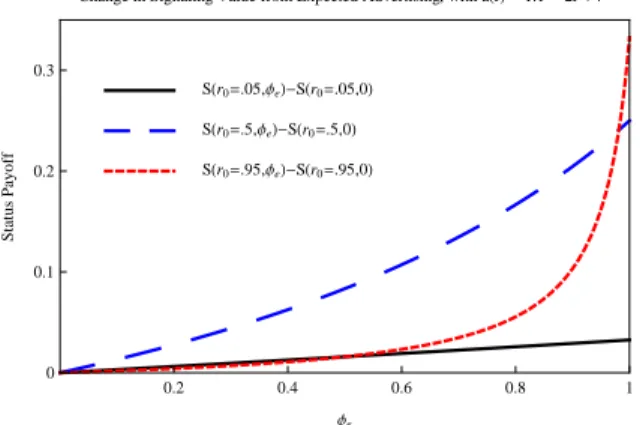
Figure 3
SHr0=.05,ΦeL-SHr0=.05,0L SHr0=.5,ΦeL-SHr0=.5,0L
SHr0=.95,ΦeL-SHr0=.95,0L
0.2 0.4 0.6 0.8 1
0 0.1 0.2 0.3
Φe
Status
Payoff
Change in Signaling Value from Expected Advertising, with aHrL=1.1-2r+r2
Figure 3 plots the signaling value, normalized for purposes of exposition, as a function
of expected advertising intensity, holding r0 fixed at three different values corresponding
to different prices. Both the solid curve (high price), and the dotted curved (low price)
are flatter than the dashed curve (medium price) for most values of expected advertising,
reflecting the non-monotonicity from Proposition 2(i). All three curves are also convex. In
particular, when the price is low, the marginal impact of advertising is usually small but
shoots up when expected advertising approaches one, as the perceived composition of
non-buyers shifts rapidly from the mainly uninformed to a small group of the very poor. These
increasing returns are so strong at low prices that the dotted curve eventually crosses the
dashed curve, reflecting Proposition 2(ii).10
10
This argument, based on the direct impact of expected advertising on the signaling value, does not rely
on any particular functional form foraprq. It will hold more generally whenever the direct impact dominates
The most dramatic increasing returns occur if all consumers want to buy,p0. Then the relationship between expected advertising and stigma is discontinuous. There is no stigma
for any φe P r0,1q, and zero willingness to pay, because buyers and non-buyers are equally wealthy. But when φe equals 1, all consumers are expected to buy. There is then a discrete
jump in willingness to pay, allowing the firm to charge a positive price, as each consumer
understands that not buying will lead others to believe he has the lowest wealth. These
beliefs reflect the fact that willingness to pay is strictly decreasing in wealth, so the poorest
consumer always has the lowest incentive buy.11
This discussion suggests that threshold effects, where a small change in expected
adver-tising can have a large impact on consumer behavior, should mainly occur for low-priced
products. It might seem there is little status reason to buy these products, since they are
not very exclusive. This is indeed the case at most values of expected advertising
inten-sity. However, when expected advertising gets particularly high, status effects will kick in to
increase willingness to pay, and they will do so with a vengeance.
Proposition 2 shows that the price affects how consumers respond to a change in expected
advertising. But can expected advertising itself affect how consumers respond to a change in
price? The question is what happends to willingness to pay when consumers expect price pe
but the firm instead setspp. It turns out that expected advertising will affect consumers’ price sensitivity through two distinct channels. Both channels relate to status concerns but
differ from the stigma effect analyzed so far.
Differentiating willingness to pay with respect to price, holding the expected price
con-stant, yields
dV dp VS
BS Br0
dr0
dp. (14)
Expression (14) shows how informed consumers’ willingness to pay adjusts if the firm
11
They also reflect the spirit of the D1 refinement (Cho and Kreps, 1987), as the set of out-of-equilibrium
beliefs for which not buying is optimal is largest for the poorest consumer. Moreover, willingness to pay
must exhibit some discontinuity atr0φe1, for any beliefs, since limφ
eÑ1sN
p1, φeqlimr
charges a slightly higher price than expected. A higher price results in a lower cutoff,
dr0{dp 0, which affects social status by making the good more exclusive. IfdV{dp¡0, then consumers react to a price increase like snobs, where higher exclusivity increases willingness
to pay. If dV{dp 0, then consumers instead react like conformists, as willingness to pay drops. Which reaction occurs depends on how the signaling value varies with the cutoff,
leading to the following definition from Corneo and Jeanne (1997).
Definition 1. For given p P r0, pHs corresponding to cutoff r0 P r0,1s, consumption is snobbish at r0 if
BS Br0
0, and consumption is conformist at r0 if
BS Br0
¡0.
If consumption is conformist, then demand q φr0 will be relatively price sensitive. A price increase then directly reduces demand, which decreases willingness to pay, which in
turn reduces demand further still. If consumption is snobbish then the situation is reversed.
A price increase then reduces demand directly but the resulting increase in willingness to
pay limits the overall drop in demand.1213
In Corneo and Jeanne (1997), how strongly consumers react to a price change, and
whether they react like conformists or snobs, depends only on the shape of the rank utility
function aprq. I now demonstrate that here, consumers’ reaction will depend on expected advertising. To start, consider how the signaling value depends on both the actual and
expected price. Suppose that consumers expect price pe and the firm sets p. Uninformed
consumers do not observe p so they believe the cutoff is defined by (9) evaluated atpe,
pe Vpr
u
0, Spr
u
0, φeqq, (15) where the superscript stands for uninformed.
Each informed consumer observes p, realizes that uninformed consumers expect pe, and
knows that all other informed consumers realize the same. This allows informed consumers
12
Notice from (10) that|dr0{dp|tends to be large if the two terms in its denominator have opposite signs,
i.e. if consumption is conformist.
13
Whether consumption is snobbish or conformist also influences the size of the stigma effect. From (12)
and (13), the indirect impact of expected advertising on both willingness to pay and the signaling value will
to infer the true cutoff, again defined by pVpr0, Sq, but where the signaling value S now depends both on the true cutoff and on the cutoff perceived by uninformed consumers.
In-formed consumers expect a fractionφeof consumers to infer r0 and the remaining consumers
to perceive ru
0, so (1) implies that buying yields expected status
sBpr0, r
u
0, φeqφesBpr0q p1φeqsBpr
u
0q, with sBpq given by (6). From (2), not buying gives expected status
sNpr0, r
u
0, φeqφesNpr0, φeq p1φeqsNpr
u
0, φeq, with sNpq given by (7). This implies signaling value
Spr0, r
u
0, φeqφe
sBpr0qsNpr0, φeq p1φeq
sBpr
u
0qsNpr
u
0, φeq . (16) Combining (5) and (16), the true cutoff r0 is defined implicitly by
pVpr0, Spr0, r
u
0, φeqq, (17) and can be written as r0pφe, p, peq. When the firm charges the expected price, ppe, then all consumers agree on the cutoff,r0 r
u
0, so that the signaling value (16) and the expression
for the cutoff (17) coincide respectively with (8) and (9) from the earlier analysis.
Consumer reaction to a price change will again depend on BS{Br0, the rate of change of the signaling value with respect to the cutoff. Differentiating (16) with respect to r0 yields
BS Br0
φe B Br0
sBpr0qsNpr0, φeq . (18) The termφethat enters explicitly on the right-hand-side of (18) captures the first channel
through which expected advertising influences price sensitivity. When expected advertising
is low, a price change has little impact on willingness to pay, because the signaling value
varies little with the cutoff. Intuitively, a price change cannot appreciably affect status if the
change is largely unobserved, since it cannot influence the beliefs of uninformed consumers.
to one. This impact then makes demand more price sensitive if consumption is conformist
and less price sensitive if it is snobbish.
Expected advertising can also influence whether willingness to pay increases or decreases
following a price change, so whether consumers react like conformists or snobs. Consider first
the baseline case with φe 1, where the analysis effectively reduces to Corneo and Jeanne (1997). If all consumers are informed, a price increase will push all those on the margin not
to buy, increasing the average wealth of both buyers and non-buyers. This means that the
status of buyers and non-buyers are both decreasing in the cutoff.
If sB drops more quickly than sN, then the signaling valueS sBsN is decreasing in the cutoff and consumption is snobbish. IfsN drops more quickly thansB, then consumption
is conformist. For aprq quadratic, consumption will be snobbish for all r0 P r0,1s if aprq is convex, and conformist for all r0 Pr0,1s if aprq is concave, as depicted in Figures 4 and 5.
Figure 4
sB
sN
0.2 0.4 0.6 0.8 1
0 0.5 1
r0
Status
Payoff
Status Payoff as a Function of Cutoff , withΦe=1, aHrL=1.1-2r+r2
Figure 5
sB
sN
0.2 0.4 0.6 0.8 1
0 0.5 1 1.5 2
r0
Status
Payoff
The situation changes if expected advertising intensity is less than one, so that some
consumers are believed to be uninformed.
Proposition 3. i If consumption is snobbish at r0 P r0,1s when φe 1, then it is also
snobbish at r0 whenever φe P r0,1q. If consumption is conformist at r0 P r0,1q when
φe 1, then it is also conformist at r0 whenever φe is sufficiently close to 1.
ii When φe 1, consumption is snobbish for all r0 sufficiently close to 1. When φe is
sufficiently close to zero, then consumption is snobbish for all r0 Pr0,1s.
Proposition 3 captures a second channel through which expected advertising affects price
sensitivity. It shows that consumption will be snobbish at low prices (r0 close to 1) as long
as some consumers are believed to be uninformed, and it will be snobbish at all prices if their
number is believed to be sufficiently high. In this latter case, a price increase will always
increase willingness to pay even if it would always have the opposite effect in the baseline.
This also means that a sufficiently large increase in expected advertising can lead consumers
to stop behaving like snobs and start behaving like conformists, as illustrated in Figure 6.
Figure 6
sB
sNHΦe=1L
sNHΦe=.95L
sNHΦe=.8L
sNHΦe=.4L
0.2 0.4 0.6 0.8 1
0 0.5 1 1.5 2
r0
Status
Payoff
Status Payoff as a Function of Cutoff , with aHrL=2-2r2
Figure 6 displays the baseline status from Figure 5, where consumption was always
conformist, but now with three additional curves. These curves depict the status from
not buying as a function of the cutoff for different values of expected advertising intensity.
not affect whether consumption is snobbish or conformist, but serves to isolate this second
channel from the first one described above.
Consistent with Proposition 3, consumption is always snobbish when expected advertising
is low, φe .4. When expected advertising is high, φe .95, consumption is largely conformist but is snobbish at low prices, so when the cutoff is close to 1. High expected
advertising in fact makes consumption extremely snobbish at very low prices, as the signaling
value drops sharply towards zero as the cutoff approaches 1. It is only when expected
advertising intensity equals exactly one that consumption is everywhere conformist.14
Low expected advertising results in snobbish consumption because a price change cannot
affect the behavior of uninformed consumers, even if they were to know that the change had
occurred. This means that if most non-buyers are uninformed, then a price increase has little
impact on their purchase decisions and the status associated with not buying. In contrast,
a price increase leads to higher exclusivity and drives up the status associated with buying.
The positive impact on the status of buyers dominates when expected advertising is low,
resulting in a higher signaling value and increased willingness to pay.
Combining both channels by which expected advertising affects the price sensitivity of
demand leads to the following conclusion. If expected advertising is close to zero, consumers
react to a price change in a conventional way, checking whether the new price exceeds their
willingness to pay. If expected advertising is slightly higher, the price increase will itself cause
willingness to pay to increase. This means that a small increase in expected advertising from
a low initial level always makes consumption more snobbish and demand less price sensitive.
In contrast, a large increase in expected advertising can make demand more price sensitive
by making consumption conformist, at least if the price is not too low.
The link between low expected advertising and snobbish consumption also provides
in-sights into the reputational effects in Benabou and Tirole (2006, 2012). These studies show
14
The status from not buying is always non-monotonic in price when φe 1, as shown in Figure 6,
because this status reaches its maximum when non-buyers are on average similar to consumers in the overall
population. This occurs when the price is high, as then most consumers don’t buy, but also when the price
how introducing explicit incentives to take a pro-social action can generate pushback if they
reduce the reputation of types who take the action more than of types who do not, thereby
making the incentives less effective. The parallel here is that willingness to pay will drop
following a price reduction if consumption is snobbish. Applying Proposition 3 suggests that
explicit incentives to take a pro-social action will always generate pushback if the main reason
for avoiding the action is unrelated to these incentives, for example a lack of information.
Since a price reduction can push willingness to pay up or down, it may seem curious
that higher expected advertising always leads to higher willingness to pay. The intuition is
that a small price change, just like increased explicit incentives, only affects the behavior of
types near the margin, whereas increased advertising can generate sales from a wide range
of inframarginal types. This includes some wealthy consumers whose willingness to pay far
exceeds the price. It is the behavior of these wealthy consumers that drives down the status
of non-buyers and ensures that the stigma effect is always positive.
4.
Advertising and Firm Behavior
Turning now to firm behavior, I investigate whether the stigma effect influences the firm’s
incentive to advertise. At least on the surface, it may seem unclear how such influence would
occur, since the stigma effect is associated with expected advertising, and actual advertising
intensity is unobservable. It the firm decided to unexpectedly increase its advertising, then
stigma and willingness to pay would be unchanged, because consumers would not realize
advertising had increased.
To explore how the stigma effect relates to optimal advertising, suppose that consumers
expect pricepe and intensity φe, and the firm sets p and φ. Profits are then
π φpr0KCpφq. (19)
The cutoff r0 is defined by (17), p Vpr0, Spr0, r
u
0, φeqq, with r
u
0 is defined by (15),
pe Vpr
u
0, Spr
u
Differentiating (19) with respect to φ yields the first-order-condition for advertising,
pr0KC 1
pφq0. (20)
Equilibrium advertising must satisfy (20) when evaluated at p pe and φ φe. This condition shows that the firm only considers the classic role of informative advertising when
setting advertising intensity. Advertising generates sales by informing consumers with rank
r ¤ r0, whose willingness to pay exceeds the price. At the optimum, the marginal revenue from these newly informed consumers,pr0, should equal advertising’s marginal cost,KC
1 pφq. Advertising intensity affects marginal costs but not marginal revenue which instead depends
on consumer expectations.
Nonetheless, I now show that the presence of stigma pushes up equilibrium advertising
and profits. I do so by comparing the impact of a drop in advertising costs across two different
scenarios. The first takes into account the stigma effect, as willingness to pay adjusts to the
new signaling value consistent with the new equilibrium advertising intensity. The second
effectively shuts off the stigma effect by fixing willingness to pay at its original level. This
is the level that corresponds to the signaling value that was consistent with the equilibrium
advertising intensity before the cost reduction.
Before stating the result, I make a few additional comments about the first-order-condition
(20) and the cost parameter K. The comparative statics in Proposition 4 will apply to a
solution to (20) that is interior,φφe 1, and that is stable, so for which the left-hand side of (20) is locally decreasing in φ φe when evaluated at the solution. An interior solution will exist if K is sufficiently high or if Cpφq is sufficiently convex.
15 Moreover, if an
inte-rior solution exists, then a simple geometric argument shows that at least one such solution
will be stable and will vary smoothly with K.16 The reason to focus on such a solution in
Proposition 4 is that comparative statics move in a plausible direction: a marginal drop in
advertising costs will lead to a marginal increase in equilibrium advertising.
15
SinceC1
p0q0, equilibrium advertising will be strictly positive wheneverp pH.
16
A sufficient condition for this stable, interior solution to be unique is that the left-hand side of (20) is
Proposition 4. Fix price p pe P p0, pHq. Let φpp, K, Spp, Kqq denote equilibrium
ad-vertising intensity given p, advertising costs K, and the resulting signaling value Spp, Kq;
denote willingness to pay by Vpr, Spp, Kqq given this signaling value. Then the stigma effect
increases the sensitivity of equilibrium advertising with respect to costs. That is, a drop in
advertising costs will lead to a larger increase in equilibrium advertising than it would if
willingness to pay was fixed at Vpr, Spp, Kqq,
d dK
φpp, K, Spp, Kqq
¡
B BK
φpp, K, Spp, Kqq
¡0,
and will also lead to a larger increase in equilibrium profits.
Even though advertising intensity is unobservable, the firm is able to exploit status
concerns in equilibrium, since actual and expected advertising must then coincide. Any
non-zero expectation of advertising will lead to a positive signaling value, which allows the
firm to set a positive price. And a positive price gives the firm an incentive to generate sales
through advertising, as expected by consumers.
The same logic helps explain how equilibrium advertising adjusts to a reduction in costs.
Lower costs push up the optimal advertising intensity, holding consumer expectations
con-stant. But consumers realize that advertising will increase, and understand that others
realize this as well, which increases the stigma associated with not buying. The resulting
higher demand leads the firm to advertise even more, until expected and actual advertising
coincide at a new, higher intensity. As a result, the stigma effect can makes a relatively small
drop in costs translate into a relatively large increase in equilibrium advertising and profits.
Whereas Proposition 4 held price fixed, I now examine the relationship between expected
advertising and equilibrium pricing. Recall that expected advertising influences how strongly
consumers react to a price change and whether they react like conformists or snobs. In what
follows, I take a different approach towards pricing, by exploring how expected advertising
affects the firm’s incentive to set the price that consumers expect.
Differentiating (19) with respect to pyields the first-order-condition for price
φpr0 p dr0
The equilibrium price must satisfy (21) when evaluated at p pe and φ φe, with the cutoffr0 defined by (15) and (17).17 Section 3 showed that this cutoff may depend separately
on the actual price and the expected price, suggesting that the firm may face a problem with
commitment. The optimal price under commitment must also satisfy (21), but wherepe p is imposed before, rather than after, differentiating the cutoff.
Proposition 5 (Commitment). Fix advertising intensity φ φe ¡ 0. Let ppφeq denote
the equilibrium price, given φe, and let pcpφeq denote the optimal price under commitment.
Then the equilibrium price and the commitment price coincide, ppφeq p
c
pφeq, if and only
if φe 1. Moreover, if φe 1, then equilibrium profits are strictly lower than profits under
commitment: π ppφeq, φφe
π p
c
pφeq, φ φe
.
Proposition 5 describes the commitment effect by which high expected advertising helps
the firm commit to a more profitable price. The firm faces a commitment problem in pricing
because willingness to pay depends on the beliefs of uninformed consumers, who will not
observe if it deviates to a different price. The firm also realizes that each informed consumer
understands that the deviation cannot affect uninformed consumer beliefs about his wealth.
Setting an unexpected price effectively allows the firm to help informed consumers mislead
the uninformed. For example, if consumption is snobbish, then willingness to pay may still
remain high after a price reduction, if consumers who are informed believe that many others
don’t realize the good has become less exclusive. Similarly, if consumption is conformist,
willingness to pay may remain high following a price increase if many consumers don’t
realize sales have dropped. Either way the firm can increase profits by deviating away from
the optimal price under commitment. But the temptation to deviate reduces profits in
equilibrium, where uninformed consumers cannot be mislead.18
17
Notice that a solutionppe¡0 to (21) will always exist. The left-hand-side is positive atppe0,
and negative at sufficient highppe, where (11) implies
dr0
dp 0.
18
In Section 3, the fact that uninformed consumers did not observe the price led to the first channel linking
expected advertising to the price sensitivity of demand. The added insight from Proposition 5 is that this
The above logic also explains how the commitment effect helps with pricing. If expected
advertising is low, then informed consumers’ response to a price change reflects their
per-ception that the change is not widely observed. The higher the expected advertising, the
lower the perceived number of uninformed consumers, so the lower the firm’s temptation to
help informed consumers’ mislead them. The commitment problem vanishes when expected
advertising intensity equals one. All consumers then believe that everyone is informed, just
like them, allowing the firm to effectively commit to its price.
The commitment effect reinforces the positive relationship between expected advertising
and actual advertising that arises due to stigma. High expected advertising not only increases
willingness to pay (stigma effect), but also helps the firm with pricing (commitment effect).
Both effects increase marginal revenues and make advertising more attractive.
5.
Targeting and Recognition
I have assumed so far that all consumers are equally likely to receive an ad. But in practice,
firms may be able to engage in targeting, sending ads specifically to consumers who are
more likely to buy. Firms often do just that, carefully deciding which audiences to reach via
specialized cable television, satellite radio, and magazines (Esteban et al., 2006). Targeting
has also become easier over time, in particular for online advertising, as technology improves
(Johnson 2013, Esteves and Resende 2013). Previous work has focused on costs, suggesting
that firms will use targeting if it is the cheapest way to inform potential buyers
(Hernandez-Garcia 1997, Esteban et al. 2001 and Esteban et al. 2006). This section instead focuses on
revenues by exploring the link between targeting and willingness to pay.
Specifically, I now assume the firm can choose how closely to target wealthy consumers,
by setting both intensity φ and targeting tP r0,1s. Only consumers r Pr0, ts can receive an ad and each does so with probability φ.19 Setting t
1 corresponds to broad advertising
19
This particular targeting technology is also used in Hernandez-Garcia (1997), Esteban et al. (2001) and
as considered in the previous sections. I assume that informed consumers can observe t, so
they understand the reach of the medium through which they receive an ad.
Given advertising intensity φ and targeting t, let Cpφ, tq denote advertising costs, which are finite for all pφ, tq P r0,1s
r0,1s. I assume Cφp0, tq 0 for all t P r0,1s. I also assume Cφpφ, tq¡0 whenφ¡0, withCφφpφ, tq¡0, andCtpφ, tq¡0, so it is always costly to inform more consumers, whether through higher intensity or lower targeting. Ctpφ, tq¡0 amounts to assuming there are no cost diseconomies to targeting. That is, to inform a given measure
of consumers with rank r P r0, r0s, it is always cheaper to target these consumers directly, tr0, than to advertise more broadly.
Surprisingly, the firm’s ability to use targeted advertising may actually reduce profits.
Proposition 6. In equilibrium, the firm will target ads precisely on consumers who are
willing to buy, t r0. However, if advertising costsK are sufficiently low, then equilibrium
profits would be higher if the firm could commit to advertise as broadly as possible, t1.
In line with previous work on targeting, the firm targets ads on potential buyers to save
on costs. Advertising more broadly would mean that some ads reach poor consumers who
will never buy, so a higher intensity would be needed to reach a given number of buyers.
The novel result is that the firm may suffer from its ability to target, even though it retains
the option to advertise broadly. This occurs because the firm faces a commitment problem
with respect to targeting which exacerbates its commitment problem with respect to price.
The firm benefits if informed consumers believe that many others are also informed, even
consumers who will not buy, because of the commitment effect from Section 4. For any given
expected intensity, expectations of broader advertising allow the firm to set a price closer
to the optimal level under commitment. But the firm cannot credibly commit to advertise
broadly if it can deviate to targeting and save on costs. Thus, from the firm’s perspective,
advances in advertising technology that make targeting possible may actually be undesirable,
if their negative impact on commitment outweighs their positive impact on costs.
In practice, a good deal of advertising doesn’t just inform consumers by allowing them
different products and distinguish them from one another when displayed by others.20 The
importance of recognition is echoed in the marketing literature on brand image: a brand
can be thought of as an idea that is more powerful if widely shared. More people should
therefore be familiar with the brand than just the consumers who buy (Kotler and Keller,
2008). For example, it is precisely because everyone knows BMW and what it stands for,
even those who will never buy a BMW, that the brand has so much power (Kapferer, 2008).
To explore the relationship between advertising, recognition, and social status, I now
assume that advertising allows consumers both to buy the conspicuous good and to recognize
it when others buy. The status payoff of consumer r1
, conditional on whether he buys,
br P t0,1u, depends on the beliefs of another consumer r 1
with whom he is later matched. I
incorporate recognition into the analysis by assuming that consumer r1
only observes br if
he himself received an ad. This means that only φet consumers are expected to distinguish
between those who buy and those who don’t. For given r0 r
u
0, t, and φe, the signaling value is therefore reduced to a fraction φet of its value in the earlier analysis.
This change means that expected advertising now affects the signaling value in two ways.
It affects whether non-buyers are mainly perceived as poor or uninformed, as before, and
whether buyers and non-buyers expect to be distinguished from one another. This latter
recognition effect will also influence the firm’s incentive to use targeting advertising.
Proposition 7 (Recognition). Suppose that advertising is necessary for recognition, so
a consumer can only observe whether someone bought the conspicuous good if he himself
received an ad. Then when advertising costs K are sufficiently low, the firm will advertise
as broadly as possible, t1.
When advertising promotes recognition, the firm may choose to advertise to consumers
who are unwilling to buy, in sharp contrast to previous conclusions in the literature on
targeting. This result is unrelated to commitment issues related to pricing. Such issues are
20
For example, the fact that a new high-end smartphone is visible to observers may not be enough to
influence beliefs about its owner, unless observers are informed enough to distinguish that particular phone
no longer present, since uninformed consumers cannot recognize the conspicuous good, so
their beliefs cannot affect the signaling value. The result is also not driven by stigma, since
informing consumers who don’t buy cannot affect whether non-buyers are mainly poor or
uninformed.
Broad advertising arises from the need to convince consumers who buy that they will be
recognized and appreciated by those who don’t. Targeting is effective at reaching buyers,
but broad advertising can inform more consumers overall. When costs are low, this leads
the firm to advertises broadly and with high intensity to maximize recognition. It has no
incentive to unexpectedly revert to targeting, since informed consumers would observe this
deviation and reduce their willingness to pay.
The recognition effect suggests firms may choose to advertise broadly, not to directly
generate sales, but to strengthen brand image, as also expressed by Miller (2009):
The luxury brands with the highest brand equity ... advertise in Vogue and
GQ not so much to inform rich potential consumers that they exist, but to
reas-sure rich potential consumers that poorer Vogue and GQ readers will recognize
and respect these brands when they see them displayed by others. (Miller 126)
Kapferer and Bastien (2009) make a similar point in what they call an anti-law of marketing
for luxury goods. That is, a firm will benefit if many people are familiar with its brand, and
traditional advertising campaigns may be ineffective if they focus only on the target market.
6.
Welfare
I now briefly consider the link between expected advertising and welfare in the setting from
Sections 3 and 4. The following result echoes that in Corneo and Jeanne (1997).
Proposition 8. SupposepP p0, pHq, so thatr0 Pp0,1q. Then banning sale of the conspicuous
good will increase the total payoff of consumers. It will increase the payoff of every consumer
if
upwr 0
qu wr 0
Vpr0, Spr0, φqq
¡ ³
r0
0 aprqdr r0
»
1
0
which can only hold if expected advertising intensity φe is sufficiently high.
From a consumer welfare perspective, sale of the conspicuous good amounts to pure
waste, since aggregate status remains constant. Sales simply redistribute status from poor
consumers who don’t buy to wealthy consumers who do. These buyers also consume less of
the numeraire good, which reduces their intrinsic payoff. It follows that an advertising or
sales ban may be attractive both for reasons of efficiency and equity. It will increase consumer
payoffs in the aggregate, and in particular the payoff of non-buyers, who are relatively poor.
The new element of Proposition 8 compared with Corneo and Jeanne (1997) is that high
expected advertising is necessary for a ban to benefit all consumers. In principle, wealthy
buyers may end up paying such a high price to avoid stigma that a ban would leave them
all better off. This can only occur if high expected advertising makes the stigma effect
sufficiently strong. The extreme case is where expected advertising intensity and the cutoff
are both equal to one. All consumers then buy, sacrificing consumption of the numeraire
good in order to avoid appearing very poor, but they end up with the same status they
would have obtained if nobody bought at all.
7.
Conclusion
This paper explores the social side of informative advertising, where advertising is seen as tool
to exploit consumer desires for social status. Explicitly modeling the relationship between
expected advertising, consumer beliefs, and status, generates a variety of novel insights.
These include the idea that expected advertising can increase willingness to pay by exploiting
stigma, and that small changes in consumer expectations can have large effects; that expected
advertising can affect the price sensitivity of demand, influence whether consumers behave
like conformists or snobs, and help the firm commit to a more profitable price; and that
the firm’s ability to target ads at high-valuation consumers may actually reduce profits. By
exploring the link between advertising and recognition, I also provide an explanation for the
these issues may all appear different, but the analysis suggests they are linked by a common
thread: how advertising affects the social pressure to consume.
Appendix
Proof of Proposition 1. Suppose φe P p0,1q and p P p0, pHq, which implies r0 P p0,1q.
Implicitly differentiating (9) with respect to dφe and rearranging gives
dr0
dφe
1 Vr0 Vs
BS Br0
VS
BS Bφe
. (22)
The expression in large brackets is strictly positive by (11), and VS ¡0 holds by (4). To show BS
Bφe
¡0, use (6), (7), and (8) to write
BS Bφe
³
r0
0 aprqdrp1φer0qr0p1φeq ³
r0
0 aprqdrr0 ³
1
r0a
prqdr p1φer0q
2 . (23)
Simplifying yields
r0
p1φer0q
2
³
r0
0 aprqdr r0
»
1
0
aprqdr
,
which is strictly positive by a1
prq 0. It follows from (22) that
dr0
dφe
¡ 0, which in turn implies dpφr0q
dφe
φ
dr0
dφe
¡0. From (6), write dsB dφe dsB dr0 dr0 dφe
apr0q ³r
0 0 aprqdr
r0 r0 dr0 dφe .
The expression in large brackets is strictly negative by a1
prq 0. Hence
dr0
dφe
¡0 also implies
dsB
dφe
0. By
dr0
dφe
¡0 and the definition ofr0in (9), a marginal increase in expected advertising gives consumer rr0 a strict incentive to buy. Willingness to pay is Vpr, Spr0, φeqq, hence
dV dφe |r r0
VS|r r0
dS dφe
¡0. Combining with VS|r
r0
¡ 0 from (4) then yields
dS dφe
¡ 0. But (4) also implies VS ¡ 0 for all r Pr0,1s, hence
holds for all consumers r Pr0,1s.
Proof of Proposition 2. Suppose that φe 1. For part (i), Proposition 1 showed that
dV dφe
¡0 whenever pP p0, pHq, for all consumers r Pr0,1s. Consider instead p0 or p¥pH, so that r0 P t0,1u. Direct substitution of r0 P t0,1u into (23) yields
BS Bφe
0, so that (22) implies dr0
dφe
0. Combining with (13) in turn implies
dV dφe
0. For part (ii), write B
Bp
Vpr, Spr0p1, pq,1qqVpr, Spr0pφe, pq, φeqq
as
VS
BSpr0p1, pq,1q Br0
dr0p1, pq dp
VS
BSpr0pφe, pq, φeq Br0
dr0pφe, pq dp
, (24)
with VS ¡0, and where (10) and (11) imply
dr0pφe,pq
dp 0. Thus, to establish that (24) is strictly negative, it is sufficient to show that
BSpr0p1,pq,1q Br0
0 and
BSpr0pφe,pq,φeq Br0
0. Since rank utility is linear, write aprqABr, whereB ¡0. This implies
»
r0
0
aprqdrAr0 B 2r 2 0, and » 1 r0
aprqdrA B 2 Ar0 B 2r 2 0 ,
which can be substituted into (8) to give
Spr0, φeqA B
2r0
p1φeqpAr0
B
2r 2
0q pA
B
2qpAr0
B
2r 2 0q 1φer0
.
Simplifying yields
Spr0, φeq
1r0 1φer0
B
2. The derivative of Spr0, φeq with respect to the cutoff is therefore
BSpr0, φeq Br0
p1φeq p1φer0q
2
B 2,
so that
BSpr0p1,pq,1q Br0
0 and
BSpr0pφe,pq,φeq Br0
Proof of Proposition 3. I first show that B Br0
pSpr0,1qSpr0, φeqq¡ 0 for all φe P r0,1q, which will mean that B
Br0
Spr0,1q 0 implies B Br0
Spr0, φeq 0. From (6), (7), and (8), write
Spr0,1qSpr0, φeq
p1φeq ³
r0
0 aprqdr ³
1
r0a
prqdr 1φer0
³
1
r0a
prqdr p1r0q
,
or equivalently
p1φeqr0 1φer0
³
r0
0 aprqdr r0
³
1
r0a
prqdr 1r0
, (25)
where the expression in large brackets in (25) is just Spr0,1q. Thus,
B Br0
pSpr0,1qSpr0, φeqq
p1φeqp1φer0q φep1φeqr0q p1φer0q
2
Spr0,1q
p1φeqr0 1φer0
BSpr0,1q Br0
,
which simplifies to
p1φeq p1φer0q
2
Spr0,1q r0p1φer0q
BSpr0,1q Br0
. (26)
SinceSpr0,1q¡0, a sufficient condition for (26) to be strictly positive is B Br0
pr0Spr0,1qq¡ 0. Again using (6), (7) and (8), write
r0Spr0,1q »
r0
0
aprqdr r0
1r0 »
1
r0
aprqdr, so that
Bpr0Spr0,1qq Br0
apr0q
r0
1r0
apr0q 1
p1r0q
2
»
1
r0
aprqdr,
1 1r0
apr0q ³
1
r0a
prqdr 1r0
,
which is strictly positive by a1
prq 0. To complete part (i), fix r0 P r0,1q. Then (26) shows that limφeÑ1
B Br0
pSpr0,1qSpr0, φeqq0. Thus, forφesufficiently close to 1, B Br0
Spr0,1q¡0 implies B
Br0
Spr0, φeq¡0.
For part (ii), fix φe Pp0,1q. From (6), write
BsB Br0
apr0q
1
r0
³
r0
0 aprqdr r0