A Dictionary of Wisdom and Wit:
Learning to Extract Quotable Phrases
∗Michael Bendersky Dept. of Computer Science University of Massachusetts
Amherst, MA
David A. Smith Dept. of Computer Science University of Massachusetts
Amherst, MA
Abstract
Readers suffering from information overload have often turned to collections of pithy and famous quotations. While research on large-scale analysis of text reuse has found effective methods for detecting widely disseminated and famous quotations, this paper explores the complementary problem of detecting, from internal evidence alone, which phrases are quotable. These quotable phrases are mem-orable and succinct statements that people are likely to find useful outside of their original context. We evaluate quotable phrase extrac-tion using a large digital library and demon-strate that an integration of lexical and shallow syntactic features results in a reliable extrac-tion process. A study using a reddit commu-nity of quote enthusiasts as well as a simple corpus analysis further demonstrate the prac-tical applications of our work.
1 Introduction
Readers have been anxious about information over-load for a long time: not only since the rise of the web, but with the earlier explosion of printed books, and even in manuscript culture (Blair, 2010). One traditional response to the problem has been ex-cerpting passages that might be useful outside their original sources, copying them into personal com-monplace books, and publishing them in dictionaries such as Bartlett’s Familiar Quotations or the Oxford
∗“The book is a dictionary of wisdom and wit...” (Samuel
Smiles, “A Publisher and His Friends”) This and all the subse-quent quotations in this paper were discovered by the proposed quotable phrase extraction process.
Dictionary of Quotations. Even on the web,
collec-tion of quotable phrases continues to thrive1, as evi-denced by the popularity of quotation websites such as BrainyQuote and Wikiquote.
According to a recent estimate, there are close to 130 million unique book records in world li-braries today (Taycher, 2010). Many of these books are being digitized and stored by commercial providers (e.g., Google Books and Amazon), as well as non-profit organizations (e.g., Internet Archive and Project Gutenberg).
As a result of this digitization, the development of new methods for preserving, accessing and ana-lyzing the contents of literary corpora becomes an important research venue with many practical appli-cations (Michel et al., 2011). One particularly in-teresting line of work in these large digital libraries has focused on detecting text reuse, i.e., passages from one source that are quoted in another (Kolak and Schilit, 2008).
In contrast, in this paper we explore the modeling of phrases that are likely to be quoted. This phrase modeling is done based on internal evidence alone, regardless of whether or not the phrase actually is quoted in existing texts.
We call such potential quotation a quotable phrase – a meaningful, memorable, and succinct statement that can be quoted without its original context. This kind of phrases includes aphorisms, epigrams, maxims, proverbs, and epigraphs.
1“Nothing is so pleasant as to display your worldly
wis-dom in epigram and dissertation, but it is a trifle tedious to hear another person display theirs.” (Kate Sanborn, “The Wit of Women”)
Book
Sentence Segmentation
Naive Bayes Filtering
Quotable Phrase Detection
Labeled Quotation Set External
Quotation Set
[image:2.612.101.506.55.152.2]Extracted Quotes
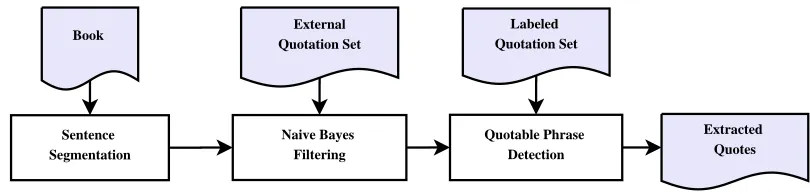
Figure 1: Diagram of the quotable phrase extraction process.
A computational approach to quotable phrase ex-traction has several practical applications. For in-stance, it can be used to recommend new additions to existing quotable phrase collections, especially fo-cusing on lesser read and studied authors and liter-ary works2. It can also generate quotable phrases that will serve as catchy and entertaining previews for book promotion and advertisement3.
In this work, we describe such a computational approach to quotable phrase extraction. Our ap-proach leverages the Project Gutenberg digital li-brary and an online collection of quotations to build a quotable language model. This language model is further refined by a supervised learning algorithm that combines lexical and shallow syntactic features. In addition, we demonstrate that a computational approach can help to address some intriguing ques-tions about the nature of quotability. What are the lexical and the syntactic features that govern the quotability of a phrase? Which authors and books are highly quotable? How much variance is there in the perceived quotability of a given phrase?
The remainder of this paper is organized as fol-lows. In Section 2 we provide a detailed description of the entire process of quotable phrase extraction. In Section 3 we review the related work. In Sections 4 and 5 we evaluate the quotable phrase extraction process, and provide some corpus quotability analy-sis. We conclude the paper in Section 6.
2 Quotable Phrase Extraction
There are three unique challenges that need to be addressed in the design of the process of quotable
2
“There is life in a poet so long as he is quoted...” (Sir Alfred Comyn Lyall, “Studies in Literature and History”)
3
As an example, see the “Popular Highlights” feature for Kindle e-books in the Amazon bookstore.
phrase extraction. The first challenge stems from the fact that the boundaries of potential quotes are often ambiguous. A quotable phrase can consist of a sen-tence fragment, a complete sensen-tence, or a passage of text that spans several sentences.
The second challenge is that the occurrence of quotable phrases is a rare phenomena in literary cor-pora. A randomly selected book passage is unlikely to be quotable without any additional context.
The third challenge is related to the syntax and se-mantics of quotable phrases. For instance, consider the phrase
“Evil men make evil use of the law, though the law is good, while good men die well, al-though death is an evil.” (Thomas Aquinas, “Summa Theologica”)
and contrast it with
“Of the laws that he can see, the great se-quences of life to death, of evil to sorrow, of goodness to happiness, he tells in burning words.” (Henry Fielding, “The Soul of a Peo-ple”)
While both of these phrases share a common vocab-ulary (law, death, good and evil), the latter sentence contains unresolved pronouns (he, twice) that make it less amenable to quotation out of context.
Accordingly, we design a three-stage quotable phrase extraction process, with each stage corre-sponding to one of challenges described above. The diagram in Figure 1 provides a high-level overview of the entire extraction process on a single book. Next, we provide a brief description of this diagram. Then, in the following sections, we focus on individ-ual stages of the extraction process.
(Sentence Segmentation) we segment the text of the input book into sentences using an implementation of the Punkt sentence boundary detection algorithm (Kiss and Strunk, 2006). In an initial experiment, we found that 78% of the approximately 4,000 quota-tions collected from the Quotaquota-tionsPage4 consist of a single sentence. From now on, therefore, we make a simplifying assumption that an extracted quotable phrase is confined within the sentence boundaries.
The second processing stage (Na¨ıve Bayes
Filter-ing) aims to address the second challenge (the
rar-ity of quotable phrases) and significantly increases the ratio of quotable phrases that are considered as candidates in the final processing stage (Quotable
Phrase Detection). To this end, we use a set of
quo-tations collected from an external resource to build a
quotable language model. Only sentences that have
a sufficiently high likelihood of being drawn from this language model are considered at the final pro-cessing stage.
For this final processing stage (Quotable Phrase
Detection), we develop a supervised algorithm that
focuses on the third challenge, and analyzes the syn-tactic structure of the input sentences. This super-vised algorithm makes use of structural and syntac-tic features that may effect phrase quotability, in ad-dition to the vocabulary of the phrase.
2.1 Na¨ıve Bayes Filtering
In order to account for the rarity of quotable phrases in the book corpus, we use a filtering approach based on a pre-built quotable language model. Using this filtering approach, we significantly reduce the num-ber of sentences that need to be considered in the su-pervised quotable phrase detection stage (described in Section 2.2). In addition, this approach increases the ratio of quotable phrases considered at the super-vised stage, addressing the problem of the sparsity of positive examples.
To build the quotable language model, we boot-strap the existing quotation collections on the web. In particular, we collect approximately 4,000 quotes on more than 200 subjects from the QuotationsPage. This collection provides a diverse set of high-quality quotations on subjects ranging from Laziness and
Genius to Technology and Taxes.
4www.quotationspage.com
Then, we build two separate unigram language models. The first one is the quotable language model, which is built using the collected quotations (LQ). The second one is the background language model, which is built using the entire book corpus (LC). Using these language models we compute a log-likelihood ratio for each processed sentence s, as
LLRs=
X
w∈s
lnp(w|LQ)
p(w|LC)
, (1)
where the probabilitiesp(w|·)are computed using a maximum likelihood estimate with add-one smooth-ing.
A sentencesis allowed to pass the filtering stage if and only ifLLRs ∈ [α, β], where α, β are posi-tive constants5. The lower bound on the LLRs,α, requires the sentence to be highly probable given the quotable language modelLQ. The upper bound on theLLRs,β, filters out sentences that are highly
im-probable given the background language modelLC. Finally, the sentences for which LLRs ∈ [α, β] are allowed to pass through the Na¨ıve Bayes filter. They are forwarded to the next stage, in which a su-pervised quotable phrase detection is performed.
2.2 Supervised Quotable Phrase Detection
In a large corpus, a supervised quotable phrase de-tection method needs to handle a significant num-ber of input instances (in our corpus, an average-sized book contains approximately 2,000 sentences). Therefore, we make use of a simple and efficient perceptron algorithm, which is implemented follow-ing the description by Bishop (2006).
We note, however, that the proposed supervised detection method can be also implemented using a variety of other binary prediction techniques. In an initial experiment, we found that more complex methods (e.g., decision trees) were comparable to or worse than the simple perceptron algorithm.
Formally, we define a binary functionf(s)which determines whether an input sentencesis a quotable (q) or a non-quotable (q) phrase, based on:
f(s) = (
q ifwxs>0
q else, (2)
5
Feature Description
Lexical
LLR Sentence log-likelihood ratio (Eq. 1)
#word Number of words ins.
#char Number of characters ins.
wordLenAgg Feature for each aggregateAggof word length ins.
Agg={min, max, mean}
#capital Number of capitalized words ins.
#quantifier Number of universal quantifiers ins(from a list of 13 quantifiers, e.g., all, whole, nobody).
#stops Number of common stopwords ins.
beginStop Trueifsbegins with a stopword,Falseotherwise.
hasDialog Trueifscontains at least one of the three common dialog terms{say, says, said}.
#abstract Number of abstract concepts (e.g., adventure, charity, stupidity ) ins. Punctuation
hasP Five features to indicate whether punctuation of typePis present ins.
P={quotations, parentheses, colon, dash, semi-colon}. Parts of Speech
#POS Four features for the number of occurrences of part-of-speechPOSins.
POS={noun, verb, adjective, adverb, pronoun}.
hasComp Trueifscontains a comparative adjective or adverb,Falseotherwise.
hasSuper Trueifscontains a superlative adjective or adverb,Falseotherwise.
hasPP Trueifscontains a verb in past participle,Falseotherwise.
[image:4.612.78.535.56.337.2]#IGSeq[i] Count of the POS sequence with thei-th highestIG(X, Y)(Eq. 3) ins.
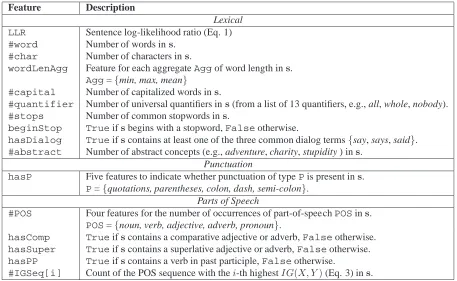
Table 1: Description of the quotability features that are computed for each sentences.
where xs is a vector of quotability features com-puted for the sentence s, and wis a weight vector associated with these features. The weight vectorw
is updated using stochastic gradient descent on the perceptron error function (Bishop, 2006).
Since Eq. 2 demonstrates that the supervised quotable phrase detection can be formulated as a standard binary classification problem, its success will be largely determined by an appropriate choice of feature vector xs. As we are unaware of any previous work on supervised detection of quotable phrases, we develop an initial set of easy-to-compute features that considers the lexical and shallow syn-tactic structure of the analyzed sentence.
2.3 Quotability Features
A decision about phrase quotability is often sub-jective; it is strongly influenced by personal taste and circumstances6. Therefore, the set of features that we describe in this section is merely a coarse-grained approximation of the true intrinsic qualities of a quotable phrase. Nevertheless, it is important to
6
“One man’s beauty another’s ugliness; one man’s wisdom another’s folly.” (Ralph Waldo Emerson, “Essays”)
note that these features do prove to be beneficial in the context of the quote detection task, as is demon-strated by our empirical evaluation in Section 5.
Table 1 details the quotability features, which are divided into 3 groups: lexical, punctuation-based and POS-based features. All of these features are conceptually simple and can be efficiently computed even for a large number of input sentences.
Some of these features are inspired by existing text analysis tasks. For instance, work on readabil-ity detection for the web (Kanungo and Orr, 2009; Si and Callan, 2001) examined features which are similar to the lexical features in Table 1. Parts of
speech features (e.g., the presence of comparative
and superlative adjectives and adverbs) have been extensively used for sentiment analysis and opinion mining (Pang and Lee, 2008).
In addition, we use a number of features based on simple hand-crafted word lists. These lists include word categories that could be potential indicators of quotable phrases such as universal quantifiers (e.g.,
all, everyone) and abstract concepts7.
7
The novel features in Table 1 that are specifically designed for quotable phrase detection are based on part of speech sequences that are highly indicative of quotable (or, conversely, non-quotable) phrase (features #IGSeq[i]). In order to compute these features we first manually label a validation set of 500 sentences that passed the Na¨ıve Bayes Filtering (Section 2.1). Then, we apply a POS tagger to these sentences, and for each POS tag sequence of length
n,seqn, we compute its information gain
IG(X, Y) =H(X)−H(X|Y). (3)
In Eq. 3,Xis a binary variable indicating the pres-ence or the abspres-ence of seqn in the sentence, and
Y ∈ {q, q}.
We selectksequencesseqnwith the highest value ofIG(X, Y)8. We use the count in the sentence of
the sequenceseqnwith thei-th highest information gain as the feature#IGSeq[i]. Intuitively, the fea-tures #IGSeq[i]measure how many POS tag se-quences that are indicative of a quotable phrase (or, conversely, indicative of a non-quotable phrase) the sentence contains.
3 Related Work
The increasing availability of large-scale digital li-braries resulted in a recent surge of interest in com-putational approaches to literary analysis. To name just a few examples, Genzel et al. (2010) examined machine translation of poetry; Elson et al. (2010) extracted conversational networks from Victorian novels; and Faruqui and Pad´o (2011) predicted for-mal and inforfor-mal address in English literature.
In addition, computational methods are increas-ingly used for identification of complex aspects of writing such as humor (Mihalcea and Pulman, 2007), double-entendre (Kiddon and Brun, 2011) and sarcasm (Tsur et al., 2010). However, while successful, most of this work is still limited to an analysis of a single aspect of writing style.
In this work, we propose a more general compu-tational approach that attempts to extract quotable phrases. A quotability of a phrase can be affected by various aspects of writing including (but not
lim-8
In this work, we setn = 3, k = 50. This setting is done prior to seeing any labeled data.
Number of books 21,492
Number of authors 8,889
Total sentences 4.45·107
[image:5.612.332.520.56.113.2]After Na¨ıve Bayes filtering 1.75·107
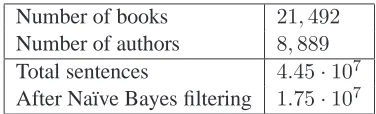
Table 2: Summary of the Project Gutenberg corpus.
ited to) humor and irony9, use of metaphors10, and hyperbole11.
It is important to note that our approach is con-ceptually different from the previous work on para-phrase and quote detection in book corpora (Kolak and Schilit, 2008), news stories (Liang et al., 2010) and movie scripts (Danescu-Niculescu-Mizil et al., 2012). While this previous work focuses on mining popular and oft-used quotations, we are mainly in-terested in discovering quotable phrases that might have never been quoted by others.
4 Experimental Setup
To evaluate the quotable phrase extraction process in its entirety (see Figure 1), we use a collection of Project Gutenberg (PG) books12 – a popular digital library containing full texts of public domain books in a variety of formats. In particular, we harvest the entire corpus of 21,492 English books in textual for-mat from the PG website.
The breakdown of the PG corpus is shown in Ta-ble 2. The number of detected sentences in the PG corpus exceeds 44 million. Roughly a third of these sentences are able to pass through the Na¨ıve Bayes Filtering (described in Section 2.1) to the supervised quotable phrase detection stage (Section 2.2).
For each of these sentences, we compute a set of lexical and syntactic features described in Section 2.3. For computing the features that require the part of speech tags, we use the MontyLingua package (Liu, 2004).
9“To be born with a riotous imagination and then hardly ever
to let it riot is to be a born newspaper man.” (Zona Gale, “Ro-mance Island”)
10
“If variety is the spice of life, his life in the north has been one long diet of paprika.” (Fullerton Waldo, “Grenfell: Knight-Errant of the North”)
11“The idea of solitude is so repugnant to human nature, that
even death would be preferable.” (William O.S. Gilly, “Nar-ratives of Shipwrecks of the Royal Navy; between 1793 and 1849”)
0.0 0.2 0.4 0.6 0.8 1.0
0.2
0.4
0.6
0.8
1.0
Precision−Recall Curves
Recall
Precision
[image:6.612.334.518.55.178.2]Word Features All Features
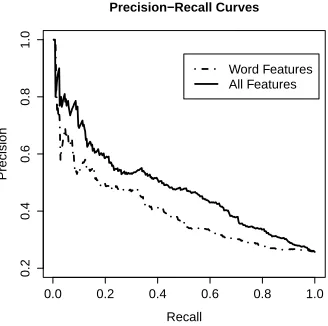
Figure 2: Prec. vs. recall for quotable phrase detection.
We find that the extraction process shown in Fig-ure 1 is efficient and scalable. On average, the entire process requires less than ten seconds per book on a single machine.
The complete set of extracted quotable phrases and annotations is available upon request from the authors. In addition, the readers are invited to visit
www.noisypearls.com, where a quotable phrase from the set is published daily.
5 Evaluation and Analysis
5.1 Na¨ıve Bayes Filtering Evaluation
In the Na¨ıve Bayes Filtering stage (see Section 2.1) we evaluate two criteria. First, we measure its abil-ity to reduce the number of sentences that pass to the supervised quotable phrase detection stage. As Ta-ble 2 shows, the Na¨ıve Bayes Filtering reduces the number of these sentences by more than 60%.
Second, we evaluate the recall of the Na¨ıve Bayes Filtering. We are primarily interested in its ability to reliably detect quotable phrases and pass them through to the next stage, while still reducing the total number of sentences.
For recall evaluation, we collect a set of
2,817 previously unseen quotable phrases from the
Goodreads website13, and run them through the Na¨ıve Bayes Filtering stage. 2,262 (80%) of the quotable phrases pass the filter, indicating a high quotable phrase recall.
13http://www.goodreads.com/quotes
1 #abstract +91.64
2 #quantifier +61.67
3 hasPP −60.34
4 #IGSeq[16](VB IN PRP) +39.71
5 #IGSeq[6](PRP MD VB) −38.78
6 #adjective +37.71
7 #IGSeq[14](DT NN VBD) −36.88
8 #verb +35.22
9 beginStop +31.73
[image:6.612.99.263.66.229.2]10 #noun +29.63
Table 3: Top quotability features.
Based on these findings, we conclude that the pro-posed Na¨ıve Bayes Filtering is able to reliably detect quotable phrases, while filtering out a large number of non-quotable ones. It can be further calibrated to reduce the number of non-quotable sentences or to increase the quotable phrase recall, by changing the setting of the parametersαandβ, described in Sec-tion 2.1. In the remainder of this secSec-tion, we use its output to analyze the performance of the supervised quotable phrase detection stage.
5.2 Quotable Phrase Detection Evaluation
To evaluate the performance of the supervised quotable phrase detection stage (see Section 2.2) we randomly sample 1,500 sentences that passed the Na¨ıve Bayes Filtering (this sample is disjoint from the sample of 500 sentences used for computing the IGTagSeq feature in Section 2.3). We anno-tate these sentences withq (Quotable) andq
(Non-Quotable) labels.
Of these sentences, 381 (25%) are labeled as
Quotable. This ratio of quotable phrases is much
higher than what is expected from a non-filtered con-tent of a book, which provides an indication that the Na¨ıve Bayes Filtering provides a relatively balanced input to the supervised detection stage.
We use this random sample of 1,500 labeled sen-tences to train a perceptron algorithm (as described in Section 2.2) using 10-fold cross-validation. We train two variants of the perceptron. The first variant is trained using only the lexical features in Table 1, while the second variant uses all the features.
Popular ⇑≥10 12
Upvoted 1≤⇑≤10 34
No upvotes ⇑≤0 14
[image:7.612.108.264.57.115.2]p(⇑>0) = .77
Table 4: Distribution of reddit upvote scores.
quote phrase detection at all recall levels. For in-stance at the 0.4 recall level, it can improve precision by almost 25%.
Figure 2 also shows that the proposed method is reliable for high-precision quotable phrase de-tection. This is especially important for applica-tions where recall is given less consideration, such as book preview using quotable phrases. The pro-posed method reaches a precision of 0.7 at the 0.1 recall level.
It is also interesting to examine the importance of different features for the quotable phrase detection. Table 3 shows the ten highest-weighted features, as learned by the perceptron algorithm on the entire set of 1,500 labeled examples.
The part of speech features #IGTagSeq[i] oc-cupy three of the positions in the Table 3. It is inter-esting to note that two of them have a high negative
weight. In other words, some of the POS sequences
that have the highest information gain (see Eq. 3) are sequences that are indicative of non-quotable phrases, rather than quotable phrases.
The two highest-weighted features are based on handcrafted word lists (#abstract and
#quantifier, respectively). This demonstrates the importance of task-specific features such as these for quotability detection.
Finally, the presence of different parts of speech in the phrase (nouns, verbs and adjectives), as well as their verb tenses, are important features. For instance, the presence of a verb in past participle (hasPP) is a strong negative indicator of phrase quotability.
5.3 The reddit Study
As mentioned in Section 2.3, the degree of the phrase quotability is often subjective, and therefore its estimation may vary among individuals. To val-idate that our quotability detection method is not biased by our training data, and that the detected quotes will have a universal appeal, we set up a
veri-fication study that leverages an online community of quote enthusiasts.
For our study, we use reddit, a social content web-site where the registered users submit content, in the form of either a link or a text post. Other regis-tered users then upvote or downvote the submission, which is used to rank the post.
Specifically, we use the Quotes subreddit14, an ac-tive reddit community devoted to discovering and sharing quotable phrases. At the time of this writ-ing, the Quotes subreddit has more than 12,000 sub-scribers. A typical post to this subreddit contains a single quotable phrase with attribution. Any reddit user can then upvote or downvote the quote based on its perceived merit.
To validate the quality of the quotes which were used for training the perceptron algorithm, we sub-mitted 60 quotes, which were labeled as quotable by one of the authors, to the Quotes subreddit. At most one quote per day was submitted, to avoid negative feedback from the community for “spamming”.
Table 4 presents the upvote scores of the submit-ted quotes. An upvote score, denosubmit-ted⇑, is computed as
⇑= #upvotes −#downvotes.
Table 4 validates that the majority of the quotes la-beled as quotable, were also endorsed by the
red-dit community, and received a non-negative upvote
score. As an illustration, in Table 5, we present five quotes with the highest upvote scores. Anecdotally, at the time of this writing, only one of the quotes in Table 5 (a quote by Mark Twain) appeared in web search results in contexts other than the origi-nal book.
5.4 Project Gutenberg Corpus Analysis
In this section, we briefly highlight an interesting ex-ample of how the proposed computational approach to quotable phrase extraction can be used for a liter-ary analysis of the PG digital librliter-ary. To this end, we train the supervised quotable phrase detection method using the entire set of 1,500 manually la-beled sentences. We then run this model over all the 17.5 million sentences that passed the Na¨ıve Bayes filtering stage, and retain only the sentences that get positive perceptron scores (Eq. 2).
Quote ⇑
“One hour of deep agony teaches man more love and wisdom than a whole long life of happiness.” 49
(Walter Elliott, “Life of Father Hecker”)
“As long as I am on this little planet I expect to love a lot of people and I hope they will love me in return.” 43
(Kate Langley, Bosher, “Kitty Canary”)
“None of us could live with an habitual truth-teller; but thank goodness none of us has to.” 40
(Mark Twain, “On the Decay of the Art of Lying”)
“A caged bird simply beats its wings and dies, but a human being does not die of loneliness, even when he prays for death.” 33
(George Moore, ”The Lake”)
“Many will fight as long as there is hope, but few will go down to certain death.” 30
(G. A. Henty, “For the Temple”)
Table 5: Five quotes with the highest upvote scores on reddit.
(a) Authors (b) Books
1 Henry Drummond .045
2 Ella Wheeler Wilcox .041
3 S. D. Gordon .040
4 Andrew Murray .038
5 Ralph Waldo Emerson .037
6 Orison Swett Marden .034
7 Mary Baker Eddy .031
8 ‘Abdu’l-Bah´a .029
9 John Hartley .029
10 Rabindranath Tagore .028
1 “Friendship” (Hugh Black) .113
2 “The Dhammapada” (Translated by F. Max Muller ) .112
3 “The Philosophy of Despair” (David Starr Jordan) .106
4 “Unity of Good” (Mary Baker Eddy) .097
5 “Laments” (Jan Kochanowski) .084
6 “Joy and Power” (Henry van Dyke) .079
7 “Polyeucte” (Pierre Corneille) .078
8 “The Forgotten Threshold” (Arthur Middleton) .078
9 “The Silence” (David V. Bush) .077
10 “Levels of Living” (Henry Frederick Cope) .075
Table 6: Project Gutenberg (a) authors and (b) books with the highest quotability index.
This procedure yields 701,418 sentences, which we call quotable phrases in the remainder of this section. These quotable phrases are less than 2% of the entire Project Gutenberg corpus; however, they still constitute a sizable collection with some poten-tially interesting properties.
We propose a simple example of a literary anal-ysis that can be done using this set of quotable phrases. We detect books and authors that have a high quotability index, which is formally defined as
QI(x) = # quotable phrases(x)
# total sentences(x) ,
wherexis either a book or an author. To ensure the statistical validity of our analysis, we limit our atten-tion to books with at least25 quotable phrases and authors with at least5books in the PG collection.
Using this definition, we can easily compile a list of authors and books with the highest quotability in-dex (see Table 6). An interesting observation is that many of the authors and books in Table 6 deal with religious themes: Christianity (e.g., Mary Baker Eddy, S. D. Gordon), Bah´a’´ısm (‘Abdu’l-Bah´a) and Buddhism (“The Dhammapada”). This is not sur-prising considering the figurative language common in the religious prose15.
15
“If a man speaks or acts with an evil thought, pain follows
6 Conclusions
As the number of digitized books increases, a com-putational analysis of literary corpora becomes an active research field with many practical applica-tions. In this paper, we focus on one such appli-cation: extraction of quotable phrases from books. Quotable phrase extraction can be used, among other things, for finding new original quotations for dictionaries and online quotation repositories, as well as for generating catchy previews for book ad-vertisement.
We develop a quotable phrase extraction process that includes sentence segmentation, unsupervised sentence filtering based on a quotable language
model, and a supervised quotable phrase detection
using lexical and syntactic features. Our evaluation demonstrates that this process can be used for high-precision quotable phrase extraction, especially in applications that can tolerate lower recall. A study using a reddit community of quote enthusiasts as well as a simple corpus analysis further demonstrate the practical applications of our work.
7 Acknowledgments
This work was supported in part by the Center for Intelligent Information Retrieval, in part by NSF grant 0910884 and in part by ARRA NSF IIS-9014442. Any opinions, findings and conclusions or recommendations expressed in this material are those of the authors and do not necessarily reflect those of the sponsor.
References
Christopher M. Bishop. 2006. Pattern Recognition and Machine Learning. Springer.
Ann M. Blair. 2010. Too Much to Know: Managing Scholarly Information before the Modern Age. Yale University Press.
Cristian Danescu-Niculescu-Mizil, Justin Cheng, Jon Kleinberg, and Lillian Lee. 2012. You had me at hello: How phrasing affects memorability. In Proc. of ACL, page To appear.
David K. Elson, Nicholas Dames, and Kathleen R. McK-eown. 2010. Extracting social networks from literary fiction. In Proc. of ACL, pages 138–147.
Manaal Faruqui and Sebastian Pad ´o. 2011. “I thou thee, thou traitor”: predicting formal vs. informal address in English literature. In Proceedings of ACL-HLT, pages 467–472.
Dmitriy Genzel, Jakob Uszkoreit, and Franz Och. 2010. “Poetic” Statistical Machine Translation: Rhyme and Meter. In Proc. of EMNLP, pages 158–166.
Tapas Kanungo and David Orr. 2009. Predicting the readability of short web summaries. In Proc. of WSDM, pages 202–211.
Chloe Kiddon and Yuriy Brun. 2011. That’s What She Said: Double Entendre Identification. In Proc. of ACL-HLT, pages 89–94.
T. Kiss and J. Strunk. 2006. Unsupervised multilingual sentence boundary detection. Computational Linguis-tics, 32(4):485–525.
Okan Kolak and Bill N. Schilit. 2008. Generating links by mining quotations. In Proc. of 19th ACM confer-ence on Hypertext and Hypermedia, pages 117–126. Jisheng Liang, Navdeep Dhillon, and Krzysztof
Koper-ski. 2010. A large-scale system for annotating and querying quotations in news feeds. In Proc. of Sem-Search.
Hugo Liu. 2004. Montylingua: An end-to-end natural language processor with common sense. Available at:
web.media.mit.edu/∼hugo/montylingua. Jean-Baptiste Michel, Yuan Kui Shen, Aviva Presser
Aiden, Adrian Veres, Matthew K. Gray, The
Google Books Team, Joseph P. Pickett, Dale Hoiberg, Dan Clancy, Peter Norvig, Jon Orwant, Steven Pinker, Martin A. Nowak, and Erez Lieberman Aiden. 2011. Quantitative analysis of culture using millions of digi-tized books. Science, 331(6014):176–182.
Rada Mihalcea and Stephen Pulman. 2007. Character-izing humour: An exploration of features in humorous texts. In Proc. of CICLing, pages 337–347.
Bo Pang and Lillian Lee. 2008. Opinion mining and sentiment analysis. Foundations and Trends in Infor-mation Retrieval, 2(1-2):1–135.
Luo Si and Jamie Callan. 2001. A statistical model for scientific readability. In Proc. of CIKM, pages 574– 576.
Leonid Taycher. 2010. Books of the world, stand up and be counted! All 129,864,880 of you. Inside Google Books blog.