Pruning Sets of Modularity Partitions in Single and Multi-layer
Networks Via an Equivalence to Stochastic Block Model Inference
Ryan A. Gibson
An undergraduate honors thesis submitted to the faculty of the University of North Carolina at Chapel Hill in fulfillment of the requirements for the Honors Carolina Senior Honors Thesis in the Department of Mathematics.
Chapel Hill 2019
Approved by:
Peter J. Mucha
©2019 Ryan A. Gibson ALL RIGHTS RESERVED
ABSTRACT
RYAN A. GIBSON: Pruning Sets of Modularity Partitions in Single and Multi-layer Networks Via an Equivalence to Stochastic Block Model Inference
(Under the direction of Peter J. Mucha, Katherine Newhall, and Marc Niethammer)
To Peter Mucha and all members of the Mucha research group, past, present, and future. . .
ACKNOWLEDGEMENTS
I would like to express my deep gratitude to my thesis advisor, Peter Mucha, for his endless enthusiam and guidance on all things related to network science, navigating the complexities of higher education, and so much more. He fosters an amazing amount of collaboration in his research group and in doing so, has provided the most interesting experiences of my undergraduate career at UNC. Our weekly meetings have been and continue to be the highlight of my week.
A special thank you goes to Saray Shai, who introduced me to the world of network science and encouraged me to get involved in research when I was just a first-year student in her discrete mathematics course. Without her, I would never have met the great people of Dr. Mucha’s group and would likely not have delved into the intricacies of networks and their widespread applications.
I extend my thanks to William Weir and his invaluable work on the CHAMP software package. It is greatly appreciated and this project would not have been possible without it.
I am also extremely grateful of every single person in the research group, of which there are too many to name. Your comments and suggestions in our weekly meetings have guided the progress of this thesis through the last few months and all of you have helped this come to fruition in one way or another.
TABLE OF CONTENTS
LIST OF TABLES . . . viii
LIST OF FIGURES . . . ix
LIST OF COMMON ABBREVIATIONS AND SYMBOLS . . . xii
1 Introduction to Community Detection . . . 1
1.1 Modularity-Based Methods . . . 2
1.2 Stochastic Block Model Inference . . . 3
1.3 Newman’s Equivalence Between Modularity Maximization and Maximum Likelihood of a Stochastic Block Model . . . 4
2 The Use of Newman’s Parameter Estimation in Pamfil et al. . . 8
2.1 Multi-layer Modularity . . . 8
2.2 Temporal Networks . . . 9
2.2.1 Uniform Coupling . . . 9
2.2.2 Non-Uniform Coupling . . . 12
2.3 Multilevel Networks . . . 12
2.4 Multiplex Networks . . . 13
2.5 Differences with Newman’s Scheme for Determining the “Correct Values” of Resolution Parameters . . . 15
3 Introduction to the CHAMP Algorithm and Partition Post-Processing . . . 19
3.1 Linearity of Modularity . . . 19
3.2 Definitions . . . 21
3.3 The CHAMP Algorithm . . . 21
3.4 Summary of CHAMP’s Benefits . . . 23
4 Using CHAMP with the Parameter Estimation Map . . . 24
4.1 Stability Under the Resolution Parameter Estimation Map with CHAMP . . . 24
4.2 Benefits Gained from Using CHAMP . . . 25
4.2.1 Suppression of Stochasticity in Parameter Estimation . . . 25
4.2.2 Statistically Principled When Restricting the Number of Communities . . . 25
4.2.3 Handling Networks with Multiple “Correct” Resolution Parameter Values . . . 26
4.2.4 When Communities are Strong Enough,KDoes Not Need to be Fixed . . . 26
5 Results . . . 27
5.1 The Karate Club . . . 27
5.2 Synthetic Multi-layer Temporal Network . . . 29
5.3 Lazega Law Network . . . 34
6 MaximumγEstimates . . . 41
6.1 Equal Block Size, Non-Degree-Corrected, Planted Partition SBMs . . . 41
6.2 Degree-Corrected, Planted Partition SBMs . . . 45
6.3 ObservedγEstimates in Real-World Networks . . . 47
7 Conclusion and Future Work . . . 49
Appendix A A Closer Look at the Details and Consequences of Newman’s Equivalence . . . 51
A.1 Equivalence to Modularity Maximization Holds Only Whenωin > ωout . . . 51
A.2 “Assumptions of Modularity” . . . 52
A.3 Mapping BetweenγandΩin the Equivalence . . . 53
A.4 Mapping Ranges ofγ to PossibleΩParameters of Planted Partition SBMs . . . 54
A.5 The “Equivalence” WhenKis not Fixed . . . 56
Appendix B Explicit Construction of a “Bistable” SBM . . . 58
LIST OF TABLES
5.1 A description of the unique partitions returned by running the Louvain heuristic 10 million times on Zachary’s karate club network and the pruned
subsets from running CHAMP on these partitions. . . 28 5.2 Details of the stable partitions from CHAMP’s pruned subset on this
syn-thetic network. Recall that the ground truth resolution parameter estimates
here are(ω, γ)≈(0.98,0.94). . . 33 5.3 A breakdown of the unique partitions returned by the running the
Lou-vain algorithm 1 million times on the Lazega Law Firm network and the
resulting pruned subsets from CHAMP. . . 35 5.4 Normalized Mutual Information (NMI) scores of our five stable partitions
withK= 2,3,4and the three consensus clusterings from Pamfil et al. [17]. . . 39
6.1 Maximum “expected ground truthγ estimates” for our simple SBM with
2 ≤ K ≤ 10, rounded to four decimal places. We note that all the γ estimates given in Newman’s original paper on the duality [14] are less
than the associatedγmaxderived here. . . 44
LIST OF FIGURES
2.1 Behavior of the iteration to determine “correct” values for the resolution parameterγ. Arrows show the average movement (over 100 trials) induced inγspace where the base of the tail lies at the initializationγand the head of the tail lies at the resultingγ estimate after one iteration.
Pairs of (initializationγ, final convergedγ) obtained across many runs as shown in blue.
Left: Behavior of the scheme when using the Louvain algorithm [12], which does not fixK. Right: Behavior of the scheme when using the spin
glass algorithm [6] restricted to findingK = 2communities. . . 16 2.2 Frequency of γ estimates on the Karate Club from 1,000,000 runs of
Louvain across a uniform grid of γ ∈ [0.0,2.0]. Relative frequencies are given in terms of all observed partitions with the same number of
communitiesK. . . 17
3.1 Summary of the CHAMP algorithm for single-layer networks with one resolution parameterγ. Left: Partitions are sampled in(γ, Q)space, using a modularity maximization heuristic. Center: The partitions are considered as halfspaces in(γ, Q)space. Right: The intersection of the halfspaces is obtained and the resulting facets are projected into the space of resolution parameters to obtain the set of somewhere dominant partitions and their
domains of optimality. . . 22
5.1 The domains of optimality and associatedγestimates for the 9 partitions
of the karate club in the pruned subset from CHAMP. . . 28 5.2 Force-directed layouts of the 3 stable partitions of the network from
CHAMP’s pruned subsets when only considering partitions of 2, 3, and 4
communities, respectively (left to right). . . 29 5.3 The behavior of the iterative procedure introduced in Pamfil et al. [17] on
our synthetic network. The parameter values for the ground truth commu-nity are shown as a blue point near(ω, γ)≈(0.98,0.94). Over a grid of the(ω, γ)plane, arrows indicate the direction of the updated resolution parameter estimates after maximizing modularity with the Louvain algo-rithm for this choice of(ω, γ), averaged over five trials. As in [17], arrow sizes are scaled down for clarity (here, shown as 10% their actual update
movement). . . 30 5.4 Domains of optimality for the partitions in CHAMP’s pruned subset
(ap-proximately 25 partitions are somewhere dominant in the region of the
(ω, γ)plane shown). For each partition, an arrow is drawn from the cen-troid of the partition’s domain of optimality to its resolution parameter
5.5 Top: Domains of optimality from CHAMP’s pruned subset, colored by AMI with the ground truth partition. Bottom: Domains of optimality from
CHAMP’s pruned subset, colored by number of communities. . . 32 5.6 Domains of optimality for the partitions in CHAMP’s pruned subset when
we restrictK = 2. For each partition, an arrow is drawn from the centroid
of the partition’s domain of optimality to its resolution parameter estimate(ω, γ). . . . 34 5.7 Domains of optimality for the partitions in CHAMP’s pruned subset,
colored by number of communities. . . 36 5.8 Domains of optimality for the partitions in CHAMP’s pruned subset. Left:
Domains are annotated with arrows that indicate their partition’s resolution parameter estimates(ω, γ). Partitions with communities that are the same across all layers have an estimate ofω = ∞, so we have truncated to ω = 3for plotting purposes. Right: Domains and resolution parameter
estimates for the three stable partitions. . . 36 5.9 Domains of optimality and resolutions parameter estimates for the stable
partitions when we separately fixK = 2,3,4(shown top-to-bottom) prior
to pruning with CHAMP. . . 37 5.10 Visualizations of the stable partitions in the Lazega Law Firm network with
K = 2,3,4. In each plot, the nodes are colored based on their community label and all plots show the same ordering of nodes. Note that stable partition 5 is very similar to stable partition 8. Also, stable partitions 4 and
6 are virtually identical. . . 38
6.1 The expectedγestimates for various choices ofKin our SBM aspout/pinvaries. . . . 43
6.2 Visualization of possibleωinandωoutvalues and associated maximumγ
estimates in our simple SBM withK = 2,3. . . 45 6.3 Visualization of possibleωinandωoutvalues in our degree-corrected SBM
forK= 2,3. Note that the maximumγestimates from section 6.1 hold
whenωin > ωout(“assortative SBMs”). . . 47
6.4 Boxplots of observedγ estimates on 16 social networks from SNAP [31], plotted alongside the average and maximumγ estimates from our
degree-corrected SBM. . . 48
A.1 Left: The value of theγestimate asωinandωoutvary. Right: The possible
(ωin, ωout)pairs associated with various choices ofγ. . . 53
A.2 Regions of possibleωin,ωoutvalues for various ranges ofγestimates. . . 55
B.1 Ground truthγ estimates for the 2-community and 3-community ground truth partitions in our bistable SBM asN → ∞. The range of choices for
δwhich give expected bistability are shown with dashed vertical lines. . . 61 B.2 Probability of stability for the 2-community and 3-community partitions
returned by the Louvain algorithm on realizations of our example bistable
SBM withN = 2400(taken over 100 trials for each choice ofδ). . . 62 B.3 Force directed layouts from igraph [25] of realizations from our bistable
SBM withN = 600. For eachδ, the 2-community ground truth is shown on the left and the 3-community ground truth is shown on the right. Top: Realization withδ = 0.02, just before the start of the bistable region forδ. Center: Realization withδ = 0.035, in the middle of the bistable region.
LIST OF COMMON ABBREVIATIONS AND SYMBOLS
AMI Adjusted Mutual Information NMI Normalized Mutual Information
CHAMP Convex Hull of Admissible Modularity Partitions algorithm [26] SBM Stochastic Block Model
Aij Elements of (intralayer) adjacency matrix
Cij Elements of interlayer adjacency matrix (“interlayer coupling”)
ωrs Edge propensities in a single-layer, degree-corrected SBM
θrs Intralayer edge propensities in a multi-layer, degree-corrected SBM
K Number of communities in a partition or number of blocks in an SBM norN Number of nodes in a network
m Number of edges in a network T Number of layers in a network
ki Degree of (or number of edges connected to) nodei
κr Strength of groupr,κr=Pikiδ(gi, r)
ciorgi Community or group membership of nodei
Q Modularity
γ Resolution parameter of single-layer modularity
ω Interlayer resolution parameter of multi-layer modularity
CHAPTER 1
Introduction to Community Detection
Many real-world data sets can be naturally encoded as a “network” in which entities and their relationships are represented by the nodes and edges in an underlying graph structure, respectively. The use of graph-based analysis has proved to be a powerful tool in biology, computer science, sociology, neuroscience, and many related fields.
One of the most popular techniques for the analysis of networks is community detection (also known as graph or network clustering in some fields). A precise definition of “community” has never been widely accepted, but informally the problem is to partition a network into clusters of nodes that are more densely connected internally than to the rest of the network.
While the interpretation of such community structure is domain-specific, its existence is often of significant interest. For example, in social networks, communities may demarcate the limits of social cliques or groups. In biological networks encoding the relations between genes or proteins, clusters can reveal information about biological pathways and processes. In technological networks, the hierarchical structure of communities (that is, the recursive structure obtained by repeatedly dividing a graph into communities within communities) can be used to compress datasets and detect abnormalities. In computer science, many standard problems such as scheduling work on computing clusters can be naturally reduced to community detection or graph partitioning. For general reviews of community detection’s applications, see [1–4].
1.1
Modularity-Based Methods
One of the most popular methods for community detection is to heuristically maximize a quantity known as modularity, which for unweighted networks and the standard Newman-Girvan [5] null model is given by
Q= 1 2m
X
i,j
Aij −γ·
kikj
2m
δ(ci, cj), (1.1)
whereAis the adjacency matrix of the network (Aij = 1when nodesiandjare connected and
Aij = 0otherwise),mis the number of edges in the network,kiis the degree of nodei(the number
of edges connected to nodei),ci is the community label of nodei, andδ is the Kronecker delta
function so thatδ(ci, cj) = 1when nodesiandjare in the same community (i.e. ci=cj) and is 0
otherwise.
In Newman and Girvan’s original definition,γ = 1so thatQgives a measure of how many more edges are observed in the network’s communities than would be expected in a random rewiring of its edges. That is, if the communities in a partition are much more densely connected than one would expect by random chance alone, the partition has a “high” value ofQ.
The “resolution parameter”γ was added by Reichardt and Bornholdt [6] (similar to an approach proposed by Arenas et al. [7]) to overcome detectability issues in large networks. In particular, when the network is very large in comparison to its communities, modularity withγ = 1can fail to detect some community structure (in such cases, merging two communities may increaseQeven when the connections between them are very weak [8]).
This addition of theγprefactor helps resolves this issue by allowing us to detect communities at many different scales – whenγ is small, we tend to find a few large communities and asγ increases, we tend to find many smaller communities. In this way,γcan serve as a parameter that chooses the “importance” of the network topology (theAij term) versus the null model (here, thek2imkj term).
Exact optimization of modularity is NP-Hard1[11] and many limitations are known when the null model does not describe the network well (e.g. when the community sizes vary drastically). Regardless, fast heuristics exist for its maximization (perhaps most notably the Louvain [12] and
1
In fact, for any constantρ >0, it is NP-Hard to find a partition of a network with modularity at leastρ·Qoptwhere
Qoptis the optimal modularity over all possible partitions [9, 10].
Leiden [13] algorithms) and this strategy remains one of the most popular methods for detecting communities in real-world networks.
1.2
Stochastic Block Model Inference
Another popular method for detecting communities is to fit a particular generative model known as a “stochastic block model” to the network of interest. Importantly, this method is statistically principled
rather than being ad hoc or motivated through heuristics alone.
In general, one divides a set ofnnodes intoKgroups and denotes the group membership of nodeibygi. Additionally, a matrixΩis specified whose elements determine the connection strengths
between the various communities; the higher the value for Ω
rs=ωrs, the greater the number of
edges between groupsrands.
The simplest of these models considers every possible edge between nodes in groupsrands to exist with probabilityωrs(and thus, no edge to exist with probability1−ωrs). In this way, the
diagonal of theΩmatrix determines the internal connection densities of theKcommunities and the off-diagonal terms specify the density of connections between communities.
Unsurprisingly, this simple model does not fit real-world networks well2 and as with most community detection methods, many different variants exist. For the remainder of this section, we will direct our focus towards the “degree-corrected stochastic block model”, which can fit networks with arbitrary degree distributions. Much of the discussion here is adapted from [14, 15], but we’ve altered the notation to more closely match later parts of the thesis.
In addition to the group assignments andΩmatrix, we assign an expected degree to the nodes of the network such that nodeiwill on average haveki neighbors. Then, the number of edges between
nodesiandjare independently Poisson distributed with mean kikj
2m ·ωgigjor half this value when
i=j.
Naturally, when fitting such a model to a network, one chooses the observed degree sequence for theki’s and the observed number of edges form. With this information, we can determine the
probability that a partition of a network with adjacency matrixA and group assignmentsg was 2
drawn from this stochastic block model by simply considering each possible edge one-by-one:
P(A|Ω,g) =
" Y
i
1 4mk
2
iωgigi Aii/2
(Aii/2)!
e−41mk
2
iωgigi # · Y i<j 1
2mkikjωgigj Aij
Aij!
e−21mkikjωgigj
lnP(A|Ω,g) =X
i
1 2Aiiln
1 4mk
2
iωgigi
−ln
(Aii/2)!
− 1
4mk 2
iωgigi
+X
i<j
Aijln
1
2mkikjωgigj
−ln(Aij!)−
1
2mkikjωgigj
.
For the purposes of optimization, we may neglect constants that do not alter the argmax of this expression and simplify this log-likelihood to
lnP(A|Ω,g) =X
i
1 2Aiiln
1 4mk
2
iωgigi
−
ln
(Aii/2)!
− 1
4mk 2
iωgigi
+X
i<j
Aijln
1
2mkikjωgigj
−ln(Aij!)−
1
2mkikjωgigj
=X
i,j
Aijlnωgigj−
1
2mkikjωgigj + X i,j
Aijln
1 2mkikj
lnP(A|Ω,g) =X
i,j
Aijlnωgigj −
kikj
2mωgigj
. (1.2)
Essentially, partitions of a network whose groups exhibit strong community structure consistent with
Ωwill have “large” log-likelihoods in this equation. Hence, it is possible to heuristically maximize this quantity with respect toΩandg to find the most likely set of group assignments under this generative model.
1.3
Newman’s Equivalence Between Modularity Maximization and
Maximum Likelihood of a Stochastic Block Model
Newman demonstrated that these two schemes of community detection, modularity maximization and statistical inference based on stochastic block models, become equivalent under certain conditions. In this section, we briefly review his primary results from [14].
Consider a restricted version of the stochastic block model discussed in section 1.2 where theΩ
matrix only takes on two values: one shared by all diagonal entries and one shared by all off-diagonal
entries. That is,
ωrs=
ωin, ifr =s,
ωout, ifr 6=s
so that all communities have the same in-group and between-group connection propensities. This particular case is called a “planted partition model”.3 Following Newman, note that this allows us to write
ωrs= (ωin−ωout)δ(r, s) +ωout
lnωrs= ln
ωin
ωout
δ(r, s) + lnωout
= (lnωin−lnωout)δ(r, s) + lnωout.
We can use these equations to rewrite our objective function from Equation 1.2 for optimizing the log-likelihood that an observed graph fits a degree-corrected SBM,
lnP(A|Ω,g) =X
i,j
Aijlnωgigj−
kikj
2mωgigj =X i,j Aij ln ωin ωout
δ(gi, gj) + lnωout
− kikj
2m [(ωin−ωout)δ(gi, gj) +ωout]
= ln ωin ωout X i,j
Aij−
kikj
2m ·
ωin−ωout
lnωin−lnωout
δ(gi, gj)
+X
i,j
Aijlnωout−
kikj
2m ωout
.
Once again, we may ignore constants that do not affect optimization to obtain
lnP(A|Ω,g) =
ln ωin ωout X i,j
Aij −
kikj
2m ·
ωin−ωout
lnωin−lnωout
δ(gi, gj)
+X
i,j
Aijlnωout−
kikj
2mωout
=X
i,j
Aij −
kikj
2m ·
ωin−ωout
lnωin−lnωout
δ(gi, gj),
3More commonly, “planted partition” refers to the case in which nodes are connected with probabilitiesp
Note the striking resemblance to modularity! In particular, maximizing this expression is exactly the same as maximizing
Q= 1 2m
X
i,j
Aij−γ·
kikj
2m
δ(ci, cj)
when
γ = ωin−ωout lnωin−lnωout
. (1.3)
In this way, this choice ofγ is the “correct value” of the resolution parameter if we wish to make modularity maximization equivalent to the maximum likelihood fit of a planted partition, degree-corrected stochastic block model. We will often call this the “γestimate” or “resolution parameter estimate” of a partition.
Additionally, Newman gives an iterative procedure to find this correct choice ofγ. First, note that the expected number of within-community edges in this model is
min =
1 2
X
i,j
kikj
2m ·ωin·δ(gi, gj)
= ωin 4m
X
r
κ2r,
whereκr=Pikiδ(gi, r)is the sum of the degrees of all nodes in groupr. Then, we can estimate
ωin =
2min P
rκ2r/(2m)
, ωout =
2mout P
r6=sκrκs/(2m)
= 2m−2min 2m−P
rκ2r/(2m)
. (1.4)
Thus, with an initial guess for γ, we can repeatedly maximize modularity with the number of communities fixedand compute new estimates forωinandωout. This gives a new value forγ and
we repeat until convergence. Moreover, when considering networks drawn from a planted partition model, this scheme is guaranteed to converge in the limit of large node degrees.
For real-world networks (which are obviously not drawn from such planted partitions), no such guarantee can be made, but the procedure still appears to be efficient in practice.
We emphasize that this equivalence only holds if the number of communities is fixed during the maximization of modularity. Otherwise, maximizing modularity is akin to the simultaneous maximum likelihood fit between many different SBMs, each with a different number of blocksK and potentially different parametersωinandωout.4 Unsurprisingly, this method of statistical inference
4In this case, it is not exactly the same as the simultaneous maximum likelihood fit, but we defer a more in-depth discussion to section A.5.
among many different SBMs is not common in the literature (though some recent work has focused on choosing priors that allow for comparison between different models [16]) and is one of the reasons that modularity maximization is not used to infer the number of communities in a network. Indeed, in discussing the equivalence, Newman notes that
“Maximization of modularity with [the number of communities] allowed to vary does not, in general, give good estimates of the number of communities in a network, and it is certainly possible that we get different and incorrect numbers of communities were [the number of communities] allowed to vary.” [14]
Unfortunately, in practice the number of communities in a network is not known a priori. Indeed, one of the goals of community detection is to find statistically significant clusters of nodes without considering how many exist in the system that the network is drawn from.
CHAPTER 2
The Use of Newman’s Parameter Estimation in
Pamfil et al.
Pamfil et al. [17] generalized Newman’s [14] original equivalence to several variants of “multi-layer networks” in which a collection of interrelated networks are treated as individual ““multi-layers” in a larger, connected network. In this chapter, we briefly describe this extension of Newman’s duality to multi-layer settings.
As usual, they are many different formulations of multi-layer networks, but Pamfil et al.’s extension focuses on three particular types: “temporal”, “multilevel”, and “multiplex” networks. Under certain choices of resolution parameters, an extension of modularity to multi-layer settings can be shown to be equivalent to statistical inference using multi-layer stochastic block models.
2.1
Multi-layer Modularity
Consider a set ofT layers ofn×nadjacency matricesAt,1≤t≤T, each representing the same set ofnnodes. Further introduce a set of interlayer couplingsCst, one for each pair of distinct layers
1≤s, t≤T such that nodejin layersis connected to itself in layerrwith weightCsr j .
Then, the goal of community detection is to determine group membership per node and per layer, so e.g. we must find the group assignmentgs
i of nodeiin layers.1Under this framework, Mucha et
al. [18] derived an extension of modularity to multi-layer settings:
Q= 1 2µ
X
ijsr
Asij −γs
ks ikjs
2ms
δ(s, r) +Cjsrδ(i, j)
δ gis, gjr
, (2.1)
1
In the original paper, all variables are indexed with subscripts, so the group assignment of nodeiin layersis denoted
where ks
i is the degree of node i in layer s, ms is the number of edges in layer s, and 2µ = P
is(ksi + P
rCisr)is twice the sum of all the network’s edge weights. Note that in this formulation,
each layer has a different “intralayer resolution parameter” with the weighting of the null model in layersbeing controlled byγs.
Mucha et al. [18] also introduced an interlayer resolution parameterωto control the importance of the interslice couplings in Equation 2.1. Similar to the usage ofγs, one could include this as a
multiplicative factor on theCst
j term, but the original formulation takes the equivalent approach of
absorbingωinto the definition of the weights ofCst. For simplicity, the interslice couplings were
taken to be binary so that this resolution parameterωappears as
Cst
j =
ω, if nodejis connected between layerssandt
0, otherwise
(2.2)
This particular choice is known as uniform (interslice) coupling [19] since the weights of the interslice couplings are identical across all layers.
2.2
Temporal Networks
Temporal networks are those in which each layer encodes interactions during some period or instance of time. Hence, the layers can be placed in chronological order and a larger graph can be created by connecting each node to its copy in the preceding and subsequent layers (“ordinal coupling” between layers). Other interlayer connection strategies exist, but when the literature refers to “temporal networks”, it is almost always the case that interlayer connections are strictly ordinal [20].
2.2.1 Uniform Coupling
matrix” given by A=
A1 ω2I 0 . . . 0
0 A2 ω3I . . . 0 ..
. ... ... . .. 0 0 0 0 . . . ωtI
0 0 0 . . . At
so that each block on the diagonal represents intralayer connections and each nonzero off-diagonal block represents connections between adjacent layers (directed so as to represent the flow of informa-tion forward in time, though this is equivalent to having half the weight in both direcinforma-tions). In this way, nodeiin layertis represented in the supra-adjacency matrix by noden(t−1) +i.
We will initially restrict our focus to the uniform interslice coupling case whereωt=ωfor all
layerst. Then, the setup of the underlying multi-layer SBM is a fairly straightforward extension of Newman’s strategy [14] for the duality in the monolayer case.
As before, consider the intralayer connections in layer t given by At to be drawn from a degree-corrected, planted partition stochastic block model withKblocks. In this SBM, the within-community edge propensities are given byθinand between-community edge propensities are given
byθout.
Note that these edge propensitiesθin andθoutare directly analogous to the values ofωin andωout
from our discussion of the monolayer duality in section 1.3. However,ωis already used to represent the interlayer resolution parameter in Equation 2.1 and Equation 2.2, so to avoid confusion we adopt thisθin, θout notation from Pamfil et al. [17].
The underlying SBM model further assumes that labels are copied between layers with “copying probability”p. That is, the ground truth group assignmentgt
i of nodeiin layertis copied from layer
t−1with probabilitypand is assigned randomly according to a null distributionP0with probability
1−p. For the purposes of the equivalence here, this null distributionP0is taken to be uniform across all possible community labels1, . . . , K.
Under this model, consider a partition g of the multi-layer network where gt
i is the group
membership of nodeiin layert. Then, neglecting constants that do not affect optimization, we can
write out the posterior probability ofgin our model2
lnP(g|A, θin, θout, p, K) = T X t=1 N X i,j=1
Atij− θin−θout
lnθin−lnθout ·
kt iktj
2mt !
δ gti, gtj
+ T X t=2 N X i=1
ln1 +1−ppK
lnθin−lnθout ·
δ gt−1
i , gti
,
where as before, kt
i is the degree of nodeiin layert andmt is the number of edges in layert.
Note the resemblance to multi-layer modularity – maximizing this expression is exactly the same as maximizing multi-layer modularity
Q= 1 2µ T X t=1 N X i,j=1
Atij−γ·k
t iktj
2mt !
δ gti, gtj
+ T X t=2 N X i=1
ω·δ gti−1, git
(2.3)
when
γ= θin−θout lnθin−lnθout
and ω=
ln1 +1−ppK
lnθin−lnθout
, (2.4)
where we have rewritten Qfrom Equation 2.1 with uniform interlayer and intralayer resolution parameters to make the equivalence more obvious.
Hence, theseγ andωare the “correct values” of the intralayer and interlayer resolution parame-ters if we want multi-layer modularity maximization to be equivalent to the maximum likelihood fit of the SBM considered here. As before, we will call the values in Equation 2.4 the “γestimate” and “ωestimate” (together, “resolution parameter estimates”) of a partition.
θinandθout are estimated in much the same way as we estimatedωinandωoutin the monolayer
case, with the added restriction that group memberships are considered per-layer rather than in aggregate.3
The copying probabilitypof labels from one layer to the next is simply estimated using the observed frequency with which the group membership of nodeipersists across layers – i.e. we can estimatepby calculating the probability thatgit−1 =gt
i over all layerst= 2, . . . , T and all nodes
i= 1, . . . , N. 2
Some of the simplifications required here are particularly nontrivial, so we direct the interested reader to the original description in [17] for the complete derivation.
3I.e. the community strengths in layertare computed asκt
r=
P ik
t iδ gti, r
and then normalized using the number of edges per layer in Equation 1.4 withP
rκ
2
Then as in the monolayer case in section 1.3, we can iteratively find “correct” values for(γ, ω)
by maximizing modularity with the number of communities fixed, computing new estimates forγ andω, and then repeating until convergence.
2.2.2 Non-Uniform Coupling
A similar result can be derived when considering non-uniform coupling where the intralayer SBM parameters θt
in, θtout, number of communities per layer Kt, intralayer resolution parameters γt,
interlayer resolution parametersωt, and copying probabilitiesptvary over the layerst. We defer that
discussion to the original paper in [17], but for the sake of completeness, the equivalence in this case is to multi-layer modularity with added intralayer weightsβt(cf. Equation 2.3)
Q= 1 2µ T X t=1 βt N X i,j=1
Atij−γt·
kt ikjt
2mt !
δ git, gjt
+ T X t=2 N X i=1
ωt·δ git−1, git
and the correct choices ofγt,ωt, andβtare given by
γt=
θt in−θtout
lnθt
in−lnθtout
, ωt=
ln1 + pt
1−ptKt
hlnθt
in−lnθtoutit
, βt=
lnθt
in−lnθtout
hlnθt
in−lnθtoutit
(2.5)
whereh·itdenotes a mean across all layers.
2.3
Multilevel Networks
A multilevel network is an extension of temporal networks in which the interactions between layers encode a hierarchy of relationships [21]. For example, individuals may work in a department of a company in a certain sector the economy and this inclusion could be modeled as interlayer edges between four different layers (individual, department, company, and sector of economy). In contrast to temporal networks, these interlayer relationships need not represent an ordinal flow (e.g. across time) and nodes connected across layers do not necessarily represent the same entity.
Importantly, the hierarchy of relationships admits a natural ordering of layers and the copying probability model from temporal networks in section 2.2 can be adapted for use here. In particular,
the group memberships need to be copied from parent to child across layers to ensure that at most a single connection exists to each node as the labels are copied from layer to layer.
Other than this tweak to copying probabilities, the derivation is very similar to temporal networks. Indeed, the correct choices for resolution parameters match exactly with the temporal case! For uniform coupling, the “correctγ andωestimates” are given in Equation 2.4 and for non-uniform coupling, the “correct parameters” are as in Equation 2.5.
2.4
Multiplex Networks
Multiplex networks are those in which the edges between nodes are categorized by type. Then, the edges of each type are embedded into layers of a larger network with exactly one type of edge per layer [20]. Here, the interactions between layers are taken to be fully connected.
The precise details of the derivations for the multiplex case are complicated and we will only briefly summarize the methods and results here. Once again, we direct the interested reader to the full description in the original paper [17].
Unfortunately, these networks do not admit any natural ordering of layers and so the copying probability approach from the temporal and multilevel network models does not directly apply here. In fact, the approach taken in Pamfil et al. [17] is essentially to consider label copying over all possible orderings of the layers.
Indeed when the network hasTlayers, the derived expression for the optimal interlayer resolution parameterωstbetween layerssandtrequires a sum over the symmetric groupST−1in which each summand individually involves a product over all layerst= 2, . . . , T. Needless to say, this sum has
(T −1)!terms and is only tractable for networks with an extremely small number of layers,4though it is not uncommon to have only a few layers in some real-world settings.
However, simplifications can be made when the copying probabilitiespst between all pairs of
layerss, t∈ {1, . . . , T}are taken to have the same valuepst =pand all possible orderings of the
layers are sampled with equal probability1/(T!). In this case, the problematic sum overST−1can 4The rate of growth of the factorial function is often not fully appreciated – over the course of a few days, current high end desktop CPUs can perform about19!operations, high end GPUs or computational accelerators can perform about21!
be approximated to obtain
ω=
ln1 +1−ppK Thlnθin−lnθoutit
as the optimal value for the interlayer resolution parameter in uniform multiplex networks. Note that this estimate is equivalent to dividing theωestimate from temporal and multilevel models by the number of layersT (cf. Equation 2.5). Informally, this scaling by a factor ofT corrects for the T-fold increase in number of interlayer edges when compared to temporal networks.5
Moreover, it is not straightforward to estimatepin the multiplex case since one must consider all permutations of the layers individually. The estimate of persistence of group labels must be considered across all pairs of layers
P(gsi =gti)≈ 1 N T(T−1)
N X
i=1
T X
t=1
X
s6=t
δ gsi, gti
(2.6)
and it can be shown that the expected probability ofgs
i =gitunder all possible permutations of layers
is given by
P(gs
i =gti) =
2 1− 1
K
T(T−1)
T−1
X
n=1
pn(T −n) + 1
K . (2.7)
Hence, we can estimatephere by equating the right-hand sides of Equation 2.6 and Equation 2.7 and solving the resulting polynomial root-finding problem.
This calculation only works when all copying probabilities take the same valuepst = p as
before. A tractable method for accurately approximatingpstwhen this is not the case remains an
open problem. 5
Due to the ordinal coupling in temporal networks withTlayers andNnodes per layer, such networks haveN(T−1)
interlayer edges. However, multiplex networks here have fully connected interlayer interactions and thus haveN·T(T−1)
interlayer edges.
2.5
Differences with Newman’s Scheme for Determining the “Correct
Values” of Resolution Parameters
Importantly in Newman’s equivalence [14] and the extensions described in this chapter, the duality between modularity maximization and maximum likelihood to a stochastic block model only holds when the number of communities,K, is fixed.
In iterating until the resolution parameter estimates converge, Pamfil et al. [17] maximizes modularity using the GenLouvain algorithm [22]. Notably, this algorithm is based on the Louvain procedure of [12] and thus does not keep the number of communities fixed. This poses three primary issues in practice.
1. Due to a significantly larger search space, modularity maximization algorithms that allowK to vary tend to be much more stochastic than those that fixK. This can cause problems with the convergence of the iterative resolution parameter estimation.
2. When not fixingK, we will discover multiple “correct” values for the resolution parameters far more frequently than whenKis fixed, depending on the initialization values (e.g. when two fixed points of the iterative scheme correspond to different K). Indeed, one of the nice guarantees of Newman’s original procedure was that it would eventually “converge to the correct value ofγ (and the correct community structure) for networks that are actually generated from a planted partition model (in the limit of large node degrees)” [14].
3. In regions where modularity maximization heuristics do not consistently return partitions with the same number of communities, the resulting resolution parameter estimates vary wildly and can lead to convergence problems. In fact, this can “hide” significant partitions when heuristics do not effectively estimateK.
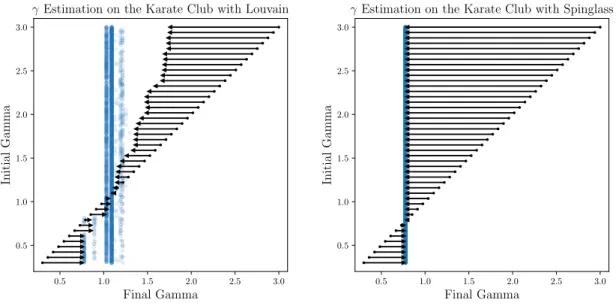
First, we analyze the results of the iterative scheme to findγestimates when using two different modularity maximization algorithms: the Louvain algorithm [12] as implemented by Vincent Traag in [24] (which does not restrict the number of communities K) and the spin glass algorithm of Reichardt and Bornholdt [6] as implemented in igraph [25] (where we restrictK = 2as in Newman’s paper [14]). The behavior ofγestimation under these two algorithms is shown in Figure 2.1.
0.5 1.0 1.5 2.0 2.5 3.0
Final Gamma
0.5 1.0 1.5 2.0 2.5 3.0
Initial
Gamma
γEstimation on the Karate Club with Louvain
0.5 1.0 1.5 2.0 2.5 3.0
Final Gamma
0.5 1.0 1.5 2.0 2.5 3.0
Initial
Gamma
γEstimation on the Karate Club with Spinglass
Figure 2.1: Behavior of the iteration to determine “correct” values for the resolution parameterγ. Arrows show the average movement (over 100 trials) induced inγspace where the base of the tail lies at the initializationγand the head of the tail lies at the resultingγestimate after one iteration. Pairs of (initializationγ, final convergedγ) obtained across many runs as shown in blue.
Left: Behavior of the scheme when using the Louvain algorithm [12], which does not fix K. Right: Behavior of the scheme when using the spin glass algorithm [6] restricted to findingK = 2
communities.
First, note that the stochasticity is greatly increased when using Louvain to maximize modularity. Newman [14] found that his iterative scheme consistently converged to finding an optimal estimate γ ≈0.78where a 2-community partition has highest modularity. This matches the behavior we see when using the spin glass algorithm where convergence toγ ≈0.78occurs after the first iteration of the scheme, regardless of initializationγ.
However, when using Louvain, the scheme more frequently converges to an estimate of1.0≤
γ ≤1.1, where a 4-community partition has highest modularity. Indeed, convergence toγ ≈0.78
only occurs when the iterative procedure is initialized with a very smallγ value. Even then, the algorithm still usually returns an estimate of1.0≤γ ≤1.1.
Second, while the procedure using the spin glass algorithm always returns the same final resolution parameter estimate, the procedure using Louvain finds multiple “correct values”. Most frequently, a 4-community partition with1.0≤γ≤1.1is returned, but the 2-community partition withγ ≈ 0.78 from Newman’s experiments [14] and a 3-community partition withγ ≈ 0.9 are occasionally found as well.
Indeed, there is a strong dependence of a partition’sγ estimate and its number of communities, which causes much of the inconsistency when using Louvain here. We show this dependency on the karate club in Figure 2.2.
0.6 0.8 1.0 1.2 1.4 1.6
γEstimate
0.0 0.2 0.4 0.6 0.8 1.0
Relativ
e
F
requency
Dependence ofγ Estimate onK
2 Communities 3 Communities 4 Communities 5 Communities 6 Communities 7 Communities 8 Communities
Figure 2.2: Frequency ofγestimates on the Karate Club from 1,000,000 runs of Louvain across a uniform grid ofγ ∈[0.0,2.0]. Relative frequencies are given in terms of all observed partitions with the same number of communitiesK.
In hindsight, this is unsurprising – the duality between modularity optimization and stochastic block model inference depends on estimates of the SBM parameters, which may differ greatly when the number of blocks is changed.6Hence, in general, the results of resolution parameter estimation will strongly depend on the number of communities returned by the modularity maximization heuristic of choice.
6We will discuss the duality more in appendix A and will analyze models in which multiple meaningful ground-truth partitions exist with different number of blocksKin appendix B.
CHAPTER 3
Introduction to the CHAMP Algorithm and
Par-tition Post-Processing
Weir et al. described a method in [26] for pruning a set of partitions of a network to a subset in which each partition has higher quality than all others for some choice of resolution parameter values. The motivation and “CHAMP” (Convex Hull of Admissible Modularity Partitions) algorithm are briefly summarized here.
3.1
Linearity of Modularity
Initially, we’ll restrict our focus to the single-layer notion of modularity. This is given by
Q= 1 2m
X
i,j
[Aij −γPij]δ(ci, cj),
where the “null model” is typically taken to be the configuration null model so thatPij = k2imkj.
We often run modularity maximization heuristics at many different values ofγto detect commu-nities at various scales, especially when a ground truth number of commucommu-nities is unknown. In these cases, runs of the heuristics at one value ofγare treated completely independently from those at a different valueγ06=γ.
affect optimization), the modularity of a fixed partitionσ is given by
Qσ(γ) = X
i,j
[Aij −γPij]δ(ci,σ, cj,σ)
=X
i,j
Aij·δ(ci,σ, cj,σ)−γ X
i,j
Pi,j·δ(ci,σ, cj,σ)
= ˆAσ−γPˆσ,
whereAˆσandPˆσare the within-community sums ofAij andPij respectively. Note that for a fixed
partitionσ, these values are constant, soQσ is linear inγ.
A similar result holds for multi-layer networks where we introduce an additional interlayer connections matrixCand interlayer resolution parameterω. In this case, (ignoring multiplicative constants), modularity is given by
Qσ(γ, ω) = X
i,j
[Aij −γPij +ωCij]δ(ci,σ, cj,σ)
= ˆAσ −γPˆσ+ωCˆσ,
whereAˆσ,Pˆσ, andCˆσare the within-community sums ofAij,Pij andCij respectively. Importantly,
this is linear in both resolution parametersγandω.
In other words, each partition of a single-layer network is represented by a line in(γ, Q)space and each partition of a multi-layer network is represented by a plane in(γ, ω, Q)space. In this way, we can consider the quality of a partition across many different resolution parameter values.
This generalizes in a straightforward way to the case in which we have an arbitrary number of resolution parameters. If we have a form of modularity written as
Qσ(γ1, . . . , γk) = X
i,j
[Aij −γ1P1,i,j−γ2P2,i,j− · · · −γkPk,i,j]δ(ci,σ, cj,σ)
= ˆAσ−γ1Pˆ1,σ−γ2Pˆ2,σ− · · · −γkPˆk,σ,
then each partition is represented by a hyperplane in(γ1, . . . , γk, Q)space.
3.2
Definitions
Consider a network and a set of partitionsΣ ={σ1, . . . , σs}of this network. When modularity has
resolution parametersγ1, . . . , γk, we introduce the following terminology:
• A partitionσ ∈Σis “dominant” or “optimal” at(γ1, . . . , γk)ifQσ(γ1, . . . , γk)≥Qσ0(γ1, . . . , γk)
for allσ0 ∈Σ.
• A partitionσ ∈Σis “somewhere optimal” if it is optimal for some choice of(γ1, . . . , γk).
Otherwise, we sayσis “nowhere optimal”.1
• The “domain of optimality” or “domain of dominance” ofσ ∈Σis the convex polytope of values(γ1, . . . , γk) for whichσ is dominant. This domain is nonempty if and only ifσ is
somewhere optimal.
For example, the domain of optimality of a single-layer partition is a (potentially empty) contiguous range ofγ values. Similarly, the domain of optimality of a multi-layer partition is a convex polygon in the(γ, ω)plane.
3.3
The CHAMP Algorithm
Consider a set of partitionsΣ ={σ1, . . . , σs}of a network. For any particular choice of resolution
parameter, one might be interested in the partitionσi ∈Σthat has maximal modularity.
The CHAMP algorithm provides a method for determining the set of optimal partitions at all values for the resolution parameters at once while simultaneously determining each partition’s domain of optimality.
This is done by noting that the optimal partition inΣfor any given choice of resolution parameters
(γ1, . . . , γk)is the one with greatest modularity valueQ(γ1, . . . , γk). Hence, the set of all partitions
that are somewhere optimal can be described by the piecewise hyperplanar upper envelope of the hyperplanes in(γ1, . . . , γk, Q)space that represent the partitions inΣ.
In this way, finding the set of all partitions that are somewhere dominant is equivalent to finding the region in(γ1, . . . , γk, Q)space that is above all the partitions’ hyperplanes. That is, if we consider
1
for each partitionσi, the halfspace defined by the region “above” its hyperplane in(γ1, . . . , γk, Q)
space (i.e. the region of largerQvalues for all choices of resolution parameters), then our problem reduces to “halfspace intersection”.
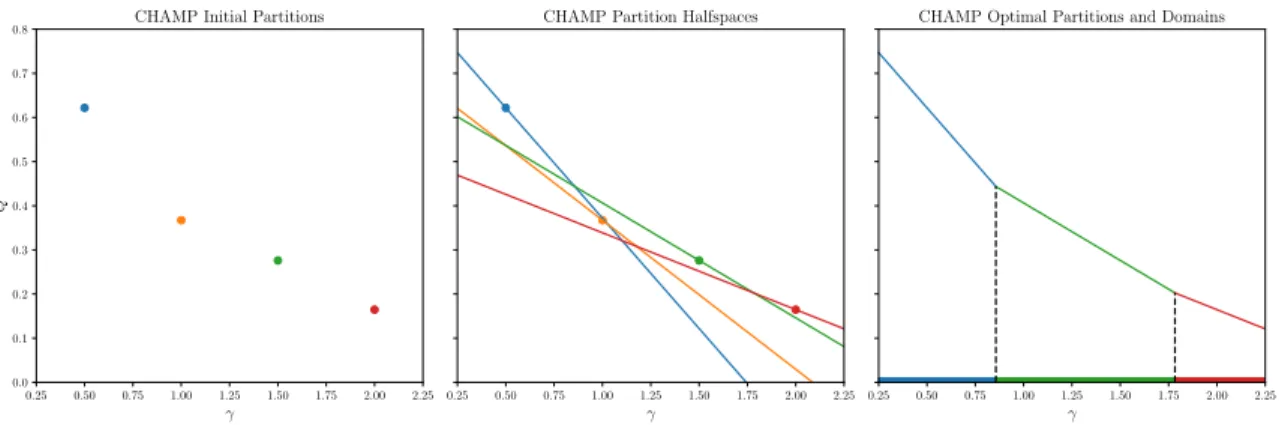
This is precisely the method that CHAMP uses to construct the subset of Σ consisting of somewhere dominant partitions and their associated domains of optimality. This procedure is visually summarized in Figure 3.1.
0.25 0.50 0.75 1.00 1.25 1.50 1.75 2.00 2.25 γ
0.0 0.1 0.2 0.3 0.4 0.5 0.6 0.7 0.8
Q
CHAMP Initial Partitions
0.25 0.50 0.75 1.00 1.25 1.50 1.75 2.00 2.25 γ
CHAMP Partition Halfspaces
0.25 0.50 0.75 1.00 1.25 1.50 1.75 2.00 2.25 γ
CHAMP Optimal Partitions and Domains
Figure 3.1: Summary of the CHAMP algorithm for single-layer networks with one resolution parameterγ. Left: Partitions are sampled in(γ, Q)space, using a modularity maximization heuristic. Center: The partitions are considered as halfspaces in(γ, Q)space. Right: The intersection of the halfspaces is obtained and the resulting facets are projected into the space of resolution parameters to obtain the set of somewhere dominant partitions and their domains of optimality.
Halfspace intersection is a well studied computational geometry problem and efficient algorithms exist for solving it (provided the dimensionality of the space is not too large). In particular, CHAMP’s implementation at [27] uses the software package Qhull which “may be used for 2-d up to 8-d”, according to the authors on qhull.org [28]. Crucially, for single-layer and multi-layer network analysis (where only 2 and 3 dimensions are needed, respectively), the worst case running time of Qhull isO(nlgn)forninput partitions.
3.4
Summary of CHAMP’s Benefits
Primarily, CHAMP provides a method for pruning a large number of partitions of a network (po-tentially taken from a vast range of the resolution parameter space and from various computational heuristics) into the small subset of partitions that are somewhere dominant.
Importantly, each partition is treated as a hyperplane and not just as a single point in the resolution parameter space to take full advantage of the input partitions. Indeed, if a partition were returned by a computational heuristic running at resolution parameterγ, it is possible for that partition to be dominant for many valuesγ0 6=γ. Moreover, we have found that the most common partitions returned by the Louvain algorithm atγare generally less optimal than the highest quality partition obtained by sweeping over nearbyγ0 ≈γ.
In the original CHAMP paper, the pruned subsets were often observed to be several orders of magnitude smaller than the full set of partitions,2 though this obviously depends on the size and variance in quality of the set of partitions to be pruned.
Moreover, since this pruning problem reduces to halfspace intersection, the method is very quick for practical resolution parameter spaces where the dimensionality is small. In fact, taking the intersection of millions of random halfspaces inR3takes only a few seconds – compared to running
modularity maximization heuristics, this amounts to a vanishingly small fraction of the execution time of community detection pipelines.
CHAPTER 4
Using CHAMP with the Parameter Estimation Map
4.1
Stability Under the Resolution Parameter Estimation Map with
CHAMP
If we use CHAMP [26] to prune a set of partitions, we can consider the behavior of the resolution parameter estimation procedures on each of the somewhere dominant partitions. Here, by passing through Newman’s duality from [14], note that restricting focus to somewhere dominant partitions is equivalent to only comparing those partitions that have a maximum likelihood fit to a (planted partition, degree corrected) stochastic block model as the parameters vary.1
Crucially, the resolution parameter estimation on this pruned subset of partitions is completely deterministic and discrete.
For instance, consider a set of somewhere dominant partitions of a multi-layer network so that the convex 2D domains of optimality tile the(γ, ω)plane. Then, since each partition admits an estimate for its “correct”(γ, ω)parameters, we can consider the domain of optimality in which these parameters lie. This defines a discrete map between all domains given by the movements through the resolution parameter space induced by our estimates.
Then, a partition whose resolution parameter estimate lies within its domain of optimality is analogous to a fixed point of the iterative estimation procedures from Newman [14] and Pamfil et al. [17]. In this case, we will say that the partition is “stable under the resolution parameter estimation map” with respect to the pruned subset of partitions or (for the purposes of brevity) that the partition is “stable”.
1
4.2
Benefits Gained from Using CHAMP
First, recall precisely what it means for a partition to be stable under our map here. Such a partition has greater quality than all other partitions of interest at the value of the resolution parameter where modularity maximization becomes equivalent to (planted partition, degree corrected) stochastic block model inference. In short, stability of a partition under the resolution parameter estimation map signifies that it is “statistically significant” from the perspective of SBM inference.
The benefit of using CHAMP here is many fold.
4.2.1 Suppression of Stochasticity in Parameter Estimation
First, by suppressing the stochasticity of modularity maximization heuristics during iterative resolu-tion parameter estimaresolu-tion, we no longer have to worry about issues of randomness while determining stability or fixed points. Of course, we have to pay for this by actually finding a set of partitions to prune in the first place, but testing a partition for stability now becomes as easy as finding self loops in a graph.
4.2.2 Statistically Principled When Restricting the Number of Communities
Second, we may regain the statistical grounding of Newman’s [14] scheme that Pamfil et al.’s [17] lacks by restricting our focus to partitions with a fixed number of communities through CHAMP. Then, the duality between modularity maximization and stochastic block model inference is well principled once again.
4.2.3 Handling Networks with Multiple “Correct” Resolution Parameter Values
Third, the reduction to a deterministic map allows us to more easily handle networks in which there are multiple “correct” values for the resolution parameter. We have seen this occur in practice and have explicitly constructed models (see appendix B) in which multiple partitions of a network are simultaneously stable under the parameter estimation map.
4.2.4 When Communities are Strong Enough,K Does Not Need to be Fixed
Fourth, particularly strong community structure may be stable under the map even when the number of communities is not fixed (as in Pamfil et al.’s proposal [17]). As previously stated, this notion of stability is not as well founded as convergence in Newman’s original scheme, but it is strictly stronger.
By fixing the number of communities being considered and thus decreasing the number of partitions of interest, we only increase the sizes of the domains of optimality. Hence, if a partition is stable when considering any number of communities, it will also be stable when only considering those partitions that share its number of communities. Indeed, stability of a partitionσwith respect to a full set of partitionsΣnecessarily implies stability ofσ with respect to any subset ofΣthat includesσ.
CHAPTER 5
Results
In this chapter, we discuss the results of our pruning strategy from chapter 4 on a synthetic multi-layer network and two real-world networks. In all three cases, we will make direct comparisons to the behavior of Pamfil’s et al.’s procedure in [17].
5.1
The Karate Club
We first show the results of our procedure on the karate club network of Zachary [23] that we used in section 2.5. Recall that this network describes the social relationships in a university karate club shortly before a disagreement split the club in half.
We obtained 10,000,000 partitions1 of this network by running the Louvain algorithm (as implemented by Vincent Traag in [24]) across a uniformly spaced grid forγ ∈[0.0,2.0]and then used CHAMP [26] to prune this to the subset of partitions that are somewhere dominant.
Among these partitions were 539 unique partitions with more than one community (the single-community partition is optimal for very small values ofγ) and the pruned subset from CHAMP has only 9 partitions. Some details of these partitions are shown in Table 5.1 and their domains of optimality andγ estimates are shown in Figure 5.1.
1
It’s important to note that we are running the Louvain algorithm an extremely large number of times only for the purposes of being exhaustive (though 10 million runs on this small of a network takes fewer than 5 minutes on my desktop computer) – the results for this network are qualitatively similar when the number of Louvain runs are as low as 100 to 1000. In fact, the stable partitions of interest in Figure 5.2 generally appear with as few as a dozen input partitions.
Number of communitiesK 2 3 4 5 6 7 8 Number of unique partitions 10 23 109 184 156 49 7 Number of unique partitions in CHAMP’s pruned subset 1 1 2 1 2 1 0 Number of unique partitions in CHAMP’s pruned subset
when only considering partitions withKcommunities
2 3 3 4 4 3 2
Table 5.1: A description of the unique partitions returned by running the Louvain heuristic 10 million times on Zachary’s karate club network and the pruned subsets from running CHAMP on these partitions.
0.00 0.25 0.50 0.75 1.00 1.25 1.50 1.75 2.00 γ
1 2 3 4 5 6 7
Num
b
er
of
comm
unities
Karate Club CHAMP Domains of Optimality and Gamma Estimates
Figure 5.1: The domains of optimality and associatedγestimates for the 9 partitions of the karate club in the pruned subset from CHAMP.
Note that when the number of communities is left unrestricted, there is exactly one stable partition in CHAMP’s pruned subset (namely, the 4-community partition in Figure 5.1 whoseγ estimate lies within its domain of optimality). This corresponds to the partition that Pamfil et al.’s iterative procedure most frequently converged to in Figure 2.1.
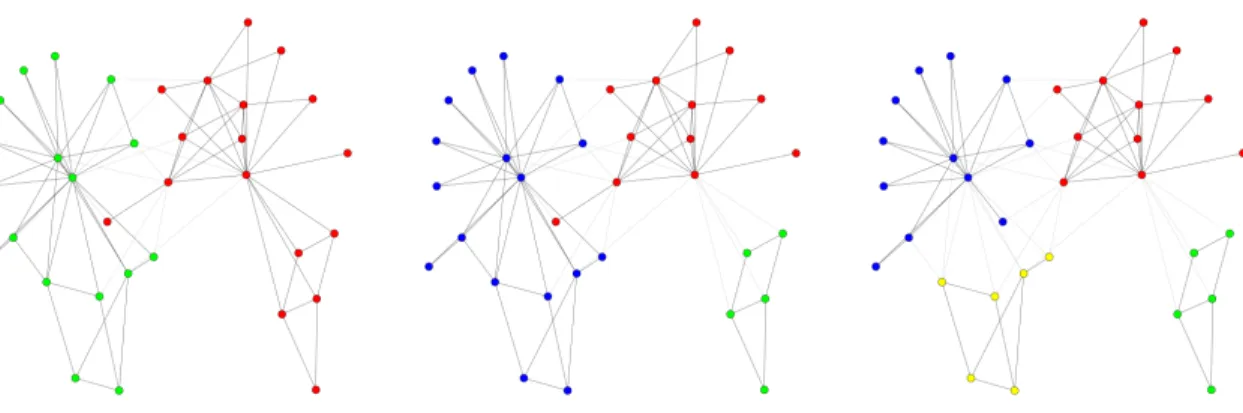
However, when the number of communitiesKis restricted prior to post-processing with CHAMP, we find exactly one stable partition per choice ofK = 2,3, . . . ,8. The stable 2, 3, and 4 community partitions are shown in Figure 5.2.
Figure 5.2: Force-directed layouts of the 3 stable partitions of the network from CHAMP’s pruned subsets when only considering partitions of 2, 3, and 4 communities, respectively (left to right).
Importantly, our 2-community stable partition closely matches the true splitting of the karate club and our 4-community stable partition is the same as the one obtained from Pamfil et al.’s iterative procedure.2
5.2
Synthetic Multi-layer Temporal Network
Recall from section 2.2 that a temporal network represents interactions that occurred at several different instances of time. In such a network, each period of time is represented by a layer and the nodes in each layer are connected to the instances of the same node in the previous and subsequent layers (hence encoding the chronological sequence of the layers’ interactions).
In this section, we focus on a synthetic test used in Pamfil et al. [17] to generate temporal networks. The generative model, first used by Ghasemian et al. [29], is as follows.
copied from the previous layer with probabilityηand randomly assigned from allKpossible labels with probability1−η.
Using this ground-truth community assignment, edges are independently placed between pairs of nodes in each layer with probabilitypinif the nodes are in the same ground-truth community and
with probabilitypoutotherwise. A model parameterε=pout/pinis used to control the strength of the
community structure in these layers (smaller values ofεplace more edges within communities than between communities).
In our tests here, we generated multi-layer networks with “copying probability”η= 0.7, edge probability ratioε= 0.4, number of layersT = 15, number of communitiesK = 2and 150 nodes per layer.3 The behavior of Pamfil et al.’s iterative procedure on this network is shown in Figure 5.3.
0.4 0.6 0.8 1.0 1.2 1.4 1.6
ω 0.6
0.7 0.8 0.9 1.0 1.1 1.2 1.3 1.4
γ
Synthetic Network (Gamma, Omega) Estimates from Louvain
Figure 5.3: The behavior of the iterative procedure introduced in Pamfil et al. [17] on our synthetic network. The parameter values for the ground truth community are shown as a blue point near
(ω, γ)≈(0.98,0.94). Over a grid of the(ω, γ)plane, arrows indicate the direction of the updated resolution parameter estimates after maximizing modularity with the Louvain algorithm for this choice of(ω, γ), averaged over five trials. As in [17], arrow sizes are scaled down for clarity (here, shown as 10% their actual update movement).
3
Note that this choice ofK= 2means the copying of labels from one layer to the next actually occurs with probability
η+1
2(1−η) = 0.85. This choice is used in both [17] and [29], so we have also chosen to use only two ground truth
communities.
This iterative scheme converges close to the ground truth resolution parameter estimates for much of the(ω, γ)plane, but notably there are regions for which the scheme diverges away from the ground truth values (e.g. most initializations withγ >1.1fail to converge to the ground truth).
We now compare these results to our method, which in part will explain why the above scheme can diverge in this way.
After generating a network using the above model, we obtained 50,625 partitions by running the Louvain algorithm in a225×225uniform grid ofγ ∈[0.0,2.0],ω∈[0.0,2.0]. Of these partitions were 33,410 unique partitions with more than one community. We start by pruning with CHAMP with the number of communities left unconstrained.
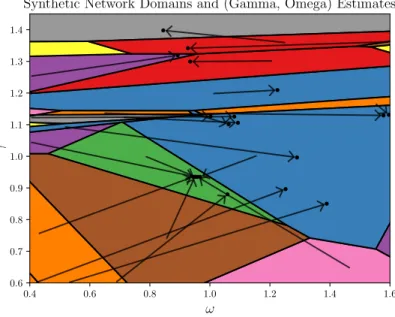
Across the entire resolution parameter areaγ ∈[0.0,2.0],ω ∈[0.0,2.0], our pruned subset from CHAMP has 77 partitions with more than one community. The domains of optimality and associated resolution parameter estimates are shown in Figure 5.4.
0.4 0.6 0.8 1.0 1.2 1.4 1.6
ω 0.6
0.7 0.8 0.9 1.0 1.1 1.2 1.3 1.4
γ
Synthetic Network Domains and (Gamma, Omega) Estimates
Figure 5.4: Domains of optimality for the partitions in CHAMP’s pruned subset (approximately 25 partitions are somewhere dominant in the region of the(ω, γ)plane shown). For each partition, an arrow is drawn from the centroid of the partition’s domain of optimality to its resolution parameter estimate(ω, γ).
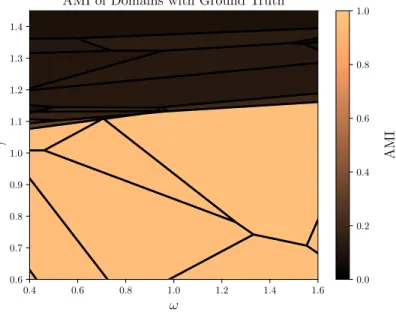
(ω, γ)≈(0.98,0.94). Once again, the partitions dominant in the approximate regionγ >1.1do not converge near this ground truth. To see why this is the case, we plot the number of communities in these partitions and their AMIs4with the ground truth 2-community partition in Figure 5.5.
0.4 0.6 0.8 1.0 1.2 1.4 1.6
ω 0.6
0.7 0.8 0.9 1.0 1.1 1.2 1.3 1.4
γ
AMI of Domains with Ground Truth
0.0 0.2 0.4 0.6 0.8 1.0
AMI
0.4 0.6 0.8 1.0 1.2 1.4 1.6
ω 0.6
0.7 0.8 0.9 1.0 1.1 1.2 1.3 1.4
γ
Domains with Number of Communities
2 4 6 8 10 12 14 16 18 20 22 24 Num b er of Comm unities
Figure 5.5: Top: Domains of optimality from CHAMP’s pruned subset, colored by AMI with the ground truth partition. Bottom: Domains of optimality from CHAMP’s pruned subset, colored by number of communities.
4In short, the adjusted mutual information (AMI) is a measure of how closely two partitions agree where values closer to 1 indicate stronger alignment and 0 indicates “no alignment”. In contrast to normalized mutual information (NMI), AMI is adjusted for chance so that random clustering have an expected AMI of 0.
Here, we see the issue is precisely the one discussed in section 2.5 where the resolution parameter estimates depend heavily on the number of communities in the partition. In fact, the transition around γ ≈1.1is marked by an incredibly rapid increase in the number of communities fromK = 2to K ≈15! Unsurprisingly, this transition also coincides with a sharp decrease in alignment with the ground truth partition.
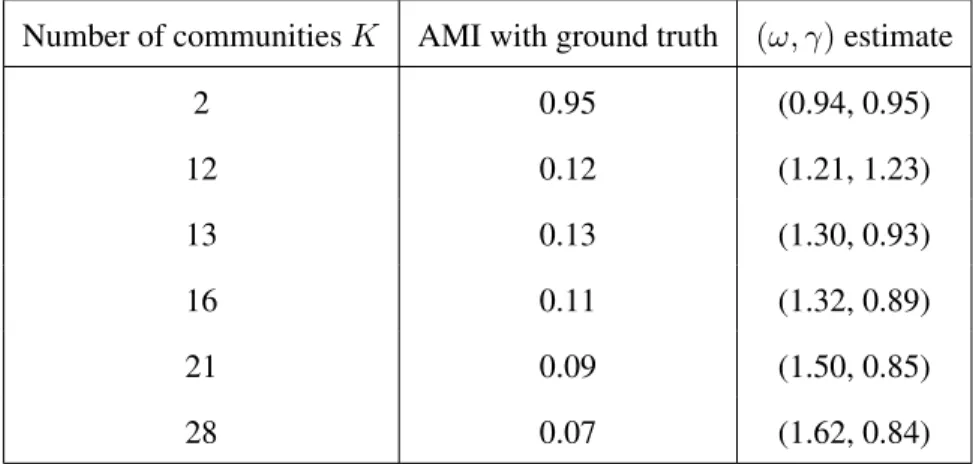
Now, we analyze the stable partitions from CHAMP’s pruned subset (once again, with the number of communities unconstrained). 5 out of the 77 partitions with more than one community are stable and the details of these partitions are given in Table 5.2.
Number of communitiesK AMI with ground truth (ω, γ)estimate
2 0.95 (0.94, 0.95)
12 0.12 (1.21, 1.23)
13 0.13 (1.30, 0.93)
16 0.11 (1.32, 0.89)
21 0.09 (1.50, 0.85)
28 0.07 (1.62, 0.84)
Table 5.2: Details of the stable partitions from CHAMP’s pruned subset on this synthetic network. Recall that the ground truth resolution parameter estimates here are(ω, γ)≈(0.98,0.94).
Notably, the 2-community stable partition has very strong alignment with the ground truth (agreeing for∼99.5%of the network’s nodes). In fact, it has the highest AMI value with the ground truth group membership among any of the partitions in CHAMP’s pruned subset.
The domains of all other stable partitions lie beyond the transition where the number of com-munities increases atγ ≈1.1and do not closely match the ground truth. Indeed, in a network with two ground truth communities and only 15 layers, the relatively large number of communities in the other stable partitions (K = 12,13,16,21,28) suggest that they are only dominant for unreasonable choices of the intralayer resolution parameterγ.
0.4 0.6 0.8 1.0 1.2 1.4 1.6 ω
0.6 0.7 0.8 0.9 1.0 1.1 1.2 1.3 1.4
γ
Synthetic Network Domains and (Gamma, Omega) Estimates,K= 2
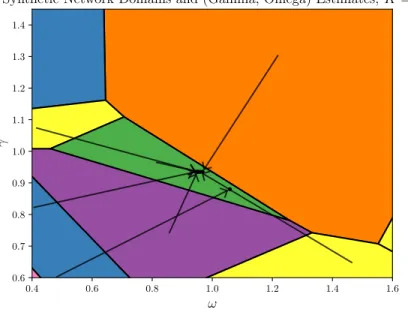
Figure 5.6: Domains of optimality for the partitions in CHAMP’s pruned subset when we restrict K = 2. For each partition, an arrow is drawn from the centroid of the partition’s domain of optimality to its resolution parameter estimate(ω, γ).
In this case, CHAMP’s pruned subset has 23 partitions that are somewhere dominant and exactly one of these is stable. This is the same high-AMI, stable 2-community partition that was discovered whenK was left unconstrained (since as we’ve seen before, stability of a partition persists when restricting focus to a smaller subset of partitions).
5.3
Lazega Law Network
Following Pamfil et al. [17], we now demonstrate our approach on the “Lazega Law Firm” network [30]. This is a 3-layer multiplex network that describes the relationships between 71 attorneys. In particular, the individuals were asked to list
1. The members of the firm that they go to for basic professional advice.
2. The members of the firm that they closely work with.
3. The members of the firm that they socialize with outside of work.
![Figure 2.2: Frequency of γ estimates on the Karate Club from 1,000,000 runs of Louvain across a uniform grid of γ ∈ [0.0, 2.0]](https://thumb-us.123doks.com/thumbv2/123dok_us/8333191.2211282/29.918.245.651.530.851/figure-frequency-estimates-karate-club-runs-louvain-uniform.webp)

![Figure 5.3: The behavior of the iterative procedure introduced in Pamfil et al. [17] on our synthetic network](https://thumb-us.123doks.com/thumbv2/123dok_us/8333191.2211282/42.918.247.650.464.784/figure-behavior-iterative-procedure-introduced-pamfil-synthetic-network.webp)